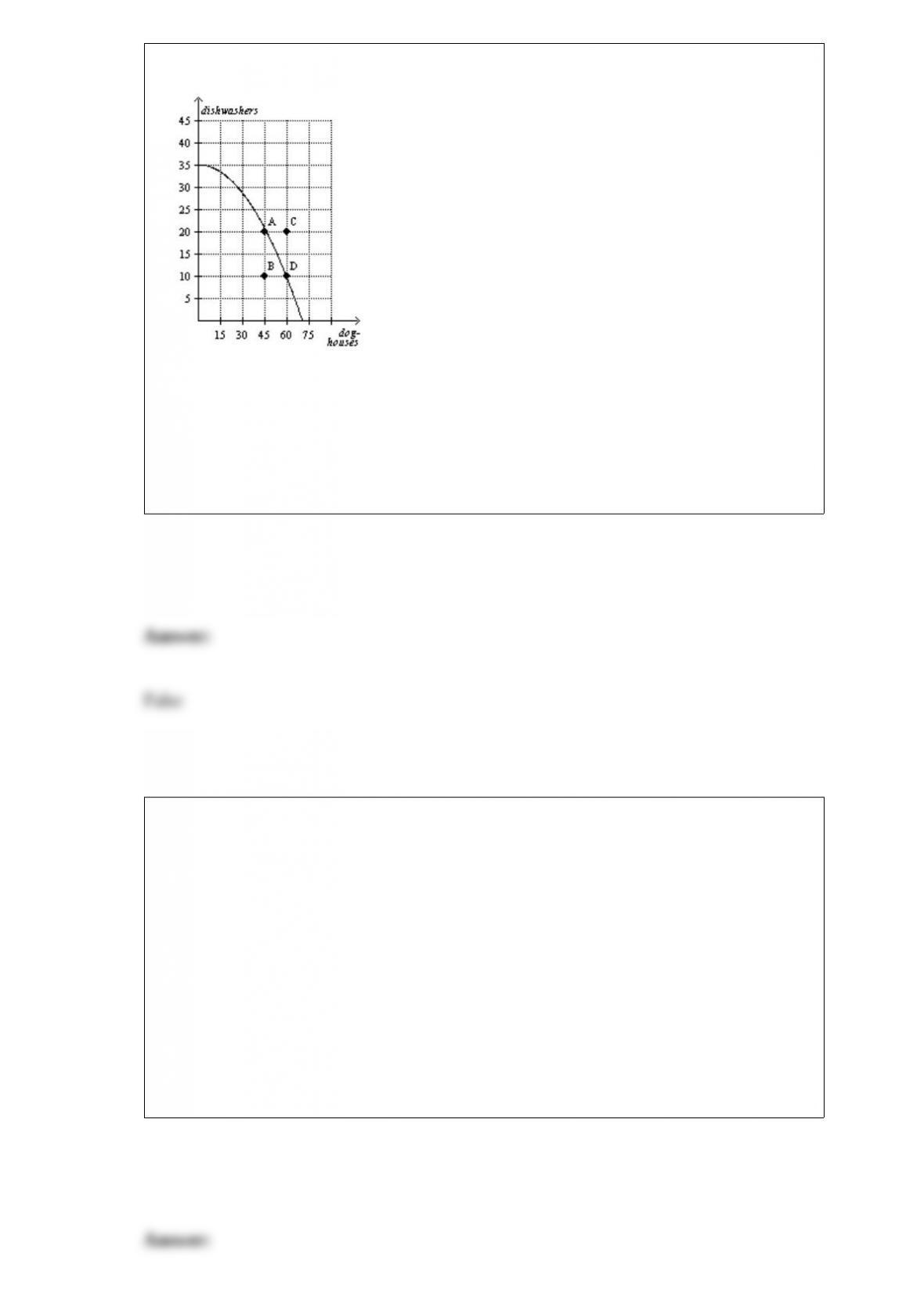
Figure 2-23
RefertoFigure2-23. The opportunity cost of moving from point B to point D is 15
doghouses.
a. True
b. False
It is claimed that mutual funds have two advantages. The first is that mutual funds allow
people with small amounts of money to diversify. The second is that mutual funds
provide the skills of professional money managers who buy stocks they believe will be
the most profitable and thereby increase the return that mutual fund depositors earn on
their savings.
a. Economists strongly agree with both claims.
b. Economists are skeptical of both claims.
c. Economists are skeptical of the first claim, but strongly agree with the second.
d. Economists strongly agree with the first claim, but are skeptical of the second.
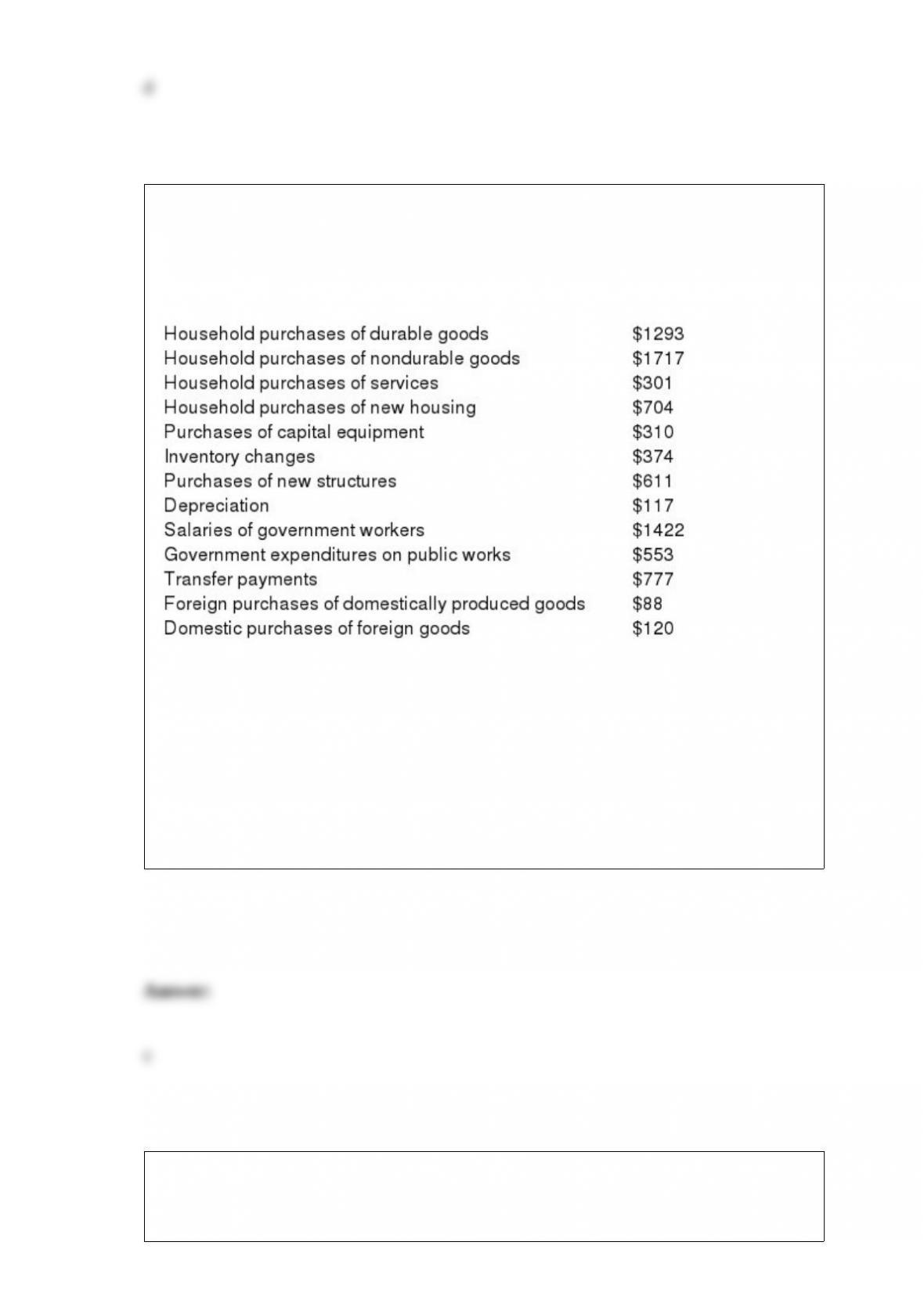
Table 23-2
The table below contains data for country A for the year 2010.
RefertoTable23-2.What were country A’s government purchases in 2010?
a. $553
b. $1198
c. $1975
d. $2752
An Italian company exchanges euros for dollars from U.S. residents and then uses the
dollars to buy U.S. products to sell in its stores in Rome. U.S. residents who exchanged
their dollars for euros use the euros to buy bonds issued by French corporations. At this

point
a. both U.S. net exports and U.S. net capital outflows have risen.
b. both U.S. net exports and U.S. net capital outflow have fallen.
c. U.S. net exports have risen and U.S. net capital outflow have fallen.
d. U.S. net exports have fallen and U.S. net capital outflow have risen.
The unemployment rate equals the percentage of the labor force that is unemployed.
a. True
b. False
An increase in the price of pizza will shift the demand curve for pizza to the left.
a. True
b. False

Other things the same,when the price level falls, interest rates
a. rise, so firms increase investment.
b. rise, so firms decrease investment.
c. fall, so firms increase investment.
d. fall, so firms decrease investment.
In one month, Moira can knit 2 sweaters or 4 scarves. In one month, Tori can knit 1
sweater or 3 scarves. Together, they could produce more output in total if Moira knits
only sweaters and Tori knits only scarves.
a. True
b. False
Other things the same, if a country’s domestic investment decreases, then
a. net capital outflow rises, so net exports rise.

b. net capital outflow rises, so net exports fall.
c. net capital outflow falls, so net exports rise.
d. net capital outflow falls, so net exports fall.
Which of the following shifts aggregate demand to the left?
a. The price level rises.
b. Interest rates fall.
c. The dollar depreciates for some reason other than a change in the price level.
d. Stock prices fall for some reason other than a change in the price level.
Figure 4-20
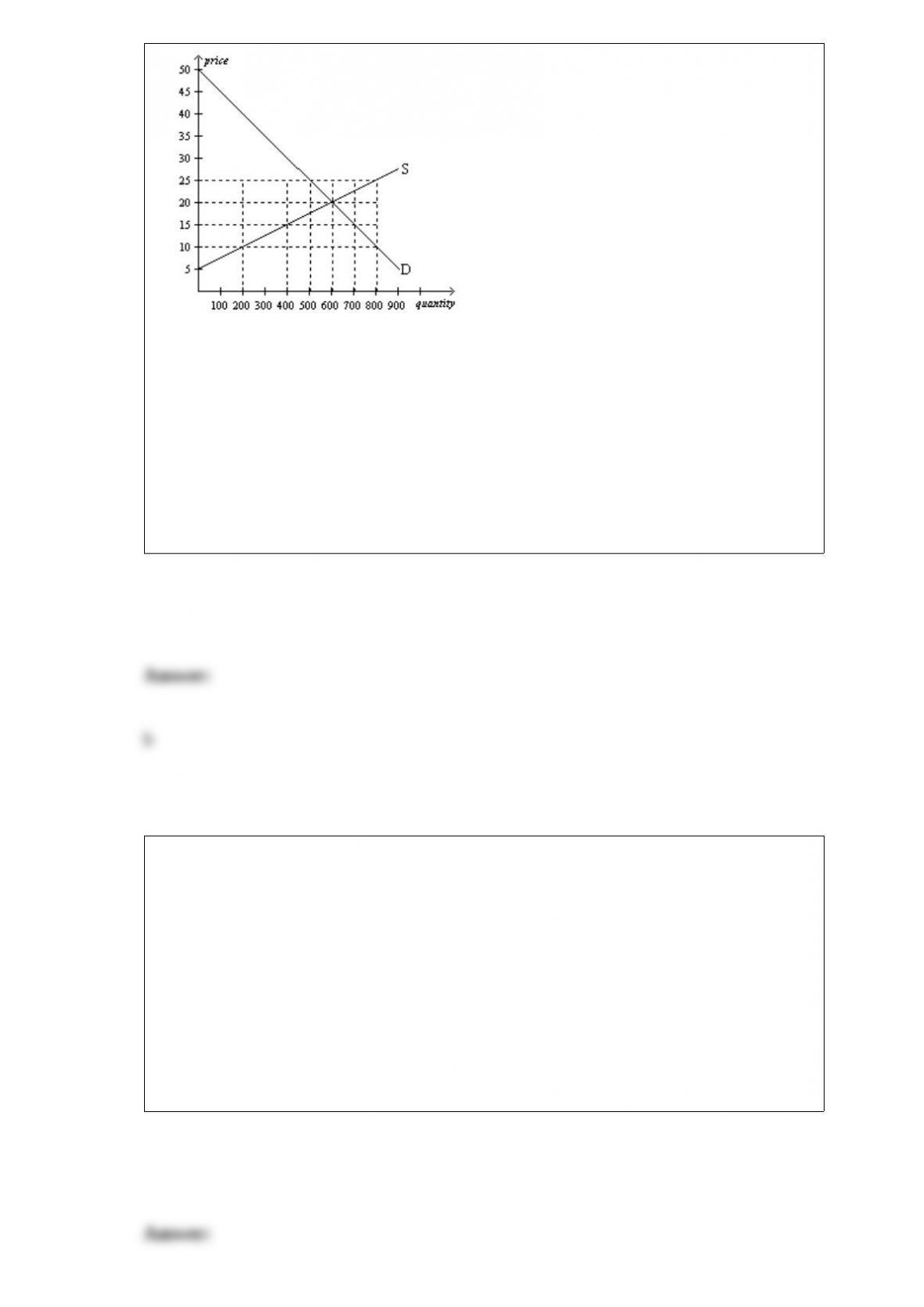
RefertoFigure4-20. In this market, equilibrium price and quantity, respectively, are
a. $15 and 400 units.
b. $20 and 600 units.
c. $25 and 500 units.
d. $25 and 800 units.
The price of a basket of goods is $2000 in the U.S. If purchasing-power parity holds,
and the dollar buys two units of some country’s currency, then how many units of
foreign currency does the same basket of goods cost in that country?
a. 4000
b. 2000
c. 1000
d. None of the above are correct.
According to purchasing-power parity what should the nominal exchange rate between
the U.S. and another country be equal to?
a. 1
b. the real exchange rate between the U.S. and that country
c. the price level in the U.S. divided by the price level in the other country
d. the price level in the other country divided by the price level in the U.S.
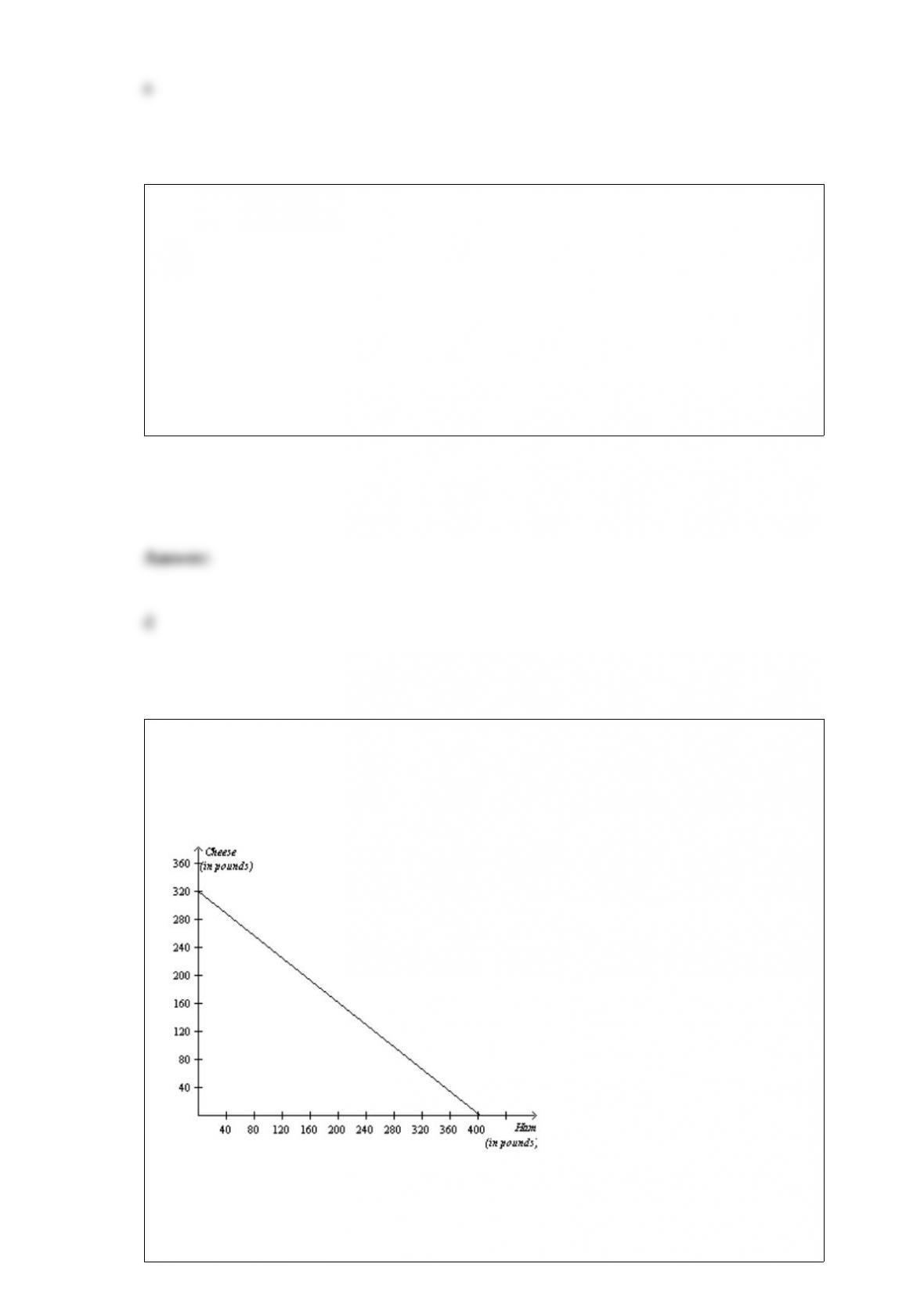
Figure 3-23
The graph below represents the various combinations of ham and cheese (in pounds)
that the nation of Bonovia could produce in a given month.
RefertoFigure3-23.The nation of Cropitia has a comparative advantage over Bonovia
in producing ham if
a. Cropitia can produce more than 400 pounds of ham per month.

b. Cropitia can produce more than 320 pounds of cheese per month.
c. Cropitia’s opportunity cost of producing a pound of ham is less than 0.8 pounds of
cheese.
d. Cropitia’s opportunity cost of producing a pound of ham is greater than 0.8 pounds of
cheese.
Recessions are notassociated with which of the following?
a. increased bankruptcies
b. falling profits
c. falling incomes
d. falling unemployment
Timmy can edit 2 pages in one minute and he can type 80 words in one minute. Olivia
can edit 1 page in one minute and she can type 100 words in one minute. Timmy has an
absolute advantage and a comparative advantage in editing, while Olivia has an
absolute advantage and a comparative advantage in typing.
a. True
b. False
A bank has a 10 percent reserve requirement, $36,000 in loans, and has loaned out all it
can given the reserve requirement.
a. It has $3,600 in deposits.
b. It has $32,400 in deposits.
c. It has $39,600 in deposits.
d. It has $40,000 in deposits.
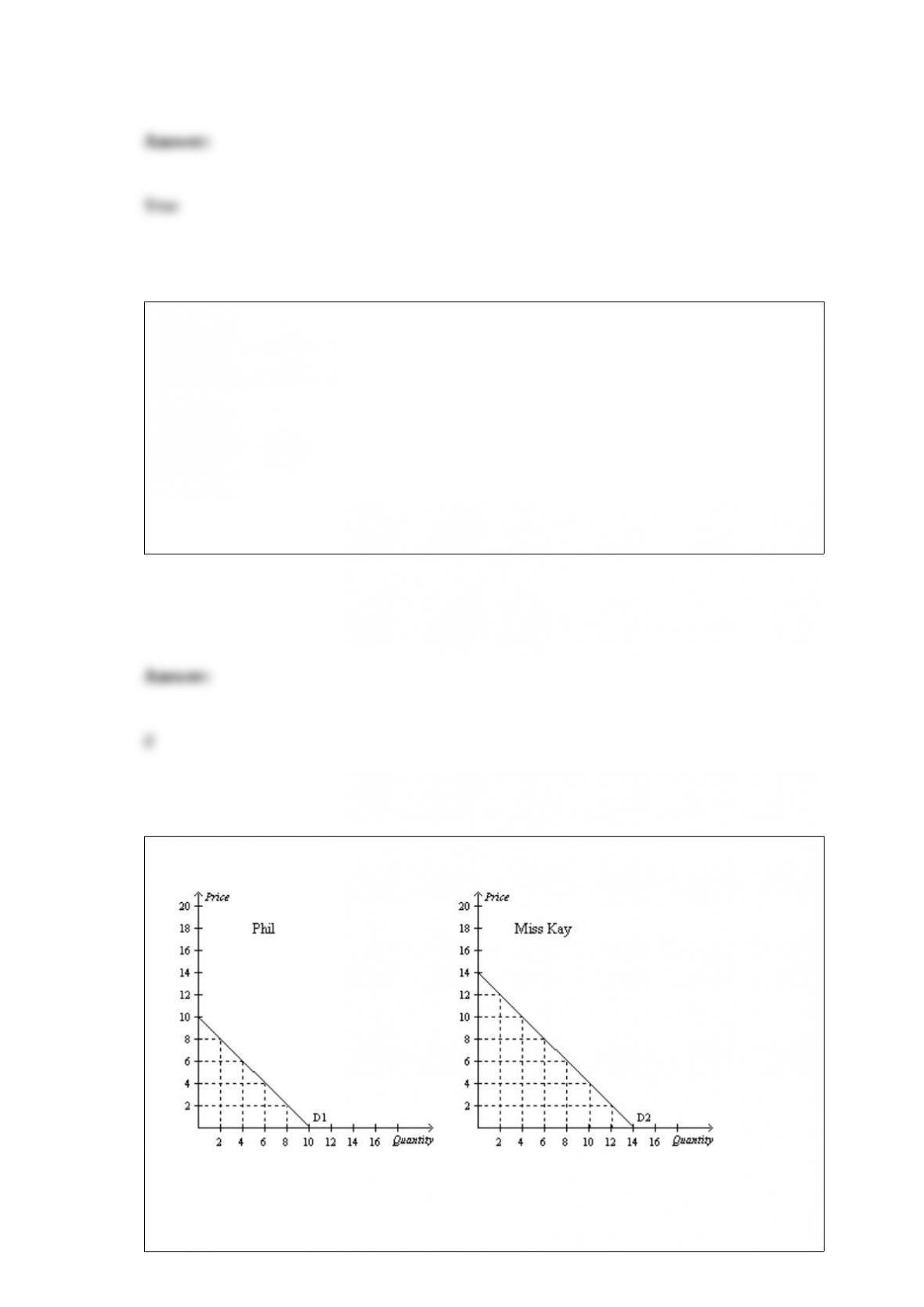
Figure 4-2
RefertoFigure4-2.Suppose Phil and Miss Kay are the only consumers in the market. If
the price is $12, then the market quantity demanded is

a. 0 units.
b. 2 units.
c. 4 units.
d. 6 units.
Which of the following statements about models is correct?
a. The more details a model includes, the better the model.
b. Models assume away irrelevant details.
c. Models cannot be used to explain how the economy functions.
d. Models cannot be used to make predictions.
Which of these statements best represents the law of supply?
a. When input prices increase, sellers produce less of the good.
b. When production technology improves, sellers produce less of the good.
c. When the price of a good decreases, sellers produce less of the good.
d. When sellers’ supplies of a good increase, the price of the good increases.

The sticky-price theory of the short-run aggregate supply curve says that if the price
level rises by 5% and people were expecting it to rise by 2%, then firms have
a. higher than desired prices, which leads to an increase in the aggregate quantity of
goods and services supplied.
b. higher than desired prices, which leads to a decrease in the aggregate quantity of
goods and services supplied.
c. lower than desired prices, which leads to an increase in the aggregate quantity of
goods and services supplied.
d. lower than desired prices, which leads to a decrease in the aggregate quantity of
goods and services supplied.
Which of the following shifts the short-run aggregate supply curve right?
a. both an increase in the price level that is greater than expected and an increase in the
expected price level.
b. an increase in the price level that is greater than expected, but not an increase in the
expected price level.
c. an increase in the expected price level, but not an increase in the price level that is
greater than expected.
d. neither an increase in the price level that is greater than expected nor an increase in
the expected price level.

A country has national saving of $90 billion, government expenditures of $30 billion,
domestic investment of $50 billion, and net capital outflow of $40 billion. What is its
demand for loanable funds?
a. $40 billion
b. $60 billion
c. $90 billion
d. $130 billion
Money demand refers to
a. the total quantity of financial assets that people want to hold.
b. how much income people want to earn per year.
c. how much wealth people want to hold in liquid form.
d. how much currency the Federal Reserve decides to print.
In the circular-flow diagram, another name for goods and services produced by firms is
a. factors of production.
b. output.
c. inputs.
d. resources.
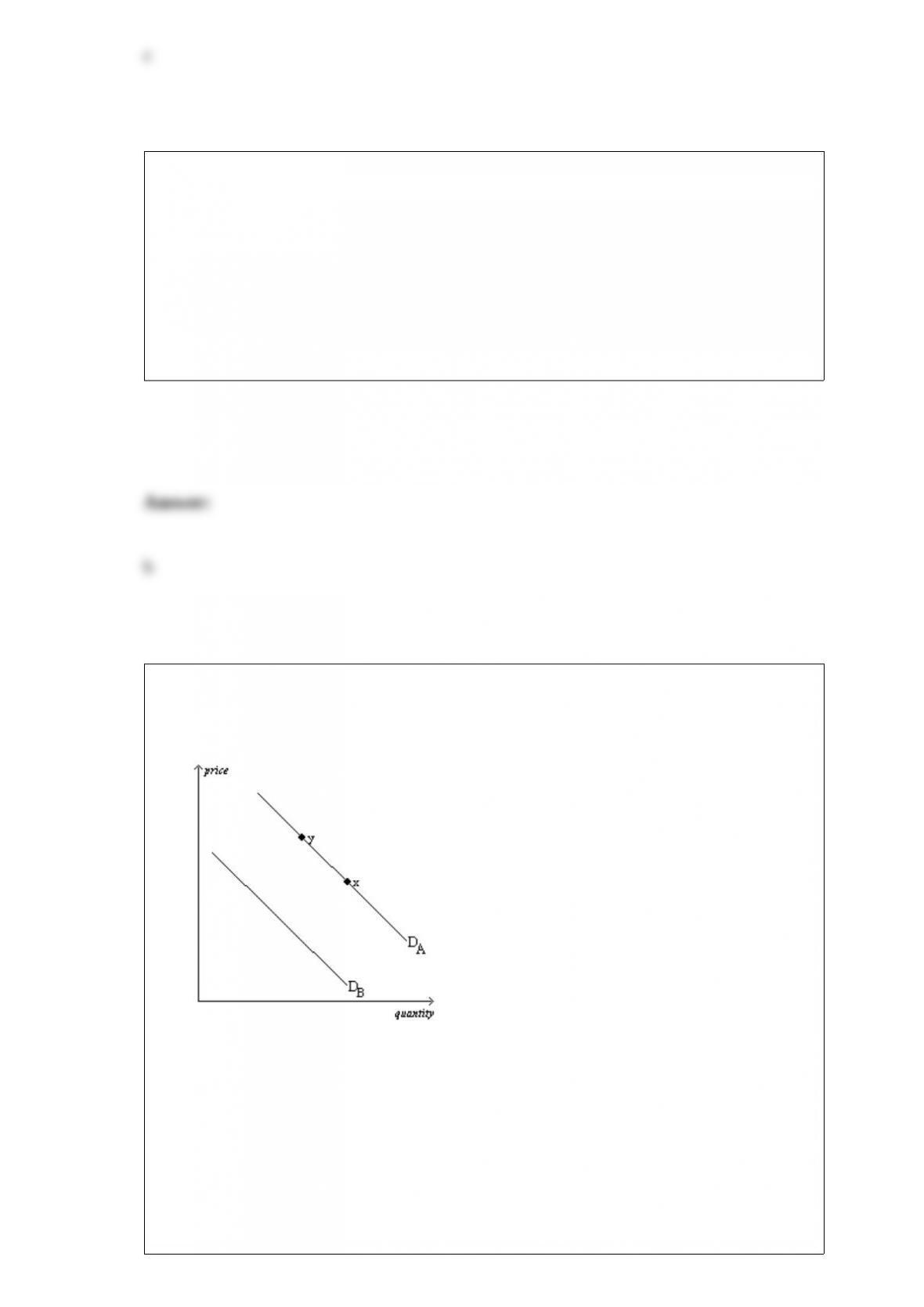
Figure 4-24
The diagram below pertains to the demand for turkey in the United States.
RefertoFigure4-24.All else equal, a sale on chicken would cause a move from
a. DAto DB.
b. DBto DA.
c. x to y.

d. y to x.
Fiscal policy refers to the idea that aggregate demand is affected by changes in
a. the money supply.
b. government spending and taxes.
c. trade policy.
d. All of the above are correct.
If the nominal interest rate is 4 percent and the real interest rate is -2.5 percent, then the
inflation rate is
a. -6.5 percent.
b. -1.5 percent.
c. 1.5 percent.
d. 6.5 percent.

The local car dealership has an increase in inventory of 100 newly produced cars in
2015. In 2016, it sells all 100 cars. Which of the following statements is correct?
a. The value of the cars in inventory will be counted as part of 2015 GDP, and the value
of the cars sold in 2016 will not increase 2016 GDP.
b. The value of the cars in inventory will not affect 2015 GDP, and the value of the cars
sold in 2016 will increase 2016 GDP.
c. The value of the cars in inventory will be counted as part of 2015 GDP, and the value
of the cars sold in 2016 will increase 2016 GDP.
d. The value of the cars in inventory will not affect 2015 GDP, and the value of the cars
sold in 2016 will not increase 2016 GDP.
If the Federal Open Market Committee decides to increase the money supply, then the
Federal Reserve
a. creates dollars and uses them to purchase government bonds from the public.
b. sells government bonds from its portfolio to the public.
c. creates dollars and uses them to purchase various types of stocks and bonds from the
public.
d. sells various types of stocks and bonds from its portfolio to the public.

In the production function , which symbol reflects the state of
technology?
a. A
b. K
c. H
d. N
“Leaning against the wind” is exemplified by a
a. tax cut when there is a recession.
b. decrease in the money supply when there is a recession.
c. decrease in government expenditures when there is a recession.
d. All of the above are correct.
Variations in the standard of living across countries are due almost entirely to

differences in each nation’s total output of goods and services.
a. True
b. False
Countries with more than 80 percent of their population living within 100 kilometers of
a coast will have an average GDP per person that is
a. around four times a country with less than 20 percent of the population living near
the coast.
b. around ten times a country with less than 20 percent of the population living near the
coast.
c. around twenty times a country with less than 20 percent of the population living near
the coast.
d. around fifty times a country with less than 20 percent of the population living near
the coast.