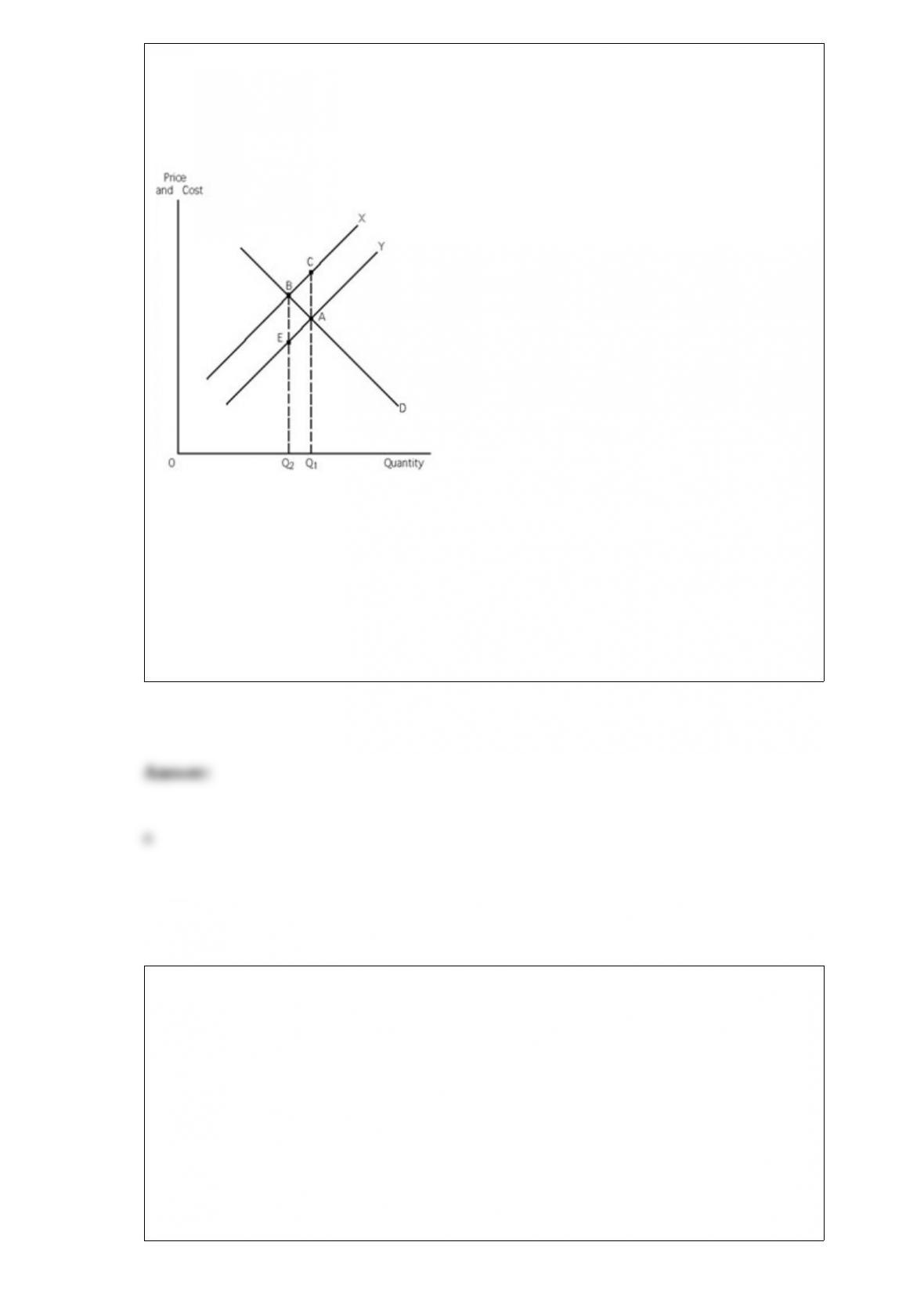
Refer to Exhibit 31-1. If the exhibit represents a negative externality situation, the net
social cost of expanding output from Q2 to Q1 is the area of
Exhibit 31-1
a. ABC.
b. BEA.
c. Q2BAQ1.
d. Q2EAQ1.
If supply is perfectly inelastic, it follows that a
a. rise in price will not change quantity supplied.
b. fall in price will not change quantity supplied.
c. rise in price will change quantity supplied by more than a fall in price.
d. fall in price will change quantity supplied by more than a rise in price.
e. a and b
If the current market price of good Z is below the equilibrium price of good Z
a. it must be because the government has imposed a price ceiling in the market for good
Z.
b. there is a shortage of good Z.
c. there is a surplus of good Z.
d. demand must necessarily decrease to restore equilibrium.
e. a and b
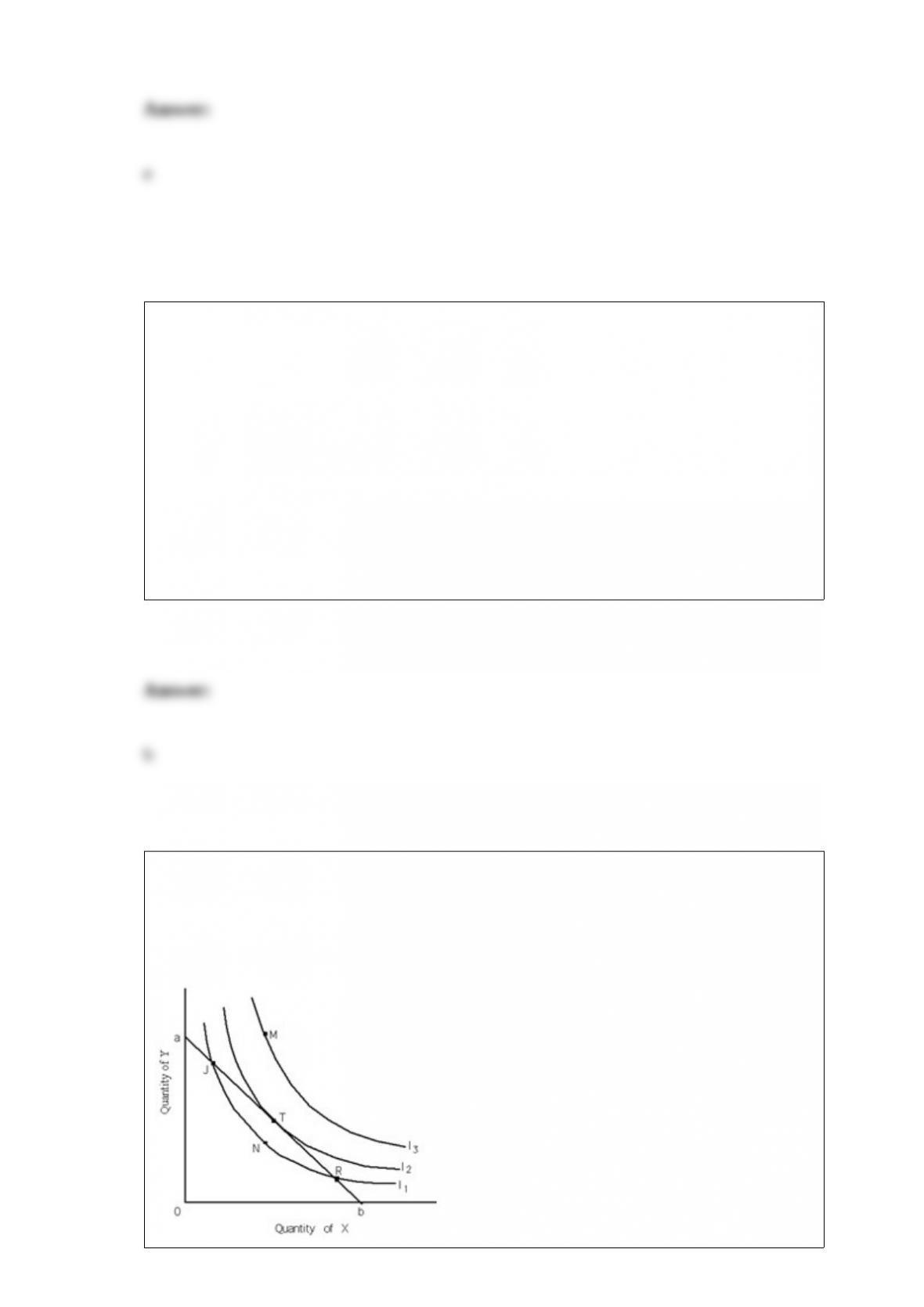
Refer to Exhibit 21-6. I1, I2 and I3 are indifference curves and line ab is the relevant
budget constraint. If the consumer is initially at point R, he should
Exhibit 21-6

a. strive for point N by obtaining a larger money income.
b. purchase more of X and less of Y.
c. remain at that point in order to maximize utility.
d. purchase more of Y and less of X.
e. none of the above
When P = $5, the quantity demanded of a good is 30 units, and the quantity supplied of
the good is 50 units.For every $1 decrease in the price of this good, quantity demanded
rises by 5 units and quantity supplied falls by 5 units.The equilibrium price of this good
is ___________and the equilibrium quantity of this good is _________ units.
a. $3; 40
b. $4; 35
c. $2; 45
d. $2; 35
e. $3; 35
The market in which the currencies of different countries are exchanged is called the
a. money market.

b. capital market.
c. foreign exchange market.
d. loanable funds market.
A perfectly competitive market is initially in long-run competitive equilibrium. Then,
market demand increases. As a result, existing firms in the market begin to
__________. By the time all adjustments have been made, profits will __________.
a. earn positive economic profit, rise even higher
b. earn positive economic profit; be back at zero
c. produce more output; be less than zero
d. produce less output; rise
e. earn positive economic profit; turn into losses
Most economists believe that the supply curve of labor in the aggregate is extremely
elastic.
a. True
b. False

Suppose a Mexican consumer wants to buy an American television for $500 and an
American wants to buy a Mexican raincoat for 700 pesos. If the exchange rate is $0.10
= 1 peso, then the price of the television in pesos will be __________ and the price of
the raincoat in dollars will be __________.
a. 5000 pesos;$70
b. 50 pesos;$7,000
c. 500 pesos;$7
d. 5 pesos;$7,000
A nonexcludable public good is
a. nonrivalrous in consumption.
b. rivalrous in consumption.
c. asymmetric.
d. a good for which it is impossible (or prohibitively costly) to exclude someone from
receiving the benefits of its services.
e. a and d

Which of the following goods is least likely to be rivalrous in consumption?
a. a car
b. a pair of shoes
c. a book
d. a computer
e. a sunset
The author of the textbook defines economics as the
a. science of efficiency.
b. science of scarcity.
c. study of markets.
d. study of human activity.

Suppose that on Monday, a Big Mac cost $3.00 in the United States and 310 Japanese
yen in Japan. On Monday, the exchange rate was $1 = 85 yen. According to the
purchasing power parity theory, the yen was __________ by approximately
__________ percent.
a. overvalued; 22
b. undervalued; 40
c. overvalued; 29
d. undervalued; 22
e. overvalued; 18
Economies of scale are relevant to the __________, whereas the law of diminishing
marginal returns is relevant to the __________.
a. long run; short run
b. short run; long run
c. industry; firm
d. firm; industry
e. firm in the short run; industry in the long run

Here are four positions that Farmer Gomez can be in:(1) bad weather for Gomez and
good weather for all other farmers; (2) bad weather for all farmers except Gomez (who
witnesses good weather); (3) bad weather for all farmers; (4) good weather for all
farmers. Assuming the demand for foodstuffs is inelastic, Farmer Gomez would
probably rank these four positions, from best for him to worst for him, the following
way:
a. 1,2,3,4.
b. 2,1,3,4.
c. 2,3,4,1.
d. 4,3,2,1.
e. 3,4,1,2.