
The nominal interest rate is the
a. interest rate corrected for inflation.
b. interest rate as usually reported by banks.
c. real rate of return to the lender.
d. real cost of borrowing to the borrower.
An increase in the demand for loanable funds increases the equilibrium interest rate and
increases the equilibrium level of saving.
a. True
b. False
A reduction in an input price will cause a change in quantity supplied but not a change
in supply.
a. True
b. False
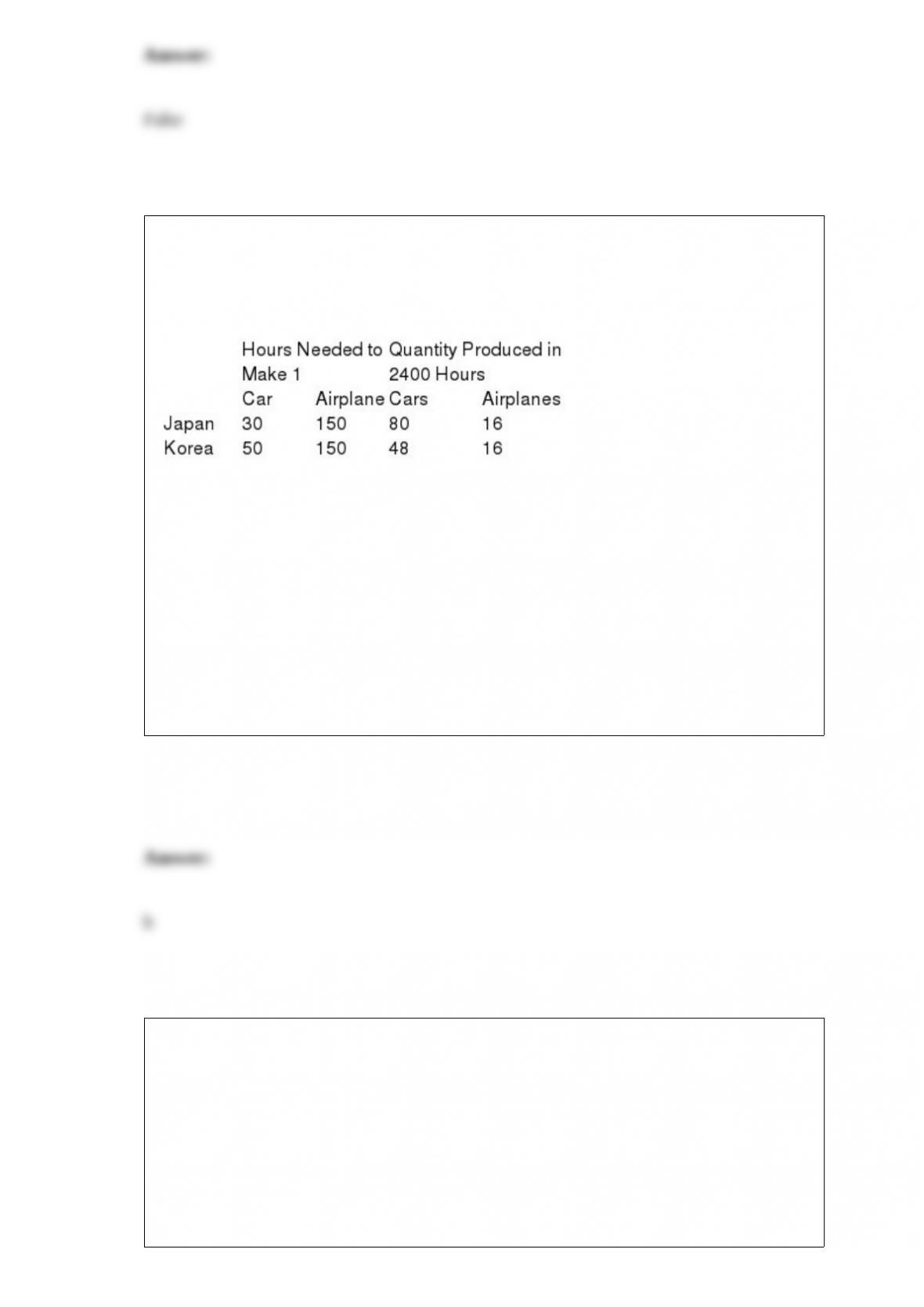
Table 3-26
Assume that Japan and Korea can switch between producing cars and producing
airplanes at a constant rate.
Refer to Table3-26. Assume that Japan and Korea each has 2400 hours available. If
each country spends all its time producing the good in which it has a comparative
advantage and trade takes place at a price of 12 cars for 6 airplanes, then
a. Japan and Korea will both gain from this trade.
b. Japan will gain from this trade, but Korea will not.
c. Korea will gain from this trade, but Japan will not.
d. neither Japan nor Korea will gain from this trade.
A creditor of a corporation holds
a. bonds sold by the corporation. If the corporation experiences financial difficulties
stock holders are paid before bond holders.
b. bonds sold by the corporation. If the corporation experiences financial difficulties
bond holders are paid before stock holders.
c. stocks sold by the corporation. If the corporation experiences financial difficulties

stock holders are paid before bond holders.
d. stocks sold by the corporation. If the corporation experiences financial difficulties
bond holders are paid before stock holders.
According to liquidity preference theory, if the quantity of money supplied is greater
than the quantity demanded, then the interest rate will
a. increase and the quantity of money demanded will decrease.
b. increase and the quantity of money demanded will increase.
c. decrease and the quantity of money demanded will decrease.
d. decrease and the quantity of money demanded will increase.
Which of these activities will most likely impose an external cost?
a. An athlete works out at a gym.
b. A secretary smokes a cigarette in a crowded break room.
c. A young mother pushes her baby in a stroller.
d. A construction worker eats a hotdog during his lunch break.

The Bureau of Labor Statistics produces data on unemployment based on the number of
people collecting unemployment insurance.
a. True
b. False
In the open-economy macroeconomic model, if net capital outflow increases then
a. the demand for dollars in the market for foreign-currency exchange shifts right.
b. the demand for dollars in the market for foreign-currency exchange shifts left.
c. the supply of dollars in the market for foreign-currency exchange shifts right.
d. the supply of dollars in the market for foreign-currency exchange shifts left.
Trade between the United States and Guatemala
a. benefits both the United States and Guatemala.
b. is a losing proposition for the United States because Guatemalan labor is less
expensive than U.S. labor.
c. is a losing proposition for Guatemala because capital is much more abundant in the
U.S. than in Guatemala.
d. is a losing proposition for Guatemala because U.S. workers are more productive than
Guatemalan workers.
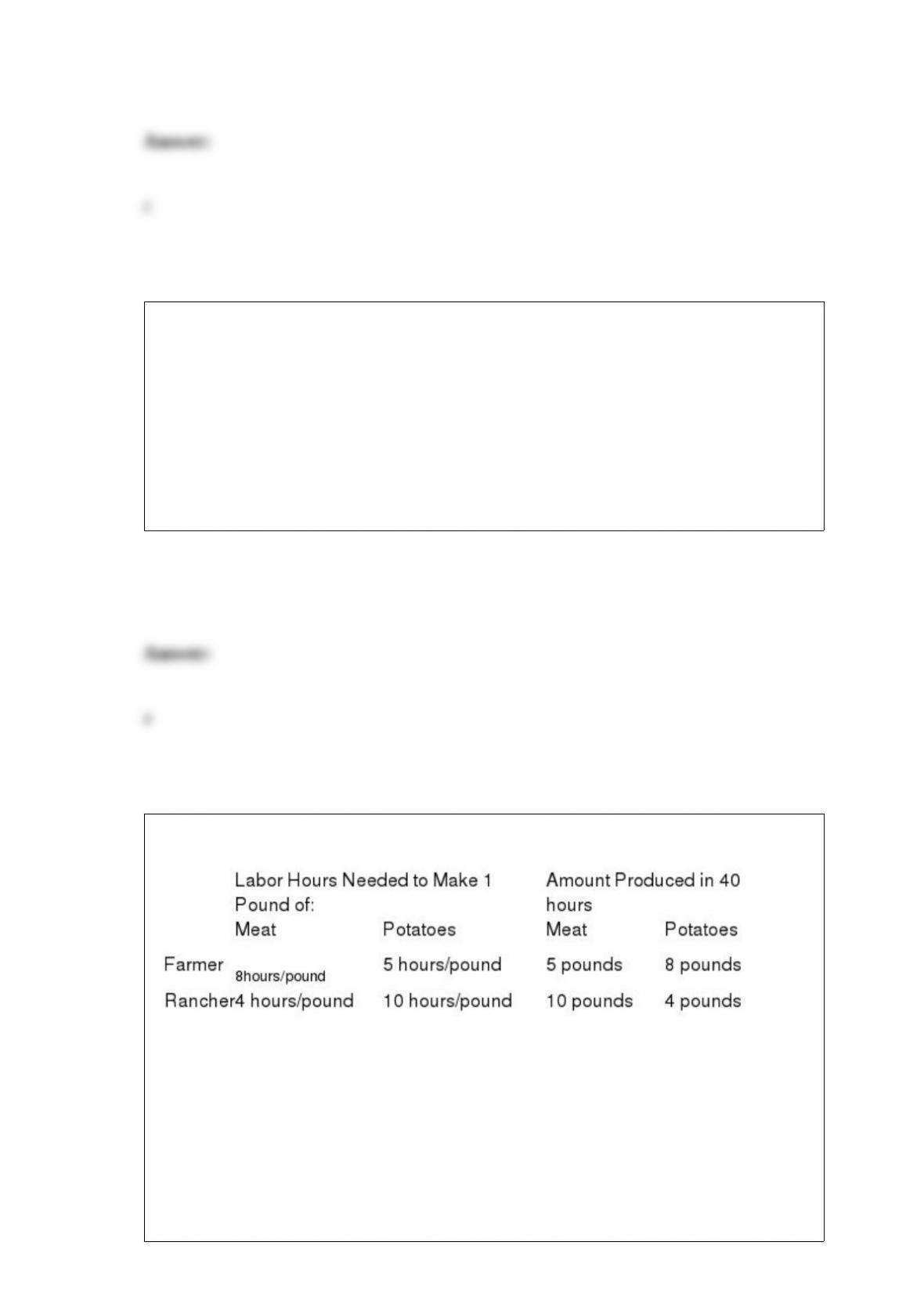
Table 23-6
The table below contains data for the country of Batterland, which produces only
waffles and pancakes. The base year is 2013.
RefertoTable23-6.In 2012, this country’s real GDP was
a. $510.
b. $690.
c. $930.
d. $780.
The relative importance of housing in the breakdown of consumer spending is
a. 41 percent.
b. 15 percent.
c. 6 percent.
d. 4 percent.
Table 3-31
RefertoTable3-31.For the rancher, the opportunity cost of 1 pound of meat is
a. 0.4 pound of potatoes.
b. 2.5 pounds of potatoes.
c. 4 pounds of potatoes.
d. 10 pounds of potatoes.

Which of the following is nota reason the New York Federal Reserve Bank president
always gets to vote at the Federal Open Market Committee meetings?
a. New York is the traditional financial center of the U.S. economy.
b. All Fed purchases and sales of bonds go through the New York Fed’s trading desk.
c. New York has higher population than other cities in the U.S.
d. All of the above are reasons.
A university’s football stadium is never more than half-full during football games. This
indicates
a. the ticket price is above the equilibrium price.
b. the ticket price is below the equilibrium price.
c. the ticket price is at the equilibrium price.
d. nothing about the equilibrium price.

A closed economy
a. does not trade with other economies.
b. is centrally-planned.
c. does not allow financial intermediation.
d. All of the above are correct.
An increase in the U.S. interest rate
a. raises the opportunity cost of holding dollars.
b. induces households to increase consumption.
c. shifts money demand to the right.
d. leads to a depreciation of the U.S. dollar.
The Economy in 2008

In the first half of June 2008 the effects of a housing and financial crisis and an increase
in world prices of oil and foodstuffs were affecting the economy.
RefertoTheEconomyin2008.Given the effects of the financial and housing crisis on the
price level and output and the effects of increased world commodity prices on the price
level and output, the aggregate demand and aggregate supply model tells us that
a. output rises and the price level falls.
b. output may rise, fall or stay the same and the price level rises.
c. output falls and the price level may rise, fall or stay the same.
d. None of the above is correct.
If money is neutral, then changes in the quantity of money
a. do not affect real output.
b. affect both nominal and real output
c. do not affect nominal output.
d. affect neither nominal nor real output.
When aggregate demand is high, risking higher inflation, those in favor of using
monetary and fiscal policy to stabilize the economy might recommend

a. increasing government spending.
b. expanding the money supply.
c. lowering taxes.
d. the Fed sell government bonds.
A Turkish firm exchanges lira (Turkish currency) for dollars. It then uses these dollars
to purchase computers from the U.S. These actions decrease U.S. net capital outflow
and increase U.S. net exports.
a. True
b. False
Who did President Jimmy Carter appoint to head the Federal Reserve beginning in
1979?
a. Ben Bernanke
b. Alan Greenspan
c. Paul Volcker
d. Arthur Burns

Financial Crisis
Suppose that banks are less able to raise funds and so lend less. Consequently, because
people and households are less able to borrow, they spend less at any given price level
than they would otherwise. The crisis is persistent so lending should remain depressed
for some time.
RefertoFinancialCrisis.Suppose the economy reaches long-run equilibrium without
the Fed responding. Now suppose the financial crisis ends and the ability of banks to
lend returns to normal. In which case is the price level lower compared to its value prior
to the crisis?
a. both after the economy reaches long-run equilibrium during the crisis and in the
long-run equilibrium after the crisis is over
b. after the economy reaches long-run equilibrium during the crisis but not in the
long-run equilibrium after the crisis is over
c. in the long-run equilibrium after the crisis is over but not after the economy reaches
long-run equilibrium during the crisis
d. neither after the economy reaches long-run equilibrium during the crisis nor in the
long-run equilibrium after the crisis is over
According to the misperceptions theory of the short-run aggregate supply curve, if a
firm thought that inflation was going to be 4 percent and actual inflation was 2 percent,
then the firm would believe that the relative price of what it produces had
a. increased, so it would increase production.

b. increased, so it would decrease production.
c. decreased, so it would increase production.
d. decreased, so it would decrease production.
The idea that nominal variables are heavily influenced by the quantity of money and
that money is largely irrelevant for understanding the determinants of real variables is
called the
a. velocity concept.
b. Fisher effect.
c. classical dichotomy.
d. Mankiw effect.
Table 3-26
Assume that Japan and Korea can switch between producing cars and producing
airplanes at a constant rate.
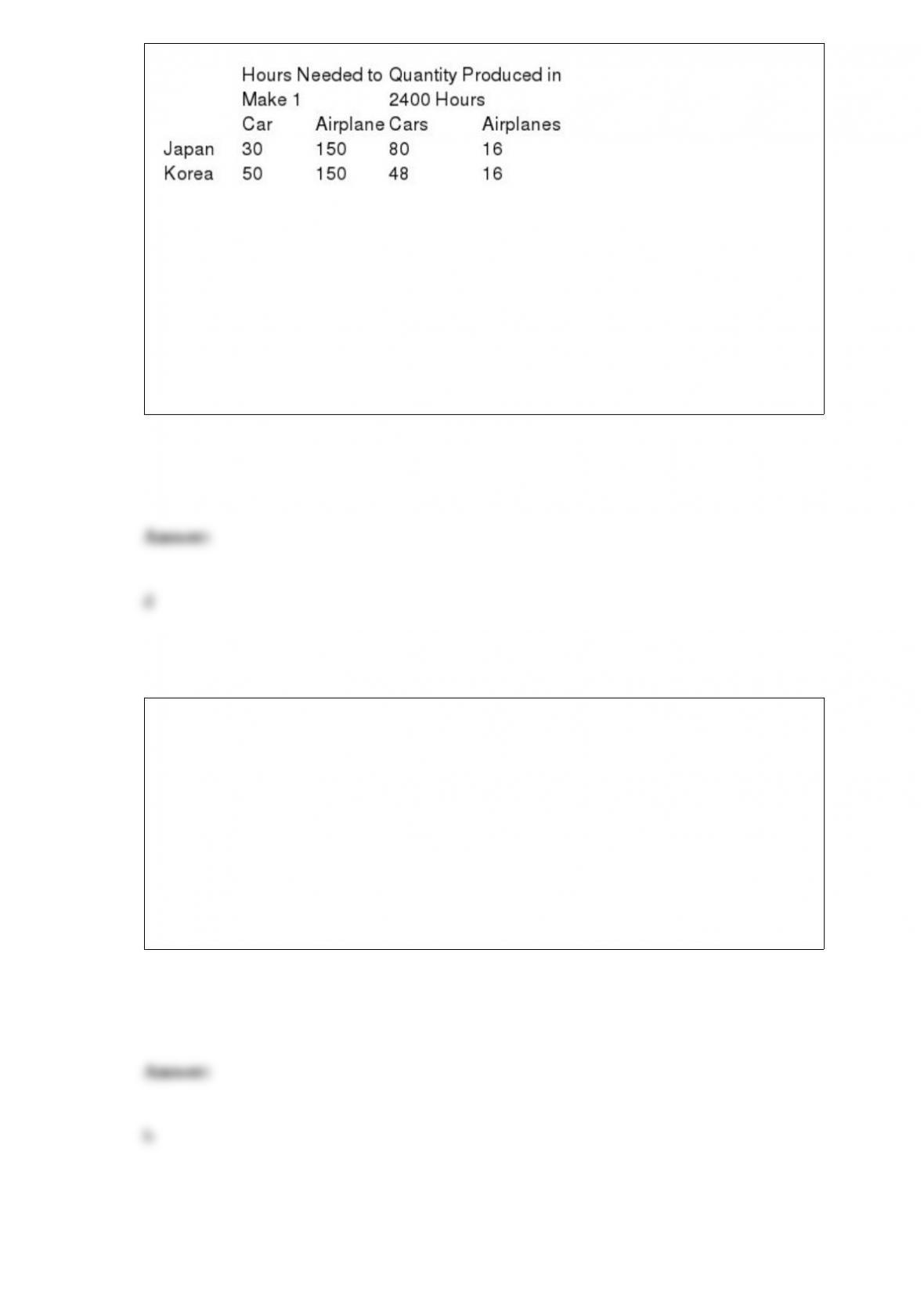
RefertoTable3-26.Japan’s opportunity cost of one airplane is
a. 1/5 car and Korea’s opportunity cost of one airplane is 1/3 car.
b. 1/5 car and Korea’s opportunity cost of one airplane is 3 cars.
c. 5 cars and Korea’s opportunity cost of one airplane is 1/3 car.
d. 5 cars and Korea’s opportunity cost of one airplane is 3 cars.
The change in aggregate demand that results from fiscal expansion changing the
interest rate is called the
a. multiplier effect.
b. crowding-out effect.
c. accelerator effect.
d. Ricardian equivalence effect.

The Bureau of Labor Statistics’ U4 measure of joblessness includes discouraged
workers.
a. True
b. False
Unemployment that results because the number of jobs available in some labor markets
may be insufficient to give a job to everyone who wants one is called
a. the natural rate of unemployment.
b. cyclical unemployment.
c. structural unemployment.
d. frictional unemployment.
According to the classical dichotomy, which of the following is notinfluenced by
monetary factors?
a. the price level
b. real GDP
c. nominal interest rates

d. All of the above are correct.
Pessimism
Suppose the economy is in long-run equilibrium. Then because of corporate scandal,
international tensions, and loss of confidence in policymakers, people become
pessimistic regarding the future and retain that level of pessimism for some time.
RefertoPessimism.How is the new long-run equilibrium different from the original
one?
a. both price and real GDP are higher.
b. both price and real GDP are lower.
c. the price level is the same and GDP is lower.
d. the price level is lower and real GDP is the same.