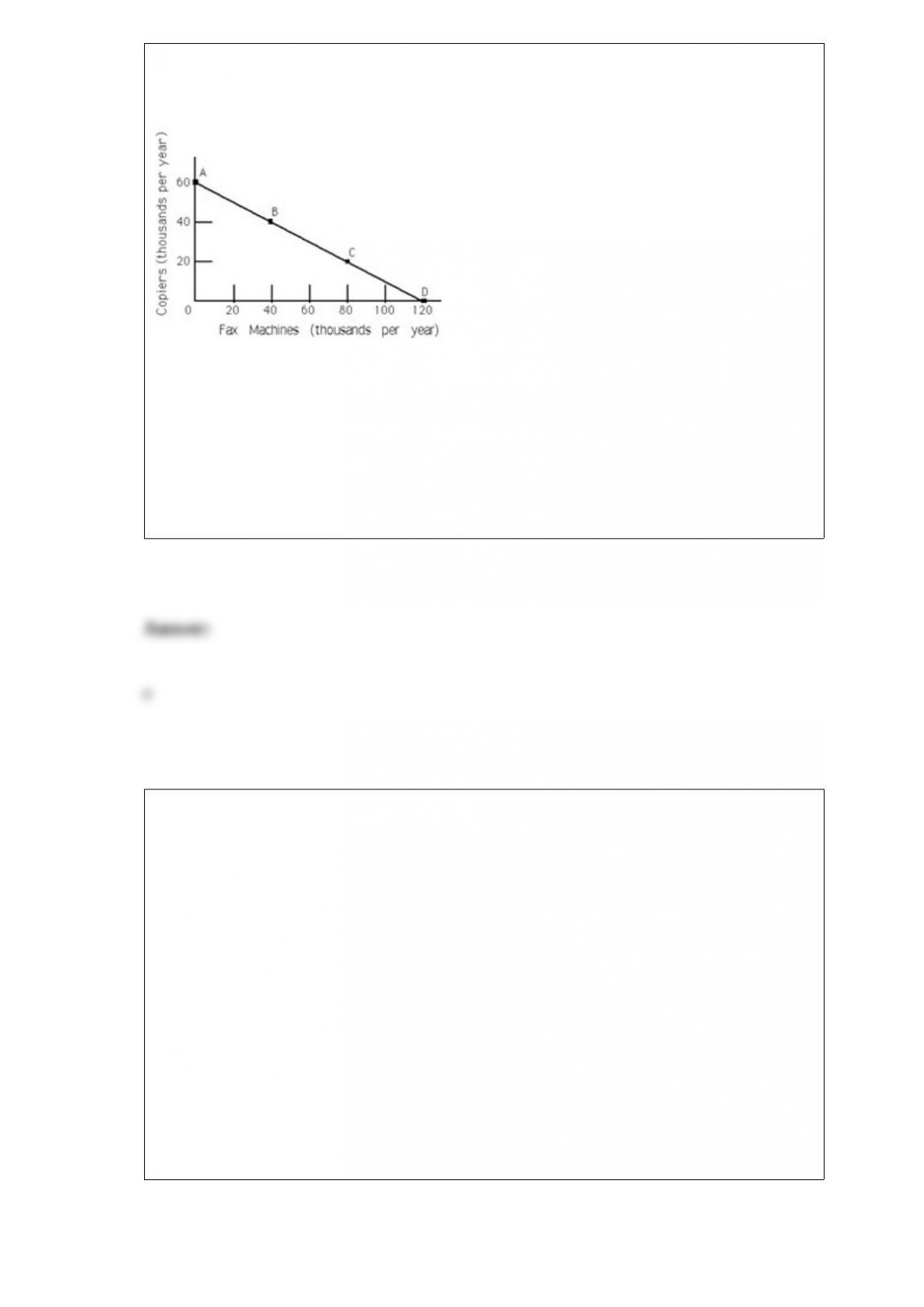
Refer to Exhibit 2-4. This economy is productive
Exhibit 2-4
a. efficient, if it operates at point B or C.
b. efficient, if it operates at point A or D.
c. inefficient, if it operates at point A or D.
d. inefficient regardless of the particular point.
e. both a and b
Refer to Situation 4-1. If no price controls had been in place, the effect of the oil
embargo on the equilibrium price and quantity of gasoline would have been
Situation 4-1
During the winter of 1973-74, a general system of wage and price controls (including a
price ceiling on gasoline) was in force in the United States. At the beginning of 1974,
some oil-producing countries imposed an oil embargo (a legal prohibition on
commerce) on the West. In the spring of 1974, price controls were abolished.
a. an increase in both price and quantity.
b. an increase in price and a decrease in quantity.
c. a decrease in price and an increase in quantity.
d. a decrease in both price and quantity.

If there are six firms in an industry and the market shares of the firms are 30 percent, 25
percent, 20 percent, 11 percent, 10 percent and 4 percent, the Herfindahl index is
a. 2,162.
b. 2,046.
c. 8,600.
d. 10,000.
e. 86.
If a perfectly competitive firm and a single-price monopolist face the same demand and
cost curves, then
a. the competitive firm will attain resource-allocative efficiency, but the monopolist will
not.
b. the competitive firm will attain resource-allocative efficiency, but the monopolist
may or may not, depending upon the demand for its product.
c. the competitive firm will not attain resource-allocative efficiency, but the monopolist
will.
d. both the competitive firm and the monopolist will attain resource-allocative
efficiency.
e. neither the competitive firm nor the monopolist will attain resource-allocative
efficiency.
If the price of good X rises and the demand for good X is elastic, then the percentage
__________ in quantity demanded is __________ the percentage rise in price, and total
revenue __________.
a. fall; greater than; rises
b. fall; less than; falls
c. fall; equal to; remains constant
d. rise; greater than; falls
e. fall; greater than; falls
It is very important for the seller of a good to know whether the good is elastic, unit
elastic, or inelastic in demand so that she will know what will happen to total revenue
when she changes the price of the good.
a. True
b. False

If the demand for good X is inelastic in the short run, then it will be __________ in the
long run (as more time passes).
a. inelastic
b. elastic
c. unit elastic
d. perfectly inelastic
e. There is not enough information to answer the question.
Low voter turnouts that appear to be a result of voter apathy may instead be a result of
a. government intervention.
b. special interest group activity.
c. cost-benefit calculations.
d. a and b
e. a, b, and c
According to the contestable markets theory,

a. even if an industry is comprised of a small number of firms, this is not sufficient
evidence that the firms perform in a noncompetitive way.
b. profits cannot be zero in an industry if the number of sellers in the industry is small.
c. if a market is contestable, inefficient producers are more likely to survive than if the
market is not contestable.
d. b and c
e. a, b, and c
Colleges and universities use such things as grade point averages and standardized test
scores as
a. a measure of consumer utility.
b. non-price rationing devices.
c. a means to shift the supply curve for a college education.
d. solely to frustrate prospective students.
Firm X pays firm Y $345 for a pollution permit. This expenditure on the part of firm X
is considered a __________. Firm Y ends up spending $200 to eliminate some
pollution. This expenditure on the part of firm Y is considered a __________.
a. resource cost; transfer
b. fixed cost; sunk cost
c. market environmental cost; standards cost
d. transfer; resource cost
e. none of the above
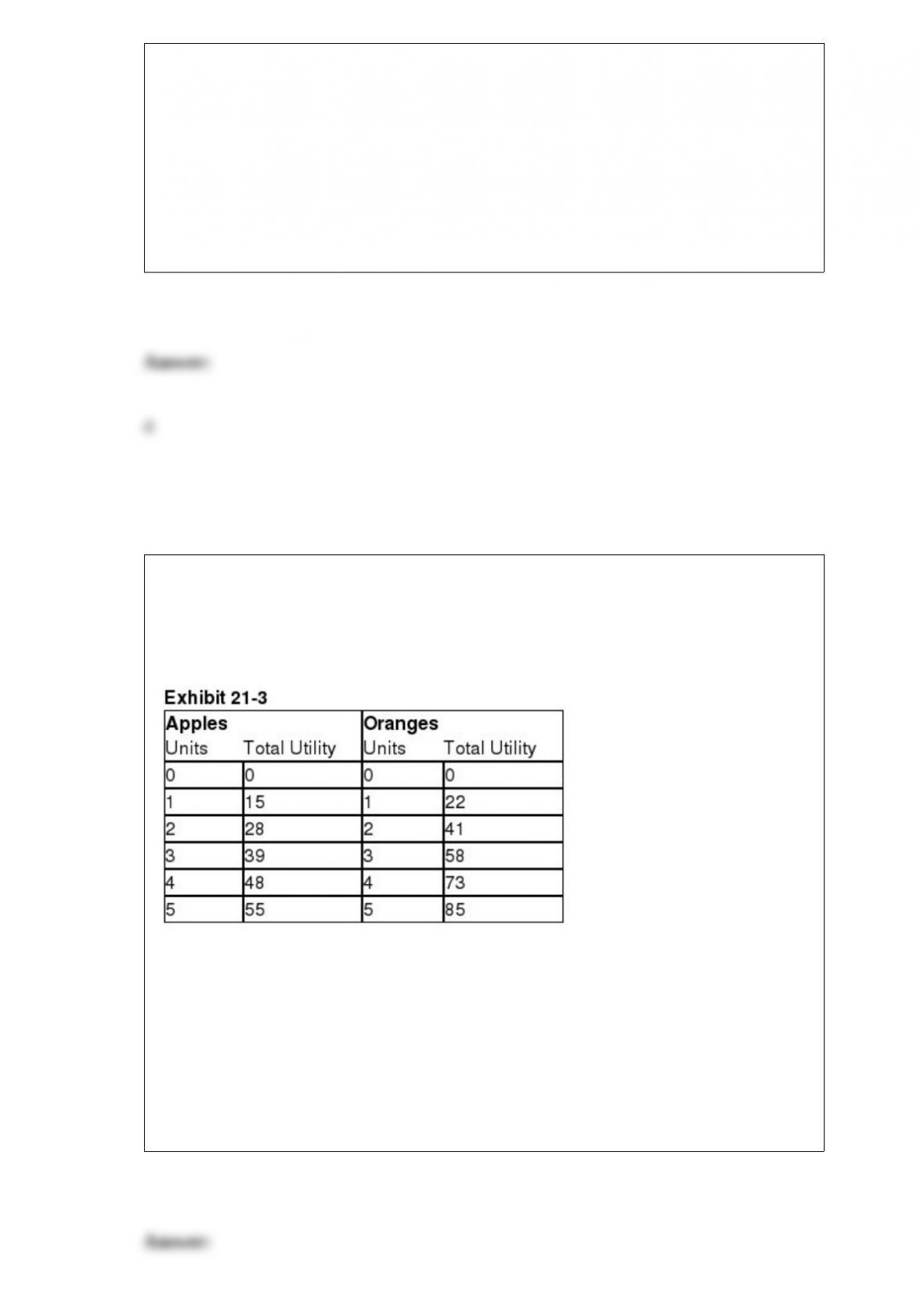
Refer to Exhibit 21-3. Linda spends $5 a week on apples and oranges. If the price of
both goods is $1 per unit, what is Linda’s total utility from consuming the optimal
bundle of goods?
a. 85
b. 86
c. 88
d. 209
e. 279

Marginal utility is always a positive number.
a. True
b. False
Refer to Exhibit 22-14. What is the MPP of the fourth unit of labor [blank (D)]?
Exhibit 22-14
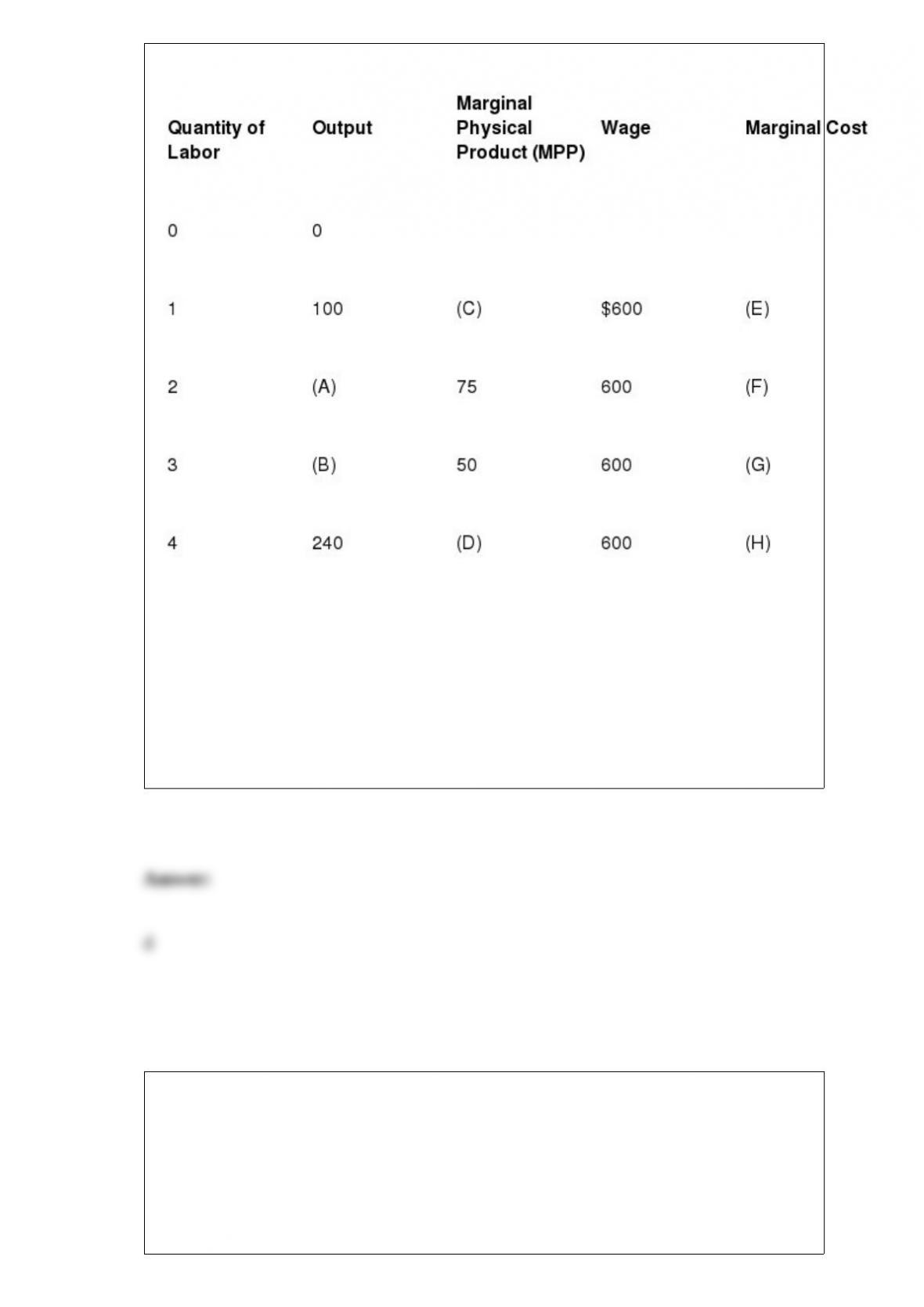
a. 70 units
b. 60 units
c. 100 units
d. 15 units
Which of the following is false?
a. When the U.S. government imposed price ceilings on gasoline, the result was a
surplus of gasoline.
b. When the U.S. government imposed price ceilings on gasoline, the result was a
shortage of gasoline.
c. If a price ceiling is imposed below the equilibrium price in a given market, the result
is a shortage in that market.
d. First-come-first-served is a commonly used rationing device.
The shorter the period of time consumers have to adjust to price changes, the
__________ the __________ elasticity of demand.
a. lower; income
b. lower; price
c. higher; income
d. higher; price