1) A Federal funds rate reduction that is caused by monetary policy will:
A.increase the prime interest rate.
B.decrease the size of the monetary multiplier.
C.increase the Fed’s discount rate.
D.decrease the prime interest rate.
2) The rule of reason indicated that:
A.if less than four firms account for three-fourths of an industry’s sales, the industry is
in violation of the Sherman Act.
B.social regulation should not be enforced unreasonably so that costs exceed benefits.
C.the mere possession of monopoly power is a violation of the antitrust laws.
D.only contracts and combinations that unreasonably restrain trade violate the antitrust
laws.
3) If nominal GDP is $600 billion and, on the average, each dollar is spent three times
per year, then the amount of money demanded for transactions purposes will be:
A.$1800 billion.
B.$600 billion.
C.$200 billion.
D.$1200 billion.
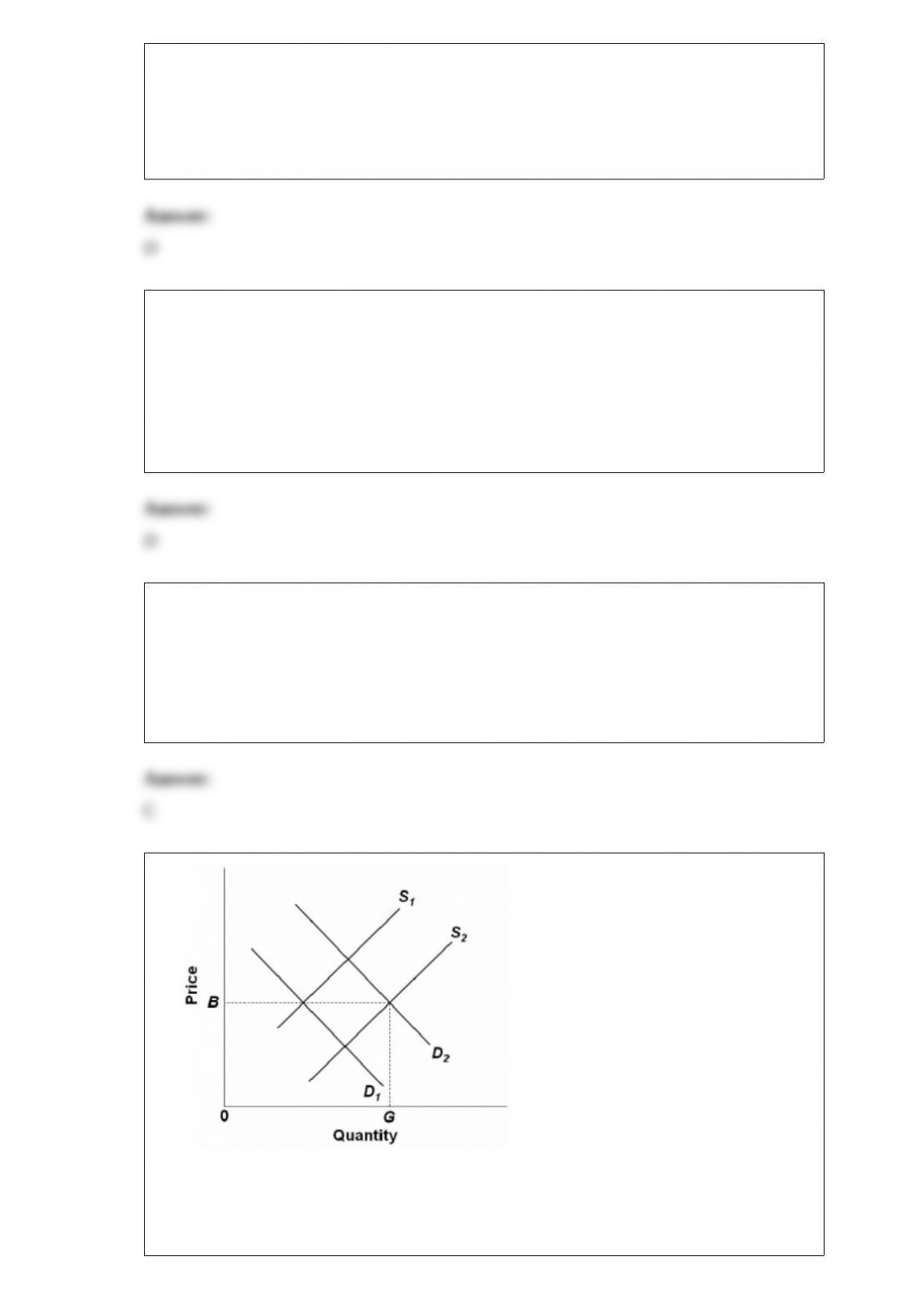
4)
Refer to the above competitive market diagram for product Z. Assume that the current
market demand and supply curves for Z are D2 and S2. If there are substantial external
costs associated with the production of Z, then:
A.a price lower than B and an output greater than G would improve resource allocation.
B.government should levy a per unit excise tax on Z to shift the demand curve to the
right.
C.government should levy a per unit excise tax on Z to shift the supply curve toward
S1.
D.government should subsidize the production of Z to lower equilibrium price and
increase equilibrium output.
5) a single-price pure monopoly is economically inefficient:
a.only because it produces beyond the point of minimum average total cost.
b.only because it produces short of the point of minimum average total cost.
c.because it produces short of minimum average cost and price is greater than marginal
cost.
d.because it produces beyond minimum average total cost and marginal cost is greater
than price.
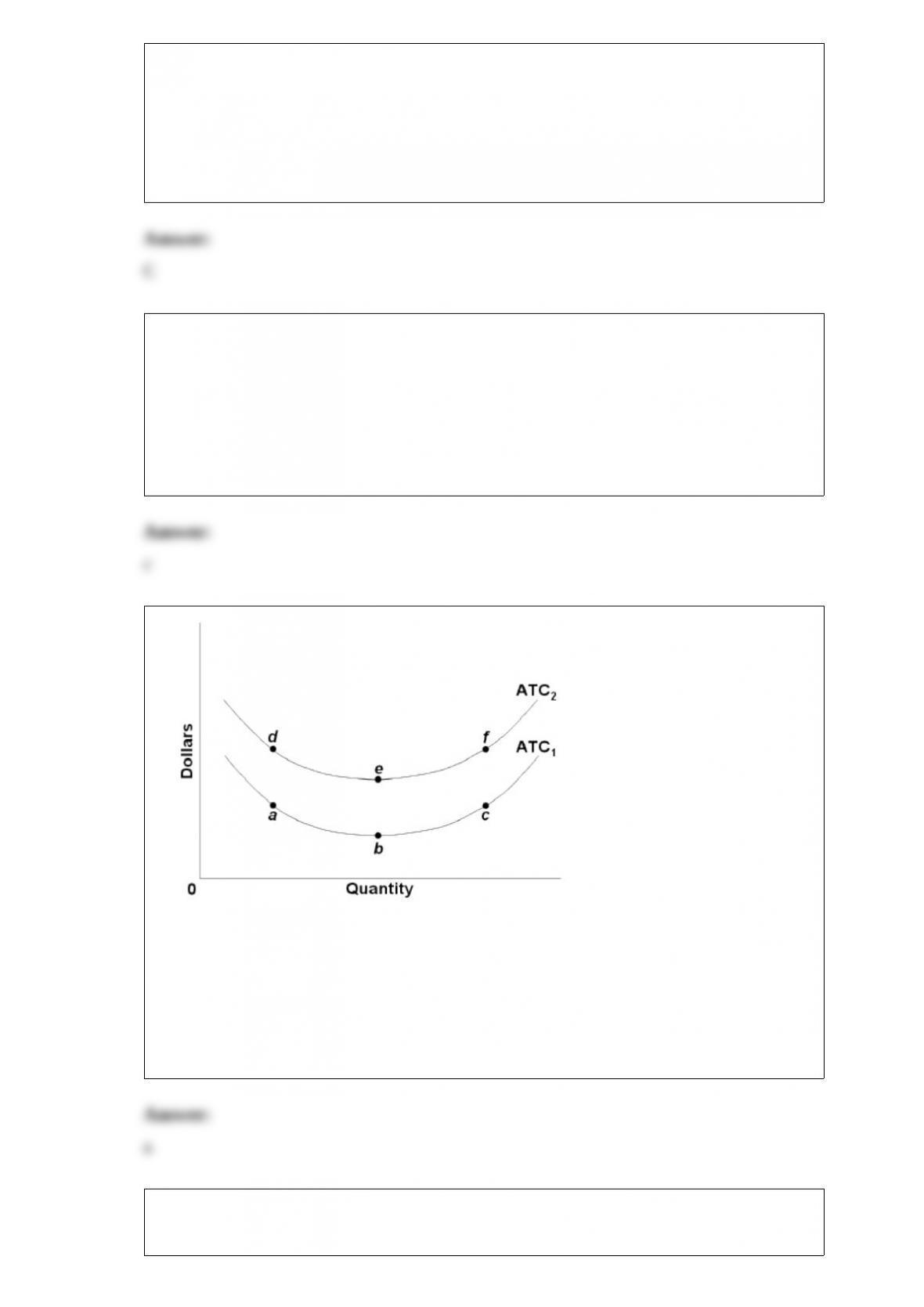
6)
refer to the above graph. which one of the following would cause a move from point e
on short-run average total cost curve atc2 to point b on short-run average cost curve
atc1?
a.a decline in total fixed costs
b.diminishing marginal returns
c.an increase in the wage rate
d.increasing marginal returns
7) wait unemployment and search unemployment are both types of:
a.cyclical unemployment.
b.hidden unemployment.
c.frictional unemployment.
d.structural unemployment.
8) Farm programs such as those of the United States and the European Union:
A.encourage the United States and the European Union to use tariffs and quotas to
restrict agricultural imports.
B.cause United States and European Union farmers to produce less than domestic
consumers want to purchase.
C.increase world market prices for agricultural products.
D.raise farm output in developing nations.
9) assume you are spending your full budget and purchasing such amounts of x and y
that the marginal utility from the last units consumed is 40 and 20 utils respectively.
assume (a) the prices of x and y are $8 and $4 respectively; (b) it takes 3 hours to
consume a unit of x and 1 hour to consume a unit of y; and (c) your time is worth $2 per
hour. you
a.should substitute x for y until the marginal utility per hour is the same for both
products.
b.are consuming x and y in the optimal amounts.
c.should consume less of y and more of x.
d.should consume less of x and more of y.
10) People who buy foreign currency for the sole goal of selling it at a profit are called:
A.numismatics.
B.currency hedgers.
C.currency manipulators.
D.currency speculators.
11) Suppose the economy is experiencing a recession and high unemployment. What
would be the interpretation of how an expansionary monetary policy would address this
problem?
12) What are the components of national income? What is the relative share going to
wages and salaries and to corporate profits?
13) Summarize the main research conclusions found by prominent economists on the
economic effects of immigration.
14) How do expectations about the future by households and businesses affect the
effectiveness of fiscal policy? Cite examples.
15) What are two positive roles that speculators play in currency markets?
16) Use an aggregate demandaggregate supply analysis to explain the impact of the
publics expectations of severe inflation on real domestic output and the price level.
17) How do long terms for appointments benefit the Federal Reserves Board of
Governors?