
All of the following would be considered explicit costs of operating a business except
A) rent paid to a landlord.
B) bonuses paid to employees.
C) a normal rate of return for investors.
D) corporate income taxes.
Workers laid off as a result of a recession suffer
A) frictional unemployment.
B) structural unemployment.
C) cyclical unemployment.
D) seasonal unemployment.
E) natural unemployment.
When people who buy insurance change their behavior after the purchase because they
are protected from loss by the insurance, the insurance market is said to face the
problem of
A) moral hazard.
B) adverse selection.

C) asymmetric information.
D) economic irrationality.
If, as your taxable income decreases, you pay a smaller percentage of your taxable
income in taxes, then the tax is
A) regressive.
B) proportional.
C) progressive.
D) unfair.
Which of the following models relies on emphasizing the importance of sticky wages
and prices?
A) the monetarist model
B) the new classical model
C) the real business cycle model
D) the new Keynesian model
If the purchasing power of the dollar is less than the purchasing power of the British
pound, purchasing power parity predicts that the exchange rate will
A) increase if the exchange rate is greater than 1 pound per dollar.
B) decrease if the exchange rate is less than 1 pound per dollar.
C) be equal to the relative purchasing power across the currencies in the long run.
D) All of the above are correct.
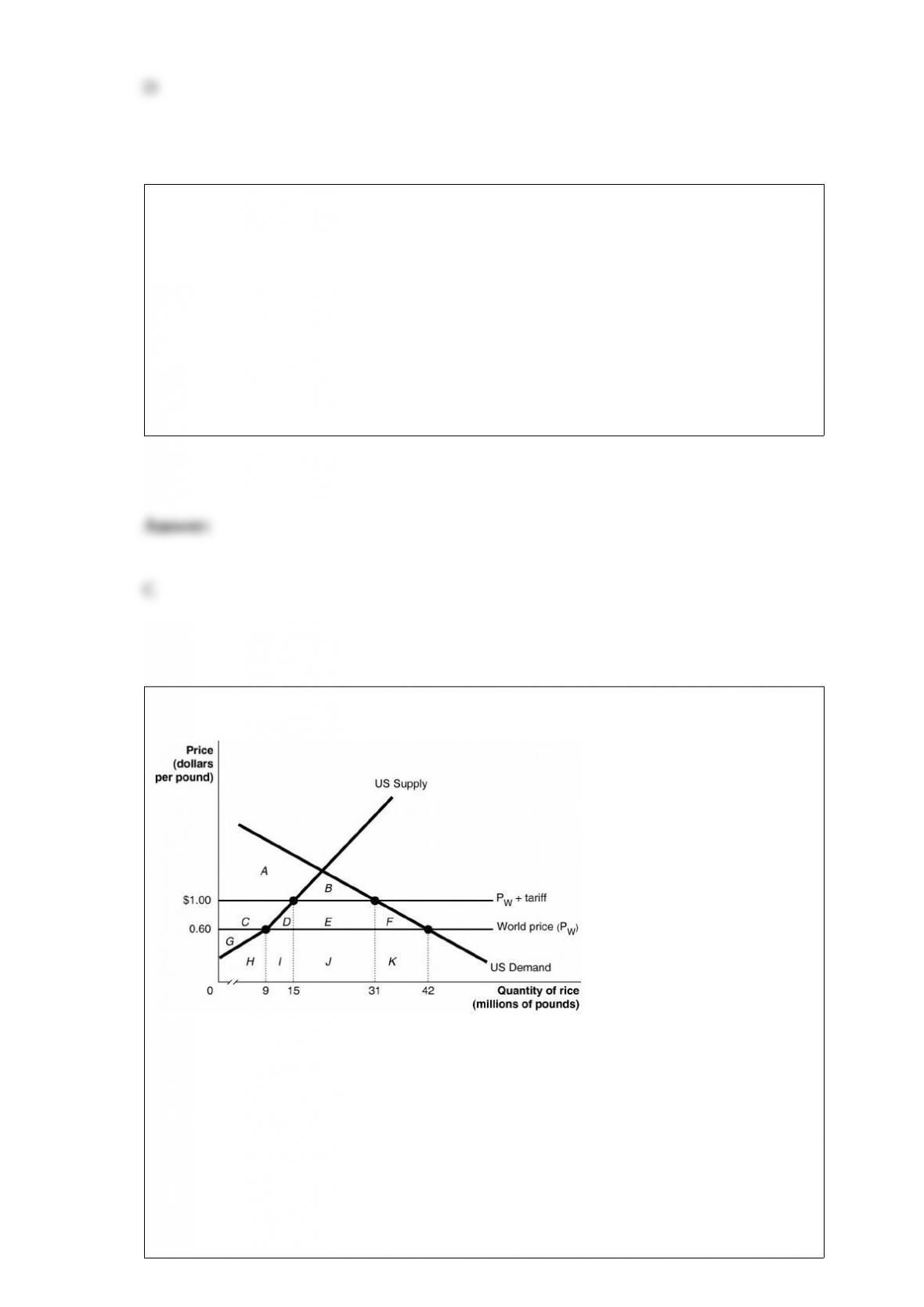
Figure 9-2
Suppose the U.S. government
imposes a $0.40 per pound tariff on rice imports. Figure 9-2 shows the impact of this
tariff. With the tariff in place, the United States
A) imports 16 million pounds of rice.
B) imports 9 million pounds of rice.
C) imports 15 million pounds of rice.
D) exports 31 million pounds of rice.

All else equal, the decrease in consumer preference predicted by Apple for its iPhone 5
would be represented by a
A) shift in the supply curve for iPhones to the right.
B) shift in the supply curve for iPhones to the left.
C) shift in the demand curve for iPhones to the right.
D) shift in the demand curve for iPhones to the left.
The federal budget deficit can be reduced by
A) raising taxes.
B) raising government spending.
C) raising transfer payments.
D) higher interest rates.
The current account does not include which of the following?
A) net exports
B) net investment income
C) net transfers
D) U.S. holdings of foreign assets
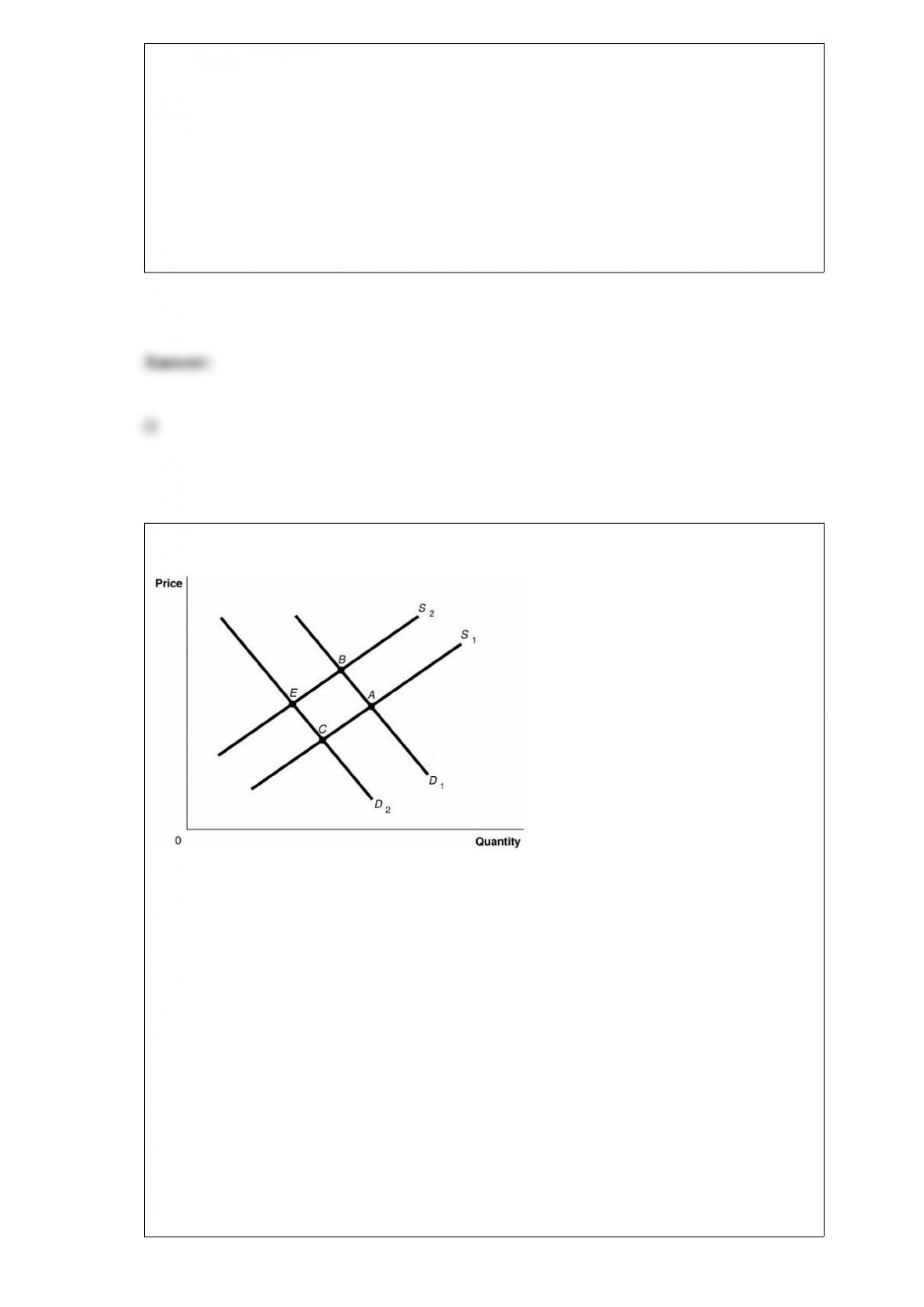
Figure 3-8
The graph in this figure illustrates an initial competitive equilibrium in the market for
apples at the intersection of D1 and S2 (point B). Which of the following changes would
cause the equilibrium to change to point C?
A) A positive change in the technology used to produce apples and decrease in the price
of oranges, a substitute for apples.
B) An increase in the wages of apple workers and an increase in the price of oranges, a
substitute for apples.
C) An increase in the number of apple producers and a decrease in the number of apple
trees as a result of disease.
D) A decrease in the wages of apple workers and an increase in the price of oranges, a
substitute for apples.