A common property is
a. both nonrivalrous and nonexcludable.
b. nonrivalrous, but not nonexcludable.
c. nonexcludable, but not nonrivalrous.
d. either nonrivalrous or nonexcludable, but not both.
When silk is shipped from China to Atlanta, transportation costs will make the price of
high-quality silk relative to low-quality silk higher in Atlanta than in China.
The Strong Coase Theroem states that in the absence of transaction costs, the
assignment of property rights has
a. a negative affect on how resources are allocated.
b. a positive affect on how resources are allocated.
c. has no affect on how resources are allocated.
d. does not affect the efficiency of how resources are allocated.
Assume that the supply curve is horizontal because marginal cost is constant at $10.
John, Robert, and Jimmy each value one compact disc at $20 but only Jimmy and John
value a second compact disc (Jimmy at $5 and John at $15). The maximum possible
value achieved in this market is
Sales Tax
The following questions refer to the accompanying diagram which shows the effects of
a sales tax imposed on consumers. The initial price and quantity are P0 and Q0,
respectively. After the tax is imposed, the equilibrium quantity is Q1, firms receive the
price Ps, and consumers pay the price Pd.
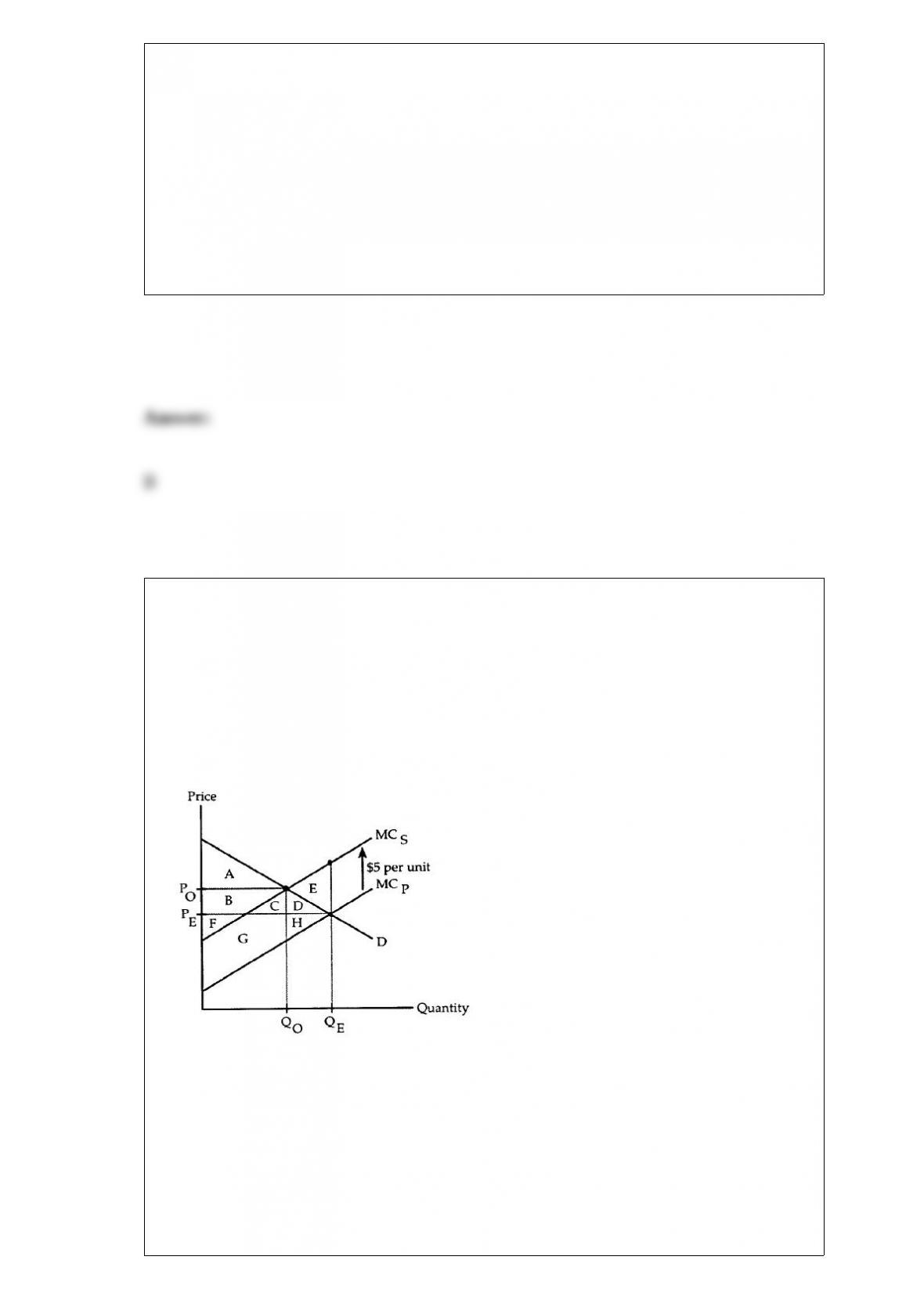
The portion of the tax revenue ultimately paid by consumers is
a. area A + B + C + D.
b. area C + D.
c. area C + D + E.
d. area A + B + C + D + E.
Negative Externality
The following questions refer to the accompanying diagram, which shows the effects of
a negative externality created by an industry’s production. The equilibrium quantity in
the absence of any attempt to internalize the externality is QE, and the optimal quantity
according to a Pigovian analysis is QO.
According to a Pigovian analysis of this externality, when a tax of $5 per unit is
imposed on the firms in this industry, the external costs created by the firms’ production
will equal
a. area C + D + E + G + H.
b. area C + D + G + H.
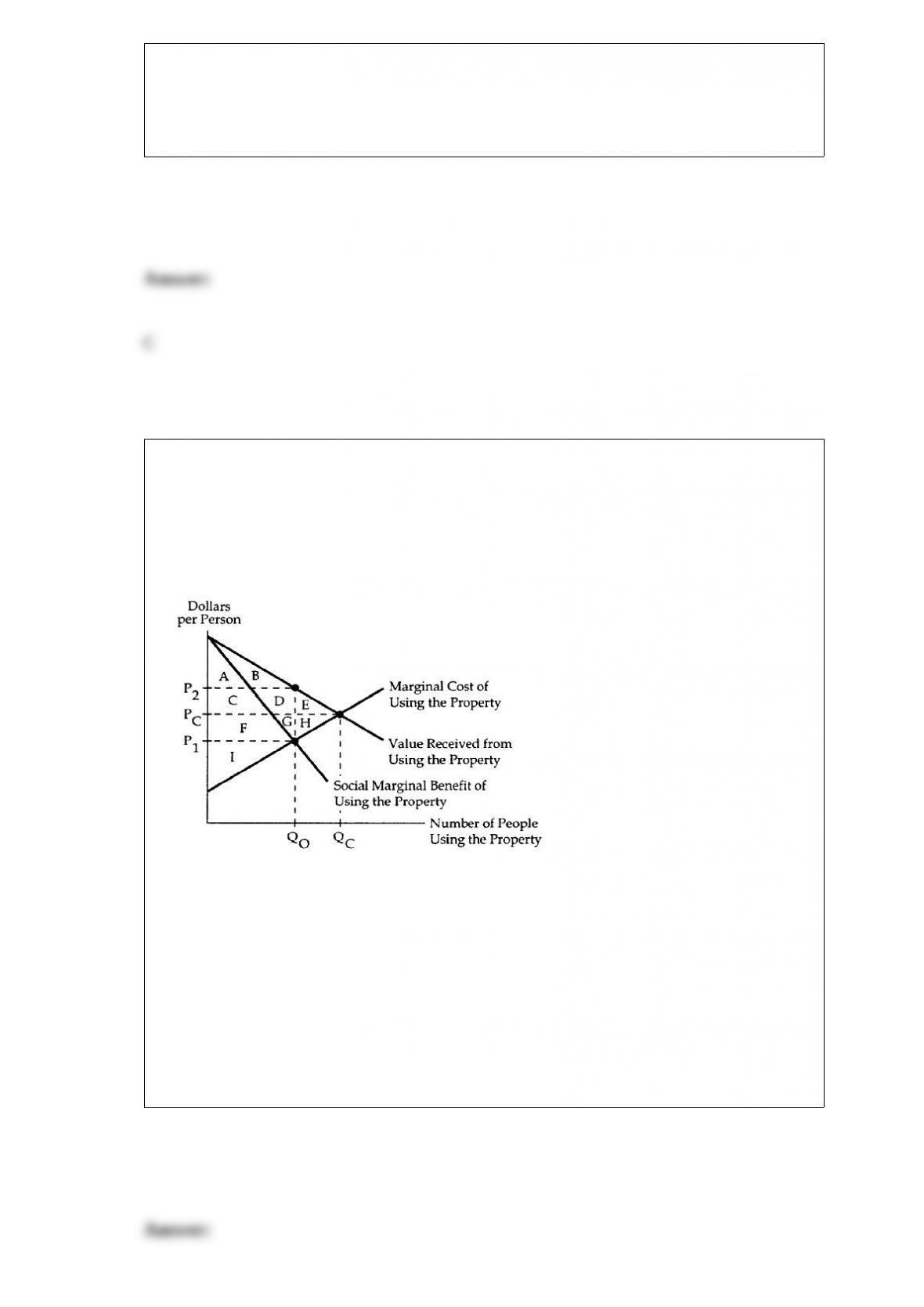
c. area C + G.
d. zero.
Common Property II
The following questions refer to the accompanying diagram, which shows the benefits
and costs associated with the use of a common property.
If access cannot be prohibited, then users of the common property receive a surplus of
a. zero.
b. area I.
c. area F + G + H + I.
d. area A + C + F + I.

If the wage rate is $10 per hour and the rental rate is $5 per hour, then the vertical
intercept of the isocost line
a. is $2.
b. is 50 cents.
c. is $5.
d. can not be determined without more information.
Suppose the price of a good rises. When will the resulting income effect reduce the
quantity demanded of the good?
a. Always.
b. Whenever the good is a non-Giffen good.
c. Only when the good is normal.
d. Only when the good is inferior.

Suppose a price index is formed to measure changes in the price level between 1989 to
1995. A price index based on changes in the cost of the basket of goods purchased by
the typical consumer in 1995 is called a
a. relative price index.
b. consumer price index.
c. Laspeyres price index.
d. Paasche price index.
The key defining feature of oligopoly, in addition to firms’ market power, is
a. collusion.
b. free entry and exit.
c. firms take rivals’ actions into account.
d. the Prisoner’s Dilemma.
Which of the following is an example of a good that is excludable and nonrivalrous?
a. A fishery.
b. Cable television.
c. Over the air television broadcasts.
d. Disney World.
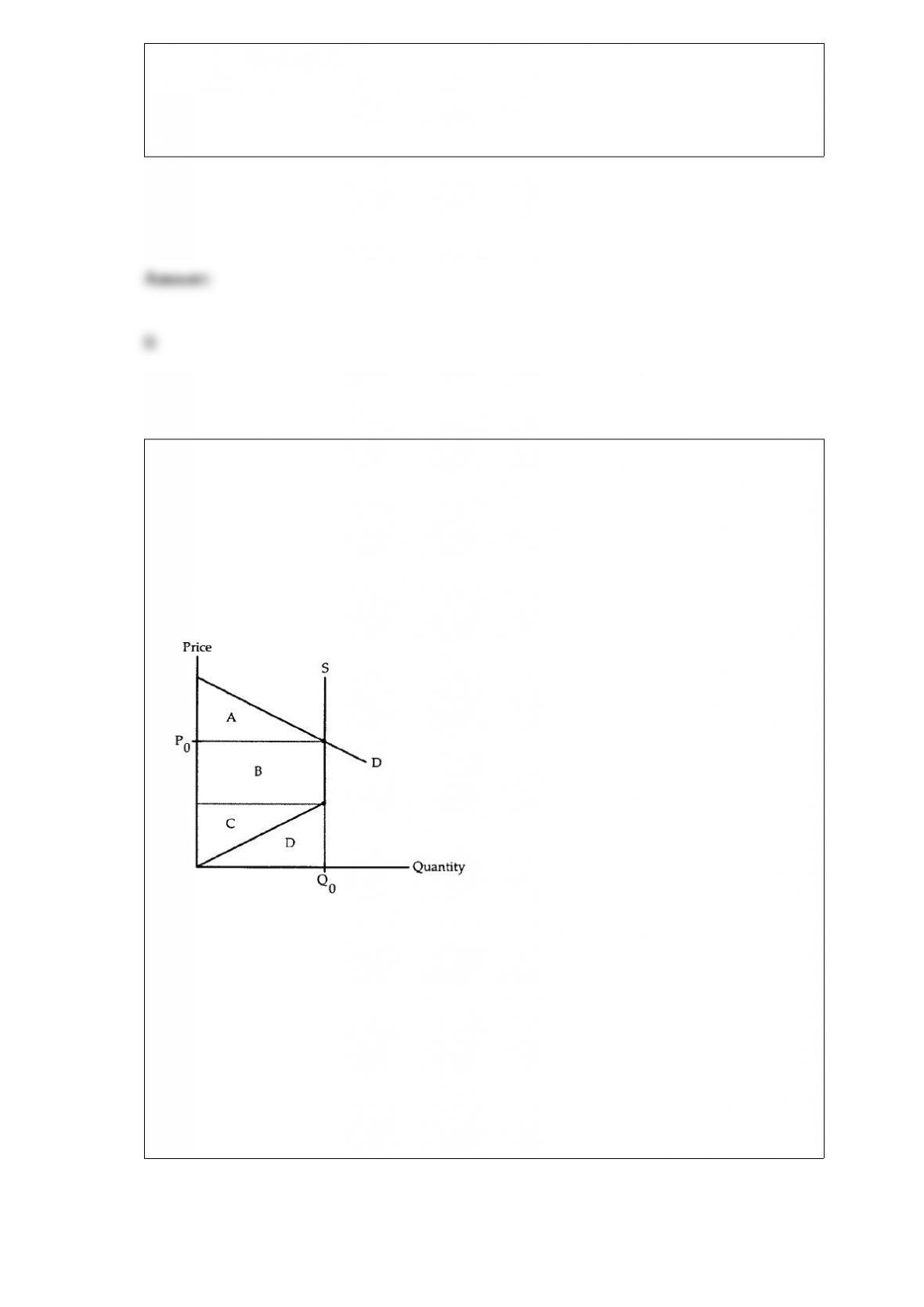
Resource Supply/Demand
The following questions refer to the accompanying graph, which shows the supply and
demand for a resource. The owner of the resource is receiving the price P0 and is
providing the quantity Q0.
The social gain from this resource being sold is
a. area A
b. area A + B
c. area A + B + C
d. area A + B + C + D
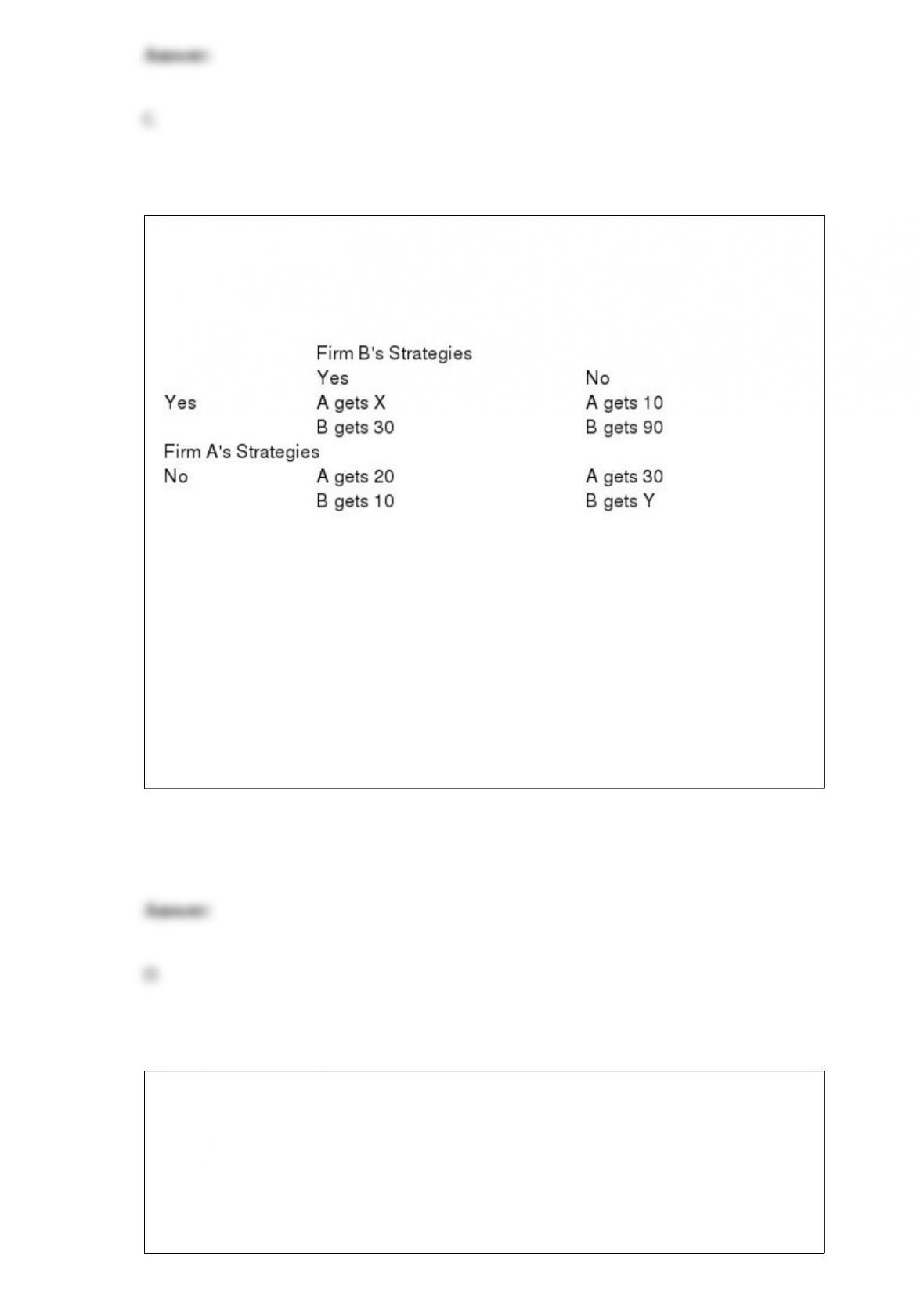
RGame Matrix V
The following questions refer to the game matrix below. Each firm has a choice of
saying Yes or NO. The profits each gets depend upon which it chooses.
efer to Game Matrix V. Which of the following values of X and Y result in the only
Nash Equilibrium being (Yes, Yes)?
a. X = 21, Y = 9.
b. X = 19, Y = 11.
c. X = 21, Y = 11.
d. It is not possible for (Yes, Yes) to be a Nash Equilibrium.
If the wage rate rises, then in the long run, the firm will replace some of its labor with
other factors such as capital, even if it keeps its output level constant. This phenomenon
is known as
a. the substitution effect.
b. the scale effect.

c. the regressive-factor effect.
d. the factor-price effect.
One reason that DOWN,RIGHT is not a NASH equilibrium is that
a. Player B receives a payoff of 8 as opposed to the payoff of 20 that he would receive
if he changed his strategy.
b. Player B receives a payoff of 20 as opposed to the payoff of 30 that he would receive
if he changed his strategy.
c. Player A receives a payoff of 20 as opposed to the payoff of 30 that he would receive
if he changed his strategy.
d. The statement is false. DOWN, RIGHT is a Nash equilibrium.
Suppose pizzas are the only good and people have homothetic preferences. The supply
of pizzas today is perfectly inelastic and determined solely by people’s endowments.
Which of the following would cause the interest rate to rise?
a. A 50% increase in pizza production, this year and throughout the future.
b. A 50% increase in this year’s pizza production that is not expected to affect future
harvests.

c. An expected 50% increase in future pizza production.
d. A hurricane that permanently destroys 50% of all pizza parlors.
According to the standard competitive model, industries with increasing returns would
not be profitable. However, economist Paul Romer argues that many industries may be
experiencing increasing returns because
a. many important inputs are common property and therefore equally available to all
firms.
b. many important inputs may be nonrivalrous so that there is no limit to how much
they can be used.
c. of a decline in the number of monopsonistic firms in labor markets.
d. of an increase in the number of firms that are natural monopolies.
The preferences between baskets of outcomes when the state of the world is not yet
known are called
a. ex ante preferences.
b. ex post preferences.
c. risk-averse preferences.

d. diversified preferences.
When a game has more than one Nash equilibrium,
a. at least one of them will be Pareto optimal.
b. they will all tend to be unstable.
c. they must provide the same total payoff to the players.
d. it is difficult to predict which of them will actually occur.
The Peltzman study suggests that minimum standards of quality
a. overall create a net benefit for consumers by protecting them from dangerous
products.
b. overall hurt consumers by limiting entry and raising prices.
c. are beneficial to consumers only when they are strictly enforced.
d. rarely have any significant effect on the market.

If a firm can adjust its employment of all inputs, then it is
a. experiencing economies of scale.
b. in the long run.
c. off its expansion path.
d. limited only by the capacity of its fixed capital.
Suppose you place $10,000 in a retirement fund that earns a nominal interest rate of
8%. If you expect inflation to be 5% or lower, then you are expecting to earn a real
interest rate of at least
a. 1.6%.
b. 3%.
c. 4%.
d. 5%.

When the wage rate rises, the substitution effect leads a worker to
a. increase consumption while the income effect leads to a decrease in consumption.
b. decrease consumption while the income effect leads to an increase in consumption.
c. increase consumption, as does the income effect.
d. substitute sleep for other leisure.
Assume that the supply curve is horizontal because marginal cost is constant at $10.
John, Robert, and Jimmy each value one compact disc at $20 but only Jimmy and John
value a second compact disc (Jimmy at $5 and John at $15). If a social planner dictates
that five compact discs be produced and distributed to John, Robert, and Jimmy, then
even if the compact discs are allocated based on demand, this market will lose out on
$___ of value.
a. $5.
b. $10.
c. $15.
d. There will be no lost value as five compact discs is the efficient level..
The curve representing the set of efficient portfolios must be

a. concave.
b. linear.
c. convex.
d. a ray from the origin.
The temporary producers’ surpluses earned in the short run by factors that are
inelastically supplied are called
a. regressive rents.
b. transitory rents.
c. windfall rents.
d. quasi-rents.
The economist assumes that people act in accordance with the equimarginal principle,
because the economist assumes that people are
a. altruistic.
b. selfish.
c. rational.

d. price takers.
Which of the following is the most likely to cause the price of air travel to rise?
a. Lower prices and improved service in Amtrak (the nation’s passenger railroad).
b. Improved productive efficiency resulting from airline mergers.
c. Higher airplane fuel costs.
d. Reports that air travel safety is deteriorating.
The key assumption of the capital asset pricing model is that an investor cares only
about his portfolio’s
a. degree of diversification.
b. expected income.
c. level of risk.
d. expected return and standard deviation.

Your artistically talented friend Pablo offers to sell you one of his paintings that he
knows you enjoy looking at. You value this enjoyment at $100 and then expect to sell
the painting at the end of one year for $500. You would buy the painting when interest
rates are at 5% so long as the price he asks for is no greater than
a. $600.
b. $576.
c. $480.
d. $400.
When do insurance companies encounter the problem of moral hazard?
a. When simply having insurance causes people to take more risks than they would
otherwise.
b. When they do not have enough information to distinguish between people who are
“good risks” and those who are “bad risks.”
c. When the price of insurance premiums fully reflects all available information.
d. When the insurance company suffers large losses because a major catastrophe has
affected a large number of people simultaneously.
Marginal benefit is defined as
a. the net gain from a particular level of an activity.
b. the additional benefit gained from the last unit of an activity.
c. the difference between total benefits and total costs of a particular level of an activity.
d. the difference between variable costs and fixed costs.
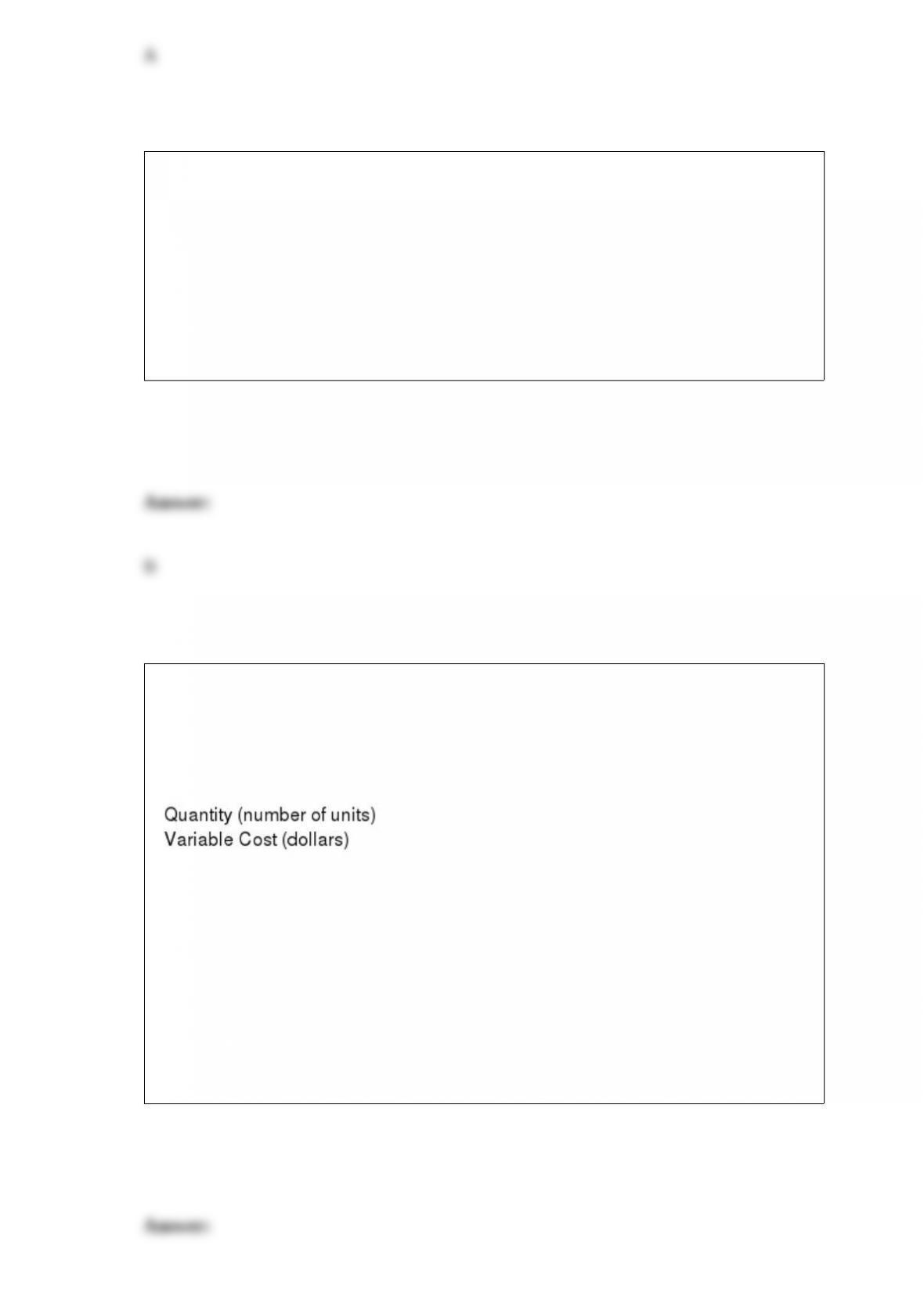
Variable Cost of Production
The following questions refer to the following table which shows a firm’s variable costs
of production.
If the total cost of producing the fifth unit of output is $150, fixed costs must be
a. $8.
b. $22.
c. $30.
d. $40.

When both players have dominant strategies, there is one and only one Nash
equilibrium.
If the wage and rental rates are $10 and $50 per hour respectively and an additional
worker could produce 100 units of output in an hour, then an extra unit of capital could
produce 500 units of output in an hour.
If most employers discriminate on the basis of race, then wage differentials between
whites and blacks will certainly occur.
Use of a common property is nonrivalrous.
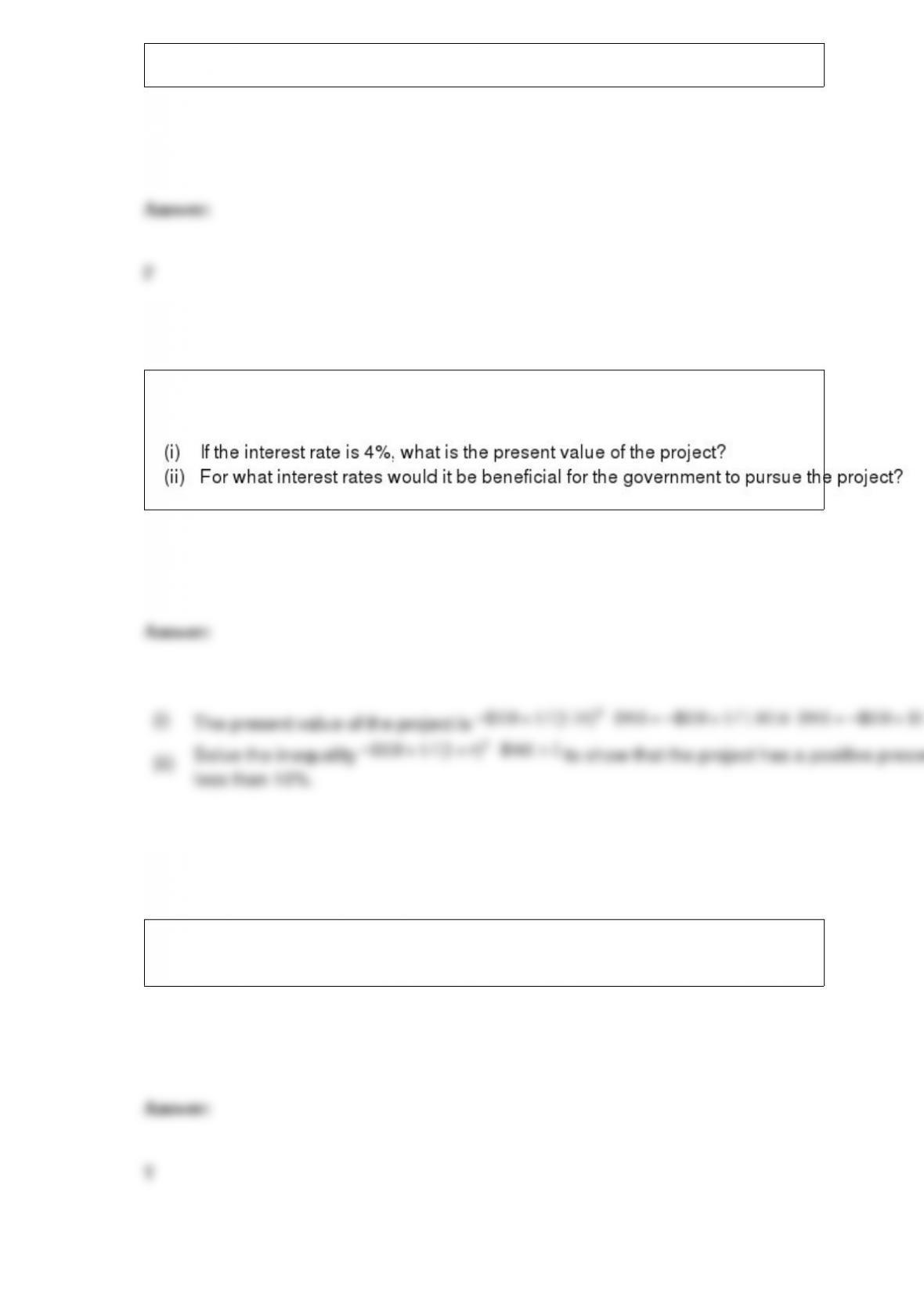
A local government can spend $800 today on a project that will yield $968 of benefits
two years from today.
An excise tax will increase the deadweight loss due to monopoly, but an excise subsidy
can reduce the deadweight loss.
Explain why a rent increase at Joe’s Rib Shack would not cause Joe to raise his prices,
but a rent increase at Joe’s competitors may cause him to raise prices.
Stock options create the wrong incentive in that they create a principal-agent problem.
Provide economic explanations of the following puzzling behaviors.
Unlike perfectly competitive firms, monopolies do not produce where marginal revenue
equals marginal cost, thus leading to deadweight loss.
When mixed strategies are allowed, the Copycat Game does have a Nash equilibrium.
The cross elasticity between California and Florida oranges is likely to be negative
because they are substitutes for one another.

A limitation of game theory is that players are only allowed two possible strategies
while players in the real world usually have more than just two options.
If a person is willing to trade one good for another, their new basket after the trade must
lie on a lower indifference curve than their original basket.
The accompany diagram shows the market for gasoline, in which there are 1,000
consumers. Gasoline can be produced at a constant marginal cost of $2 per gallon.
When the market is in equilibrium, the average consumer uses 15 gallons of gasoline
per week.
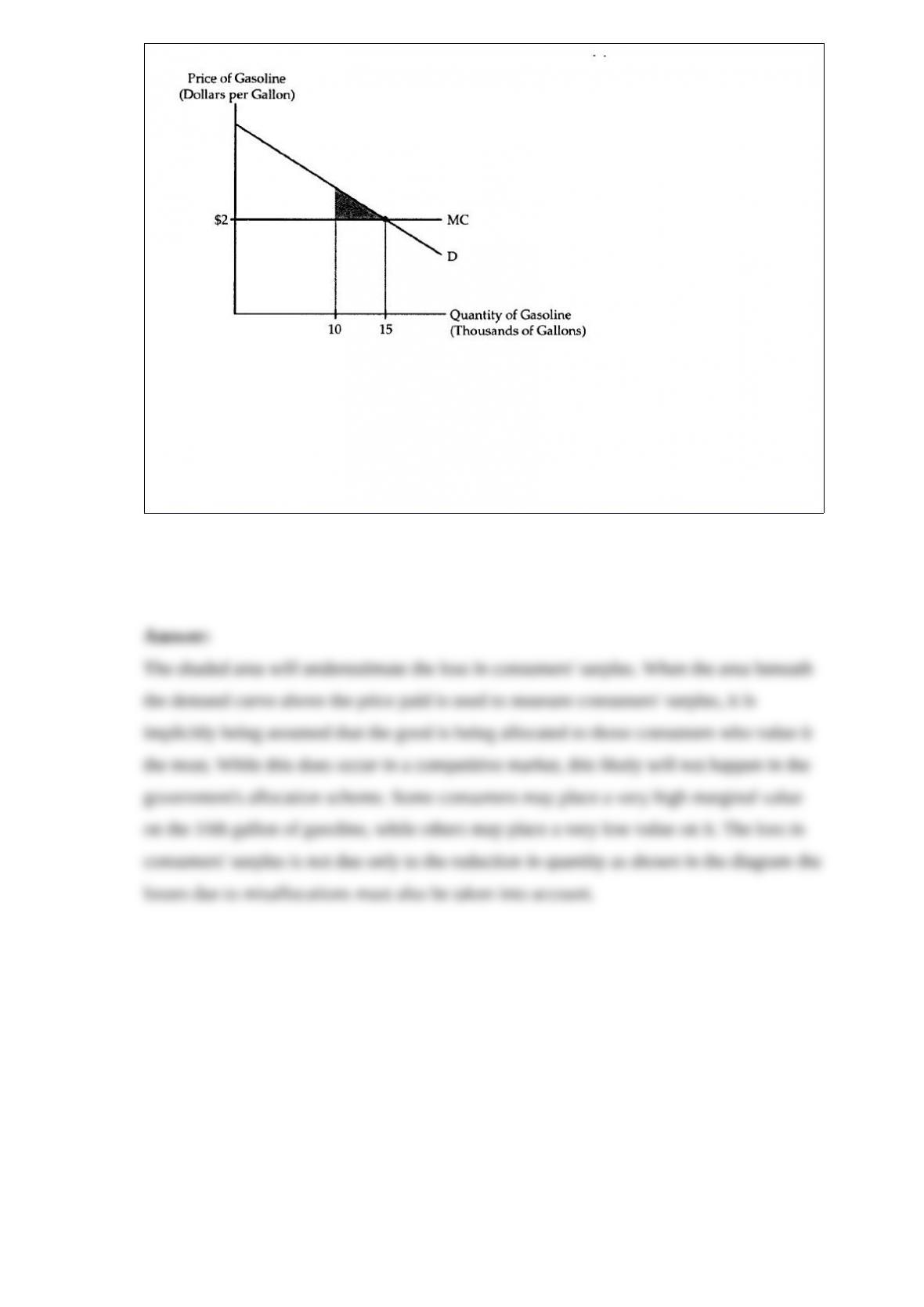
Suppose a war breaks out, temporarily limiting the amount of gasoline available for
civilian use to 10,000 gallons per week. In the interest of fairness, the government
allocates 10 gallons per week to each consumer, taxes each consumer $20 per week,
and forbids barter in gasoline. Will the shaded area in the diagram accurately measure
the loss in consumers’ surplus? Why or why not?