1) One of the implications of the supply-side anecdote is that:
A.tax cuts distributed equally across all workers would result in some people being paid
by the government to work.
B.it is unwise to dine with supply-side economists if you are the wealthiest person at
the table.
C.tax cuts are generally distributed unfairly.
D.the U.S. tax system is proportional.
2)
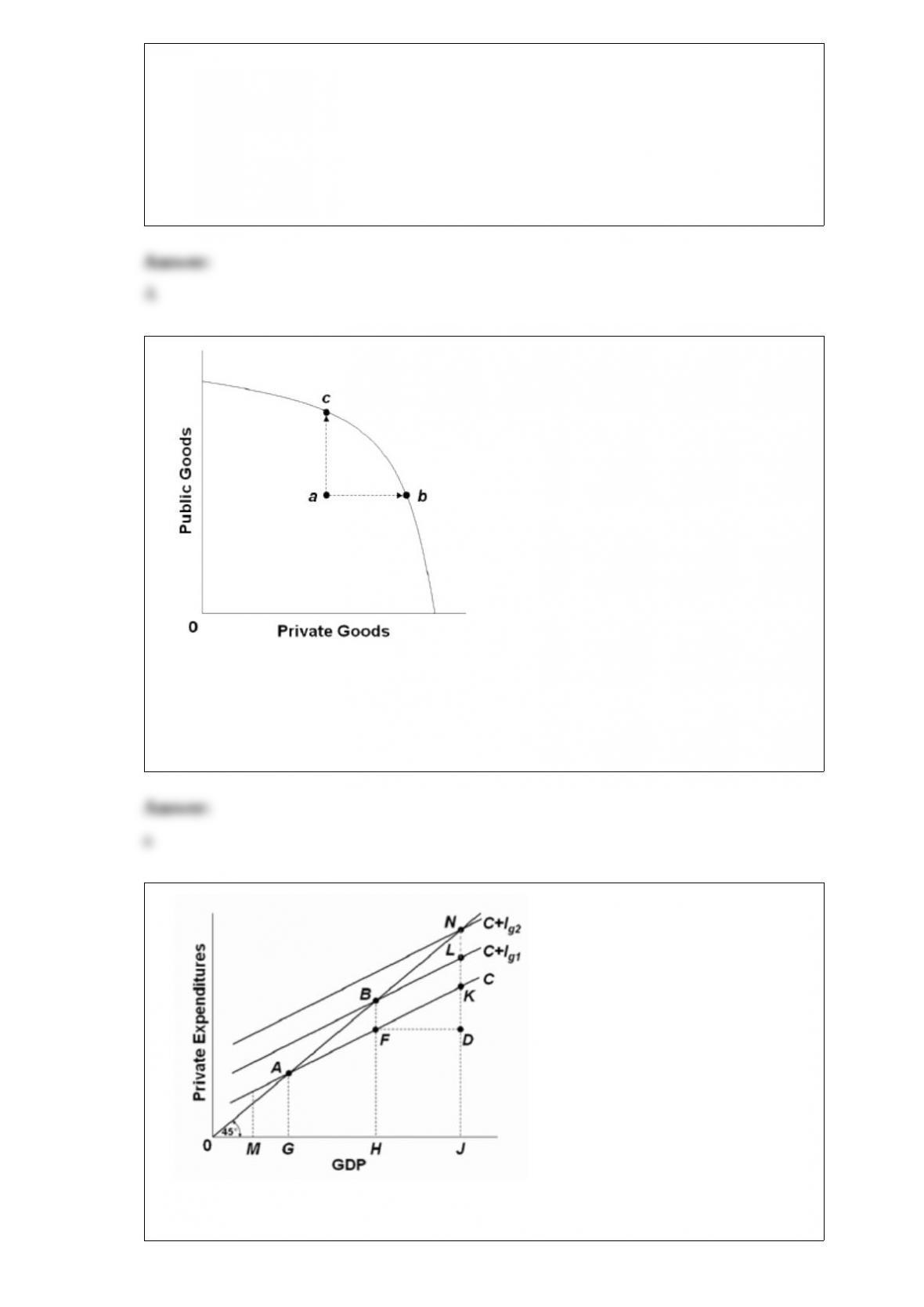
refer to the above diagram. the movement from point b to point c can be achieved by:
a.increasing taxes and increasing government spending.
b.increasing taxes and decreasing government spending.
c.decreasing taxes and increasing government spending.
d.decreasing taxes and decreasing government spending.
3)
Refer to the above diagram that applies to a private closed economy. The APC is equal
to 1 at income level:
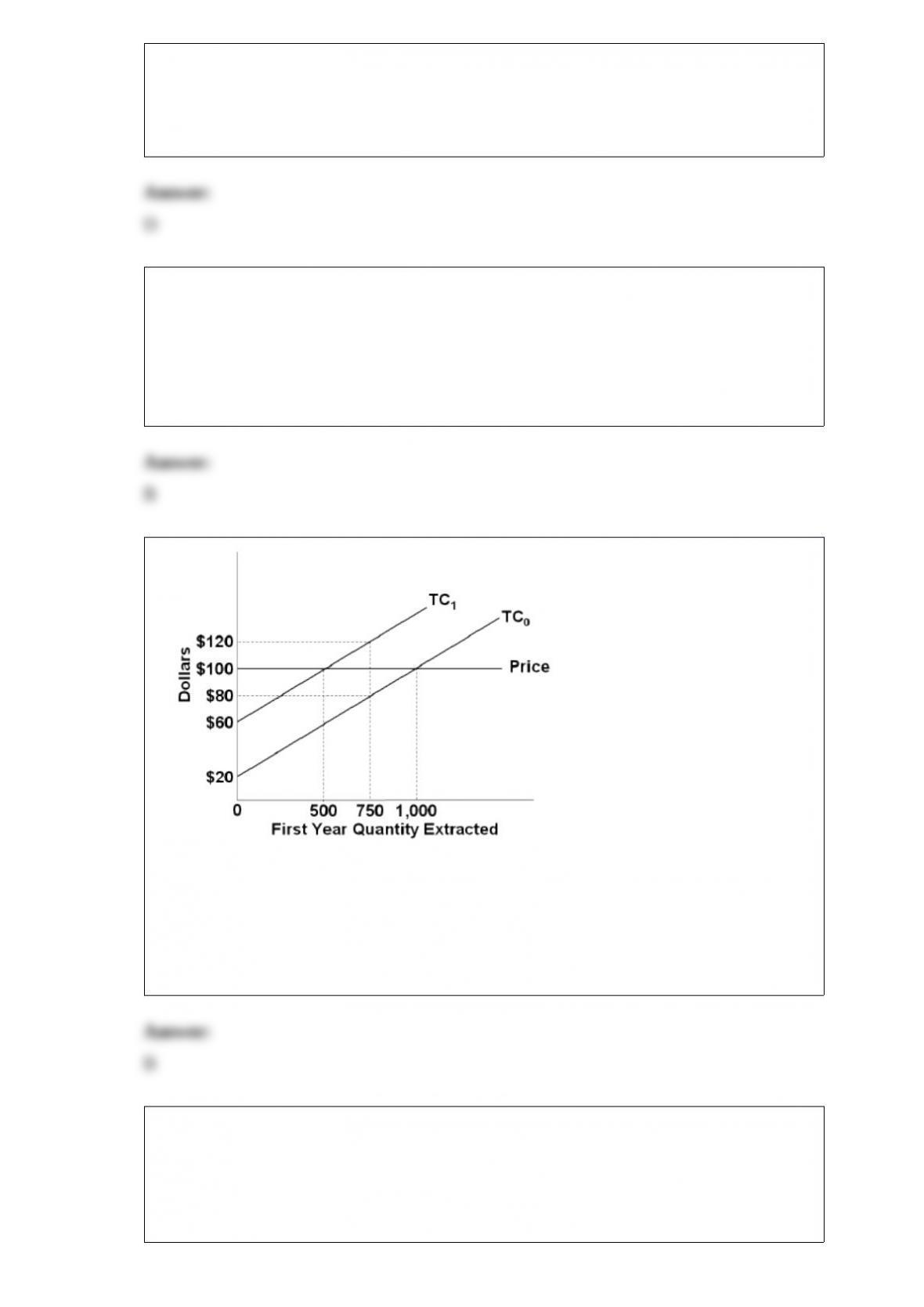
A.J.
B.M.
C.H.
D.G.
4) When the Fed auctions and loans reserves using the term auction facility, what
determines the interest rate that will be charged for those reserves?
A.The interest rate of the highest bidder.
B.The interest rate of the lowest bidder whose bid is accepted.
C.The interest rate of the lowest bidder.
D.Each bank with an accepted bid is charged whatever interest rate it bid.
5)
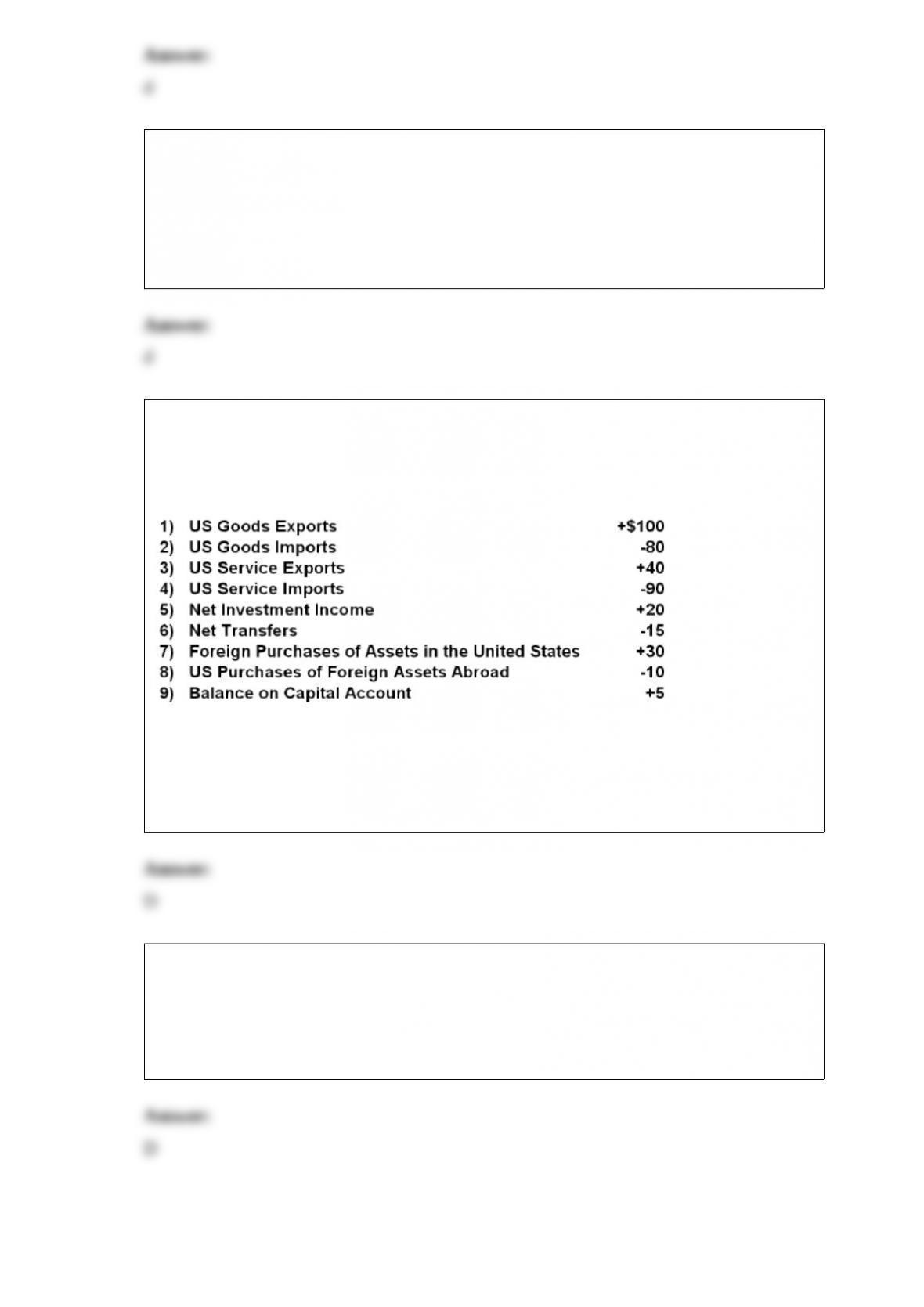
Refer to the diagram above, assuming that the firm represented is operating on curve
TC0. A change from TC0 to TC1 could be caused by:
A.a decrease in extraction costs.
B.an increase in user costs.
C.an increase in the price of the resource.
D.a decrease in the price of the resource.
6) if the demand for a product is elastic, then total revenue will:
a.increase whether price increases or decreases.
b.be constant in response to a price change.
c.fall as price falls.
d.rise as price falls.
7) the demand for most products varies directly with changes in consumer incomes.
such products are known as:
a.complementary goods.
b.competitive goods.
c.inferior goods.
d.normal goods.
8) The following table contains hypothetical data for the 2010 U.S. balance of
payments. Answer the next question(s) on the basis of this information. All figures are
in billions of dollars.
Refer to the above data. The United States has a balance of goods:
A.deficit of $10 billion.
B.surplus of $30 billion.
C.deficit of $30 billion.
D.surplus of $20 billion.
9) Which of the following is correct?
A.Required reserves minus actual reserves equal excess reserves.
B.Required reserves equal excess reserves minus actual reserves.
C.Required reserves equal actual reserves plus excess reserves.
D.Actual reserves minus required reserves equal excess reserves.
10)
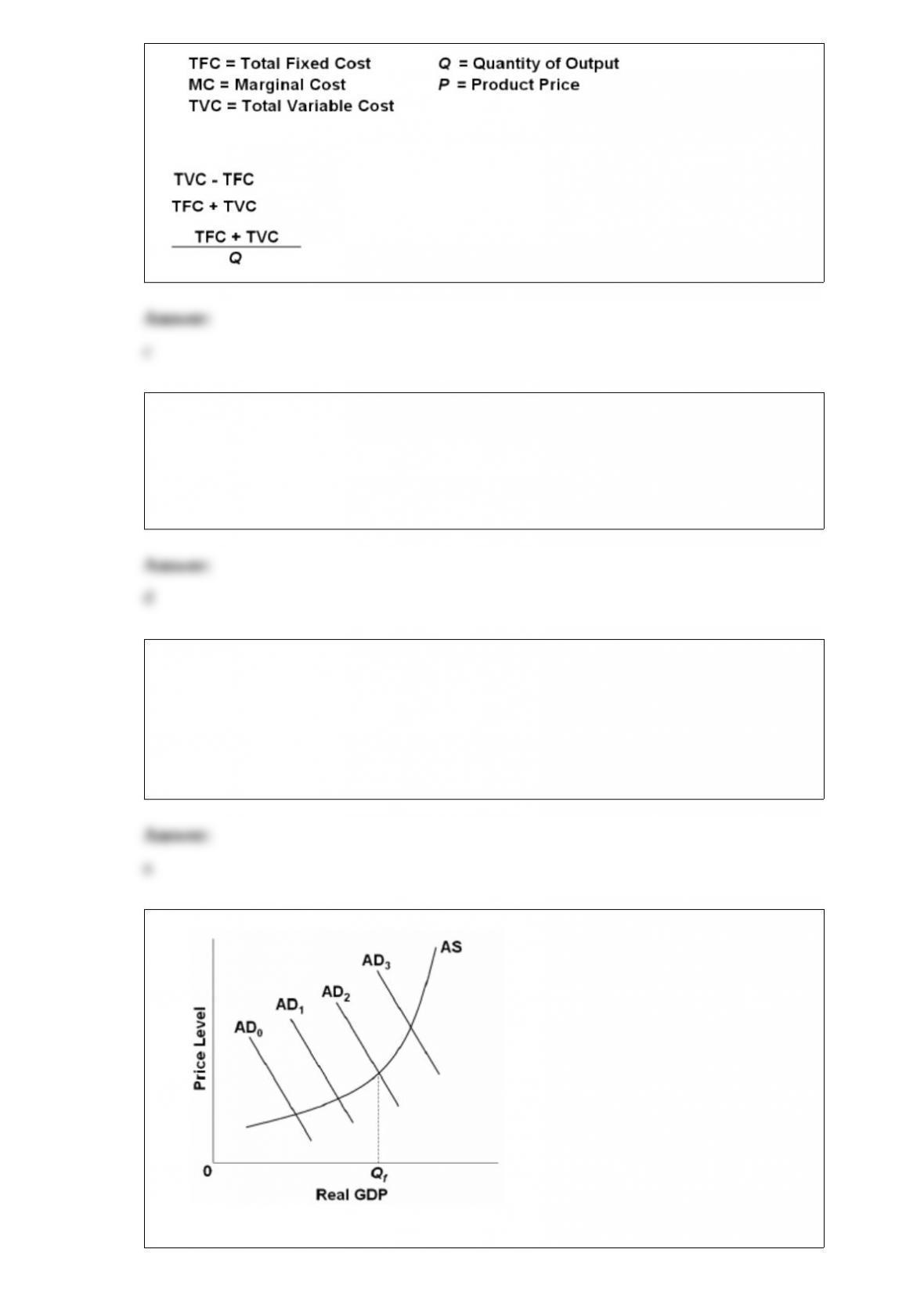
refer to the above information. total cost is:
a.the change in marginal cost.
b.
c.
d.
11) in the treatment of u.s. exports and imports, national income accountants:
a.subtract exports, but add imports, in calculating gdp.
b.subtract both exports and imports in calculating gdp.
c.add both exports and imports in calculating gdp.
d.add exports, but subtract imports, in calculating gdp.
12) the construction of demand and supply curves assumes that the primary variable
influencing decisions to produce and purchase goods is:
a.price.
b.expectations.
c.preferences.
d.incomes.
13)
Refer to the above diagram, in which Qf is the full-employment output. If the
economy’s current aggregate demand curve is AD0, it is experiencing:
A.a positive GDP gap.
B.a negative GDP gap.
C.inflation.
D.an adverse supply shock.
14) The retained earnings that corporations often use to finance R&D are also known
as:
A.venture capital.
B.undistributed corporate profits.
C.dividends.
D.mutual funds.
15) The fact that monopoly and monopsony exist in resource markets means that:
A.the marginal productivity theory of income distribution is valid.
B.resource prices need not accurately measure contributions to output.
C.the resulting income distribution is ethically correct.
D.income shares do not exhaust the total output.
16) A tariff can best be described as:
A.an excise tax on an imported good.
B.a government payment to domestic producers to enable them to sell competitively in
world markets.
C.an excise tax on an exported good.
D.a law that sets a limit on the amount of a good that can be imported.
17) The level of aggregate expenditures in a mixed open economy is comprised of:
A.Ca + Ig + Xn.
B.Ca + Ig + G + T + Xn.
C.Ca + Ig + Xn + G.
D.Ca + G.
18) In a mixed closed economy:
A.government purchases and saving are injections, while investment and taxes are
leakages.
B.taxes and government purchases are leakages, while investment and saving are
injections.
C.taxes and savings are leakages, while investment and government purchases are
injections.
D.taxes and investment are injections, while saving and government purchases are
leakages.
19) which of the following statements is correct?
a.supply is more elastic in the short run than in the long run.
b.demand is more elastic in the short run than in the long run.
c.demand is more elastic when a large number of substitute goods are available.
d.supply is more elastic when there are a small number of producers in the industry.
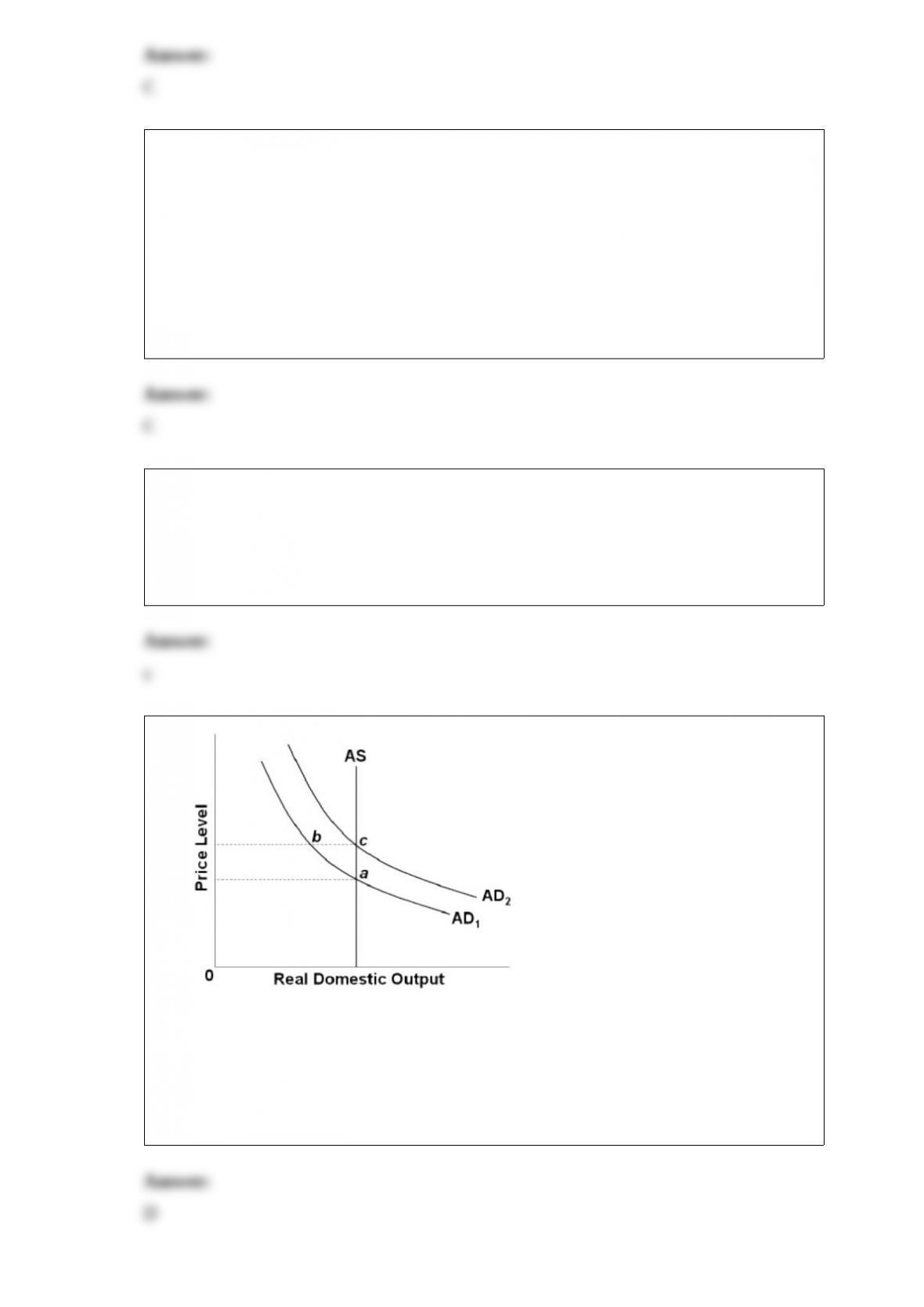
20)
Refer to the above diagram. Rational expectations theory says that a fully anticipated
decrease in aggregate demand from AD2 to AD1 will:
A.move the economy from a to b to c.
B.shift the AS curve to the left.
C.move the economy from c to new equilibrium b.
D.move the economy directly from c to a.