
In order for a firm to earn economic profits, price must exceed average total cost.
a. True
b. False
The national defense argument for trade protectionism holds that
a. what is good for business is good for the country.
b. what is good for consumers is good for the country.
c. consumers’ surplus rises by more than producers’ surplus falls.
d. producers’ surplus rises by more than consumers’ surplus falls.
e. none of the above
Exhibit 22-14
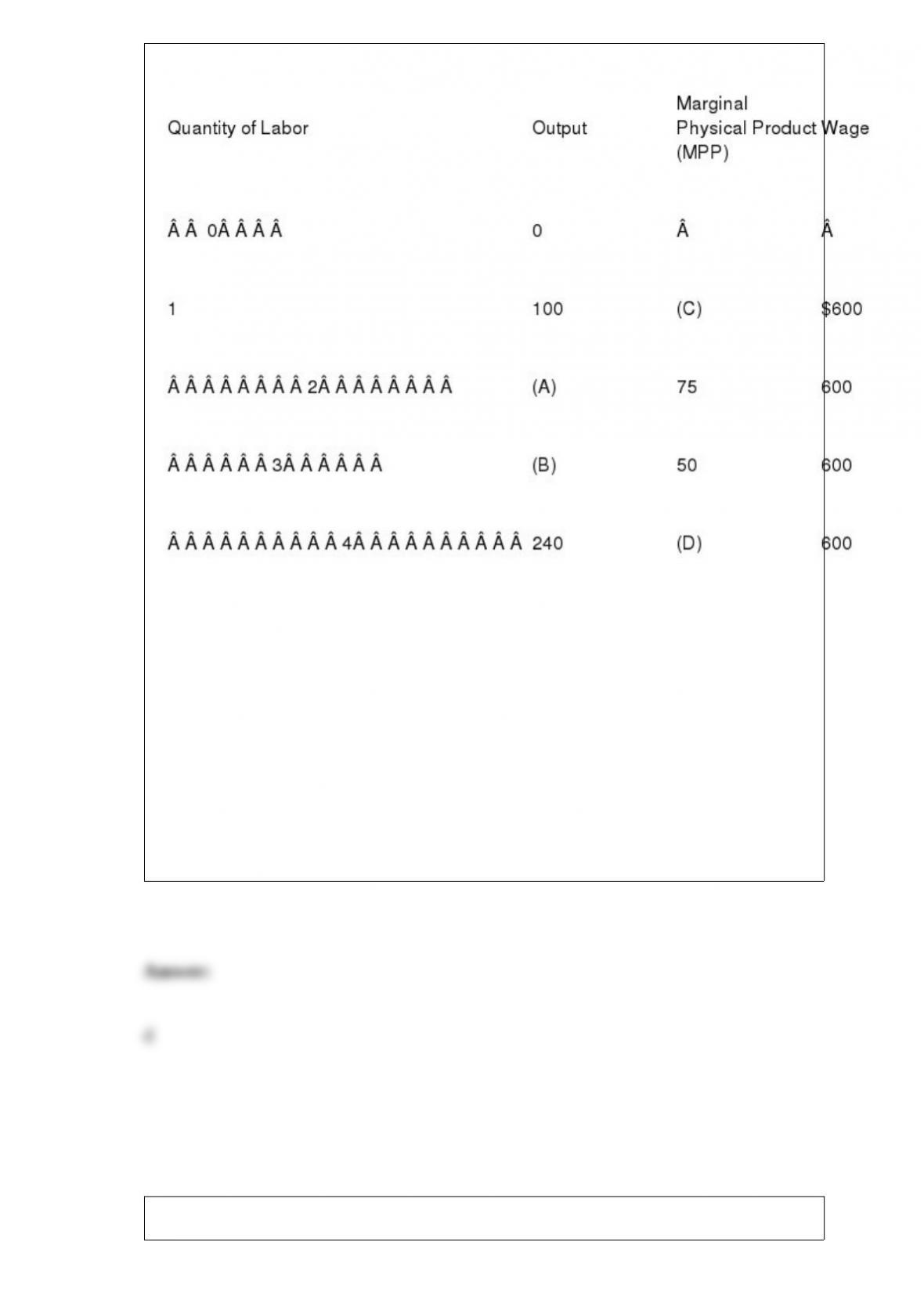
Assume that labor is the only variable input and that each additional laborer is paid
$600.
What is the MPP of the fourth unit of labor [blank (D)]?
a. 70 units
b. 60 units
c. 100 units
d. 15 units
For economic imperialists, economics is more of a method of analysis than a specific

field of study.
a. True
b. False
For each additional lamp produced, aconstant opportunity cost is incurredin terms of
bookshelves. This means
a. that it takes more resources to produce a lamp than a bookshelf.
b. that it takes fewer resources to produce a lamp than a bookshelf.
c. that for every lamp produced, a constant number of bookshelves is forfeited.
d. that for every lamp produced, a different number of bookshelves is forfeited.
“Dumping” refers to
a. the sale of goods abroad at a price below their cost and below the price charged in the
domestic market.
b. unloading of foreign goods on domestic docks.
c. government actions to remedy “unfair” trade practices.
d. buying goods at low prices in foreign countries and selling them at high prices in the
United States.
If MPPX/PX > MPPY/PY, the firm should buy
a. more of factor X and less of factor Y.
b. less of factor X and more of factor Y.
c. more of factor Y and the same amount of factor X.
d. less of factor X and factor Y.
e. more of factor X and factor Y.
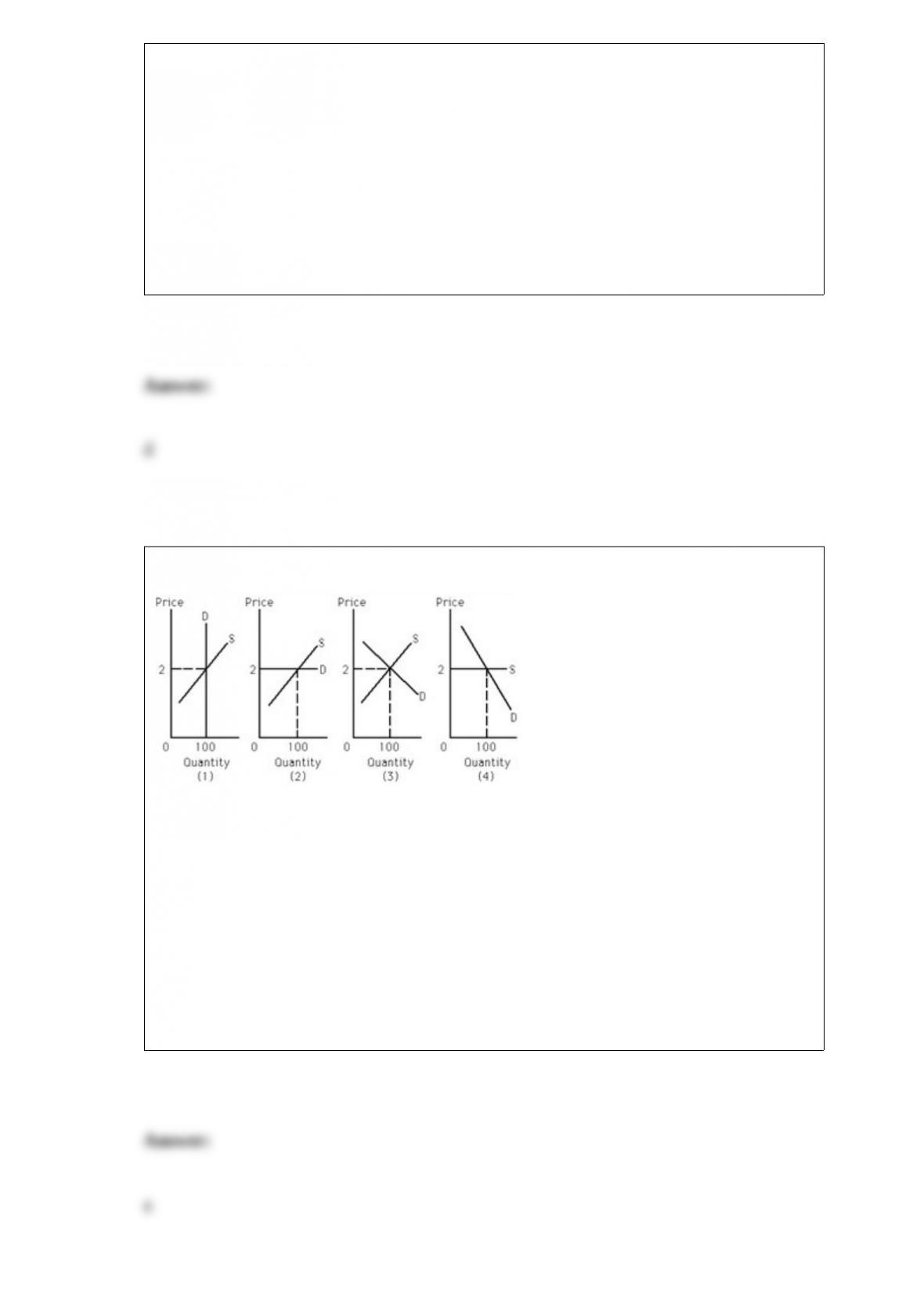
Exhibit 34-3
The world price is PW. If a tariff is imposed, the price rises to PW + T. Because of the
tariff, producers’ surplus is __________ by an amount equal to the area of __________.
a. increased; 1 + 2
b. decreased; 1
c. increased; 3 + 4
d. increased; 1
e. decreased; 3
Exhibit 20-7
As a producer, if you had a choice, which of the depicted markets would you operate
in?
a. (1)
b. (2)
c. (3)
d. (4)
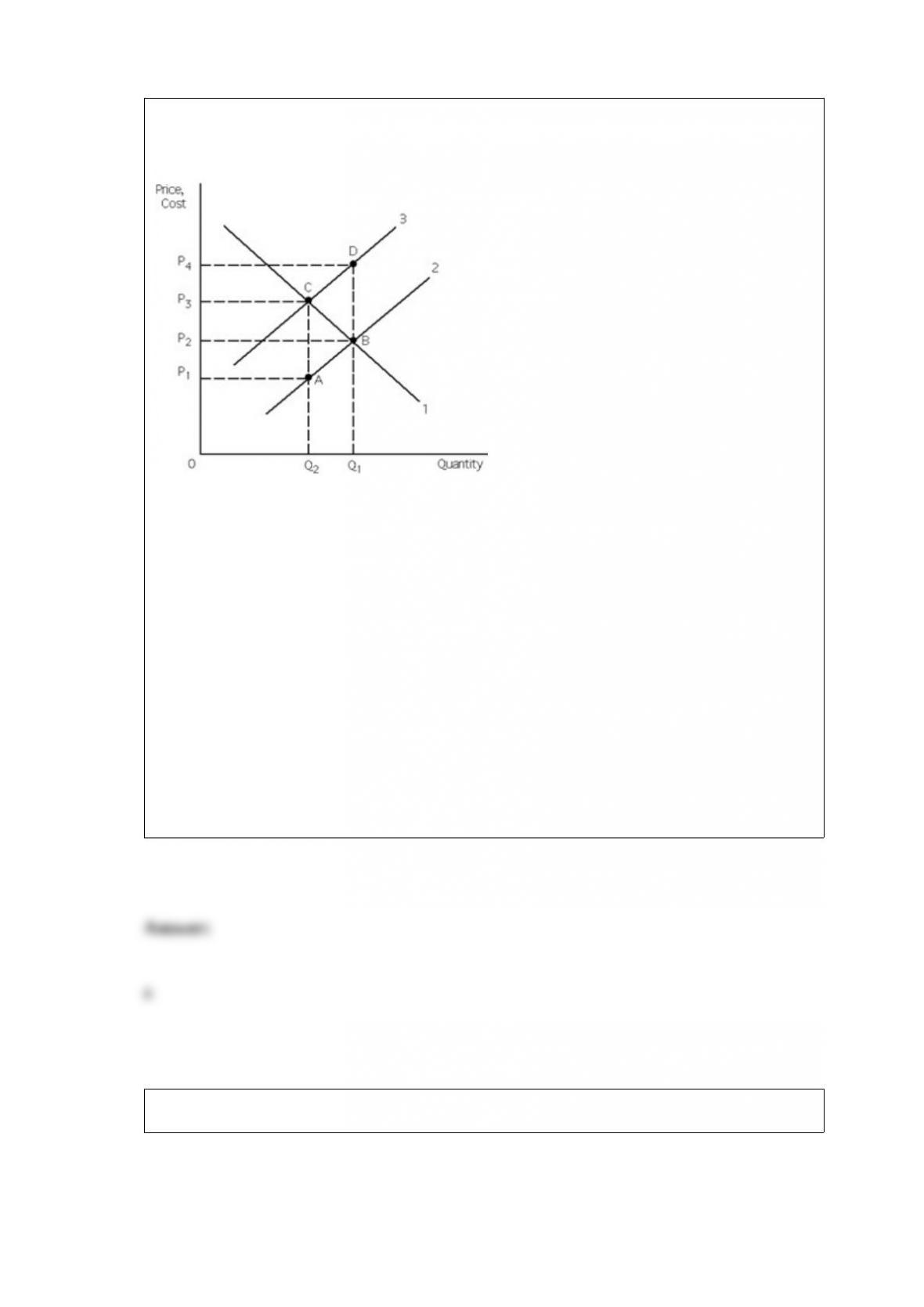
Exhibit 31-4
If a negative externality exists, then the external costs associated with the negative
externality equal the distance between points __________, and the socially optimal
output is __________.
a. A and C; Q2
b. D and B; Q1
c. C and B; Q2
d. A and B; Q2
e. none of the above
Exhibit 21-7
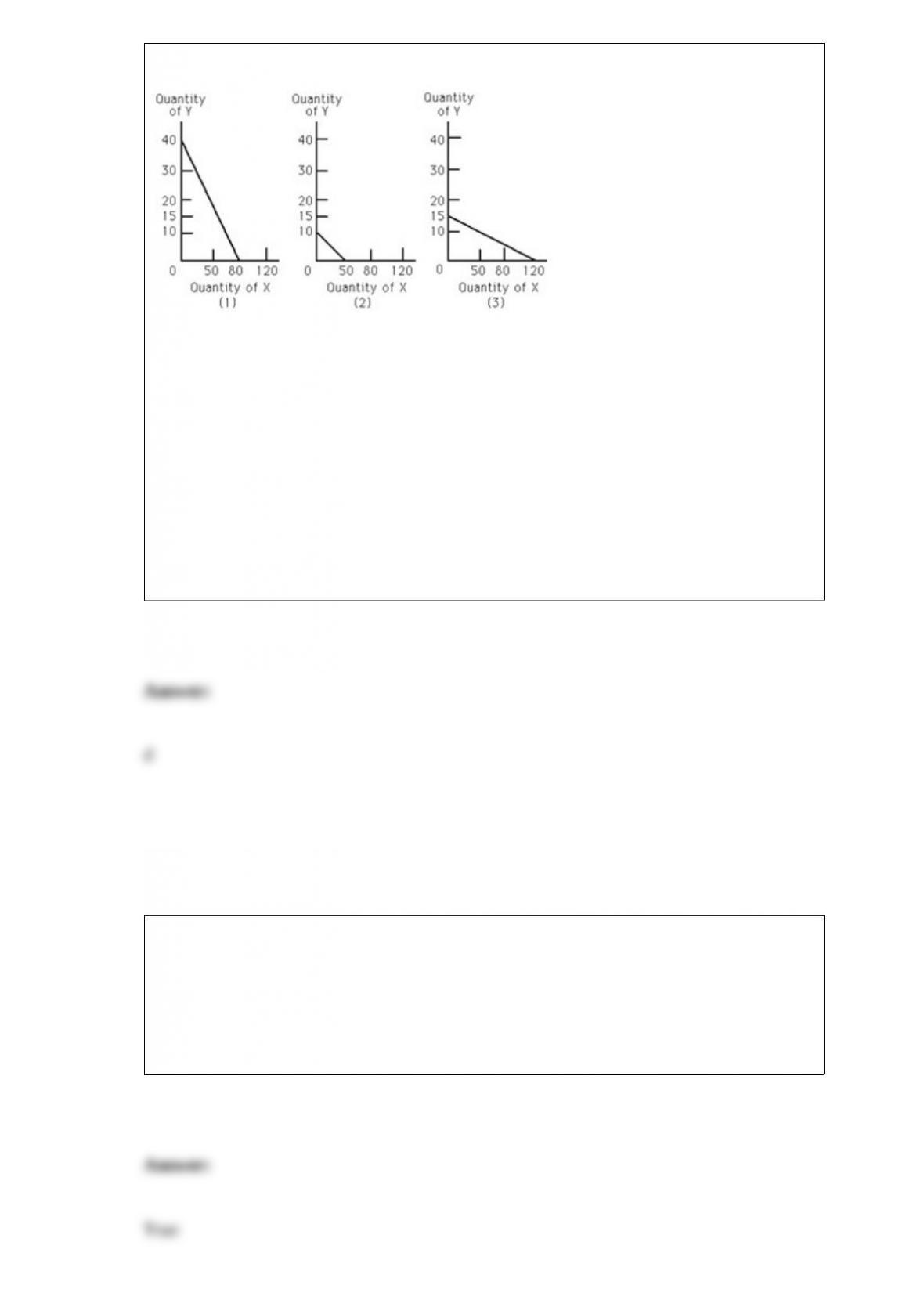
For graph (3), if the price of Y is $200, the price of X is
a. $50.
b. $40.
c. $30.
d. $25.
e. $15.
The major way that the government supports crop prices is by granting nonrecourse
loans to farmers.
a. True
b. False

An increase in productivity in the agricultural sector when the demand curve is inelastic
results in __________ prices for consumers and __________ revenues for farmers
a. higher; lower
b. higher; higher
c. lower; lower
d. lower; higher
e. no change in; no change in
A decreasing-cost industry is characterized by
a. an upward-sloping long-run supply curve.
b. a downward-sloping long-run supply curve.
c. a perfectly elastic long-run supply curve.
d. perfectly elastic short-run and long-run supply curves.
e. a perfectly elastic short-run supply curve and an upward-sloping long-run supply
curve.
In long-run competitive equilibrium SRATC = LRATC, because if SRATC > LRATC

(at the quantity of output at which MR = MC) firms would
a. have an incentive to change their plant size to produce their current output.
b. not be covering their total fixed costs.
c. not be covering their total variable costs.
d. a and b
e. b and c
Marginal revenue product (MRP) is
a. equal to marginal revenue multiplied by marginal physical product.
b. the additional revenue generated by employing an additional factor unit.
c. the additional output generated by employing an additional factor unit.
d. a and b
e. a and c
If workers can do the work in both the unionized sector and the nonunionized sector,
then an increase in the wage rate paid in the unionized sector (relative to the wage rate
paid in the nonunionized sector), which is brought about by a permanent leftward shift
in the labor supply curve, will lead to
a. an increase in the supply of labor in the nonunionized sector and lower wages in that

sector.
b. an increase in the supply of labor in the unionized sector and lower wages in that
sector.
c. no change in the supply of labor in either of the sectors mentioned.
d. an increase in the supply of labor in the unionized sector and even higher wages in
that sector.
e. There is not enough information to answer the question.
At college X and at college Y, students pay $3,000 less than the equilibrium tuition. If
the supply of openings is the same at both colleges, it follows that a shortage of
openings will be greater at
a. college X than college Y.
b. college X than the surplus at college Y.
c. college Y than the surplus at college X.
d. college X than college Y if the demand is greater at college X.
e. college X than college Y if the demand is less at college X.
If the supply of and demand for a product decrease at the same time, then equilibrium
a. quantity and equilibrium price must both decline.

b. quantity must decline, but equilibrium price may either rise, fall, or remain
unchanged.
c. price must fall, but equilibrium quantity may either rise, fall, or remain unchanged.
d. quantity must fall and equilibrium price must rise.