
Suppose your expenses for this term are as follows: tuition: $28,000, room and board:
$9,000, books and other educational supplies: $2,500. Further, during the term, you can
only work part-time and earn $16,000 instead of your full-time salary of $42,000. What
is the opportunity cost of going to college this term, assuming that your room and board
expenses would be the same even if you did not go to college?
A) $36,500
B) $56,500
C) $65,500
D) $72,500
What is the dominant strategy in a second-price auction?
A) bidding below one’s true value
B) bidding above one’s true value
C) bidding one’s true value
D) There is no dominant strategy.
If a decrease in income leads to in a decrease in the demand for ice cream, then ice
cream is
A) a normal good.
B) a neutral good.
C) a complement.
D) a necessity.
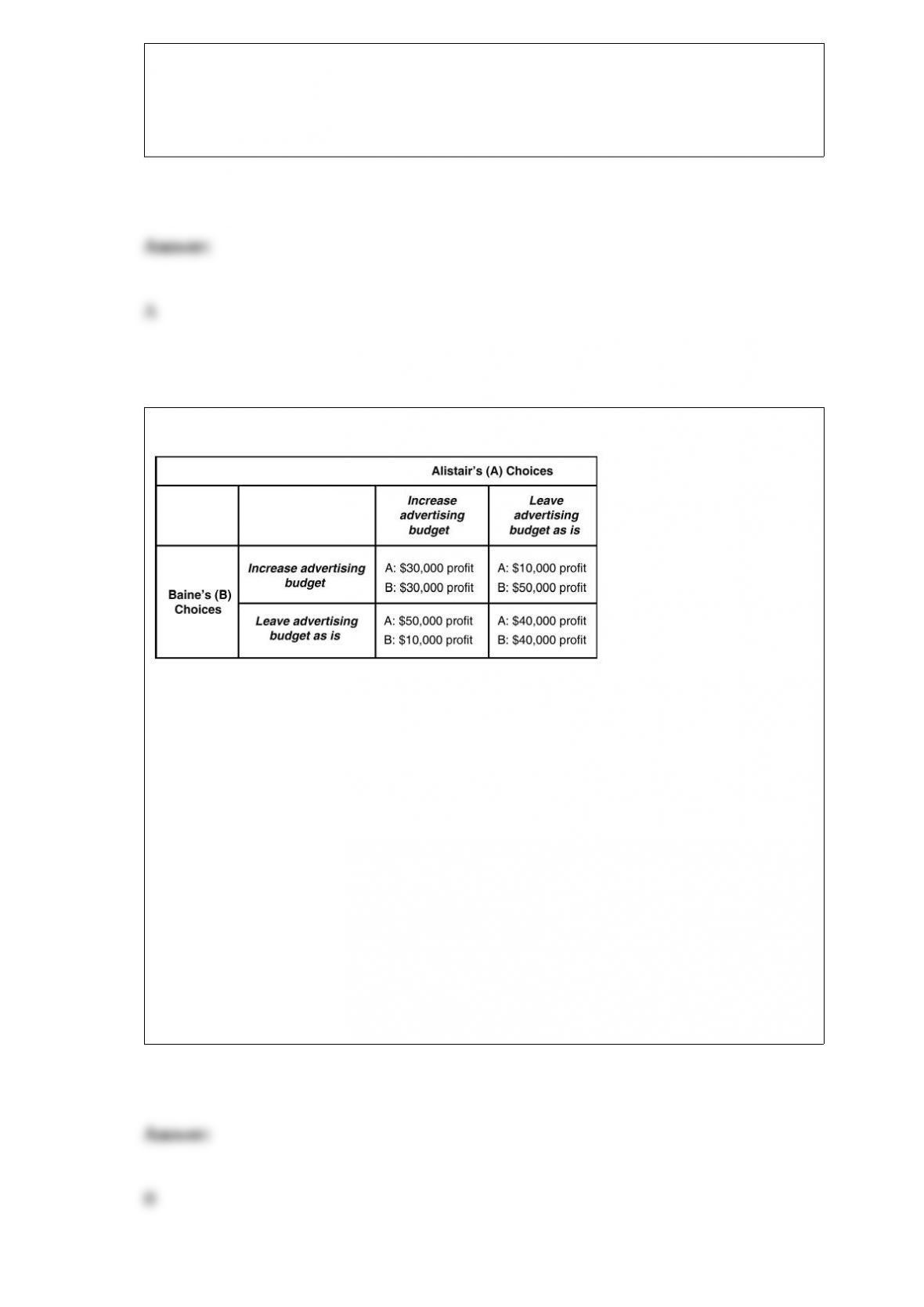
Table 14-4
Alistair Luggage and Baine
Baggage are the only firms selling luggage in the upscale town of Montecito. Each firm
must decide on whether to increase its advertising spending to compete for customers.
If one firm increases its advertising budget but the other does not, then the firm with the
higher advertising budget will increase its profit. Table 14-4 shows the payoff matrix
for this advertising game. If Alistair assumes that Baine would increase its advertising
budget, what should it do?
A) Alistair should keep its own budget the same and allow Baine to incur the higher
cost.
B) Alistair should also increase its advertising spending.
C) Alistair should reduce its advertising spending.
D) Being a duopolist, Alistair is not affected by Baine’s choices because it has a secure
50 percent market share.

In 2008, Timothy Geithner referred to investment banks, money market mutual funds,
hedge funds, and other financial firms engaged in similar activities as the
A) shadow banking system.
B) commercial banking system.
C) securitization market.
D) secondary market.
Which of the following is not a characteristic of monopolistic competition?
A) Firms are price takers.
B) There are many buyers and sellers.
C) Barriers to entry are low.
D) Firms sell similar, but not identical, products.
Many firms use technology to gather information on the preferences of consumers and
their responses to changes in prices. This information is then used to adjust prices of the
firms’ goods and services. This practice is called
A) price discovery.

B) empirical research.
C) yield management.
D) econometrics.
Consider three pricing strategies that the firm can pursue:
a. optimal two-part tariff pricing
b. perfect price discrimination
c. single-price monopoly pricing Of these three strategies, which method gives the firm
the highest profit?
A) optimal two-part tariff pricing
B) perfect price discrimination
C) single-price monopoly pricing
D) The profit is the same under optimal two-part tariff pricing and perfect price
discrimination and the profit is higher than under single-price monopoly pricing.
Today, Walt Disney World charges different customers different prices for admission.
This pricing strategy is called
A) arbitrage.
B) odd pricing.

C) cost-price pricing.
D) price discrimination.
In June, buyers of titanium expect that the price of titanium will fall in July. What
happens in the titanium market in June, holding everything else constant?
A) The demand curve shifts to the right.
B) The quantity demanded increases.
C) The quantity demanded decreases
D) The demand curve shifts to the left.
During the German hyperinflation of the 1920s, the large increases in the money supply
were generated by the German government
A) significantly lowering the required reserve ratio to enable German businesses to
obtain loans.
B) significantly raising the required reserve ratio to reduce business loans.
C) printing large quantities of German marks.
D) selling large quantities of government bonds to the central bank, the Reichsbank.