
The price elasticity of supply is calculated as the change in supply divided by the
change in price.
The GDP deflator is the best measure that reflects the prices of goods and services
purchased by the typical household.
The income effect of a price change refers to the change in the quantity demanded of a
good that results from a change in the price of a complementary product.
Nominal income is equal to real income if the CPI is less than 100.

A normal good is a good for which the demanded increases as income decreases,
holding everything else constant.
At a long-run macroeconomic equilibrium, real GDP is always equal to potential GDP.
A quota is the same as a voluntary export restraint.
Moral hazard refers to the actions people take after they have entered into a transaction
that make the other party to the transaction worse off.

The unemployment rate is higher with a minimum wage law than it would be without a
minimum wage law.
If it costs Vijay $150 to design 5 websites and $175 to design 6 websites, then $175 is
the marginal cost of producing the 6th Websites.
Your income will increase if the Federal Reserve buys a Treasury bill from you and
pays you with a check from the Fed.
Which of the following would result in GDP for an economy equal to $10 trillion?
A) C = $6 trillion
I = $2 trillion
G = $1.5 trillion
NX = -$2 trillion

B) C = $7 trillion
I = $2 trillion
G = $4 trillion
NX = $3 trillion
C) C = $5 trillion
I = $5 trillion
G = $2 trillion
NX = -$2 trillion
D) C = $4 trillion
I = $3 trillion
G = $2 trillion
NX = -$1 trillion
A financial security that represents a promise to repay a fixed amount of funds is a
A) share of stock.
B) coupon.
C) dividend.
D) bond.

On a balance sheet
A) total assets must equal total liabilities plus equity.
B) total assets plus equity must equal total liabilities.
C) total assets plus total liabilities must equal zero.
D) total assets plus total liabilities plus equity must equal zero.
Article Summary. Concerned about slow economic growth, the Fed announced in
September 2013 that it would postpone winding down its $85 billion a month bond
purchasing program which has been a key component of its monetary stimulus
package. Fed Chairman Ben Bernanke would not commit to a timeline for
reducing the bond purchases, stating that the program was “not on a preset
course.” The Fed’s forecasts of economic growth have been lowered for 2013 and
2014, and the Fed does not expect to raise interest rates until 2015. Since late 2008,
the Fed has held its benchmark interest rate near zero, while its balance sheet has
tripled to more than $3.6 trillion. The Fed also stated that so long as inflation did
not become a threat, it would not raise interest rates until the unemployment rate
dropped to 6.5 percent. At the time of the announcement, the unemployment rate
was 7.3 percent.
Source: Pedro da Costa and Alister Bull, “Fed Surprises, sticks to stimulus as it
cuts growth outlook,” Reuters, September 18, 2013.
When the Fed announced it did not expect to raise its benchmark interest rate until
2015, it was referring to the
A) prime rate.
B) federal funds rate.
C) long-term real rate of interest.
D) required reserve rate.

Article Summary. Cuba has announced its intentions to end its dual currency
system which has been in place since 1994. Presently, Cuba has two official
currencies, the national peso (CUP) and the convertible peso (CUC). The national
peso is the currency used by most businesses and citizens, and the convertible peso
was designed to be used primarily in the tourism industry and for foreign trade.
The coveted convertible peso is pegged to the U.S. dollar and is worth 25 times the
national peso, despite the government treating them as having equal value in
official accounts, trading on a one-for-one basis for official state entities. Few
Cubans other than those with government ties have access to convertible pesos,
which allows them to enjoy a much improved lifestyle due to the currency’s
relative value. One exception is people working in the tourist-centered hospitality
industries, such as waiters and hotel staff, who receive convertible pesos as tips,
often earning them more than medical and legal professionals who are paid in
national pesos. The currency unification is expected to be a gradual process, taking
up to 18 months, and could involve both a devaluing of the convertible peso and a
revaluing of the national peso.
Source: Hannah Strange, “Cuba to end dual currency as part of Castro’s
economic reforms,” Telegraph, October 22, 2013.
The convertible peso (CUC), which is pegged to the U.S. dollar, is worth 25 times the
national peso, yet Cuban officials treat the convertible peso and the national peso as
being of equal value. This indicates that the national peso is ________ compared to the
convertible peso, and would need to be ________ to for the two currencies have equal
value in the marketplace.
A) undervalued; revalued
B) undervalued; devalued
C) overvalued; revalued
D) overvalued; devalued

Table 9-6
Consider the following values of the consumer price index for 1996, 1997, and 1998:
The inflation rate for 1997 was equal to
A) 1.2 percent.
B) 2.0 percent.
C) 2.5 percent.
D) 4.0 percent.
Where does the short-run Phillips curve intersect the long-run Phillips curve?
A) at the point where the rate of inflation and the unemployment rate are equal
B) at the natural rate of inflation
C) at the point where actual inflation is equal to expected inflation
D) There is no intersection between the short-run and long-run Phillips curves.

How does the decreasing use of traditional cameras affect the market for traditional
camera film?
A) The demand curve for traditional camera film shifts to the right.
B) The quantity of traditional camera film demanded decreases.
C) The quantity of traditional camera film demanded increases.
D) The demand curve for traditional camera film shifts to the left.
Clarissa Kessler operates a store that sells recorded music. Her business suffered
tremendously when a giant discount store chain opened a store in the area and is able to
sell its products for less than Clarissa’s wholesale cost. Is this evidence of illegal price
discrimination on the part of the discount store chain?
A) Yes, it is clearly a violation of the Robinson-Patman Act.
B) No, because it can be argued that the discount store chain is justified in charging
lower prices because it is a large-volume buyer and is able to purchase recorded music
at a lower wholesale price than Clarissa.
C) Yes, the discount store chain is engaging in predatory pricing.
D) No, even if the price discrimination is based on differences in cost, the law states
that it is not illegal.

The income elasticity of demand measures
A) the responsiveness of quantity demanded to changes in income.
B) how a consumer’s purchasing power is affected by a change in the price of a product.
C) the percentage change in the price of a product divided by the percentage change in
consumer income.
D) the income effect of a change in price.
In economics, the difference between a firm’s revenues and its costs is referred to as
A) physical capital.
B) profit.
C) capital gains.
D) factor payments.
The current account deficits incurred by the United States in the 1980s were caused, in
the opinion of many economists, by
A) federal budget deficits.
B) “flight to quality” as foreign investors favored U.S. investments.
C) a sharp decline in private saving.

D) Both B and C are correct.
Airlines often engage in last-minute price cutting to fill remaining empty seats on a
flight because this practice will generally
A) prevent rival airlines from competing in that market.
B) increase marginal revenue more than marginal cost.
C) maximize marginal revenue.
D) discourage rivals from matching price cuts.
The combined effect (both income and substitution) of a wage increase is that
A) the substitution effect always dominates, leading to more work at a higher wage.
B) the income effect always dominates, leading to less work at a higher wage.
C) if the substitution effect outweighs the income effect, the labor supply curve slopes
upward, but if the income effect outweighs the substitution effect, the labor supply
curve is backward bending.
D) if the substitution effect outweighs the income effect, the labor supply curve is
backward bending, but if the income effect outweighs the substitution effect, the labor
supply curve slopes upward.
Are the costs of utilities always fixed, always variable, or can they be both? Briefly
explain.
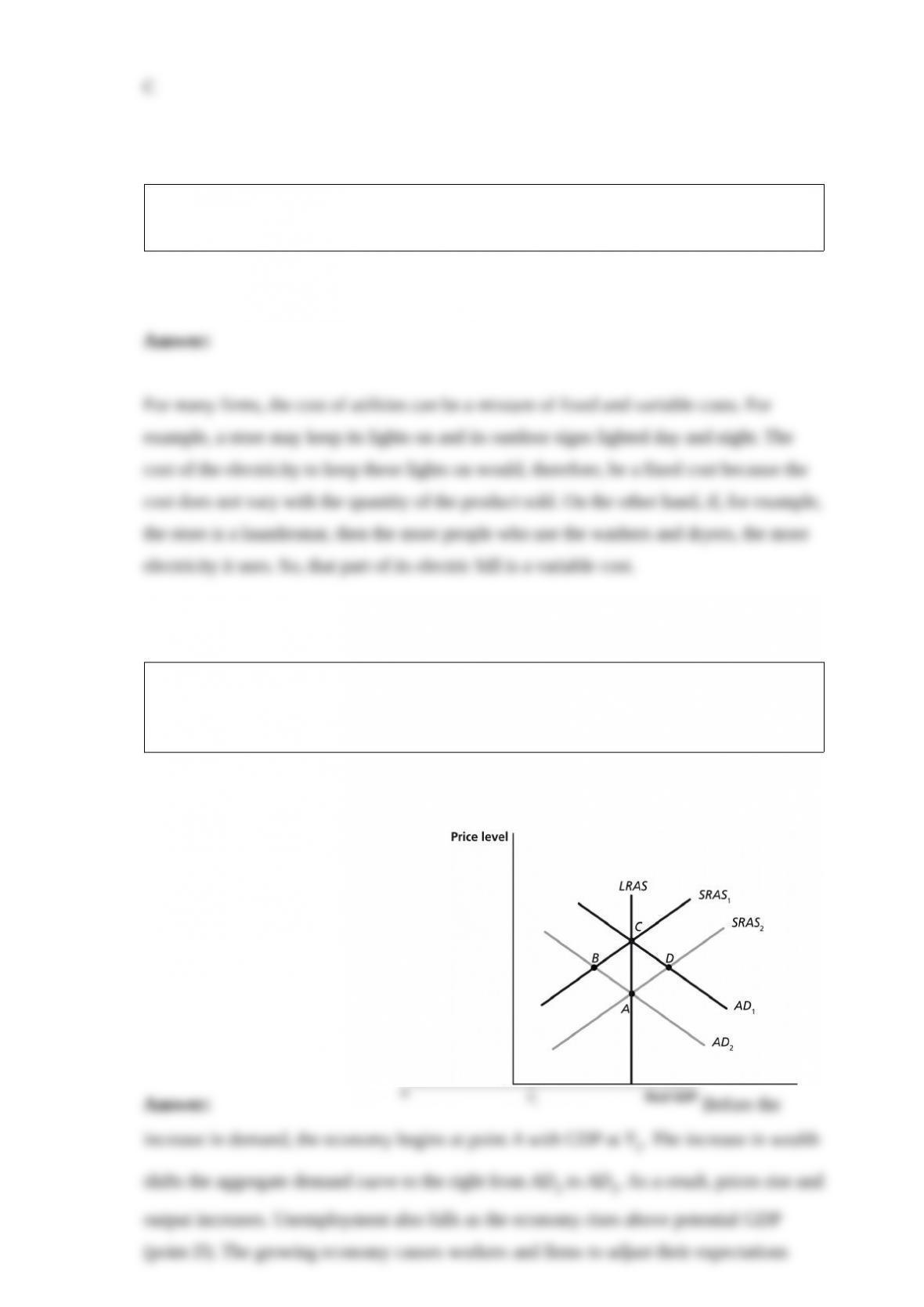
Starting from long-run equilibrium, use the basic aggregate demand and aggregate
supply diagram to show what happens in both the long run and the short run when there
is an increase in wealth.
Suppose that if a local McDonald’s restaurant reduces the price of a Big Mac from
$4.00 to $3.25, the number of Big Macs it sells per day will increase from 4 to 5.
Explain the output effect and the price effect resulting from this change. Using a graph,
illustrate both the loss in revenue from selling each of the first 4 Big Macs for $0.75
less and the additional revenue from selling 1 more Big Mac. What is the total change
in revenue received which results from this price decrease?
How is the impact of expansionary monetary policy different in an open economy than
in a closed economy?
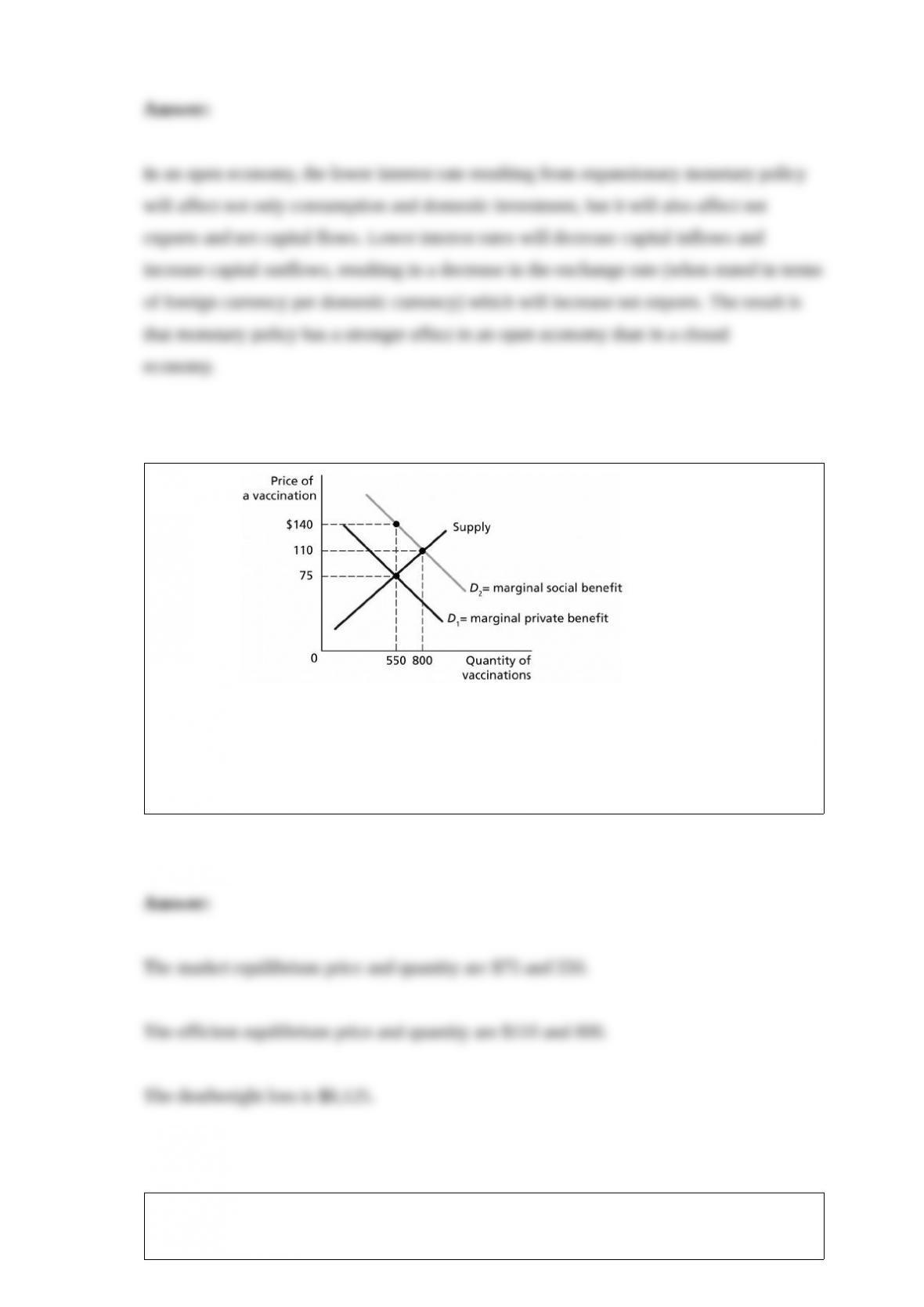
Figure 7-3 Figure 7-3 shows the
effect of a positive externality on the market for vaccinations.
On the above graph, identify the market equilibrium price and quantity, the efficient
equilibrium price and quantity, and the value of the deadweight loss resulting from too
few people receiving vaccinations.
Explain the meaning of the word “convergence” in the context of economic growth and
standards of living.
How have U.S. imports and exports, as a fraction of GDP, changed from 1970 to the
present?
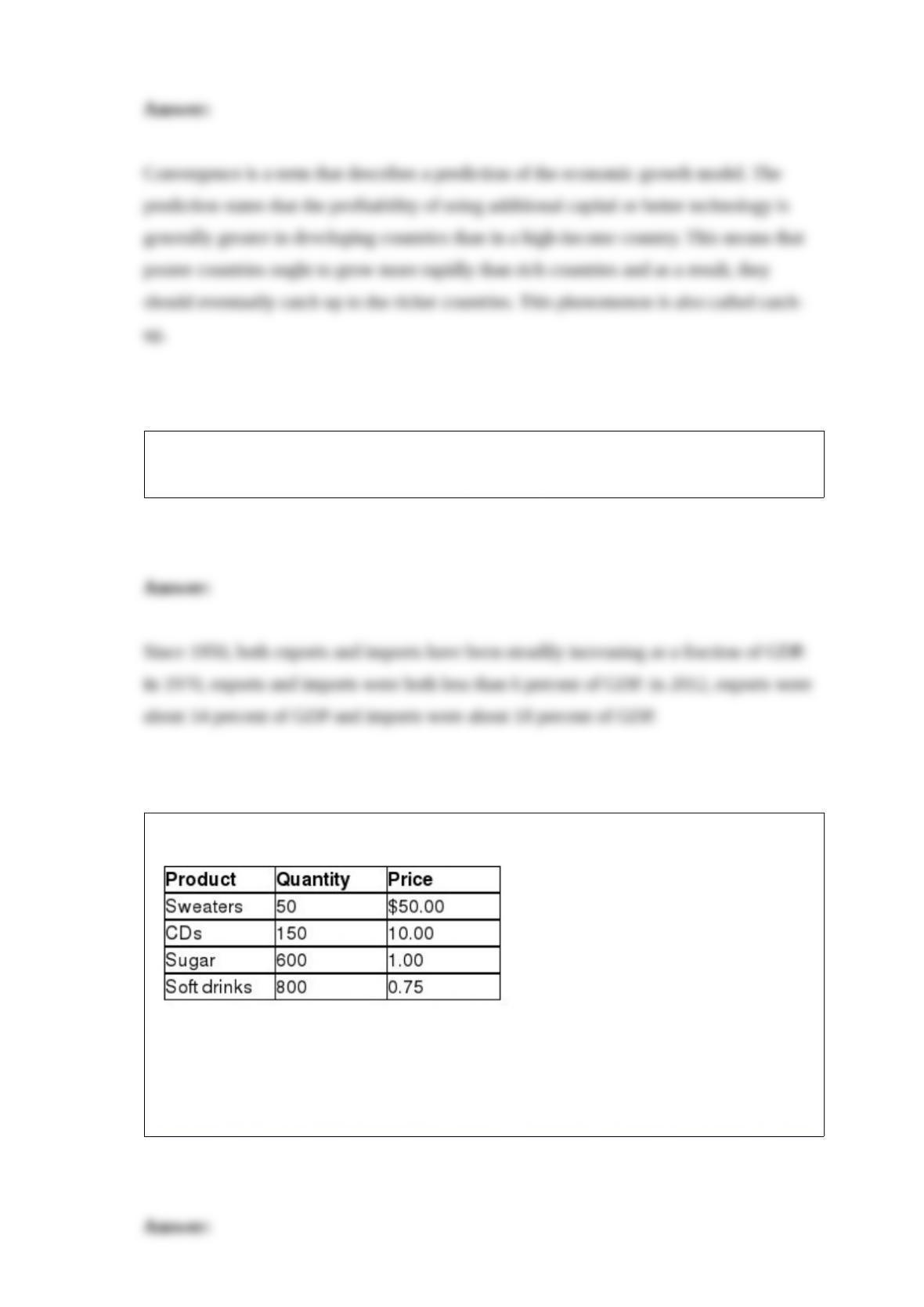
Table 8-8
Suppose that a simple economy produces only four goods and services: sweaters, CDs,
sugar, and soft drinks. Assume one half of the sugar is used in making the soft drinks
and the other half of the sugar is purchased by households. Calculate nominal GDP for
this simple economy.
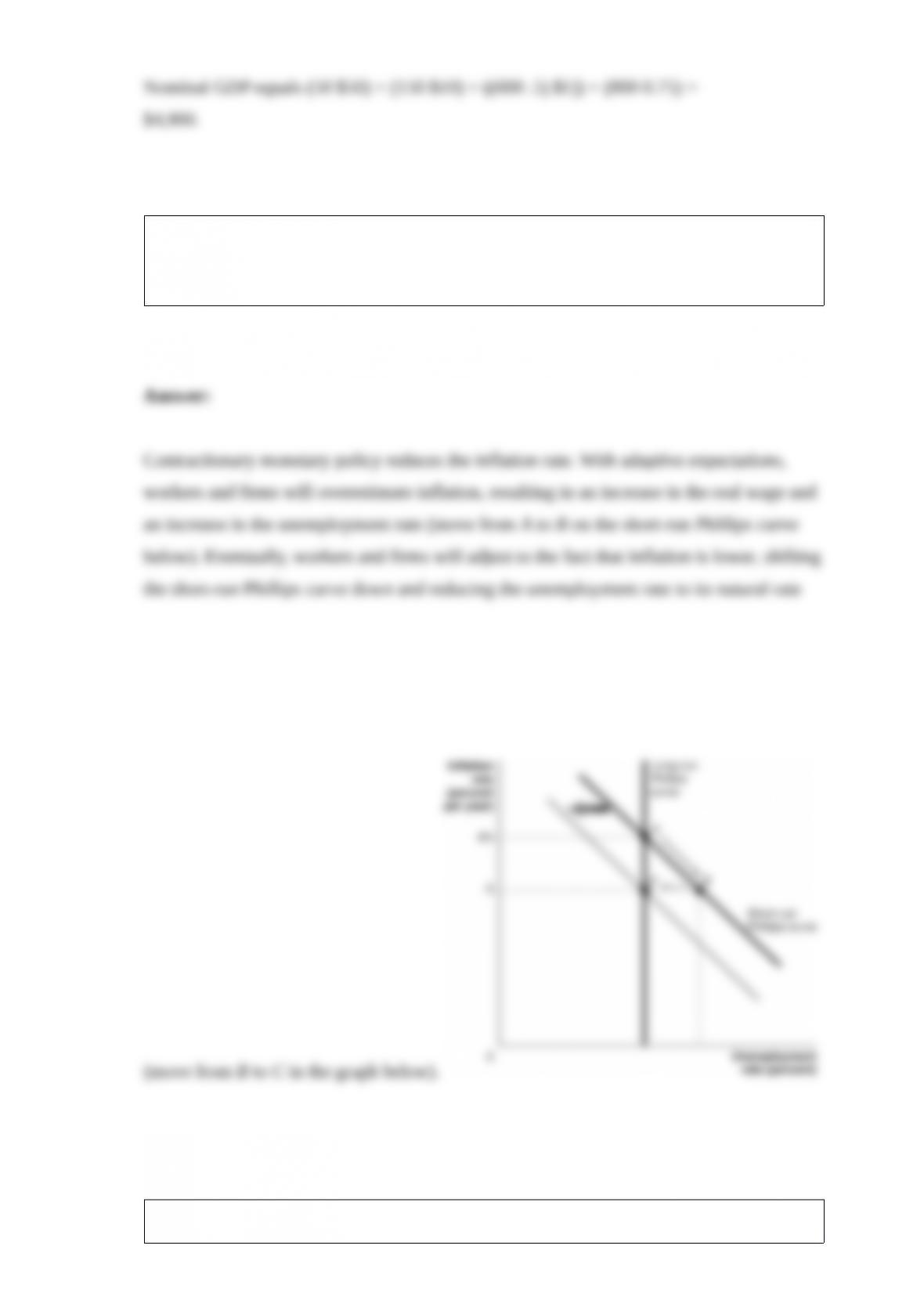
If expectations are adaptive, how will the economy adjust to a new long-run
equilibrium in response to contractionary monetary policy? Support your answer with a
graph of the Phillips curve.
You review a salesman’s income over a 5-year period. You note it fluctuates
tremendously from year to year, yet his consumption of goods and services remains
consistently at the same level, year after year. Does this mean that income is not a
determinant of consumption, or could something else explain his behavior?