1) The benefits-received principle of taxation is used to support corporate and personal
income taxes.
2) although sleeping in on a work day or school day has an opportunity cost, sleeping
late on the weekend does not.
3) the purchase of wal-mart stock is a part of gross investment, but not of net
investment.
4) proponents of economic growth claim that rising living standards can lead to
environmental improvements as people can afford to care more about the environment.
5) Non-renewable natural resources are fixed in supply.
6)
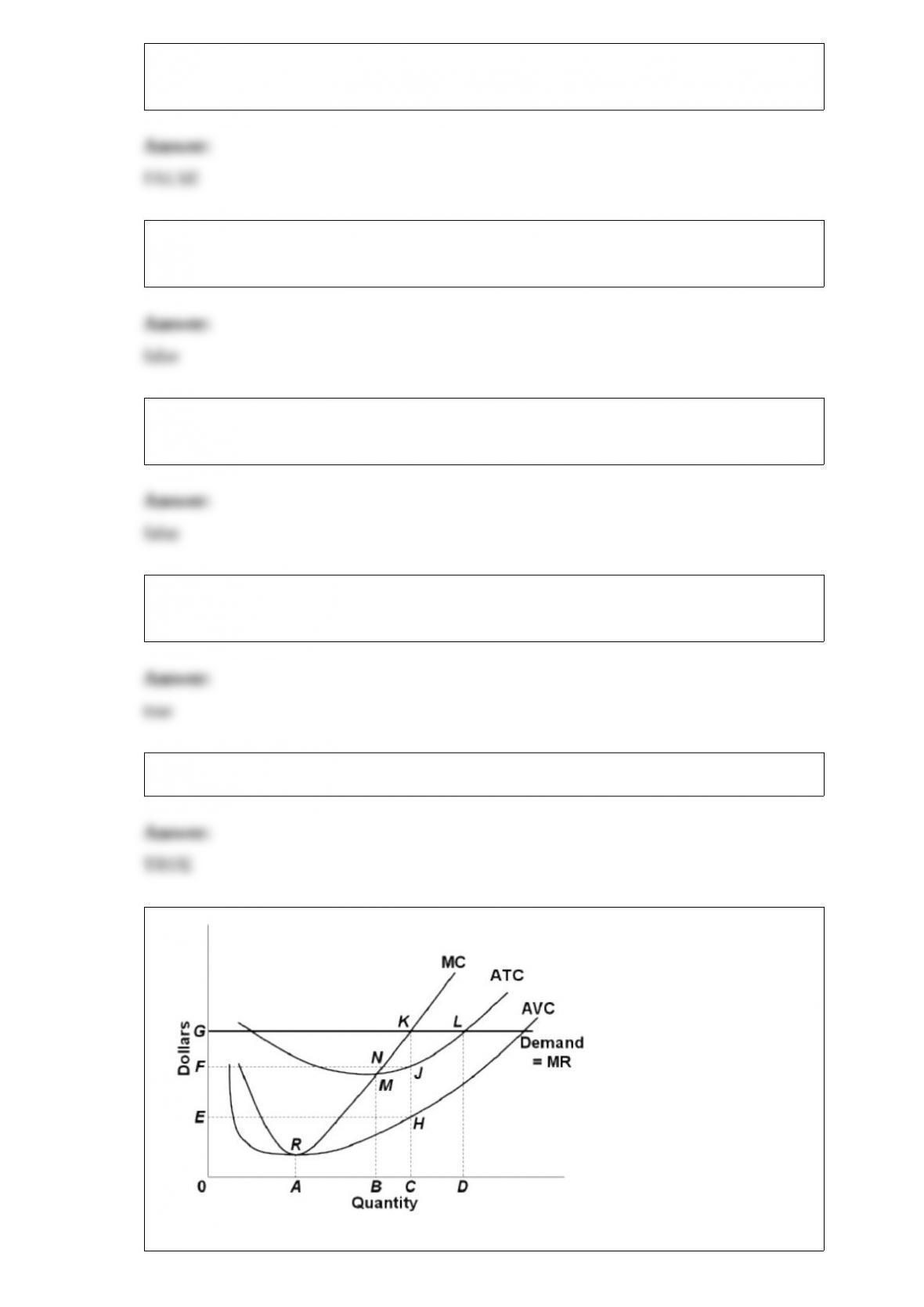
refer to the above diagram. total costs are minimized at output level b.
7) Monetarists say the velocity of money is highly variable and there is no close link
between the money supply and the level of economic activity.
8) Inclusive unions restrict the number of jobs directly by shifting the labor supply
curve to the left; exclusive unions restrict the number of jobs by imposing
above-equilibrium wage rates on the employer.
9) The U.S. poverty rate for the elderly (65 and over) is higher than for the general
population.
10) The greater the upward slope of the AS curve, the larger is the realized multiplier
effect of a change in investment spending.
11)
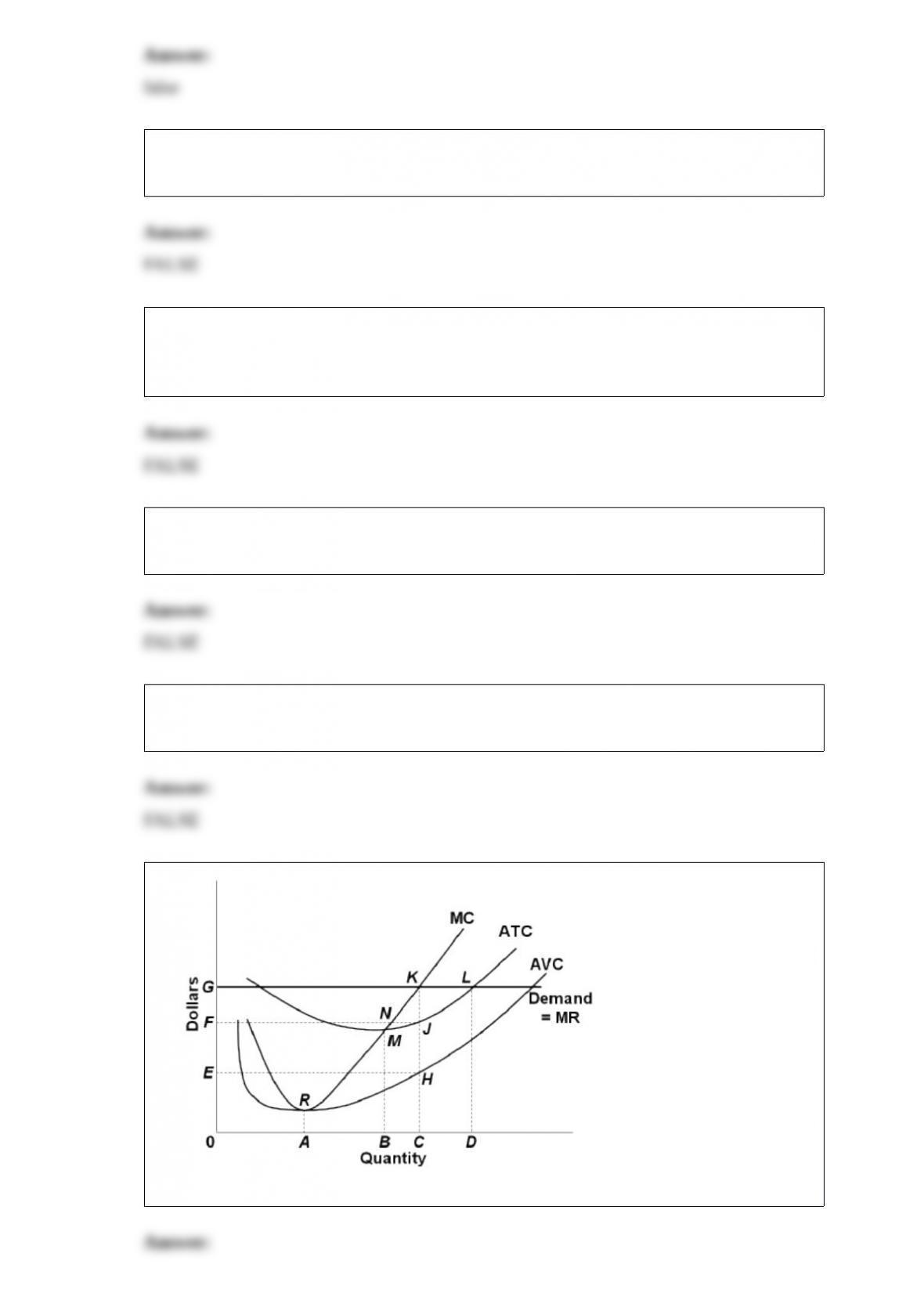
refer to the above diagram. at output c total variable cost is fgkj.

12) A fishery is a stock of fish or other marine animal thought of as a logically distinct
group, and usually identified by its location and species.
13) Budget surpluses from 1998 to 2001 gave way to deficits because a recession
reduced tax revenues.
14) Diffusion is the first successful commercial introduction of a product, the use of a
new method, or the creation of new form of business enterprise.
15) The United States has experienced both budget surpluses and deficits over the past
decade.
16) which of the following is correct?
a.budget lines are linear and upsloping; indifference curves are downsloping and
concave to the origin.
b.budget lines are linear and downsloping; indifference curves are downsloping and
concave to the origin.
c.budget lines are linear and downsloping; indifference curves are downsloping and
convex to the origin.
d.budget lines are downsloping and convex to the origin; indifference curves are linear
and downsloping.
17) a purely competitive seller’s average revenue curve coincides with:
a.its marginal revenue curve only.
b.its demand curve only.
c.both its demand and marginal revenue curves.
d.neither its demand nor its marginal revenue curve.
18) in the short run a purely competitive firm will maximize profit by producing that
output at which:
a.total revenue exceeds total cost by a maximum amount.
b.total revenue exceeds total cost by a minimum amount.
c.total revenue and total cost are equal.
d.total fixed cost equals total variable cost.
19) economists would describe the u.s. automobile industry as:
a.purely competitive.
b.an oligopoly.
c.monopolistically competitive.
d.a pure monopoly.
20) The legal cartel theory of regulation argues that:
A.regulation encourages firms to inflate their production costs.
B.firms in certain industries want to be regulated rather than face the rigors of
competition.
C.social regulation has been carried beyond the point at which marginal benefits and
marginal costs are equal.
D.the government is the logical agency to protect consumers from natural monopolies.
21)

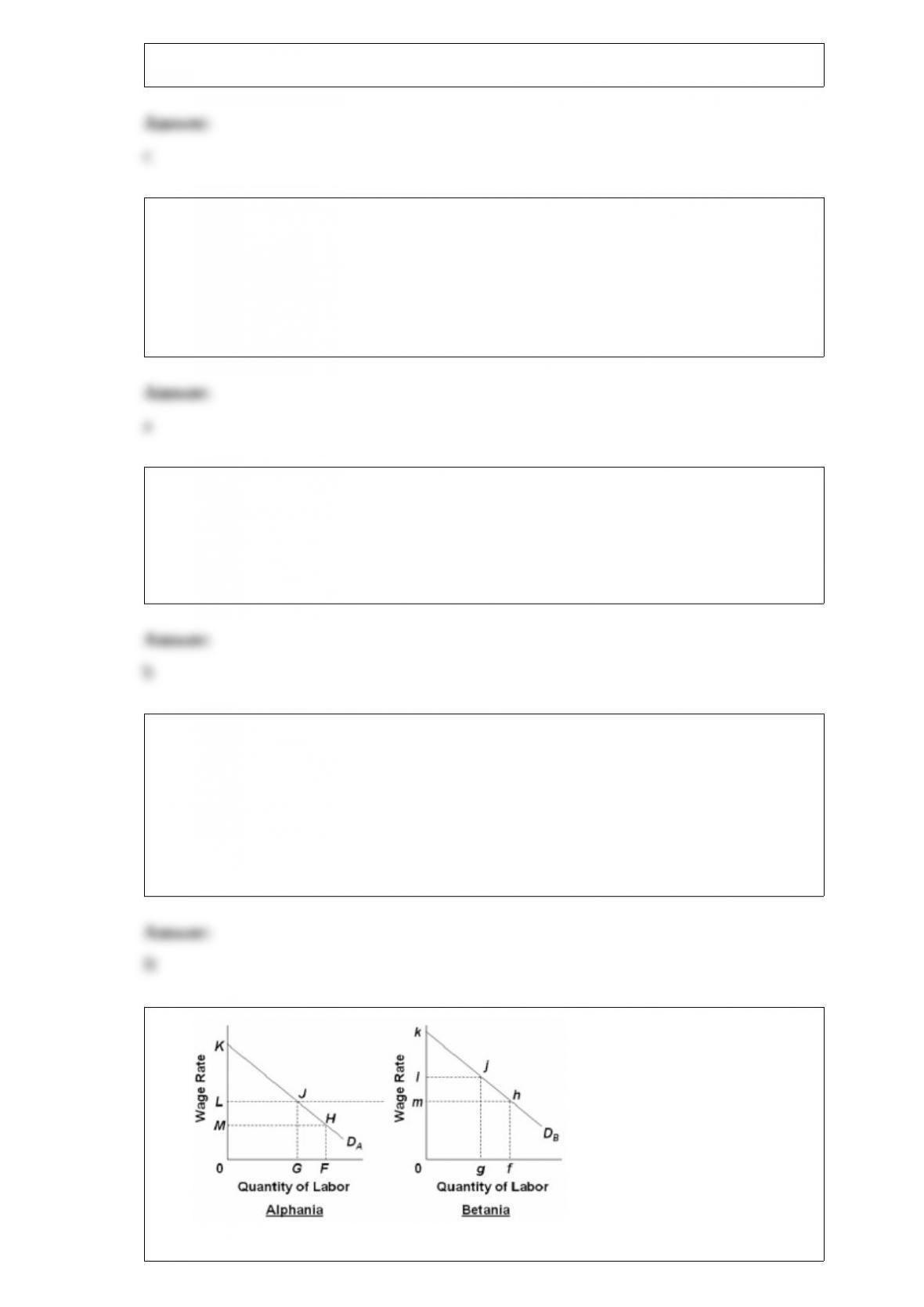
assumptions: (1) the demand for labor in alphania and betania are as shown by da and
db, respectively; (2) alphania’s native labor force is f and that of betania is g; (3) wage l
in alphania is equal to wage m in betania; and (4) full employment exists in both
countries.
refer to the above diagram and assumptions. if migration is costless and unimpeded, the
absolute wage bill will necessarily:
a.increase in alphania if its labor demand curve is elastic.
b.increase in betania if its labor demand curve is elastic.
c.decrease in betania.
d.increase in betania.
22) According to age-earnings data,
A.lower educated workers have similar earnings at age 65 as higher educated workers.
B.investments in education result in higher earnings.
C.high earnings are due to motivation and innate ability, rather than education.
D.there is no clear relationship between education and worker productivity.
23) The true size of Federal budget deficits may be understated because:
A.a portion of government spending is public investment.
B.inflation reduces the real value of the public debt.
C.Social Security surpluses are included as government tax revenues in measuring the
budget deficit.
D.foreign holdings of the debt have recently increased.
24) if the price of a is $12 and the price of b is $3, the budget line tells us that a
consumer in effect can trade:
a.12 units of a for 3 of b
b.1 unit of a for 4 of b
c.1 unit of a for 3 of b
d.1 unit of b for 4 of a
25)
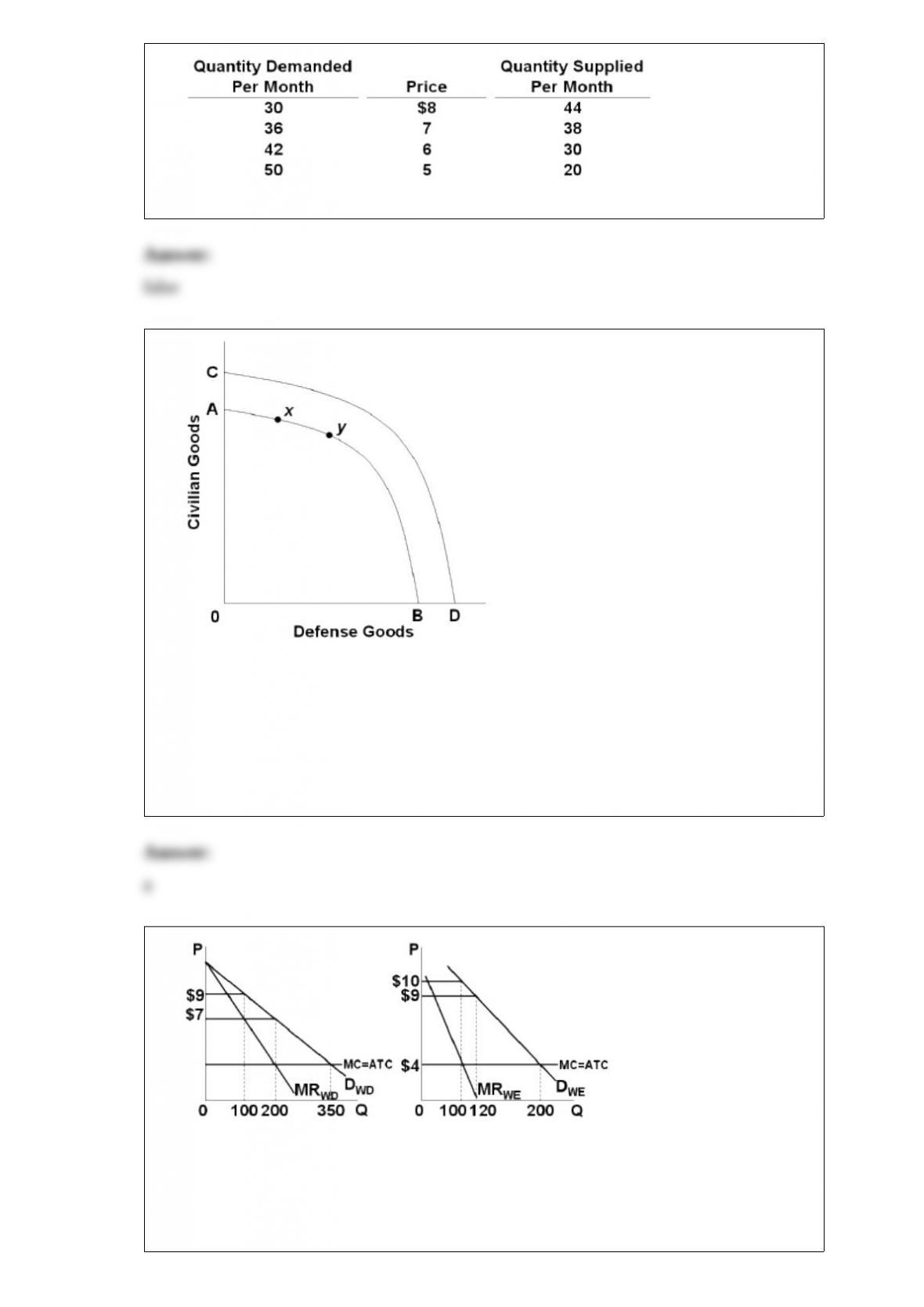
refer to the above data. the supply of this product is inelastic in the $6-$5 price range.
26)
(consider this) in response to the terrorist attacks of september 11, 2001, the
government decided to allocate more resources toward defense goods. the government’s
decision reflects their assessment that:
a.the marginal benefits of additional defense goods outweighed the marginal cost.
b.the marginal cost of additional defense goods outweighed the marginal benefit.
c.there cannot be too many defense goods.
d.civilian goods are not worth producing.
27)
refer to the figure above. suppose the graphs represent the demand for use of a local
golf course for which there is no significant competition (it has a local monopoly); p
denotes the price of a round of golf; q is the quantity of rounds ‘sold” each day. if the
left graph represents the demand during weekdays, and the right graph the weekend
demand, this profit-maximizing golf course will earn how much economic profit over

the course of a full seven-day week?
a.$4,200
b.$3,700
c.$3,400
d.$2,700
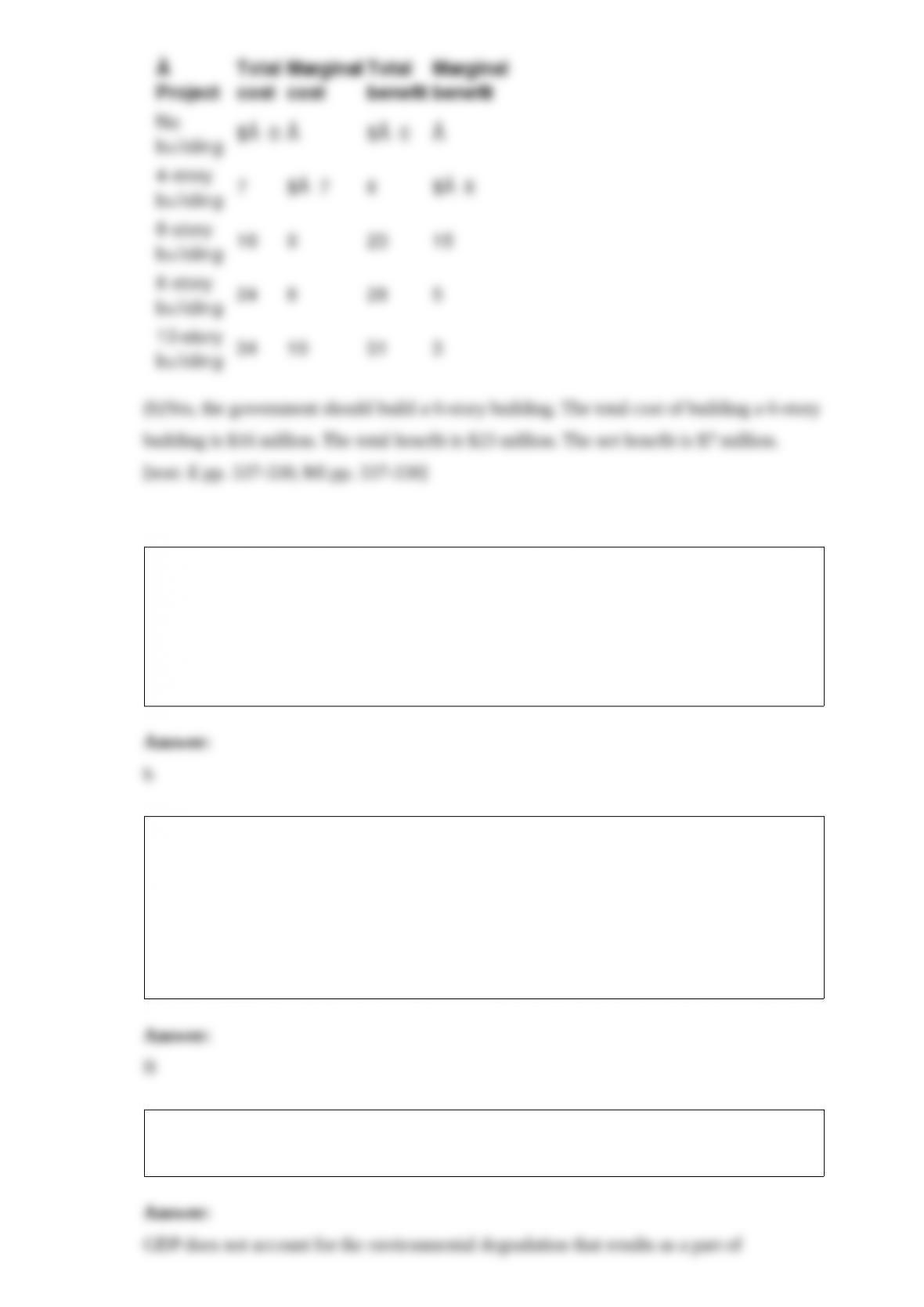
28) Imagine that a state government is considering the construction of a new state office
building to consolidate state operations. Its estimate of the total costs and the total
benefits of building a 4- 6-, 8-, or 10-story building is shown in the table below. (All
figures are in millions of dollars.)
(a)Compute the marginal cost and the marginal benefit of the 4-, 6-, 8-, and 10-story
buildings.
(b)Should the state build a new office building? If so, what size building and what will
be the total benefit, total cost, and net benefit to society?
29) a person will be more likely to migrate the:
a.greater the distance they will have to travel from their country of origin.
b.greater the wages in their prospective new country relative to wages in their home
country.
c.fewer the number of beaten paths that exist to their prospective new country.
d.greater the number of children they have.
30) (Last Word) In 2001 Congress appropriated $273,000 for the Blue Springs
(Missouri) Youth Outreach Unit for educational training in combating the Goth culture.
This is an example of:
A.the paradox of voting.
B.pork barrel politics.
C.the benefits-received principle.
D.the fallacy of limited decisions.
31) Why is GDP overstated in terms of the environment? What are some ways to
address this issue?
32) (Consider This) Give two examples of legal actions against price fixing among
firms.
33) A monopolistically competitive firm is producing 50 units of output in the short run
where marginal cost is $3.00, average total costs are $5.00, price is $4.50, average
variable cost is $4.00, and marginal revenue is $3.00. How much profit is the firm
making? What output recommendation would you make for the firm?
34) Compare and contrast the views of new classical economists and mainstream
economists on the issue of policy rules versus the use of discretionary monetary and
fiscal policy.
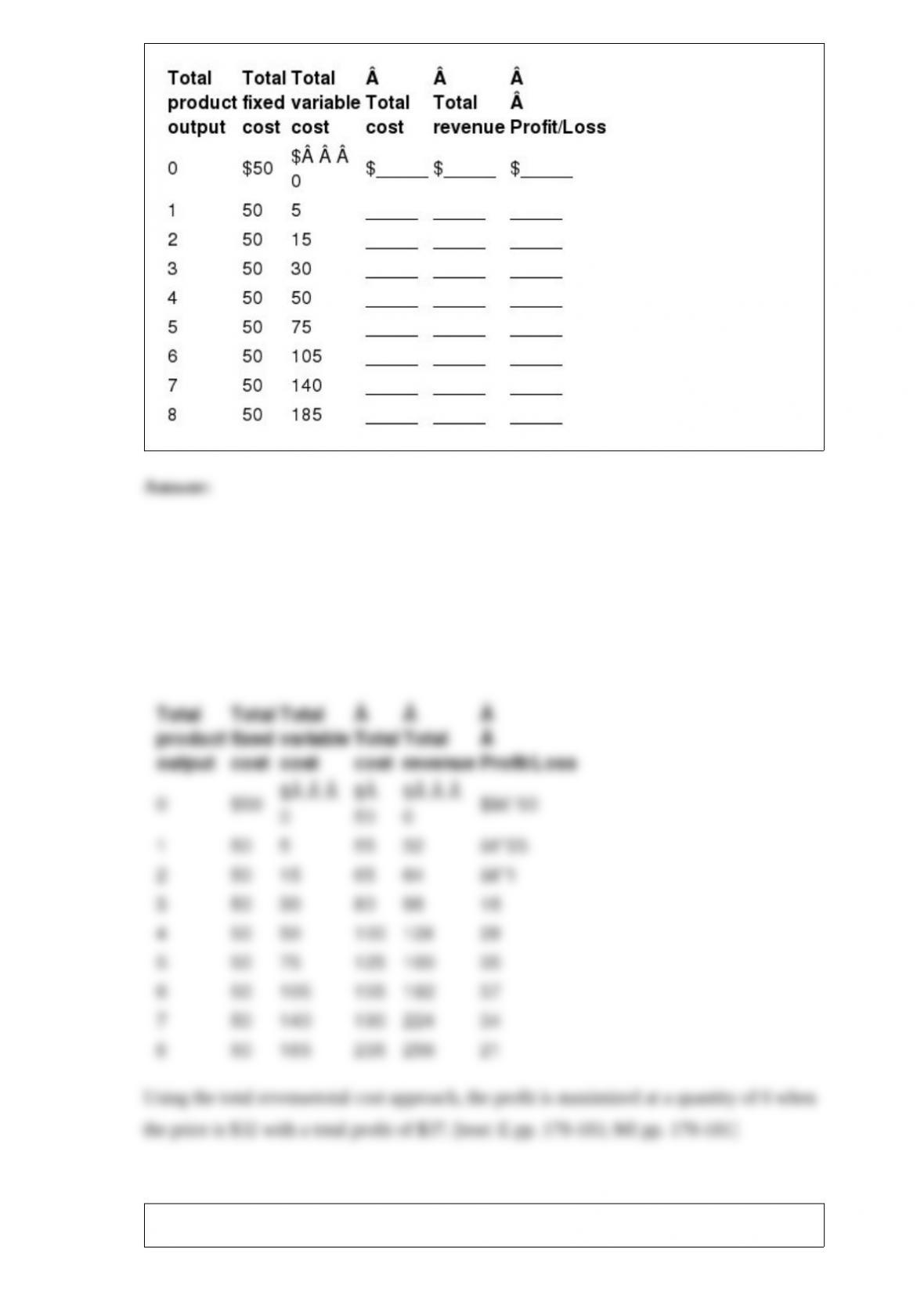
35) Fill in the following table for a product in a purely competitive market. The market
price for the good is $32. Use the total revenuetotal cost approach to evaluate at what
quantity the firm can maximize its profits.
36) What are three policy options for dealing with pure monopolies that are entrenched

and inefficient?