1) A person arguing that income inequality is actually less than that described by the
standard Census data might say that the:
A.Census data fail to include cash transfers as income.
B.Census data fail to include the value of noncash transfers as income.
C.lifetime distribution of income is less equal than the annual distribution.
D.household distribution of wealth is much more equally distributed than the household
distribution of income.
2)
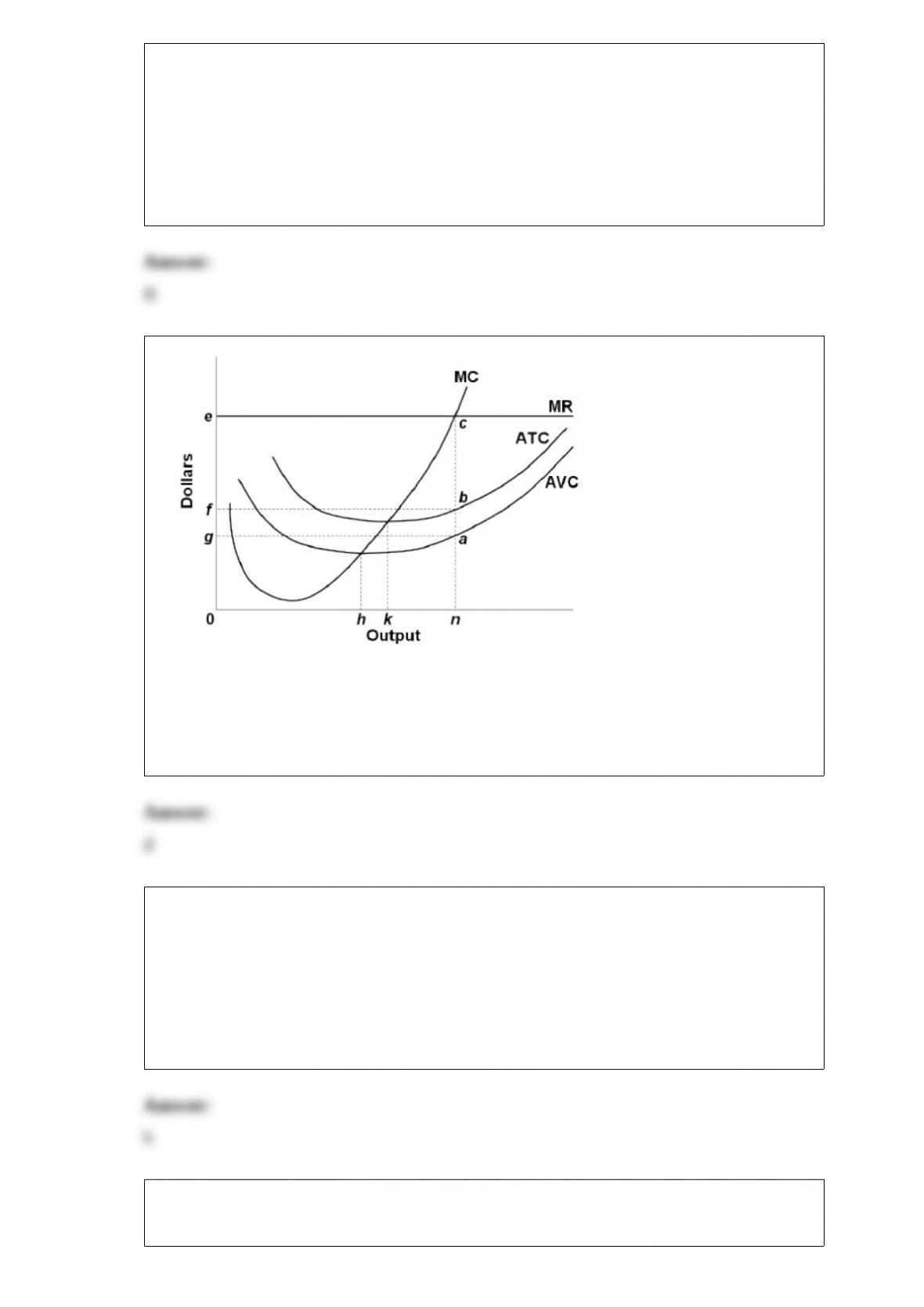
refer to the above diagram. the short-run supply curve for this firm is the:
a.entire mc curve.
b.segment of the avc curve lying to the right of the mc curve.
c.segment of the mc curve lying to the right of output level k
d.segment of the mc curve lying to the right of output level h
3) the most efficient combination of resources in producing any output is the
combination that:
a.comes closest to using the same quantities of land, labor, capital, and entrepreneurial
ability.
b.can be obtained for the smallest money outlay.
c.uses the smallest total quantity of all resources.
d.conserves most on the use of labor.
4) when the u.s. economy has achieved full employment, the unemployment rate is
between:

a.5 and 6 percent.
b.4 and 5 percent.
c.3 and 4 percent.
d.2 and 3 percent.
5) The amount by which government expenditures exceed revenues during a particular
year is the:
A.public debt.
B.budget deficit.
C.full-employment.
D.GDP gap.
6) refer to the above diagram. which line(s) show(s) a positive vertical intercept?
a.a and d only.
b.b and c only.
c.a, d, and e
d.a, d, and b
7) kara voluntarily quit her job as an insurance agent to return to school full-time to
earn an mba degree. with degree in hand she is now searching for a position in
management. kara presently is:
a.cyclically unemployed.
b.structurally unemployed.
c.frictionally unemployed.
d. not a member of the labor force.
8) which of the following would not be expected to occur in a purely competitive
market in long-run equilibrium?
a.consumer and producer surplus will be minimized.
b.p = mc = lowest atc.
c.the maximum willingness to pay equals the minimum acceptable price.
d.we would expect all of these to occur in the long run in a purely competitive market.
9) Which of the following provides retirement income to qualified retirees?
A.Medicare
B.Supplemental Security Income (SSI)
C.Social Security
D.TANF
10) we would expect the cross elasticity of demand between pepsi and coke to be:
a.positive, indicating normal goods.
b.positive, indicating inferior goods.
c.positive, indicating substitute goods.
d.negative, indicating substitute goods.
11)
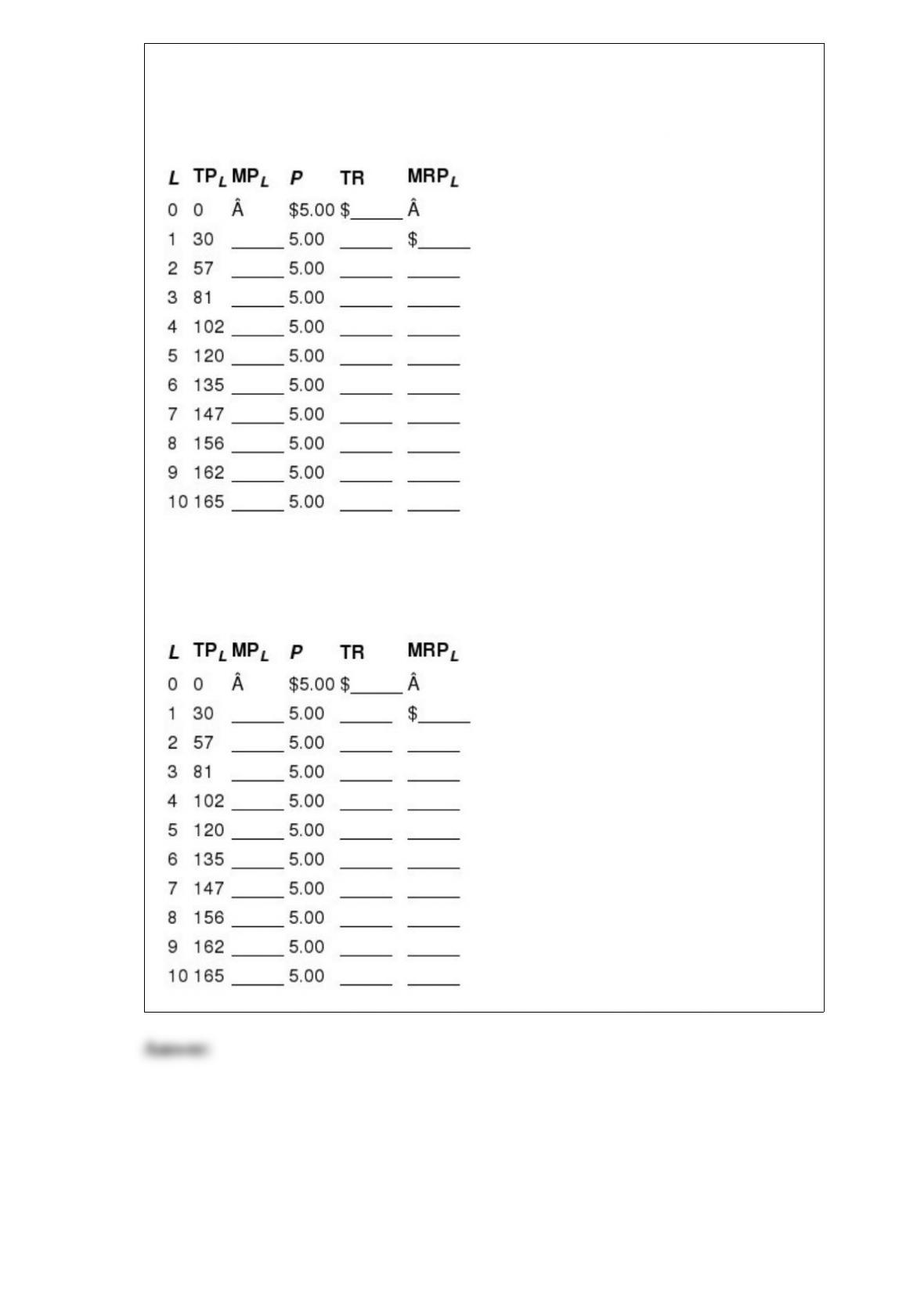
Refer to the diagram above, assuming that the firm represented is operating on curve
TC0. If the user cost increases by $20 at the beginning of the year, the quantity
extracted in the first year will:
A.remain unchanged
B.decline by 250
C.decline by 500
D.decline by 1,000
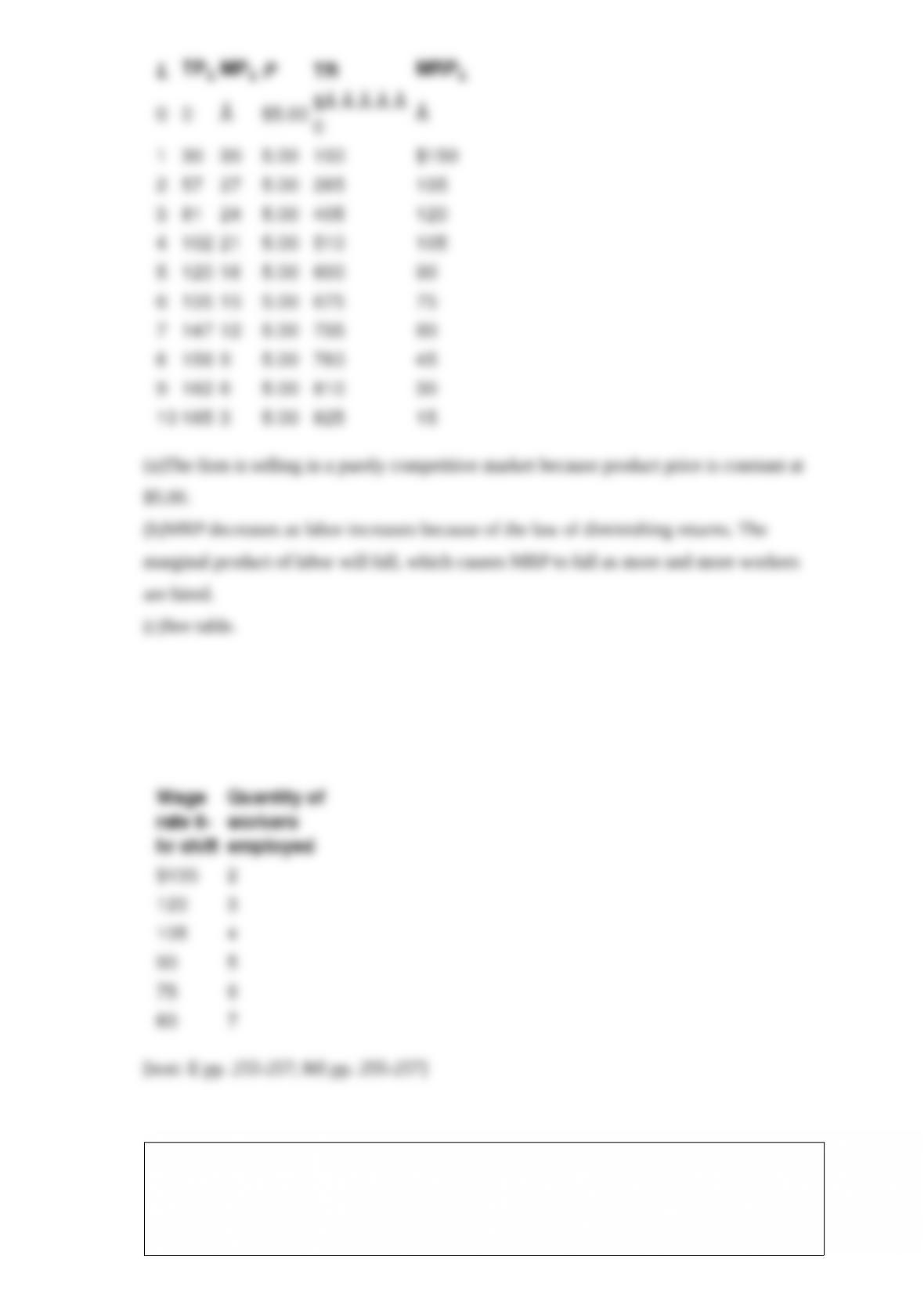
12) Complete the following table, where L is the units of labor, TPL is the total product
of labor, MPL is the marginal product of labor, P is product price, TR is total revenue,
and MRPL is the marginal revenue product of labor.
(a)In what type of market is the firm selling its product? How do you know?
(b)Why does the MRP schedule decrease as labor increases?
(c)Complete the following table.
13) Which of the following describes a purely competitive labor market?
A.MRP < Wage Rate
B.MRP > Wage Rate
C.Wage Rate = MRC

D.Wage Rate < MRC
14)
refer to the above table. over the $8-$6 price range, supply is:
a.inelastic.
b.elastic.
c.perfectly inelastic.
d.perfectly elastic.
15) Which of the following actions by the Fed would cause the money supply to
increase?
A.purchases of government bonds from banks.
B.an increase in the reserve requirement.
C.an increase in the discount rate.
D.sales of government bonds to the public.
16) suppose that an economy is producing on its production possibilities curve, but is
not producing quantities of each good where the marginal benefit equals the marginal
cost for each good. this economy:
a.should not change its production because it cannot improve its allocation by shifting
resources.
b.can improve its allocation by lowering the unemployment rate.
c.can improve its allocation by producing more of one good and less of the other.
d.can improve its allocation by producing more of both goods.
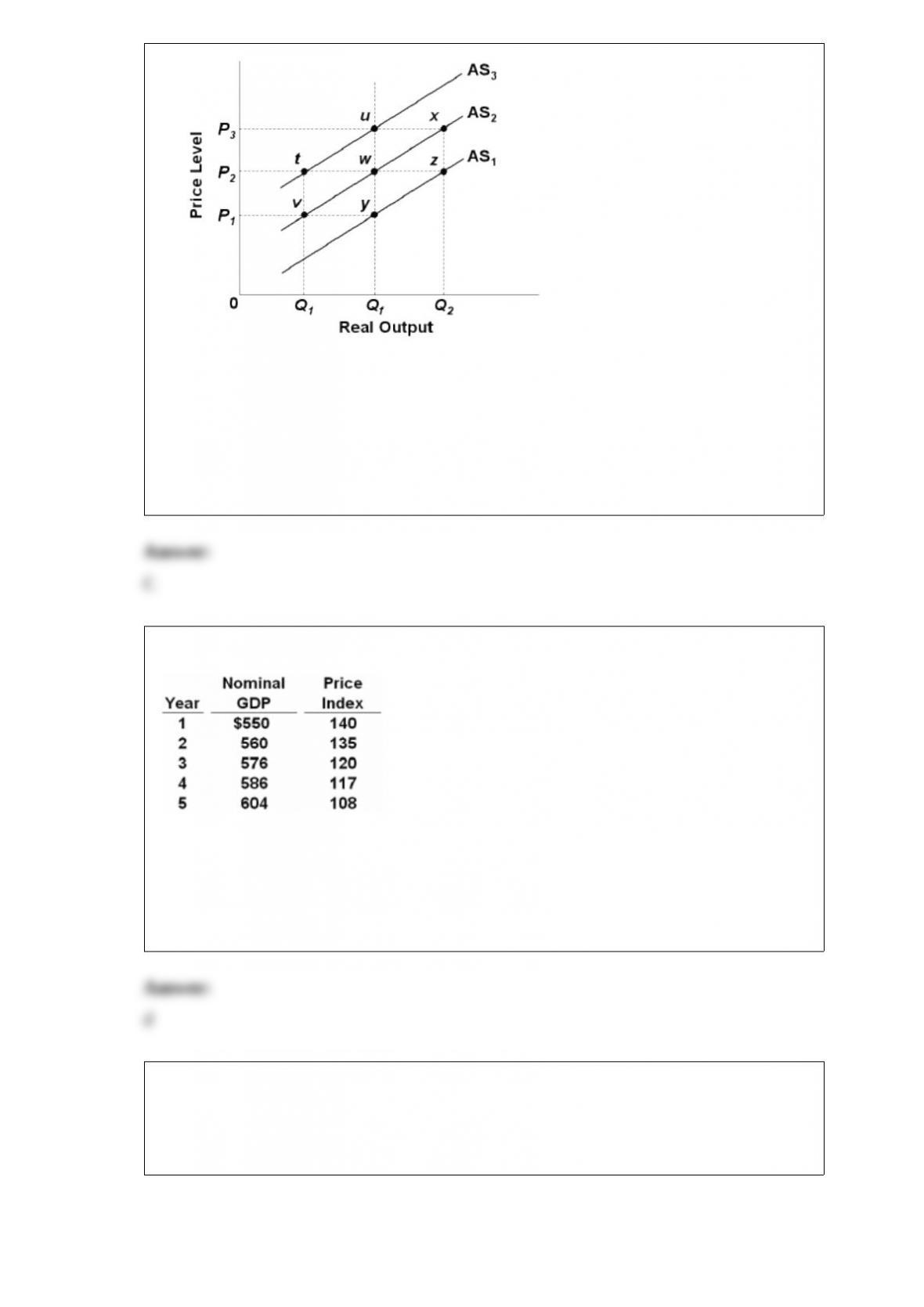
17)
Refer to the above diagram and assume the economy is operating at equilibrium point
w. In the long run, an increase in the price level from P2 to P3 would move the
economy from point w to point:
A.v
B.x
C.u
D.y
18) answer the next question(s) on the basis of the following information:
the economy above has experienced a:
a.a declining nominal gdp.
b.a rising price level.
c.a declining real gdp.
d.a rising real gdp.
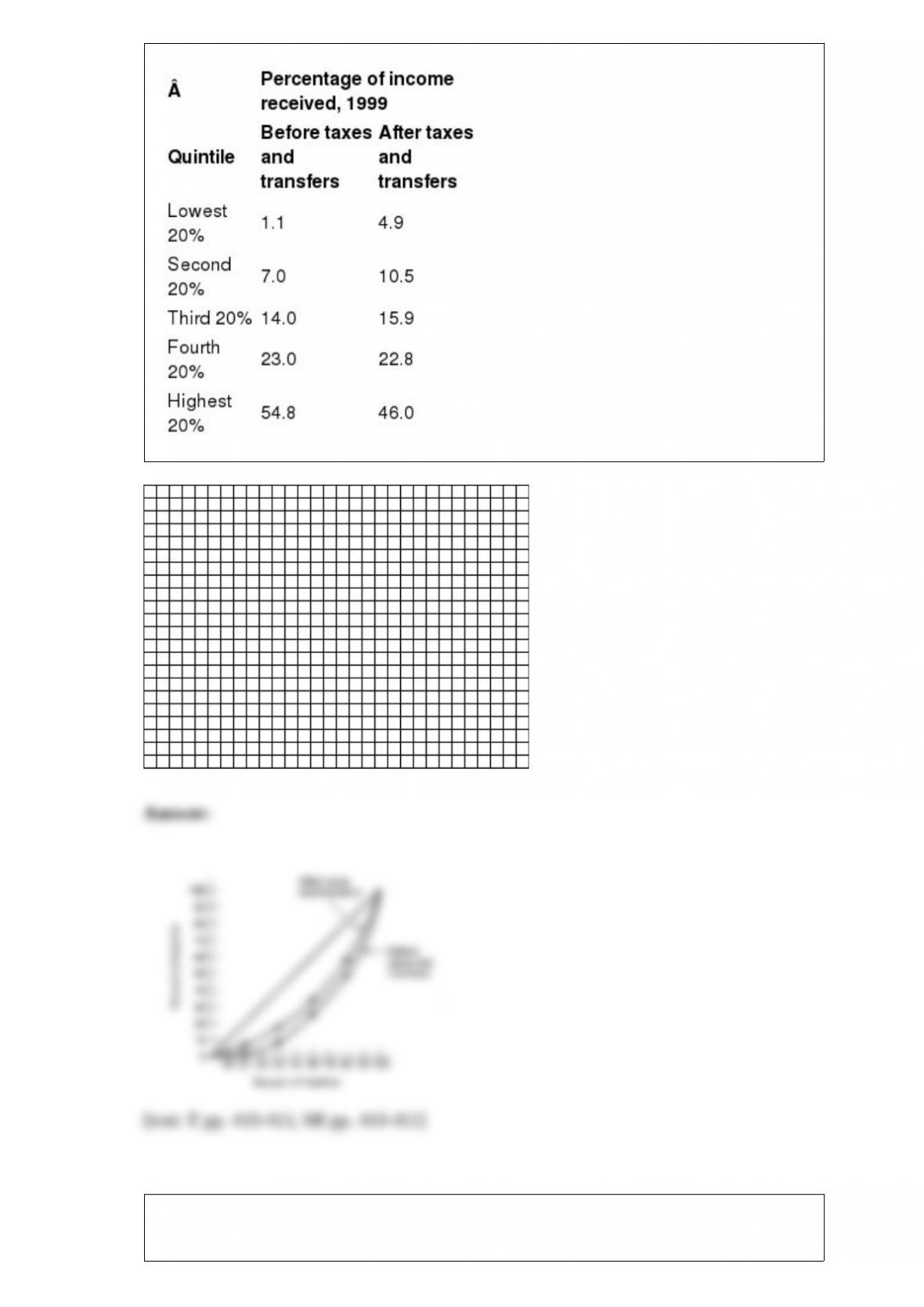
19) The following table shows the percentage of income received by quintile. In the
graph below, draw a Lorenz curve using the before taxes and transfer data and a Lorenz
curve for the after taxes and transfer data. Label the Lorenz curves and each axis of the
graph.
20) the construction of demand and supply curves assumes that the primary variable
influencing decisions to produce and purchase goods is:

a.price.
b.expectations.
c.preferences.
d.incomes.