
Which of the following did not contribute to the high transaction related risks for U.S.
potato sales in 1840?
a) Infrequency of transactions
b) Changing transaction partners
c) Lack of availability of sales and prices for comparable goods
d) Competition from European merchants
e) Geographic distance between buyers and sellers
What process involves using computer simulations to track the likely competitive
implications of pricing and investment decisions over many years?
a) Regression testing
b) Virtual reality
c) War gaming
d) Commitment testing
e) Scenario testing
Which of the following modes of task interdependence exists when two or more
workers or work groups depend on each other to do their work?
a) Technology interdependence

b) Environment interdependence
c) Reciprocal interdependence
d) Sequential interdependence
e) Pooled interdependence
Which of the following is the most visible example of a firm’s social context?
a) Employment practices
b) Contracting
c) Regulation
d) Entry-deterring behaviors
e) Formal controls
Which of the following is not a reason for customer survey bias in quality measures?
a) Different customers may use different measurement criteria
b) Customers may have an incentive to inflate ratings to influence the average score
c) Customers often lie in consumer surveys
d) Customers are reluctant to leave negative feedback

e) Consumer feedback is unverifiable.
Which of the following terms involves the flow of information within an organization
to facilitate subunit decisions that are consistent with each other and with organizational
objectives?
a) Complex hierarchy
b) Coordination
c) Control
d) Hierarchy of authority
e) Departmentalization
How does a centralized organization solve coordination problems?
a) Allows for face to face communication
b) Creates a smaller organization
c) Reduces the costs of business
d) Concentrates decision making authority in a one or a small group of people
e) Information can take more time to trickle down
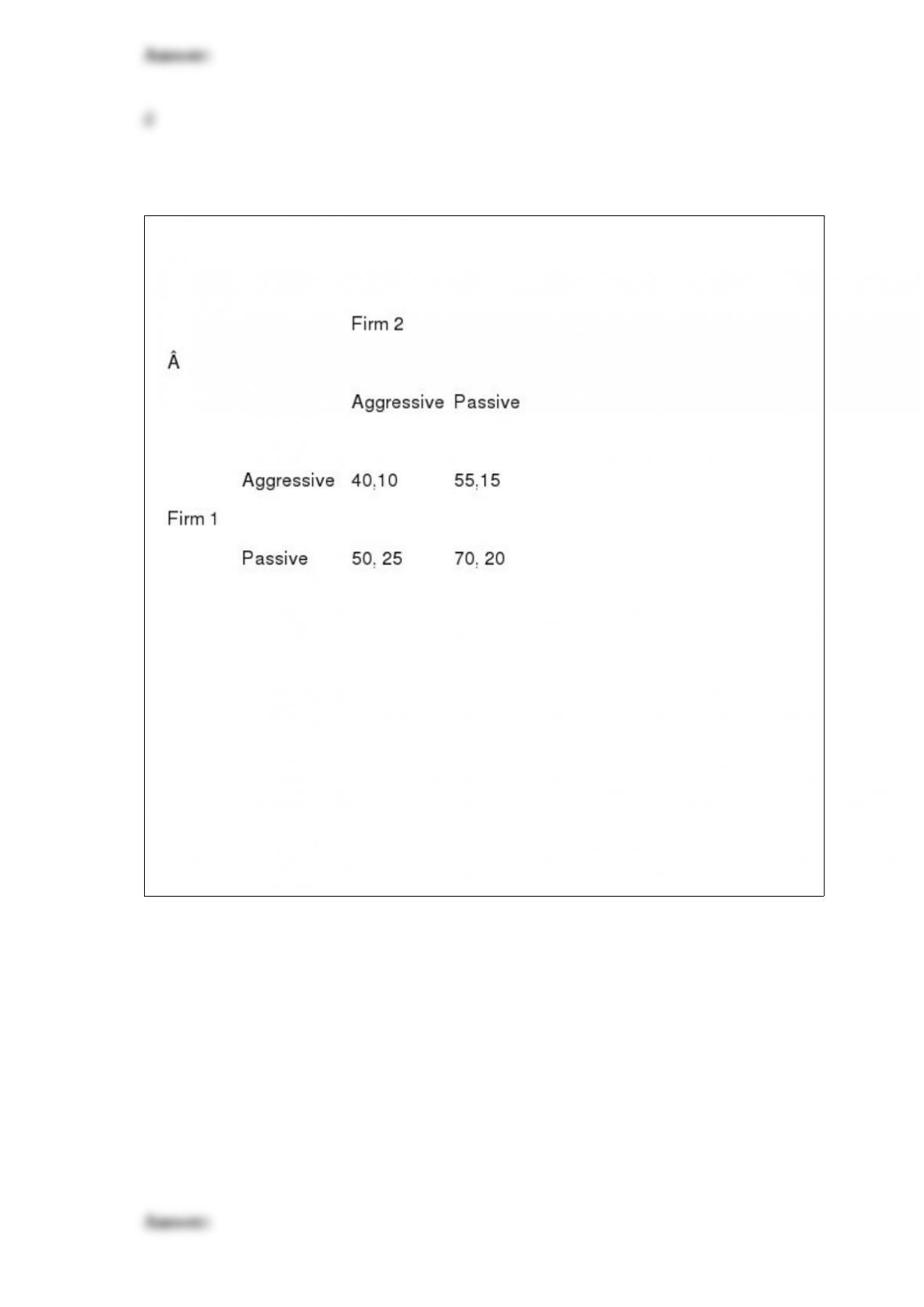
Given the following payoff diagram:
How much can firm 1 improve its outcome by committing to a strategy thus
transforming the simultaneous move game to a sequential move game?
a) 5
b) 10
c) 15
d) 20
e) 20

What was a key factor that aided foreign steel producers in penetrating U.S. markets?
a) Shifting demand in the economy to “lighter” products
b) Invention of the basic oxygen furnace
c) Development of the continuous casting process
d) U.S. steelmakers’ commitment to ‘light’ products
e) Development of the electric arc furnace
What term best describes clusters of activities that a firm does especially well in
comparison with other firms?
a) Competitive advantage
b) Resources
c) Capabilities
d) Threats to sustainability
e) Strategic firm assets
Which of the following variables does not influence the quantity of product that a firm
is able to sell?
a) Price of the product
b) Price of related products
c) Plant production costs

d) Incomes and tastes of consumers
e) Advertising
What term is defined as a firm selling goods at a price below their normal price (and
generally below cost) usually as an export in international trade?
a) Predatory pricing
b) Cost plus pricing
c) Dumping
d) Marginal cost pricing
e) Price leading
Which of the following is most true regarding the strategic value of institutional logics?
a) When institutional logics are stable, they have the most strategic importance
b) Institutional logics are coveted by firms (not taken for granted)
c) If firms share an institutional logic, the logic provides a basis for relative advantage
among firms
d) Institutional logics are valuable because they raise the costs for firms adapting to
their environments
e) Competitive advantage must come on some other dimension than institutional logic
if firms share that institutional logic

What term describes a policy in which a firm is prepared to match whatever change in
strategy a competitor makes?
a) Response strategy
b) Always cooperate strategy
c) Always aggress strategy
d) Tit-for-tat strategy
e) Trigger strategy