
When management shows little concern for its employees and workplace relations are
bad, employees may support a unionization effort.
Answer:
Egalitarian pay structures send the message that the organization values differences in
work content, individual skills and contributions to the organization.
Answer:
Today, benefits are twenty-five percent of payroll costs.
Answer:
The Employee Retirement Security Act states that employers must offer a retirement
plan to their employees if they work at least 1250 hours per year.

Answer:
Typical data collected for a job analysis would not include relationships with suppliers
and customers.
Answer:
The assumption that pay systems must be designed to fit different national cultures
assumes most inhabitants share a national character.
Answer:
Research shows that a sound job evaluation process and instrument is not susceptible to
influence by one group or person.
Answer:

The reliability and validity of quantitative methods of job analysis has significantly
reduced the importance of human judgment in job analysis.
Answer:
Companies are turning away from 401K type pension plans because they require
putting money in “up front” rather than when workers retire.
Answer:
The most popular method of special compensation for supervisors is paying overtime.
Answer:
Benefits can be an effective tool to attract and retain employees when benefits address
needs of a target group.

Answer:
In most cases, when an executive calls in a compensation consultant, regardless of how
well the company is performing, the executive’s pay is raised.
Answer:
The purpose of prevailing wage laws is to assure that government projects do not waste
tax dollars.
Answer:
The most influential theory explaining pay-level differences is marginal revenue
productivity.
Answer:

In virtually all the studies on job evaluation, job-based evaluation is treated as a
measurement device.
Answer:
One way of evaluating a managerial job’s multinational responsibilities would be to rate
the percent of time spent on multinational issues.
Answer:
Skill-based pay is used for the same types of jobs as competencies.
Answer:
Formal job or competency-based evaluations play the most important role in
determining executive salaries.

Answer:
The only two benefits shown to reduce turnover are pensions and medical coverage.
Answer:
Employees working under individual incentive plans tend to resist the introduction of
new technology.
Answer:
One of the best solutions to a poorly defined or changing job is including more
respondents.
Answer:

Before World War II, hourly employees were given time off for holidays but without
pay.
Answer:
A common problem with incentive systems is workers focus primarily on behaviors and
results that are rewarded.
Answer:
Cost pressure related to increasing diversity of the workforce is one of the reasons
companies are offering flexible benefit plans.
Answer:
Research has shown that the BARS format has proven the best for reducing rating
errors.

Answer:
According to ADA regulations, essential functions refers to the fundamental job duties
of the employment position the individual with a disability holds or desires.
Answer:
A job analysis should include poor performers as well as high performing employees.
Answer:
There is good evidence that a sound benefits program reduces turnover.
Answer:

Workers’ compensation is covered federal laws.
Answer:
Broad-based option plans are usually limited to managerial and professional employees.
Answer:
Most contracts recognize that jobs in the same occupations should receive different
wage rates.
Answer:
Though commonly believed by managers, there is only anecdotal evidence supporting
the belief that higher benefit levels increase employee retention.
Answer:

Job analysis and gain-sharing are not examples of inherent controls on managers’
compensation decisions.
Answer:
In a total decentralized pay system, employees are likely to be treated unequally and
unfairly.
Answer:
Goal setting theory argues that employees’ performance in maximized when
performance targets are stated as “do your very best”.
Answer:

According to the Hudson survey, __________ is the single thing that would make them
happier.
A. more personal days and family leave
B. a more flexible work schedule
C. more money
D. better health insurance
Answer:
The gap between workers and their managers is 27 percent smaller in unionized firms
because _____.
A.managers in union firms receive lower wages
B.worker wages are less likely to go up in unionized firms
C. managers in nonunion firms receive higher wages to maintain internal equity
D.worker wages go up faster than manager wages in unionized firms
Answer:
The effect of “living wage” laws is ____pay structures.____

A.more person-based
B.flatter more compressed
C.taller more compressed
D.more job-based
Answer:
Among peer raters, the most objective evaluations are given by:
A.more experienced workers.
B.workers who are not close friends with ratees.
C.high performing workers.
D.low performing workers.
Answer:
Which of the following types of workers are generally not covered by workers’
compensation?
A.State government employees
B.Coal miners
C.Railroad employees
D.Farm workers
Answer:
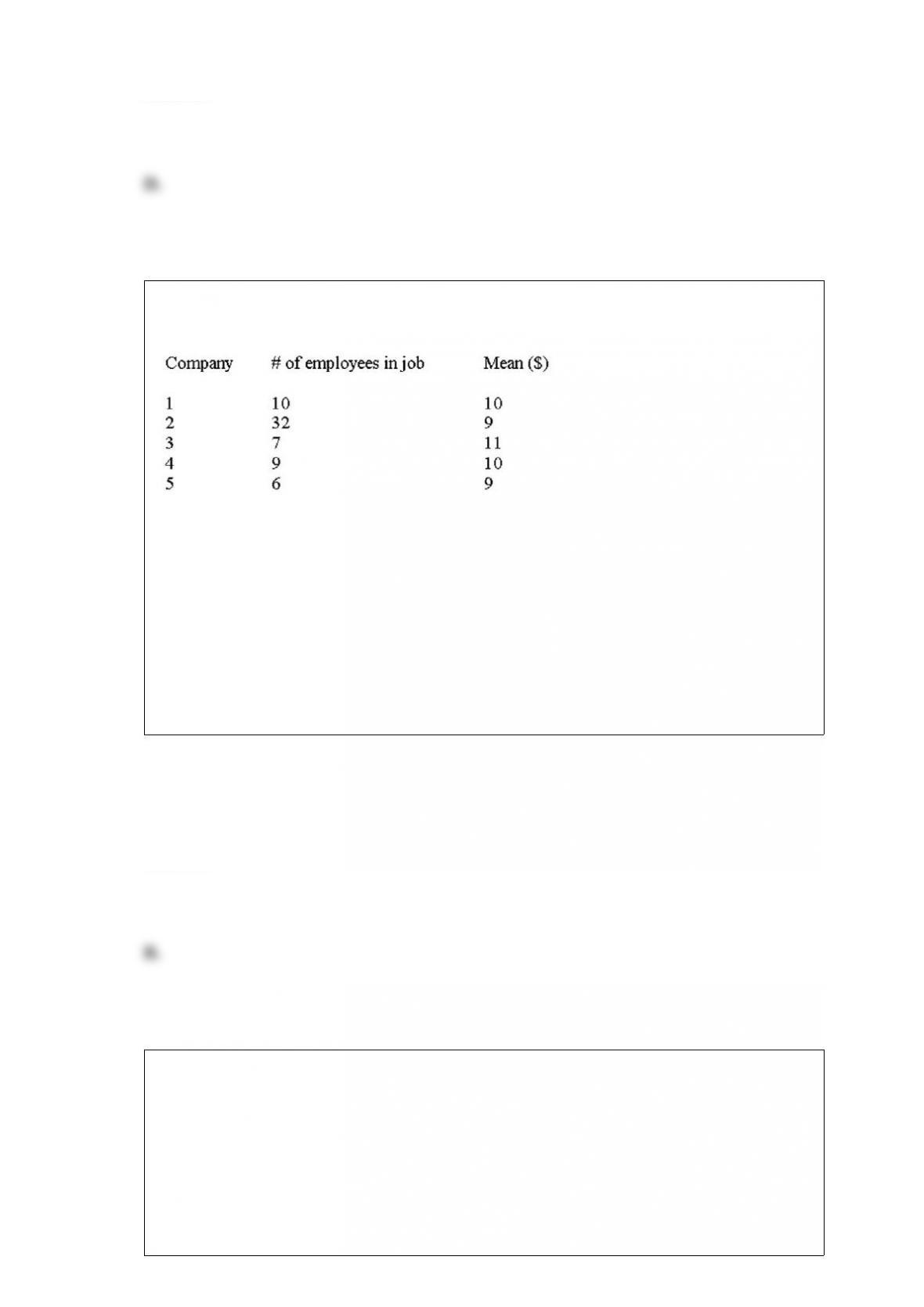
You work in a midsize organization and have just conducted a wage survey. Five
midsize companies have provided wage data for a particular job. Here are the numbers.
Which of the following statistics will be the most accurate reflection of the market rate?
A.Mean
B.Weighted mean
C.Median
D.Mode
Answer:
The key to designing a pay-for-performance system rests on standards. Specifically,
managers need to be concerned about the:
A.objectives, structure, eligibility, and funding.
B.strategy, measures, structure, and equity.
C.structure, efficiency, equity, and funding.

D.objectives, measures, eligibility, and funding.
Answer:
Which of the following is a major factor that influences the design of sales
compensation packages?
A.Diversity of buyers’ needs and preferences
B.The nature of people who enter the sales profession
C.Political environment
D.The company’s size
Answer:
A _____ rate is when an employee is paid more than the maximum of their pay grade.
A.red circle
B.yellow circle
C.blue circle
D.green triangle

Answer:
Advantages of individual incentive plans include all of the following except:
A.lowered production costs.
B.less direct supervision.
C.greater trust between workers and management.
D.higher productivity.
Answer:
Company X pays for performance. Allan, an employee of the company, is not in favor
of this reward system and, therefore, leaves Company X in search of another company
with different rules for getting rewards. This is an example of the:
A.design effect.
B.compensation effect.
C.sorting effect.
D.incentive effect.
Answer:

Compensable factors, skill blocks, and competency sets are all for the purpose of:
A.assessing relative value.
B.collecting work content information.
C.determining what to value.
D.each of the three has a different purpose.
Answer:
Among pay-mix alternatives, base pay is largest in _____.
A.work-life balance
B.security or commitment
C.performance driven
D.market match
Answer:
Rent sharing is most commonly associated with the _____ theory.

A.human capital
B.signaling
C.marginal productivity
D.efficiency wage
Answer:
Skill-based plans tend to work best in organizations using a(n) _____ strategy.
A.innovator
B.defender
C.laissez-faire
D.cost-cutter
Answer:
Which of the following would not be included in job identification information in a job
analysis?
A.Job title
B.Department in which job is located
C.Number of people who hold job

D.Current pay level
Answer:
Which of the following is not one of the areas on which unions have a major impact?
A.General benefit levels
B.Customer service
C.Structure of wages
D.Salary policies and practices
Answer:
An advantage of conventional job analysis interviews and questionnaires is _____.
A.increased employee understanding of the process
B.lower cost to the organization
C.reduced subjectivity
D.less time to complete the process

Answer:
To be valid, acceptable, and useful, job information must be _____.
A.authentic
B.technical
C.industry specific
D.up to date
Answer:
_____ sets a maximum pay level an employer can pay.
A.Government legislation
B.The product market
C.The labor market
D.Labor market competitors
Answer:

Information such as quality course, shop floor control, tool setup and plant first aid are
examples information that might be used to develop a _____ pay structure.
A.job-based
B.classification
C.competencies
D.skill-based
Answer:
Gross margin on sales or price per unit would be the appropriate measurement if the
goal is _____.
A.increased sales growth
B.improved account retention
C.profit improvement
D.greater emphasis on quality
Answer:

There is some evidence that gain-sharing plans are more common in __________ than
___________.
A. service industries, manufacturing
B. union, non-union
C. large companies, small companies
D. small companies, large companies
Answer:
A set of identical positions is a(n) _____.
A.job family
B.occupation
C.job group
D.job
Answer:
A recent survey shows employees ranking employee benefits __________ in explaining
job satisfaction.

A.first
B. second
C.third
D.last
Answer:
Government job analysis procedures recommend interviewing
A.the best performing employees.
B.long tenure employees.
C.the typical employee.
D.workers just completing the probationary period.
Answer:
Employers spend ____ cents for benefits in addition to each dollar of wages or salaries.
A.44
B. 34
C. 24

D. 14
Answer:
Compensatory time off would _____.
A.give employers and employees the option of trading overtime pay for time off
B.provide employees overtime pay after 8 hours for a 10-hour workday
C.allow an employer flexibility in the use of “on-call” employees
D.enable employers to monitor the employment practices of subcontractors
Answer:
The market pay rate is the:
A.minimum wage rate set by the Department of Labor.
B.pay rate at which applicants will accept a job.
C.going rate.
D.point at which supply and demand lines cross.
Answer:

Workers begin to show a strong interest in joining a union when _____.
A.management is not unreliable.
B.workplace relations are bad.
C.workers feel they have influence over decisions affecting them.
D.it is a condition of employment.
Answer:
_____ is the budgetary approach that begins with an estimate from top management of
the pay increase budget for the entire organization.
A.Bottom-up budgeting
B.Top-down budgeting
C.Managerial plan
D.Executive estimate budgeting
Answer: