Dell used __________ to develop an online site to generate 13,464 ideas for new
products and website and marketing improvements.
a. brainstorming
b. crowdsourcing
c. group think
d. outsourcing
e. data mining
Answer:
Because young people are postponing marriage and parenthood, this social trend will
impact all of the following purchases EXCEPT:
a. greeting cards.
b. weddings.
c. baby products.
d. homes.
e. child products.
Answer:
A recent poll by Environics International, a public-opinion research firm, found that 67
percent of North Americans are willing to boycott products on ethical grounds. This
survey did not ask if the person who was acting on ethical grounds would first see if the
boycott was based on facts. Which of the following statements describes a conclusion
that should be drawn from this information?
a. If you are an ethical person, you should act according to your instincts.
b. Realistically speaking, in order to stay in business, all businesses must occasionally
behave unethically.
c. All businesses will act unethically unless forced by consumers to act morally.
d. There is nothing consumers can do to stop unethical business activities.
e. Boycotting a product without knowing the facts can be viewed as unethical.
Answer:
While YouTube and Vimeo both allow users to upload videos, Vimeo focuses on
__________ and YouTube focuses on _________.
a. videos that will appeal to a younger audience; videos that will appeal to a
middle-aged audience
b. videos with artistic content; videos with broad appeal
c. videos with broad appeal; videos with more artistic content
d. upcoming movie trailers; amateur stunt videos
e. videos that will generate a profit; videos that will build social awareness
Answer:
Organizational buying behavior refers to
a. the actions a person takes in purchasing and using products and services, including
the mental and social processes that come before and after these actions.
b. the decision-making process that organizations use to establish the need for products
and services and identify, evaluate, and choose among alternative brands and suppliers.
c. the determination of what to purchase and the quantity to purchase based upon
derived demand.
d. the determination of what to purchase and the quantity to purchase based upon the
derived demand in the industry.
e. the process that organizations use to purchase the raw materials and tools used in the
manufacturing of a product.
Answer:
Cash payments or an extra amount of “free goods” awarded sellers in the channel for
undertaking certain advertising or selling activities to promote the product is referred to
as a
a. promotional allowance.
b. quantity discount.
c. seasonal discount.
d. purchase inducement.
e. flexible-pricing policy.
Answer:
Which of the following statements regarding odd-even pricing is most accurate?
a. Odd-even pricing is designed to give the consumer a better set of pricing alternatives.
b. Odd-even pricing can be used in conjunction with a skimming strategy, but should
not be used with a penetration strategy.
c. Odd-even pricing does not work if the product is healthcare-related.
d. Overuse of odd-ending prices tends to mute its effect on demand.
e. Odd-ending prices are best used with large ticket items; it loses its effectiveness with
moderate- to low-ticket items.
Answer:
The approaches that can be used to collect data to solve all or part of a marketing
research problem are referred to as
a. proposals.
b. strategies.
c. tactics.
d. analyses.
e. methods.
Answer:
Which of the following is a criterion used for selecting a target market?
a. similarity of needs of potential buyers within a segment
b. difference of needs of buyers between segments
c. expected growth of a segment
d. feasibility of a marketing action to reach a segment
e. simplicity and cost of assigning potential buyers to segments
Answer:
When the number of catalogs being sent to individual carrier routes is small, a database
a. can add special incentives such as product samples.
b. can add names to qualify for U.S. postal discounts.
c. is less effective since the customer base is too small to segment.
d. is more effective since the customer base does not have to be segmented.
e. can generate generic catalogs to use instead of targeted ones.
Answer:
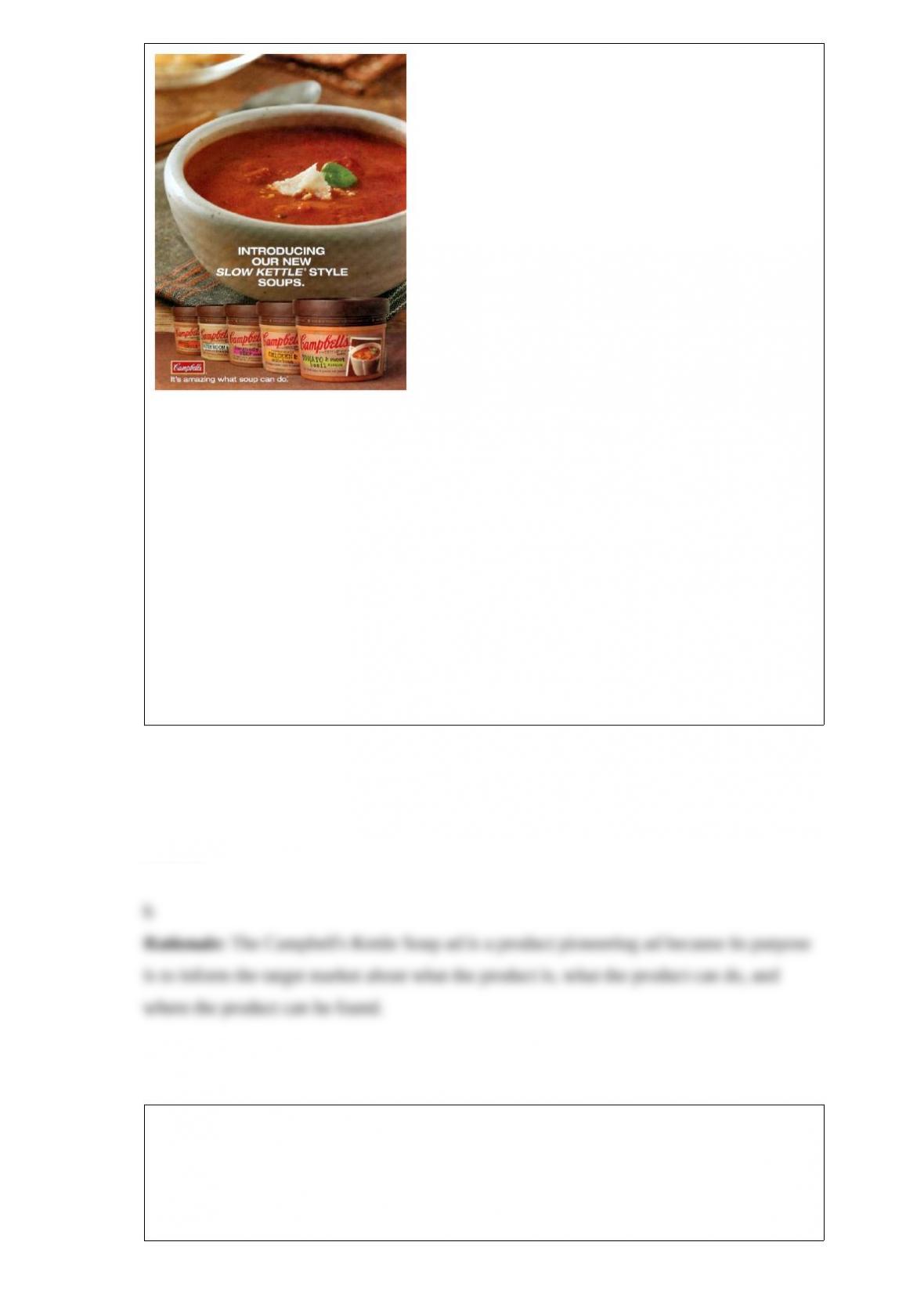
Campbell’s Kettle Soup Ad
In the Campbell’s Kettle Soup ad above, Campbell’s is introducing its new Kettle Style
soups. What type of product advertisement is this ad?
a. reminder
b. pioneering
c. reinforcement
d. comparative
e. competitive
Answer:
One disadvantage of using the yellow pages as an advertising medium is
a. there is no similar competition.
b. they are difficult to keep up to date.
c. the ads are perishable.
d. few households with telephones have them.
e. advertisers must create extensive databases for delivery.
Answer:
Aggregating prospective buyers into groups that (1) have common needs and (2) will
respond similarly to a marketing action is referred to as __________.
a. market aggregation
b. market segmentation
c. product segmentation
d. product grouping
e. mass marketing
Answer:
Don graduated high school and takes his mom to dinner after the ceremony. At the
restaurant, the server fills their water glasses, checks on their table, and takes care of
their requests. Don notes that the last time he was at this same restaurant, the experience
was much worse. This scenario illustrates the ___________ of services.
a. impressionability
b. intangibility
c. inseparability
d. uniqueness of the service
e. inconsistency
Answer:
A __________ is common in the soft drink industry where the manufacturer sells its
concentrate to wholesalers, who carbonate it, and market the finished product to
retailers.
a. service-sponsored franchise system
b. service-sponsored retail franchise system
c. manufacturer-sponsored wholesale franchise system
d. manufacturer-sponsored retail franchise system
e. administered vertical marketing system

Answer:
Factors that determine consumers’ willingness and ability to pay for products and
services are referred to as
a. supply factors.
b. demand factors.
c. affordability factors.
d. elasticity factors.
e. macro environmental factors.
Answer:
Unsought products are
a. any products associated with impulse buys at the supermarket checkout counter.
b. products that were once very popular but that have become obsolete because they are
in the decline stage of their product life cycle.
c. items within a company’s product line that do not perform as well as others in the
line.
d. products that the consumer does not know about or knows about but does not initially
want.
e. products that people choose to ignore because they find them offensive from a moral
or ethical perspective.
Answer:
International trade statistics indicate the largest exporting industries in the United States
focus on __________.
a. ultimate consumers
b. organizational buyers
c. governmental agencies
d. domestic consumers
e. foreign consumers
Answer:
In which stage in the consumer purchase decision process would a consumer ask, “Is
installation included in the price of this 3D plasma HDTV?”
a. problem recognition
b. alternative evaluation
c. purchase decision
d. evaluation
e. information search
Answer:
To minimize the cannibalization of a brand’s sales within its product line, firms often
use
a. head-to-head positioning.
b. lateral positioning.
c. differentiation positioning.
d. market repositioning.
e. the 80/20 rule.
Answer:
Once a company has decided to enter the global marketplace, it must select a means of
market entry. Four general options exist: (1) exporting; (2) licensing; (3) __________;
and (4) direct investment.
a. franchising
b. cooperative
c. multiparty
d. mutual
e. joint venture
Answer:
The objective of information and logistics management in a supply chain is to deliver
maximum customer service and to
a. minimize logistics costs.
b. maximize distribution outlets.
c. maximize profits.
d. maximize supply chain membership.
e. maximize supply chain inefficiency.
Answer:
The wholesalers most prevalent in the hardware, drug, and clothing industries would be
_________.
a. specialty wholesaler
b. full-line wholesaler
c. cash and carry wholesaler
d. limited-line wholesaler
e. universal wholesaler
Answer:
Manufacturer’s agents refer to agents who
a. represent a single producer and carry all products in the producer’s lines.
b. work for several producers and carry noncompetitive, complementary merchandise in
an exclusive territory.
c. take title to merchandise but sell only to buyers who call on them, pay cash for
merchandise, and furnish their own transportation for merchandise.
d. own the merchandise they sell but do not physically handle, stock, or deliver it.
e. furnish the racks or shelves that display merchandise in retail stores, perform all
channel functions, and sell on consignment to retailers.
Answer:
To help consumers assess and compare services, marketers try to make them
__________ or show the benefits of using the service.
a. tangible
b. intangible
c. consistent
d. timely
e. measurable
Answer:
Four basic business and management practices are important, according to researchers
who studied more than 200 management tools and techniques. These are: (1) strategy,
(2) __________, (3) culture, and (4) structure.
a. charismatic leadership
b. quality
c. execution
d. sustainability
e. ethics
Answer:
Which problem solving variation would likely be used for clothing, sheets, towels, or
electric can openers?
a. routine response behavior
b. limited problem solving
c. extended problem solving
d. simulated selection
e. integrated problem solving
Answer:
Directed to ultimate consumers, consumer-oriented sales promotions are sales tools
used to support a company’s __________ and __________.
a. advertising; public relations
b. advertising; personal selling
c. personal selling; public relations
d. personal selling; direct marketing
e. advertising; direct marketing
Answer:
Which of the following statements describes an environmental force?
a. Several states have legislation that requires people transporting children to use age-
and height-appropriate car seats.
b. Tupperware has more than 200,000 independent dealers who market its entire
product line.
c. A car battery comes with a lifetime guarantee.
d. An automobile dealer offers a $500 rebate during the month of July.
e. A major bottler offers a 10-cent refund on returnable bottles.
Answer:
Total logistics costs refer to
a. the design, installation, and maintenance of in-store displays, cabinets, and free
standing promotional materials for retail outlets.
b. expenses associated with activities performed by brokers and agents to bring buyers
and sellers together.
c. expenditures associated with the clerical or bookkeeping side of the procurement
process, which include purchase, design, and maintenance of the EDI system.
d. expenses associated with product adaptations that are made by the manufacturer in
response to the needs of a channel member closest to the consumer.
e. expenses associated with transportation, materials handling and warehousing,
inventory, stockouts, order processing, and return products handling.
Answer:
There are six commonly used techniques to deal with objections: acknowledge and

convert the objection; postpone; agree and neutralize; __________; denial; and ignore
the objection.
a. redirect the conversation
b. defer to a supervisor
c. probe by asking additional questions
d. accept the objection
e. distract by identifying competitor shortcomings
Answer:
Disposable income refers to
a. the money that remains after paying for taxes and necessities.
b. the money deducted from a person’s paycheck to pay for federal, state, and local
taxes.
c. the total amount of money made by a single individual in his or her lifetime.
d. the money a consumer has left after paying taxes to use for necessities such as food,
shelter, clothing, and transportation.
e. the money that is spent for necessities or charitable causes that is exempt from
taxation
Answer: