Legal issues for an entrepreneurial organization typically are addressed after the
organization is up and running.
The decision tree shows the profit outcomes for a sandwich shop in a strong and a weak
economy. The shop is likely to make $105,000, the sum of both projections.
An organization can be considered “global” simply if it carries out trade with other
countries.
One of the challenges in understanding organizational behavior is that it addresses
issues that aren’t obvious.
Path-goal theory states that a directive leadership style works best when tasks are
ambiguous.
Environmental destruction diminishes as economies develop, at least in the long run.
The division of labor is also referred to by the term job specification.
Employee empowerment increases productivity, but decreases employee motivation.
Taylor was the originator of the concept of scientific management.
Using a fixed-point reordering system, a business might order new inventory when it is
down to about one-third of its maximum stock.
Trust is the belief in the integrity, character, and ability of a leader.
Any action that is illegal is unethical and any action that is legal is ethical.
Trait research has given managers the ability to pick out the best leaders from a group.
Licensing and franchising typically follow the export-import phase of globalization.
All managers devote at least some of their time to planning.
In different countries, the most universal aspects of leadership seem to be elements of
transactional leadership.
Collectivist societies tend to have an enormous problem with social loafing.
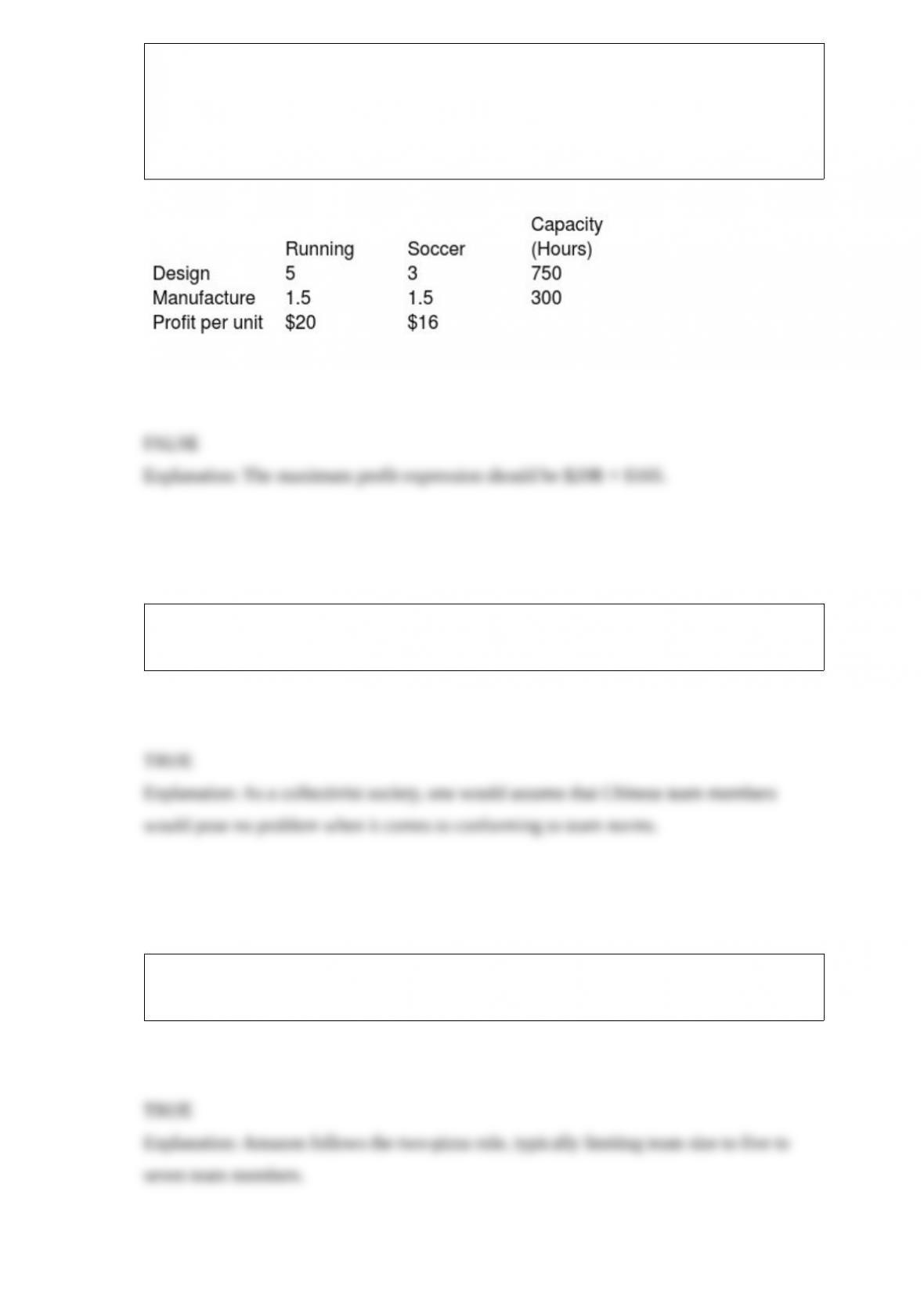
Production data is shown for the number of hours required per unit for the Running and
Soccer versions of Streaks, custom made athletic shoes. Using linear programming, if
running shoes are represented by R and soccer shoes by S, the expression $16R + $20S
is equal to the maximum profit that can be made.
Monthly Product
Asch’s findings suggest that Chinese members of a global team might be expected to
conform easily to the team’s norms.
The “two pizza” rule states that the best teams should be small enough so that they can
be satisfied with no more than two pizzas.
A group consists of individuals who share specific goals.
An organic organization tends to be flexible and have few formal rules.
One specific role of team leadership is that team leaders are troubleshooters.
A person who is risk-averse might do well as a stock trader.
Productivity goals, according to Deming, should be strictly numerical to avoid
ambiguity.
In McGregor’s theory of motivation, managers with a Theory Y view of life think
people need to be given the freedom to make their own choices.
Feedback is a response that confirms a message.
Fiedler’s contingency model focused on having employees describe their ideal
coworker.
Effective teams should avoid conflict at all costs.
The four contemporary management processes are planning, organizing, leading, and
commanding.
A goal of efficiency is to minimize output costs while maximizing input costs.
Fayol feels that managers should be given authority over workers, but not the ability to
give orders.
Operations management is a subsystem of the transformation process.
Idea champions tend to be risk takers.
Globalization Debate (Scenario)
In his international business class, Professor Jang organizes a debate on the societal
effects of market globalization. Juan Prince takes a position that highlights the negative
effects of market globalization. He emphasizes how multinational enterprises can wield
so much influence that they threaten national sovereignty. He also notes the prevalence
of low wages and sweatshop conditions as firms utilize low-cost labor abroad. Juan
then describes the detrimental effects of corporate pollution on the environment, and he
ends his argument by explaining how market globalization helps homogenize national
cultures. Rina Taylor is assigned to counter Juan’s position.
Which of the following statements most likely to counters Juan’s argument concerning
the homogenization of national cultures?
A) As globalization standardizes superficial aspects of life across national cultures,
people resist these forces by insisting on their national identity and taking steps to
protect it.
B) Foreign values tend to shift not just superficial aspects of culture, but deeply held
beliefs as well.
C) Material goods such as cell phones and computers are found in most homes
throughout the world.
D) In most industries, domestic operation alone cannot sustain competitive business
growth.
Survival rates of entrepreneurial ventures that started in a recession are ________ those
that started in an expansion.
A) somewhat greater than
B) less than
C) about the same as
D) much greater than
A system is defined as a set of interrelated and interdependent parts that function
________.
A) as separate entities
B) together as a unified whole
C) in competition with one another
D) without any link to the outside world
The dual nature of leadership behaviors suggests that both ________ and ________ are
important determinants of leadership.
A) focus on work; focus on employees
B) focus on traits; focus on behaviors
C) situations; organizations
D) followers; leaders
Recruitment (Scenario)
Keena’s company was expanding. After a period of downsizing, the company had
decided to increase organizational profitability by gaining market share, which meant a
need for more people. As assistant manager of human resources, she was in the process
of evaluating what would be the most effective means of gaining new employees who
were qualified, were cost efficient, and could help maintain the company’s commitment
to a diversified workforce.
With regard to costs to HRM, which choice would probably be best for Keena?
A) advertisement
B) employee leasing
C) private employment agency
D) internal search
All organizations produce goods or services through the ________ process.
A) transformation
B) service
C) manufacturing
D) operations
Joan Woodward conducted pioneering studies on how this affected the structure of
companies.
A) ethics
B) technology
C) values
D) corporate culture
When is it strongly recommended that a speaker use language that is highly simplified?
A) when both the listener and speaker speak the same language
B) when both the listener and speaker speak different languages
C) when both the listener and speaker speak English
D) when both the listener and speaker speak a language other than English
A bus company is a ________ organization because its product is ________.
A) service; buses
B) manufacturing; transportation
C) service; transportation
D) manufacturing; buses
Northrup Grumman Corporation empowers employees to ________ about products
throughout the manufacturing process as a means of monitoring quality.
A) accept decisions
B) reject decisions
C) make accept/reject decisions
D) obey decisions
The JCM is seen in the integrated model of motivation in that jobs that are designed
around the five JCM dimensions ________.
A) increase motivation because workers enjoy the work and autonomy they provide
B) decrease motivation because the work is too easy to complete and the autonomy
lacks structure
C) increase motivation by applying pressure to employees
D) decrease motivation by giving employees too much autonomy
Authority gives an individual the right to do this.
A) give orders
B) reprimand employees
C) command respect
D) obey orders
Mary Parker Follett’s work was devoted to identifying differences in the way
individuals behaved when they were ________.
A) under stress
B) discriminated against
C) lacking in resources
D) in groups
Which of the following defines a problem in the decision-making process?
A) a discrepancy between what exists and what the decision maker desires to exist
B) a discrepancy between the ideal and the practical
C) something that causes irritation
D) something that calls for attention
When a customer service customer gets frustrated from being put on hold during a
service call for 30 minutes, the company is having problems with which service quality
dimension?
A) timeliness
B) consistency
C) convenience
D) courtesy
The ________ is the series of work actions that add value to a product as it is being
transformed from inputs to finished product.
A) supply chain
B) value chain
C) output chain
D) input chain
Studies show that ________ personalities show negative effects from stress.
A) Type A
B) Type B
C) neither Type A nor Type B
D) both Type A and Type B
Which of the following best explains why Internet jargon tends to evolve most quickly
from cell phone users rather than computer users?
A) More people use cell phones than ever before, causing them to lead the way in every
electronic trend.
B) Cell phone keyboards are small and awkward to use so users abbreviate to avoid
typing.
C) Cell phone keyboards are compact and efficient, causing users to type more
frequently.
D) Cell phones have abbreviations that are built into their software applications. These
abbreviations tend to get adopted by consumers.
Fiedler concluded that relationship-oriented leaders performed best when the situation
was ________.
A) highly favorable
B) highly unfavorable
C) either highly favorable or highly unfavorable
D) moderately favorable or moderately unfavorable
What is the best course of action when there is a mismatch between the employee and
the job?
A) employee counseling
B) fire the employee
C) reassign the employee to a better-matched job
D) provide training
Rather than try to make employees happy, managers might do well to focus on making
work ________.
A) easy to accomplish
B) challenging and interesting
C) challenging and difficult
D) simple rather than complex
Acme Corporation (Scenario)
Acme Corporation’s management feels that employees could be more motivated by
their jobs. The jobs were enriched earlier and some improvements were seen in
motivation.
Acme managers explained how important their product was to the world economy.
Which core dimension in the job characteristics model is this?
A) skill variety
B) task identity
C) task significance
D) autonomy
Managers who are carrying out value chain management invest ________ than
managers of conventional organizations.
A) less time and energy
B) more time and energy
C) more of their own money
D) more of the company’s money
With regard to social networks, many companies are now
A) encouraging employees to use social networks as a tool to work collaboratively.
B) discouraging younger employees from using company in-house networks for
customer networking.
C) encouraging younger employees to seek counseling for social network addiction.
D) discouraging older employees to make social connections on social networks
Recruitment (Scenario)
Keena’s company was expanding. After a period of downsizing, the company had
decided to increase organizational profitability by gaining market share, which meant a
need for more people. As assistant manager of human resources, she was in the process
of evaluating what would be the most effective means of gaining new employees who
were qualified, were cost efficient, and could help maintain the company’s commitment
to a diversified workforce.
Keena’s company needs to increase the diversity of its workforce. Which choice might
this requirement rule out?
A) employee referral
B) advertising
C) school placement
D) private employment agency
Which psychological orientation would be typical of a manager who is pessimistic
about her business environment?
A) a maximin orientation
B) a minimin orientation
C) a maximax orientation
D) a minimax orientation
Manufacturing organizations ________.
A) produce physical outputs
B) produce nonphysical outputs
C) require nonphysical inputs
D) require physical inputs
In a condition of certainty, ________.
A) most outcomes are known
B) the decision is already made
C) all outcomes of all alternatives are known
D) some alternatives are not known
A queuing theory analysis for the Department of Motor Vehicles determines that
customers typically wait for 8 minutes and that the agency should strive never to exceed
more than 5 customers in a single line. An analysis comes up with a value for P of
0.125. What does this P value mean?
A) that customers will wait an average of 12.5 minutes
B) that the chances that a customer will need to wait for more than 5 people in line are 1
in 8
C) that customers will wait an average of 0.125 minutes
D) that the chances that a customer will need to wait for more than 5 people in line are
1 in 12.5
During the launching of a venture, which of the following is accomplished?
A) creating a top management team
B) establishing a mission
C) setting goals and strategy
D) patenting the product or service
Which of the following best defines plans?
A) documents that identify company problems
B) documents that define goals
C) documents that describe how goals will be met
D) documents that identify how goals from the past were met