
A critical part has a manufacturing specification (in cm) of 0.325 ± 010. Based on
historic information, if this measurement is larger than 0.335 or smaller than 0.315 the
product fails at a cost of $120. Determine the Taguchi loss function.
a. L(x) = 1,200,000 (0.325 − 315)2
b. L(x) = 1,200,000 (x − 325)2
c. L(x) = 1,200 (x − 325)2
d. L(x) = 1,200 (0.325 − 315)2
Answer:
Which is the correct order of hierarchy of process design?
a. Activity, task, process, value chain
b. Value chain, process, task, activity
c. Process, value chain, activity, task
d. Value chain, process, activity, task
Answer:
Appliances and iPods are examples of _____ goods.

a. Custom
b. Option
c. Standard
d. assemble-to-order
Answer:
For a Marriott hotel call center the expected service rate was 2.0 minutes per telephone
call per customer service representative (CSR). With 3 telephone CSRs on duty during
the 6:30 to 7:00 a.m. time period, and assuming a 90% target CSR labor utilization rate,
how many telephone calls can these 3 CSRs handle during this time period?
Answer:
Machine downtime is an example of which type of quality cost?
a. Prevention costs
b. Appraisal costs
c. Internal failure costs
d. External failure costs
Answer:
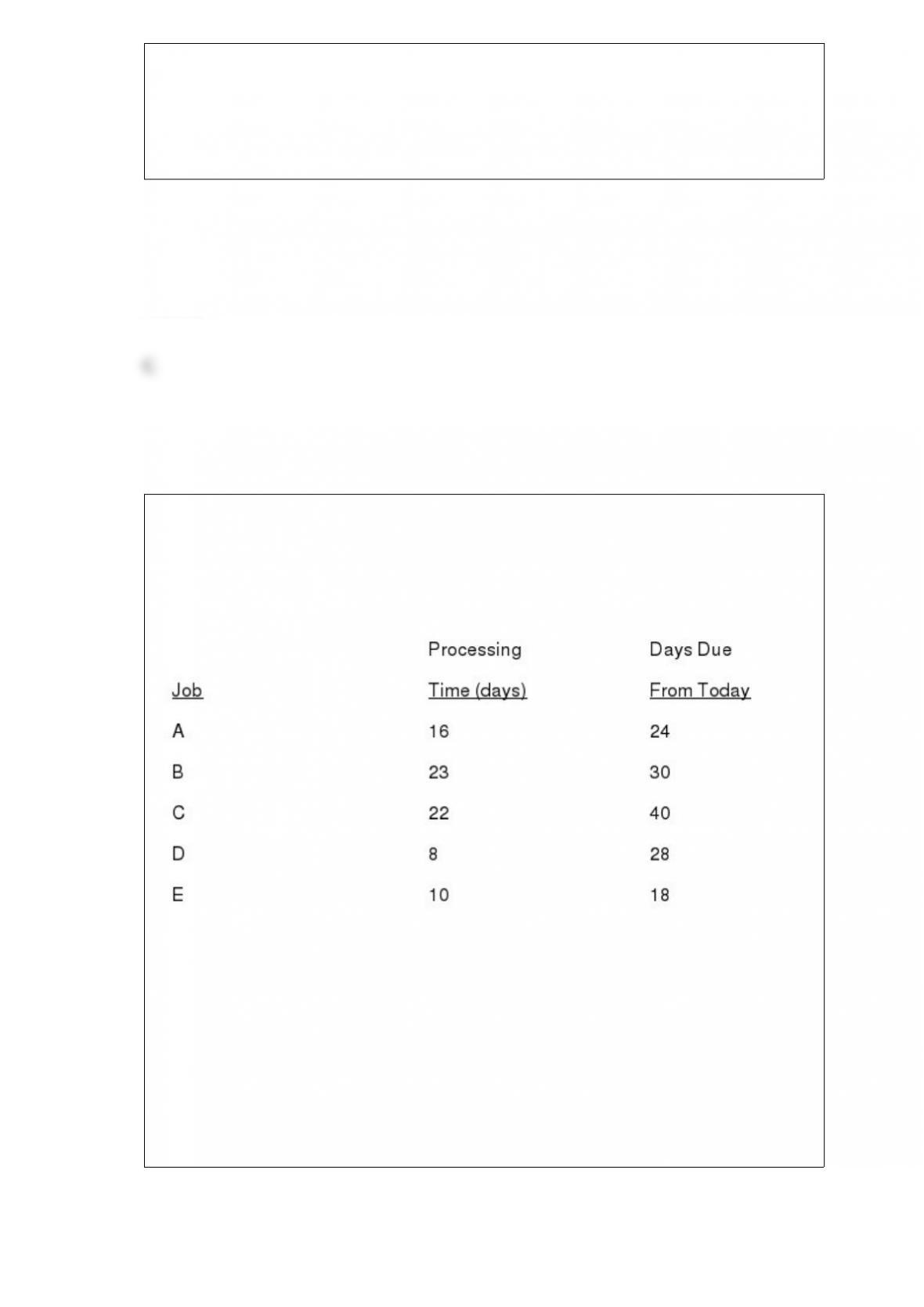
The table below includes processing times and due dates for five jobs.
Using the earliest due date (EDD) rule, the average tardiness for the five jobs is _____.
a. less than or equal to 10 days
b. more than 10 but less than or equal to 20 days
c. more than 20 but less than or equal to 30 days
d. more than 30 but less than or equal to 40 days

Answer:
Support processes typically include all of the following EXCEPT _____.
a. inventory management
b. day care on-site services
c. research and development
d. manufacturing and assembly
Answer:
To monitor the fraction of printed circuit boards that do not pass a functional test, a(n)
_____ is used.
a. k-chart
b. p-chart
c. c-chart
d. R-chart
Answer:

Which of the following statements is TRUE of a decision tree?
a. The number at each endpoint of a decision tree represents the probability associated
with a particular chain of events.
b. A decision tree cannot be used for complex business decisions.
c. In a decision tree, event nodes are represented by squares, while decision nodes are
represented by circles.
d. Expected value calculations can be made directly on a decision tree to arrive at the
best decision strategy.
Answer:
_____ forecasts are necessary to plan for facility expansion.
a. Long-range
b. Intermediate-range
c. Short-range
d. Demand planning
Answer:

_____ forecasts are needed for planning production schedules and to assign workers to
jobs.
a. Long-range
b. Intermediate-range
c. Short-range
d. Demand planning
Answer:
For a single-server queuing model, which of the following is NOT a key assumption?
a. The pattern of arrivals follows a Poisson probability distribution.
b. Service times follow an exponential probability distribution.
c. The queue discipline is random.
d. No balking or reneging happens.
Answer:
In designing _____ layouts, one is concerned with the arrangement of departments or
work centers relative to each other.
a. product
b. cellular
c. process
d. fixed-position
Answer:
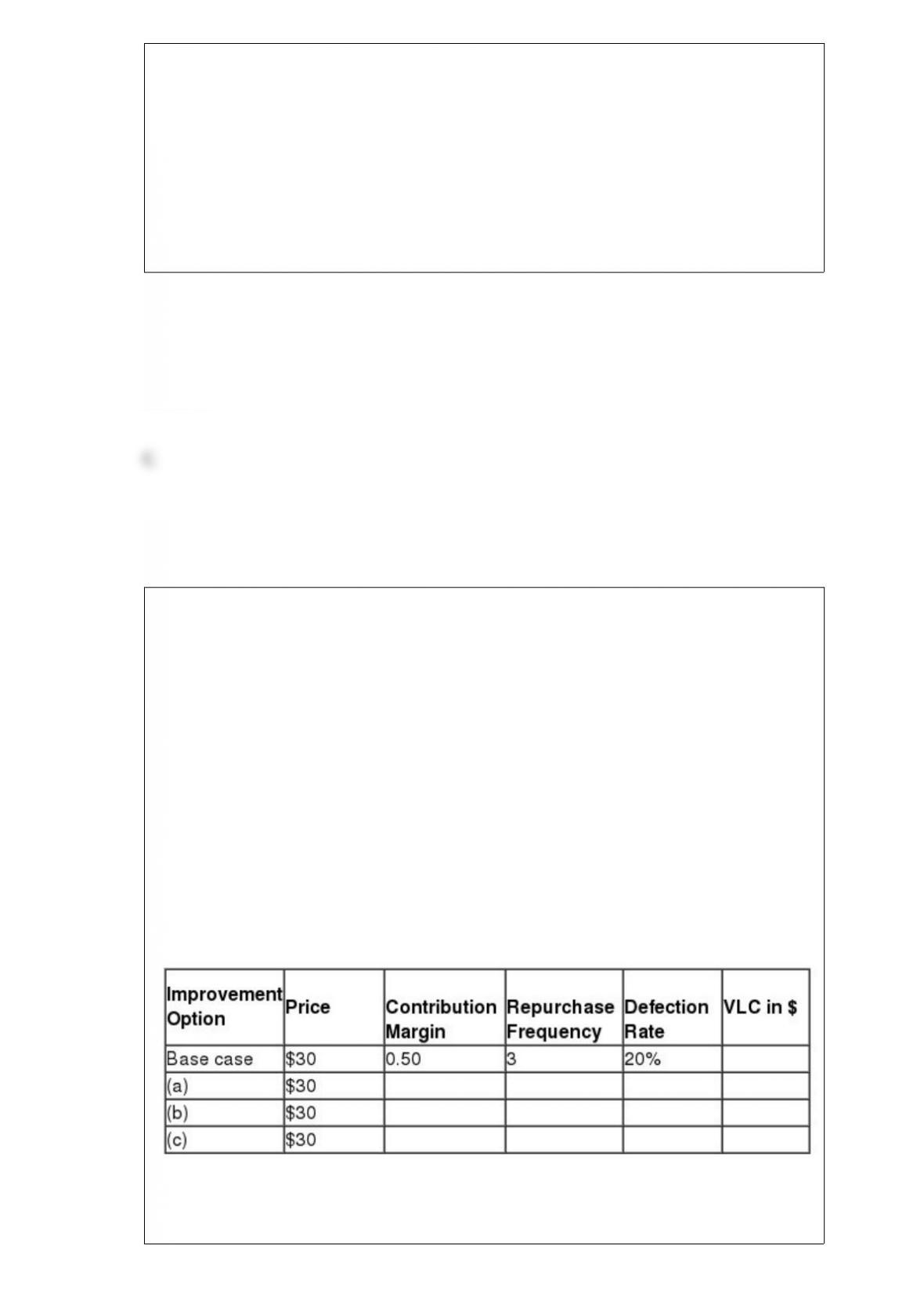
A retail store sells a popular cosmetic called Devineand the store manager is given
$300,000 by the corporate office to improve store performance any way she thinks best.
The “base case” information is a price of $30 per bottle, a contribution margin of 0.50, a
customer defection rate of 20%, and a repurchase frequency of 3 times a year. If these
improvement funds could be used to either (a) increase the contribution margin to 0.60
or (b) reduce the customer defection rate to 12% or (c) increase the repurchase
frequency to 4 times per year, what is the best way to spend these improvement funds?
(Assume all other variables remain at the base case level for each of the three
improvement options.) VLC = P*CM*RF*BLC
You may want to use the worksheet below to help organize your computations and
answer of the multiple choice question(s).
Which of the following is the best way to use the $300,000 in improvement funds?

a. Do nothing (stay with base case).
b. Improve option (a).
c. Improve option (b).
d. Improve option (c).
Answer:
John Morton, director of materials management for Computer Products Corporation
(CPC) in San Jose, is reviewing next year’s plans for the supply of a component that is
purchased from Osiega Ltd., a company in Japan. The component is the PS100 power
supply assembly that is used in many of CPC’s products.
CPC pays the supplier more than $7 million per year for these units, and John wonders
if money could be saved by developing another supplier for this component or if CPC
should gear up to manufacture the power supply assemblies in-house within one of
CPC’s own production plants.
John’s purchasing-analysis staff has developed the following estimates:
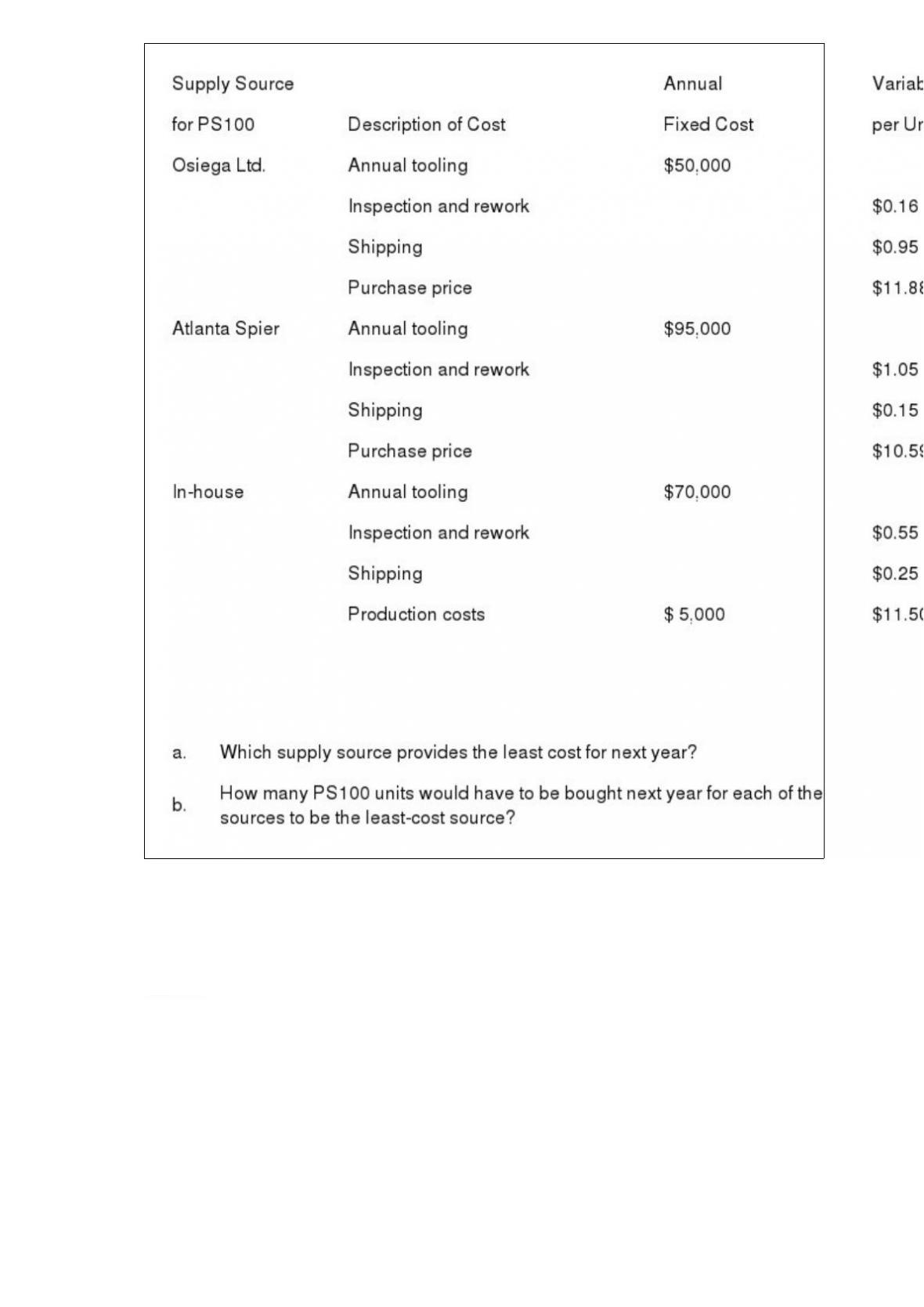
The purchasing-analysis group has learned that CPC will need about 550,000 of the
PS100 units next year.
Answer:
If a redundant component is added to a system, the overall value of system reliability
will:
a. increase.
b. decrease.
c. stay the same.
d. become unstable.
Answer:
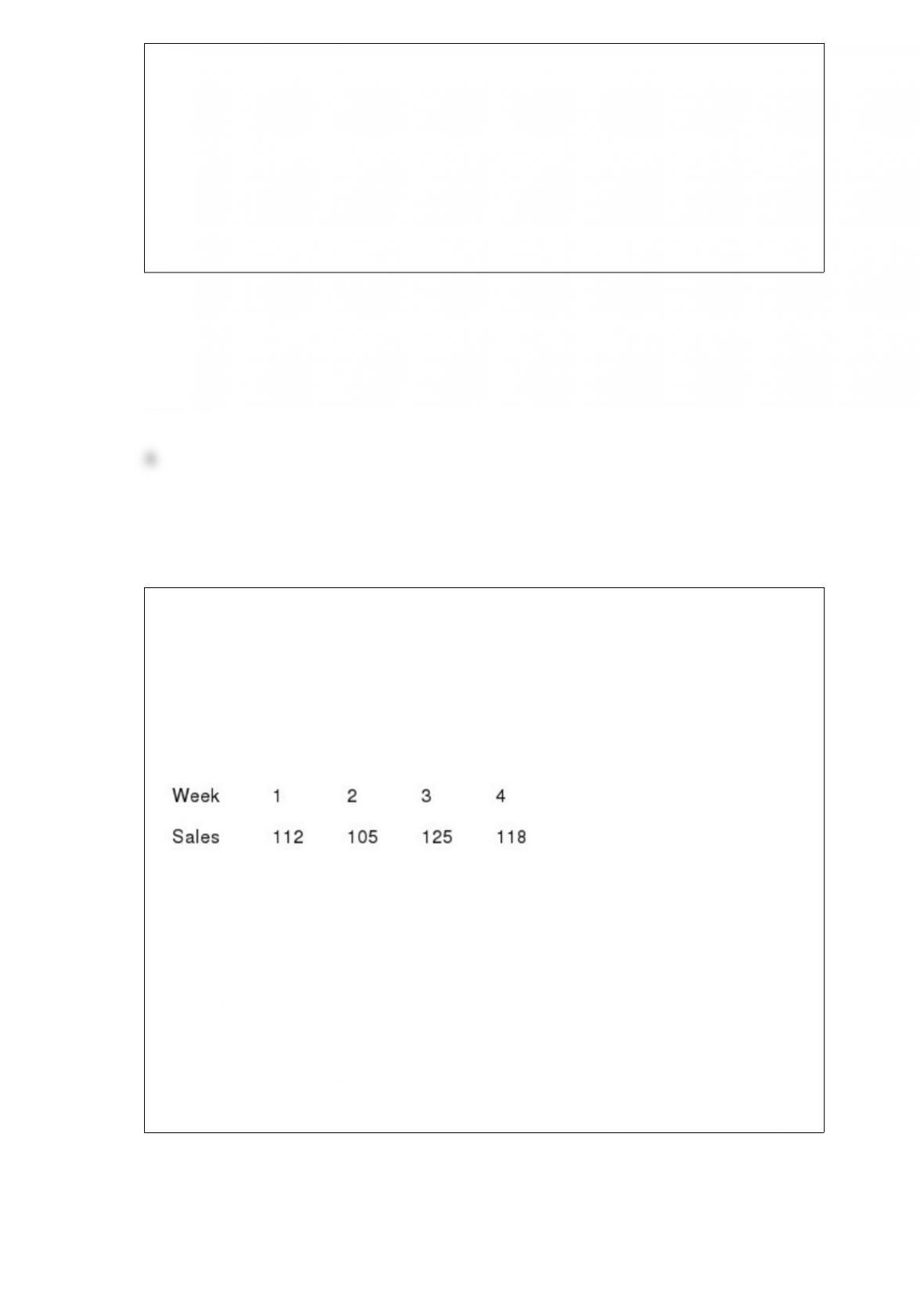
Using the data shown below in Table 3 for the sales of a new CD at a store for the last 4
weeks, answer the questions from #16 to #18.
Table 3
The actual sales for week 5 were 105 units. The four-period moving average forecast
for week 6 is:
a. less than or equal to 100.
b. more than 100 but less than or equal to 110.
c. more than 110 but less than or equal to 120.
d. more than 120 but less than or equal to 130.
Answer:
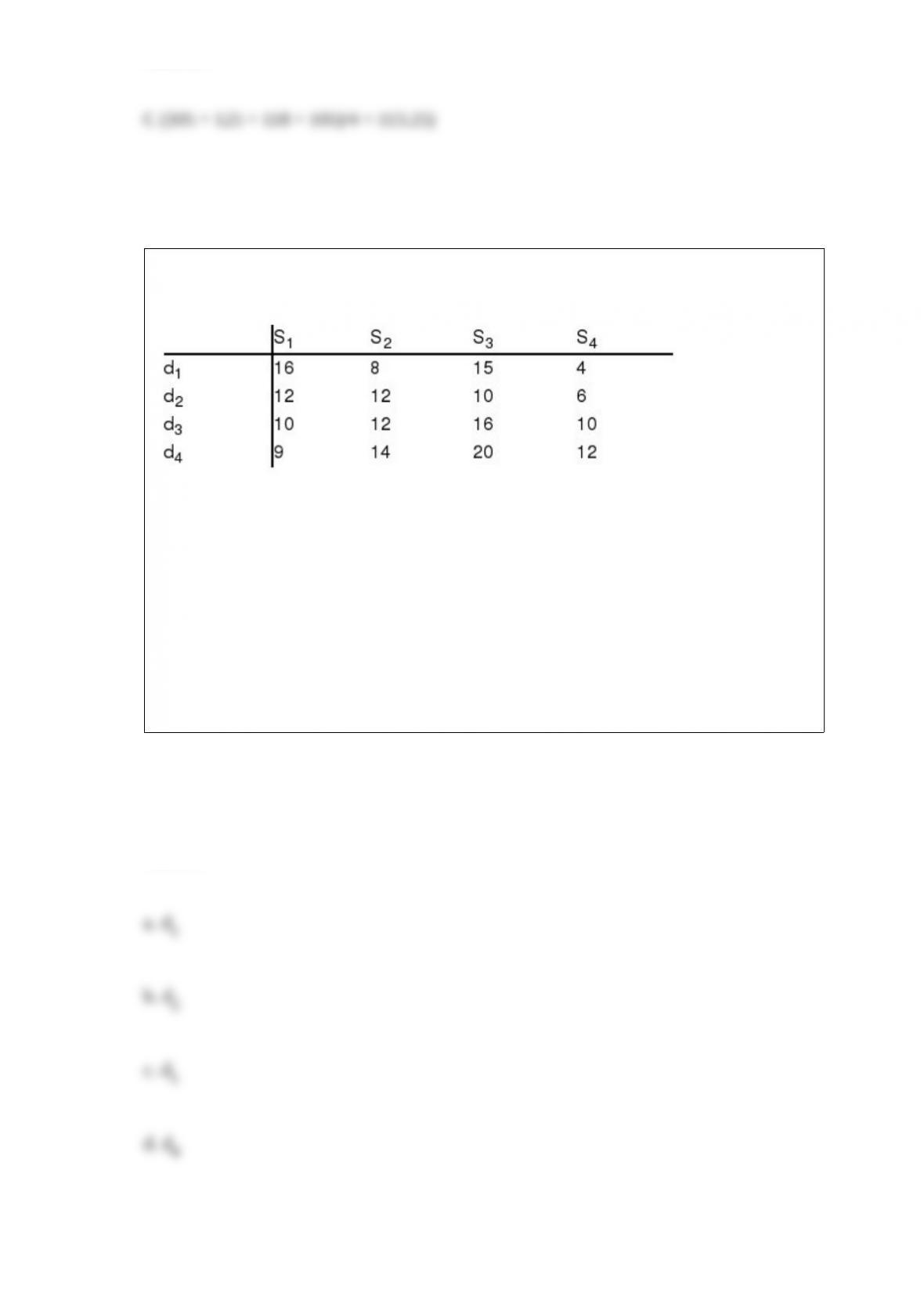
The following table shows cost payoffs for four decision variables and four states of
nature.
a. Which decision variable would be selected using minimin criteria?
b. Which decision variable would be selected using minimax?
c. Which decision variable would be selected using minimax-regret criteria.
d. Suppose the decision maker assigns the probability for S1 = 0.10; S2 = 0.25; S3 =
0.45; and S4 = 0.20, which decision variable would be selected using the expected value
criterion?
Answer:

A computer implementation free from logical errors and bugs refers to:
a. verification.
b. validation.
c. customization.
d. estimation.
Answer:
Evaluating the trade-offs between the costs of detection or replacement of a defective
part and costs of allowing a nonconformity to continue through the production process
is related to _____.
a. supplier certification and management
b. in-process control
c. finished-goods control
d. a continuous metric
Answer:
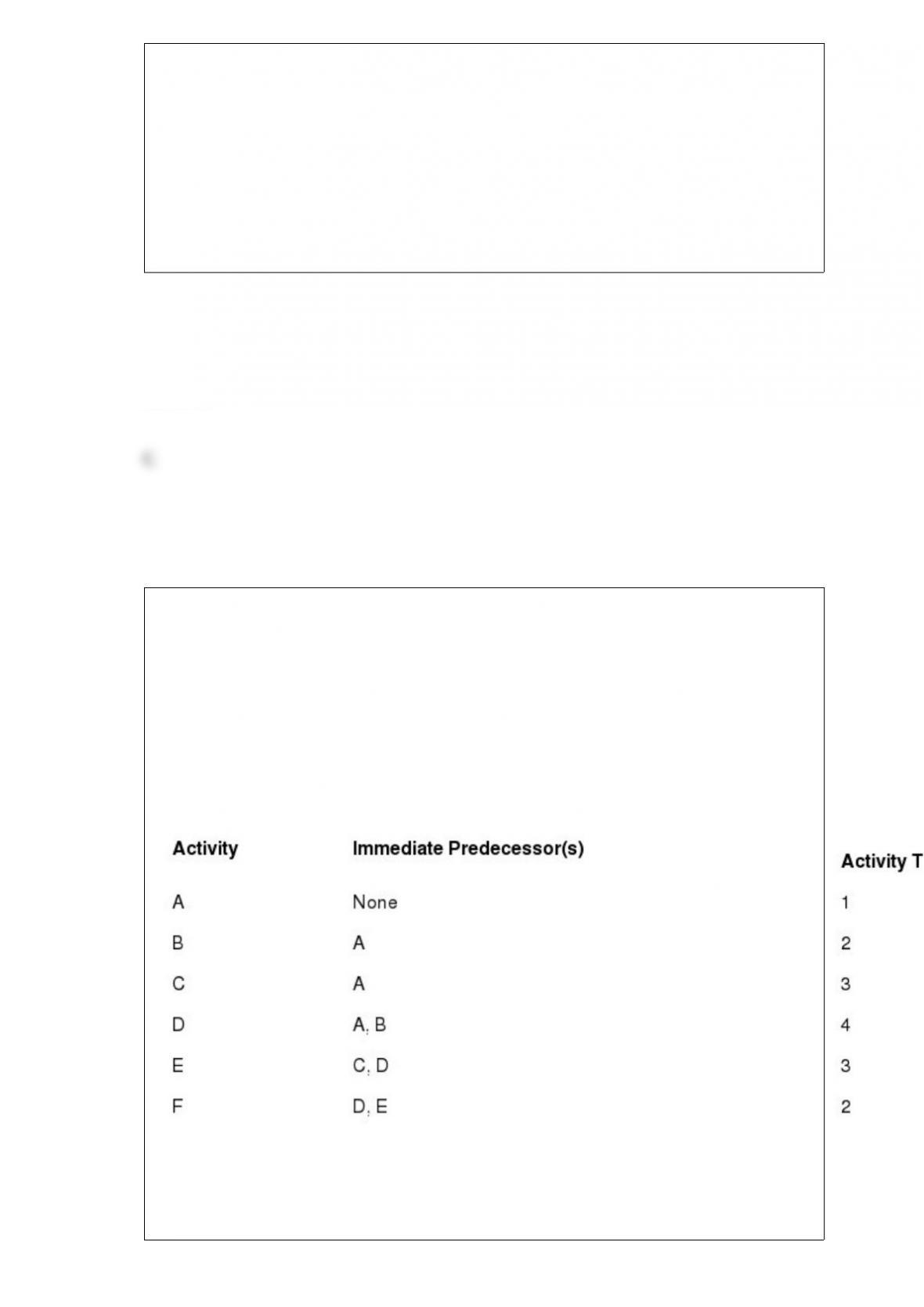
You are responsible for managing an advertising project with the following activities
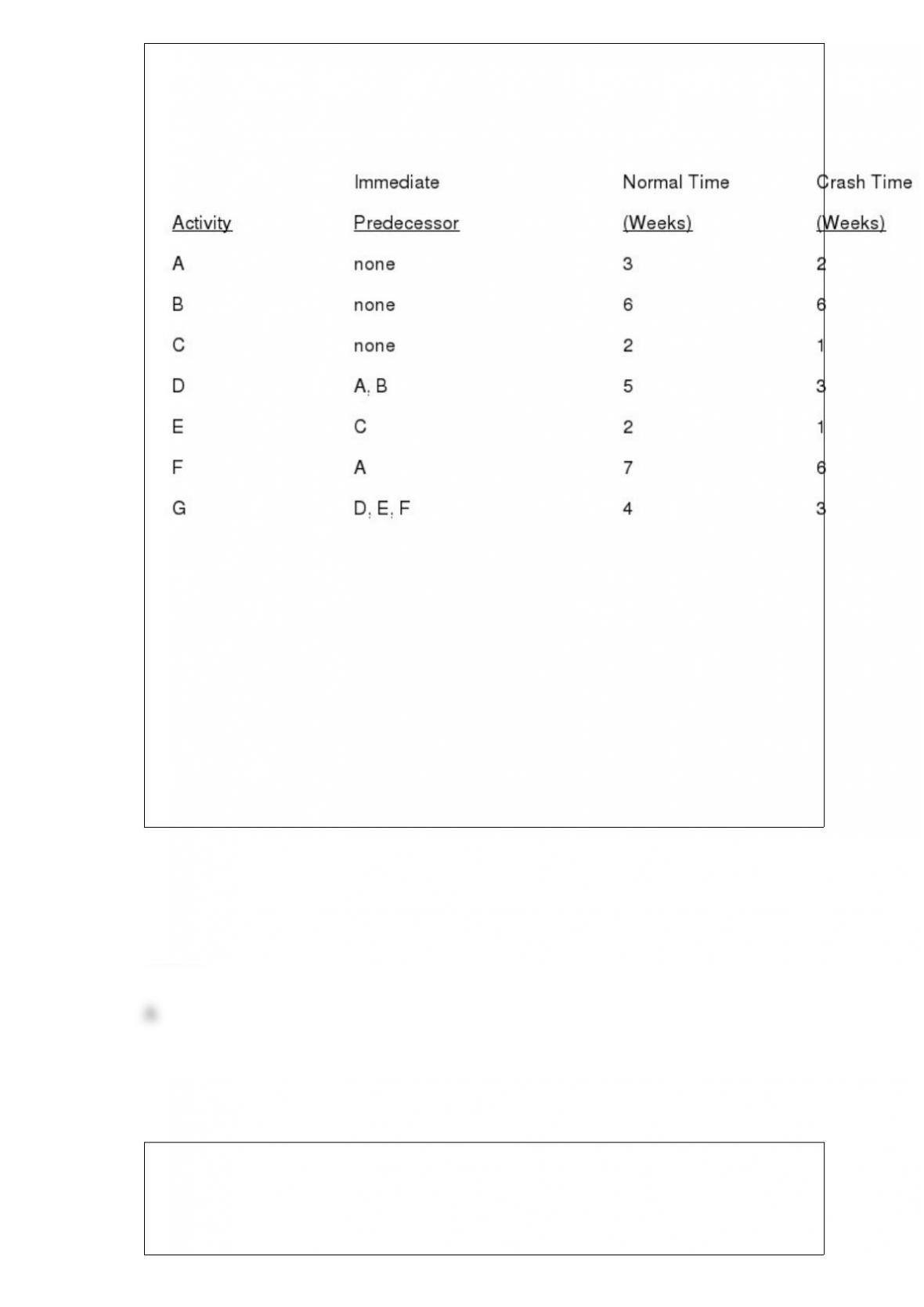
(times are given in weeks).
Draw the project network here. BLANK SPACES
If activity D is delayed by 2 weeks, which one of the following statements is TRUE?
a. There are now two critical paths in the network.
b. The slack time for activity D changes to 1 week.
c. The project completion time is still 14 weeks.
d. The project completion time becomes 18 weeks.
Answer:
Table 1Statistical Process Control (SPC) Problem Data for Service Waiting Times
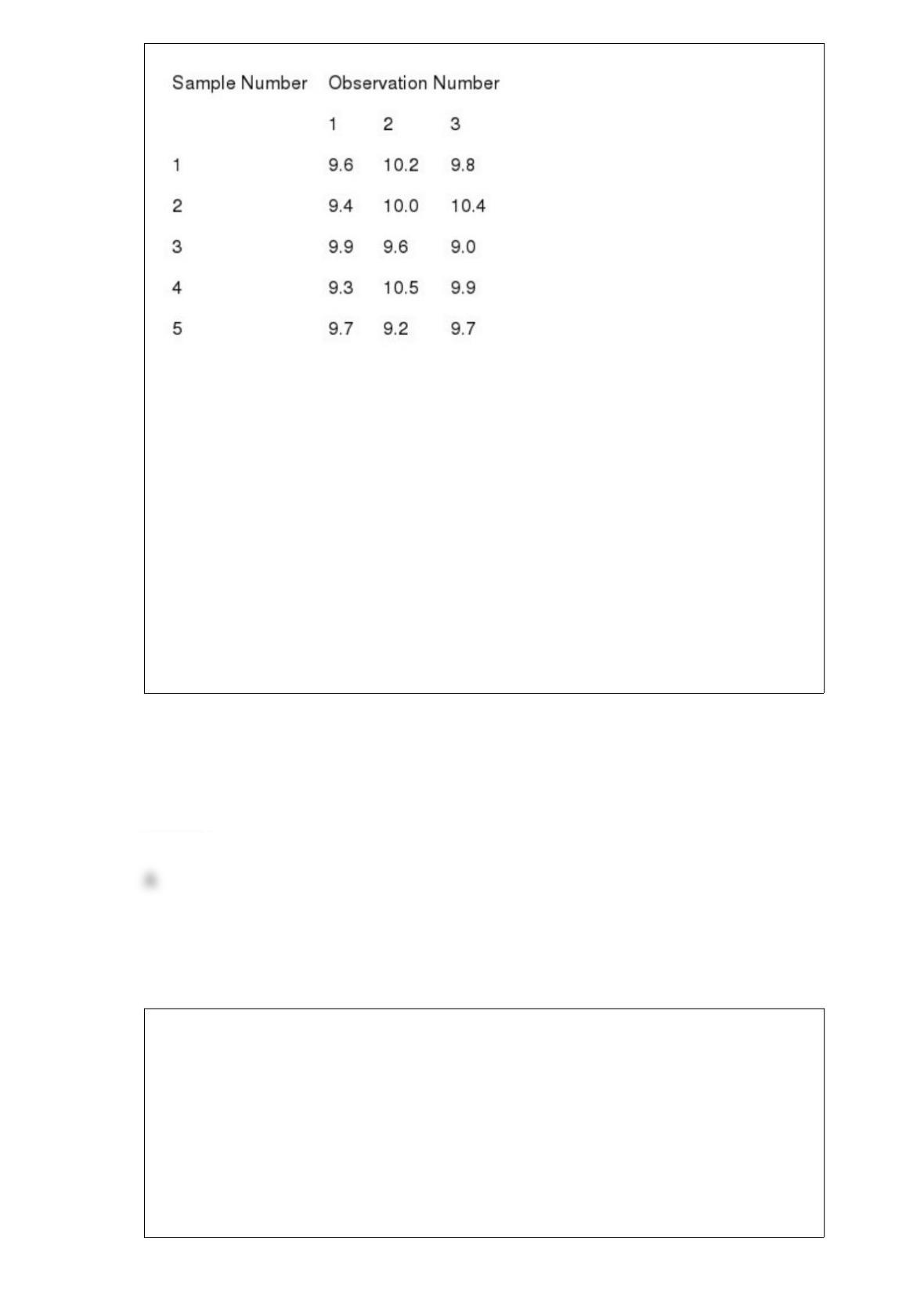
Given the previous results and analysis for the R-chart regarding service waiting times,
one would:
a. conclude that the R-chart is in statistical control and proceed to develop the x-bar
chart.
b. conclude that the R-chart is not in statistical control and proceed to develop the x-bar
chart.
c. investigate sample # 3 as it is outside the R-chart control limits and redo the R-chart.
d. conclude that the variation is not random and the decreasing trend in the range should
be investigated.
Answer:
Which one of the following statements is TRUE of Lean Six Sigma?
a. Lean principles focus on advanced statistical methods.
b. It is difficult to use lean methods in nonmanufacturing environments.
c. It uses basic root cause, process, and data analysis techniques.
d. Six Sigma and lean principles are separate bodies of knowledge.
Answer:
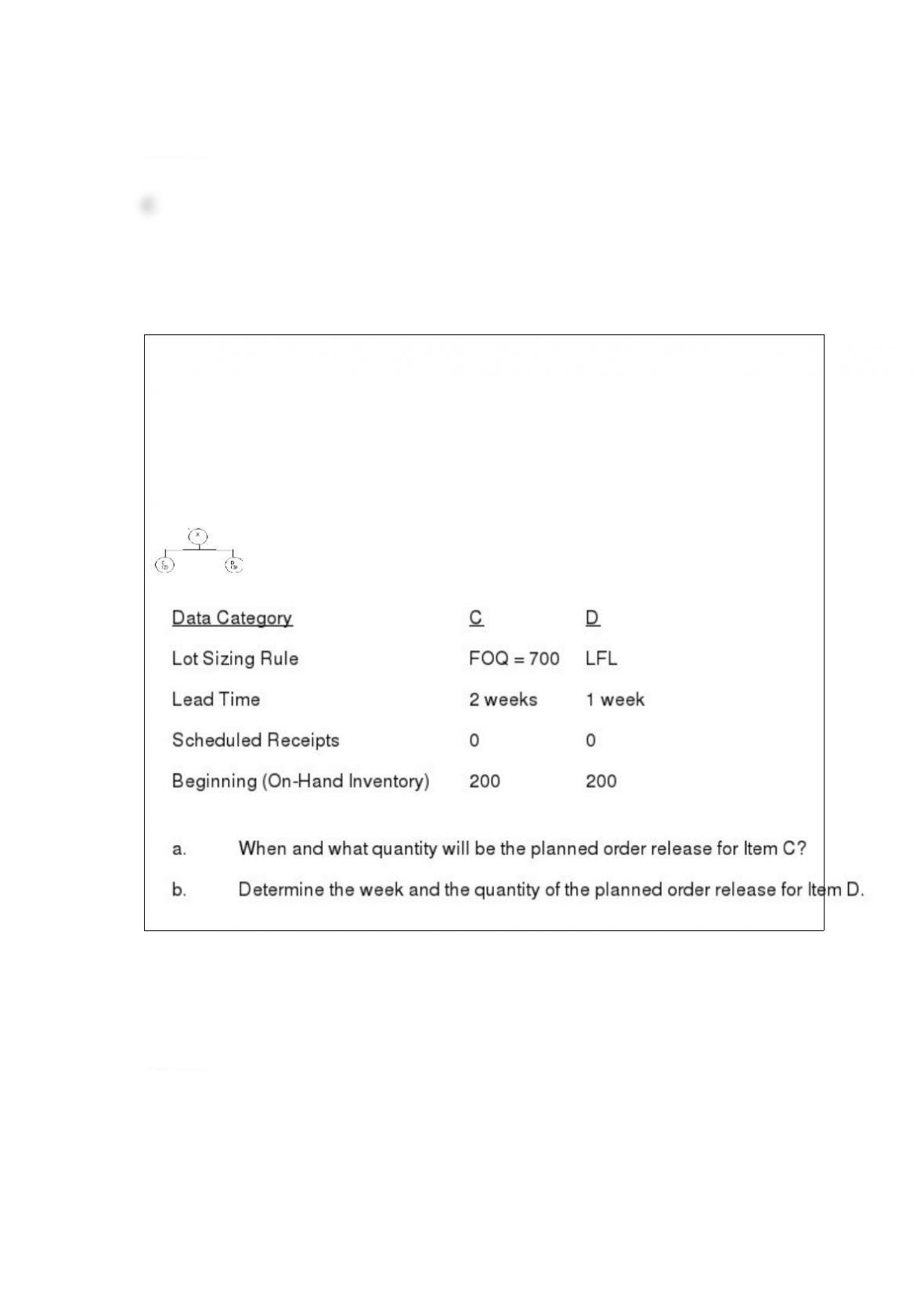
The bill of materials (BOM) for Product X is shown below, followed by a table of
inventory data. The master production schedule quantity calls for the completion of 300
Xs in Week 7. The lead time for the production of X is 2 weeks, and there are currently
no units of X available.
Answer:

Which one of the following statements about the Balloons Aloha case study on
scheduling and sequencing is TRUE?
a. The sequencing rule used did not impact average flow time but it did change
tardiness.
b. The earliest due date (EDD) rule was the best sequencing rule to use for this case
situation.
c. The shortest processing time (SPT) rule was the best sequencing rule to use for this
case situation.
d. Johnson’s rule was the best sequencing rule to use for this case situation.
Answer:
Demand that varies over time is called _____ demand.
a. static
b. dynamic
c. statistical
d. average
Answer:
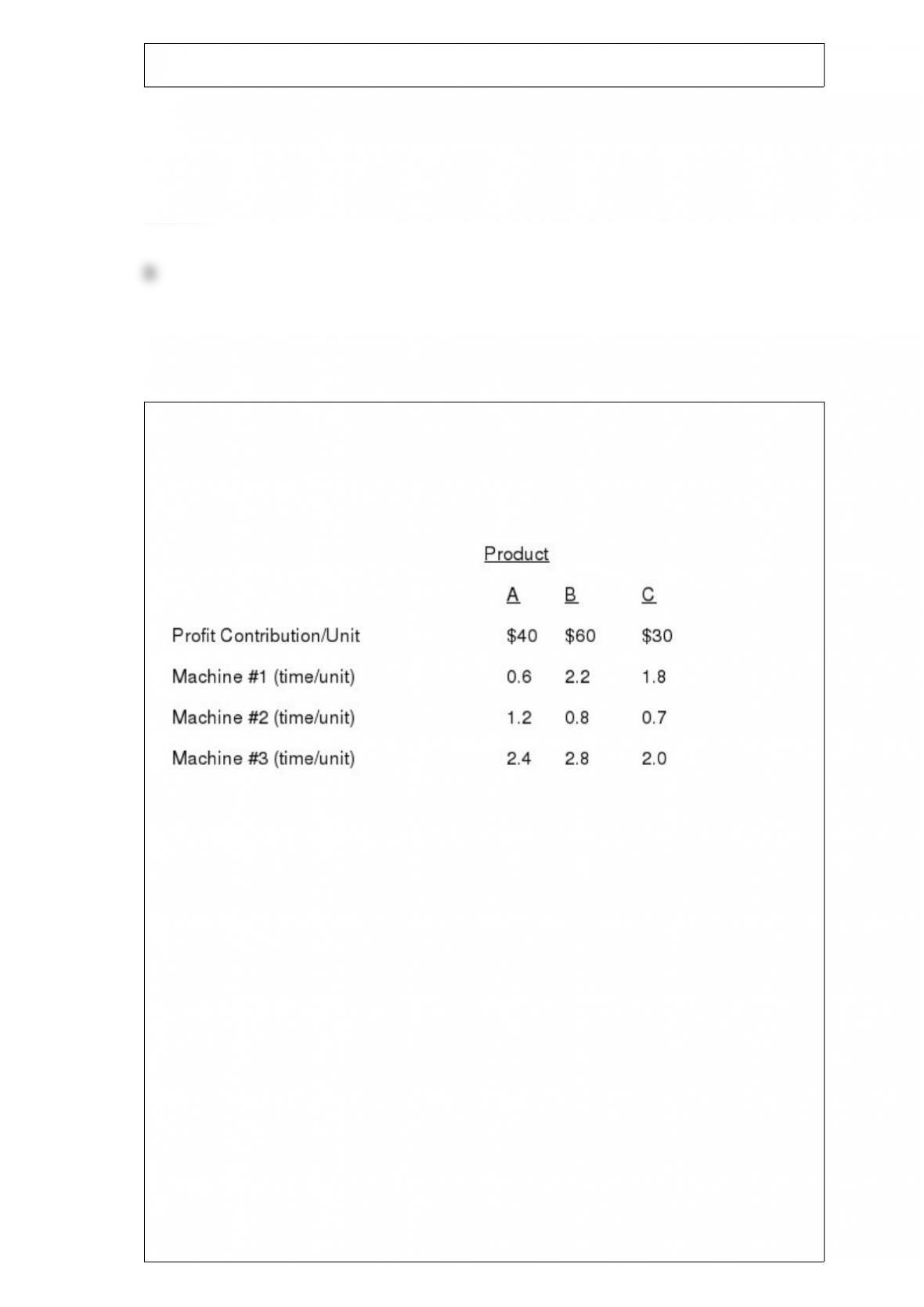
ABC Products Inc. produces three products (A, B, and C) on three machines. Machines
1 and 2 are available for 40 hours a week, and Machine 3 is available for 60 hours a
week. Profit contribution and standard production time in hours are given in the
following table:
Only one operator per machine is required on Machines #1 and #2. Two operators are
required for Machine #3. Therefore, two hours of labor must be scheduled for each hour
of Machine #3’s time. To restate this requirement, two operators must be scheduled for
each hour of Machine #3’s operation, as well as one operator for each hour of Machine
#1’s operation and one operator for each hour of Machine #2’s operation. A total of 110
labor hours is available for assignment to the three machines during the coming week.
Other production requirements are that Product A cannot account for more than 40% of
the units produced and that Product C must account for at least 25% of the units
produced.
a. Develop the constraint for the capacity limit of Machine #1.
b. Develop the constraint for the capacity limit of Machine #3.
c. Develop the constraint for the labor capacity limit.
d. Develop the constraint for limiting Product A to no more than 40% of the units
produced.
e. Develop the constraint that ensures Product C accounts for at least 25% of the units
produced.
Answer:
Which of the following factors would generally NOT be part of a linear programming
model for blending?
a. Revenue
b. Cost
c. Product/component specifications
d. Supply = demand
Answer:

A firm will encounter short periods of over- and underutilization of resources with the
_____ strategy.
a. capacity lag
b. capacity straddle
c. capacity lead
d. capacity reduction
Answer:
Computer-aided manufacturing (CAM) has advantages over conventional
manufacturing approaches under many conditions. Which of the following is NOT such
a condition?
a. When homogeneous parts are manufactured
b. When frequent design changes are made
c. When the manufacturing process is complex
d. When expert operator skills and close control are required
Answer:
Work sampling _____.
a. is based on normal distribution
b. is used for repetitive work activities
c. determines the proportion of time spent doing certain activities
d. requires a systematic (non-random) sample to obtain a distribution of activities
Answer:
Shea is in charge of the “advertising program” for the Boston Red Sox baseball team
during their spring training in Fort Myers, Florida. She has defined the advertising
program as a project with the following characteristics. The goal is to fill all stadium
seats during the spring training season or she may not have the same job next yearthe
pressure is on!
For the original critical path method problem, the minimum number of activities that
would have to be crashed in order to reduce the project’s earliest completion time by
two weeks assuming all activity crash costs per week are the same and all activities can

be crashed is:
a. one activity.
b. two activities.
c. three activities.
d. four activities.
Answer:
Identify the performance perspective in the balanced scorecard model that includes
measures like intellectual and research assets, employee satisfaction, and skills
development.
a. Financial perspective
b. Customer perspective
c. Innovation and Learning perspective
d. Internal perspective
Answer:
In the context of the perspectives of a value chain, training and transportation delivery
services for customers would be considered as _____.

a. preproduction services
b. production processes
c. postproduction services
d. packaging services
Answer:
In a bill of materials (BOM), each component is comprised of one or more parent items.
Answer:
Normal time needs to be adjusted for personal time and avoidable delays.
Answer:

The theory of Baldrige Award states that leadership drives the system that creates
results.
Answer:
Based on data from a work-sampling study, an office worker spends 5 percent of his
time filing. Over the work-sampling period, he was idle 12 percent of the time. If the
worker filed 420 items in a 40-hour workweek while performing other activities, and if
his performance rating factor for filing was 0.95, determine the standard time, in
minutes, he took to file an item.
Answer:
A manufacturer’s average work-in-process inventory for Part 1234 is 1,450 parts. The
workstation produces parts at the rate of 170 parts per day. What is the average amount
of time a part spends at this workstation?
Answer:
Define a master production schedule (MPS) and explain how it differs from a final
assembly schedule.
Answer:
The higher the customer participation, the more uncertainty the firm has with respect to
service time.
Answer:
A quality characteristic has a specification (in cm) of 0.400 ± 03. If the value of the
quality characteristic exceeds 0.400 by the tolerance of 0.030 on either side, the product
will require a $180.00 repair. What is the appropriate Taguchi loss function?
Answer:
Assume the specifications for a part (in inches) are 4.00 ± 37, and the Taguchi loss
function is estimated to be L(x) = 8,300 (x − T)2. Determine the estimated loss if the
quality characteristic under study takes on a value of 4.50 inches.
Answer:
Regression analysis is used to predict times based on different attributes of work.
Answer:
Explain the concept of a customer benefit package (CBP). Also, differentiate a primary
good or service from a peripheral good or service.
Answer:
Explain each axis of the product-process matrix. Where is the most appropriate match?
Also, discuss the importance of the matrix to a company’s life cycle.
Answer:
With an unstable economy, it is difficult to predict actual demand for a product.
Answer:
Describe the Taguchi loss function. Contrast it to the goal-post model.

Answer:
Hardy Hospital is implementing the economic order quantity (EOQ) inventory control
system, and they need a good cost estimate to process a purchase order (PO). It takes 4
total labor hours to process a PO. The average number of stock-keeping units (SKUs)
on a PO is 4. The average wage for people working in the purchasing department is $22
per hour, plus employee benefits of $3 per hour. Fixed costs for the purchasing
department are $300,000 per year assuming 2,000 hours per employee per year
workweek. From the given information what is a good estimate of order cost (Co) to
use in the EOQ model?
a. Less than $10
b. More than $10 but less than or equal to $20
c. More than $20 but less than or equal to $30
d. More than $30 but less than or equal to $40
Answer:
An automobile emission testing center has six (6) inspectors and tests 50 vehicles per
hour. What should the service rate be in order to achieve 90% utilization?
a. Less than 5 vehicles per hour
b. More than 5 but less than or equal to 10 vehicles per hour
c. More than 10 but less than or equal to 15 vehicles per hour
d. More than 15 but less than or equal to 20 vehicles per hour
Answer:
Define value and discuss three ways for organizations to increase value.
Answer:

In the Activity-On-Node (AON) network, the nodes define the precedence
relationships, and the arcs define the work activities.
Answer: