
The element of the marketing mix that describes a means of communication between
the seller and buyer is known as
a. a product.
b. promotion.
c. the price.
d. the place or distribution.
e. advertising.
Answer:
Vinyl records, cassette tapes, CDs, and music downloads (mp3 files) are all members of
the same __________.
a. product form
b. product mix
c. product line
d. product item
e. product class
Answer:
Fifty percent or more of American adults have not had their teeth checked by a dentist
within the last five years. For these people, dental services would be classified as a(n)
a. shopping product.
b. convenience product.
c. specialty product.
d. unsought product.
e. business product.
Answer:
In the hierarchy of effects, interest refers to
a. the consumer’s ability to recognize and remember the product or brand name.
b. the consumer’s appraisal of the product or brand on important attributes.
c. an increase in the consumer’s desire to learn about some of the features of the product
or brand.
d. a favorable experience on the first trial, resulting in the consumer’s repeated purchase
and use of the product or brand.
e. the consumer’s first actual purchase and use of the product or brand.
Answer:
In 2010, Gartner Research and 1To1 Media recognized Microsoft Dynamics Customer
Relationship Management (CRM) and its xRM framework for delivering increased
productivity and cost savings for customers worldwide. Microsoft experts work
individually with customers on problem recognition and resolution and adapt their
enterprise software to meet the unique needs of the customer. The Microsoft expert is
engaged in __________ selling.
a. relationship
b. formula
c. suggestive
d. adaptive
e. consultative
Answer:
Franchising is attractive for the franchisee because
a. it gives the franchisee complete control over the delivery and presentation of
merchandise.
b. the license fees paid to the franchisor are the only fees the franchisee pays.
c. it relieves the franchisee from any company or product liabilities.
d. it offers the franchisee the opportunity to enter into a well-known, established
business where managerial advice is provided.
e. the franchisee is completely his or her own boss.
Answer:
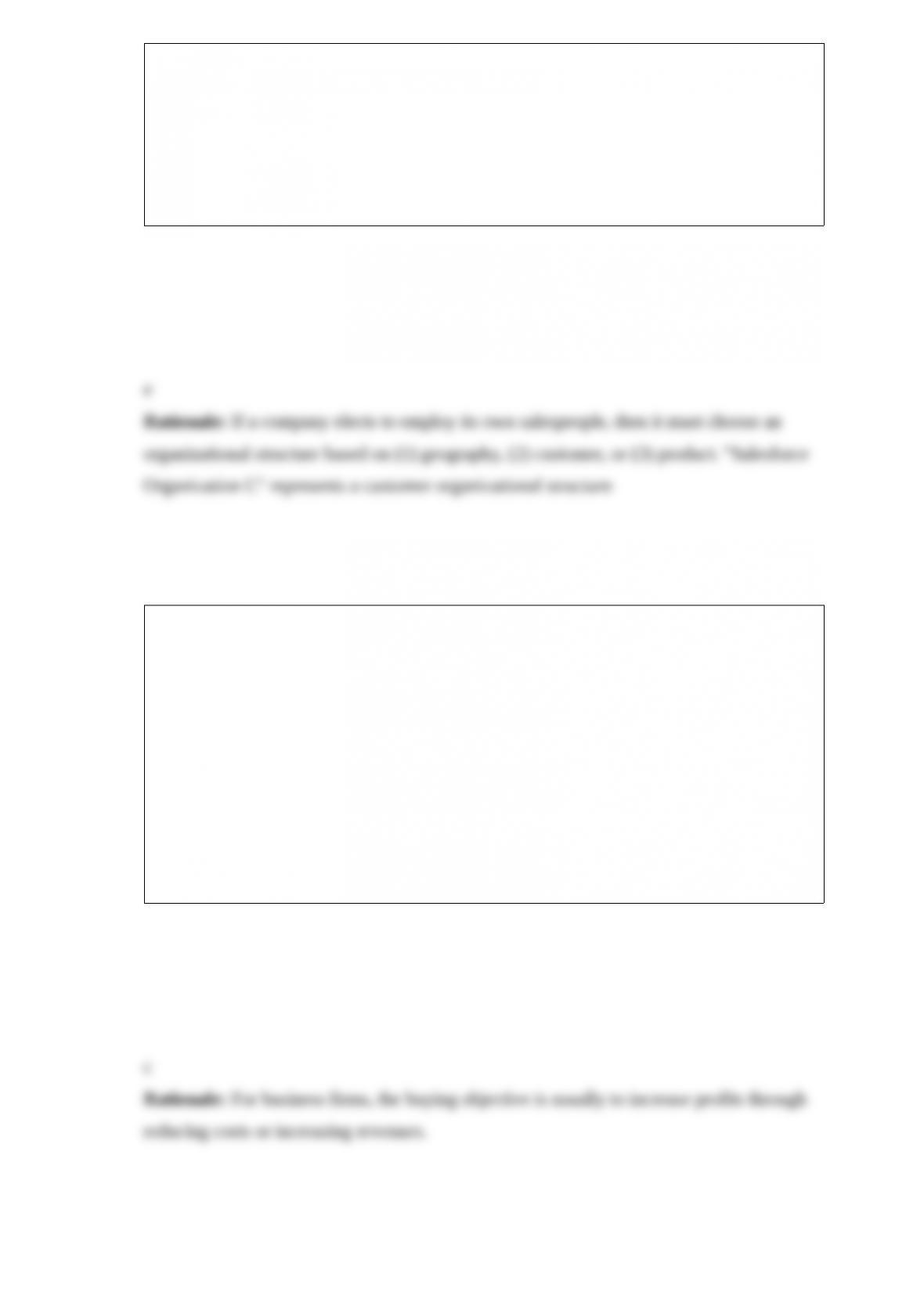
Figure 1.C
Consider Figure 1.C above. If a company chooses to employ its own salesforce, there
are three basic organizational salesforce structures from which to choose. “Salesforce
Organization C” represents which type of salesforce organizational structure?
a. geographical
b. NAICS
c. product
d. market type
e. customer
Answer:
The primary buying objective for business firms is usually to
a. increase profits through increasing costs and increasing revenues.
b. increase profits through reducing costs and decreasing revenues.
c. increase profits through reducing costs or increasing revenues.
d. maintain profits through reducing costs and increasing revenues.
e. reduce profits through reducing costs and reducing revenues.
Answer:

Subgroups within the larger, or national, culture with unique values, ideas, and attitudes
are referred to as
a. reference groups.
b. families.
c. social classes.
d. subcultures.
e. normative groups.
Answer:
You change the oil in your car yourself and dump the used oil down the sewer drain that
ultimately flows into the local river. Based on this information, is this a transaction
between you and the oil manufacturer?
a. Yes, you paid for the oil and you can do with it as you like.
b. Yes, the oil company adds a premium to the price to pay for oil cleanup in the
environment.
c. Yes, the oil will stay in the sewer and not hurt the ecosystem.
d. No, this is an issue of personal social responsibility because the polluted water affects
others in the society at large.
e. No, this is an issue solely between you and your neighbors.
Answer:
The personal selling process encompasses __________ distinct selling stages.
a. 3
b. 4
c. 5
d. 6
e. 7
Answer:
An Asian family living in San Francisco for four generations has three children. The
oldest son, George, is in medical school. Susan is a concert pianist at the age of 21. Fred
is a second-year business student. This family is likely to exhibit which of the following
Asian American buying patterns?
a. non-assimilated, yet celebrating their culture by purchasing authentic Asian goods
b. assimilated, exhibiting buying patterns very much like other typical American
consumers
c. assimilated, yet celebrating their culture by seeking traditional Asian occupations
d. non-assimilated, because of the inherent diversity of Asian subcultures that
transcends generations
e. non-assimilated, exhibiting buying patterns very much like other typical American
consumers
Answer:
A prospective buyer goes through a sequence of stages from initial awareness of a
product to eventual action (either trial or adoption of the product). The stages include
awareness, interest, evaluation, trial, and adoption, and are referred to as _________.
a. the hierarchy of effects
b. Maslow’s hierarchy
c. the purchase continuum
d. the consumer-product cycle
e. the consumer purchasing hierarchy
Answer:
The Ben & Jerry’s website states “Central to the mission of Ben & Jerry’s is the belief
that all three parts [product mission, economic mission, social mission] must thrive
equally in a manner that commands deep respect for individuals in and outside the
company and supports the communities of which they are a part.” This statement
reflects Ben & Jerry’s
a. sustainability doctrine.
b. goals and objectives.
c. core values.
d. moral distinctives.
e. functional strategy.
Answer:
The Sports Authority is a sporting goods superstore that provides year-round inventory
of equipment for just about any sport you can name. Even during the “off season”,
equipment for seasonal sports is available at the Sports Authority. Which utility does the
Sports Authority best provide?
a. time
b. convenience
c. possession
d. form
e. performance
Answer:
Smartphone apps are providing stiff competition for physical retail stores because
a. consumers using the app Instagram can shop instantly.
b. consumers can “tweet” their product preferences.
c. consumers can create and save shopping lists on their smartphones.
d. consumers can simultaneously check prices at other stores while shopping for a
product in a brick-and-mortar retail store.
e. consumers using the app ShopKick receive credit, discounts, and other incentives for
walking into a brick-and-mortar retail store.
Answer:
Harris Interactive, a large U.S. research firm, has identified six distinct online consumer
lifestyle segments: (1) click-and mortar; (2) hunter-gatherers; (3) brand loyalists; (4)
time-sensitive materialists; (5) hooked, online and single; and (6) __________.
a. desktop veterans
b. ebivalent newbies
c. media movers
d. drifting surfers
e. digital collaborators
Answer:
PepsiCo and __________ entered into a joint venture to market Frito-Lay’s, Cheetos,
Ruffles, and Doritos in Israel.
a. The Strauss Group
b. Ericsson
c. General Mills
d. Hebrew National
e. CGCT
Answer:
There are five common approaches to posttests: __________, unaided recall, attitude
tests, inquiry tests, and sales tests.
a. aided recall
b. jury tests
c. tracking testing
d. performance tests
e. comparison tests
Answer:
Based on a market-product grid framework, which marketing strategy offers all product
lines to all market segments?
a. full coverage
b. market specialization
c. product specialization
d. selective specialization
e. market-product concentration
Answer:
The four major types of limited-service merchant wholesalers are drop shippers, rack
jobbers, truck jobbers, and __________.
a. machine vendors
b. credit line wholesalers
c. transport vendors
d. cash and carry wholesalers
e. container transport vendors
Answer:
Because consumers often do not pay close attention to advertising messages, advertisers
want to reach the same audience more than once. The average number of times a person
in the target audience is exposed to a message or advertisement is referred to as

a. frequency.
b. CPM.
c. reach.
d. rating.
e. gross rating points.
Answer:
As the number of intermediaries between a producer and buyer increases, the channel is
viewed as increasing in __________.
a. variety
b. scope
c. depth
d. scale
e. length
Answer:

Campbell Soup spent seven years and $55 million on a super secret project to produce a
line of Intelligent Quisine (IQ) food products ‘scientifically proven to lower high levels
of cholesterol, blood sugar, and blood pressure.” They were responding to the needs and
desires expressed by consumers. However, after 15 months in an Ohio test market,
Campbell Soup yanked the entire IQ line because
a. Progresso Soups got to the stores first with a similar product and dominated the shelf
space.
b. the product’s claims were exaggerated and not backed up with scientific data.
c. the product was priced too high and there was too little product variety.
d. the price was too low, leaving the consumer believing that Campbell’s sacrificed taste
for nutrition.
e. a downturn in the economy shifted people’s desire from a healthy lifestyle to a desire
for home and comfort. The new soups were too different from the product they
remembered as children.
Answer:
One problem in the interstate trucking industry is the number of trucks that return
empty after making a delivery. There is a website where independent interstate truckers
can look for loads to carry on their return trips. Because the trucks would normally
return empty, truckers who use this website to generate business they would not have
had otherwise, receive a reduced shipping rate. This reduced rate is an example of
a. penetration pricing.
b. target pricing.
c. cost-plus pricing.
d. odd-even pricing.
e. yield management pricing.
Answer:
The agent for John Grisham’s newest novel has sold its rights to a British publisher for
sales in the United Kingdom and Ireland, to a U.S. publisher for the United States and
Canada, and to an Australian publisher for Australia and New Zealand. This is an
example of ________.
a. exclusive dealing
b. an exclusive territorial distributorship
c. a tying arrangement
d. a geographic compact
e. monopolistic competition
Answer:
According to the chief marketing officer at Mary Kay, Inc., “For Mary Kay to be
successful
in India, the company had to build a brand, build a sales force, and __________.”
a. establish brand licensing agreements with Chinese companies
b. engage in multibranding
c. build a multidomestic marketing strategy
d. create a private branding strategy
e. build an effective supply chain to service the sales force
Answer:
Many fast food restaurants, including Burger King, McDonald’s, and Wendy’s, no
longer use STYROFOAM™ containers (which do not degrade as quickly as paper in a
landfill) for packaging their products. Rather, these firms wrap their burgers in recycled
paper wrappers, containers, and bags. These fast-food restaurants are practicing
a. triple-top line marketing.
b. green marketing.
c. consumerism.
d. an ecological code of ethics.
e. cause marketing.
Answer:
Foreign countries with very low per capita incomes may, nonetheless, be attractive
markets for expensive goods. To get a more accurate picture of a country’s purchasing
power, a country’s __________ must also be considered.
a. total income
b. total area
c. geographical location
d. culture
e. income distribution
Answer:
At Mattel, Barbie is child-tested to be sure the doll cannot be broken apart and
accidentally choke a child. This type of safety test occurs during the __________ stage
of the new-product process.
a. new-product strategy development
b. development
c. business analysis
d. screening and evaluation
e. market testing
Answer:
Aside from an individual Facebook Page for a brand, what is the other mode of
advertising on Facebook?
a. Messages are sent to the “inbox” on a user’s profile page.
b. Pop-up ads appear after a user logs in.
c. Ads appear on the right-hand side of a user’s profile page.
d. They are integrated into the “newsfeed” on a Facebook user’s home page.
e. Facebook does not allow for any other forms of advertising.
Answer:
All of the following are psychographic segmentation variables EXCEPT:
a. lifestyle
b. needs
c. birth era
d. VALS
e. personality
Answer:
Warranties that specifically state the bounds of coverage, and more importantly, areas of
noncoverage, are referred to as __________ warranties.
a. express
b. functional
c. explicit
d. limited-coverage

e. implied
Answer: