
El Sol sunglasses were designed by an avant-garde artist. She said there were no
sunglasses out there that she would wear, so she had to design her own. Her sunglasses
were worn by a whacked-out bad guy in a blockbuster movie and, because of this, have
acquired a cult following among young teens. Print advertisements are visually
sparse-nothing more than a still shot from the movie and a logo for the brand.Eyewake
sunglasses were designed by an optician after he realized that conventional sunglasses
allowed in certain types of light that promoted eye fatigue. He made 1,000 of his
sunglasses and gave 100 of them away to friends and acquaintances. After trying them
out for awhile, several of them told him that they really liked them when they had to
drive for extended lengths of time. He placed an ad in the back of a tourism magazine,
extolling the safety benefit of driving with eyes that weren’t fatigued. He promptly sold
all of his remaining glasses.Kushyspecs sunglasses were developed after research
revealed that a small group of people didn’t like wearing sunglasses because most
sunglasses left pinch marks on their noses. The company that performed the research
developed sunglasses with a soft, cushiony nose piece. Advertisements for Kushyspecs
feature the headline “The mark of a good pair of sunglasses is no mark at all.”Which of
these brands of sunglasses uses benefit positioning in its advertisements?
a. all three-El Sol, Eyewake, and Kushyspecs
b. El Sol and Kushyspecs
c. Kushyspecs
d. Eyewake
The ____ specifies the media in which advertising messages will be placed to reach the
desired target audience.
a. media class
b. media plan
c. media vehicle
d. media mix

After a series of public relations setbacks, Japanese automaker Toyota unveiled a new
company slogan in 2010. The slogan read, “Drive a Toyota. You’ll never stop.” The
company hopes the new slogan can once again instill confidence into a number of
consumers who grew weary of the brand after a number of massive recalls in recent
years. The company chose to go with the slogan after turning down a number of others,
including, “Toyota Puts the Pedal to the Metal. And keeps it there,” and “Toyota. The
Last Car You’ll Ever Drive.” The new slogan will be featured in all of the company’s
future advertisements.(Andy Borowitz, “Toyota Unveils New Slogan: €Drive a Toyota.
You’ll Never Stop’.” The Huffington Post, February 6, 2010.)
As Toyota designs its new ad campaign, it will need to do in-depth copywriting along
the way. One of the most common mistakes in copywriting is
a. using generalizations and imprecise words.
b. failing to use cliches and superlatives.
c. communicating value to consumers.
d. avoiding sexist, racist, and offensive language.
Scenario 17-4
Trapper’s Lake Lodge is rustic hotel situated on a large lake in the Flat Tops Wilderness
Area. The lodge offers a relaxing getaway as well as guided fishing, hunting, bicycling,
and cross-country skiing trips from its remote location 250 miles away from a major
airport. Guests must travel the last 40 miles on a rough dirt road during the summer
months or ride a special snow car during the snow season. Trapper’s Lake Lodge
management has found that guests almost always have a wonderful experience during
their stay and swear they will visit again. Nonetheless, the biggest problem is getting
people to visit in the first place, probably due to the difficult travel involved. So the
lodge management has decided to mount an aggressive direct marketing campaign to
increase first-time guest visits as well as to nurture loyal frequent visitors.

A public relations consultant advises the lodge management that any direct marketing
campaign should be coordinated with its other advertising and promotional strategies.
In effect, the consultant is recommending that the lodge focus on ____, which should
always be the goal of advertising and promotion.
a. innovation
b. marcom management
c. integration
d. convenience
What test takes place over several days, usually with viewers watching a show at a
particular time, then being called later and questioned about its commercials?
a. DAR
b. MRI
c. AIO
d. ZMET
Overall, _____ marketing has been very effective for many firms and agencies because
it leads to decisions about who to attract, what to propose to them, and how to reach
them.
a. business-to-business

b. point-of-entry
c. STP
d. consumer
Which of the following are properties of emotions that make them potentially more
important than thoughts in assessing ad reactions?
a. They are good predictors of thoughts.
b. They are hard to understand but indicative of eventual purchase behavior.
c. They are easy to define and describe.
d. They are clear indicators of subliminal reactions.
Wood Carver Cabinet Makers recently developed a line of kitchen cabinets designed for
new custom homes and kitchen remodeling jobs. The line of cabinets is to be called
“Signature Hardwoods” and a new magazine advertising campaign is being tested. Each
of the ads that is being tested has a photograph of a woodworker handcrafting some part
of the cabinet. In addition, his or her signature is shown at the bottom of the page as an
indicator that the cabinets are carefully hand made.Wood Carver recruited a group of
consumers who were thinking about remodeling their kitchens and asked them a series
of questions about selecting new cabinets. A week later, Wood Carver showed the
consumers several of its magazine ads and then asked them questions to measure their
opinions towards the Wood Carver Cabinet products. What type of study did Wood
Carver conduct?
a. attitude change

b. split-transmission
c. thought listing
d. physiological
A marketer has been given the task of monitoring all the elements of the marketing mix
for a large Oregon winery. He has many responsibilities, but one aspect that he is not
concerned with is the ____ of the winery’s products.
a. production
b. conception
c. pricing
d. promotion
“Consumerism is a pattern of behavior that helps to destroy our environment, personal
financial health, the common good of individuals and human institutions.” This quote is
stated on the home page of a website called Overcoming Consumerism. The quote goes
on to say, “This site details methods that you can use to help defeat consumerism, save
money, work less and lead a more satisfying and environmentally benign life while you
help to restore the economic self-sufficiency of your
community.”(http://www.verdant.net/)
As one navigates from page to page on the site, advertising is often implicated as a
source of the movement toward consumerism. Many of the same criticisms of
advertising found on the site were outlined in the textbook.

One page on the site maintains that advertising seduces children into believing that
“their self-worth is based on $100 inflatable, illuminated sneakers.” Besides this
concern that ads promote superficiality and materialism, the text outlines other concerns
regarding children’s advertising. For instance, sophisticated ads aimed at children can
cause
a. conflicts between parents and children.
b. dissatisfaction with the actual programming.
c. controversies that cannot regulated by the government due to First Amendment
rights.
d. complex decision-making skills and adult purchasing processes at too young an age.
The truly revolutionary feature related to the growth of the Internet has been its ability
to
a. replace traditional forms of advertising.
b. grow beyond the $1 billion annually spent over the past few years.
c. alter the nature of communication within a commercial channel.
d. become the ultimate medium of today’s young people.
Websites frequented by individuals with common interests where they can post facts,
opinions, and personal experiences have emerged as sophisticated sources of product
and brand information. This definition refers to
a. spam.
b. blogs.
c. phishing.
d. chat rooms.
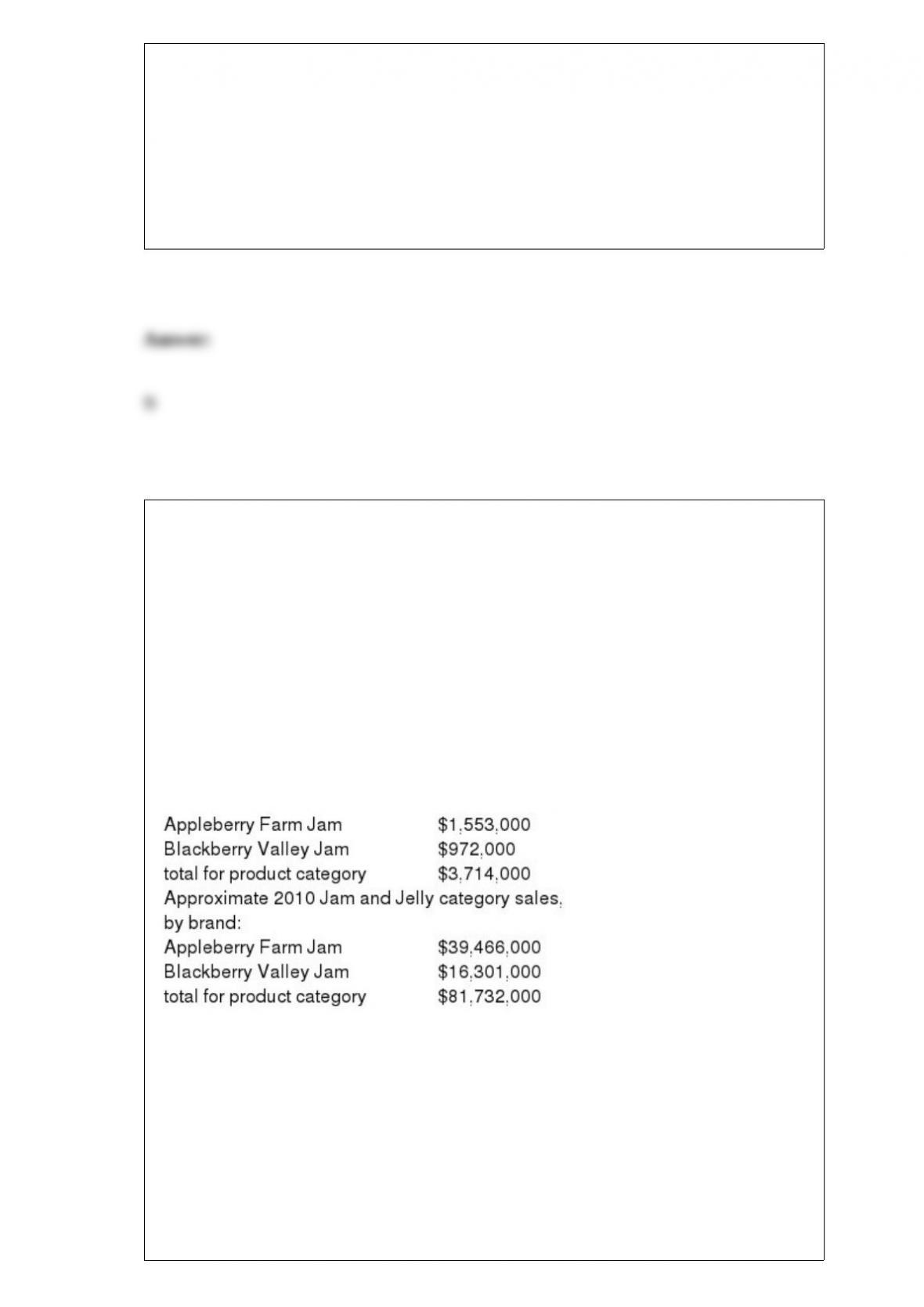
Appleberry Farm Organic Jam has remained No. 1 one in the jam and jelly food
category for several years. Although still a distant No. 2 in this category, Blackberry
Valley Organic Jam is gaining on Appleberry. Appleberry had $39,466,000 in sales last
year, while Blackberry had only $16,301,000, but that was 11 percent higher than its
2008 sales.Organic jams and jellies are important to marketers because they appeal to
health-conscious consumers and have a fresh taste that many consider superior to
traditional fruit spreads.Appleberry Farm has been put on notice. Blackberry Valley
Jam’s move up came despite lower ad spending than Appleberry Farm Jam. The
Blackberry brand spent about $972,000 in measured media during 2010, compared to
$1,553,000 for Appleberry. Blackberry also underwent an aggressive relaunch last year
with reformulated flavors, revamped packaging, new ads, and additional
media.Approximate 2010 Jam and Jelly category advertising spending, by brand:
The Blackberry CEO needs to know her company’s share of voice. What is Blackberry
Valley’s share of voice, based on the figures provided?
a. 4 percent
b. 19 percent
c. 26 percent
d. 41 percent

You are the creative director at a Milwaukee ad agency. Today, your copywriters are
presenting you with their ideas for several 30-second radio spots for the City of
Milwaukee Tourism Bureau, which wants to feature its own information center and
tours, as well as city museums, art galleries, concerts, festivals, and special events.
When they are ready, the best ideas will be taken to the marketing director at the City of
Milwaukee for review and approval.
One copywriter shows you an idea that involves an announcer reading a “top ten” list of
cool reasons to visit Milwaukee. What basic guidelines of radio copywriting does this
technique address?
a. Repeat the brand name.
b. Stress the main selling points.
c. Stimulate the imagination.
d. Tailor copy to a time, place, and audience.
Often referred to as out-of-home media, support media organizations do not include
a. bus and taxi boards.
b. databases.
c. performance arenas for sponsorships.
d. specialized directory companies.

For what type of tasks do today’s advertisers and agencies rely on external facilitators
the most?
a. production
b. research
c. management
d. accounting
An insurance company’s researchers spend a lot of time and money trying to understand
various age-related markets, from WWII veterans and baby boomers to Generations Y
and Z. Based on their findings, the target markets that are ultimately chosen based on
such demographics should be defined in the ____ section of the ad plan.
a. situational analysis
b. competitor analysis
c. executive summary
d. strategy

A media planner contacts both Simmons Market Research Bureau (SMRB) and
Mediamark Research (MRI) to supply data that will assist her in placing ads for a new
women’s fragrance. What information will SMRB and MRI most likely furnish?
a. demographic information correlated with product usage data
b. reach and frequency rates for competing products
c. fees and scheduling information for media vehicles
d. details on consumer behavior, media correlates, and lifestyle issues
One of John Sweeney’s suggestions about creativity is that bad work is more a matter of
talent than structure.
Authenticity of a brand is strongest when the content of the show and the essence of the
brand become completely intertwined and integrated.

A single ad-or a series of coordinated ads with a similar look, feel, and message-that
revolves around one consistent theme is called a promotion.
Press conferences can be strong public relations tools, because in using a news format
to present information, they lend an air of credibility.
In general, press releases are preferred over other forms of public relations because it is
an unwritten rule, widely accepted throughout the industry, that the news media will not
edit them.
Gardner found that despite the passion for their work, widely recognized creative
people are particularly shy about getting exposure for their work.

A marketing survey conducted by a Boston-based brand strategy firm found that almost
50 percent of consumers have a more favorable impression of companies that support
good causes.