Movie studios use market research to reduce their risk of losses by hiring firms like the
National Research Group to conduct test screenings and tracking studies. Often, 300 to
400 prospective moviegoers are recruited to attend a ‘sneak preview” of a film before its
release. After viewing the movie, the audience fills out an exhaustive survey to
a. evaluate the quality of directing and producing.
b. critique the title, plot, and characters.
c. rate the performances of the individual actors and actresses.
d. recall specific details of the plot and dialogue.
e. compare the final film with the original script.
Answer:
Based on the marketing program 3M developed for its Post-it Flag Highlighters and
Post-it Flag Pens, one can conclude that
a. the market segments for Post-it Flag Highlighters and Post-it Flag Pens are quite
distinct.
b. the target market segments for Post-it Flag Highlighters and Post-it Flag Pens are not
realistic.
c. the Post-it Flag Highlighters and Post-it Flag Pens are priced unfairly for its target
markets.
d. the prices for 3M’s Post-it Flag Highlighters and Post-it Flag Pens are set to
maximize 3M’s profits, not its distributors.
e. the promotion strategy is designed to increase awareness among potential users.
Answer:
Which of the following statements regarding an organization’s strategic business unit
level is most accurate?
a. The strategic business unit level is the level that works most directly with an
organization’s targeted customers.
b. The overall strategy for the organization is directed at the strategic business unit
level.
c. In more complex organizations, the corporate level and the strategic business unit
level may merge.
d. More end-user analysis is provided at the strategic business unit level than at the
functional level.
e. The strategic direction is more specific at the strategic business unit level than at the
corporate level.
Answer:
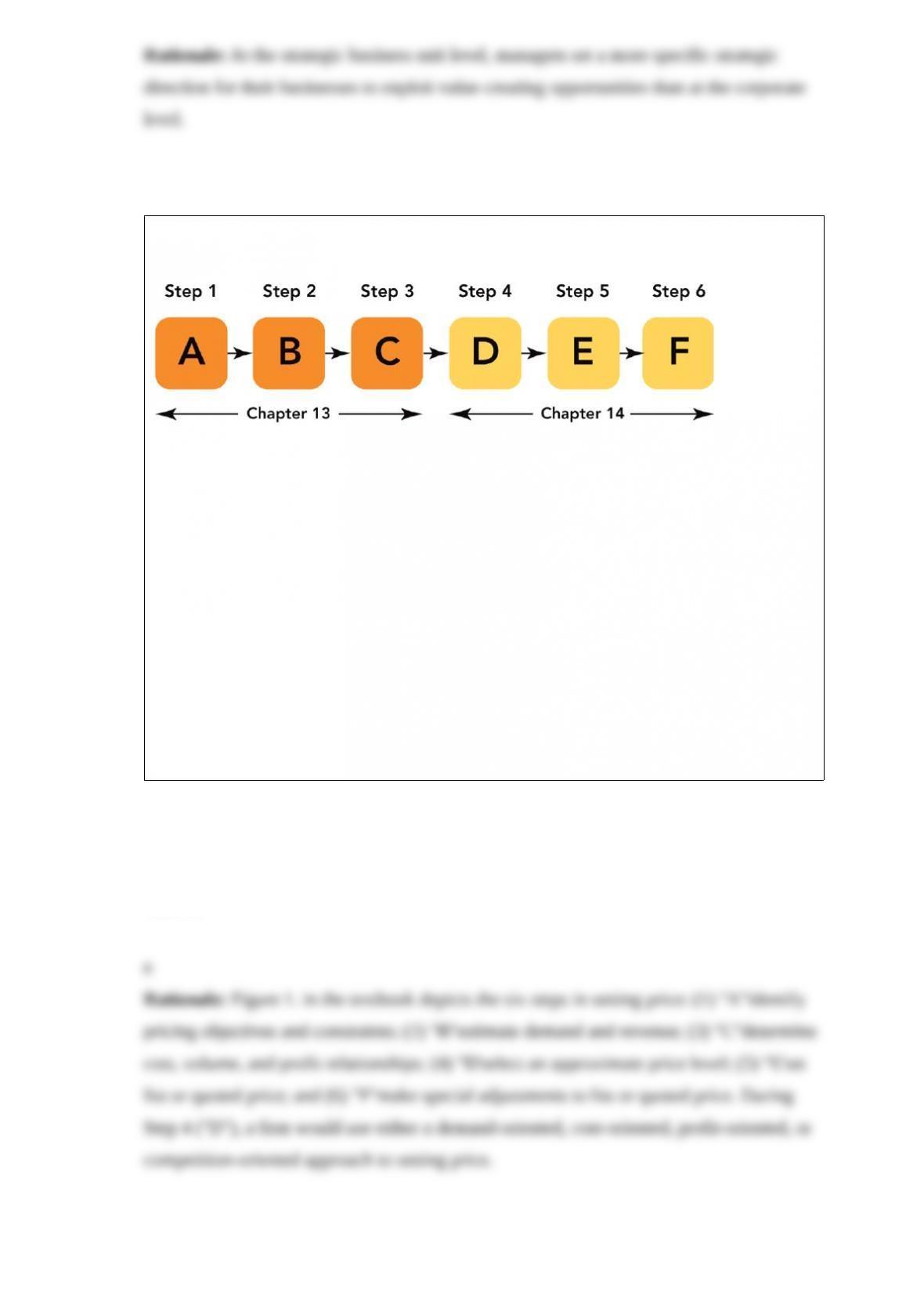
Figure 1.
Figure 1. above represents the six steps in the price-setting process. Which letter
represents the step where a firm would use a competition-oriented approach to setting
price?
a. “A”
b. “F”
c. “C”
d. “E”
e. “D”
Answer:
The owner of a small restaurant that sells take-out fried chicken and biscuits pays each
month $2,500 in rent, $500 in utilities, $750 interest on his loan, insurance premium of
$200, and $250 on advertising on local buses. A bucket of take-out chicken is priced at
$9.50. Unit variable costs for the bucket of chicken are $5.50. How many small buckets
of chicken does the restaurant need to sell to break-even each month?
a. 442 buckets
b. 764 buckets
c. 1,050 buckets
d. 3,150 buckets
e. 4,200 buckets
Answer:
A bidder’s list refers to
a. a list of firms believed to be qualified to purchase a given item.
b. a list of firms believed to be qualified to supply a given item.
c. those firms that have expressed interest in supplying a specific item but have not yet
been approved.
d. a list of firms that have not yet expressed an interest in supplying a specific item to
the firm.
e. a list of approved suppliers that have not yet been entered into the firm’s purchasing
databank.
Answer:
A type of retail outlet that focuses on one type of product at very competitive or
discount prices and often dominates the market is referred to as a __________.
a. general merchandise store
b. specialty outlet
c. hypermarket
d. category killer
e. regional dominator
Answer:
Environmental trends come from all of the following forces EXCEPT:
a. competitive
b. economic
c. regulatory
d. geographical
e. social
Answer:
The practice of organizing the cost-effective flow of raw materials, in-process
inventory, finished goods, and related information from point of origin to point of
consumption to satisfy customer requirements is referred to as __________.
a. marketing channel oversight
b. logistics management
c. production management
d. manufacturer distribution logistics
e. supply-chain management
Answer:
In the United States, there are two major political parties whose members disagree with
each other on a variety of issues. Both Republicans and Democrats view one another as
being part of a(n) _________ group.
a. membership
b. aspiration
c. dissociative
d. reference
e. involvement
Answer:
In the __________ stage of the personal selling process, the first impression is
especially critical.
a. prospecting
b. preapproach
c. approach
d. close
e. follow-up
Answer:
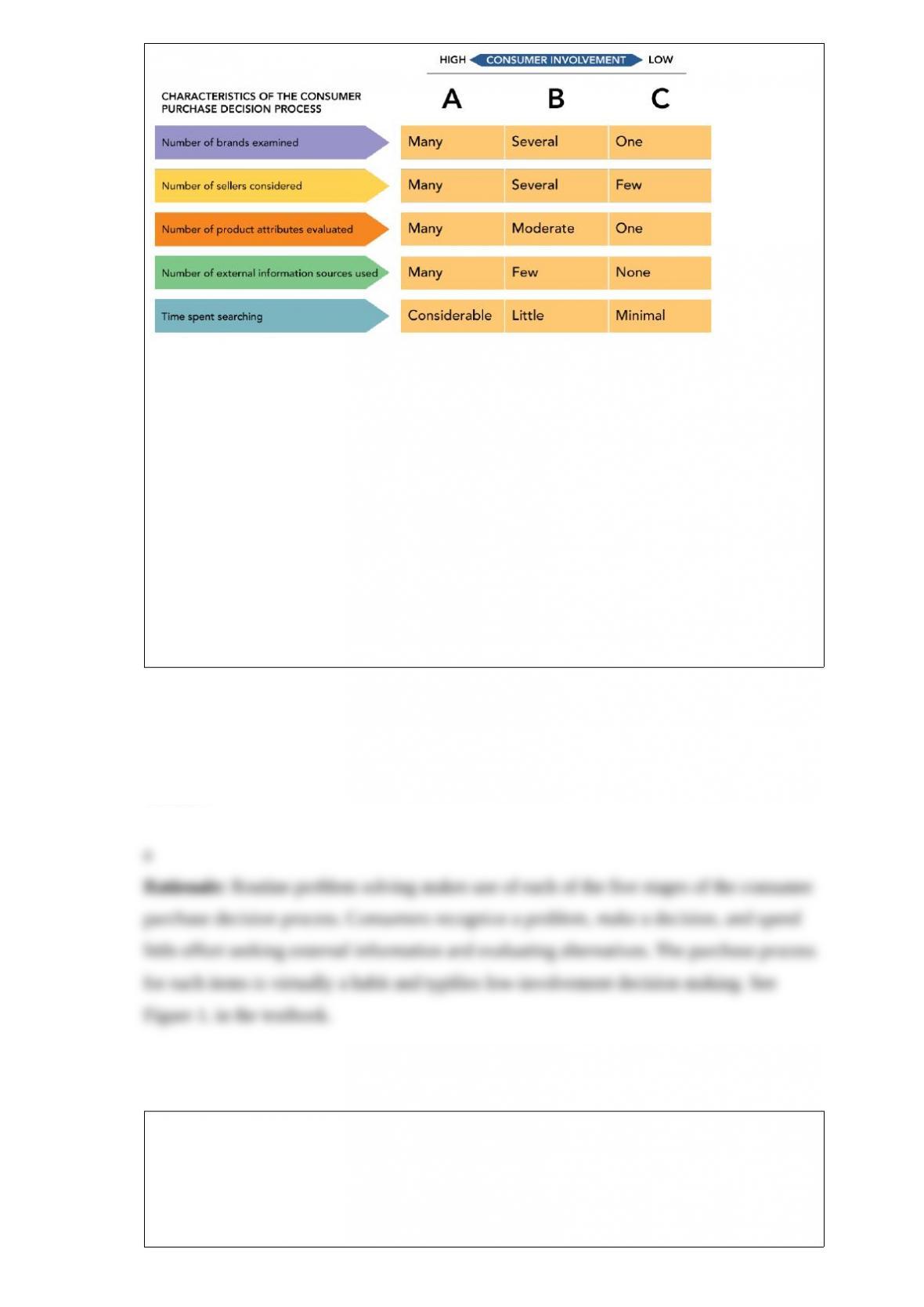
Figure 1.
In Figure 1. above, column “C” represents which of the following in terms of consumer
involvement and product knowledge?
a. routine problem solving
b. limited problem solving
c. extended problem solving
d. simulated selection
e. integrated problem solving
Answer:
The inventory for Jane Westerlund’s frame shop would include
a. her molding, matting, and glass.
b. her skill in framing prints.
c. her equipment, chairs, tables.
d. her cost of goods sold.
e. her rent and utility expenses.
Answer:
When establishing product-line pricing, the price differentials between items in the line
should make sense to customers and reflect differences in terms of the
a. perceived value of the products offered.
b. actual costs in terms of the features offered.
c. perceived risk.
d. quantity discounts and price allowances offered.
e. market segments targeted.
Answer:
The FTC established the Do Not Call Registry in 2003 for consumers who do not want
to receive unsolicited telemarketing calls. Today, a telemarketer can be fined up to
__________ for each call made to a telephone number posted on the registry.
a. $500
b. $750
c. $1,250
d. $8,750
e. $16,000
Answer:
During a visit to superbowl-ads.com, you will find
a. the worst Super Bowl TV ads ever made.
b. a rating of advertising agencies that produced ads for recent Super Bowls.
c. the ads that ran during the last 14 Super Bowls.
d. a look at how Super Bowl TV ads are made.
e. ads that never aired during a Super Bowl.
Answer:
The word cost-effective as it relates to the definition of logistics management implies
a. while it is important to drive down logistics costs, all channel members must equally
benefit financially or the chain will not function effectively.
b. speed of delivery must be measured against increased savings.
c. while it is important to drive down logistics costs, customer buying requirements
must be a part of the equation.
d. the need for multiple carriers always results in lower profit margins and therefore
should be avoided.
e. the choice of intermediaries should be made on their ability to perform their tasks
efficiently even if additional costs must be passed on to the consumer.
Answer:
There are three variations of contractual systems: wholesaler-sponsored voluntary
chains, franchising, and __________.
a. service-oriented voluntary chains
b. channel-dominated voluntary chains
c. distributorship cooperatives
d. retailer-sponsored cooperatives
e. reseller franchising
Answer:
Commercialization is the stage in the new-product process
a. at which the product is positioned and launched in full-scale production and sales.
b. during which the firm performs its final evaluations of the new-product.
c. when second-year sales forecasts are compared to actual first-year sales figures using
a marketing dashboard.
d. when advertising campaigns are evaluated using Starch scores to identify brand
awareness.
e. at which the product generates the greatest sales and profits.
Answer:
Recently, many nonprofit organizations such as the American Red Cross
a. were eager to use marketing practices.
b. thought that marketing would limit the profitability of the nonprofit organization.
c. could not afford marketing activities.
d. thought that marketing activities would create excess demand.
e. have increased their use of marketing practices.
Answer:
Promotional programs are specifically directed toward a group of prospective buyers, or
a(n) __________.
a. source
b. diffuser
c. encoder
d. target audience
e. particular media
Answer:
The Mountain Dew Dewmocracy 2 campaign was an integrated marketing
communications campaign that used many media alternatives. Mountain Dew managers
believe that the approach “uniquely situates Mountain Dew in the consumer landscape
as __________.”
a. a luxury brand
b. a low-cost substitute
c. a brand for the people, by the people
d. a category killer
e. a hillbilly beverage
Answer:
Team selling would most likely be used by a company that sells __________.
a. file cabinets
b. washing machines
c. dining room tables
d. four-wheel drive sports utility vehicle (SUVs)
e. sophisticated computer systems
Answer:
Five situational influences have an impact on a consumer’s purchase decision process.
They are: purchase task, social surroundings, physical surroundings, __________, and
antecedent states.
a. competitive offerings
b. temporal effects
c. core values
d. motivation
e. economic effects
Answer:
Changes in the services industry in the future will primarily be driven by two factors.
They are technological development and
a. reverse marketing.
b. sustainable development.
c. global development.
d. global service branding.
e. the elimination of ethnocentricity.
Answer:
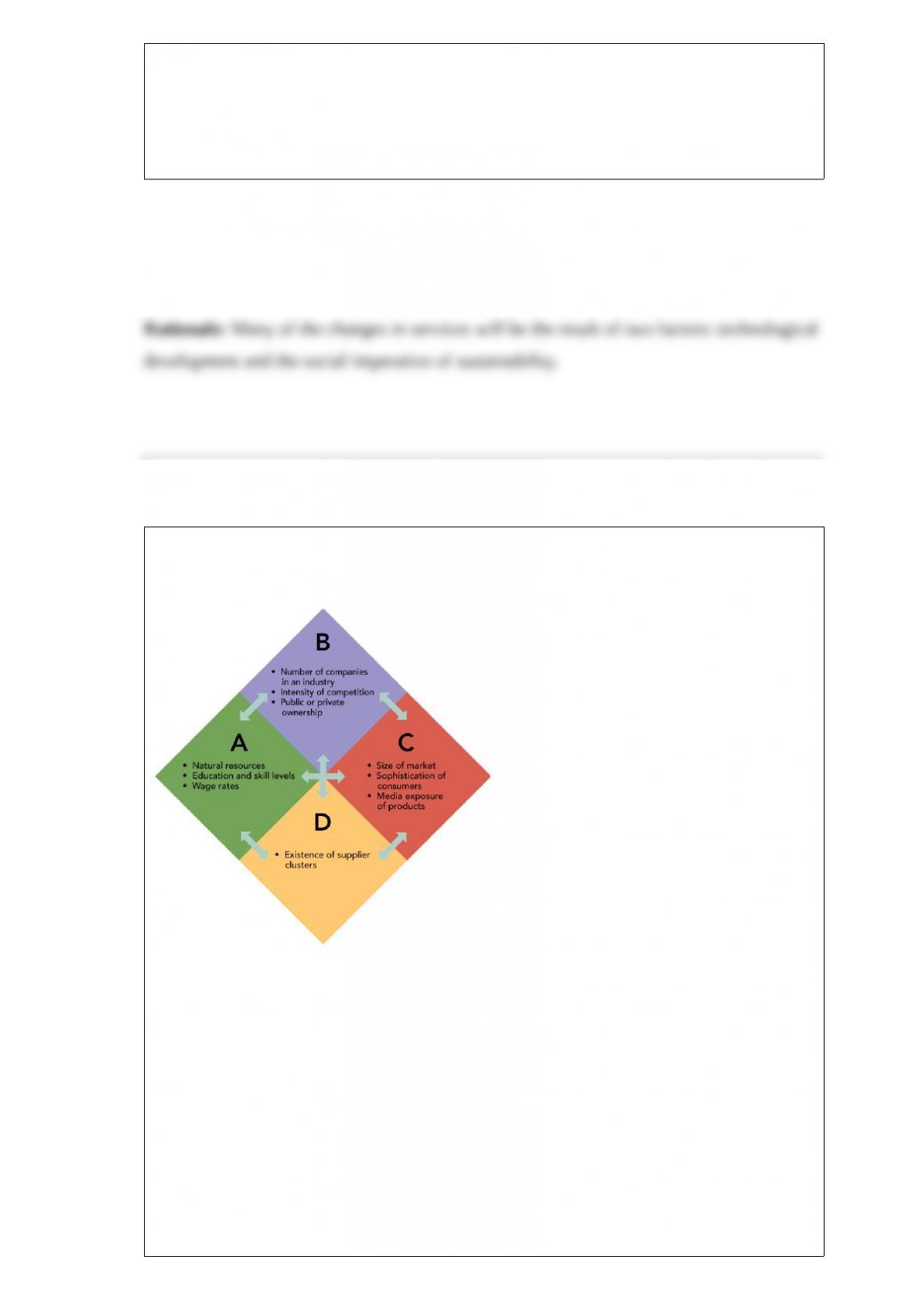
Figure 1.
According to Michael Porter’s diamond in Figure 1. above, quadrant “B” represents
a. factor conditions.
b. related and supporting industries.
c. demand conditions.
d. managerial conditions.
e. company strategy, structure, and rivalry.
Answer:
The concept that consists of the distinct phases that a family progresses through from
formation to retirement, each phase bringing with it identifiable purchasing behaviors,
is referred to as the
a. family circle.
b. family life cycle.
c. family continuum.
d. family socialization.
e. household life cycle.
Answer:
What is another term that is sometimes used interchangeably with ‘social media?”
a. net platforms
b. Web 3.0
c. user generated content
d. user platforms
e. peer-to-peer networking
Answer:
A consumer’s purchases are often influenced by the views, opinions, or behavior of
others. Two important aspects of personal influence to marketing are
a. lifestyle and motivation.
b. personality and lifestyle.
c. opinion leadership and word-of-mouth activity.
d. word-of-mouth activity and psychographics.
e. psychographics and demographics.
Answer:
An attitude refers to
a. a person’s consistent behaviors or responses to recurring situations.
b. the process by which an individual selects, organizes, and interprets information to
create a meaningful picture of the world.
c. a consumer’s subjective perception of how a product or brand performs on different
attributes based on personal experience, advertising, and discussions with other people.
d. the feelings one has about the preferable modes of conduct that tend to persist over
time.
e. a learned predisposition to respond to an object or class of objects in a consistently
favorable or unfavorable way.
Answer:
The Deceptive Mail Prevention and Enforcement Act provides specifications for direct
mail sweepstakes, such as requiring the statement
a. “A guaranteed winner in every state.”
b. “You can”t win if you don”t play.”
c. “You may never get another chance to win.”
d. “No purchase necessary to win.”
e. “There is no better time to play.”
Answer:
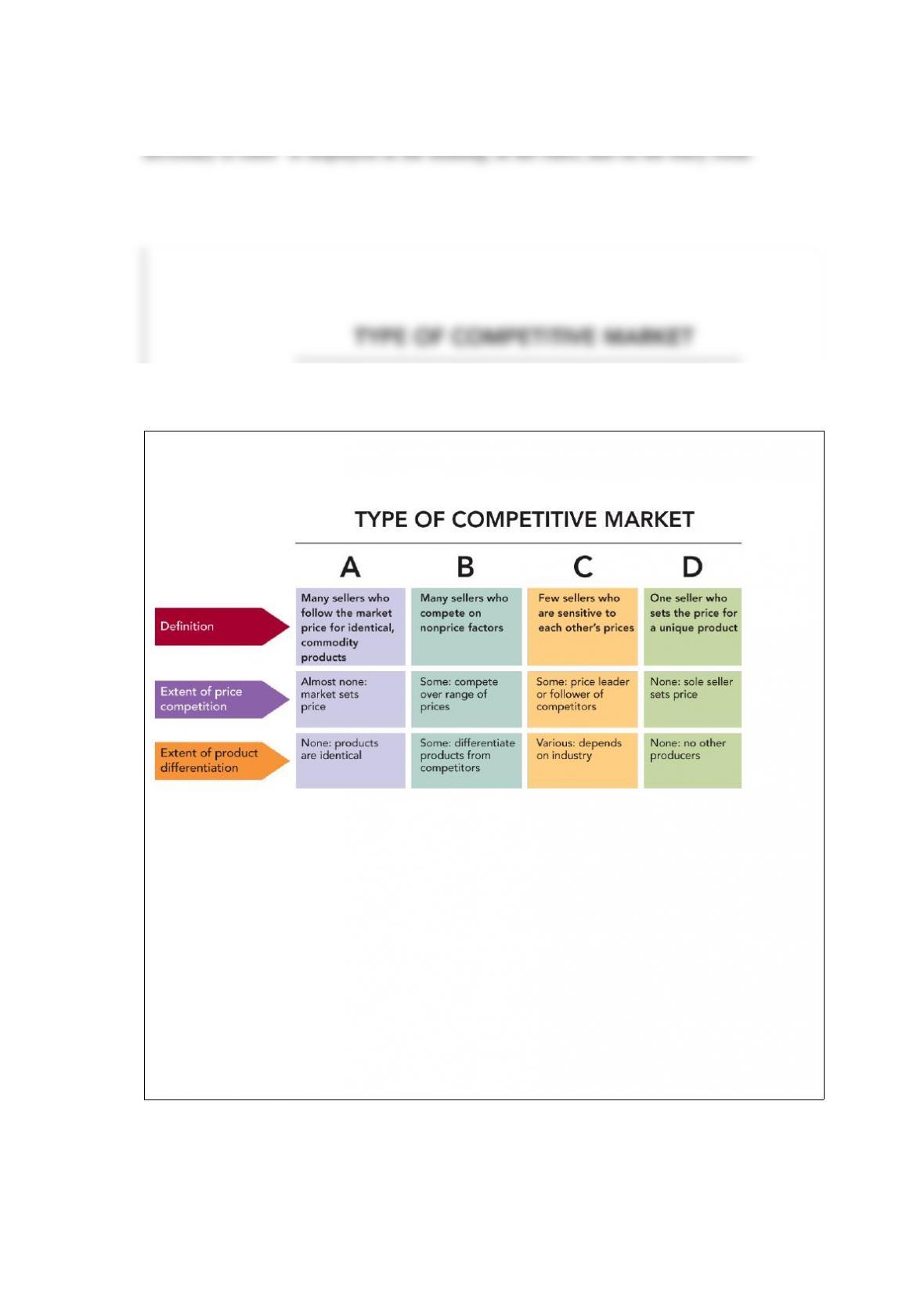
Figure 1.
In Figure 1. above, column “A” represents which type of competitive market?
a. pure monopoly
b. oligopoly
c. monopolistic competition
d. pure competition
e. monopolistic oligopoly
Answer:
There are six commonly used techniques to deal with objections: acknowledge and
convert the objection; __________; agree and neutralize; accept the objection; denial;
and ignore the objection.
a. postpone
b. redirect the conversation
c. defer to a supervisor
d. probe by asking additional questions
e. distract by identifying competitor shortcomings
Answer:
Outdoor sign makers are trying hard to stay relevant as the era of targeted mobile
advertising approaches, and their latest move is to add scent. In Morresville, NC, a
billboard has been erected that, for parts of the day, emits the smell of grilling steak.
The scent component of the sign operates during prime commute times. It was designed
by ScentAir, whose spokesperson described the aroma as, “a blend of black pepper and
kind of a charcoal grilling that smells like grilled meat with a nice pepper run on it.”
This is an example of
a. extrapolation.
b. supposition.
c. implication.
d. neuromarketing.
e. conjecture.
Answer:
A level of distribution density whereby only one retailer in a geographical area carries
the firm’s products is referred to as __________.
a. intensive distribution
b. extensive distribution
c. selective distribution
d. concentrated distribution
e. exclusive distribution
Answer: