Facebook consistently addresses issues related to user privacy because users post
personal information to their Facebook accounts and
a. have a right to know if Facebook changes the way their personal information is
released.
b. use search engines such as Google and Bing.
c. make them “opt-out” of privacy setting changes.
d. “by default” have their privacy settings changed by Facebook employees.
e. not object if their personal information is made public without their permission.
Answer:
The __________ stage of the product life cycle is characterized by the slowing of total
industry sales or product class revenue, causing marginal competitors to begin leaving
the market.
a. decline
b. maturity
c. introduction
d. growth
e. harvest
Answer:
Microsoft introduced its Zune player a few years after Apple launched its iPod and
other competitors offered their new MP3 players. Sales were very disappointing.
According to the textbook, the primary reason for the Zune’s failure was due in large
part to
a. bad timing.
b. not satisfying customer needs on critical factors.
c. poor product quality.
d. an insignificant point of difference.
e. incomplete market and product protocol.
Answer:
Minority racial and ethnic groups (excluding Caucasians) are concentrated in
geographic regions of the United States. Native American groups are heavily
concentrated in
a. Arizona.
b. Colorado.
c. Nebraska.
d. North Carolina.
e. South Carolina.
Answer:
Building open and honest relationships with communication is an example of Zappos’
__________.
a. profile of its target market
b. core values with its new ownerAmazon.com
c. ten core values for Zappos’ employees
d. qualities required of Zappos’ suppliers
e. qualities required of Zappos’ retailers
Answer:

What is the marketing objective for the growth stage of the product life cycle?
a. harvesting
b. market share
c. differentiation
d. gain awareness
e. maintain brand loyalty
Answer:
In the direct-mail and catalog retailing, the acronym PURLS stands for __________.
a. personalized URLs
b. pre-sorted URLs
c. pre-loaded URLs
d. proactive URLs
e. portable URLs

Answer:
Which of the following is a reason that marketing to Hispanics has proven to be a
challenge?
a. The Hispanic subculture is very diverse.
b. Hispanics don”t consider advertising a credible source of product information.
c. Hispanics communities are spread out through the entire country and therefore
difficult to target.
d. Hispanics don”t particularly care for American-made products; they tend to be
ethnocentric in their product preferences.
e. Assimilation is very important and the Hispanic community finds cultural target
marketing offensive.
Answer:

Internet-enabled capabilities that make possible a highly interactive and individualized
information and exchange environment for shoppers and buyers is referred to as
__________.
a. connectivity
b. customerization
c. customization
d. communication
e. convenience
Answer:
There are five stages in the consumer purchase decision process. The fifth stage is
__________.
a. information search
b. purchase decision
c. alternative evaluation
d. postpurchase behavior
e. problem recognition
Answer:
A palindrome is a word or phrase that reads the same whether read from right or left
(e.g., madam). Originally, Marshall was unaware of the term. However, once he read an
article about palindromes for his English class, he saw three examples of the term that
week. This is most likely the result of
a. selective retention.
b. selective attention.
c. selective intuition.
d. stimulus discrimination.
e. selective perception.
Answer:
The price of one country’s currency expressed in terms of another country’s currency is
referred to as the
a. balance of price.
b. currency exchange rate.
c. money conversion factor.
d. balance of payments.
e. equity exchange factor.

Answer:
Conflict occurring between intermediaries at the same level in a marketing channel,
such as between two or more retailers, is referred to as __________.
a. horizontal conflict
b. corporate conflict
c. vertical conflict
d. lateral conflict
e. contractual conflict
Answer:
The process of segmenting a market and selecting specific segments as targets is the
link between __________ and the organization’s marketing program.
a. self-regulatory industry standards
b. government regulations
c. top-level management
d. buyers’ needs

e. controllable environmental factors
Answer:
Relatively permanent, homogenous divisions in a society into which people sharing
similar values, interests, and behavior can be grouped is referred to as a ____________.
a. subculture
b. social class
c. reference group
d. family unit
e. household
Answer:
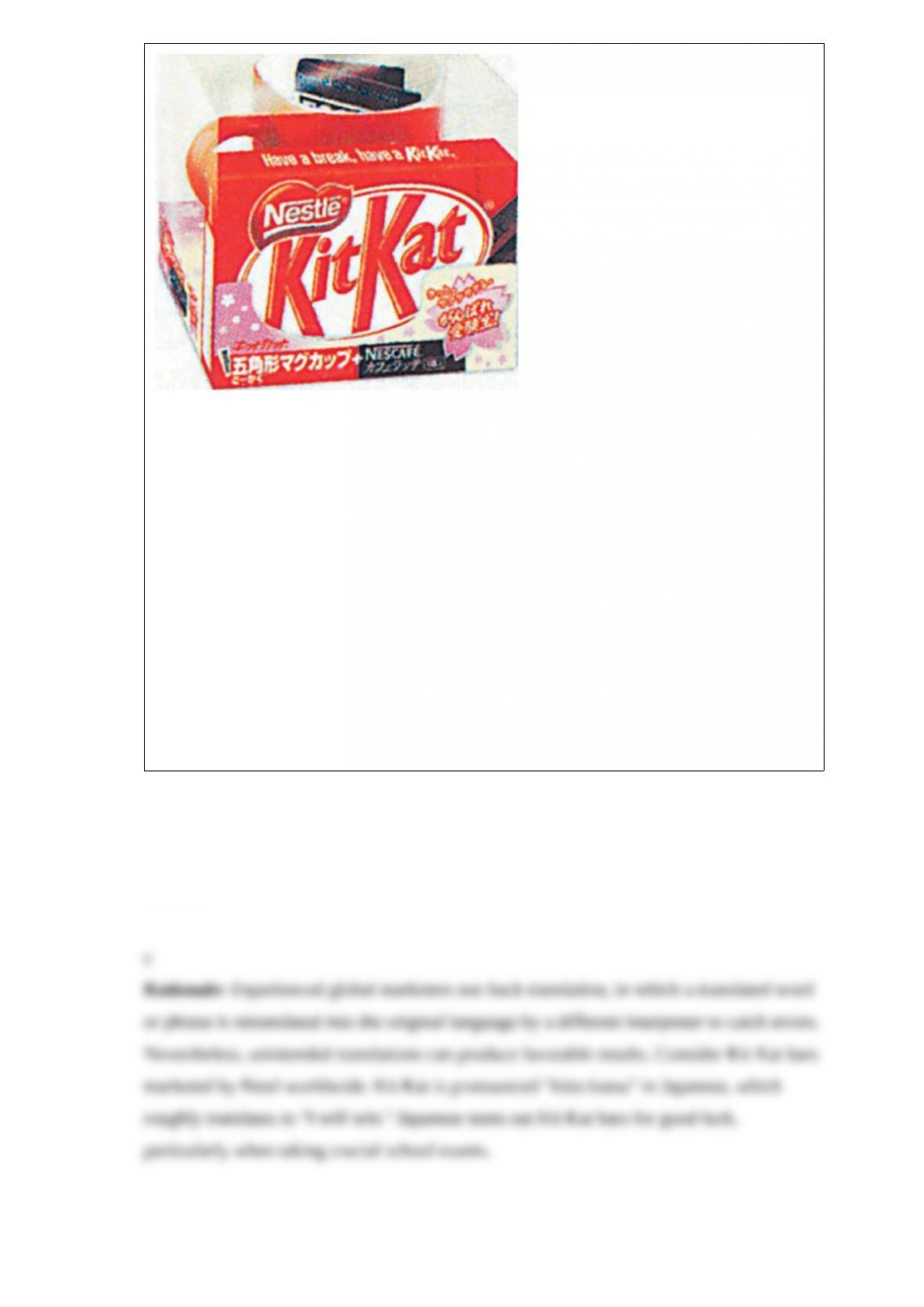
Kit Kat Bar Photo
Consider the Kit Kat bar photo above. Kit Kat bars are marketed by Nestl worldwide.
Kit Kat is pronounced “kitto katsu” in Japanese, which roughly translates to “I will
win.” Japanese teens eat Kit Kat bars for good luck, particularly when taking crucial
school exams. This is the result of
a. faulty semiotics.
b. semantic symbolism.
c. an unexpected mistake in back translation.
d. an intentional manipulation of a cultural icon.
e. a clever example of intentional transliteration.
Answer:

Products that are purchased by the ultimate consumer are referred to as __________.
a. generic goods
b. end user goods
c. personal items
d. merchandise
e. consumer products
Answer:
Profit responsibility, societal responsibility, and stakeholder responsibility are three
concepts of
a. cause marketing.
b. moral idealism.
c. social responsibility.
d. utilitarianism.
e. green marketing.
Answer:

The process of defining a marketing problem and opportunity, systematically collecting
and analyzing information, and recommending actions is referred to as __________.
a. marketing enquiry
b. strategic intelligence
c. data mining
d. marketing tactics
e. marketing research
Answer:
In terms of the online customer experience, connection is defined as the
a. the network of formal linkages between a company’s website and other sites.
b. the text, pictures, sound, and videos that the website contains.
c. the website’s capabilities to enable commercial transactions through credit, debit, or
transfer payments (PayPal, etc.).
d. the speed and ease with which a customer can move between pages on a website.
e. the website’s ability to tailor itself to different users or to allow users to personalize
the site.

Answer:
The third phase of the strategic marketing process is the __________.
a. tactics phase
b. strategic phase
c. planning phase
d. implementation phase
e. evaluation phase
Answer:
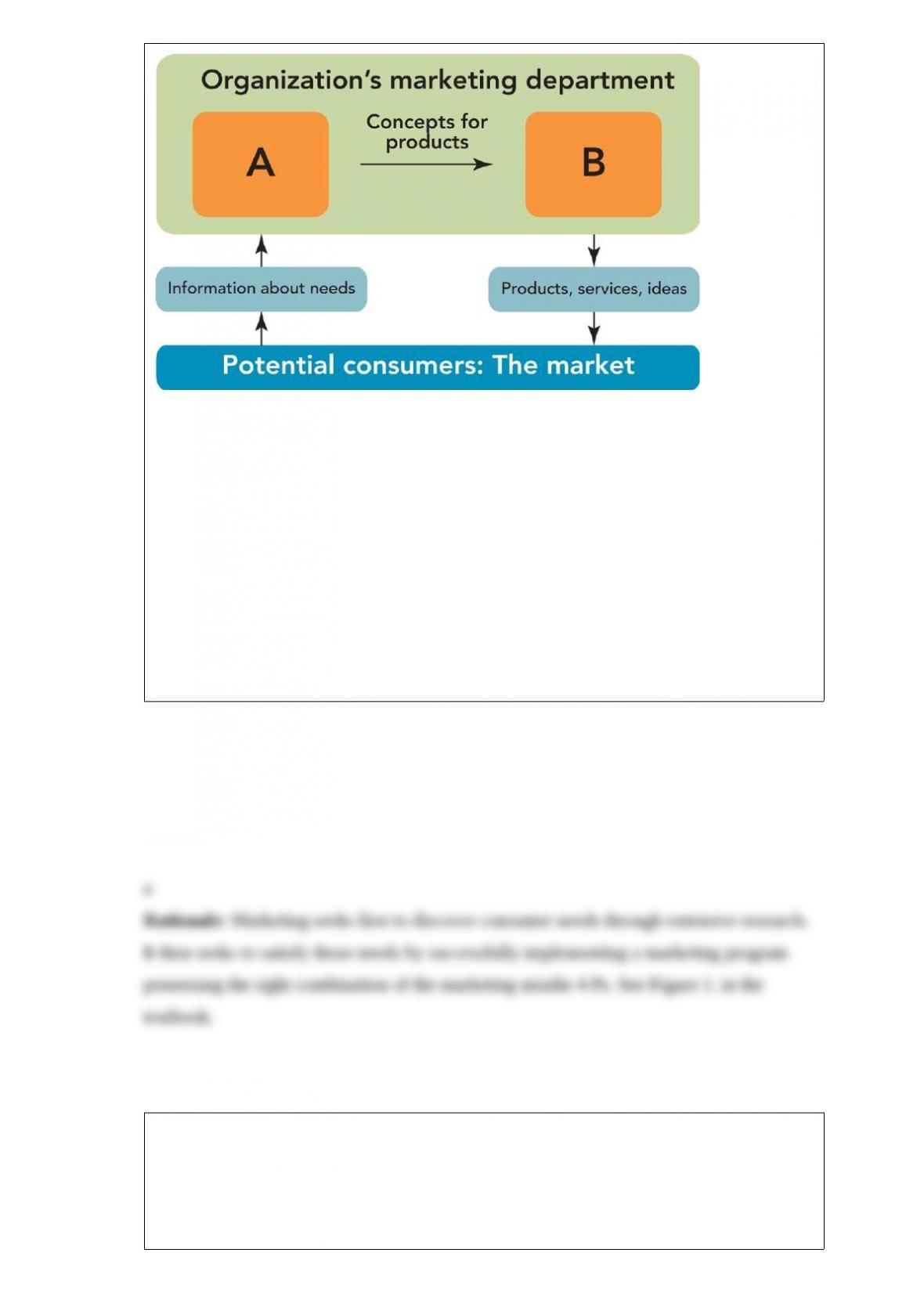
Figure 1.
In Figure 1. above, “B” is accomplished by __________.
a. designing a marketing program
b. developing the 5 Ps
c. discovering consumer needs
d. developing a marketing plan
e. identifying target markets
Answer:
Which of the following is a criterion used for selecting a target segment?
a. potential for increased profit

b. similarity of needs of potential buyers within a segment
c. difference of needs of buyers among segments
d. competitive position
e. potential of a marketing action to reach a segment
Answer:
The result of an offer designed to generate interest in a product or service and a request
for additional information is referred to as _________.
a. direct orders
b. lead generation
c. traffic generation
d. indirect orders
e. prospecting
Answer:

Which of the following statements about everyday low pricing (EDLP) is most
accurate?
a. For supermarkets, EDLP means “everyday low profits!”
b. Supermarkets have hailed EDLP as value pricing at its most effective.
c. EDLP allows supermarkets to use deeply discounted price specials.
d. EDLP can increase average retail prices by as much as 10 percent.
e. If retailers pass on their allowances to customers, they cannot make a profit.
Answer:
A nonprofit organization may pay taxes if
a. excess revenues exceed 18 percent of the budget.
b. the organization is not considered to be religious institution.
c. revenue is received from overseas subsidiaries.
d. revenue-generating holdings are not directly related to the organization’s core
mission.
e. money is spent on research and development, then it is taxed at a significantly lower
rate.
Answer:

A reference group that a person wishes to maintain distance from because of differences
in values or behaviors is referred to as a(n) __________ group.
a. socialization
b. membership
c. aspiration
d. dissociative
e. integrated
Answer:
Installations, accessory equipment, supplies, and industrial services used to assist in
producing other goods and services are referred to as __________.
a. components
b. parts
c. production goods
d. raw materials
e. support products

Answer:
Organizational synergy is the increased customer value achieved through
a. performing organizational functions more efficiently.
b. more discounts or larger rebates at the point of sale.
c. involvement of the ultimate consumer in product design.
d. an increase in the knowledge of competitors.
e. shared ownership of the organization through publicly traded stock.
Answer:
Customer satisfaction is an important focus for marketers because
a. marketing research is an expensive proposition; the fewer times it needs be done, the
better.
b. the financial value of a satisfied, loyal customer over time can be significant.
c. customer value is a non-quantifiable marketing metric.
d. attracting new customers is easier than keeping old ones.
e. a 50 percent improvement in customer retention can increase a company’s profits by
5 percent.
Answer: