In what way are traditional and social media similar?
a. They both require specialized training.
b. They both rely upon contributions from established “experts” to create credibility and
social authority.
c. They both can reach either large or niche audiences.
d. They both are relatively inexpensive or free to produce.
e. They both produce content that can be altered.
Answer:
Which type of outlet is most likely in its maturity stage of the retail life cycle?
a. single-price stores
b. value-retail centers
c. online retailers
d. business-district retailers
e. convenience stores
Answer:
Which of the following is a type of full-service merchant wholesaler?
a. cash and carry wholesaler
b. rack jobbers
c. truck jobbers
d. specialty merchandise wholesaler
e. drop shippers
Answer:
Vertical price fixing involves controlling agreements between independent buyers and
sellers whereby sellers are required to not sell products below a minimum retail price.
This practice is also called __________.
a. price discrimination
b. predatory pricing
c. a tying arrangement
d. resale price maintenance
e. exclusive dealing
Answer:
The decision on media selection is related to the target audience, the type of product,
the nature of the message, campaign objectives, available budget, and __________.
a. the capabilities of the advertising agency
b. audience preferences
c. the costs of alternative media
d. media spending by competitors
e. available air time
Answer:
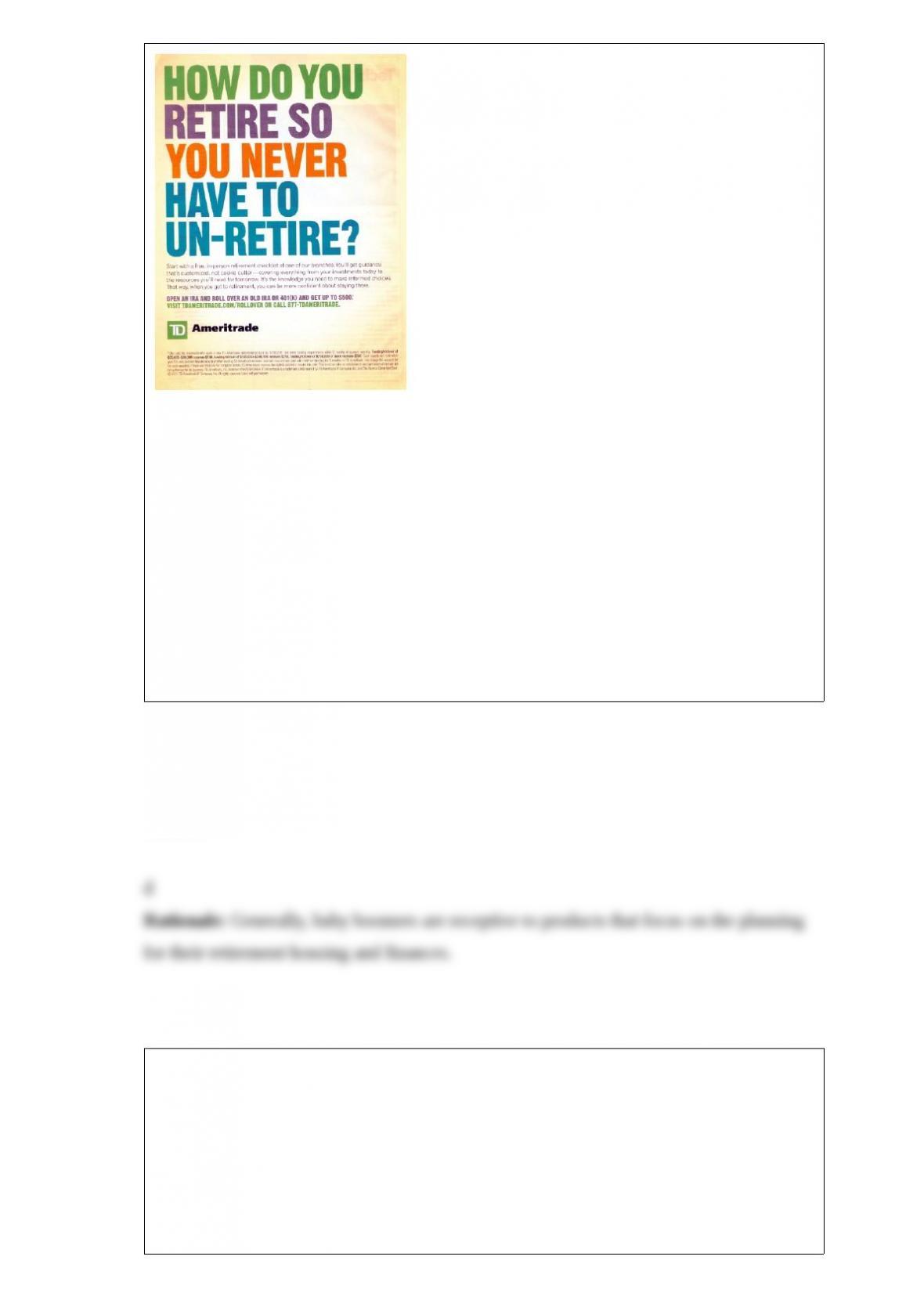
Ameritrade Ad
The Ameritrade ad shown above is targeted at which generational cohort?
a. echo-boomers
b. Generation Xers
c. Generation Yers
d. baby boomers
e. baby busters
Answer:
The retail price of DVD players has decreased from $900 in the mid-1990s to less than
$100 today. This is due in large part to
a. skimming pricing.
b. prestige pricing.
c. odd-even pricing.
d. customary pricing.
e. experience curve pricing.
Answer:
Considerable research has documented that in many product categories, consumers are
unable to distinguish among brands when given blind tests (i.e., taste or use of the
products without labels). Such products include soft drinks, coffee, and cosmetics.
Nonetheless, even when prices are similar, consumers have strong preferences for
specific brands of these product categories. This strong brand preference is the result of
a. extended problem solving.
b. limited problem solving.
c. routine problem solving.
d. high-involvement problem solving.
e. personal problem solving.
Answer:
Your local Target retailer carries a variety of different items. You can find everything
ranging from socks and DVDs to baby items and groceries. This is an example of the
__________ carried by Target.
a. breadth of product line
b. depth of product line
c. variety of product line
d. versatility of product line
e. product mix
Answer:
For nonprofit organizations, excesses in revenue over expenses are
a. taxed at one-half the rate for profit organizations.
b. distributed equally to all of the organization’s shareholders.
c. returned to the organization’s treasury for continuation of the service.
d. taxed at a reduced rate if the revenue is to be used in keeping with the organization’s
core mission.
e. not taxed at all unless it is a religious organization.
Answer:
The design of the promotion will play a primary role in determining the message that is
communicated to the audience. Successful designs are often the result of
a. accurately estimating costs of tasks.
b. identifying appropriate objectives.
c. accurately estimating what task will accomplish each objective.
d. obtaining insights regarding consumers’ interests and behavior.
e. obtaining insights regarding task performance.
Answer:
You can buy a General Electric dishwasher for $399 or you can buy a similar Bosch
brand dishwasher for $989. Since Bosch uses its pricing strategy to project a
high-quality product image, it is most likely using __________ pricing.
a. bundle
b. standard markup
c. prestige
d. penetration
e. cost plus fixed-fee
Answer:
A reinforcement ad
a. reinforces previous knowledge of a product.
b. assures current users they made the right choice.
c. promotes a specific brand’s features and benefits.
d. tells people what a product is, what it can do, and where it can be found.
e. shows one brand’s strengths relative to those of competitors.
Answer:
A product mix refers to

a. all of the different product lines offered by an organization.
b. the variations within a product class.
c. a specific product SKU that has a unique brand, size, or price.
d. a group of products that are closely related because they satisfy a class of needs, are
used together, are sold to the same customer group, are distributed through the same
types of outlets, or fall within a given price range.
e. the entire product category or industry.
Answer:
Which of the following statements about 3M’s market research prior to introducing the
Post-itFlag Highlighter is most accurate?
a. David Windorski worked with clay and wood models to see how much additional
weight students would be willing to carry in their backpacks.
b. David Windorski asked students to dump the contents of their backpacks to make
sure no clay prototype was being stolen.
c. David Windorski used focus groups, observed students’ studying behavior, and even
gave out trial Post-itFlag Highlighters to a sample of students to try for a month.
d. David Windorski hired students to act as “brand evangelists” to handout promotional
samples of Post-itFlag Highlighters to other students at their respective universities and
colleges during “move-in day.”
e. David Windorski hired students as “mystery shoppers” to see what office supplies
students bought at their college bookstores during the week before as well as the first
week of classes.
Answer:
How a person establishes expectations for a service not yet experienced is influenced by
__________, personal needs, past experiences, and promotional activities.
a. the economy
b. consumer income
c. word-of-mouth communications
d. competitive trends
e. how the organization delivers its service
Answer:
Which of the following would be LEAST LIKELY to be used for mass selling?
a. advertising
b. public relations
c. sales promotion
d. publicity
e. personal selling
Answer:
The place a product occupies in consumers’ minds on important attributes relative to
competitive products is referred to as
a. product repositioning.
b. relative positioning.
c. competitive positioning.
d. product positioning.
e. selective perception.
Answer:
The first major federal legislation passed to forbid actual monopolies or attempts to
monopolize any part of trade or commerce in the United States was the
a. Lanham Act.
b. Federal Trade Commission Act.
c. Robinson-Patman Act.
d. Sherman Antitrust Act.
e. Clayton Act.
Answer:
Which of the following is the best example of an equipment-based service?
a. lawn care
b. doctors
c. taxis
d. lawyers
e. janitorial services
Answer:
There are four popular types of franchising: (1) __________; (2)
manufacturer-sponsored wholesale franchise systems; (3) service-sponsored retail
franchise systems; and (4) service-sponsored franchise systems.
a. contractual-sponsored franchise systems
b. wholesaler-sponsored franchise systems
c. manufacturer-sponsored retail franchise systems
d. horizontal-marketing franchise systems
e. customer-oriented franchise systems
Answer:
The political and regulatory climate for marketing in a country or region of the world
means not only identifying the current climate but also determining how
a. it conducts its macrofinancing.
b. its citizens budget their money.
c. long a favorable or unfavorable climate will last.
d. the country’s stocks are performing on the stock exchange.
e. its population ranks in size compared to other countries.
Answer:
Remote suburbs are called __________.
a. exurbs
b. suburbia
c. outstate residents
d. subdivisions
e. minor statistical areas
Answer:
Identifying the buying role of the prospect would be typically done at the __________
stage of the personal selling process.
a. prospecting
b. preapproach
c. approach
d. presentation
e. closing
Answer:
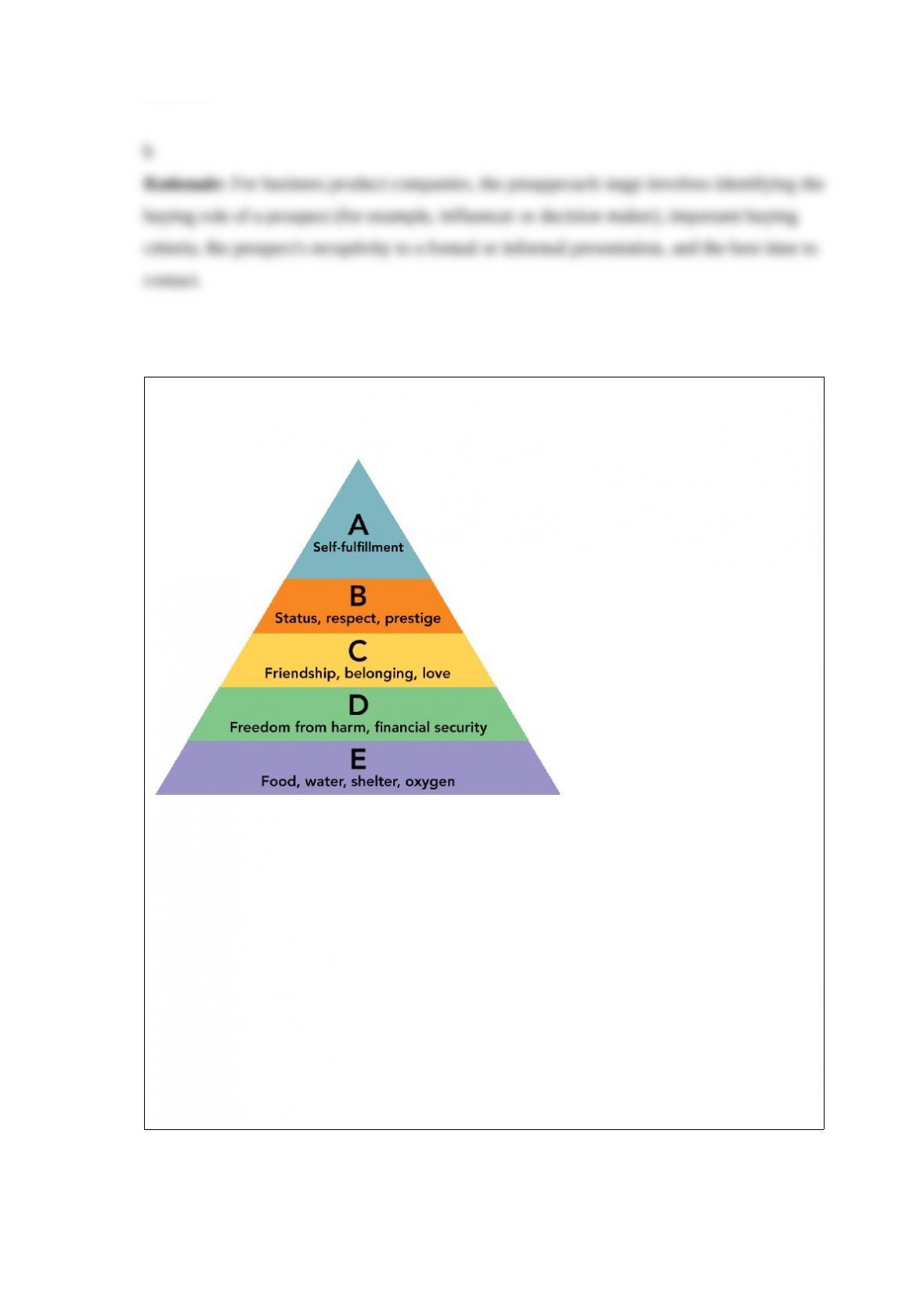
Figure 1.
According to Figure 1. above, the need for food, water, shelter, and oxygen would be
found in what level of the hierarchy of needs?
a. “A”
b. “B”
c. “C”
d. “D”
e. “E”
Answer:
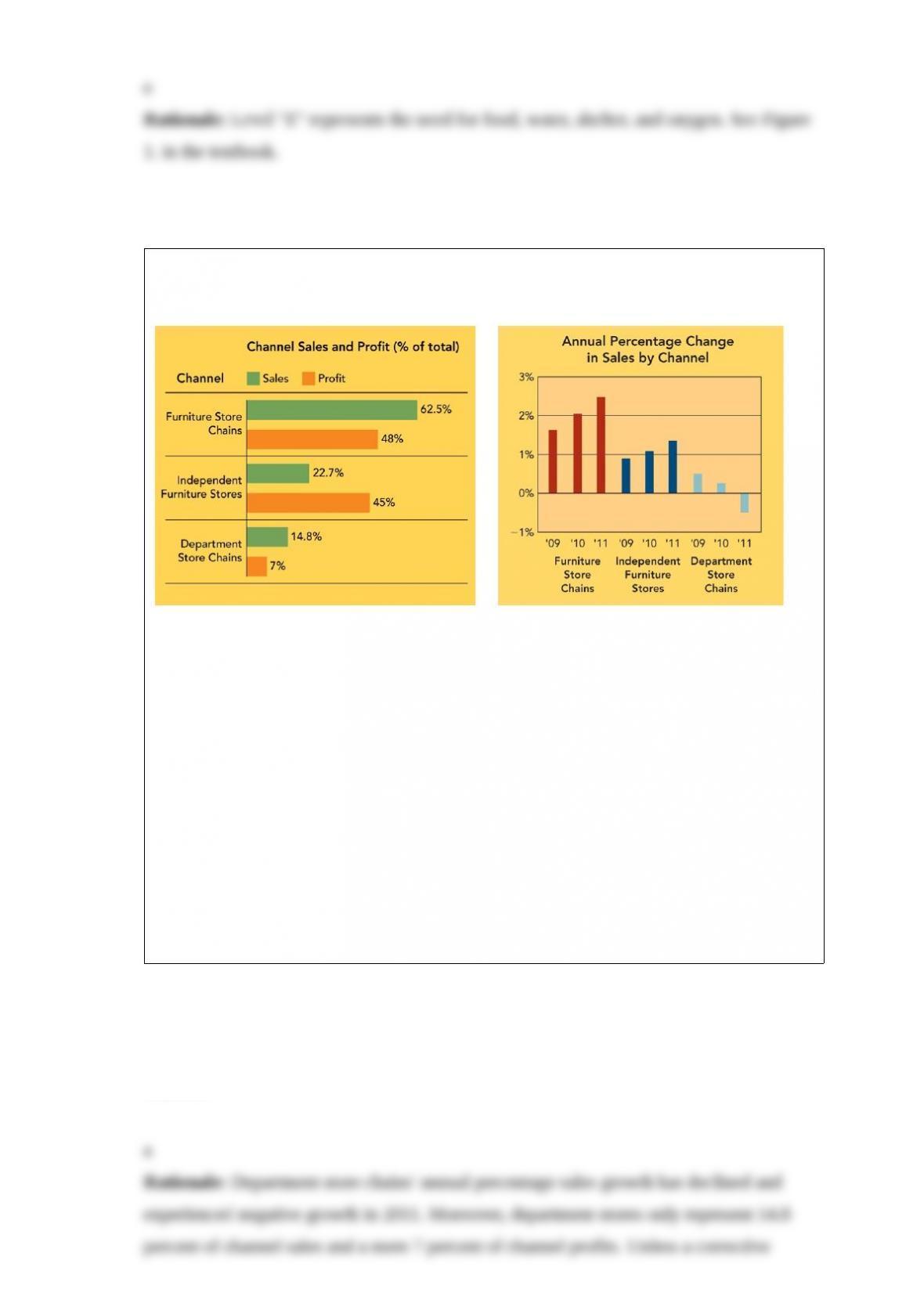
Channel Sales and Profit Marketing Dashboard
Based on the information presented in the Channel Sales and Profit Marketing
Dashboard above, which channel of distribution would the furniture manufacturer most
likely consider dropping?
a. department store chains
b. furniture store chains
c. independent furniture stores
d. none of the above
e. Not enough information is given in the dashboard to make this determination.
Answer:
The variety of different items a store carries is referred to as the
a. retailing mix.
b. depth of product line.
c. breadth of product line.
d. width of product line.
e. length of product line.
Answer:
Coupons, rebates, samples, and sweepstakes are all examples of __________.
a. endorsements
b. sponsorships
c. free publicity
d. purchase aids
e. sales promotions
Answer:
Which of the following pieces of information is used in market-product focus and goal
setting, the second step of the planning phase of the strategic marketing process?
a. marketing return on investment
b. revenues associated with each point of market share
c. trends for industry and competitors
d. possible cannibalization effects on other products in the line
e. market potential studies
Answer:
The facts and figures related to the problem are referred to as__________.
a. data
b. statistics
c. variables
d. concepts
e. constraints
Answer:
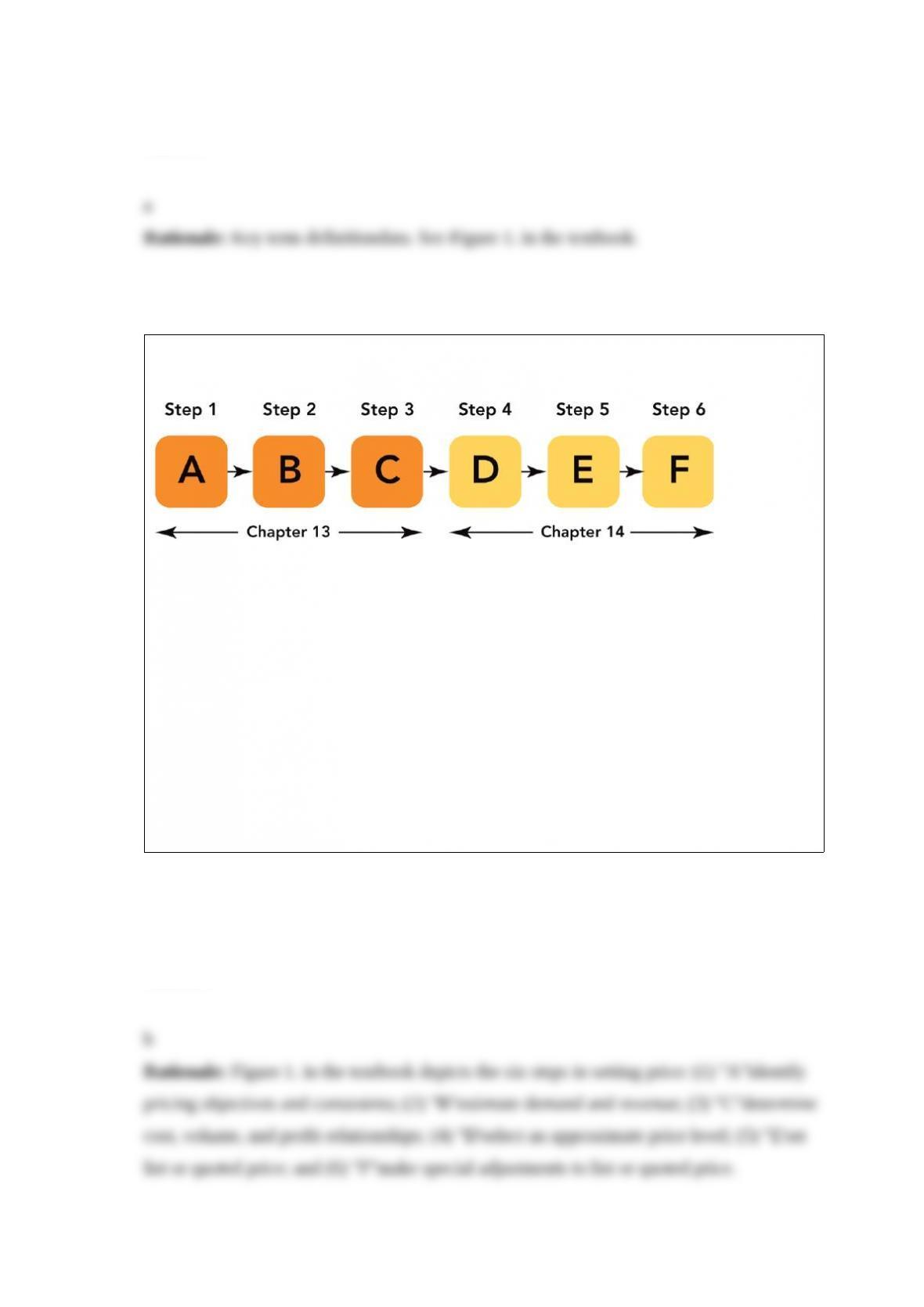
Figure 1.
According to Figure 1. above, “D” represents which step in the price-setting process?
a. estimate demand and revenue
b. select an approximate price level
c. scan competitors for prices of similar products or services.
d. determine cost, volume, and profit relationships
e. identify pricing objectives and constraints
Answer:
A mode of living that is identified by how people spend their time and resources, what
they consider important in their environment, and what they think of themselves and the
world around them is referred to as
a. culture.
b. psychographics.
c. social class.
d. lifestyle.
e. reference group.
Answer:
The actions taken during the implementation phase of the strategic marketing process
include: (1) obtain resources, (2) __________, (3) develop schedules, and (4) execute
the marketing program.
a. select target markets
b. design marketing organization
c. position the product
d. find points of difference
e. develop the budget by estimating revenues, expenses, and profits
Answer:
There are seven commonly used organizational buying criteria. One of them is
__________.
a. flexibility and adaptability
b. consumer demand
c. ability to meet required delivery schedules
d. senior management directives
e. adherence to governmental policies
Answer:
A person’s occupation, source of income (not level of income), and education determine
his or her
a. personal reference group.
b. market segment.
c. social class.
d. role in family decision making.
e. VALS segment.
Answer: