Because of the significance of labor in the scheduling of services, behavioral and social
issues, wage and hour law, and union contracts all complicate the scheduling process.
The shortest of all paths through the network is the critical path.
On an ordinary graph, unit times decrease at a decreasing rate, but on a log-log graph,
the learning “curve” appears as a straight line.
Delta uses mathematical short-term scheduling techniques and a high-tech nerve center
to manage the rapid rescheduling necessary to cope with weather delays and similar
disruptions.
Location decisions of goods-producing companies often assume that costs are relatively
constant for a given area; therefore, the revenue function is critical.
The larger the number of periods in the simple moving average forecasting method, the
greater the method’s responsiveness to changes in demand.
The 5Ss€sort/segregate, simplify/straighten, shine/sweep, standardize, and sustain/self
discipline€are important to lean production because they act as a means to reduce
waste.
The higher the process capability ratio, the greater the likelihood that process will be
within design specifications.

Starbucks Coffee’s approach to choosing new caf© locations is largely based on
executive intuition, not sophisticated models and site selection technology.
Which of the following statements is most correct?
A) KSFs are often necessary, but not sufficient for competitive advantage.
B) KSFs are often sufficient, but not necessary for competitive advantage.
C) KSFs are neither necessary nor sufficient for competitive advantage.
D) KSFs are both necessary and sufficient for competitive advantage.
E) None of the above statements is correct.
A network consists of the following list. Times are given in weeks.
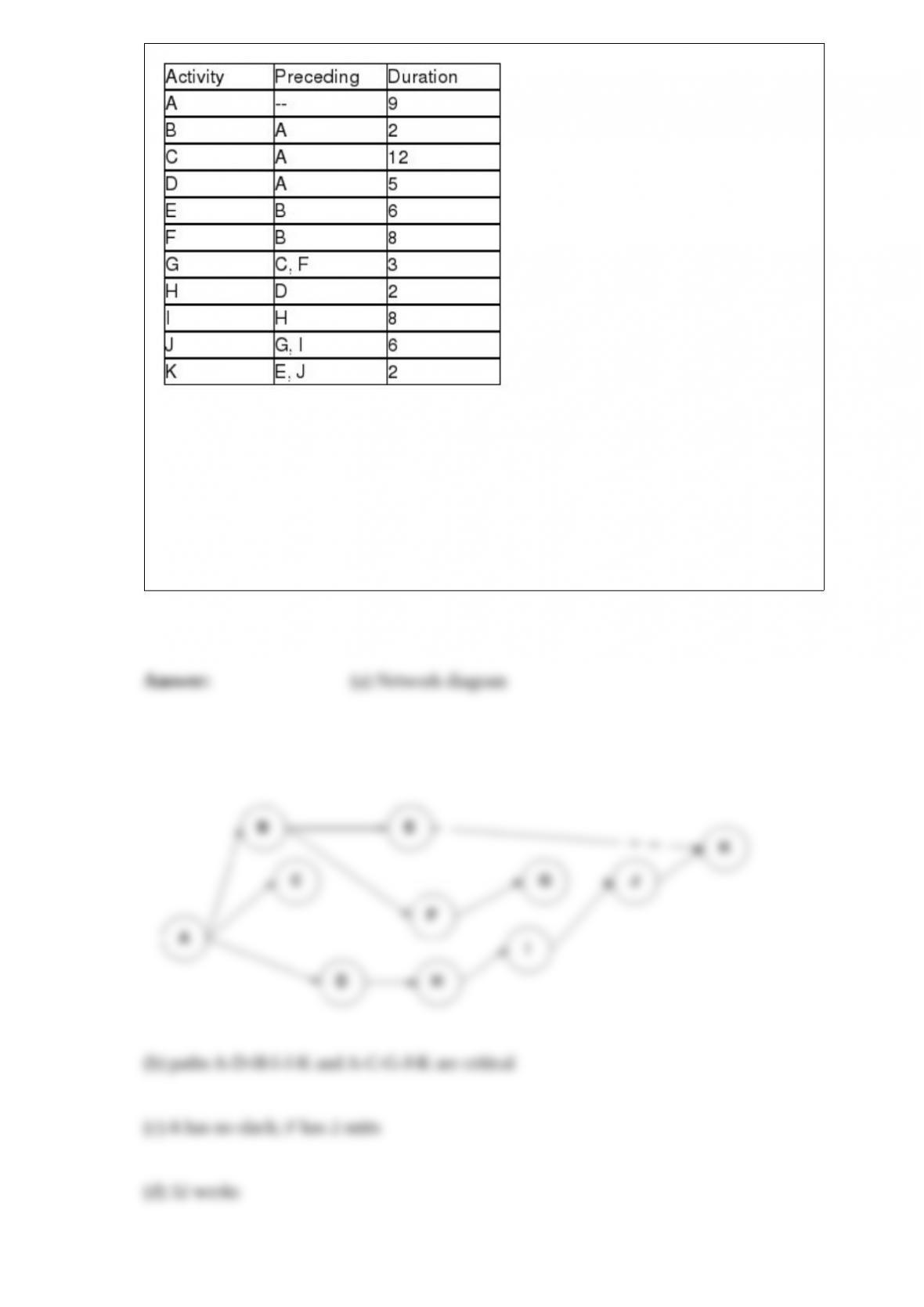
a. Draw the network diagram.
b. Which activities form the critical path?
c. How much slack exists at activities A and F?
d. What is the duration of the critical path?

Which of the following statements regarding the Dreamliner 787 is true?
A) Boeing has found partners in over a dozen countries.
B) The new aircraft incorporates a wide range of aerospace technologies.
C) The new aircraft uses engines from not one, but two manufacturers.
D) Boeing will add only 20 to 30 percent of the aircraft’s value.
E) All of the above are true.
Which type of layout is specifically designed to encourage employees to interact?
A) warehouse
B) job shop
C) open office
D) retail
E) repetitive/continuous
In a product-oriented layout, the process of deciding how to assign tasks to
workstations is referred to as
A) station balancing
B) process balancing

C) task allocation
D) line balancing
E) work allocation
For the lot-sizing technique known as lot-for-lot to be appropriate
A) future demand should be known for several weeks
B) setup cost should be relatively small
C) annual volume should be rather low
D) item unit cost should be relatively small
E) the independent demand rate should be very stable
You are a cost accountant for a firm that specializes in ‘small” (under 10 billion dollars)
defense contracts for specialty electronics products, such as fully portable, miniaturized
CD-ROM imaging stations and global positioning transmitters/transponders. Your
company is well respected in this field. One project up for competitive bids is a Field
Service, Hands-Free, Individual Multi-Protocol Secure Communicator (a battlefield
version of a cellular telephone, but built into each soldier’s helmet, and containing
necessary encryption technology). The Department of Defense wants 8 of these
experimental devices to test their practicality. You have reviewed the contract
specifications, and estimated that the first FSHFIMPSC should require 2350 hours, and
that the product is subject to a 75% learning rate. All costs of the project (machine
purchase, machine time, direct and indirect labor, and materials) have been bundled

(allocated) into an hourly labor rate of $172 per hour. Determine the total project cost
using the provided data.
Value Stream Mapping
A) is a variation on time function mapping
B) examines the supply chain to determine where value is added
C) extends time function mapping back to the supplier
D) starts with the customer and works backwards
E) All of the above are true.
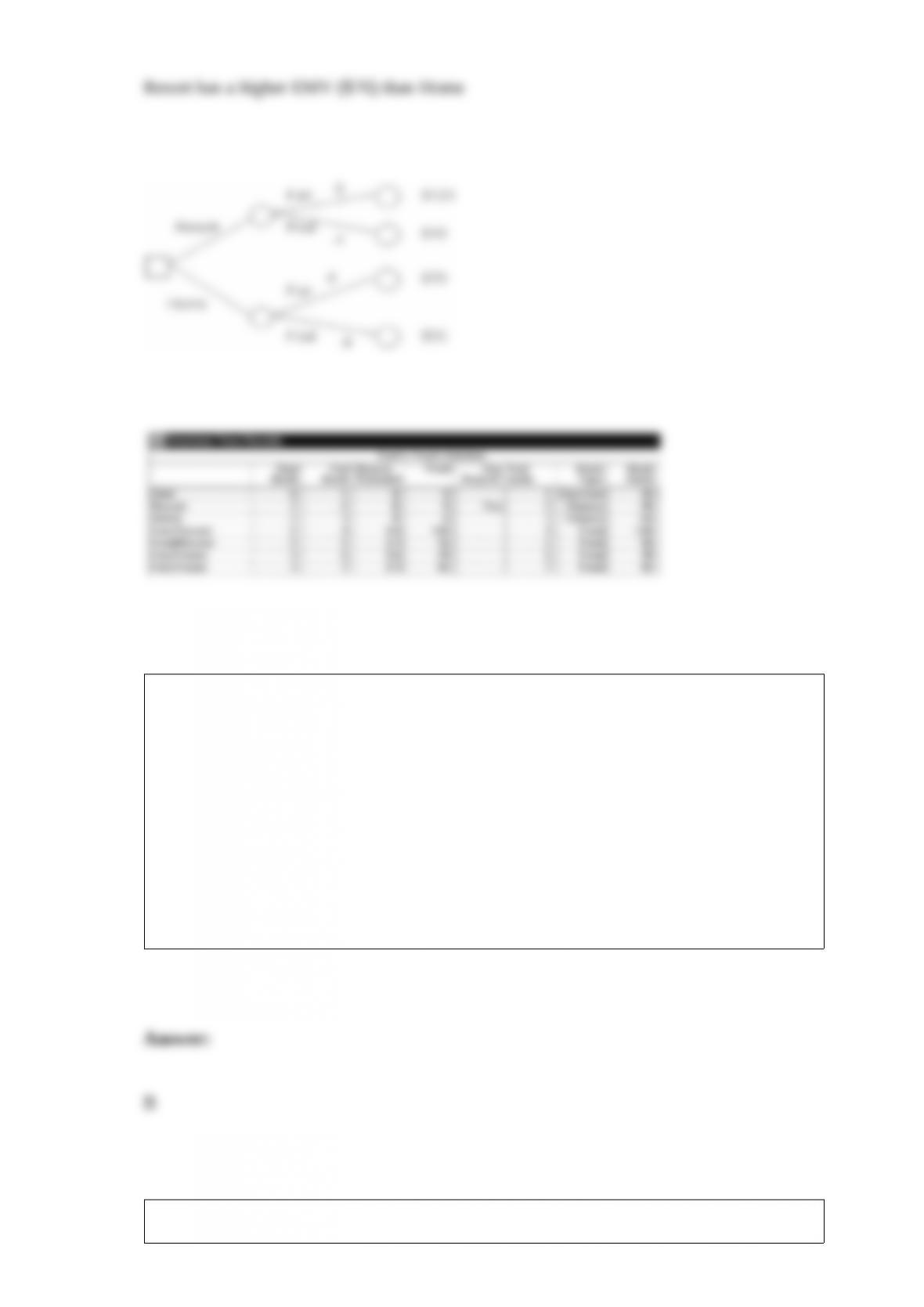
Earl Shell owns his own Sno-Cone business and lives 30 miles from a beach resort. The
sale of Sno-Cones is highly dependent upon his location and upon the weather. At the
resort, he will profit $120 per day in fair weather, $10 per day in bad weather. At home,
he will profit $70 in fair weather, $55 in bad weather. Assume that on any particular
day, the weather service suggests a 40% chance of foul weather.
a. Construct Earl’s decision tree.
b. What decision is recommended by the expected value criterion?
Which of the following is not a step in the forecasting process?
A) Determine the use of the forecast.
B) Eliminate any assumptions.
C) Determine the time horizon.
D) Select forecasting model.
E) Validate and implement the results.
Which of the following is not a method used to set labor standards?
A) historical experience
B) time study
C) predetermined time standards
D) work sampling
E) government laws and regulations
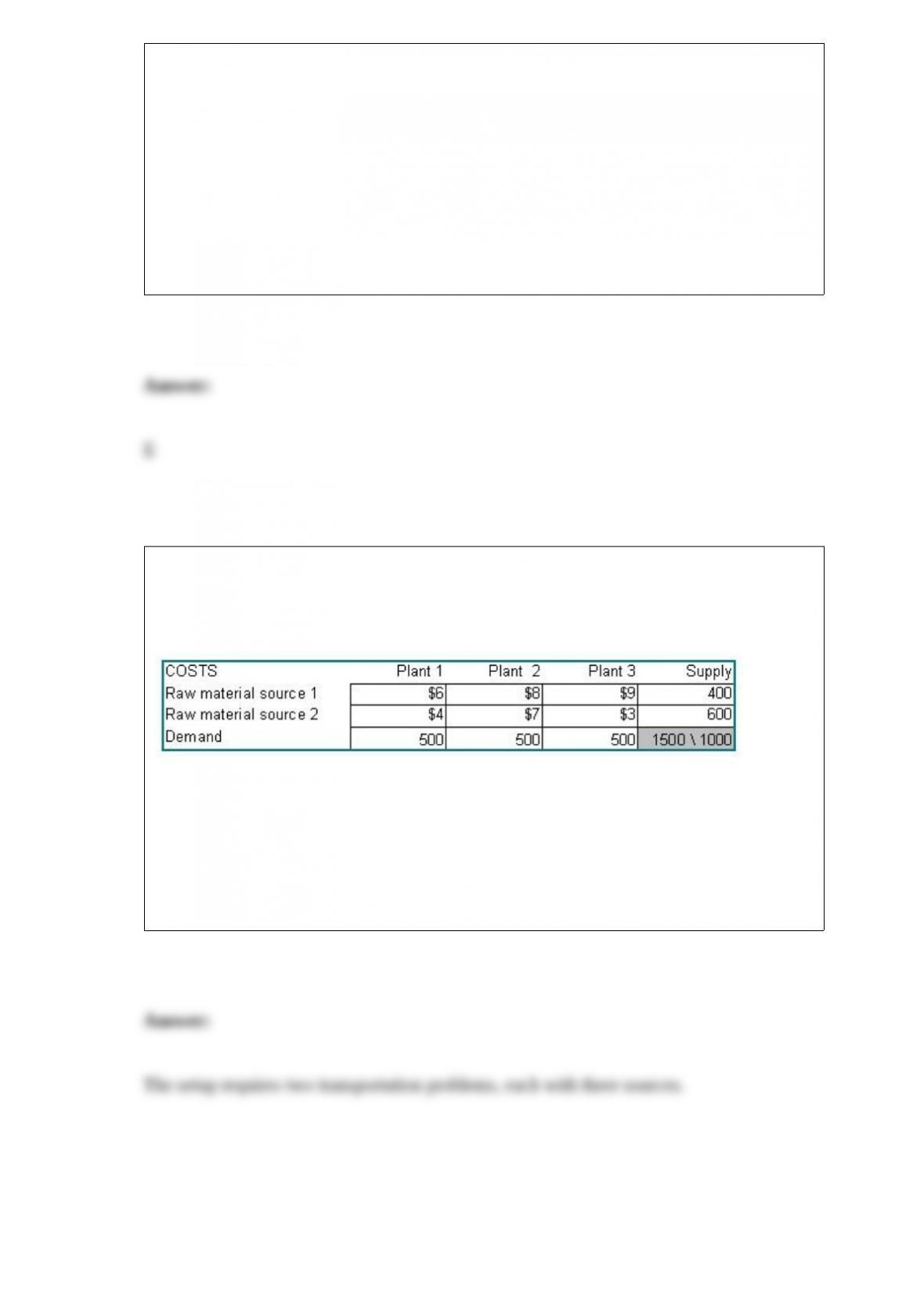
A firm has established a distribution network for the supply of a raw material critical to
its manufacturing. Currently there are two origins for this raw material, which must be
shipped to three manufacturing plants. The current network has the following
characteristics:
The firm has identified two potential sites for a third raw material source; these are
identified as Candidate A and Candidate B. From A, the costs to ship would be $9 to
Plant 1, $10 to Plant 2, and $12 to Plant 3. From B, these costs would be $11, $14, and
$8. The new source, wherever it is located, will have a capacity of 500 units. Set up€but
DO NOT SOLVE€ this problem as though you were going to solve it with
transportation problem software.
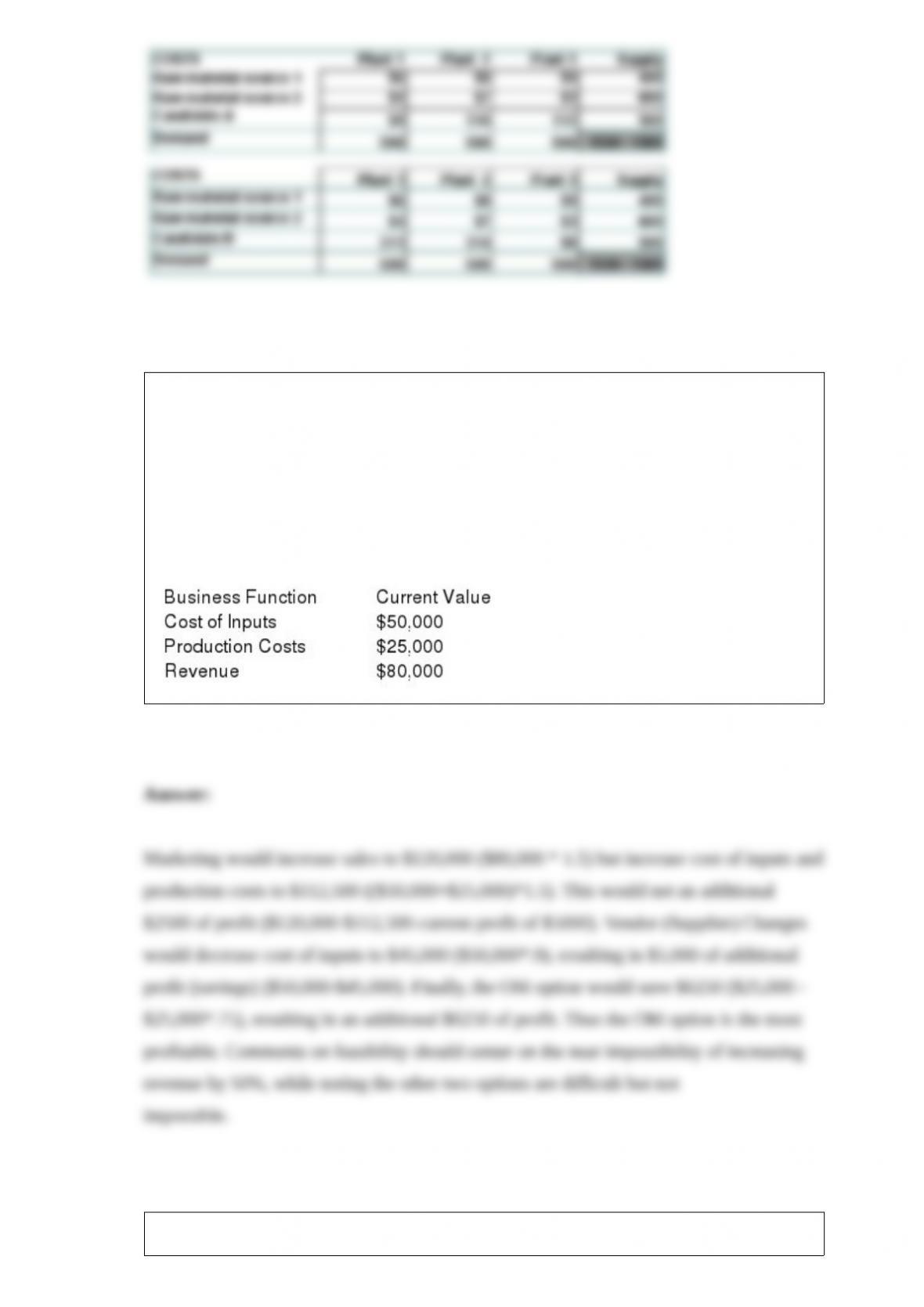
Brandon Production is a small firm focused on the assembly and sale of custom
computers. The firm is facing stiff competition from low-priced alternatives, and is
looking at various solutions to remain competitive and profitable. Current financials for
the firm are shown in the table below. In the first option, marketing will increase sales
by 50%. The next option is Vendor (Supplier) changes, which would result in a decrease
of 10% in the cost of inputs. Finally there is an OM option, which would reduce
production costs 25%. Which of the options would you recommend to the firm if it can
only pursue one option? In addition, comment on the feasibility of each option.
The data in the following table represent time-study observations on a new operation
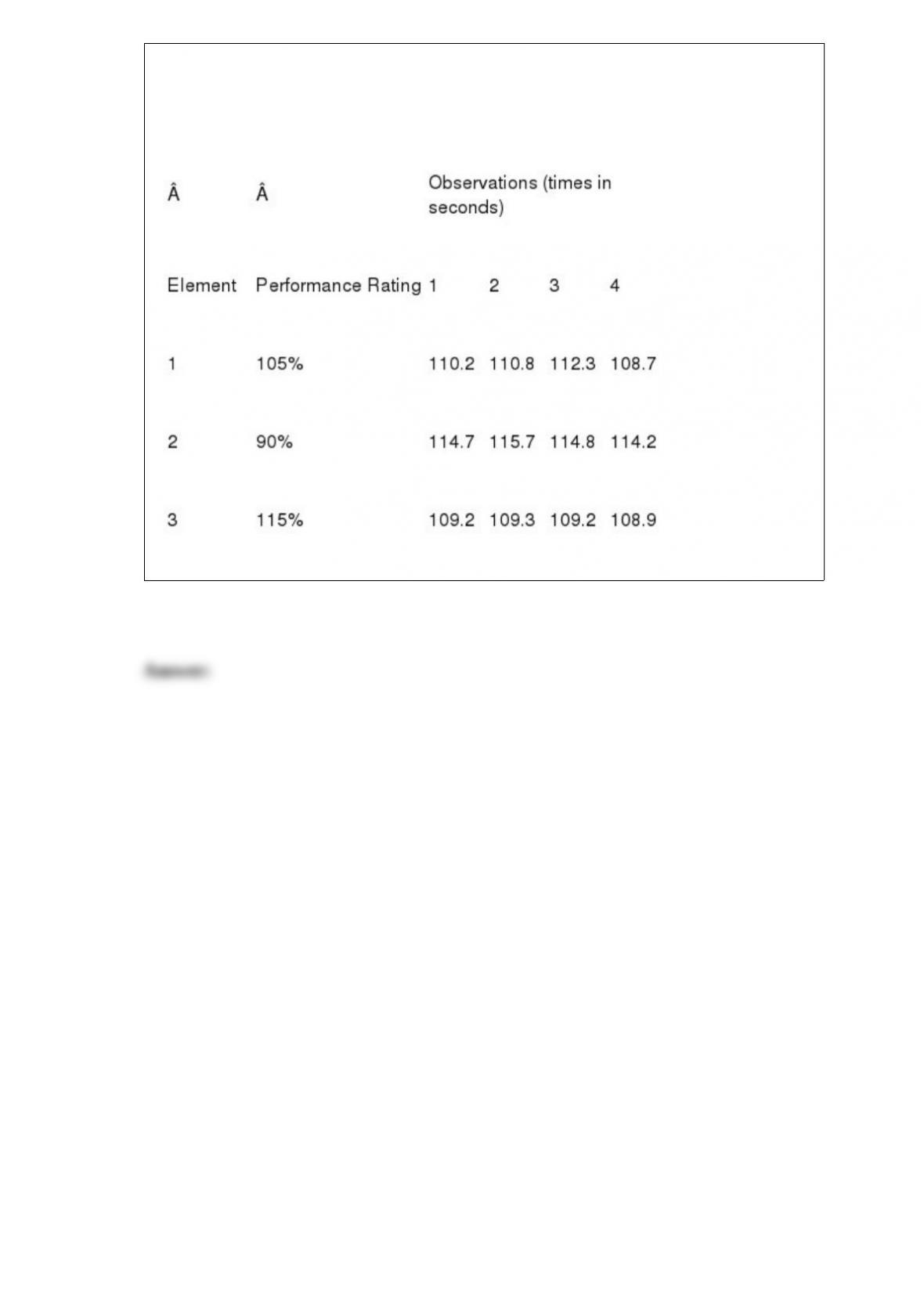
with three work elements. On the basis of these observations, find the standard time for
the process. Assume an 8% allowance factor.
Define reliability.
Of the three types of queue discipline, only __________ is assumed by the four primary
waiting line models.
The width of a bronze bar is intended to be one-eighth of an inch (0.125 inches).
Inspection samples contain five bars each. The average range of these samples is 0.01
inches. What are the upper and lower control limits for the x-bar and R-chart for this
process, using 3-sigma limits?
Describe three popular measures of forecast accuracy.
How is the expected value of perfect information (EVPI) found?
What techniques exist for dealing with bottlenecks? Which of these leads to increased
capacity? Which of these leads to more throughput without adding capacity? Do any of
these techniques fail to increase throughput?