Clinique Cosmetics has a database of more than 600,000 people who registered on its
website by providing selected personal information. The registration process requested
that customers fill out a brief survey and check a box that allows Clinique to send them
product updates via e-mail. When Clinique introduced its Anti-Aging Serum, it sent
e-mails to all women over 35 who had listed that they were worried about wrinkles.
Eight percent of the women who received the e-mail purchased the new product.
Clinique used __________ to introduce its new product.
a. opt-out marketing
b. personalization
c. viral marketing
d. buzz marketing
e. permission marketing
Answer:
Those people who object to cookies are most likely concerned with ___________.
a. costs
b. privacy
c. damage
d. waste
e. information overload
Answer:
The increased customer value achieved through performing marketing functions more
efficiently is referred to as __________.
a. points of difference
b. proficiency
c. kiatsu
d. synergy
e. competitive advantage
Answer:
Groups of a small number of people from different departments in an organization who
are mutually accountable to accomplish a task or a common set of performance goals
are referred to as
a. designated teams.
b. strategic business units.
c. cross-functional teams.
d. business consortiums.
e. venture squads.
Answer:
Marketers pay slotting fees to grocers in payment for spaceor slotson their retail
shelves. Such slotting fees significantly increase the cost of which stage of the
new-product process?
a. business analysis
b. market testing
c. screening and evaluation
d. commercialization
e. business analysis
Answer:
Kellogg’s different types of cereals are each targeted at a different type of user. This is
an example of multiple products aimed at multiple markets. Manufacturing these
different cereals is clearly more expensive than producing one, but seems worthwhile if
it adds to the manufacturer’s sales revenues and profits, serves customers’ needs better,
and
a. conforms to all FDA guidelines.
b. creates economy of scale.
c. doesn”t reduce quality or increase price.
d. decreases the cost of the physical plant.
e. stabilizes the sales revenues and profits.
Answer:
An ad for Citrucel fiber supplement claimed that in a blind taste test consumers
preferred the taste of Citrucel to Metamucil 2 to 1. This is ad is an example of
__________ advertising.
a. reinforcement
b. comparative
c. persuasive
d. informative
e. reminder
Answer:
Estimating demand, sales revenue, and price elasticity are issues that would be
addressed during __________ of the price-setting process.
a. Step 1
b. Step 2
c. Step 3
d. Step 4
e. Step 5
Answer:
Many large consulting firms are beginning to sponsor “women-only” networking
events. The purpose of these events is to offer an opportunity for women in
management to network with other businesswomen, either as clients, mentors, or
protgs. This is an example of which environmental force?
a. social
b. economic
c. technological
d. competitive
e. regulatory
Answer:
Delphi Automobile Systems manufacturers and sells satellite communications systems
for automobiles that connect you and your car to 24-hour-a-day emergency service,
direct you to a destination, and enable you to order a movie while on the road. Because
of the unique services it provides, it charges a higher price than its competitors. Delphi
Automobile Systems is using a(n) __________.
a. cost leadership strategy
b. cost focus strategy
c. differentiation focus strategy
d. innovation strategy
e. differentiation strategy
Answer:

The buying situation where an organization is a first-time buyer of the product or
service is referred to as a
a. buy class.
b. new buy.
c. make-buy.
d. straight rebuy.
e. modified rebuy.
Answer:
A need refers to
a. a sense of personal inadequacy based upon observations by others around you.
b. a sense of urgency, which causes a person to take action.
c. a feeling that is shaped by a person’s knowledge, culture, or personality.
d. a feeling of being deprived of something, but not fully understanding what it may be.
e. a situation when a person feels deprived of basic necessities such as food, clothing,
and shelter.
Answer:
The estimated cost of economic espionage to firms in the United States is estimated to
be
a. $10 billion per year.
b. $250 billion per year.
c. $750 billion per year.
d. $900 billion per year.
e. exceeding $1 trillion per year.
Answer:
Which output report would be associated with the planning phase of the strategic
marketing process?
a. performance reviews for key personnel
b. marketing plans that define goals with the relevant metrics and the marketing mix
strategies to achieve them
c. action memos that tell who is to do what by when
d. corrective action memos, triggered by comparing results with plans, often from the
firm’s marketing dashboards and metrics
e. sales reports using the firm’s marketing metrics and dashboards
Answer:
The retailing mix refers to the activities related to the management of and the
merchandise in the store, which includes
a. retail pricing, store location, retail communication, and merchandise.
b. product, price, promotion, and place.
c. the utilities of time, form, possession, and price.
d. the colors, sizes, shapes, and point-of-purchase display locations of the store’s
products.
e. selection of store location, selection of merchandise, hiring and training of
employees, and promotion of both the store and products.
Answer:
A market-product grid can help identify
a. the fastest areas of industry growth.
b. competitors that offer product substitutes.
c. marketing and R&D-manufacturing synergies.
d. technological breakthroughs leading to new product opportunities.
e. product offerings by the resources invested to maintain them.
Answer:
The analytical tool that positions retail outlets in terms of the breadth of their product
line and value added, such as location, product reliability, or prestige, is referred to as
the __________.
a. BCG growth share matrix
b. MAC breadth-depth of line framework
c. market-product grid
d. retail positioning matrix
e. wheel of retailing framework
Answer:

Wholesalers who take title to merchandise but sell only to buyers who call on them, pay
cash for merchandise, and furnish their own transportation for merchandise are referred
to as __________.
a. rack jobbers
b. truck jobbers
c. transport vendors
d. cash and carry wholesalers
e. drop shippers
Answer:
The __________ element of the marketing mix consists of communication tools,
including advertising, personal selling, sales promotion, public relations, and direct
marketing.
a. product
b. price
c. place
d. promotional
e. advertising
Answer:
Tara is enrolled for spring semester at college. The tuition is $6,000, but she has a
scholarship for $1,000 as well as a work-study grant of $1,500. The health fees and
student activity fees are $150 for the semester. What is the final price that Tara will pay
for the spring semester?
a. $2,500
b. $2,650
c. $3,150
d. $3,650
e. $6,150
Answer:
The 2010 T-Mobile holiday TV ad featuring Chuck Norris planned to use a __________
marketing strategy tailored to consumers in a single countrythe Czech Republic. But it
crossed country boundaries to reach Polish and Slovakian consumers.
a. single-country
b. cultural
c. limited
d. global
e. multidomestic
Answer:
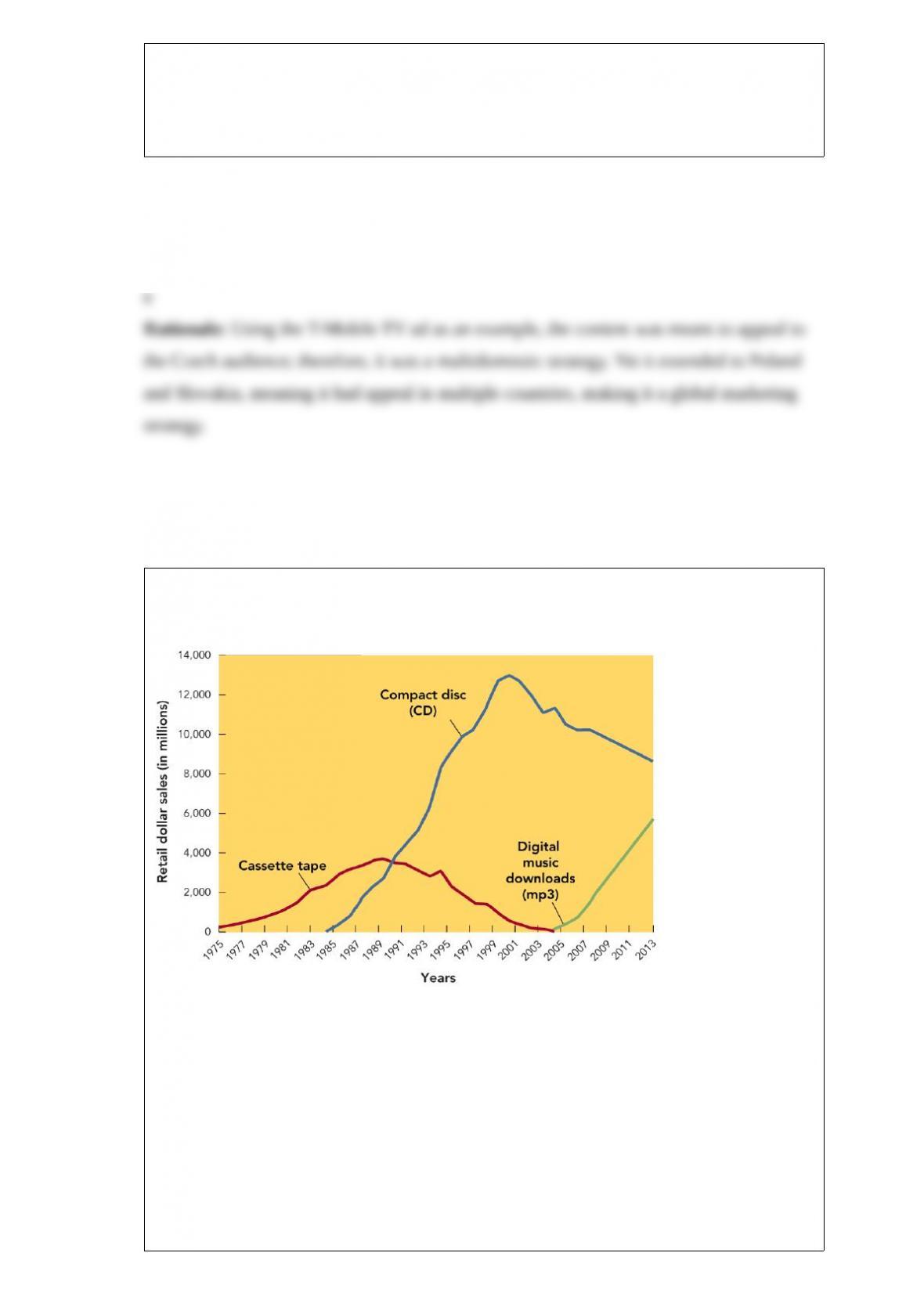
Figure 1.
Figure 1. above shows that in 2007, CDs were in which stage of the product life cycle?
a. introduction
b. growth
c. maturity
d. harvest
e. decline
Answer:
Wholesalers who handle a limited assortment of fast-moving or perishable items that
are sold for cash directly from trucks in their original packages are referred to as
__________.
a. rack jobbers
b. drop shippers
c. truck jobbers
d. cash and carry wholesalers
e. manufacturer’s representatives
Answer:
Segmentation based on where prospective customers live or work is referred to as

a. zip code segmentation.
b. geographic segmentation.
c. regional segmentation.
d. MSA segmentation.
e. NAICS code segmentation.
Answer:
Managers often use the promotion-to-sales ratio on their marketing dashboard to assess
how effective the integrated marketing communications program expenditures are at
generating _________.
a. sales
b. the media mix
c. the marketing matrix
d. the promotional blend
e. marketing by objectives (MBO)
Answer:
The primary organizational buying objective is to
a. help the firm achieve its objectives.
b. create an atmosphere of inclusiveness.
c. help smaller companies stay in business.
d. increase the proficiency of its buyers.
e. balance inventory.
Answer:
The practice of changing prices for products and services in real time in response to
supply and demand conditions is referred to as __________.
a. dynamic pricing
b. virtual pricing
c. experience curve pricing
d. skimming pricing
e. elasticity pricing
Answer:

Franchising refers to
a. a contractual agreement between multiple retailers sharing the same business mission
to operate with a consistent business model to not only achieve enhanced buying power
but also increase customer loyalty.
b. a contractual arrangement between a parent company and an individual or firm that
allows the latter to operate a certain type of business under an established name and
according to specific rules.
c. purchasing the name, branding, and raw materials from one organization and
transferring it to another.
d. a practice whereby one firm’s marketing channel is used to sell another firm’s
product.
e. selling an idea to a larger company and letting it do all the manufacturing,
distribution, and marketing.
Answer:
Retailers like Williams-Sonoma that sell products through retail stores, catalogs, and
online are examples of __________.
a. intertype competitors
b. multichannel retailers
c. vertically-integrated retailers
d. scrambled merchandisers
e. dual distributors
Answer:
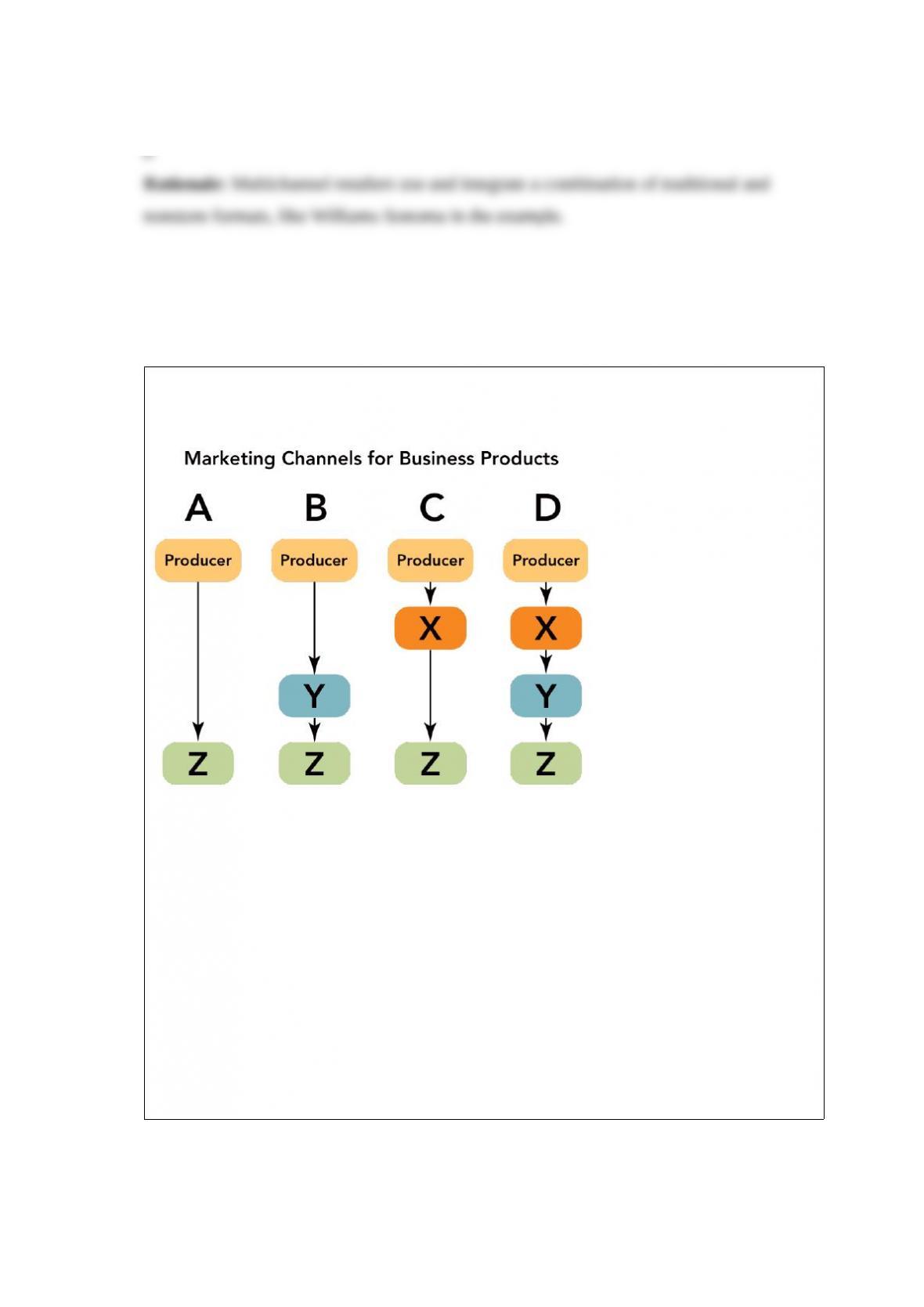
Figure 1.
Figure 1. above depicts the four most common marketing channels for business
products and services. “X” represents
a. consumers.
b. industrial users.
c. dual distributors.
d. agents or brokers.
e. industrial distributors.
Answer: