The first stage of the new-product process is
a. idea generation.
b. screening and evaluation.
c. business analysis.
d. new-product strategy development.
e. concept testing.
Answer:
Feature bloat is
a. an exaggeration of a product’s performance capabilities.
b. the overcharging in price for a minor or cost-free product enhancement.
c. the requirement of having consumers learn new behaviors with a continuous
innovation.
d. an excessive number of product attributes that overwhelms consumers with
unnecessary complexity.
e. the increase in package size when adding more content or making it larger (the
“mega” phenomenon).
Answer:
If the terms of the trade discount are listed 20/10/5, the number “5” represents
a. 5 percent of the suggested wholesale price that is available to the retailer to cover
costs and provide a profit.
b. 5 percent of the suggested retail price that is available to the jobber to cover costs and
provide a profit.
c. 5 percent of the wholesale price that is available to the jobber to cover costs and
provide a profit.
d. 5 percent of the suggested retail price that is available to the ultimate consumer.
e. 5 percent of the suggested retail price is the profit that is available to the
manufacturer.
Answer:
Drawing conclusions about every woman who wears a size 14 or larger in a particular
zip code from a representative sample of 250 women in that zip code who wear a size
14 or larger would be
a. probability sampling.
b. nonprobability sampling.
c. random sampling.
d. statistical inference.
e. interpolation.
Answer:
Airline load factor refers to
a. the percentage of paying customer seats flown one mile plus frequent flyer
redemption seats flown one mile.
b. the percentage of empty seats on a plane compared to its total capacity.
c. the percentage of available seats flown one mile occupied by a paying customer.
d. the percentage of seats that are overbooked on any given flight to prevent profit
shortfalls for “no shows.”
e. the total of all paid seats plus all luggage overcharges and all purchased beverages,
meals, and other amenities or additional services, per flight.
Answer:
Forever Quilting is a small company that makes quilting kits priced at $120 each. There
is no quantity discount. The costs of the materials that go into each kit are $45. It costs
$5 in labor to assemble a kit. The company has monthly expenses of $1,000 for rent and
insurance, $200 for heat and electricity, $500 for advertising, and $4,500 for the
monthly salary of its owner. Last month the company sold 150 kits. Forever Quilting’s
total revenue for the month was
a. $4,300.
b. $6,200.
c. $7,500.
d. $10,500.
e. $18,000.
Answer:
Coal, lumber, and chemicals, which are sold in extremely large quantities are
traditionally sold by which type of wholesaler?
a. cash and carry wholesalers
b. rack jobbers
c. truck jobbers
d. general merchandise wholesalers
e. drop shippers
Answer:
Today’s organizations must be visionarythat is, they must
a. develop strategies based on those that were successful in the past.
b. be backward-looking, examining the past carefully to learn from mistakes.
c. anticipate future events and respond quickly and effectively.
d. hire the most culturally diverse team possible in order to generate the best new ideas.
e. involve all stakeholders of the organization when defining its business mission.
Answer:
When Ann Taylor, a well-known retailer of sophisticated women’s clothing, started
losing sales to its own LOFT outlets that feature moderately priced casual clothes, Ann
Taylor was dealing with the marketing phenomenon of __________.
a. amortization
b. product appropriation
c. profit pilferage
d. marketing Darwinism
e. cannibalization
Answer:
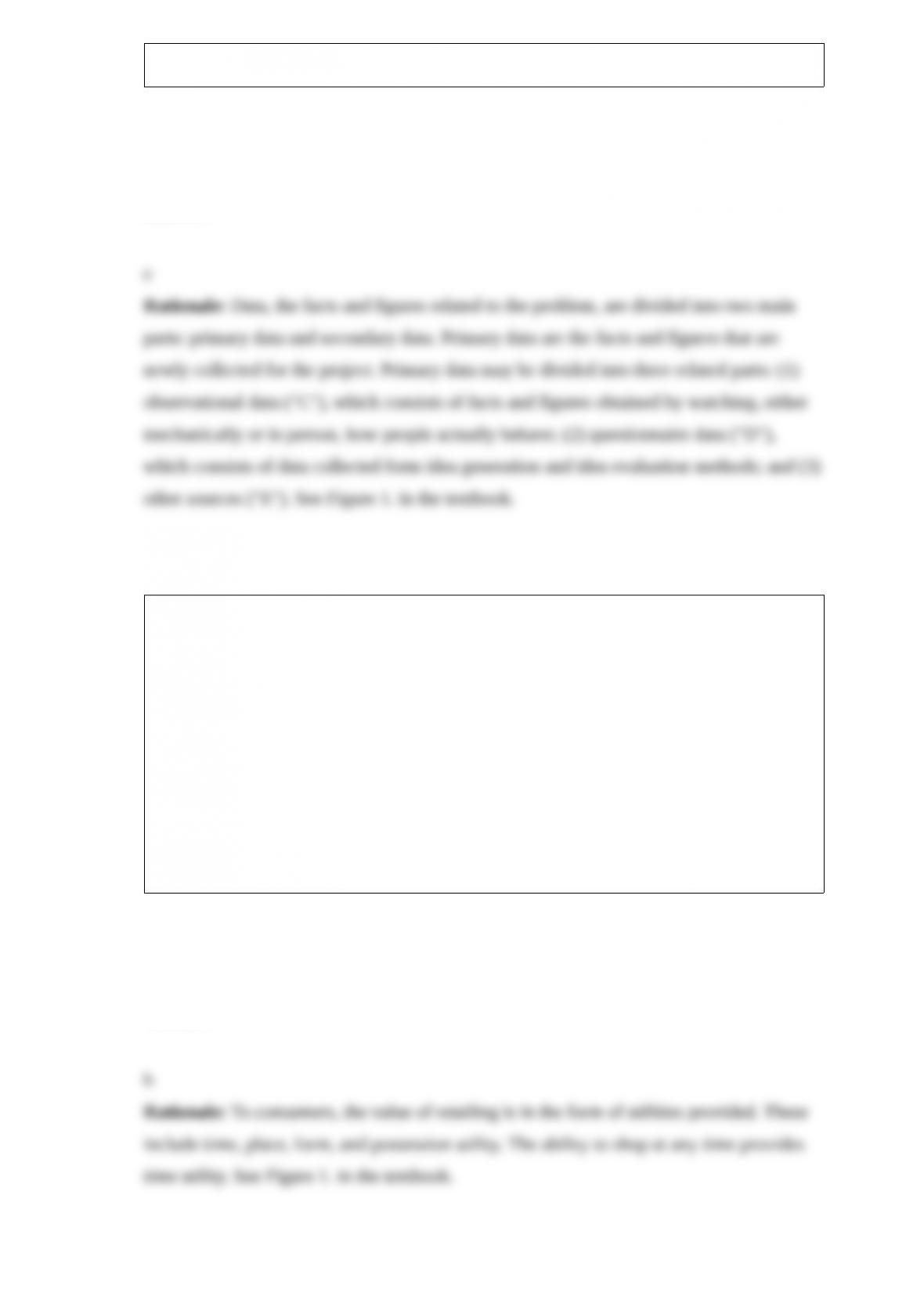
Figure 1.b
Figure 1.b above shows that primary data may be divided into three related parts. If “C”
represents data collected from individual interviews, focus groups, trend hunting, etc.,
which type of data is “C?”
a. questionnaire data
b. mined data
c. internal secondary data
d. external secondary data
e. observational data
Answer:
The ability to shop over the Internet 24/7 provides consumers with __________ utility.
a. form
b. time
c. convenience
d. possession
e. performance
Answer:
In the VALS framework, consumers with fewer resources who are practical people,
have constructive skills, value self-sufficiency, and are unimpressed by material
possessions except those with a practical or functional purpose, are referred to as
__________.
a. Experiencers
b. Thinkers
c. Makers
d. Believers
e. Strivers
Answer:
One disadvantage of using magazines as an advertising medium is
a. the inability to target specific audiences.
b. the long lead-time needed to place an ad.
c. the extremely low cost.
d. the trend to create sex or humor appeals often dilutes the effectiveness of the
message.
e. the lack of noise associated with their use in the communication channel.
Answer:
Penetration pricing refers to
a. charging different prices to different buyers for goods of like grade and quality.
b. setting the highest initial price that customers really desiring the product are willing
to pay.
c. setting a low initial price on a new product to appeal immediately to the mass market.
d. setting a market price for a product or product class based on a subjective feel for the
competitors’ prices or market price.
e. setting prices a few dollars or cents under an even number.
Answer:
Interactive marketing is characterized by
a. sophisticated choiceboard and personalization systems.
b. niche marketspaces.
c. the digital divide, which separates online consumers from traditional marketplace
consumers.
d. a marketing mix strategy that de-emphasizes the promotion element.
e. a high level of convenience with little concern about cost.
Answer:
A number of U.S.-based retail chains have begun using lines and terminals that do not
use clerks. This is an example of what level of retail service?
a. full-service
b. self-service
c. limited-service
d. customized-service
e. functional-service
Answer:
Idle production capacity refers to
a. a situation where the demand for exceeds the availability of service providers and as
a result, no services can be offered.
b. when the supply of service providers exceeds the primary demand for the service.
c. a situation where a service provider is available but there is no demand for the
service.
d. integrating the service component of the marketing mix with efforts to influence
consumer demand.
e. the potential profits of one service provider serving multiple clients at the same time.
Answer:
A nondurable good is defined as a(n)
a. item consumed in one or a few uses.
b. item that usually lasts over an extended number of uses.
c. item that lasts at least one year without becoming obsolete.
d. product purchased only for the use of ultimate consumers.
e. product used in the production of other products.
Answer:
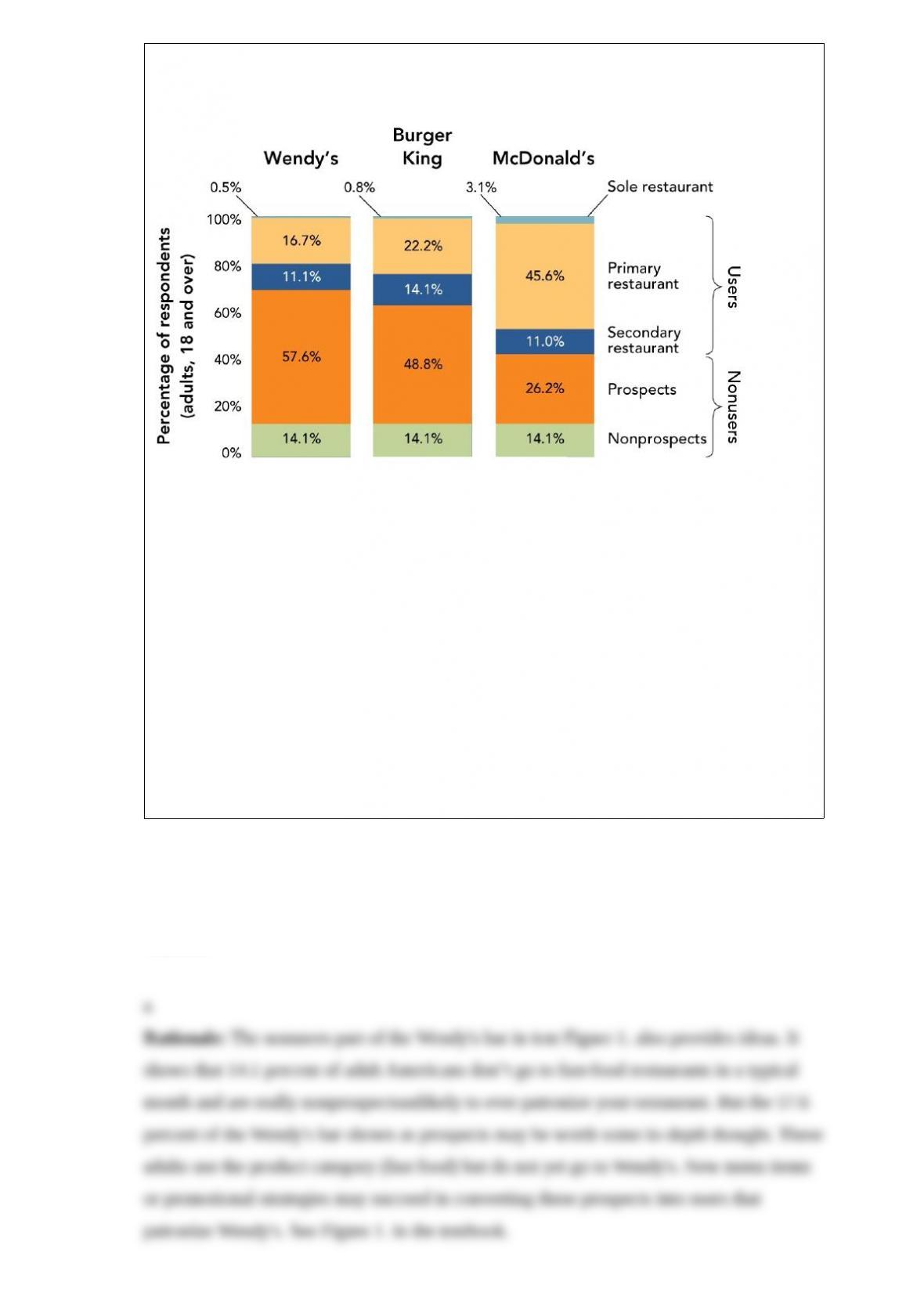
Figure 1.
As an owner of a Wendy’s fast-food restaurant, the information in Figure 1. above
suggests
a. new menu items or promotional strategies may succeed in converting the prospects
into users.
b. most of the respondents think of Wendy’s as their primary fast food restaurant.
c. McDonald’s has fewer “exclusively loyal” customers than does Wendy’s.
d. Burger King is closing in on your market share.
e. a need to devise a marketing program to change the minds of nonprospects.
Answer:
The clandestine collection of trade secrets or proprietary information about a company’s
competitors is referred to as __________.
a. economic espionage
b. industrial espionage
c. marketplace espionage
d. industrial surveillance
e. patent infringement
Answer:
There is no set time that a product takes to move through its life cycle. But, as a rule,
_________.
a. services do not have a tangible life cycle
b. consumer products have shorter life cycles than business products
c. packaged goods have a shorter life cycle than clothing
d. technological change tends to lengthen product life cycles
e. product life cycles are longer for ideas than for services
Answer:
A(n) __________ question allows respondents to express opinions, ideas, or behaviors
in their own words without being forced to choose among alternatives that have been
predetermined by a marketing researcher.
a. dichotomous
b. open-ended
c. closed-end
d. fixed-alternative
e. semantic differential
Answer:
Which of the following statements about consumer ethics is most accurate?
a. Consumer complaints about online auction fraud outnumber all reports of online
crime.
b. The cost to marketers of unethical consumer behavior is negligible in terms of lost
sales.
c. The potential cost to marketers of unethical consumer behavior is dramatically
reduced by investing in loss prevention training.
d. Retailers lose about $1 million dollars a day from shoplifting.
e. At some point, every person shoplifts or participates in an unethical exchange; to
retailers, it is simply the cost of doing business.
Answer:
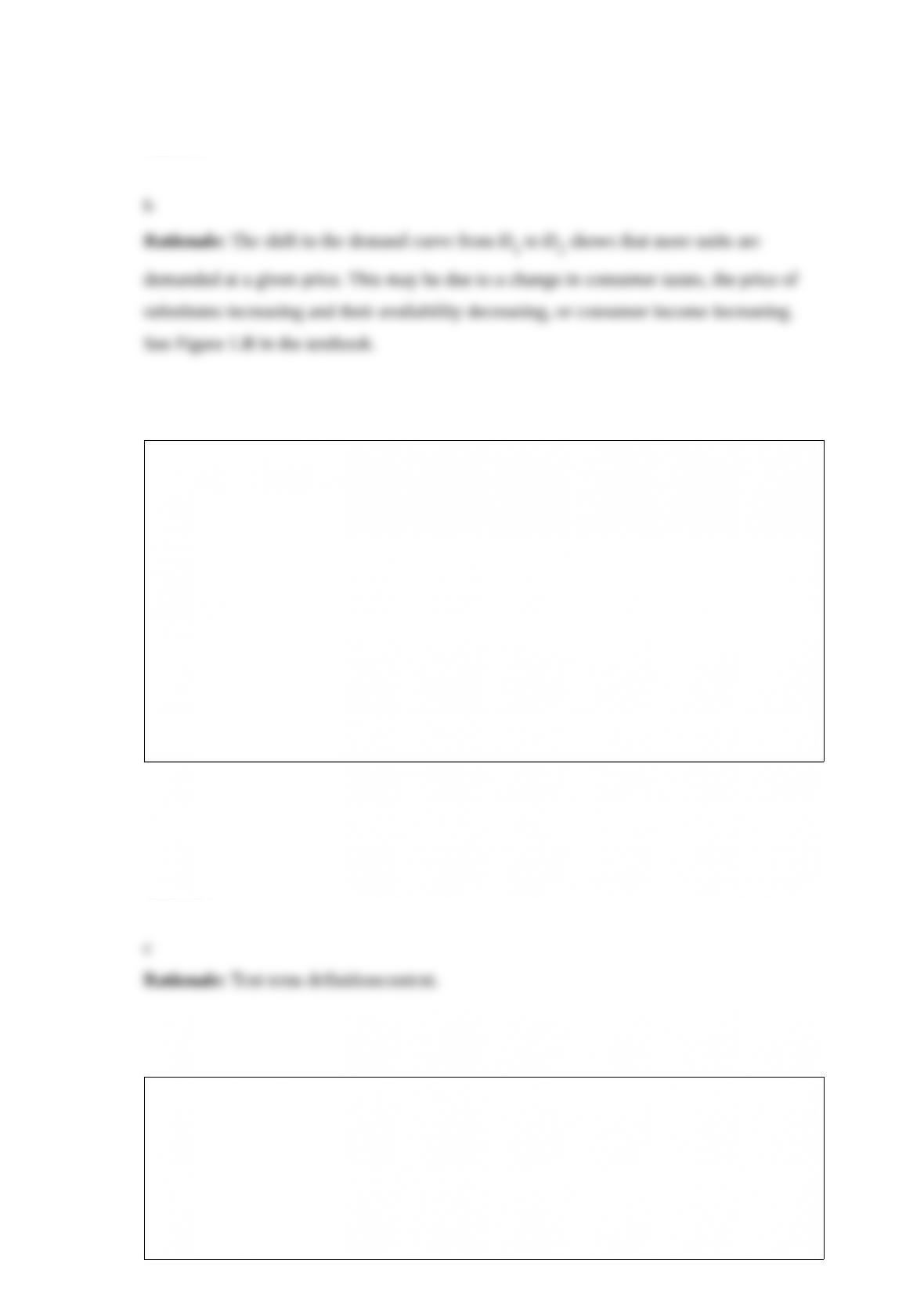
Figure 1.B
A shift of the demand curve from D1 to D2 in Figure 1.B above indicates
a. fewer units are demanded at a given price.
b. more units are demanded at a given price.
c. the price has decreased.
d. the price has increased.
e. there is not enough information given to indicate what happened.
Answer:
A website’s aesthetic appeal and functional look and feel reflected in site layout and
visual design is referred to as __________.
a. customization
b. content
c. context
d. connection
e. conductivity
Answer:
The North American Industry Classification System (NAICS) system designates
industries with a numerical code in a defined structure. A six-digit coding system is
used. The third digit designates a(n)
a. industry subsector.
b. industry group.
c. specific industry.
d. individual country-level national industry.
e. sector of the economy.
Answer:
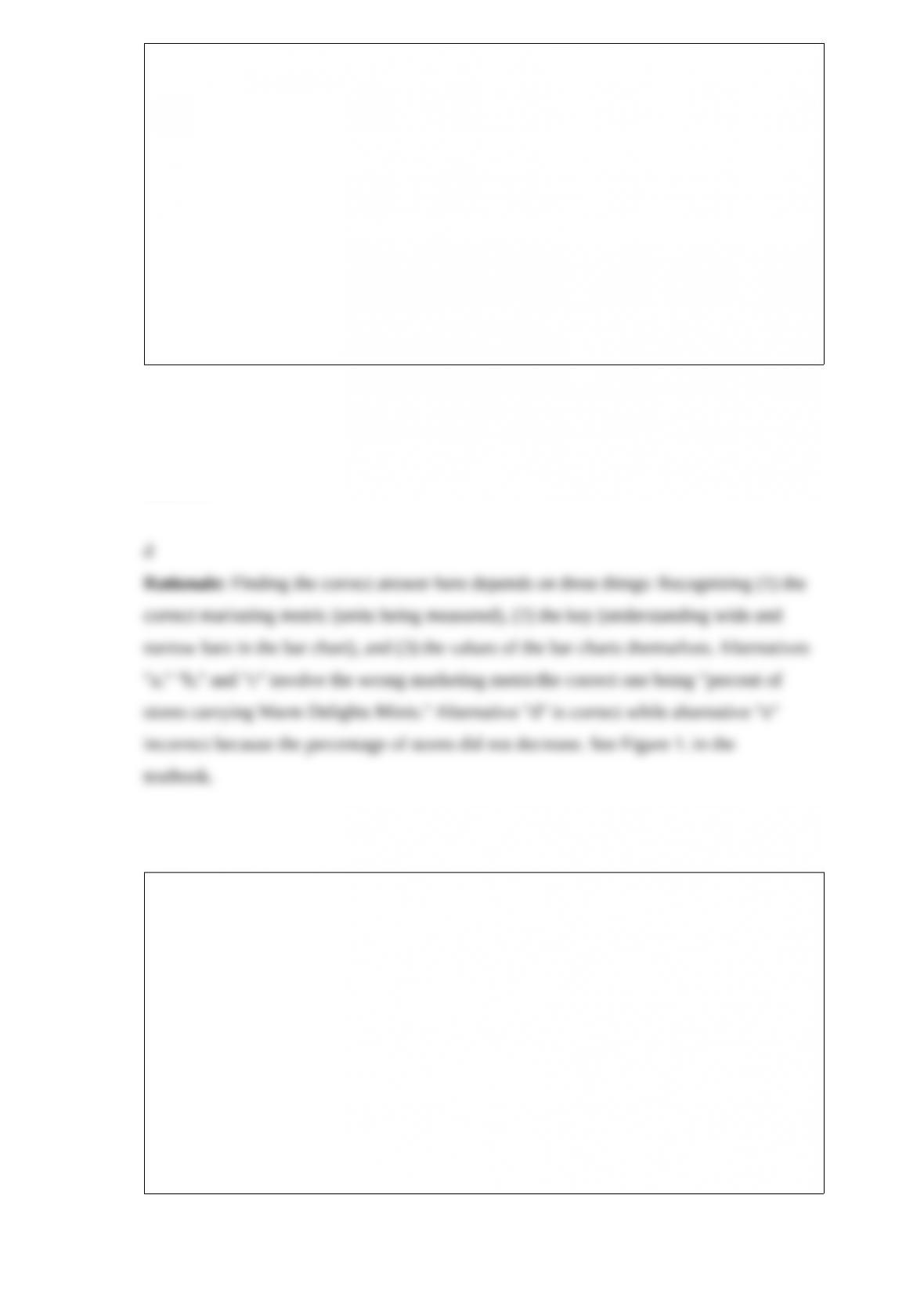
Figure 1.: General Mills Marketing Dashboard Chart “B”
Consider Figure 1.: General Mills Marketing Dashboard Chart “B” above. As part of the
Warm Delights team at General Mills, you are asked to analyze and interpret the
marketing dashboard for Warm Delights Minis. After a careful analysis of Chart “B,”
you conclude the following:
a. the drug store channel has dramatically increased the average number of flavors
Warm Delights Minis carried per store from November to December.
b. the drug store channel has dramatically increased monthly unit sales of Warm Delight
Minis from November to December.
c. the drug store channel has dramatically increased monthly sales revenues of Warm
Delights Minis from November to December.
d. the drug store channel has seen a dramatic increase in the percentage of stores
carrying Warm Delights Minis from November to December.
e. the drug store channel has seen a dramatic decrease in the percentage of stores
carrying Warm Delights Minis from November to December.
Answer:
A(n) __________ question requires respondents to select one or more response options
from a set of predetermined choices.
a. depth interview
b. open-ended
c. fixed-alternative
d. attitudinal
e. semantic differential
Answer:
A __________ exists when a buyer and its supplier adopt mutually beneficial
objectives, policies, and procedures for the purpose of lowering the cost or increasing
the value of products and services delivered to the ultimate customer.
a. supplier development agreement
b. reciprocal arrangement
c. shareholder relationship
d. supply partnership
e. strategic alliance
Answer:
According to the retail life cycle, __________ is the stage of emergence of a retail
outlet, with a sharp departure from existing competition.
a. decline
b. maturity
c. introduction
d. early growth
e. accelerated development
Answer:
What is the primary disadvantage of employing a selective specialization strategy?
a. Gaining market distribution will be costly.
b. The organization may be spread too thin.
c. The organization achieves neither marketing nor manufacturing synergies.
d. R&D-manufacturing has the difficulty of producing multiple new lines.
e. It is too risky for a company to “put all its eggs in one basket.”
Answer:
The consumer-initiated practice of generating content on a marketer’s website that is
custom-tailored to an individual’s specific needs and preferences is referred to as
__________.
a. personalization
b. digitalization
c. collaboration
d. intermediation
e. innovation
Answer:
When a Frito-Lay salesperson, such as the one shown in the photo above, takes an
inventory of Doritos chips to ensure that the snacks are in adequate supply on retailers’
shelves, what form of buying decision does the manager engage in?
a. new buy
b. modified rebuy
c. straight rebuy
d. team rebuy
e. need rebuy
Answer:
Twitter is
a. a website where users may create a personal profile, add other users as friends, and
exchange comments, photos, videos, and “likes” with them.
b. a website that enables users to send and receive short messages up to 140 characters
long.
c. a business-oriented website that lets users post their professional profiles to connect
to a network of businesspeople.
d. a video-sharing website in which users can upload, distribute, view, and comment on
videos.
e. a website enables online customers to use their collective buying power to take
advantage of deeply discounted prices for a product or service each day.
Answer:
The strategy used by firms that have as many different product variations, brand names,
and advertising programs as countries in which they do business is referred to as a(n)
a. ethnocentric strategy.
b. multidomestic strategy.
c. transnational marketing strategy.
d. meganational marketing strategy.
e. multimarket strategy.
Answer: