
Consider a market characterized by two firms that set the same price in the market, P =
$10. Total market demand is QT = 100 – 2P, of which the two firms share equally. Based
on this information, we can conclude:
A. the HHI = 5,000 and the Rothschild index is 1
B. the HHI = 2,500 and the Rothschild index is 2
C. the HHI = 5,000 and the Rothschild index is 2
D. None of the answers are correct.
Oligopoly differs from monopoly as follows:
A. Oligopoly involves a few firms; monopoly involves a single firm.
B. Oligopoly does use advertisement; monopoly does not use advertisement.
C. Oligopoly involves free entry; monopoly involves no free entry.
D. Oligopoly involves a few firms; monopoly involves a single firm and oligopoly
involves free entry; monopoly involves no free entry.
Consider the monopoly in the figure below with price regulated at $20 per unit. The
deadweight loss under the regulated price is:
A. $150.

B. $1,350.
C. $2,300.
D. There is insufficient information to compute the deadweight loss at the regulated
price.
A monopoly produces X at a marginal cost of $10 per unit and charges a price of $20
per unit. Determine the elasticity of demand at the profit-maximizing price of $20.
A. -0.5
B. -2
C. -0.333
D. There is insufficient information to determine the monopolys price elasticity of
demand.
Which of the following is the incorrect statement?
A. The marginal benefits curve is the slope of the total benefits curve.
B. dB(Q)/dQ = MB.
C. The slope of the net benefit curve is horizontal where MB = MC.
D. The difference in the slope of the total benefit curve and the total cost curve is
maximized at the optimal level of Q.
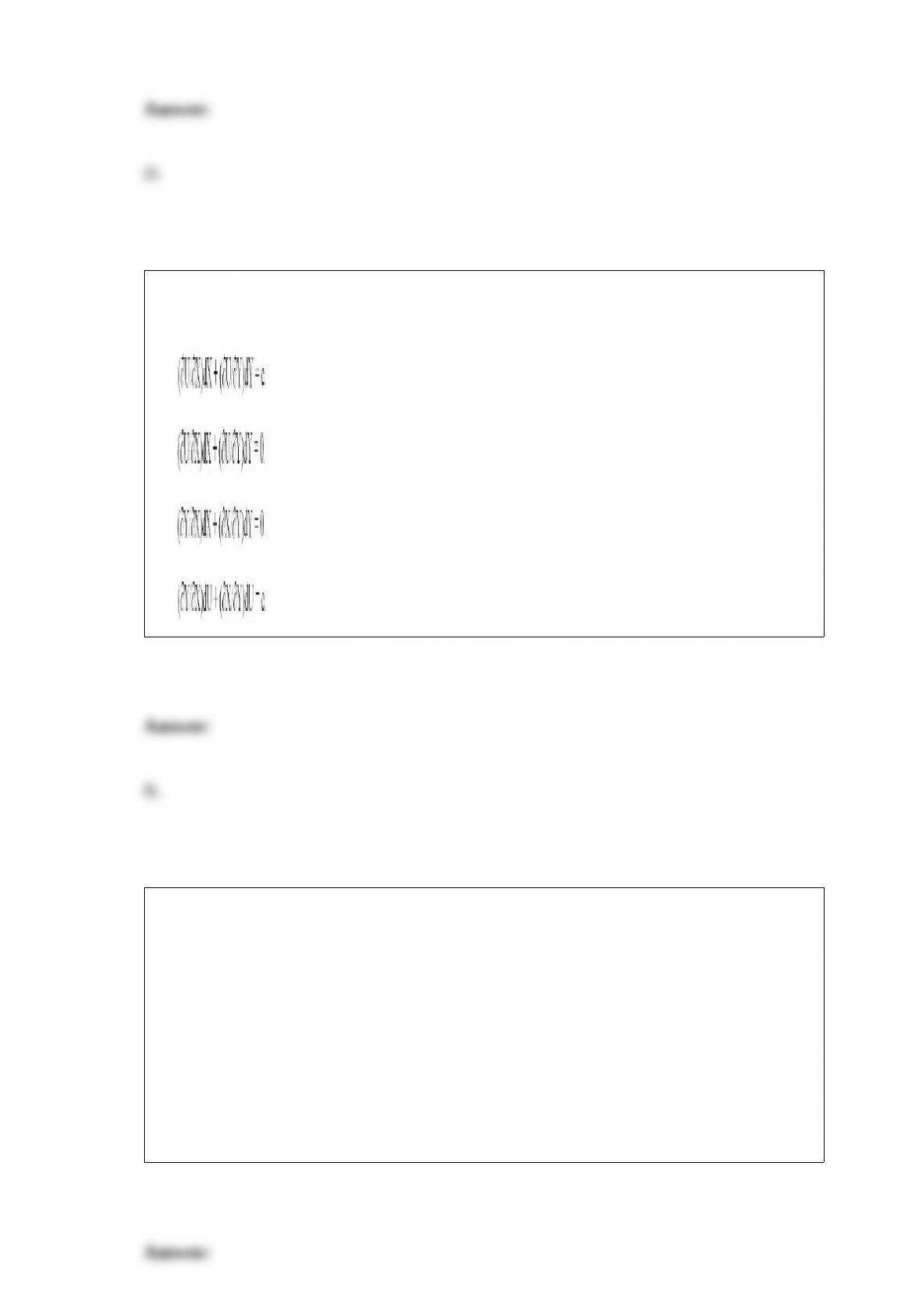
Suppose we are given that the value of a particular utility function is a constant. That is,
U(X,Y) = c. Then, the total derivative of this relation is:
A.
B.
C.
D.
Which of the following is NOT a result of certification of skills?
A. A stated minimum standard of service is provided.
B. A price higher than that which would have been charged if there were no
certification.
C. A bigger quantity exchanged than that which would have resulted if there were no
certification.
D. A profession is formed.

If you advertise and your rival advertises, you each will earn $3 million in profits. If
neither of you advertises, you will each earn $7 million in profits. However, if one of
you advertises and the other does not, the firm that advertises will earn $10 million and
the non-advertising firm will earn $1 million. If you and your rival plan to hand your
business down to your children, and this “bequest” goes on forever, then a Nash
equilibrium when the interest rate is zero is for:
A. your firm to never advertise.
B. your firm to always advertise when your rival does, provided that the interest rate is
sufficiently large.
C. each firm to not advertise until the rival does, and then to advertise forever provided
the interest rate is sufficiently low.
D. each firm to advertise until the rival does not advertise, and then not advertise
forever.
In the long run, monopolistically competitive firms charge prices:
A. equal to marginal cost.
B. below marginal cost.
C. equal to the minimum of average total cost.
D. above the minimum of average total cost.

A local telephone company charges $.10/min. based on a $.08/min. marginal cost of
operation. What is the Lerner index?
A. 0.2
B. 0.25
C. 0.40
D. 0.50
If the interest rate is 5 percent, what is the present value of $10 received one year from
now?
A. $9.50
B. $10.05
C. $9.52
D. $9.77
Determine whether integration between the following types of firms would constitute a
horizontal, vertical, or conglomerate merger.a. A food company and a drug company.b.
A milk producer and a cheese producer.c. A computer chip manufacturer and a silicon
producer.

Having worked for many of the firms in the petroleum industry, you know that the price
elasticity of demand for a representative firm is about -1.25. An industry publication
recently reported that the Rothschild index for the petroleum industry is estimated to be
0.88. Based on this information, you know that the price elasticity of demand for the
firm you currently work for in the petroleum industry is:
A. -1.42.
B. -1.10.
C. 0.704.
D. 1.10.
Consider a consumer who is searching for the lowest price for good X. The consumer
knows that 75 percent of the time she will find a store charging $10 and 25 percent of
the times she will find a store charging $7. The expected benefit from an additional
search is:
A. $3.
B. $0.75.
C. $2.25.
D. $0.

Which of the following raises domestic prices when demand is relatively high?
A. Domestic subsidies
B. Lump sum tariff
C. Excise tariff
D. Lump sum tariff and excise tariff
Which of the following is a correct statement?
A. Predatory pricing is easy to prove in a court of law.
B. An incumbent firm may experience a learning curve that allows it to produce at a
lower cost than a potential entrant.
C. A firm receives no individual benefit from strategies that raise the marginal costs of
its rivals.
D. No individual firm can benefit from strategies that raise the fixed costs of all the
firms in the industry.

Mitchells money income is $150, the price of X is $2, and the price of Y is $2. Given
these prices and income, Mitchell buys 50 units of X and 25 units of Y. Call this
combination of X and Y bundle J. At bundle J, Mitchells MRS is 2. At bundle J, if
Mitchell increases consumption of Y by 1 unit, how many units of X must he give up in
order to satisfy his budget constraint?
A.
B. 1
C. 2
D. 4
Refer to the normal-form game of bargaining shown below.
Suppose that management and the union are bargaining over how much of a $500
surplus to give to the union. It is assumed that the surplus can only be split into $250
increments. Furthermore, negotiations are set up such that management and the union
must simultaneously and independently write down the amount of surplus to allocate to
the union. The payoff structure to this one-shot bargaining game is listed in Figure
10-16. The number of inefficient outcomes resulting from the bargaining game is:
A. 3
B. 5
C. 6
D. 8
If a firm offers to pay a worker $10 for each hour of leisure the worker gives up, the
$10 implies the:
A. marginal rate of substitution between leisure and income.
B. market rate of substitution between leisure and income.
C. market rate of transformation between leisure and income.
D. marginal rate of transformation between leisure and income.
You are the CEO of a firm with an industry HHI equal to 1,000. Your firm currently
controls 20 percent of the market. The board of trustees wants you to consider merging
with a firm that controls 10 percent of the market. Should you be concerned about
antitrust proceedings? Explain.
At the recent shareholders meeting, the CEO of a small bank proposed a plan to offer
each of its employees 250 incentive options for Class A common stock. The key
provisions of the plan are that employees must exercise the options between January
2014 and December 2019, and if an employee terminates his or her employment with
the bank (or is terminated), the options are no longer exercisable. One shareholder
feverishly objected to the plan, claiming that such a move would dilute the value of the
outstanding shares. As CEO, how would you defend the stock option plan to the
shareholders?
A new manager recently was given an assignment to create two possible wage schemes
for a design firm. The manager came up with the following packages: (1) Each
employee will start at $15 per hour and will work eight hours per day; (2) each
employee will receive $8 per hour and one-tenth of 1 percent of profits (expected
profits are $80,000 per day if everyone puts out maximum effort). Which program will
motivate the employees more? Which program would you choose? Why?
As a newly hired stock analyst, your first job is determining the value of a company that
sells a service that has extremely strong network effects. Essentially, this firm sells a
two-way network that links users and currently comprises 50,000 nodes. Each
connection service within the network has a value of $10. Estimate the total value of the
firm.
At Econ Tech, the average grade in a course that all students know to be a “blow-off”
course is the same as the average grade in the toughest math course. Why?
In 1995 a $50 million major renovation project of the 19-year-old Seattle Kingdome
was completed nearly $18 million over the initial budget. Several million dollars in
other expenses were incurred during the renovation phase, including payments to the
Seattle Seahawks football team and the Mariners baseball team for revenue they lost by
not being able to play in the Kingdome. If you were on the city council, what
information would you have needed to determine whether the renovation project was a
sound investment?