
A cost object indicates how costs are related or identified.
Answer:
During the first year of operations, a company granted warranties on its products. The
estimated cost of the product warranty liability at the end of the year is $8,500. The
product warranty expense of $8,500 should be recorded in the years of the expenditures
to repair the products covered by the warranty payments.
Answer:
It is not necessary to post the closing entries to the general ledger.
Answer:
Supervisor salaries and indirect factory wages would normally appear in the direct labor
cost budget.

Answer:
The unit of measurement concept requires that economic data be recorded in a common
unit of measurement.
Answer:
For strong internal control system over cash, it is important to have the duties related to
cash receipts and cash payments divided among different employees.
Answer:
Factory overhead cost is sometimes referred to as factory burden.

Answer:
A post-closing trial balance contains only asset and liability accounts.
Answer:
Journal entries can have more than two accounts as long as the debits equal the credits.
Answer:
A debit is abbreviated as Db and a credit is abbreviated as Cr.
Answer:

Cash flows from investing activities, as part of the statement of cash flows, include
payments for the acquisition of fixed assets.
Answer:
Rarely would the cash flows from operating activities, as reported on the statement of
cash flows, be the same as the net income reported on the income statement.
Answer:
The expected period of time that will elapse between the date of a capital investment
and the complete recovery in cash of the amount invested is called the cash payback
period.
Answer:

Cash inflows and outflows are not netted in the investing or financing sections of the
statement of cash flows but are separately disclosed to give the reader full information.
Answer:
Budgets are prepared in the Accounting Department and monitored by various
department managers.
Answer:
To a major resort, timeshare properties would be classified as property, plant and
equipment.
Answer:
Costs associated with normal research and development activities should be treated as
intangible assets.
Answer:
The balance in Premium on Bonds Payable should be reported as a deduction from
Bonds Payable on the balance sheet.
Answer:
A company is considering the purchase of a new machine for $48,000. Management
expects that the machine can produce sales of $16,000 each year for the next 10 years.
Expenses are expected to include direct materials, direct labor, and factory overhead
totaling $8,000 per year plus depreciation of $4,000 per year. All revenues and expenses
except depreciation are on a cash basis. The payback period for the machine is 12 years.
Answer:
One reason not to depend solely on historical records to set standards is that there may
be inefficiencies contained in past costs.

Answer:
A clean audit opinion is the same as a qualified audit opinion.
Answer:
Payroll taxes only include social security taxes and federal unemployment and state
unemployment taxes.
Answer:
For accounting purposes, stated value is treated the same way as par value.
Answer:

The balances of the capital accounts from the Adjusted Trial Balance of the work sheet
are extended to the Statement of Owner’s Equity columns.
Answer:
Budgets are normally used only by profit-making businesses.
Answer:
The ending merchandise inventory for 2010 is the same as the beginning merchandise
inventory for 2011.
Answer:

Many partnerships provide for the admission of new partners or withdrawals of present
partners by amending existing partnership agreements, so that the firm may continue to
operate without executing a new agreement.
Answer:
Consuming goods and services in the process of generating revenues results in
expenses.
Answer:
The primary purpose of a stock split is to reduce the number ofshares outstanding in
order to encourage more investors to enter the market for the company’s shares.
Answer:
All long-term liabilities eventually become current liabilities.
Answer:
The DuPont formula uses financial and nonfinancial information to measure the
performance of a business.
Answer:
The production budget is the starting point for preparation of the direct labor cost
budget.
Answer:
“Market,” as used in the phrase “lower of cost or market” for valuing inventory, refers
to the price at which the inventory is being offered for sale by its owner.

Answer:
The amount of detail presented in a budget performance report for a cost center depends
upon the level of management to which the report is directed.
Answer:
The accounts payable account is listed in the chart of accounts as an asset.
Answer:
Planning is the process of monitoring operating results and comparing actual results
with the expected results.

Answer:
If the accounts receivable turnover for the current year has decreased when compared
with the ratio for the preceding year, there has been an acceleration in the collection of
receivables.
Answer:
If 20,000 shares are authorized, 15,000 shares are issued, and 500 shares are held as
treasury stock, a cash dividend of $1 per share would amount to $15,000.
Answer:
An equal stream of periodic payments is called an annuity.
Answer:

There is no difference in the Investing and Financing sections of the statement of cash
flows using the indirect and direct method.
Answer:
An unfunded pension liability is reported on the balance sheet as
A.current liability
B.owner’s equity
C.long-term liability
D.current liability or long-term liability, depending upon when the pension liability is to
be paid
Answer:
Which of the following is false in regards to direct materials for an auto manufacturer?
A.Steel would probably be a direct material.

B.Upholstery fabric would probably be a direct material
C.Oil to lubricate factory machines would not be a direct material.
D.Small plastic clips to hold on door panels, that become part of the auto, must be
accounted for as direct materials.
Answer:
The profit margin is the:
A.ratio of income from operations to sales
B.ratio of income from operations to invested assets
C.ratio of assets to liabilities
D.ratio of sales to invested assets
Answer:
Which of the accounts below would most likely appear on an adjusted trial balance but
probably would not appear on the trial balance?

A.Fees Earned
B.Accounts Receivable
C.Unearned Fees
D.Depreciation Expense
Answer:
The reconciliation of the cash register tape with the cash in the register is an example of
A.other controls.
B.independent internal verification.
C.establishment of responsibility.
D.segregation of duties.
Answer:
Which of the following is not a reason for a direct materials quantity variance?
A.Malfunctioning equipment
B.Purchasing of inferior raw materials
C.Increased material cost per unit
D.Spoilage of materials
Answer:
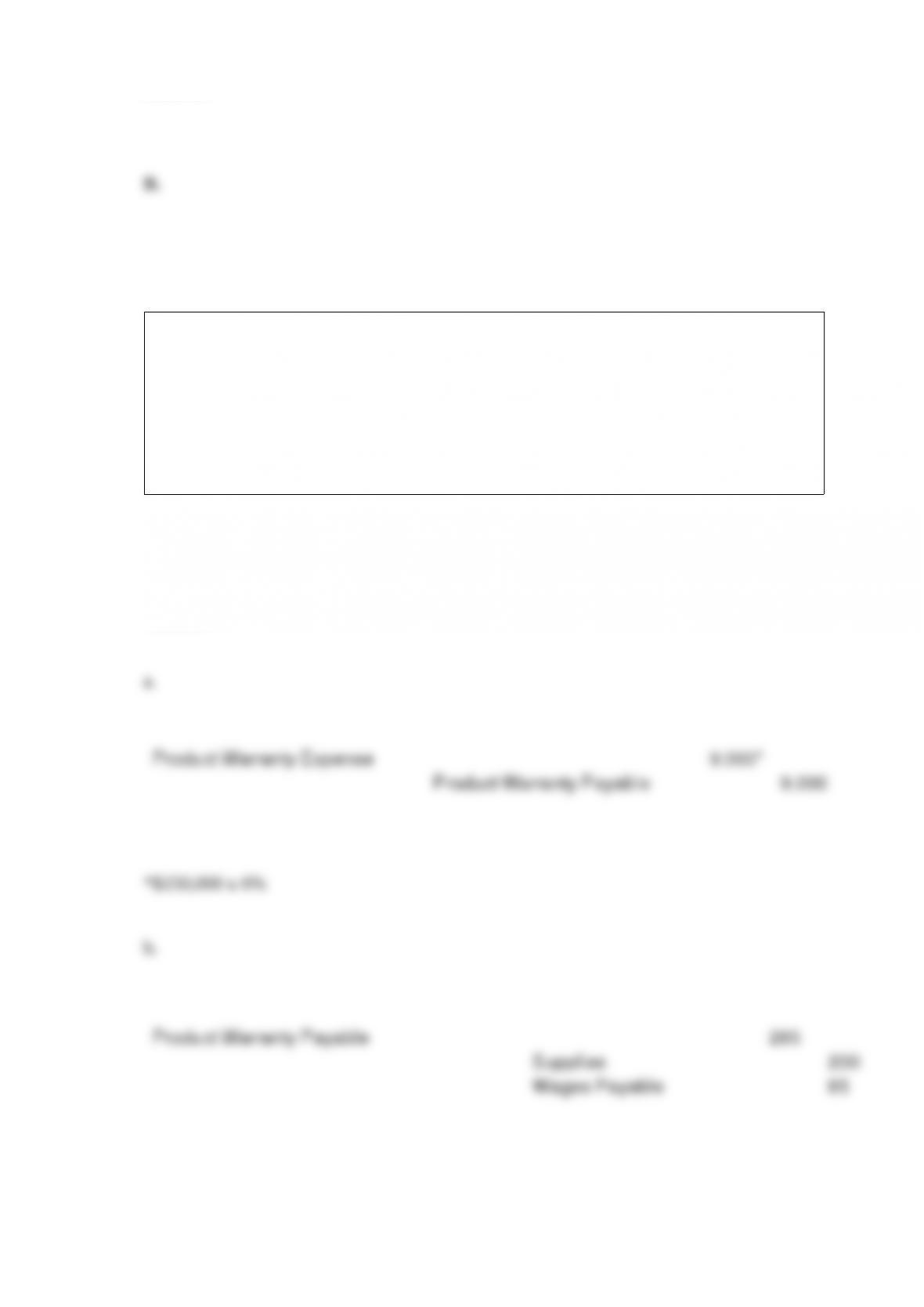
The following selected account balances appeared on the financial statements of the
Washington Company:
The Washington Company uses the direct method to calculate net cash flow from
operating activities.
Cash paid to suppliers is
A.$39,000
B.$33,000
C.$29,000
D.$23,000
Answer:
Ecco Company sold $150,000 of kitchen appliances during September under a 6 month
warranty. The cost to repair defects under the warranty is estimated at 6% of the sales
price. On October 15 a customer required a $200 part replacement, plus $85 labor under
the warranty.
Provide the journal entry for (a.) the estimated expense on September 30 and (b.) the
October 15 warranty work.
Answer:
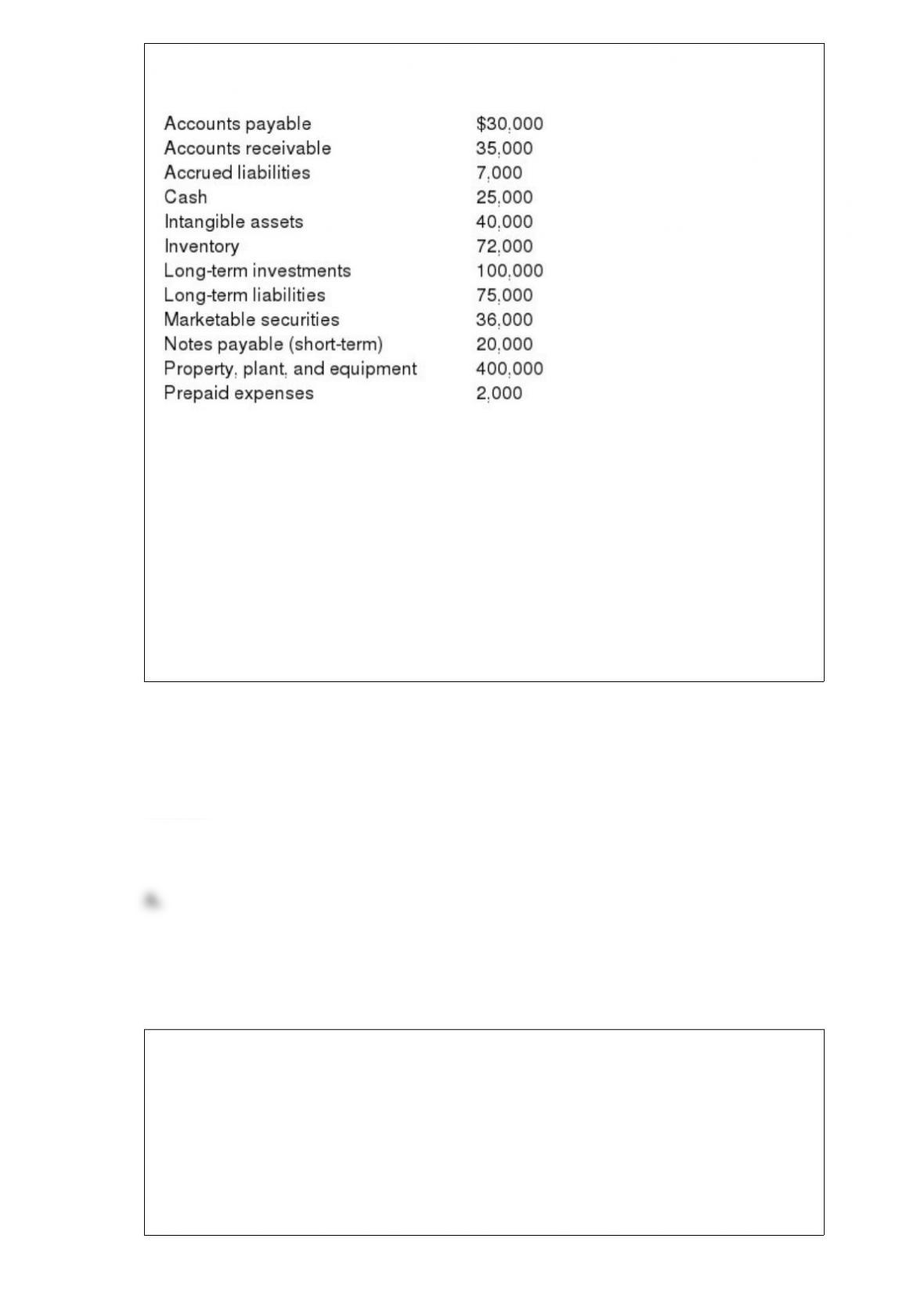
Based on the above data, what is the quick ratio, rounded to one decimal point?
A.1.7
B.2.9
C.1.1
D.1.0
Answer:
At the end of the current year, Accounts Receivable has a balance of $550,000;
Allowance for Doubtful Accounts has a credit balance of $5,500; and net sales for the
year total $2,500,000. An analysis of receivables estimates uncollectible receivables as
$25,000.
Determine (a) the amount of the adjusting entry for bad debt expense; (b) the adjusted
balances of Accounts Receivable, Allowance of Doubtful Accounts; and Bad Debt
Expense; and (c) the net realizable value of accounts receivable.
Answer:
Determine the depreciation, for the year of acquisition and for the following year, of a
fixed asset acquired on October 1 for $500,000, with an estimated life of 5 years, and
residual value of $50,000, using (a) the declining-balance method at twice the
straight-line rate and (b) the straight-line method. Assume a fiscal year ending
December
Answer:
Prepare the journal entries for the following transactions for Batson Co.
(a) Batson Co. purchased 1,200 shares of the total of 100,000 outstanding
shares of Michael Corp. stock for $20.75 per share plus a $70 commission.
(b) Michael’s total earnings for the period are $84,000.
(c) Michael paid a total of $40,000 in cash dividends to shareholders of record.
Answer:
Project A requires an original investment of $65,000. The project will yield cash flows
of $15,000 per year for seven years. Project B has a calculated net present value of
$5,500 over a five year life. Project A could be sold at the end of five years for a price
of $30,000. (a) Using the proper table below determine the net present value of Project
A over a five-year life with salvage value assuming a minimum rate of return of 12%.
(b) Which project provides the greatest net present value?
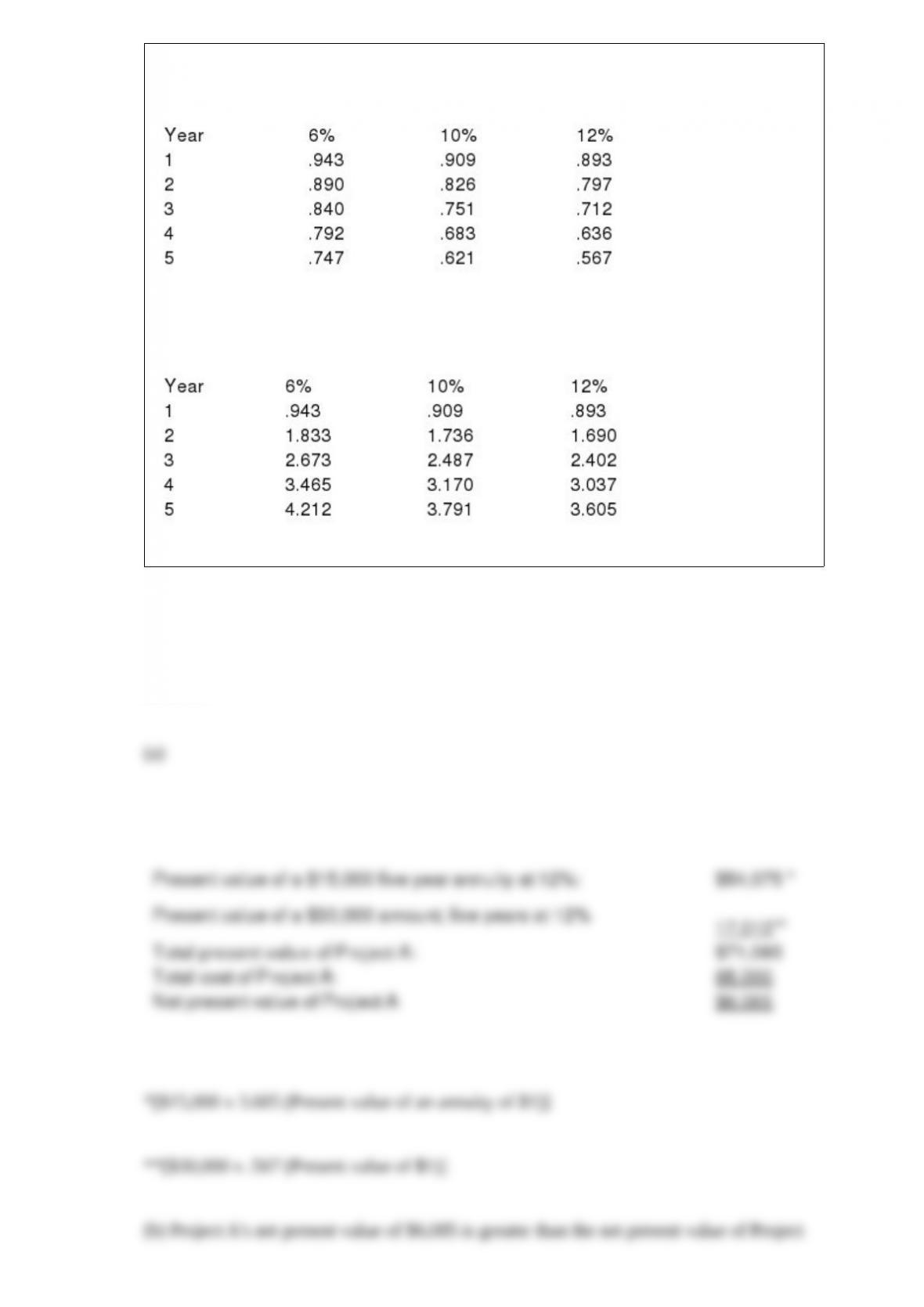
Below is a table for the present value of $1 at compound interest.
Below is a table for the present value of an annuity of $1 at compound interest.
Answer:

Debenture bonds are
A.bonds secured by specific assets of the issuing corporation
B.bonds that have a single maturity date
C.issued only by the federal government
D.issued on the general credit of the corporation and do not pledge specific assets as
collateral.
Answer:
Expenses that are incurred directly or entirely in connection with the sale of
merchandise are classified as
A.selling expenses
B.general expenses
C.other expenses
D.administrative expenses
Answer:

The journal entry to record the conversion of an $4,700 accounts payable to a notes
payable would be:
A.Cash 4,700
Notes Payable 4,700
B.Notes Receivable 4,700
Notes Payable 4,700
C.Notes Payable 4,700
Cash 4,700
D.Accounts Payable 4,700
Notes Payable 4,700
Answer:
The unfavorable volume variance may be due to all of the following factors except:
A.failure to maintain an even flow of work
B.machine breakdowns
C.unexpected increases in the cost of utilities
D.failure to obtain enough sales orders

Answer:
Partners Ken and Macki each have a $40,000 capital balance and share income and
losses in a 3:2. Cash equals $20,000, noncash assets equal $120,000, and liabilities
equal $60,000. If the noncash assets are sold for $80,000, the Macki’s capital account
will
A.decrease by $16,000.
B.decrease by $24,000.
C.increase by $24,000.
D.decrease by $40,000.
Answer:
The Swan Company produces their product at a total cost of $43 per unit. Of this
amount $8 per unit is selling and administrative costs. The total variable cost is $30 per
unit The desired profit is $20 per unit.
Determine the mark up percentage on variable cost.
A.100%
B.110%
C.80%

D.46.5%
Answer:
At the end of the current year, Accounts Receivable has a balance of $550,000;
Allowance for Doubtful Accounts has a credit balance of $5,500; and net sales for the
year total $2,500,000. An analysis of receivables estimates uncollectible receivables as
$25,000.
Determine the amount of the adjusting entry for bad debt expense and the adjusted
balance of Allowance of Doubtful Accounts, respectively.
A.$19,500 and $25,000
B.$30,500 and $525,000
C.$19,500 and $525,000
D.$30,500 and $25,000
Answer:
Singer and McMann are partners in a business. Singer’s original capital was $40,000
and McMann’s was $60,000. They agree to salaries of $12,000 and $18,000 for Singer
and McMann respectively and 10% interest on original capital. If they agree to share
remaining profits and losses on a 3:2 ratio, what will Singer’s share of the income be if

the income for the year was $50,000?
A.$24,000
B.$22,000
C.$16,000
D.$23,400
Answer:
Zenith Corporation sells some of its used store fixtures. The acquisition cost of the
fixtures is $12,500, the accumulated depreciation on these fixtures is $9,750 at the time
of sale. The fixtures are sold for $5,300. The value of this transaction in the Investing
section of the statement of cash flows is:
A.$12,500
B.$5,300
C.$2,750
D.$2,550
Answer:

Assume that divisional income from operations amounts to $192,000 and top
management has established 15% as the minimum rate of return on divisional assets
totaling $1,000,000. The residual income for the division is:
A.$42,000
B.$28,800
C.$92,000
D.$0
Answer:
A company’s history indicates that 20% of its sales are for cash and the rest are on
credit. Collections on credit sales are 20% in the month of the sale, 50% in the next
month, 25% the following month, and 5% is uncollectible. Projected sales for
December, January, and February are $60,000, $85,000, and $95,000, respectively. The
February expected cash receipts from all current and prior credit sales is:
A.$61,200
B.$57,000
C.$66,400
D.$90,250
Answer:
If the market rate of interest is greater than the contractual rate of interest, bonds will
sell
A.at a premium.
B.at face value.
C.at a discount.
D.only after the stated rate of interest is increased.
Answer:
The following lots of a particular commodity were available for sale during the year:
The firm uses the periodic system and there are 25 units of the commodity on hand at
the end of the year.
What is the amount of the inventory at the end of the year using the FIFO method?
A.$1,685
B.$1,575
C.$1,805
D.$3,585

Answer:
In a process cost system, the cost of completed production in Department A is
transferred to Department B by which of the following entries?
A.Debit Work in Process–Dept. B; credit Work in Process–Dept. A.
B.Debit Work in Process–Dept. B; credit Finished Goods–Dept. A.
C.Debit Work in Process–Dept. B; credit Cost of Goods Sold–Dept. A.
D.Debit Finished Goods; credit Work in Process–Dept. B.
Answer:
On the statement of cash flows, the cash flows from financing activities section would
include
A.receipts from the sale of investments
B.payments for the acquisition of investments
C.receipts from a note receivable
D.receipts from the issuance of capital stock

Answer:
Budgets need to be fair and attainable for employees to consider the budget important
in their normal daily activities. Which of the following is not considered a human
behavior problem?
A.Setting goals among managers that conflict with one another.
B.Setting goals too tightly making it difficult to meet performance expectation.
C.Allowing employees the opportunity to be a part of the budget process.
D.Allowing goals to be so low that employees develop a ‘spend it or lose it” attitude.
Answer:
When preparing the statement of owner’s equity, the beginning capital balance can
always be found
A.in the Income Statement columns of the work sheet
B.in the statement of cash flows
C.in the general ledger
D.in the Balance Sheet columns of the work sheet
Answer:
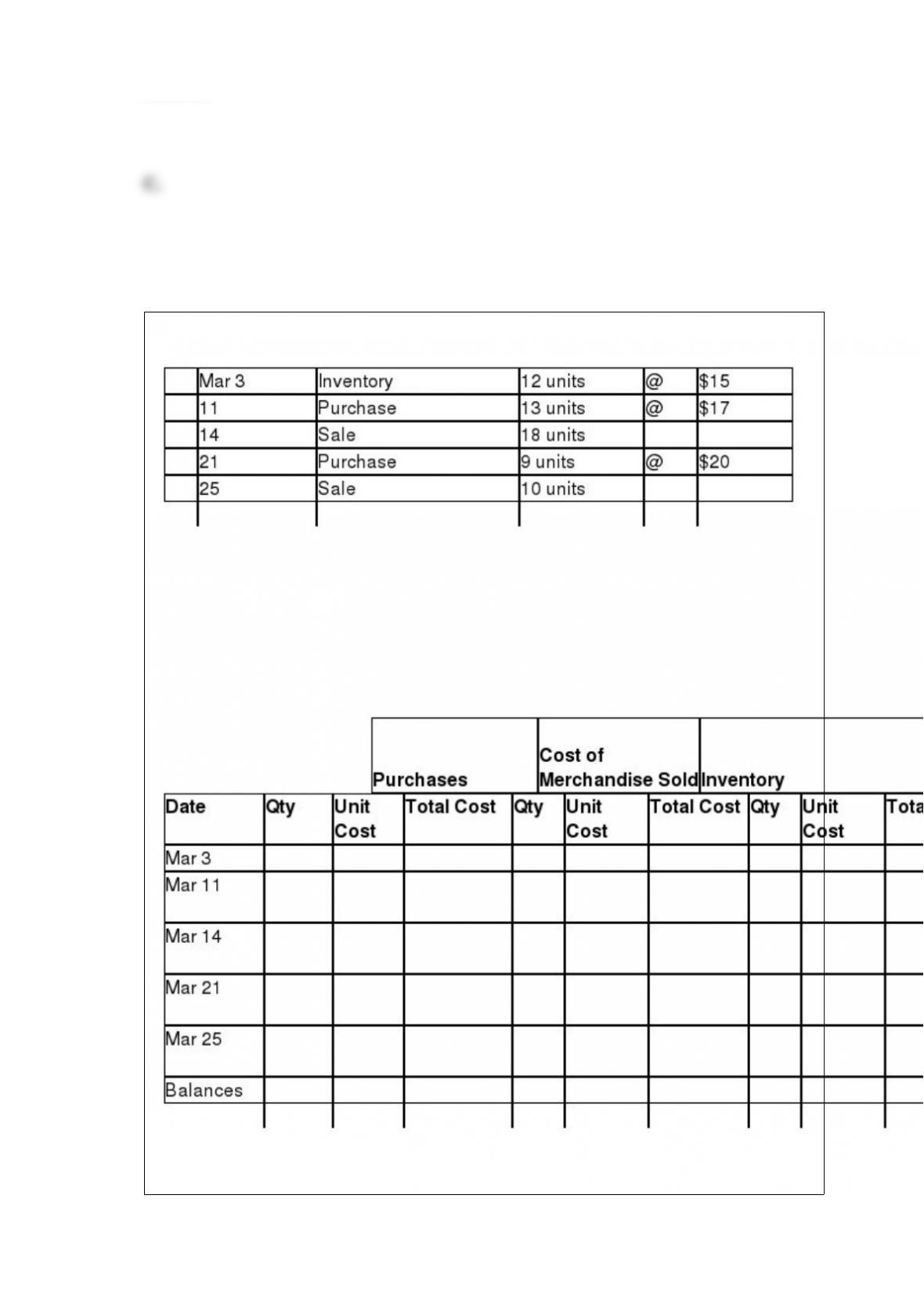
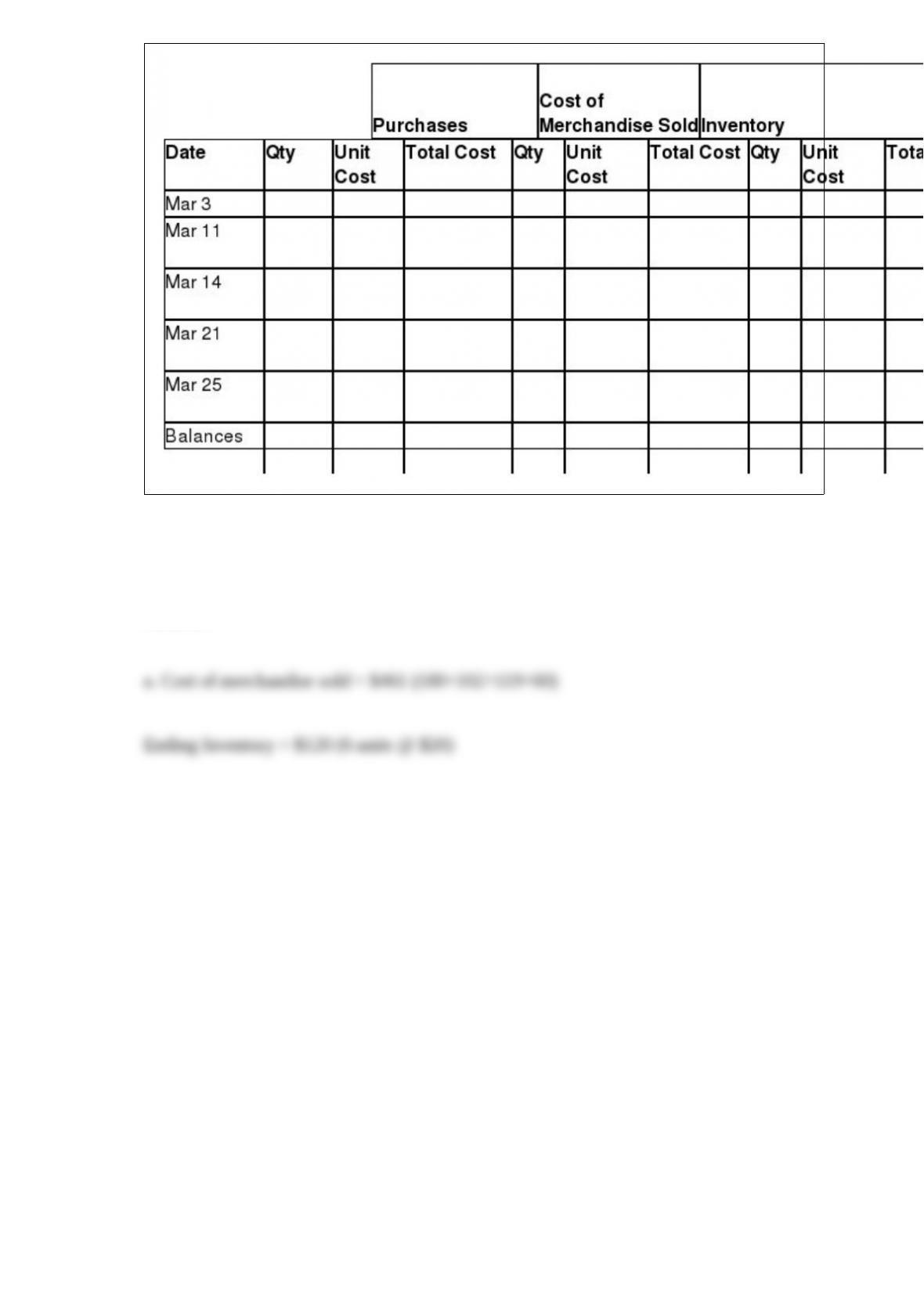
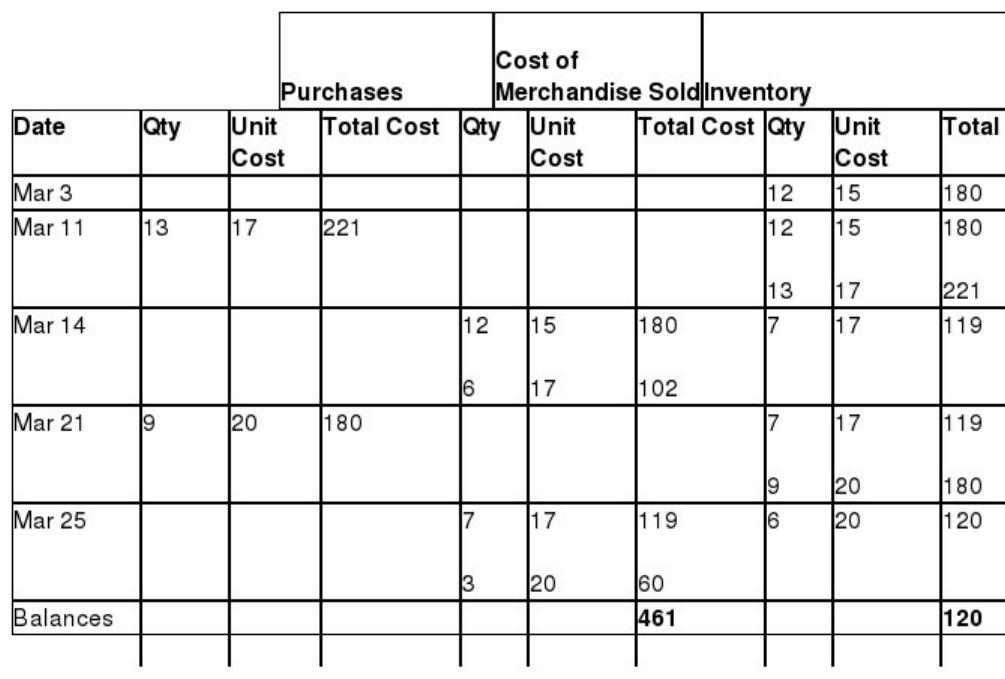
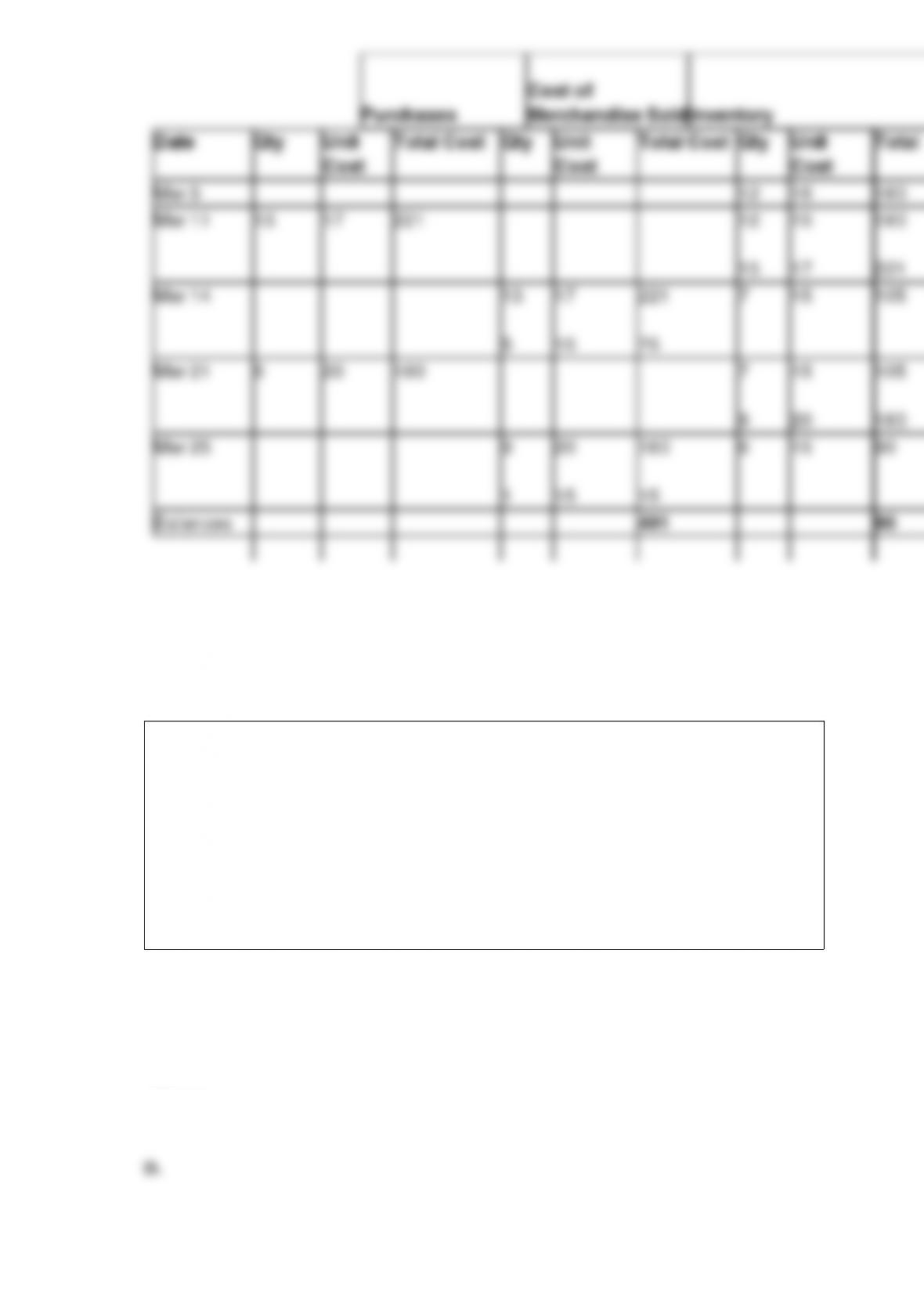
Beginning inventory, purchases and sales data for hammers are as follows:
Assuming the business maintains a perpetual inventory system, complete the inventory
cards and calculate the cost of merchandise sold and ending inventory under the
following assumptions:
a. First-in, first-out
b. Last-in, first-out
Answer:
For purposes of analysis, mixed costs are generally:
A.classified as fixed costs
B.classified as variable costs
C.classified as period costs
D.separated into their variable and fixed cost components
Answer:

A disadvantage of the corporate form of business entity is
A.mutual agency for stockholders
B.unlimited liability for stockholders
C.corporations are subject to more governmental regulations
D.the ease of transfer of ownership
Answer:
Under the allowance method of accounting for uncollectible receivables, writing off an
uncollectible account.
A.affects only income statement accounts.
B.is not an acceptable practice.
C.affects only balance sheet accounts.
D.affects both balance sheet and income statement accounts.
Answer:

The Cavy Company estimates that the factory overhead for the following year will be
$1,250,000. The company has decided that the basis for applying factory overhead
should be machine hours, which is estimated to be 40,000 hours. The machine hours for
the month of April for all of the jobs was 4,780. If the actual factory overhead totaled
$141,800, determine the over or under applied amount for the month.
Answer:
On January 31, the cash account balance was $96,750. During January, cash receipts
totaled $305,000 and cash payments totaled was $375,880. Determine the cash balance
on January 1.
Answer:
List at least three things that indicate a receivable may be uncollectible.
Answer:
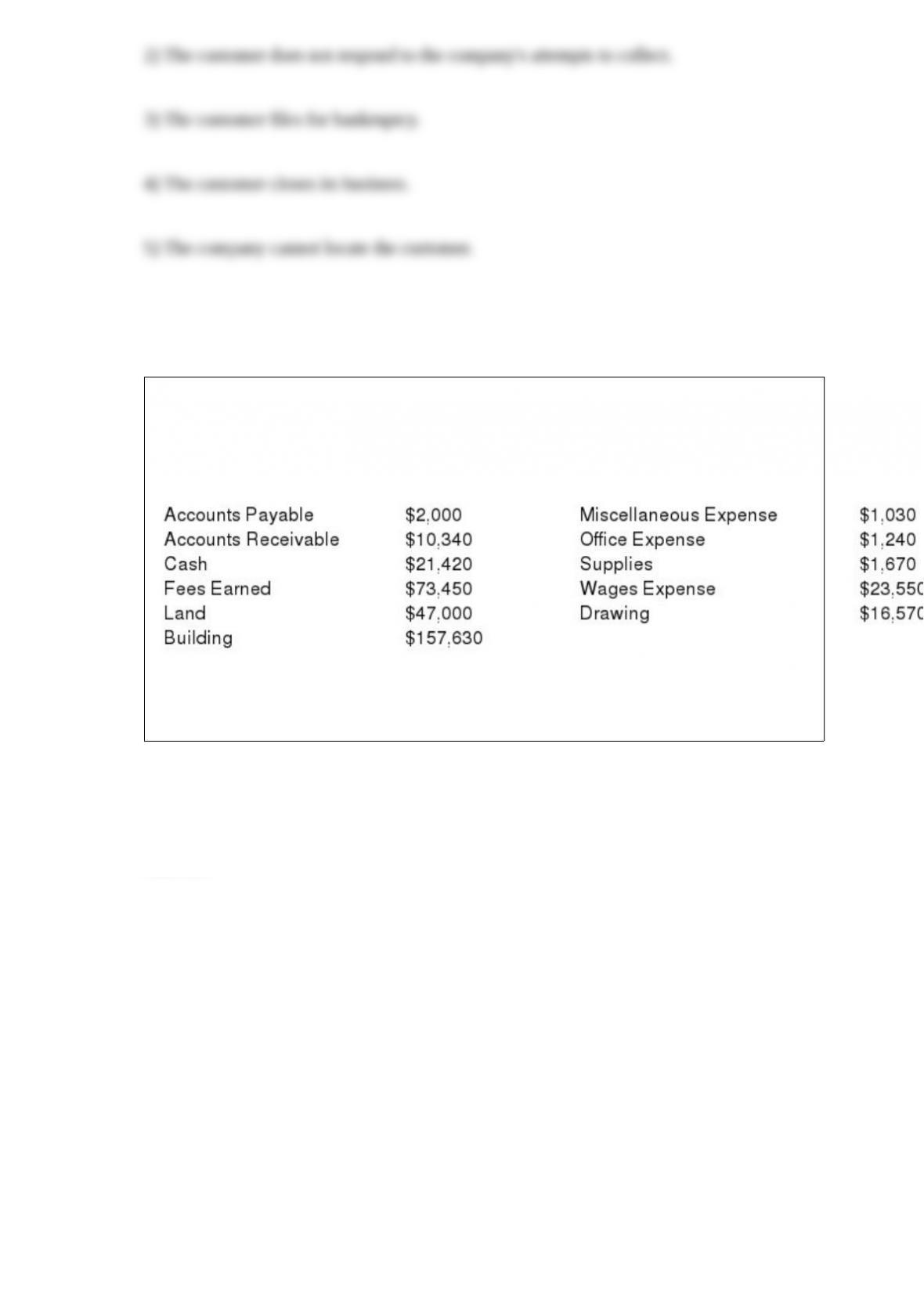
The assets and liabilities of Amos Moving Services at March 31, 2014, the end of the
current year, and its revenue and expenses for the year are listed below. The capital of
the owner was $180,000 at April 1, 2013, the beginning of the current year. Mr. Amos
invested an additional $25,000 in the business during the year.
Prepare a balance sheet for the current year ended March 31, 2014.
Answer:
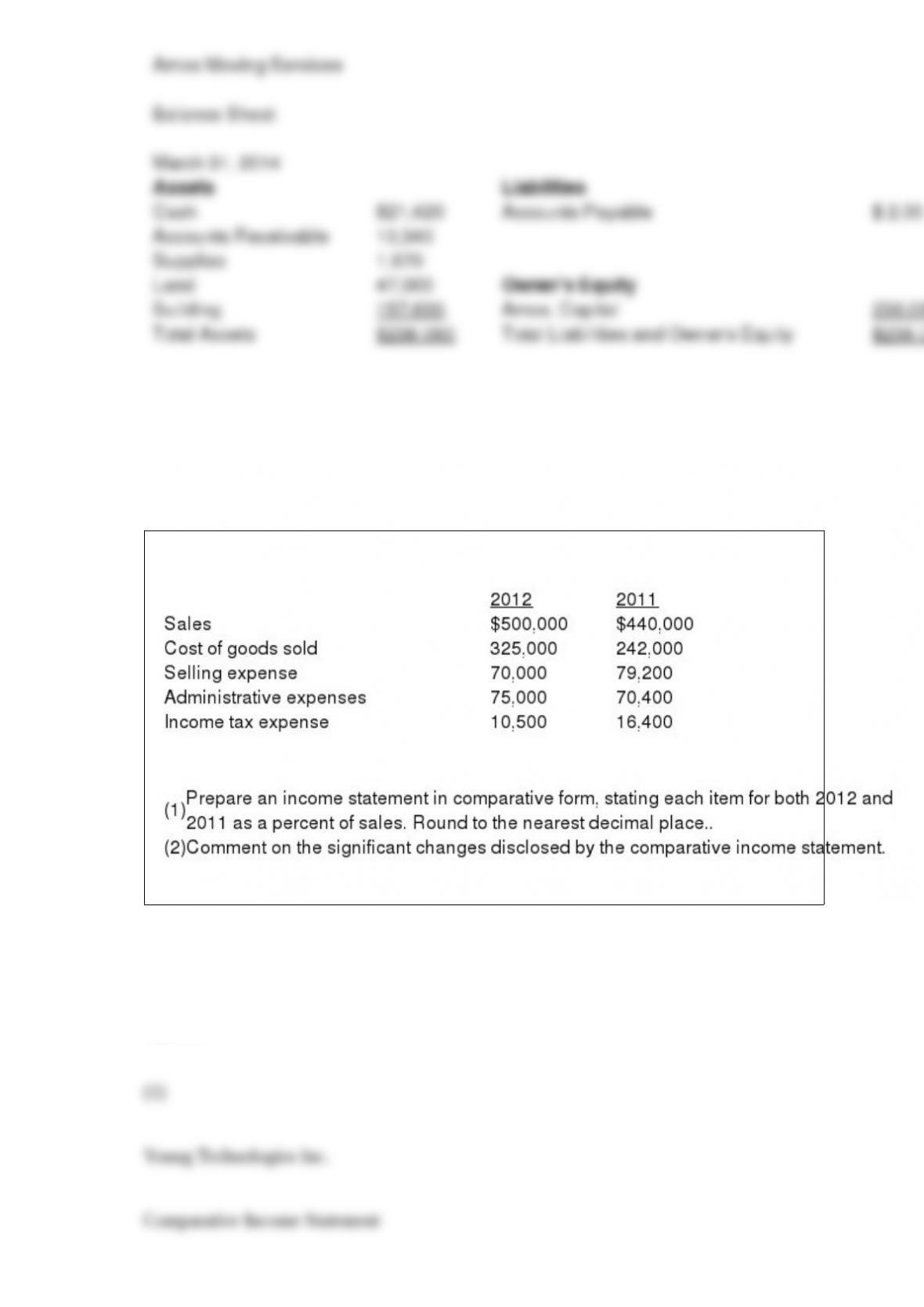
Revenue and expense data for Young Technologies are as follows:
Answer:
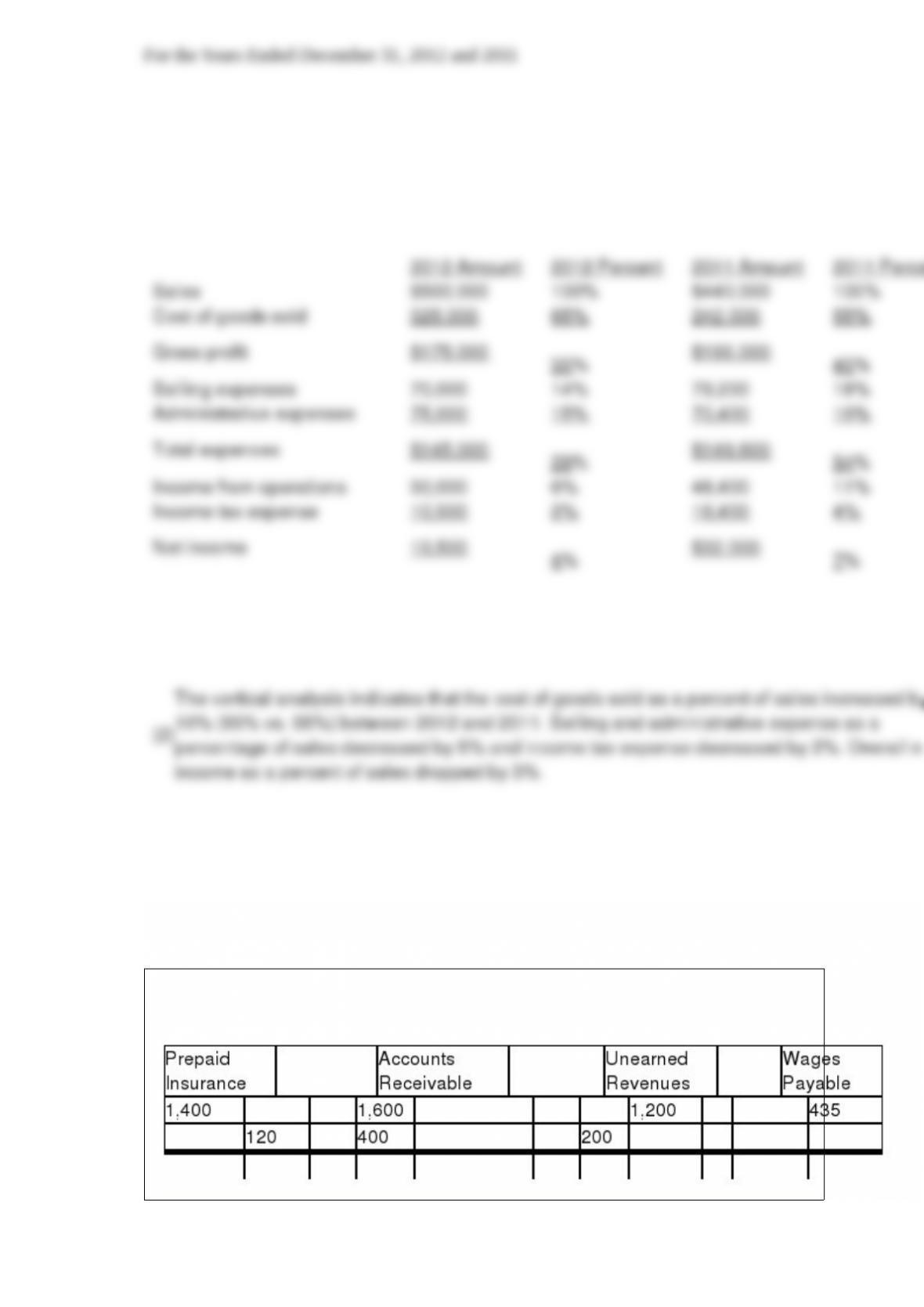
Prepare an income statement and a statement of owner’s equity for the month ended
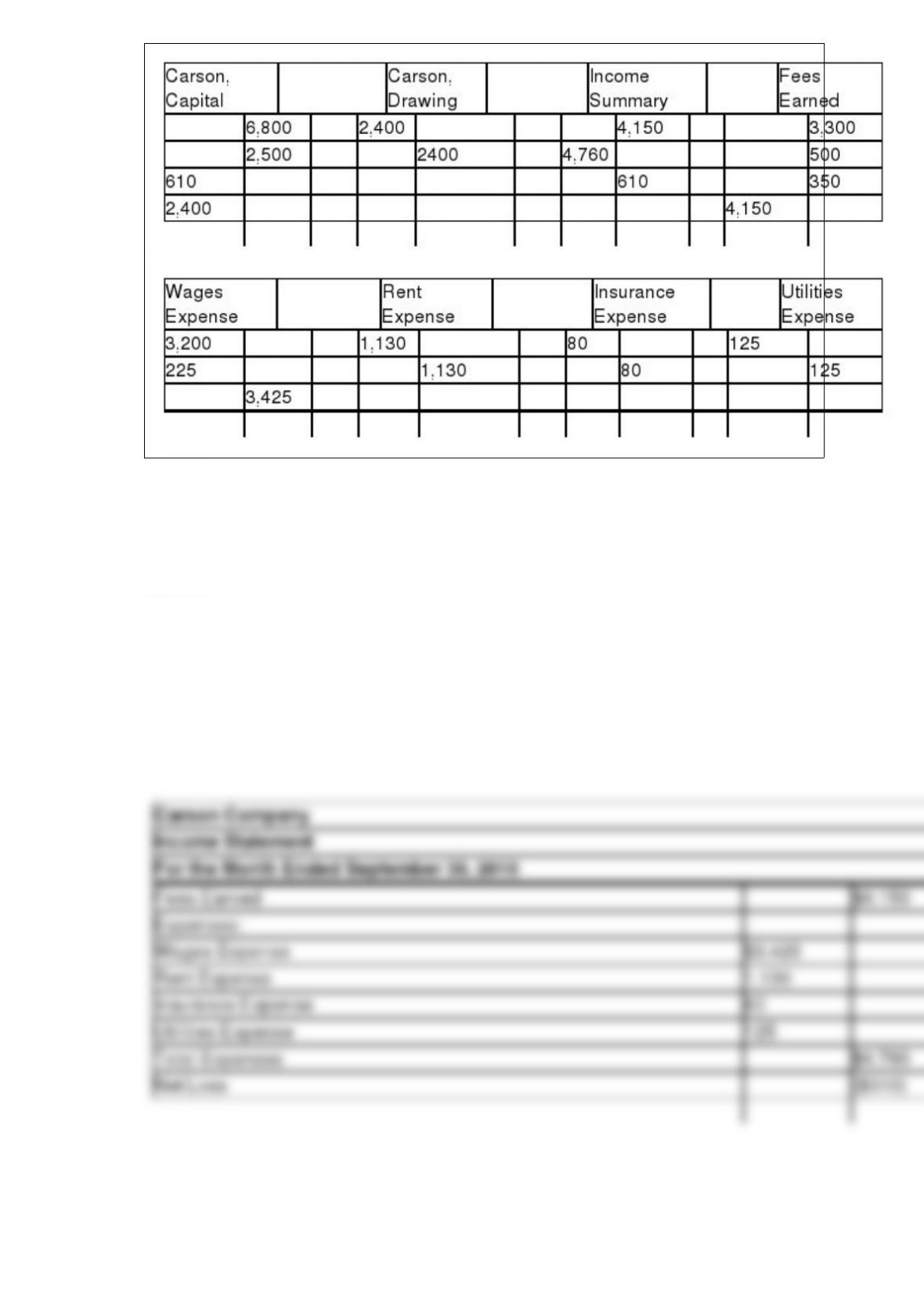
September 30, 2010 from the T-accounts below of Carson Company.
Answer:
Companies like Enron, WorldCom, and Tyco International, Ltd. have been caught in the
midst of ethical lapses that led to fines, firings, and criminal and/or civil prosecution.
List and briefly describe three factors that are responsible for what went wrong in these
companies.
Answer:
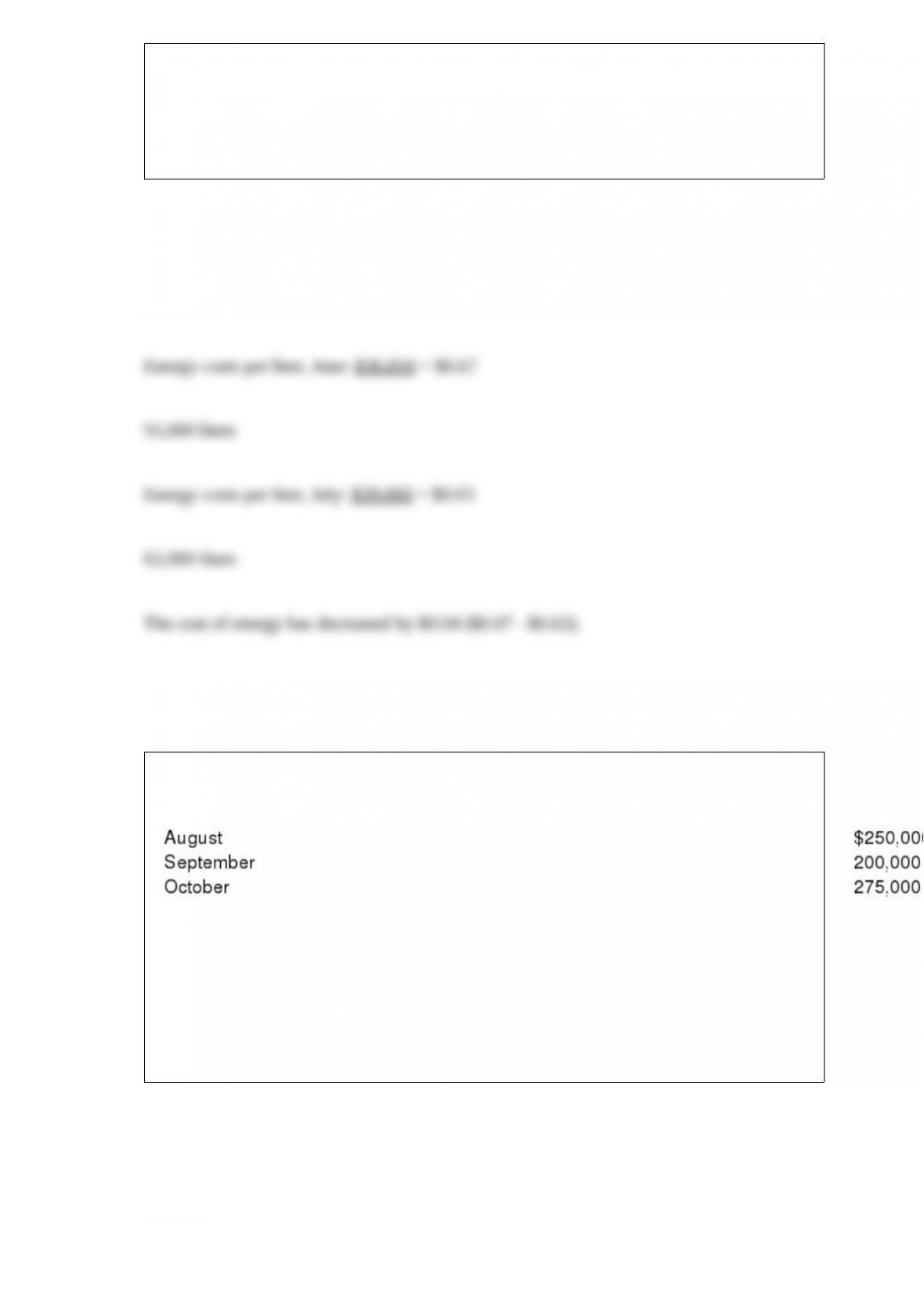
The cost of energy consumed in producing good units in the Bottling Department of
Mountain Springs Water Company was $36,850 and $39,060 for June and July,
respectively. The number of equivalent units produced in June and July was 55,000 and
62,000 liters respectively. Evaluate the change in the cost of energy between the two
months.
Answer:
Star Co. was organized on August 1 of the current year. Projected sales for the next
three months are as follows:
The company expects to sell 50% of its merchandise for cash. Of the sales on account,
30% are expected to be collected in the month of the sale and the remainder in the
following month.
Prepare a schedule indicating cash collections for August, September, and October.
Answer:
The following account balances appear on the balance sheet of Osgood Industries:
Common Stock (300,000 shares authorized, $100 par): $10,000,000
Paid-in Capital in Excess of Par Common Stock: $2,000,000;
Retained earnings: $45,000,000.
The board of directors declared a 2% stock dividend when the market price of the stock
was $135 a share. Osgood reported no income or loss for the current year.
(1) Journalize the entries to record
a. the declaration of the dividend, capitalizing an amount equal to market
value; and
b. the issuance of the stock certificates.
(2) Determine the following amounts before the stock dividend was declared:
a. Total paid-in capital;
b. Total retained earnings; and
c. Total stockholders’ equity.
(3) Determine the following amounts after the stock dividend was declared and closing
entries were recorded at the end of the year:
a. Total paid-in capital;
b. Total retained earnings; and
c. Total stockholders’ equity.
Answer:

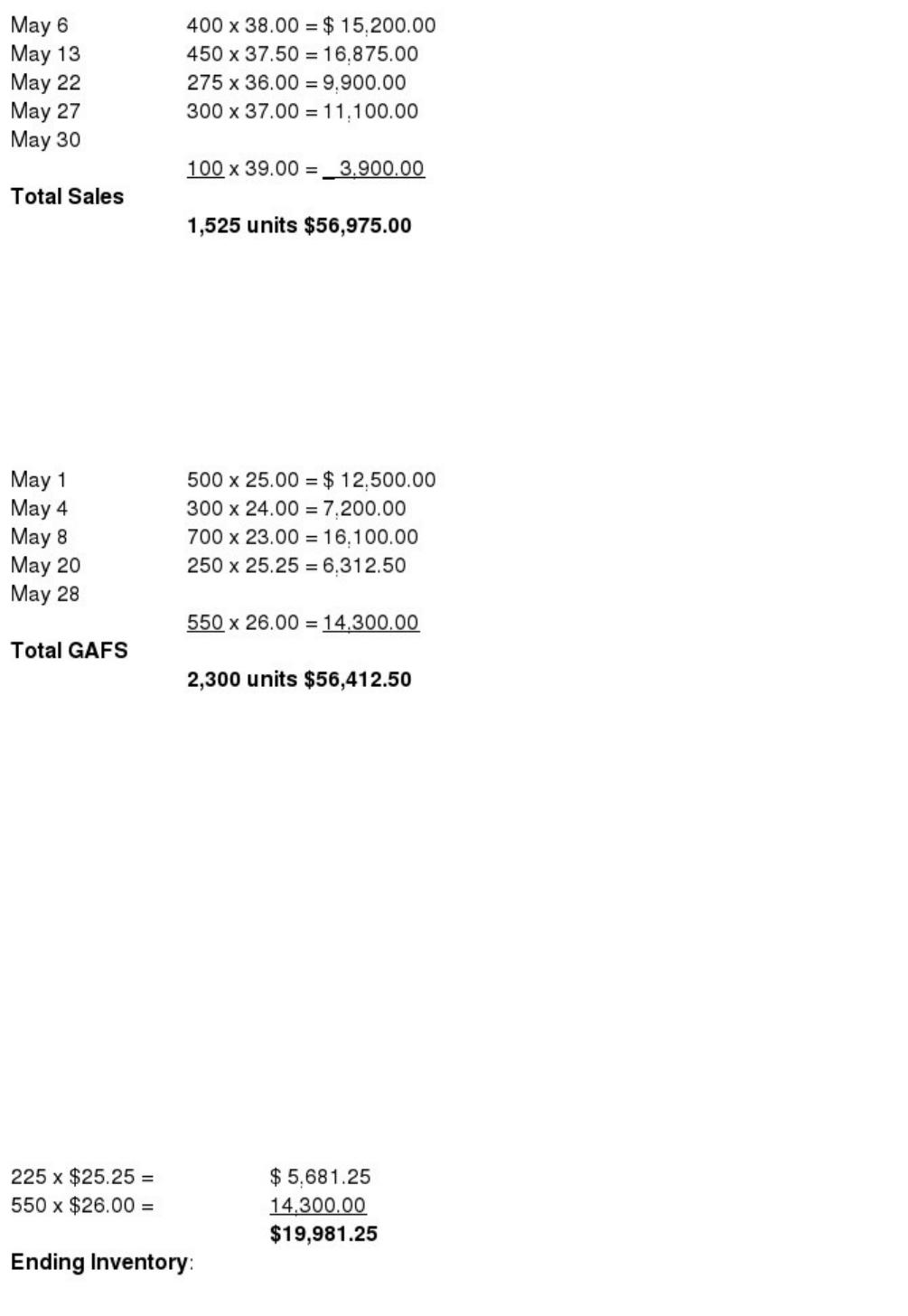
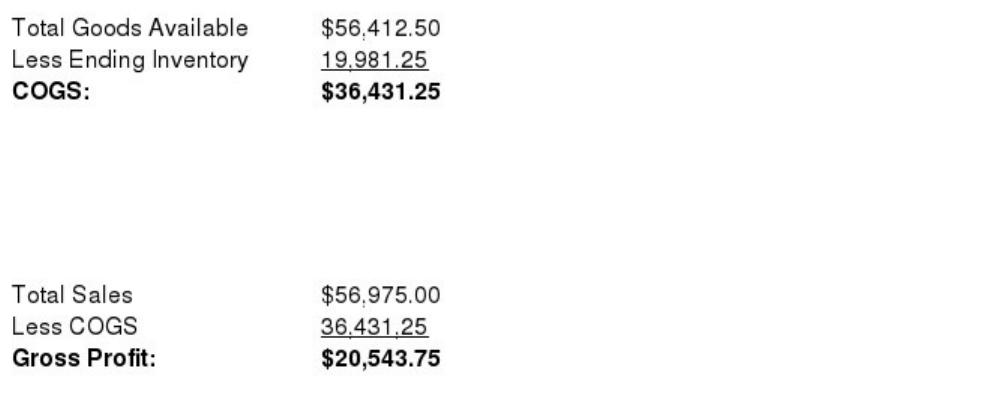
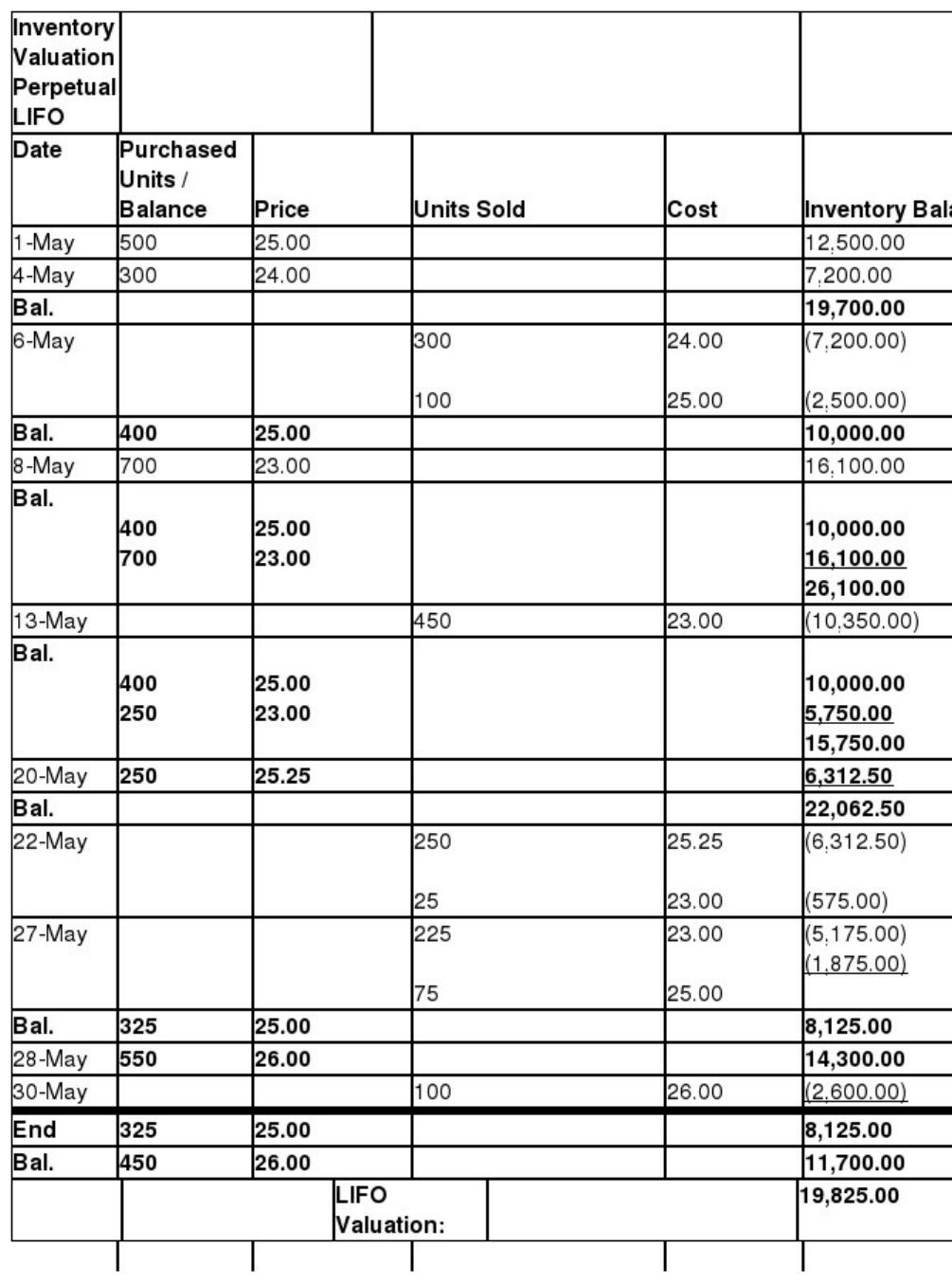
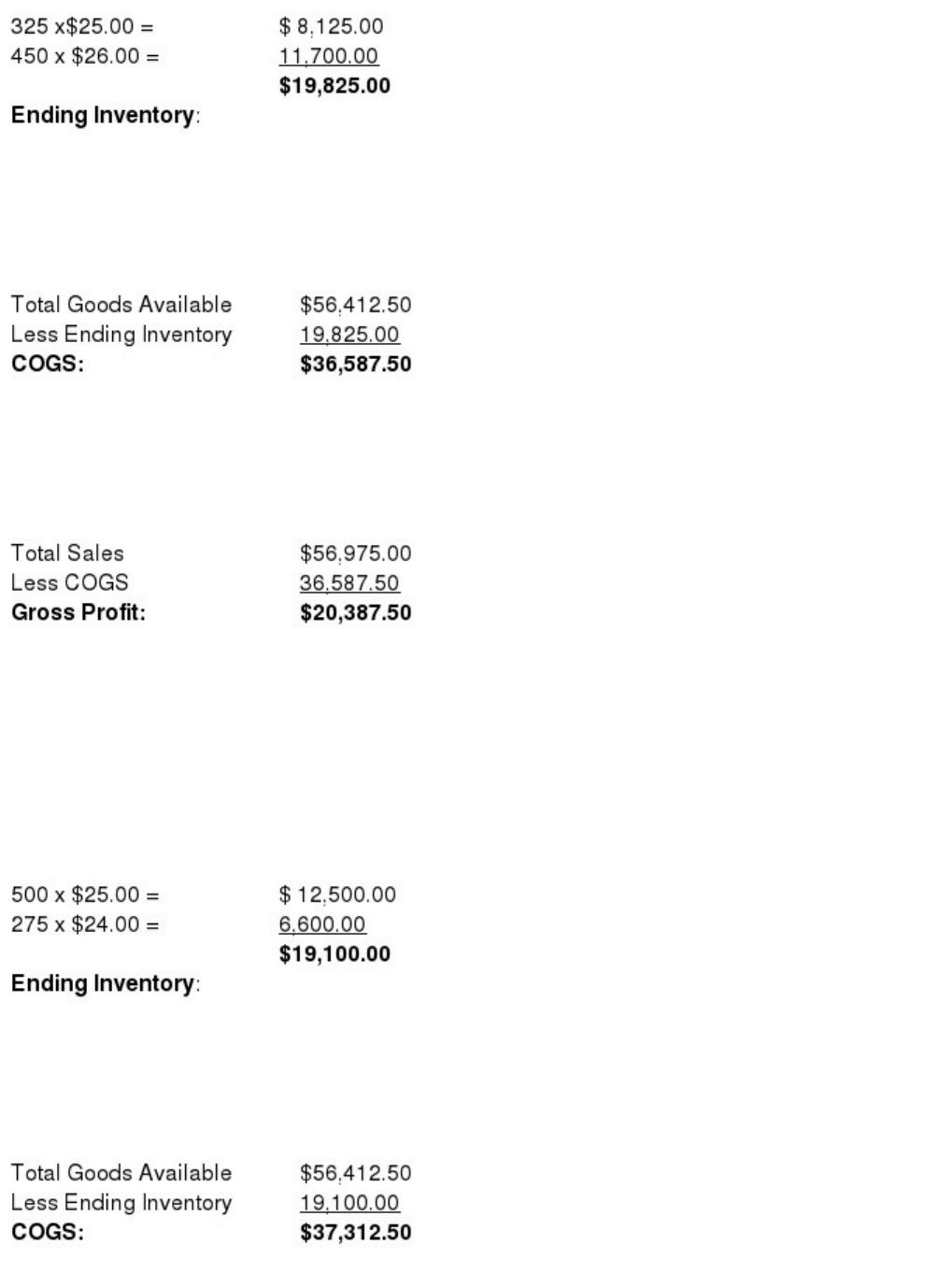
Brutus Corporation, a newly formed corporation, has the following transactions during
May, 2011, it’s first month of operation.
May 1 Purchased 500 units @ $25.00 each
May 4 Purchased 300 units @ $24.00 each
May 6 Sold 400 units @ $38.00 each
May 8 Purchased 700 units @ $23.00 each
May 13 Sold 450 units @ $37.50 each
May 20 Purchased 250 units @ $25.25 each
May 22 Sold 275 units @ $36.00 each
May 27 Sold 300 units @ $37.00 each
May 28 Purchased 550 units @ $26.00 each
May 30 Sold 100 units @ $39.00 each
Calculate total sales, cost of goods sold, gross profit and ending inventory using each of
the following inventory methods:
1) FIFO Perpetual
2) FIFO Periodic
3) LIFO Perpetual
4) LIFO Periodic
5) Average Cost Periodic (round average to nearest cent)
Answer:
Callon Industries has projected sales of 67,000 machines for 2012. The estimated
January 1, 2012, inventory is 6,000 units, and the desired December 31, 2012, inventory
is 15,000 units. What is the budgeted production (in units) for 2012?
Answer:
Beginning inventory, purchases and sales data for widgets are as follows:
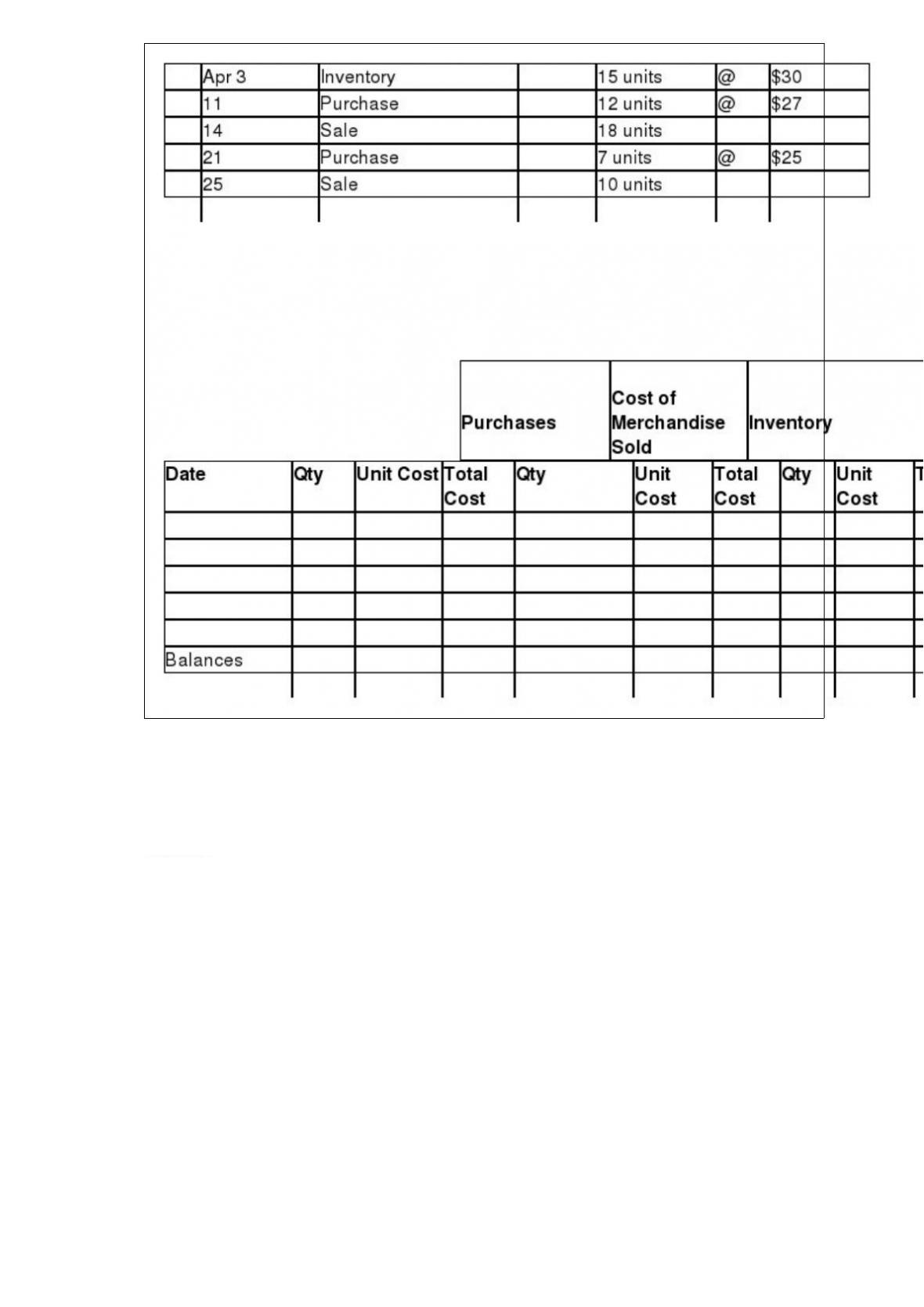
Complete the inventory cost card assuming the business maintains a perpetual
inventory system and calculates the cost of merchandise sold and ending inventory
using FIFO.
Answer:
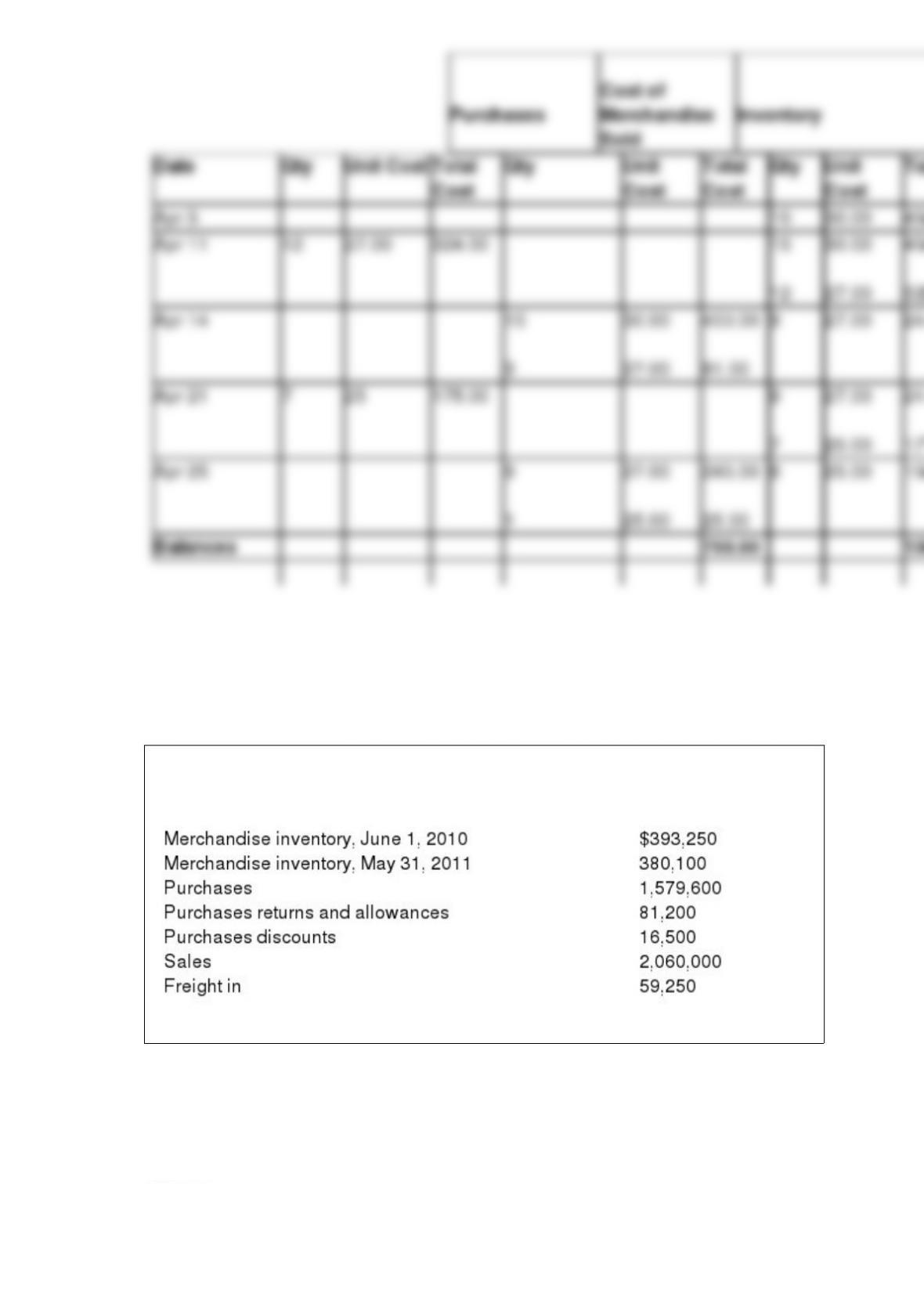
Using the following data taken from Martinez Inc., determine the gross profit to be
reported on the income statement for the year ended May 31, 2011.
Answer:
Indicate with a Yes or No whether or not each of the following accounts would, under
normal circumstances, require an adjusting entry.
1) Cash
2) Prepaid Expenses
3) Depreciation Expense
4) Accounts Payable
5) Accumulated Depreciation
6) Equipment
Answer:
Callon Industries has projected sales of 67,000 machines for 2012. The estimated
January 1, 2012, inventory is 6,000 units, and the desired December 31, 2012, inventory
is 15,000 units. What is the budgeted production (in units) for 2012?
Answer:
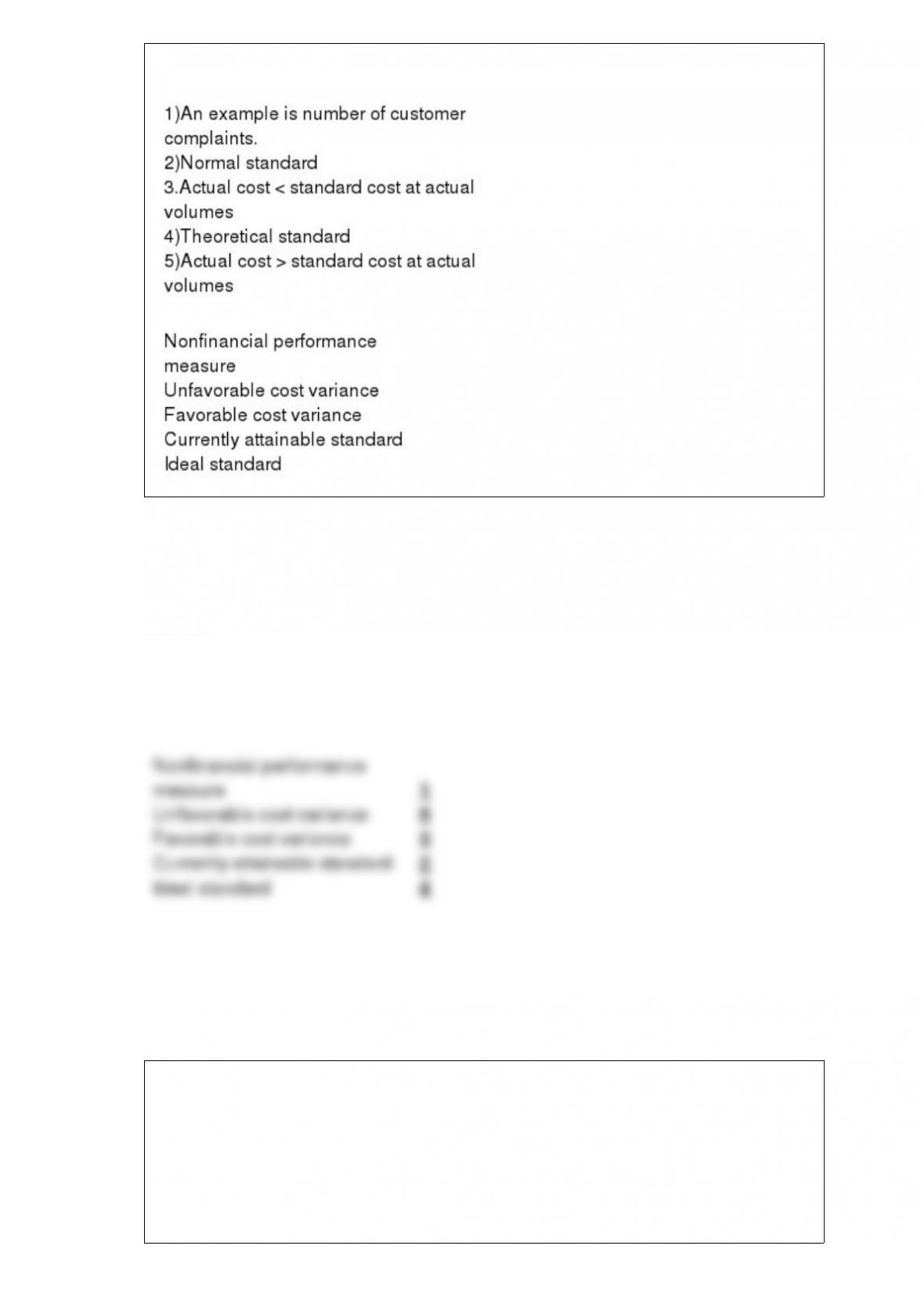
Match the following terms with the best definition given.
Answer:
Cranston Company estimates the following overhead costs for the coming year:
Equipment depreciation $160,000
Equipment maintenance 60,000
Supervisory salaries 40,000

Factory rent 100,000
Total $360,000
Cranston is also budgeting $600,000 in direct labor costs and 15,000 machine hours for
the coming year.
a. Calculate the predetermined overhead rate using direct labor costs as the
allocation base.
b. Calculate the predetermined overhead rate using machine hours as the allocation
base.
Answer: