Cost of goods sold includes the actual costs of the goods sold and the cost of selling
them to the customer.
Answer:
Continuous improvement involves the search for and implementation of the best way
to do something as practiced by other organizations or in other parts of one’s own
organization.
Answer:
The primary reason to use a dual rate allocation system is to focus a manager’s
performance evaluation on factors under the manager’s direct control.
Answer:
It is possible to have a favorable direct material price variance and an unfavorable
direct material efficiency variance.
Answer:
Using direct labor costs to allocate overhead costs in an activity-based costing (ABC)
system will encourage management to reduce labor costs.
Answer:
Both total revenues (TR) and total costs (TC) are likely to be affected by changes in the
output.
Answer:
Predetermined overhead rates are used in first-stage cost allocations but not in
second-stage cost allocations.
Answer:
The human resource department in a manufacturing company would be considered a
service department.
Answer:
In general, the ending Work-in-Process Inventory value computed using first-in,
first-out (FIFO) will be the same as the ending value computed using weighted-average
process costing.
Answer:
An increase in an organization’s tax rate will cause an increase in its break-even point.
Answer:
The predetermined overhead rate is calculated by dividing the prior period’s overhead
cost by the prior period’s allocation base (i.e., activity level).
Answer:
Operation costing is used in manufacturing goods that have some common
characteristics and some individual characteristics.
Answer:
Activity-based cost management (ABM) uses the information provided by
activity-based costing (ABC) to identify ways to improve operations.
Answer:
The only variances that should be investigated are those for which the expected
benefits of correction exceed the costs of investigating and correcting.
Answer:
First-in, first-out (FIFO) process costing transfers out the costs in beginning inventory
before transferring out the costs associated with units started and completed.
Answer:
The industry volume variance is the portion of the sales activity variance due to a
change in the company’s proportion of sales in the markets in which they operate.
Answer:
It is unethical to intentionally charge costs to the wrong job.
Answer:
In interstate transactions, transfers can reduce an organization’s tax liability when the
selling division is in a lower tax jurisdiction than the buying division.
Answer:
If materials are only added at the beginning of the production process, then the degree
of completion for materials in the ending Work-in-Process Inventory is always 100%.
Answer:
The total contribution margin is the unit contribution margin multiplied by the number
of units minus the fixed component of the total costs (TC).
Answer:
Operating profit is the unit contribution margin multiplied by the number of units
minus the fixed component of the total costs (TC).
Answer:
Operational costing accounts for material costs like job costing and conversion costs
like process costing.
Answer:
Rational managers will always make decisions that are in the best interest of the
organization employing them.
Answer:
Financial accounting information is designed for decision-makers who are directly
involved in the daily management of the firm.
Answer:
In the United States, more companies use cost-based transfer prices than market-based
transfer prices.
Answer:
It is possible to apply activity-based costing (ABC) to segments of an organization
without applying it to the entire organization.
Answer:
ABC Company wants to have 10,000 units on hand at the end of the year after selling
100,000 units during the year. If the beginning inventory is 5,000 units, ABC needs to
produce 105,000 units during the year.
Answer:
The use of sensitivity analysis techniques allows managers to ask “what-if” questions
regarding budget assumptions and estimates.
Answer:
If a company’s two joint products can be sold at the split-off point, there is no reason
for allocating the joint costs to the products.
Answer:
Benchmarking is an on-going process that compares a company’s products or services
with the best levels of performance from other firms.
Answer:
All nonvalue-added activities can be eliminated, once they are identified.
Answer:
One advantage of the account analysis method for estimating cost behavior is that it
includes actual work conditions.
Answer:
The term “product” often refers to an organization’s output and includes both tangible
items (e.g., chair, desk, etc.) and intangible items (e.g., services provided).
Answer:
Transfer prices cannot be used for decision making, product costing, or performance
evaluation.
Answer:
The following information relates to the Jax Company for the upcoming year.
The cost of goods sold includes $2,400,000 of fixed manufacturing overhead; the
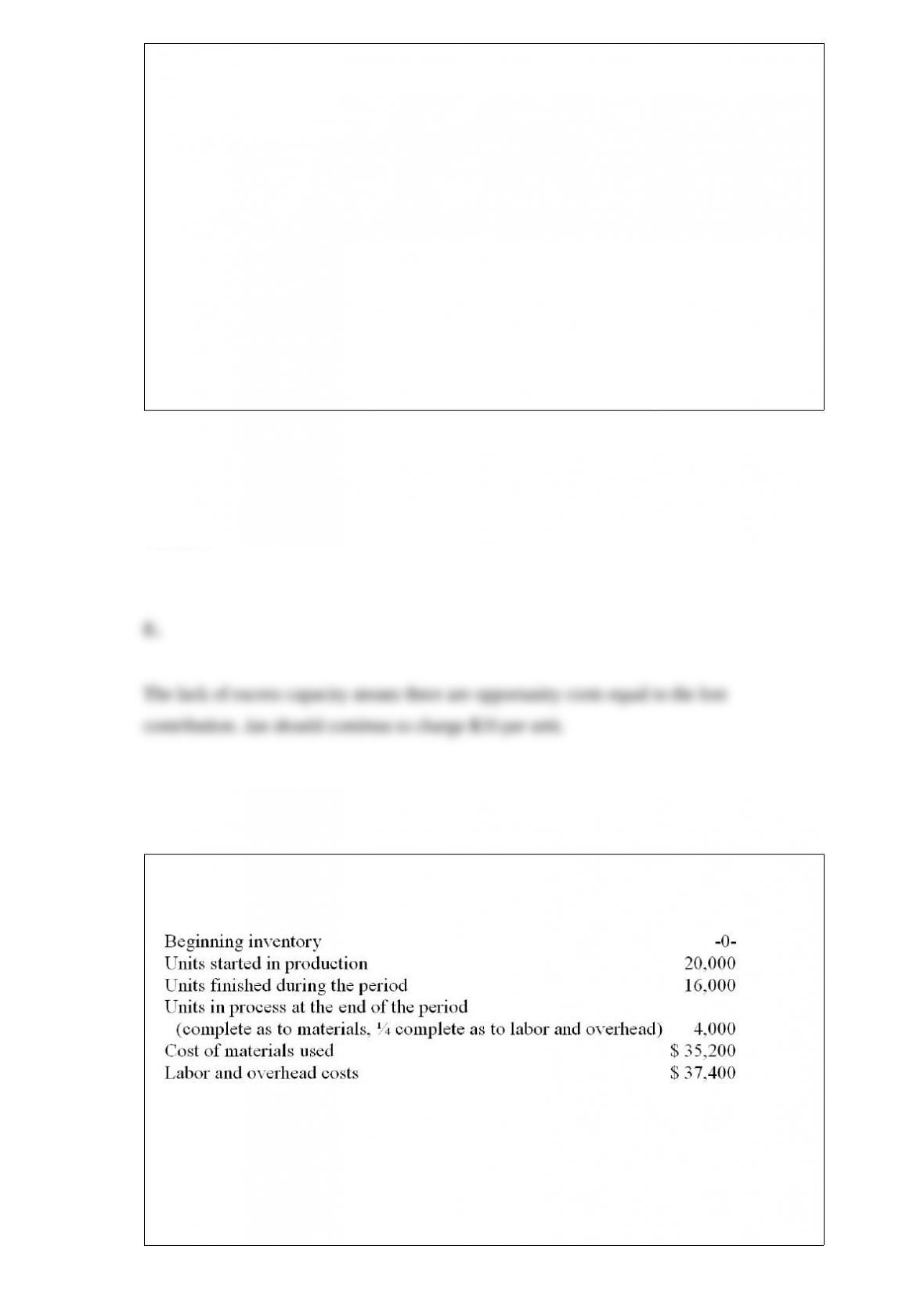
operating expenses include $200,000 of fixed marketing expenses. A special order
offering to buy 50,000 units for $15.00 per unit has been made to Jax. Fortunately, there
will be no additional operating expenses associated with the order; however, Jax is
operating at full capacity. How much will operating profits increase if Jax accepts the
special order?
A. $50,000
B. $125,000
C. $200,000
D. $250,000
E. Operating profits will not increase as a result of accepting the special order.
Answer:
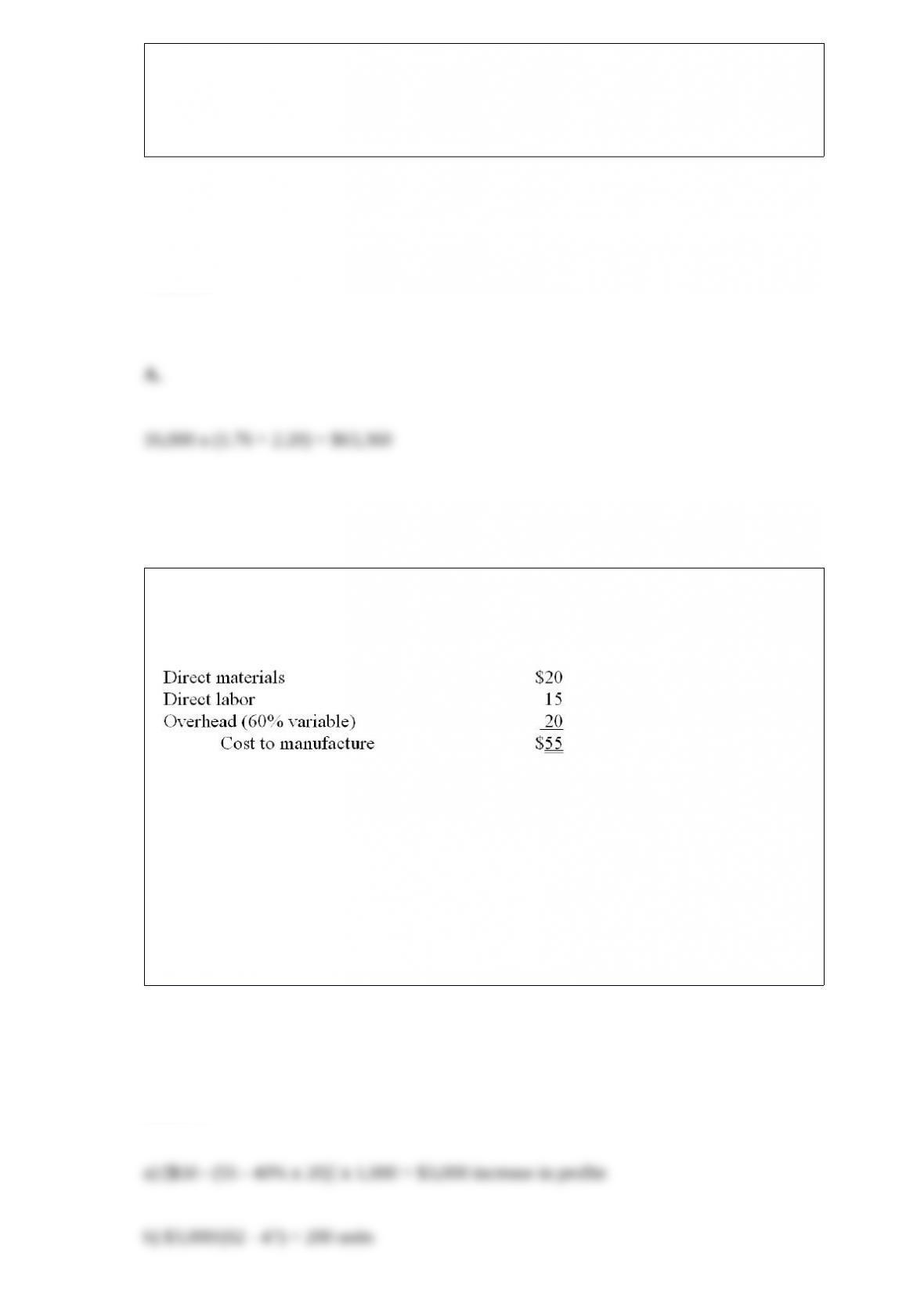
The WISCO Company uses a weighted-average process costing system. The following
data are available:
Total cost of the 16,000 units finished is
A. $63,360.
B. $67,320.
C. $72,640.
D. $65,120.
Answer:
The Pierce Company has gathered the following information for a unit of its most
popular product:
The above cost information is based on 10,000 units. Pierce currently sells 8,500 units
for $62 per unit. A distributor has offered to buy 1,000 units at a price of $50 per unit.
This special order would not disturb regular sales.
Required:
a) Calculate Pierce’s change in operating profits if the special order is accepted.
b) How many units of regular sales could be lost before this contract is not profitable?
Answer:
The labor yield variance is actual total hours at
A. actual mix times actual labor rates less actual total hours at actual mix times standard
labor rates.
B. actual mix times standard labor rates less standard total hours at standard mix times
standard labor rates.
C. actual mix times standard labor rates less actual total hours at standard mix times
standard labor rates.
D. standard mix times standard labor rates less standard total hours at standard mix
times standard labor rates.
Answer:
An accounting system that collects financial and operating data on the basis of the
underlying nature and extent of cost drivers is (CMA adapted)
A. full-absorption costing.
B. activity-based costing.
C. variable costing.
D. benchmarking.
Answer:
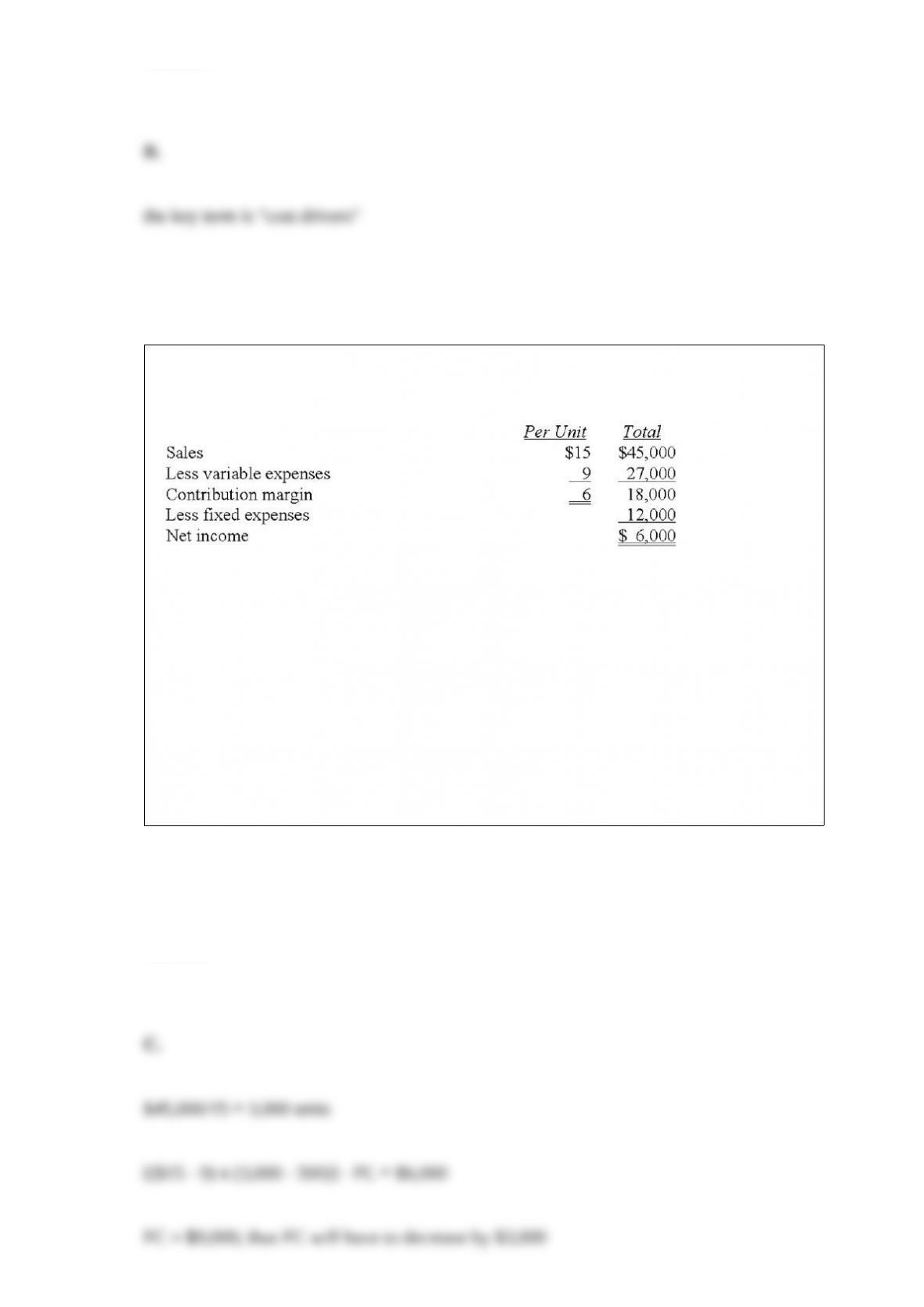
Given the following data:
If sales decrease by 500 units, by what % would fixed expenses have to be reduced by
to maintain current net income?
A. 50.0%.
B. 33.3%.
C. 25.0%.
D. 16.7%.
Answer:
An operating unit that is responsible for revenues only is commonly referred to as a(n)
A. expense center.
B. revenue center.
C. profit center.
D. asset center.
Answer:
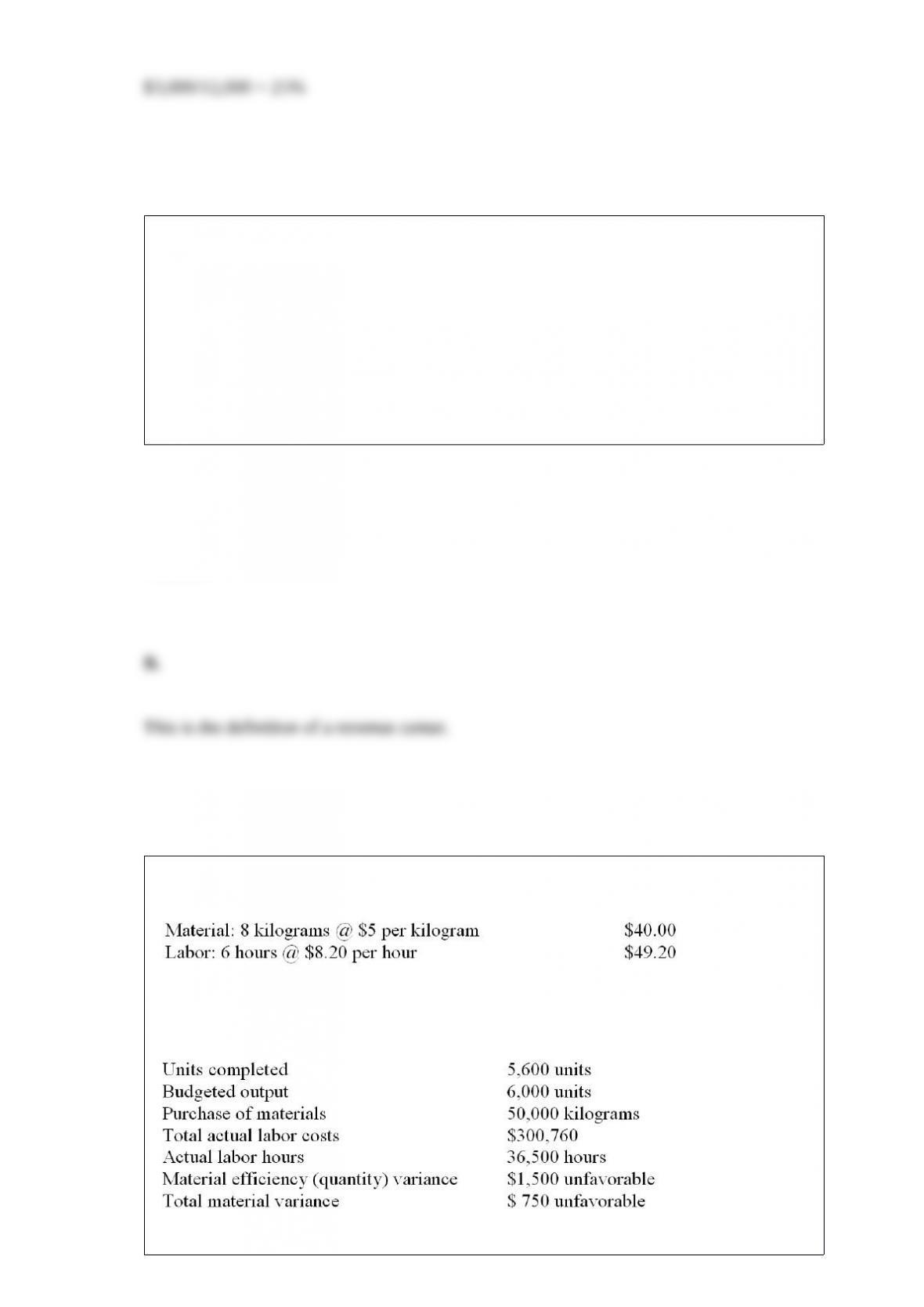
Dash Company adopted a standard cost system several years ago. The standard costs
for the prime costs of its single product are as follows:
The following operating data were taken from the records for November:
Required: (Be sure to indicate whether the variances are favorable or unfavorable.)
a) What is the direct labor price (rate) variance for November?
b) What is the direct labor efficiency variance for November?
c) What is the actual kilograms of material used in the production process during
November?
d) Assume the purchasing department is responsible for the material price variance,
what is the actual price paid per kilogram of material during November (assume no
increase/decrease in inventory during the month)?
Answer:
You have been provided with the following information:
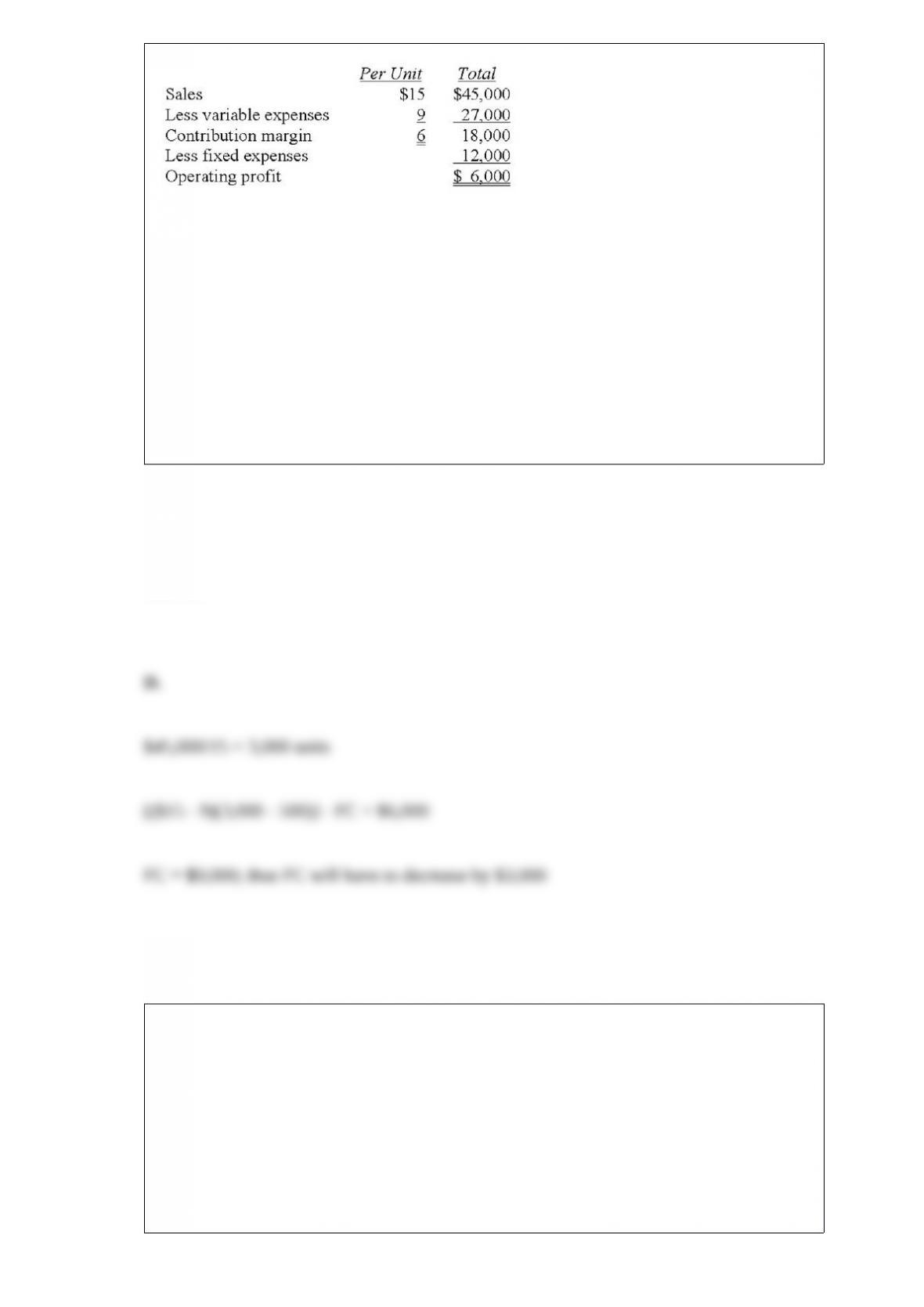
If sales decrease by 500 units, how much will fixed expenses have to be reduced by to
maintain the current operating profit of $6,000?
A. $9,000.
B. $7,500.
C. $6,000.
D. $3,000.
Answer:
A firm earning a profit can increase its return on investment by (CMA adapted)
A. increasing sales revenue and operating expenses by the same dollar amount.
B. decreasing sales revenues and operating expenses by the same percentage.
C. increasing investment and operating expenses by the same dollar amount.
D. increasing sales revenues and operating expenses by the same percentage.
Answer:
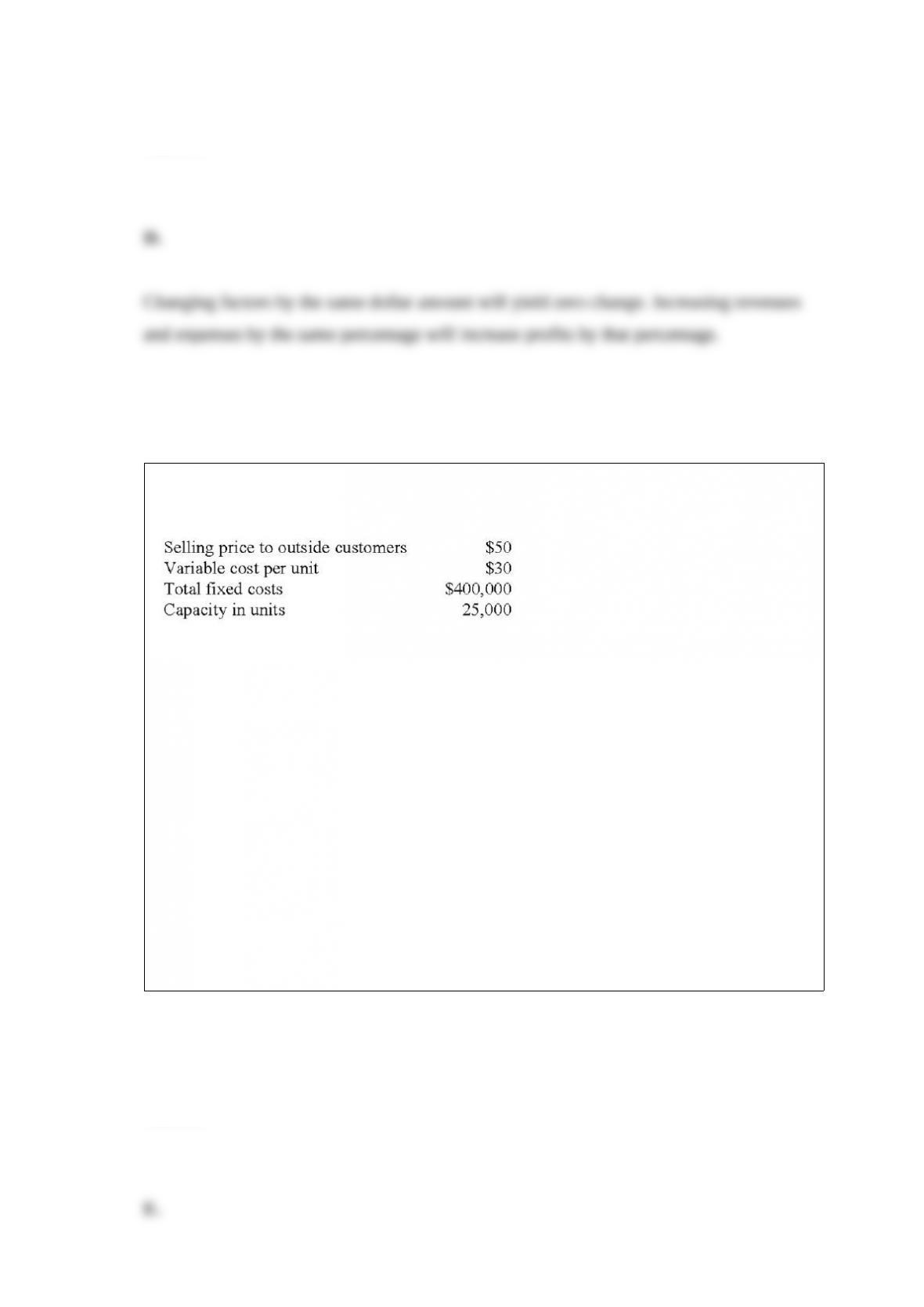
Given the following information for Division K:
Division L would like to purchase internally from Division K. Division L now
purchases 5,000 units each period from outside suppliers at $49 per unit. Division K has
ample excess capacity to handle all of Division L’s needs. What is the lowest price that
Division K could accept?
A. $50.00
B. $49.00
C. $46.00
D. $39.50
E. $30.00
Answer:
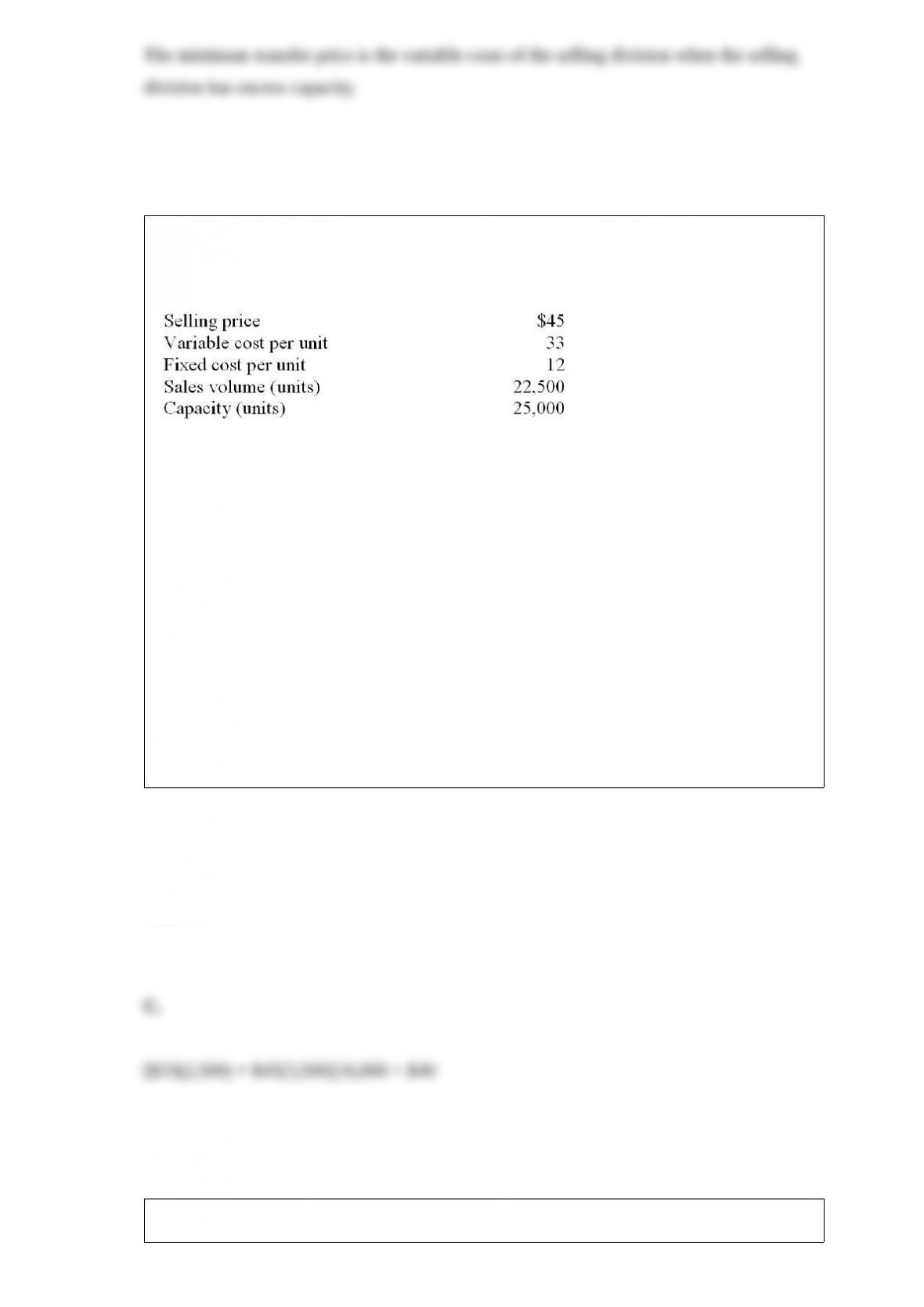
You have been provided with the following information for Division X of a
decentralized company:
Division W would like to purchase all of its units internally. Division W needs 6,000
units each period and currently pays $42 per unit to an outside firm. What is the lowest
price that Division X could accept from Division W? Assume that Division W wants to
use a sole supplier and will not purchase less than 6,000 from a supplier.
A. $45.
B. $42.
C. $40.
D. $38.
E. $33.
Answer:
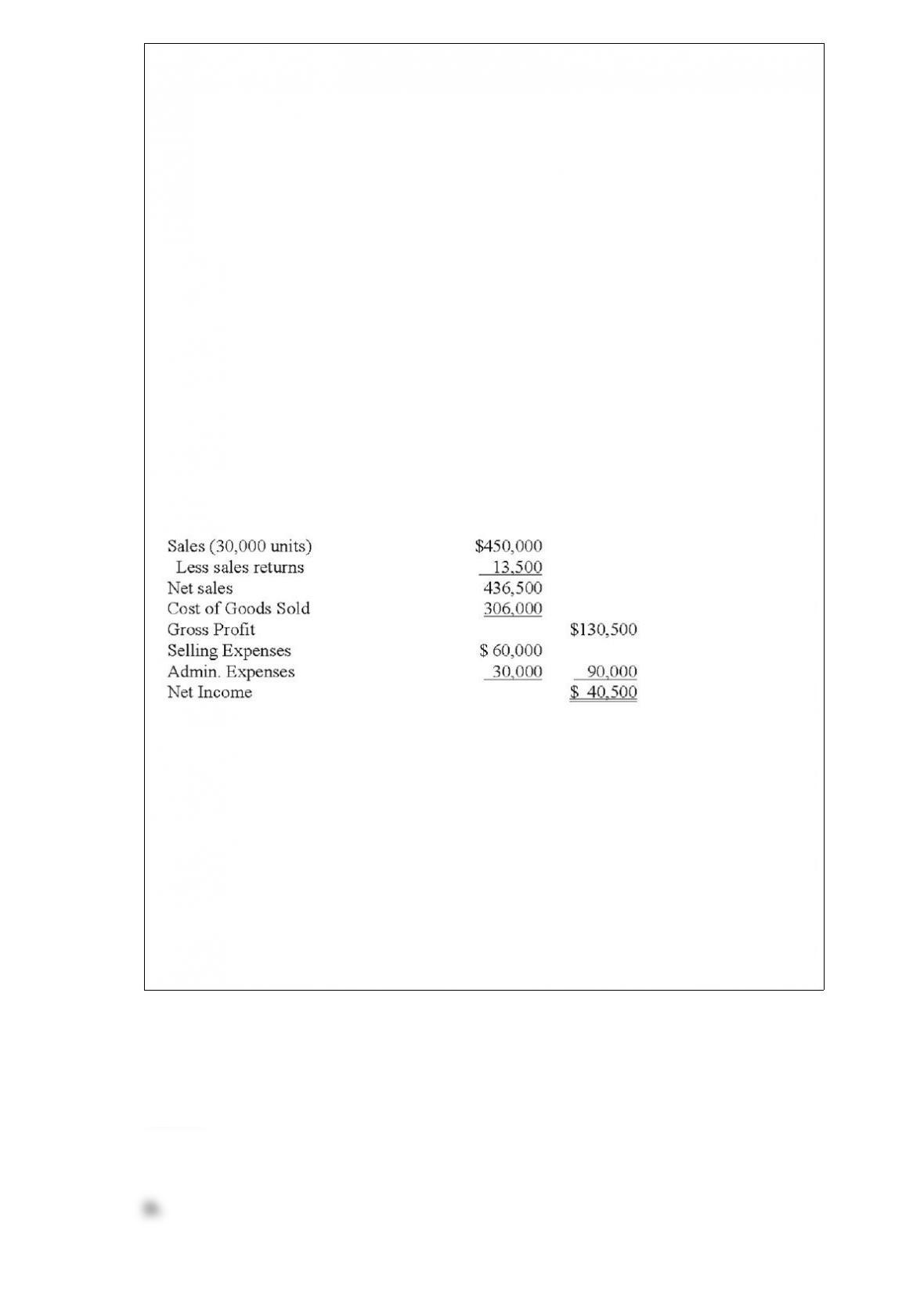
Hawle Manufacturing Company is in the process of preparing its 2010 budget and is
anticipating the following changes:
30% increase in the number of units sold
20% increase in the direct material unit cost
15% increase in the direct labor cost per unit
10% increase in the manufacturing overhead cost per unit
14% increase in the selling price
7% increase in the administrative expenses
Hawle does not keep any units in inventory.
The composition of the cost of finished products during 2010 for materials, direct labor
and factory overhead, respectively, was in the ratio of 3 to 2 to 1. The condensed
income statement for 2009 is as follows:
What is the estimated cost of goods sold for 2010 assuming the number of units sold
does not change?
A. $464,100
B. $402,900
C. $397,800
D. $357,000
Answer:
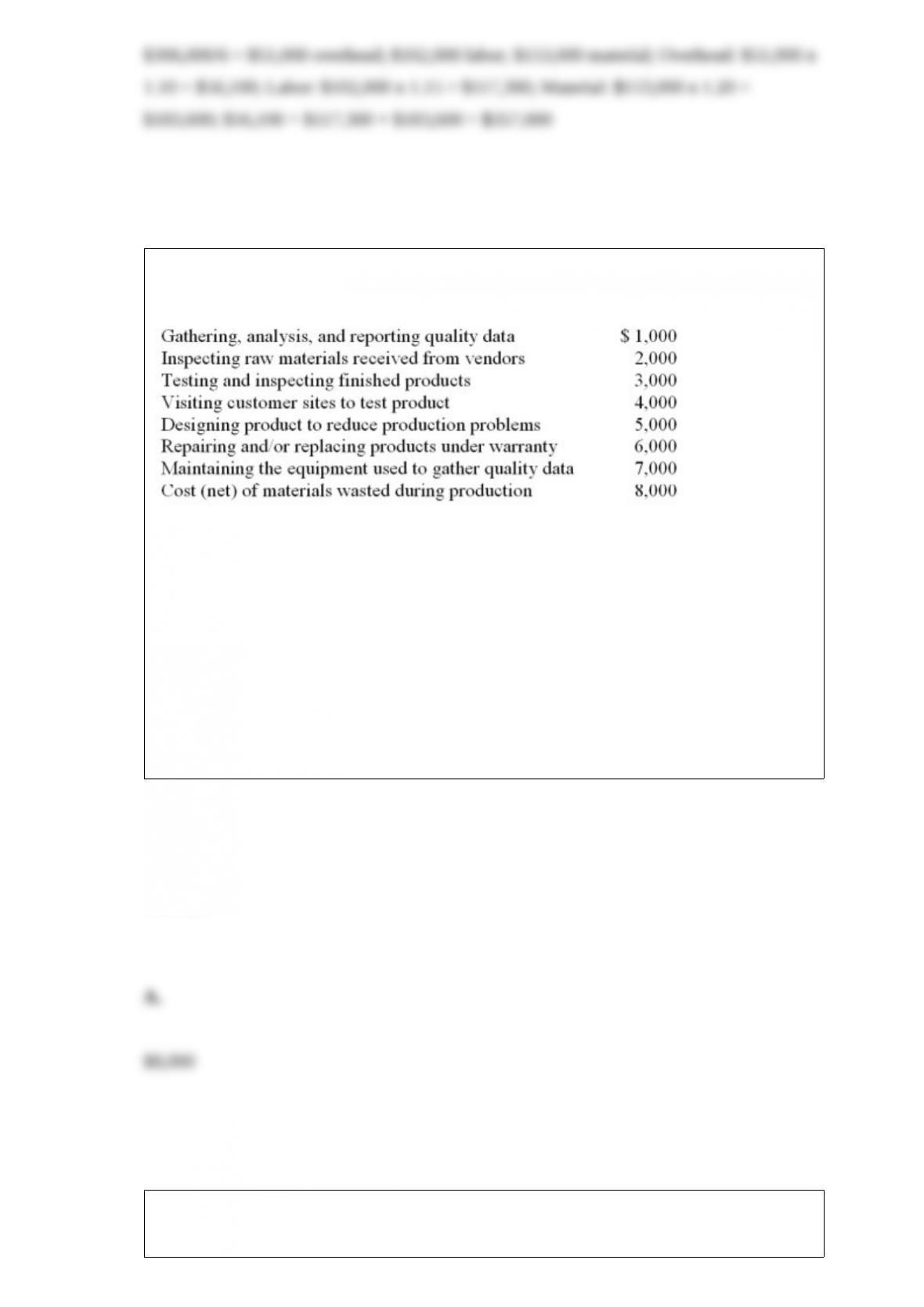
BC Enterprises’ quality control report for August contains the following items.
What would be the total of the internal failure costs on the August quality control report
for BC Enterprises?
A. $8,000
B. $13,000
C. $14,000
D. $16,000
Answer:
The financial plan of the revenues and resources needed to carry out activities and meet
financial goals is called

A. performance measure
B. benchmarking
C. budgeting
D. responsibility center
E. lean accounting
Answer:
An operating unit of an organization is called a cost center if it is responsible
A. only for costs.
B. only for revenues.
C. for costs and revenues.
D. for investments in assets.
Answer:
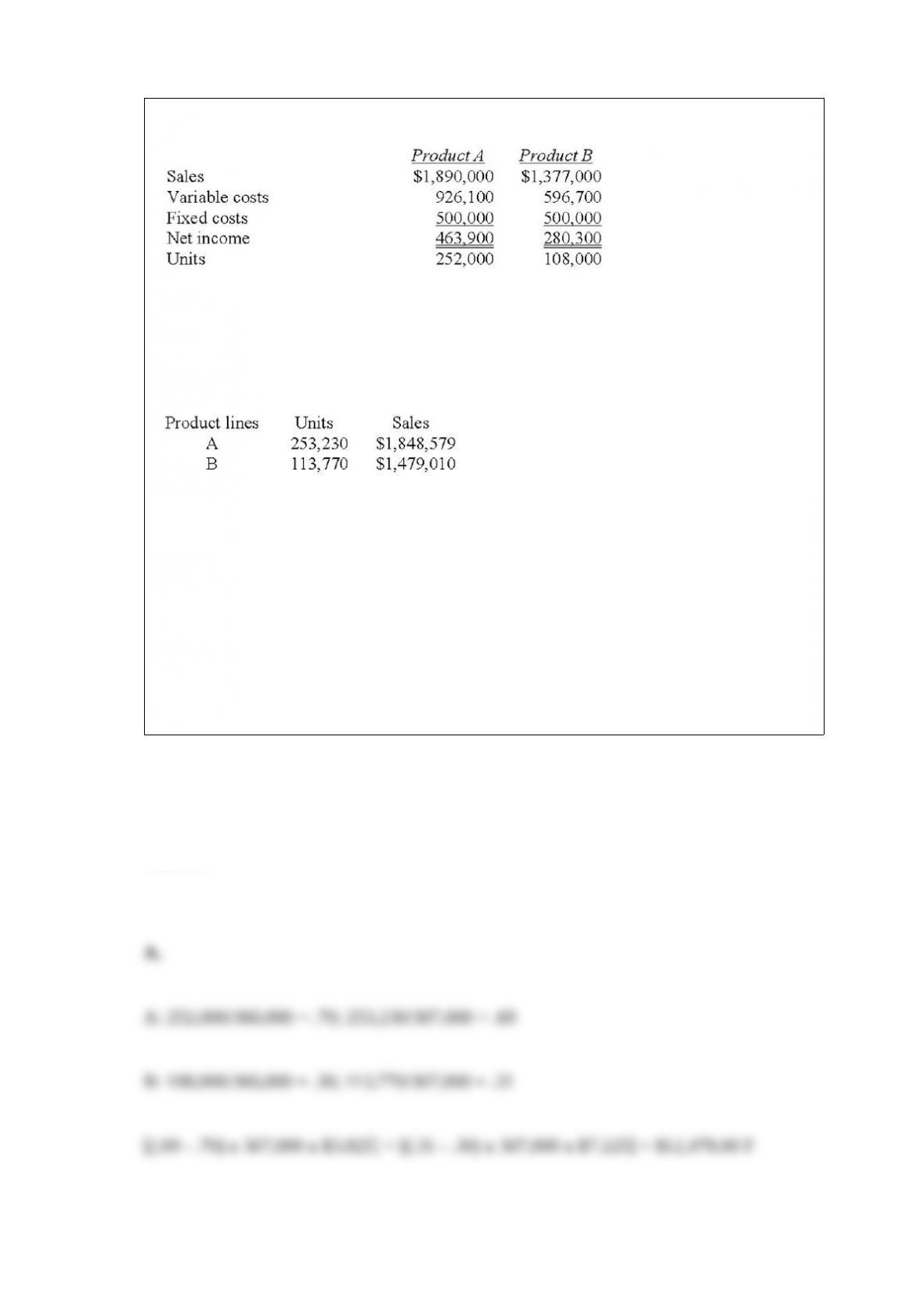
The next year’s budget for Green, Inc., a multi-product company, is given below:
At the end of the year, the total fixed costs and the variable costs per unit were exactly
as budgeted, but the following units per product line were sold. Green analyzes the
effects its sales variances have on the profitability of the company.
What is the total sales mix variance?
A. $12,478.00
B. $20,815.00
C. $33,915.00
D. $40,553.50
Answer:

Lexie Lou Industries applies manufacturing overhead to its cost objects on the basis of
75% of direct material cost. If Job 17X had $72,000 of manufacturing overhead applied
to it during May, the direct materials assigned to Job 17X was:
A. $54,000
B. $72,000
C. $96,000
D. $126,000
Answer:
Which of the following budgets is not required in a wholesale organization?
A. cash
B. sales
C. production
D. cost of goods sold
E. marketing and administrative expenses
Answer:
Residual income is a better measure for performance evaluation of an investment
center manager than return on investment (ROI) because (CMA adapted)
A. the problems associated with measuring the asset base are eliminated.
B. desirable investment decisions will not be neglected by high return divisions.
C. only the gross book value of assets needs to be calculated.
D. returns do not increase as assets are depreciated.
E. the arguments over the cost of capital are eliminated.
Answer:
Controllable revenue is included in a performance report of a
A. a
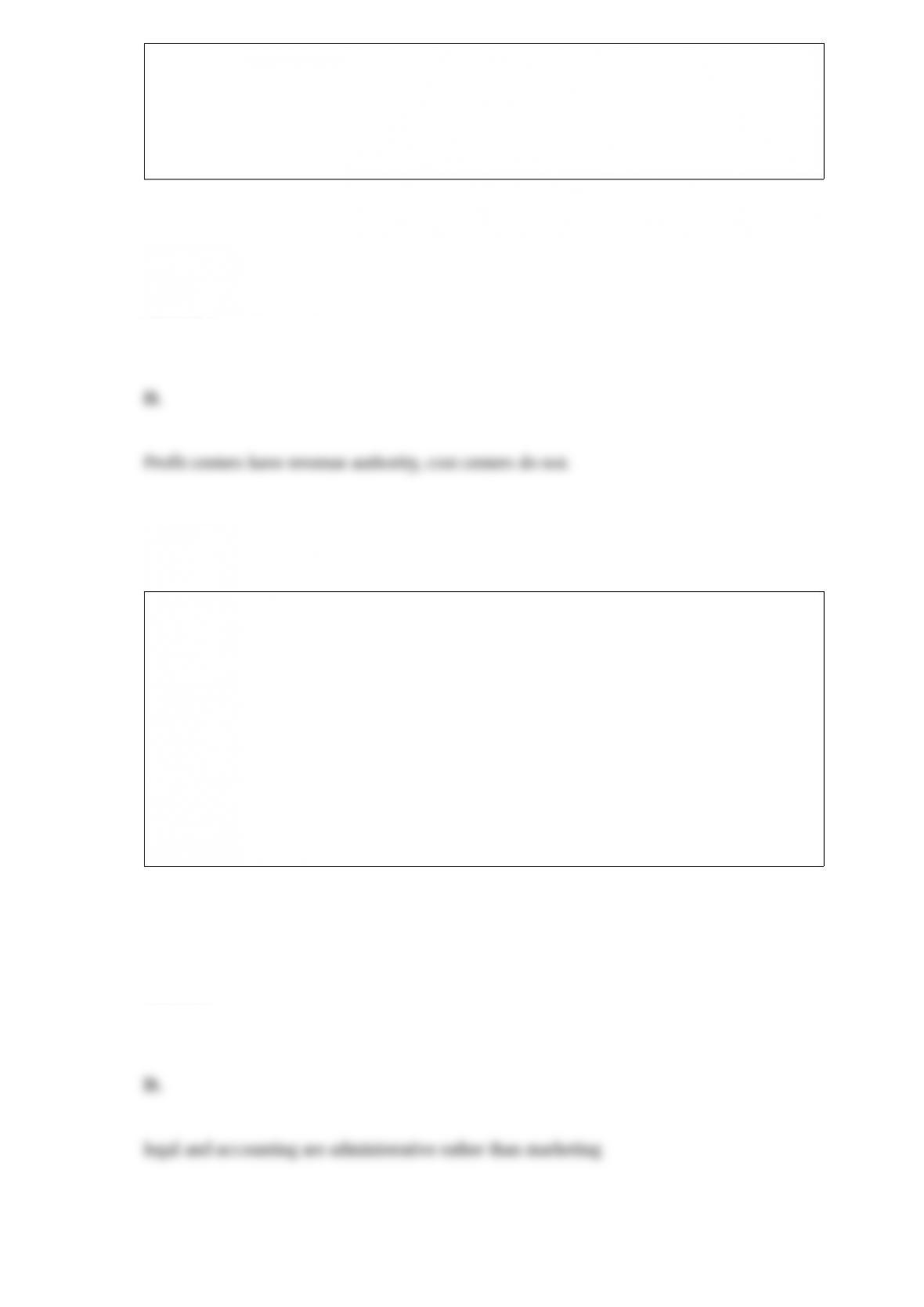
B. b
C. c
D. d
Answer:
Marketing costs include all of the following except:
A. Advertising.
B. Shipping costs.
C. Sales commissions.
D. Legal and accounting fees.
E. Office space for sales department.
Answer:

If there is excess capacity, the minimum acceptable price for a special order must
cover
A. only variable costs associated with the special order.
B. variable and fixed manufacturing costs associated with the special order.
C. variable and incremental fixed costs associated with the special order.
D. variable costs and incremental fixed costs associated with the special order, plus the
contribution margin usually earned on regular units.
Answer:
Which of the following statements is false?
A. The U.S. military is a good example of an organization that is highly decentralized.
B. The degree of decentralization depends on how many decisions principals delegate
to agents.
C. Management control systems are used to measure the performance of an agent’s
decisions.
D. Most organizations have some operating units that are centralized and some that are
decentralized.
Answer:
Standard costs should be based on
A. perfect performance.
B. an average of past costs.
C. most likely level of performance.
D. reasonably attainable levels of efficiency.
Answer:
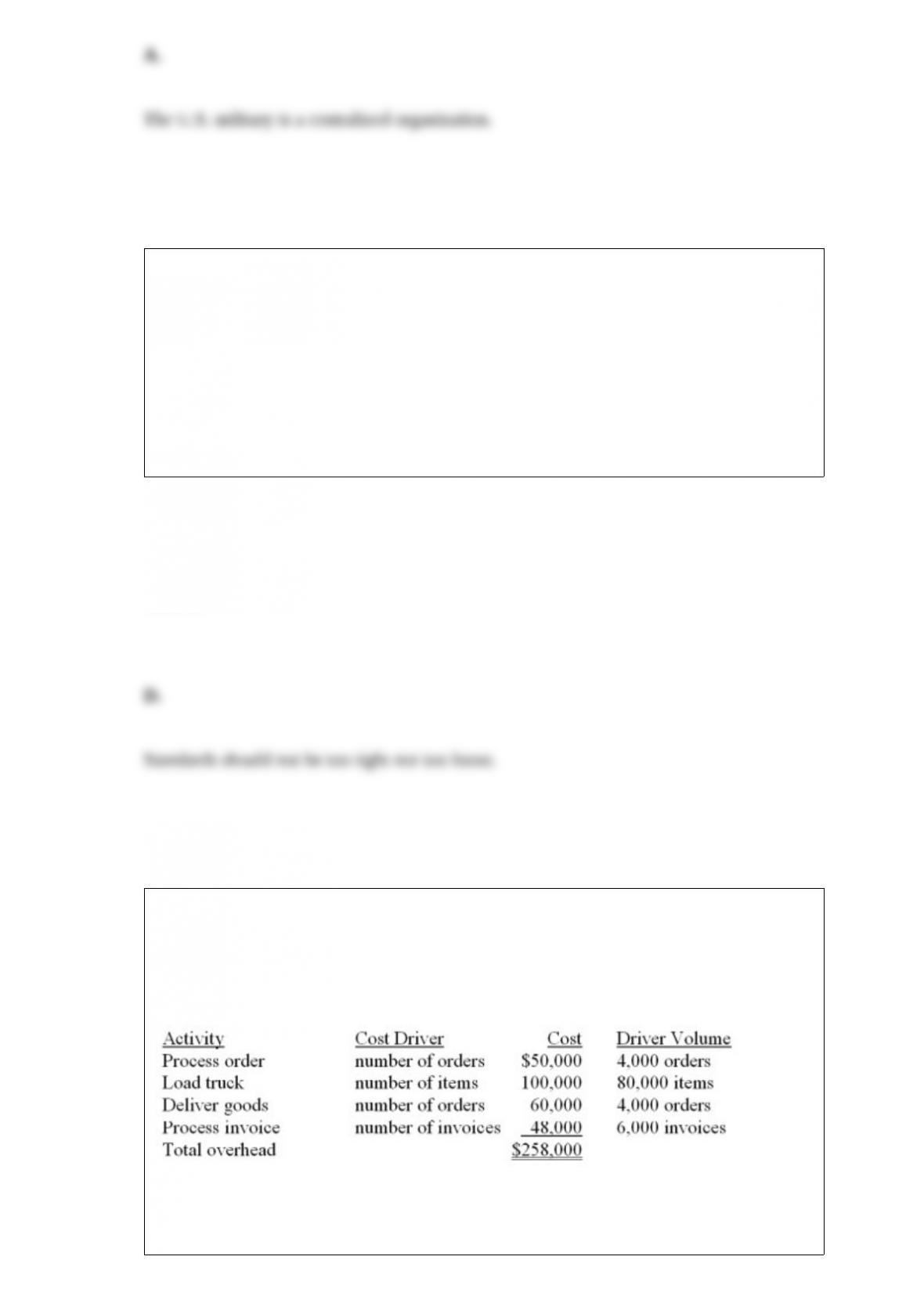
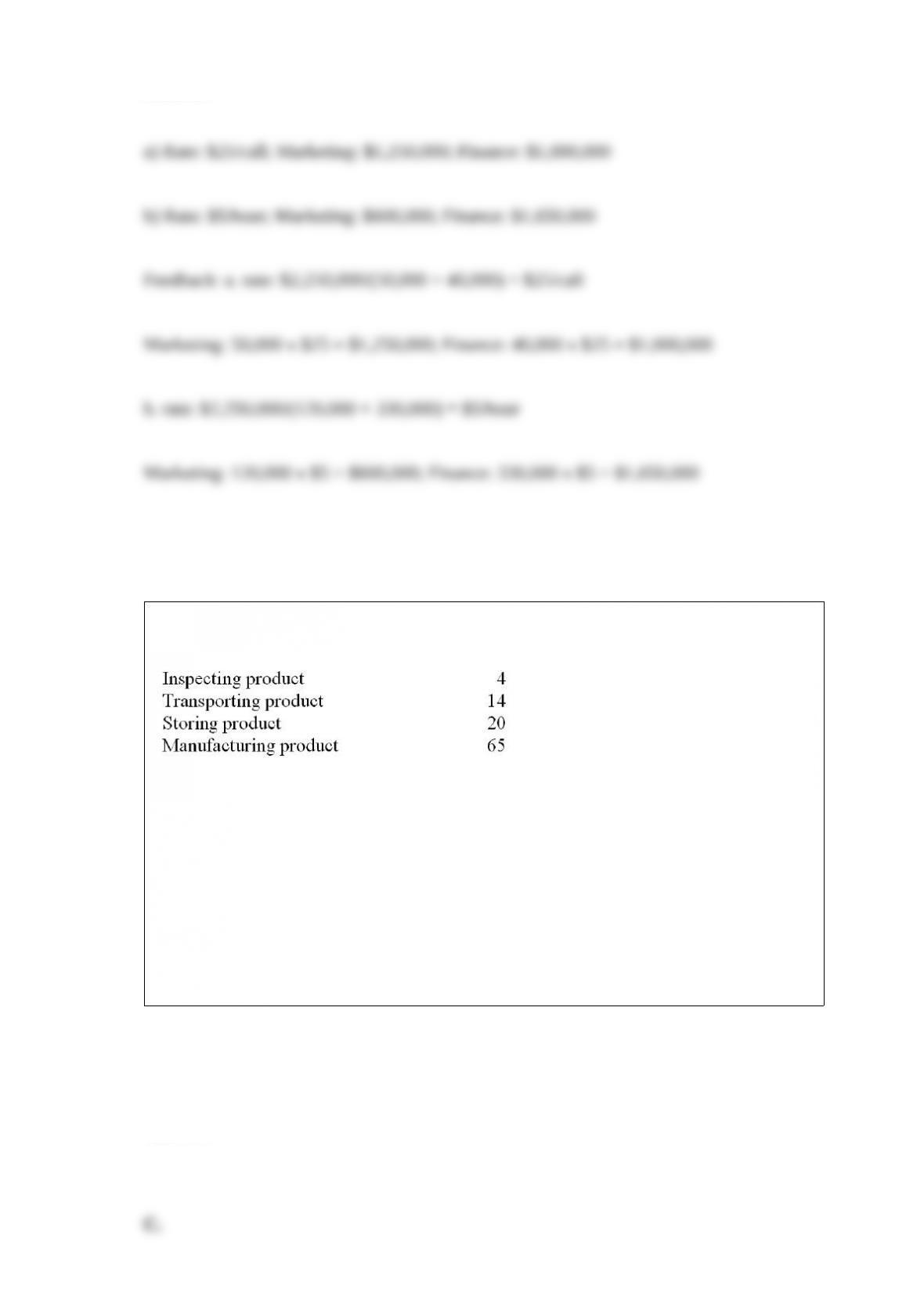
East Grand Grocer Distribution delivers supplies to small grocers throughout the
region. East Grand currently adds 5% to the order cost to cover the delivery cost. The
delivery fee is meant to just cover the cost of delivery. A consultant has analyzed the
delivery service using activity-based costing methods and identified four activities.
Data on these activities are:
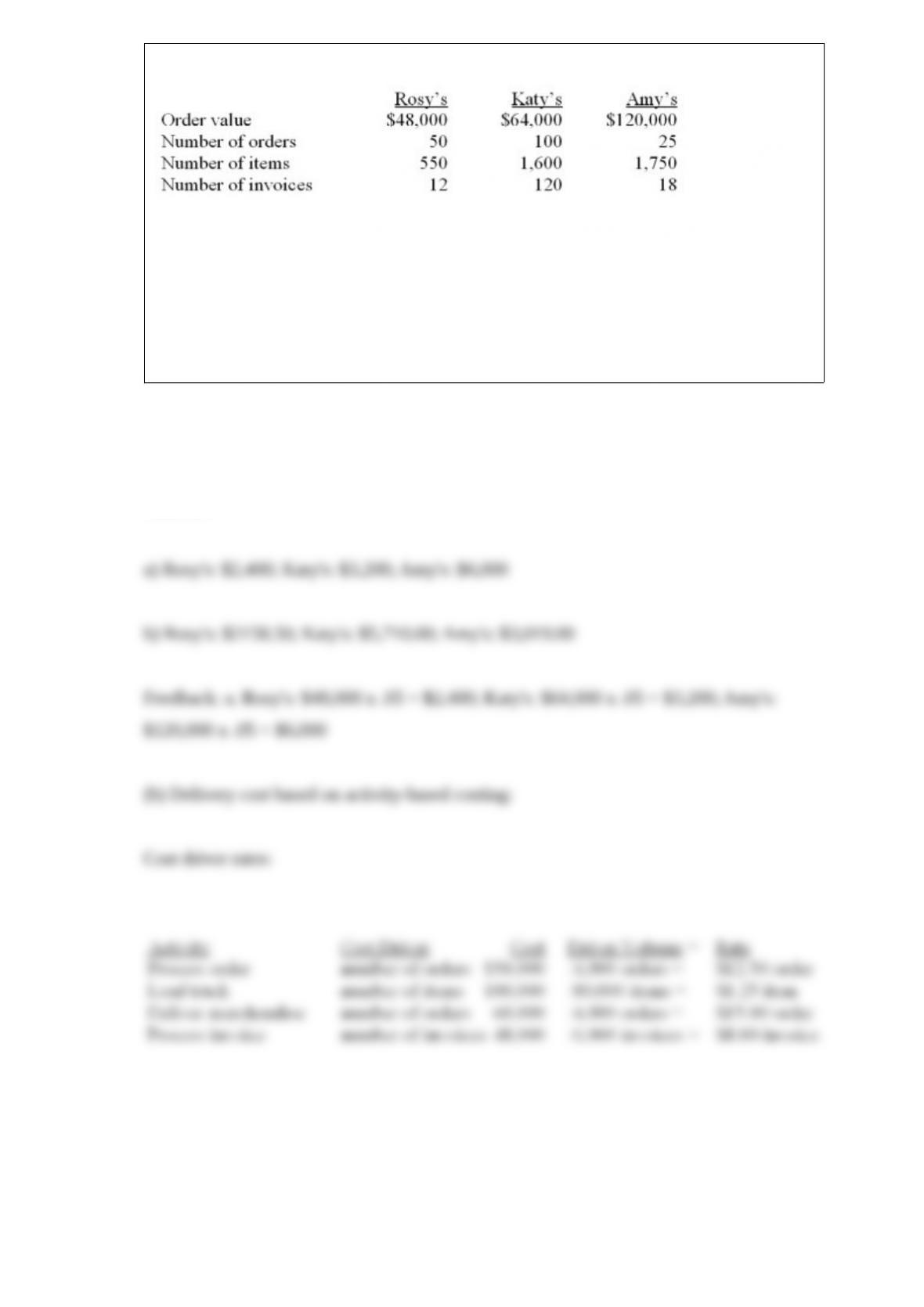
Three of East Grand’s customers are Rosy’s Corner Market, Katy’s Fine Foods and
Amy’s City Market. Below are data on orders and deliveries to these three customers:
Required:
(a) What would be the delivery charge for each customer under the current policy of 5%
of order value?
(b) What would the activity-based costing system estimate as the cost of delivering to
each customer?
Answer:
An equivalent unit of conversion costs is equal to the amount of conversion costs
required to
A. start a unit.
B. start and complete a unit.
C. transfer a unit in.
D. transfer a unit out.
Answer:
Which of the following should not be used for the cost of capital to compute residual
income?
A. Historical weighted average cost of capital.
B. Marginal after-tax cost of new equity capital.
C. Cost of debt and equity used to finance a project.
D. Return on investment (ROI).
Answer:
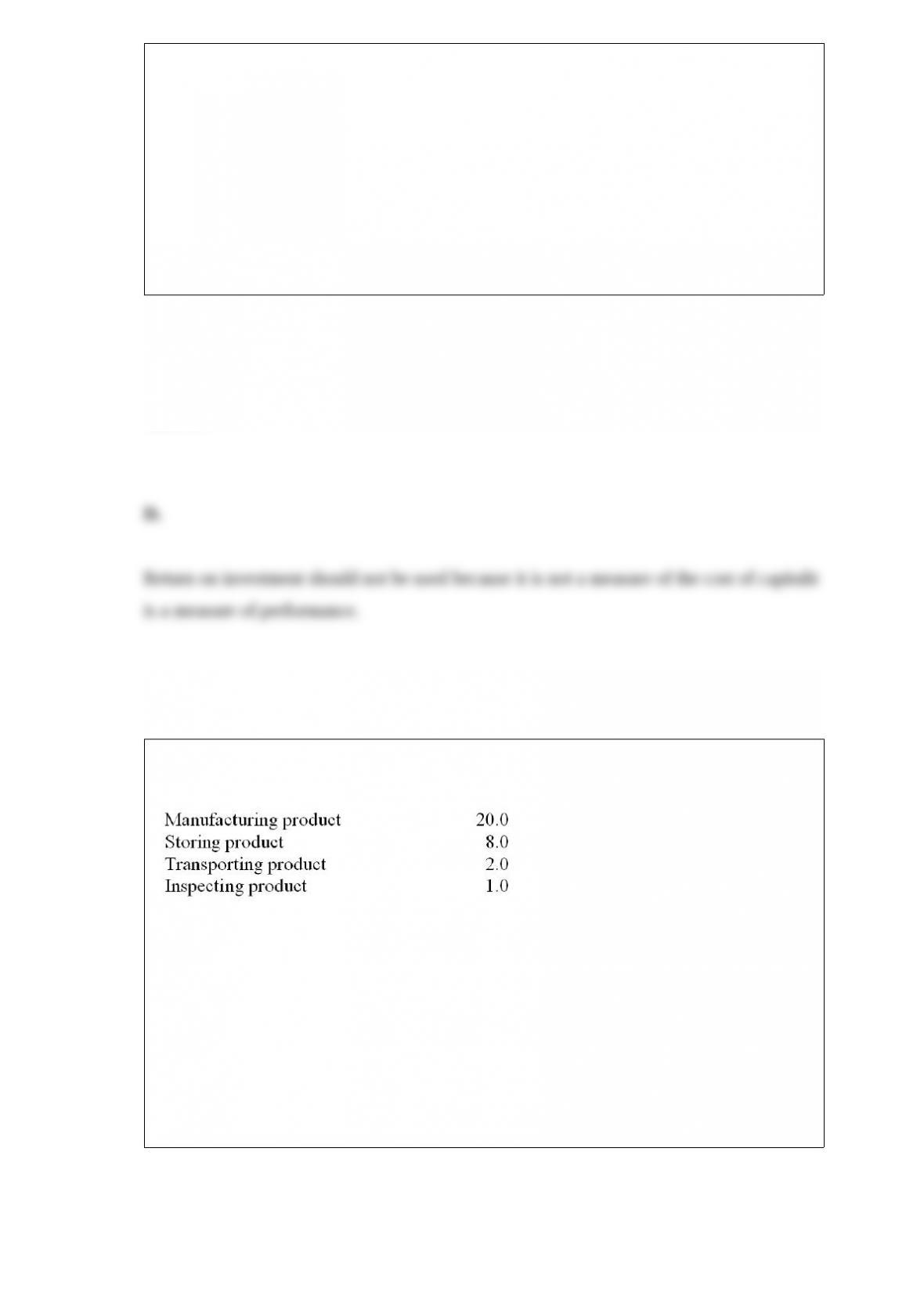
The Pepin Company collected the following information (in days):
What is the manufacturing cycle time?
A. 10 days
B. 31 days
C. 28 days
D. 22 days
Answer:
The set of activities that transforms raw resources into the goods and services of an
organization is called:
A. Value chain.
B. Supply chain.
C. Demand chain.
D. Cost-benefit analysis.
Answer:
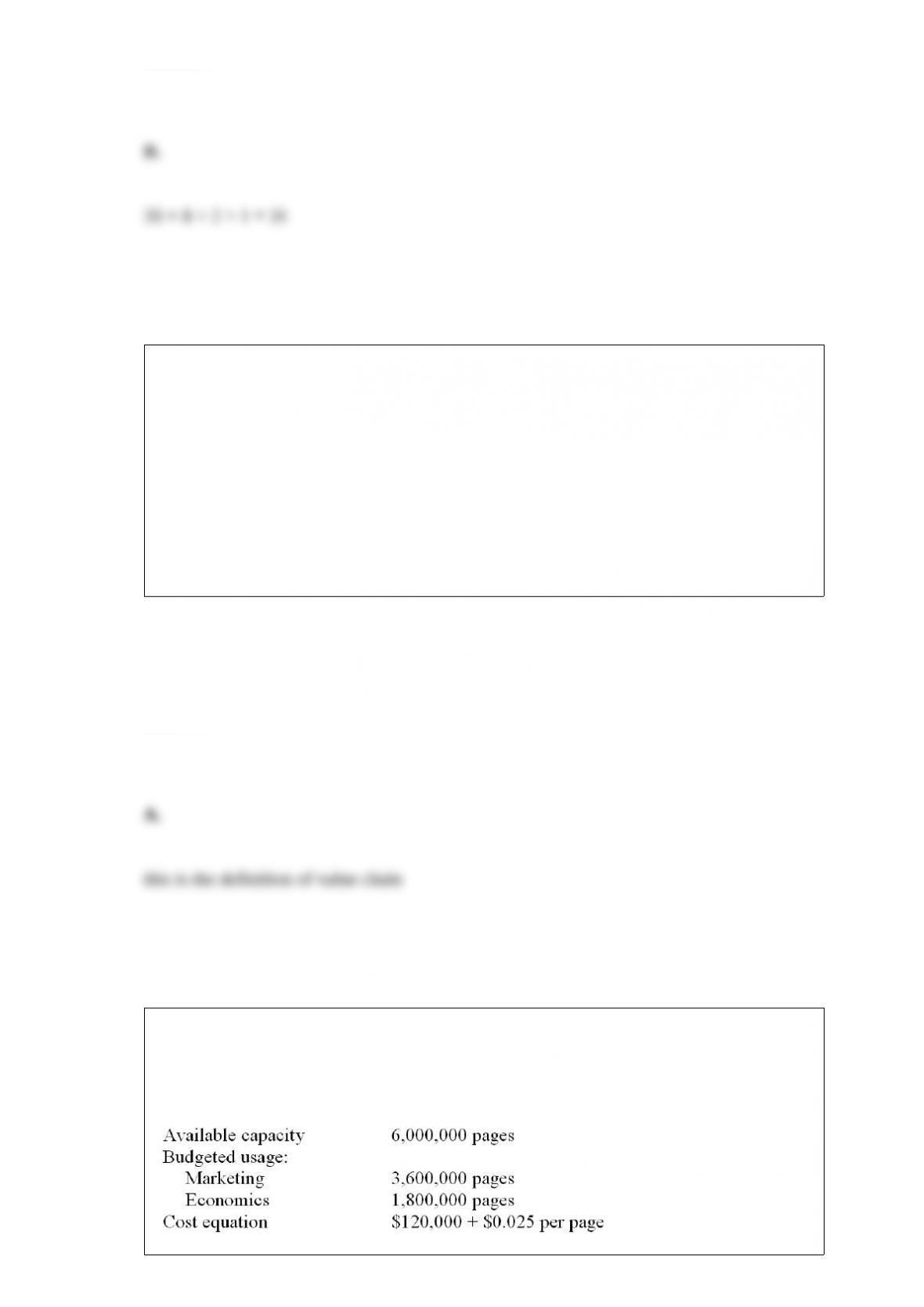
The Copy Department in the College of Business at State University provides
photocopying service for both the Marketing and Economics Department. The
following budget has been prepared for the year.
If the Copy Department uses a dual-rate for allocating its costs, how much cost will be
allocated to the Marketing Department, assuming the Marketing Department actually
made 3,800,000 copies during the year?
A. $135,000
B. $150,000
C. $155,000
D. $175,000
Answer:
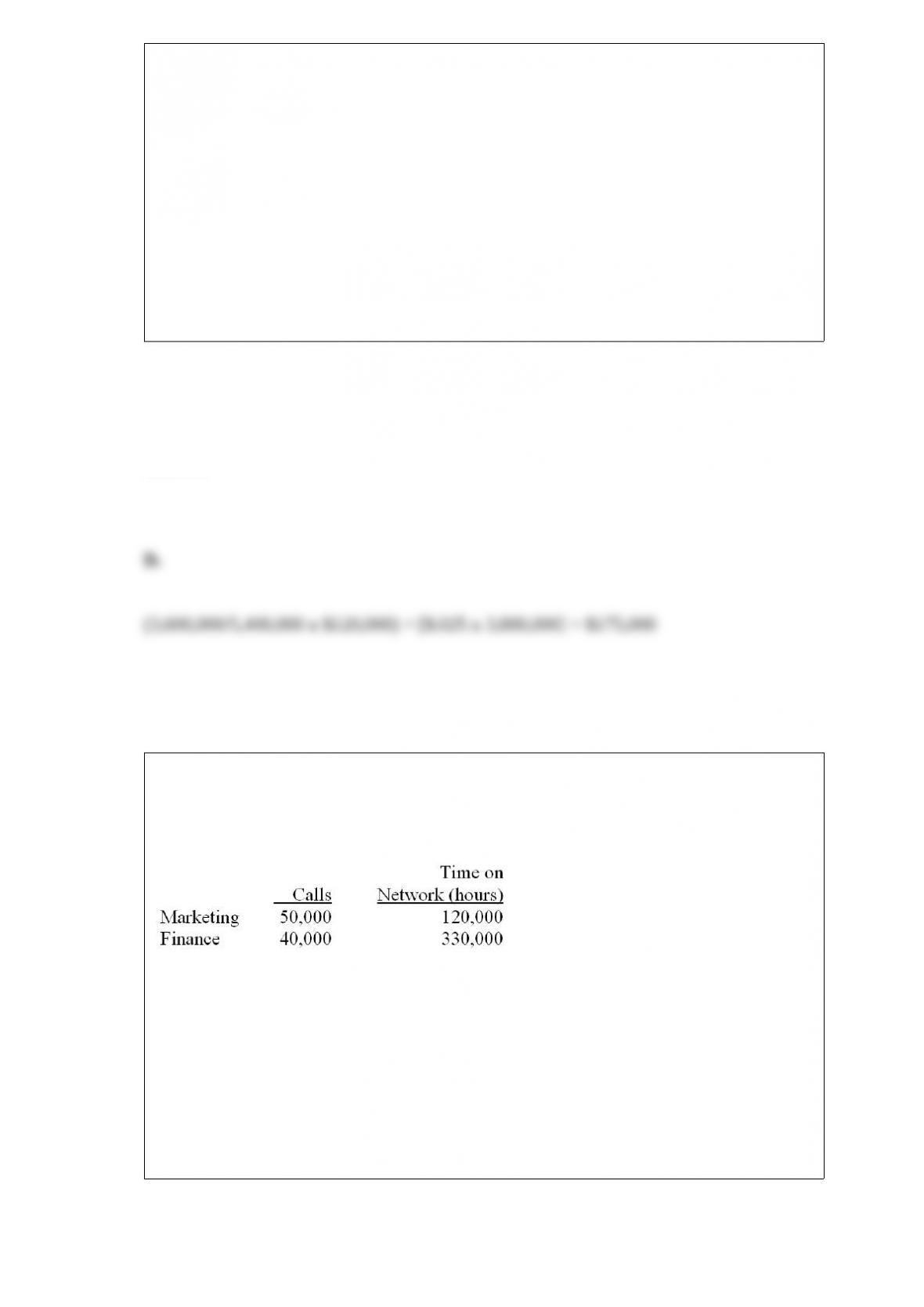
Salinas has two divisions, Marketing and Finance, that share the common costs of the
company’s communications network. The annual common costs are $2,250,000. You
have been provided with the following information for the upcoming year:
Required (use three decimal places in your calculations):
a) What is the allocation rate for the upcoming year assuming Salinas uses the
single-rate method and allocates common costs based on the number of calls? Calculate
the costs allocated to each division.
b) What is the allocation rate for the upcoming year assuming Salinas uses the
single-rate method and allocates common costs based on the time on the network?
Calculate the costs allocated to each division.
Answer:
The Nelson Company collected the following information (in days):
What is the manufacturing cycle efficiency?
A. 100.0%
B. 82.2%
C. 63.1%
D. 76.5%
Answer:
Which of the following statement(s) is/are false?
(A) Residual income can be used to compare divisions of different sizes.
(B) Residual income can be used to compare divisions that are profit centers.
A. only (A) is false
B. only (B) is false
C. both (A) and (B) are false
D. neither (A) and (B) is false
Answer:
Which variance will be unfavorable due to employees working more hours than
allowed for the actual number of units produced?
A. Price (rate)
B. Efficiency
C. Sales activity
D. Production volume
Answer:
Explain the difference between a value chain, a supply chain, and a distribution chain.
Answer:
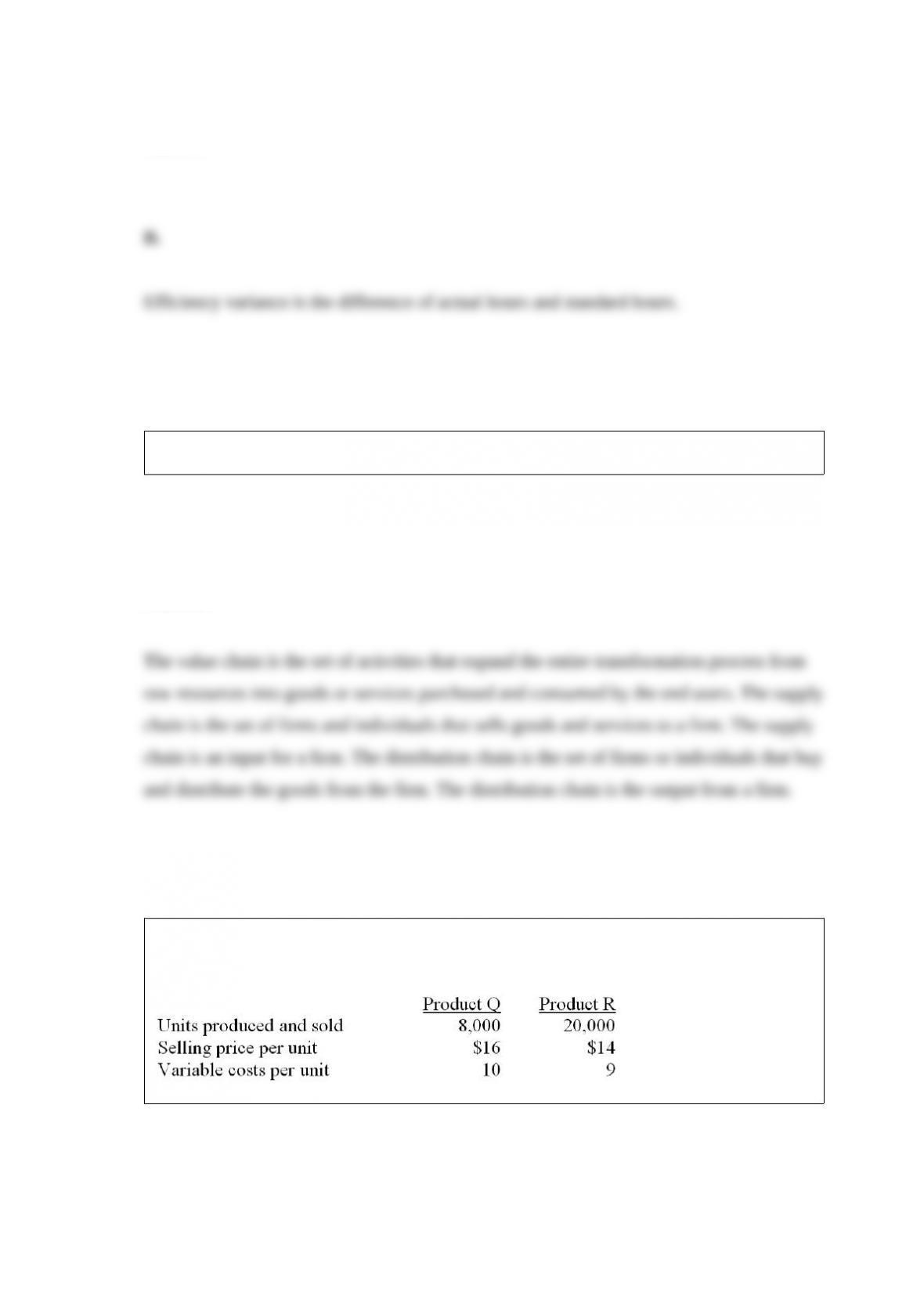
Buffalo Industries produces two products. Information about the products is as follows:
Answer:
Ethical behavior depends more on a firm’s code of conduct than the individual’s
personal beliefs.
Answer:
The Genes Company makes a product, Z, from two materials: X and Y. The standard
prices and quantities are as follows:
In May, 21,000 units of Z were produced by Genes Company, with the following actual
prices and quantities of materials used:
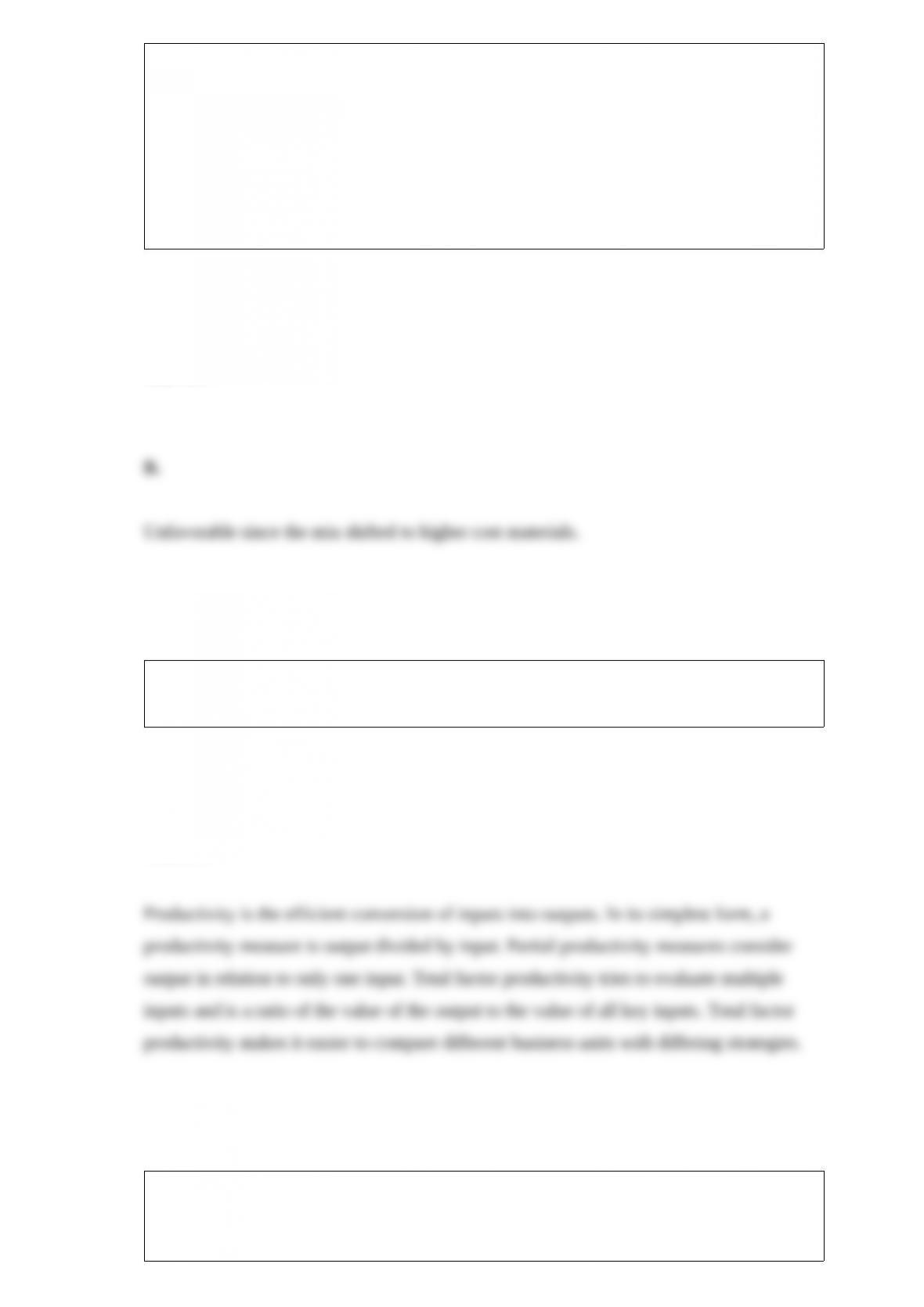
Is the total direct materials mix variance favorable or unfavorable?
A. favorable.
B. unfavorable.
Answer:
What is productivity, and what are the differences between partial productivity
measures and total factor productivity?
Answer:
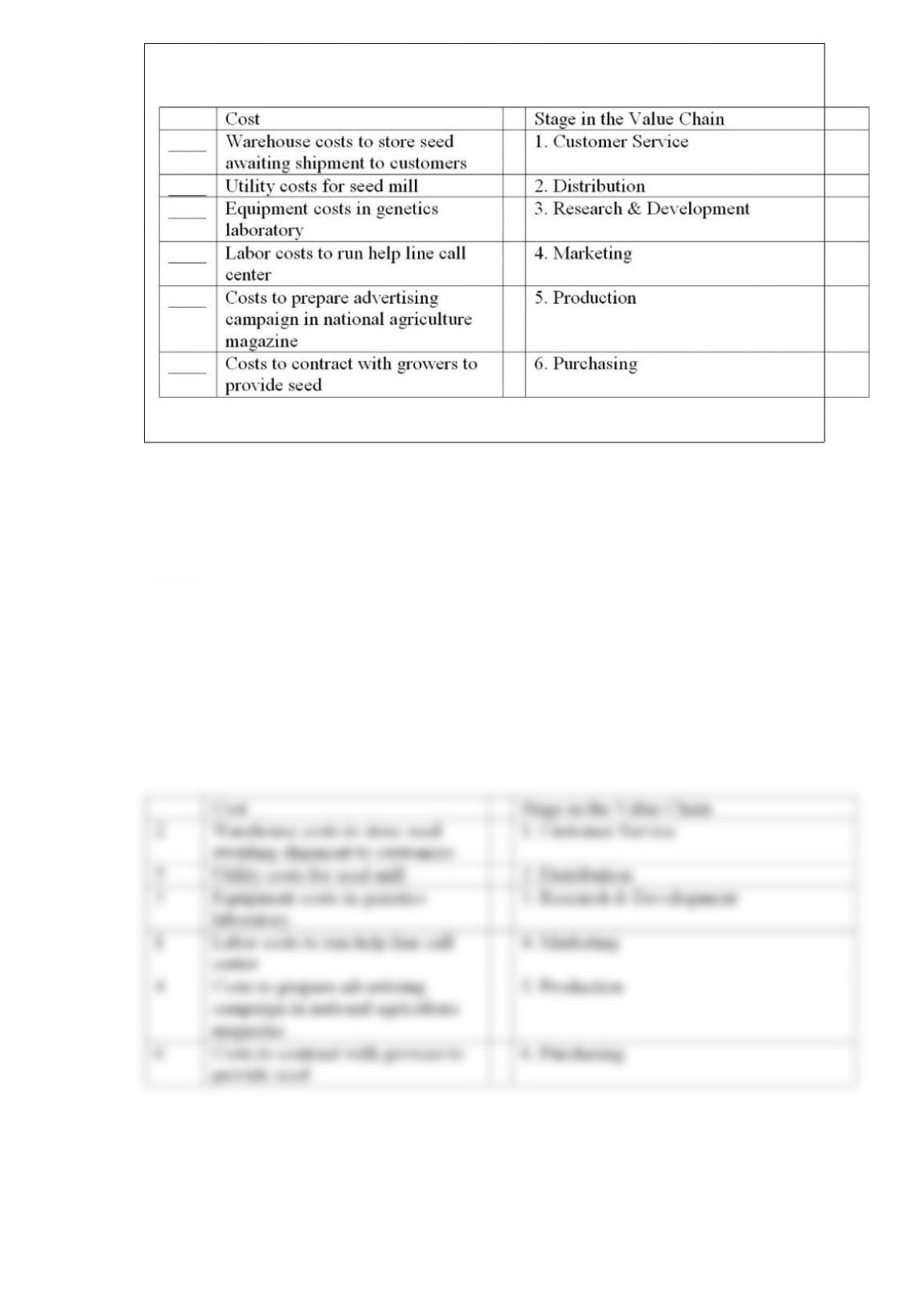
Northern King is an integrated provider of genetically engineered corn. Many types of
costs are incurred in its operations.
Required: For each cost in the following table, identify the stage in the value chain
where the cost is incurred.
Answer:
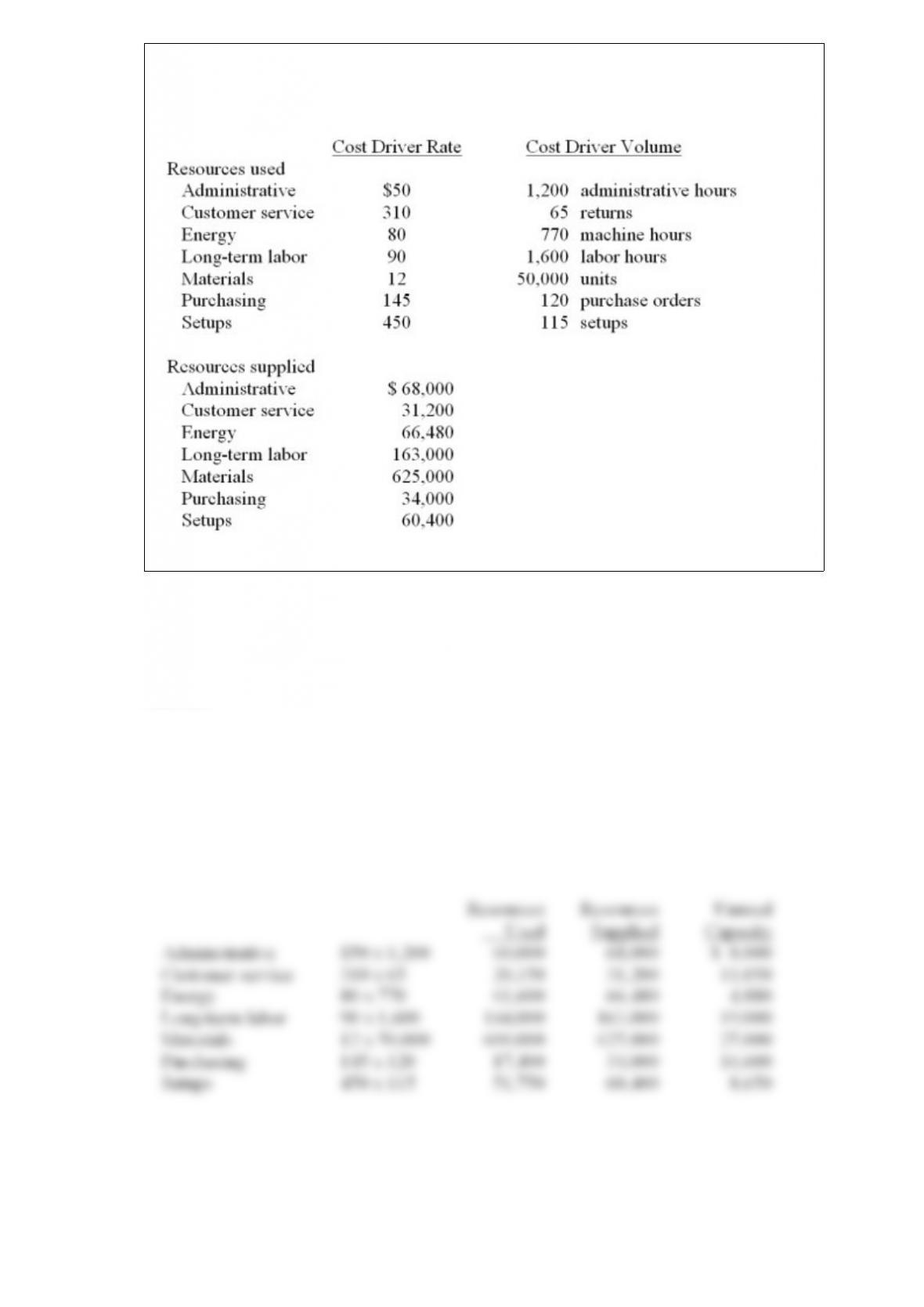
Uinta Supply provides the following information about resources:
Required: Compute the unused resource capacity for each preceding item.
Answer:
Explain how nonfinancial performance measures for customer satisfaction may differ
from functional performance measures.
Answer:
Present the profit equation and define all of the terms.
Answer:
Why is it important for the profit equation to make a distinction between fixed and
variable costs?
Answer:
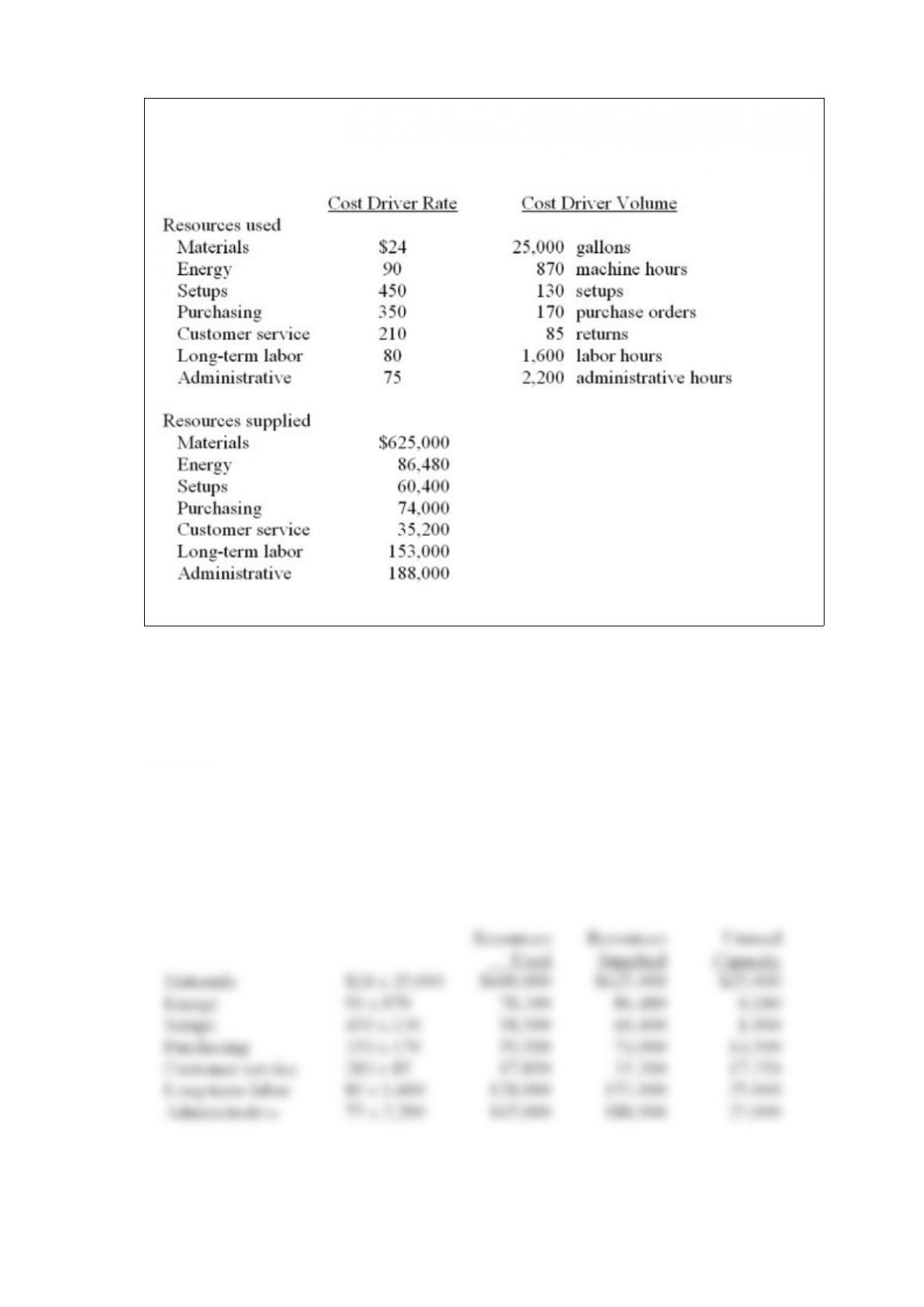
Moab Supply provides the following information about resources:
Required: Compute the unused resource capacity for each preceding item.
Answer:
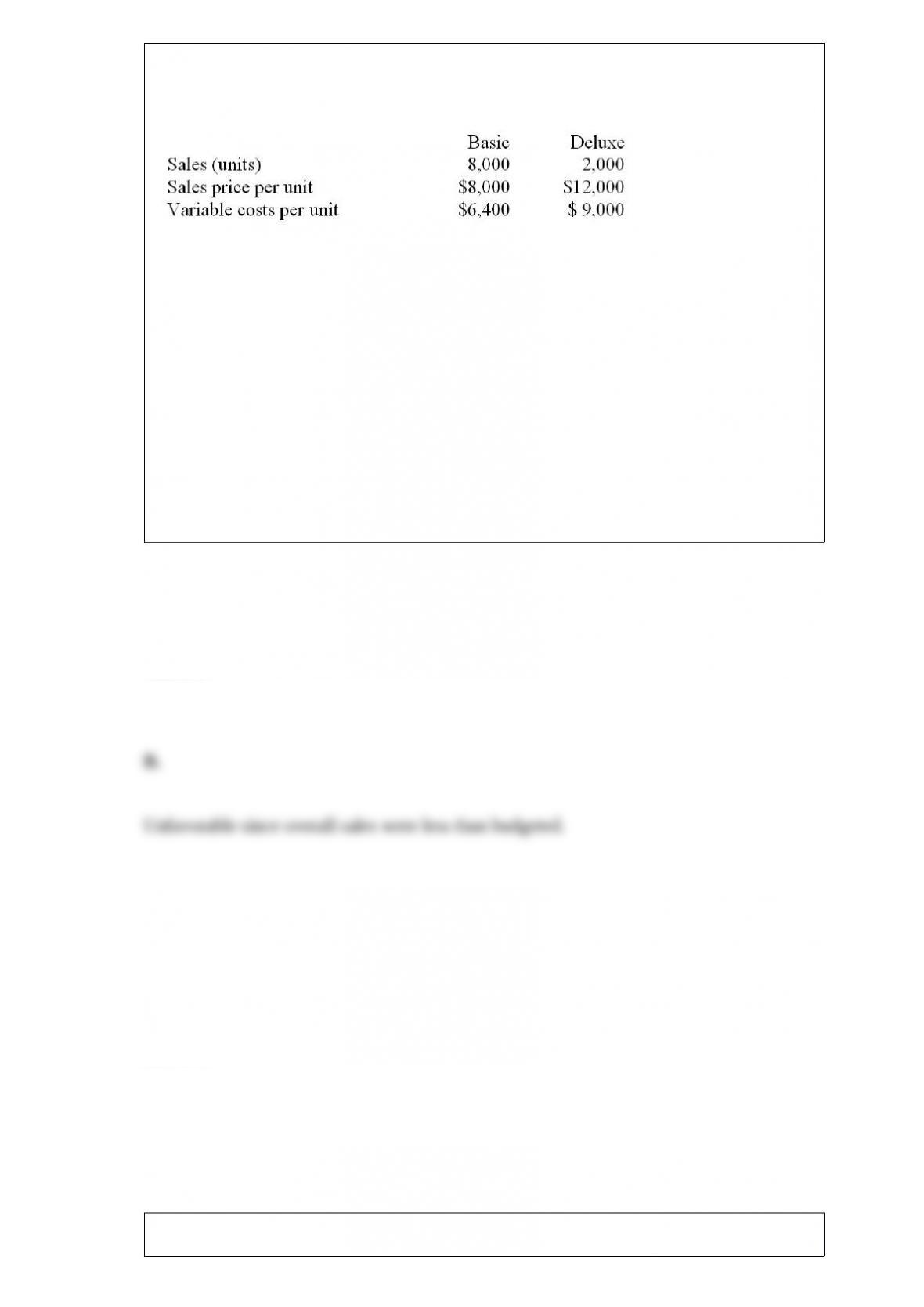
A machine distributor sells two models, basic and deluxe. The following information
relates to its master budget.
Actual sales were 7,000 basic models and 2,800 deluxe models. The actual sales prices
were the same as the budgeted sales prices for both models.
Is the sales quantity variance for the basic model favorable or unfavorable?
A. favorable.
B. unfavorable.
Answer:
Answer:
Categorize each of the following quality activities by placing an X in the appropriate
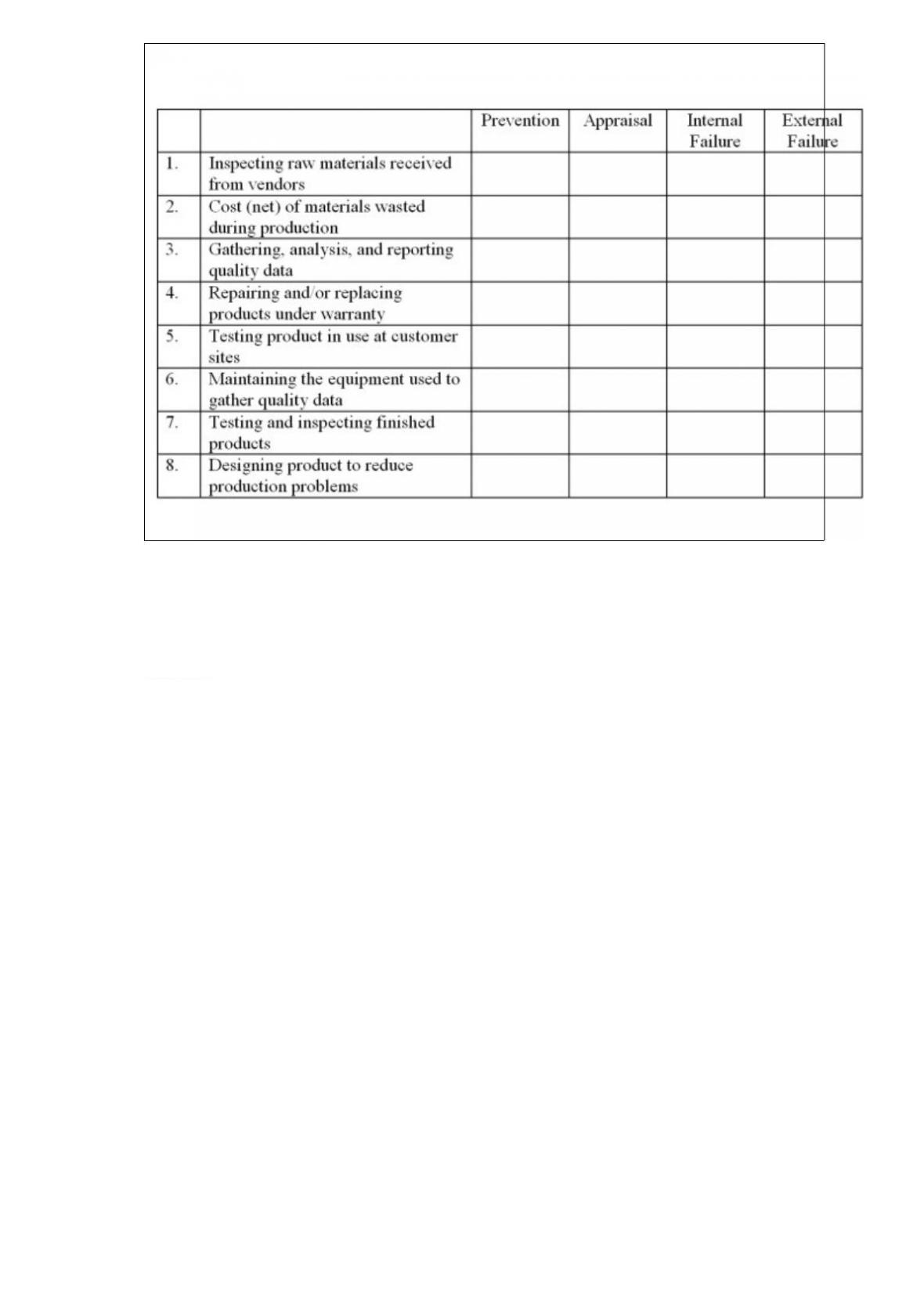
column.
Answer:
Explain the difference between the sales volume variance and the production volume
variance.
Answer: