1) Which of the following statements is false?
A.An expense is a cost incurred to generate revenues.
B.Selling assets at a gain does not result in earning revenue.
C.Revenues are reported on the income statement as they are earned.
D. Revenues result in an increase in net income and additional paid-in capital.
2) The declaration of a $5,000 dividend by JLH Company would be reported on which
of JLH’s financial statements?
A.The income statement only.
B.The statement of stockholders’ equity.
C.The balance sheet only.
D.The statement of cash flows.
3) Which of the following is not a reason that a corporation would want to issue bonds
instead of stock?
A.Interest payments can be deducted for income tax purposes.
B.Stockholders maintain control.
C.The impact on earnings from using borrowed money may be positive.
D.There is less risk associated with a bond issue.
4) Which of the following is correct when bad debt expense is recorded at year-end?
A.Current assets will increase.
B.Gross profit will decrease.
C.Income from operations will decrease.
D.Current liabilities will decrease.
5) Which of the following statements regarding the fixed asset turnover ratio is
incorrect?
A.The numerator is net operating income.
B.The denominator is average net fixed assets.
C.The ratio is used to assess a company’s effectiveness in generating sales from its fixed
assets.
D.The ratio increases when a company sells a factory building for a gain.
6) On April 1, 2015, Paxton Corporation acquired all of the outstanding voting common
stock of Stanley Company and Stanley will remain a separate corporation. Stanley’s
year-end is December 31. How should the assets and liabilities of Stanley be reported
on the consolidated financial statements when Stanley is combined with Paxton on
April 1, 2015?
A.At book values at the April 1, 2015 date of acquisition.
B.At fair values at the April 1, 2015 date of the acquisition.
C.At book values at December 31, 2014.
D.At fair values at December 31, 2014 less accumulated depreciation calculated on the
difference between book and fair values since that date.
7) Superior Company has provided you with the following information before any
year-end adjustments:
Net credit sales are $120,000.
Historical percentage of credit losses is 2%.
Allowance for doubtful accounts has a credit balance of $300.
Accounts receivables ending balance is $47,000.
What is the estimated bad debt expense using the percentage of credit sales method?
A.$2,100.
B.$2,400.
C.$940.
D.$2,700.
8) Rye Company purchased 15% of Lena Company’s common stock during 2014 for
$150,000. The 15% investment in Lena had a $160,000 fair value at the end of 2014
and a $140,000 fair value at the end of 2015. Which of the following statements is
incorrect if Rye classifies the investment as an available-for-sale security?
A.The 2014 unrealized gain is $10,000, but is not included in Lena’s 2014 net income.
B.The 2015 unrealized loss is $20,000, but is not included in Lena’s 2015 net income.
C.The 2015 unrealized loss is $10,000 and is included in Lena’s 2015 net income.
D.The 2014 unrealized gain is $10,000 and is reported on Lena’s balance sheet as a
component of stockholders’ equity.
The 2015 unrealized loss is $20,000, not $10,000. The unrealized loss for the year 2015
is the decline in fair value from $160,000 at the end of 2014 to $140,000 at the end of
2015. The unrealized loss is included in other comprehensive income, which is
accumulated on the balance sheet, and is not included in Rye’s 2015 net income.
9) Which of the following questions is incorrect with respect to determining the
accounting for leases?
A.Is the lease term greater than 75% of the asset’s expected economic life?
B.Is the present value of the payments greater than 75% of the asset’s fair market value?
C.Does the lease provide for an opportunity for the lessee to purchase the leased asset
for a price less than fair market value?
D.Does the lease provide for a transfer of title of the leased asset at the end of the lease
term to the lessee?
The capital lease determination for present value of lease payments needs for that
amount to be more than 90% of the asset’s fair [market] value.
10) Landseeker’s Restaurants reported cost of goods sold of $322 million and accounts
payable of $84 million for 2015. In 2014, cost of goods sold was $258 million and
accounts payable was $72 million. Landseeker’s accounts payable turnover ratio in
2015 is closest to:
A.4.25
B.4.13
C.3.45
D.3.31
11) McGinn Company purchased 10% of RJ Company’s common stock during 2014 for
$100,000. The 10% investment in RJ had a $90,000 fair value at the end of 2014 and a
$105,000 fair value at the end of 2015. Which of the following statements is incorrect if
McGinn classifies the investment as an available-for-sale security?
A.The 2014 unrealized loss is $10,000, but is not included in McGinn’s 2014 net
income.
B.The 2015 unrealized gain is $15,000, but is not included in McGinn’s 2015 net
income.
C.The 2015 unrealized gain is $10,000 and is included in McGinn’s 2015 net income.
D.The 2014 unrealized loss is $10,000 and is reported on McGinn’s balance sheet as a
component of stockholders’ equity.
The 2015 unrealized gain is $15,000 and is not included in McGinn’s 2015 net income.
The unrealized gain is reported on McGinn’s balance sheet as a component of other
comprehensive income, which is accumulated in stockholders’ equity.
12) Which of the following statements describes the balance sheet?
A.It reports a company’s revenues and expenses.
B.Assets are generally reported on the balance sheet at the cost incurred to acquire
them.
C.Stockholders’ equity includes only retained earnings.
D.It reports a company’s cash flow from operations.
13) Thomas Company decided to borrow $30,000 on March 1st, 2014. Thomas signed a
2-year 6% interest-bearing note. What is the adjustment amount to accrue interest on
December 31, 2015?
A.$1,800.
B.$3,600.
C.$300.
D.$1,200.
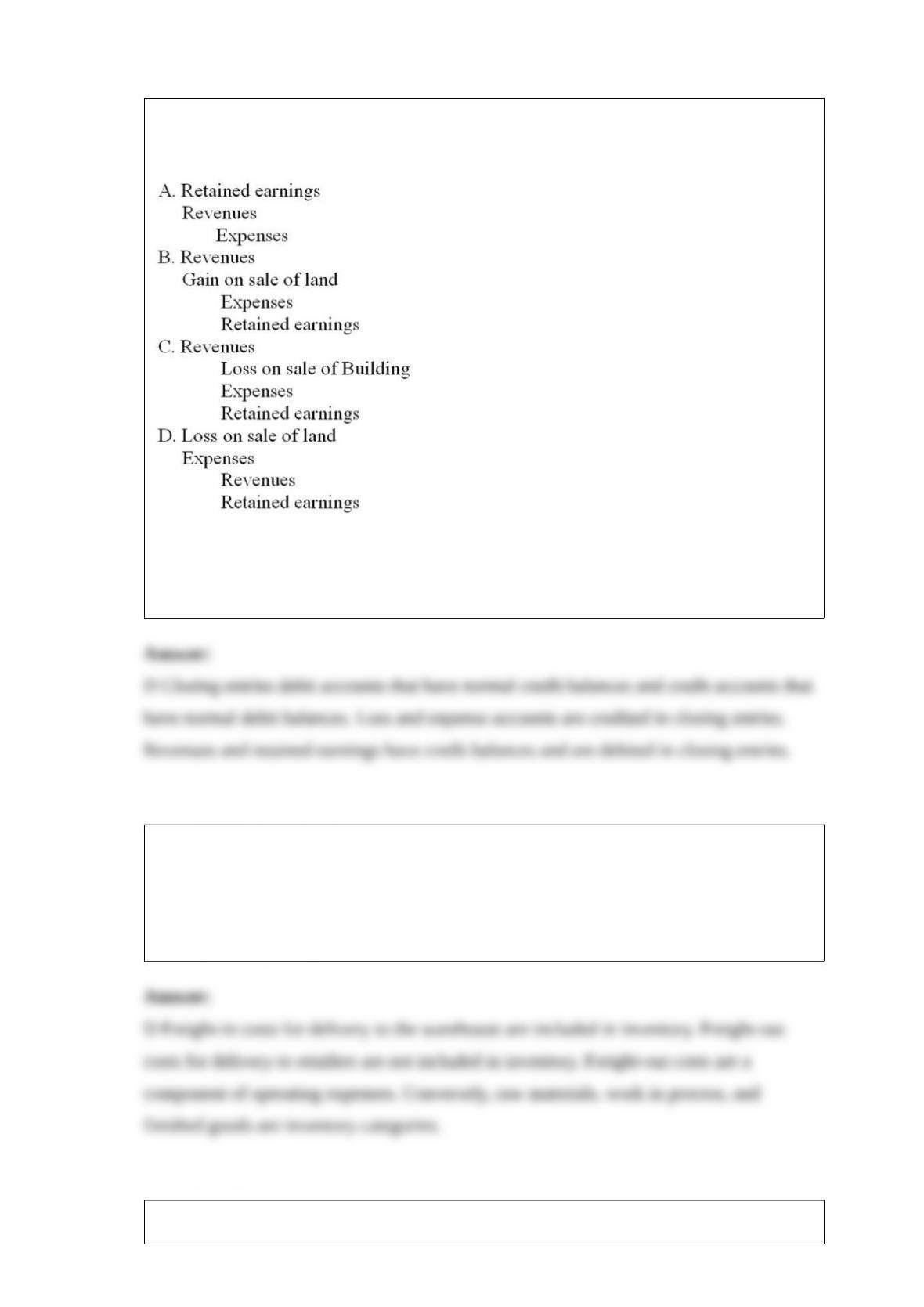
14) Which of the following is not a correct closing entry?
A.Option A
B.Option B
C.Option C
D.Option D
15) Which of the following costs is not included as inventory on the balance sheet?
A.Raw materials to be used in the manufacturing process.
B.Work in process.
C.Finished goods.
D.Freight-out costs for finished goods sent to retailers.
16) Which of the following statements regarding the effective-interest method of
amortization is incorrect?
A.The amount of interest expense is different each period.
B.The amount of discount or premium, on which amortization is calculated, increases
each period.
C.The effective-interest method is one of the options allowed by generally accepted
accounting principles for all bond issues.
D.The total interest expense over the life of a bond is the same as that reported under
the straight-line method of amortization.
17) Which of the following statements is true?
A.The statement of stockholders’ equity always reports the same amount of dividend
payments, as does the statement of cash flows.
B.The statement of cash flows has a relationship with the balance sheet.
C.Dividends paid are reported on the statement of cash flows as an operating cash flow
and on the income statement as a financing cash flow.
D.Net income is reported on the income statement but not on the statement of
stockholders’ equity.
18) Which of the following transactions will result in an increase in operating income as
of the date of the transaction?
A.The sale of plant and equipment at a gain.
B.Collection of cash from a customer for services to be provided at a later date.
C.Providing a service to a customer on account.
D.The receipt of cash dividends from an investment.
Operating income is increased by operating revenue. Operating revenues result from the
sale of goods or services to a customer, even if it is on account and will not be collected
until a later date.
19) On January 1, 2014, a corporation issued $400,000 of 10-year, 12% bonds. The
interest is payable semi-annually on June 30 and December 31. The issue price was
$413,153 based on a 10% effective (market) interest rate. Assuming the
effective-interest method of amortization is used, the interest expense for the six-month
period ending December 31, 2014 is closest to:
A.$24,000.
B.$20,491.
C.$20,000.
D.$20,825.
20) On December 31, 2014, Brave Corporation reported the following on its balance
sheet:
Prepare the stockholders’ equity section of the balance sheet.
21) Ridgetop Company issued the following ten-year bonds on January 1, 2013:
$100,000 maturity value, 5% interest payable annually on each December 31. The
bonds were dated January 1, 2013 and the accounting period ends December 31. The
bonds were issued for $98,000.
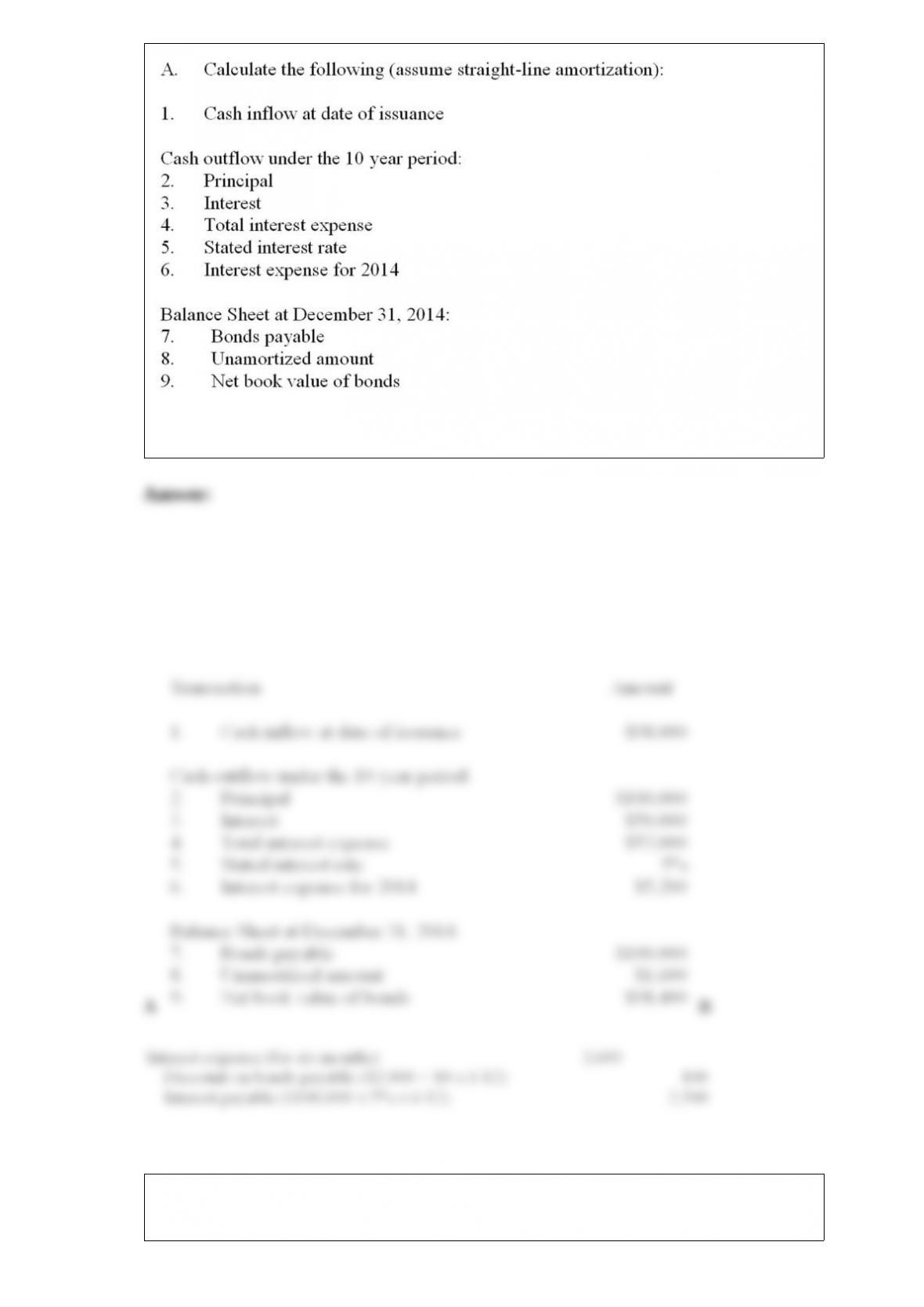
B Assuming
instead that the accounting period ends on June 30, prepare the adjusting entry related
to interest expense for 2013. No adjusting entries have been made during the year.
22) Bridge Company keeps a small inventory of supplies used for cleaning and
maintenance purposes. On January 1, 2014, the inventory of supplies on hand was
$2,000. During the year, supplies purchased were debited to the supplies account in the
amount of $6,500. On December 31, 2014, the amount of supplies in the storeroom was
$1,750. The books are adjusted only at year-end.
Prepare the adjusting entry required at December 31, 2014.
23) On January 1, 2013, Boston Company purchased a heavy duty machine having an
invoice price of $13,000. Boston paid transportation and installation costs totaling
$3,000. The machine is estimated to have a 4-year useful life and a $1,400 residual
value.
Calculate depreciation expense and book value for 2013-2016, assuming double
declining-balance method of depreciation.
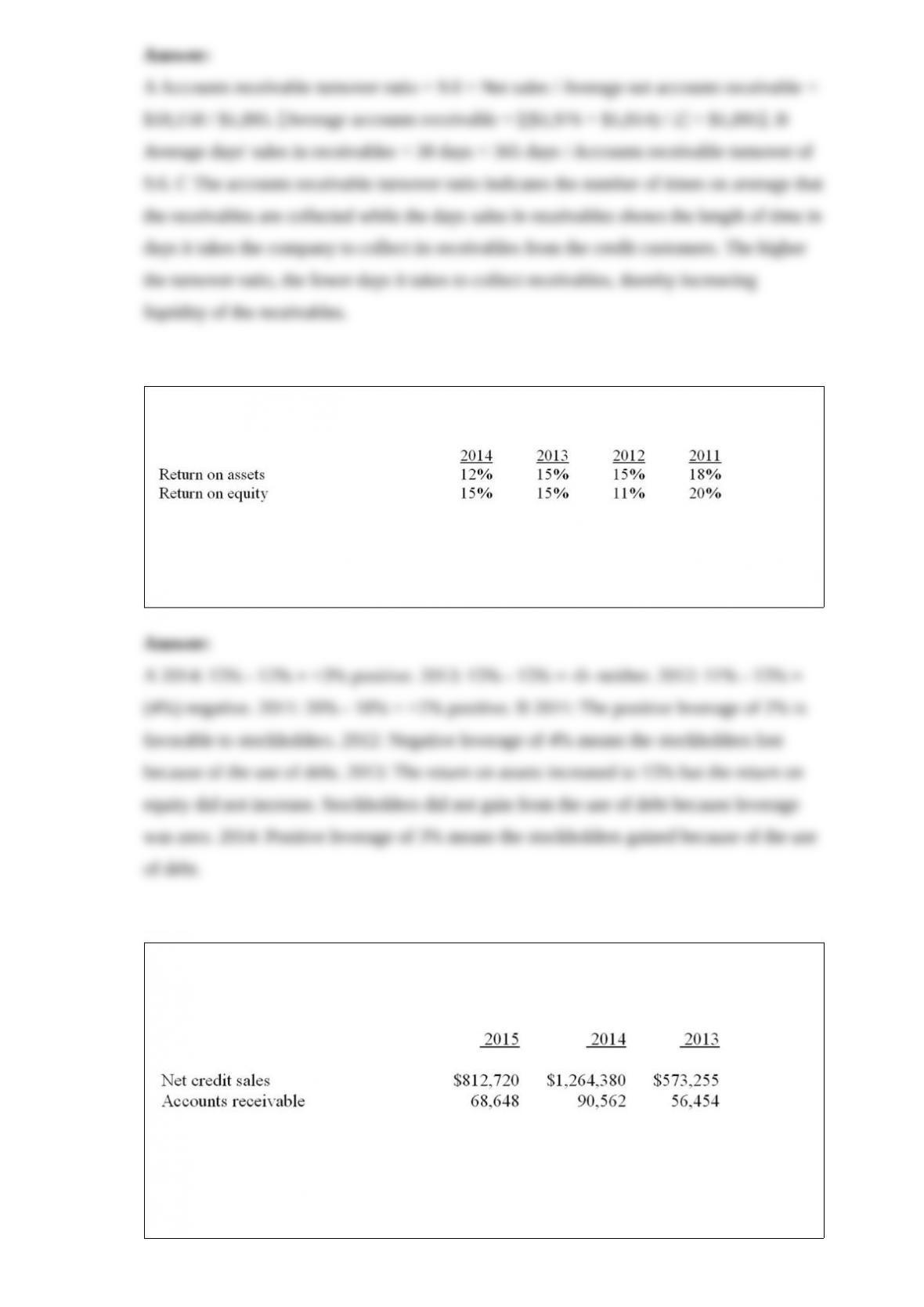
24) A recent annual report for Kirova Company contained the following data:
A Calculate the accounts receivable turnover ratio.
B Calculate the average days’ sales in receivables for 2014 (rounded to the nearest day).
C Explain the meaning of each number.
25) The following return on investment ratios were computed for Steven Company:
A Compute financial leverage percentage for each year and state whether it is positive
or negative.B Explain briefly the stockholders€ advantage or disadvantage for each
year, beginning with year 2011.
26) Matrix Corp. reported the following figures from its financial statements for the
years 2013 through 2015.
A Calculate for 2015:
1. Accounts receivable turnover
2. Average collection period
B Calculate for 2014:
1. Accounts receivable turnover
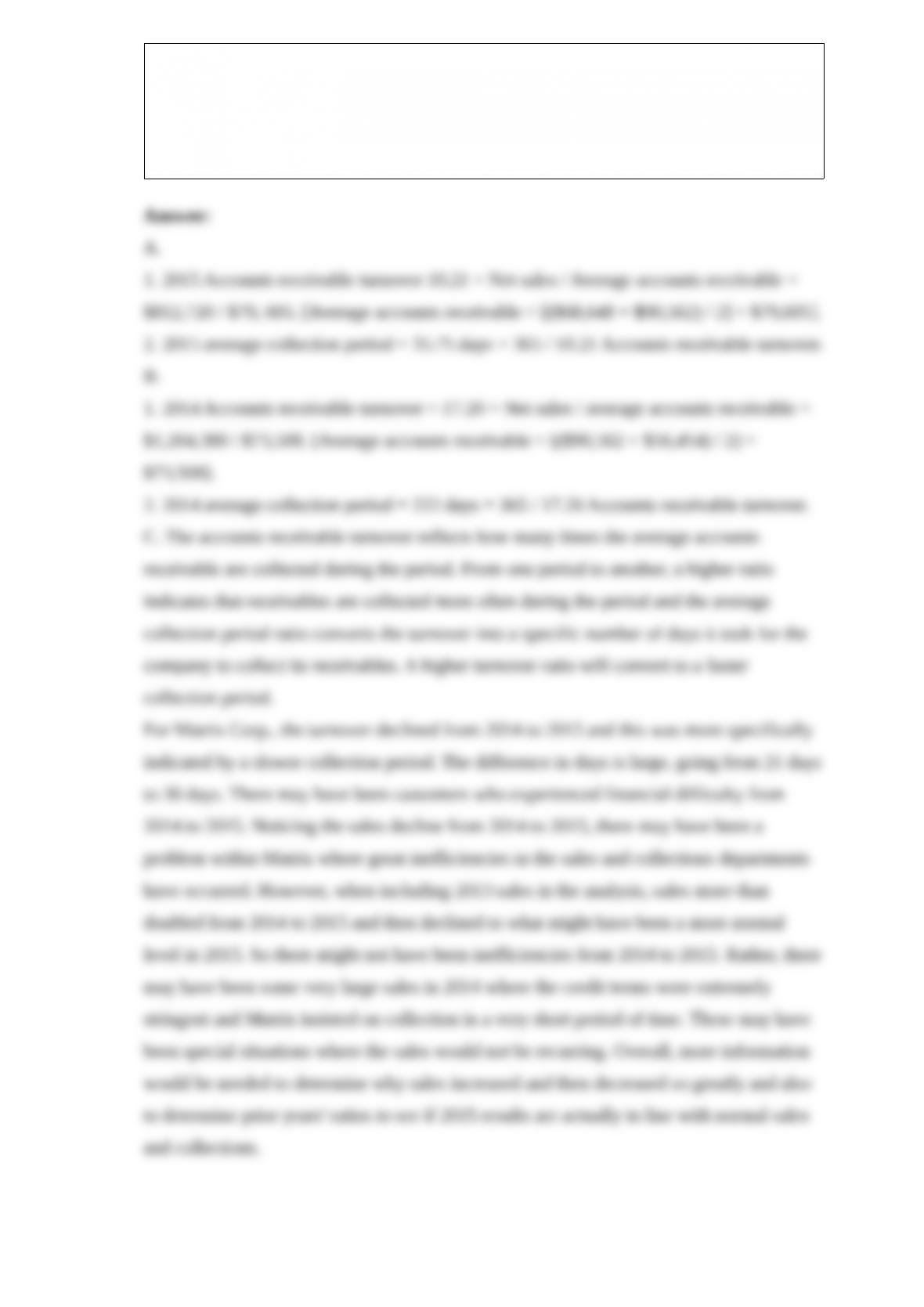
2. Average collection period
C Interpret the receivables turnover and the average collection period, in general.
Comment on the change in the ratio results from 2014 to 2015. Then discuss how the
trend in sales from 2013 to 2014 and 2015 may have affected the change in the ratios
from 2014 to 2015.
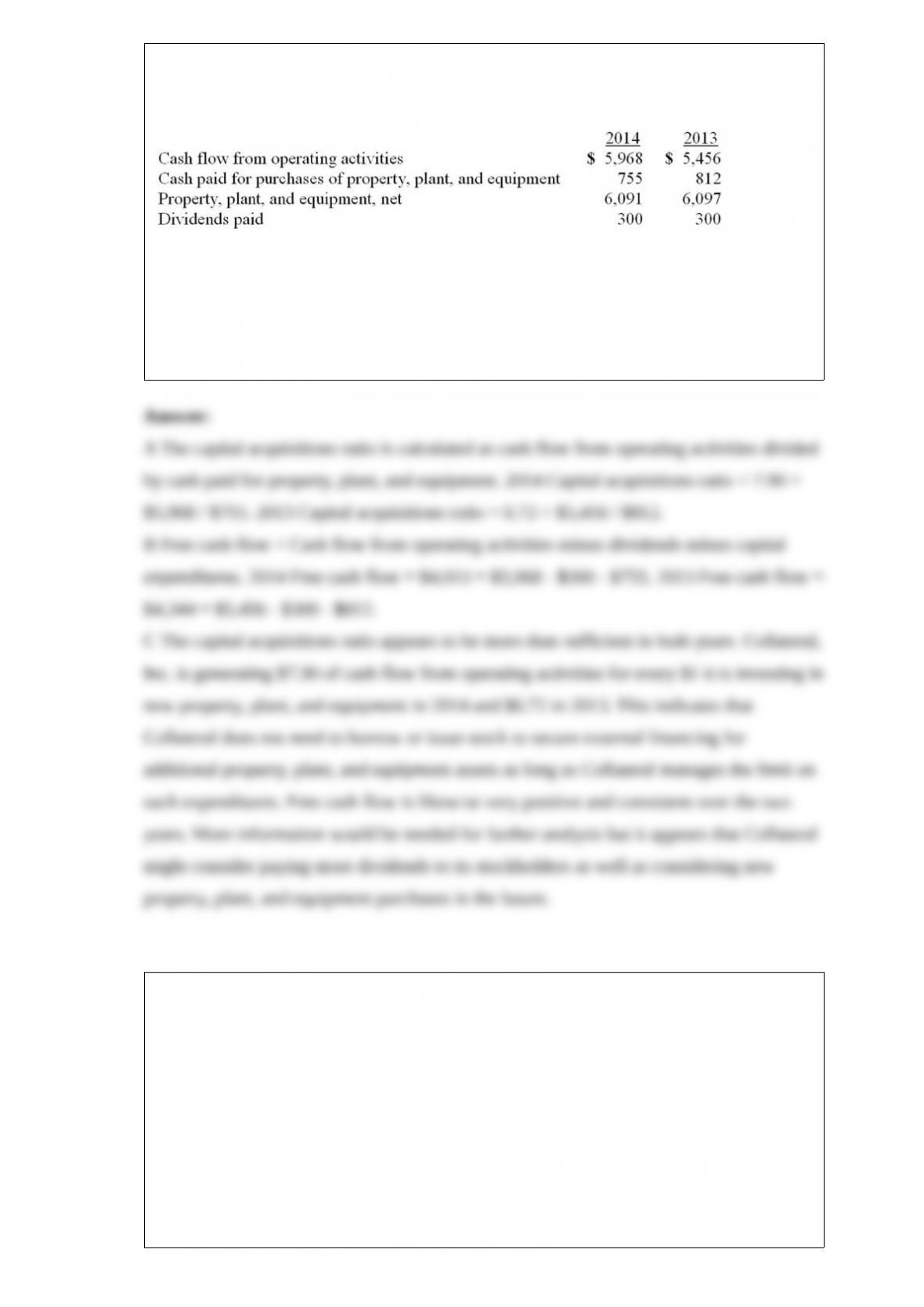
27) The following information was available from the financial statements of Collateral,
Inc. for the years 2014 and 2013 (in millions of dollars):
A Calculate the capital acquisitions ratio for each of the two years. Round your answers
to two decimal places.
B Calculate the free cash flow for each of the two years.
C Comment on the sufficiency of the capital acquisitions ratio and free cash flow for
the two years and implications for future corporate strategy.
28) Determine the effect of the following transactions on the financial statement
components identified. Code your answers as follows:
A: If the transaction results in an increase in the financial statement component.
B: If the transaction results in a decrease in the financial statement component.
C. If the transaction does not affect the financial statement component.
Transaction 1: The adjusting entry to record bad debt expense was made.
Gross profit_____
Current assets_____
Stockholders’ equity_____
Transaction 2: An account receivable was collected for which the customer took
advantage of a 2% discount and remitted the payment less the discount.
Net sales_____
Gross Profit_____
Current assets_____
29) Donald Corporation purchased 3,000 shares of the outstanding common voting
stock of Apprentice Corporation on January 2, 2014, for $80 per share. At the date of
purchase Apprentice Corporation had outstanding 10,000 shares of common stock with
a par value of $50 per share. During 2014, Apprentice reported net income of $60,000
and declared and paid a $5,000 cash dividend. The December 31, 2014, fair value of
Apprentice’s stock was $84.