
1) a contingency can be accrued when
a.it is certain that funds are available to settle the disputed amount
b.an asset may have been impaired
c.the amount of the loss can be reasonably estimated and it is probable that an asset has
been impaired or a liability incurred
d.it is probable that an asset has been impaired or a liability incurred even though the
amount of the loss cannot be reasonably estimated
2) ag inc. made a $15,000 sale on account with the following terms: 1/15, n/30. if the
company uses the gross method to record sales made on credit, what is/are the debit(s)
in the journal entry to record the sale?
a.debit accounts receivable for $14,850
b.debit accounts receivable for $14,850 and sales discounts for $150
c.debit accounts receivable for $15,000
d.debit accounts receivable for $15,000 and sales discounts for $150
3) depletion expense
a.is usually part of cost of goods sold
b.includes tangible equipment costs in the depletion base
c.excludes intangible development costs from the depletion base
d.excludes restoration costs from the depletion base
4) on september 19, 2012, mccoy co. purchased machinery for $285,000. salvage value
was estimated to be $15,000. the machinery will be depreciated over eight years using
the sum-of-the-years’-digits method. if depreciation is computed on the basis of the
nearest full month, mccoy should record depreciation expense for 2013 on this
machinery of
a.$61,354
b.$58,267
c.$58,125
d.$52,500
5) a debt security is transferred from one category to another. generally acceptable

accounting principles require that for this particular reclassification (1) the security be
transferred at fair value at the date of transfer, and (2) the unrealized gain or loss at the
date of transfer currently carried as a separate component of stockholders’ equity be
amortized over the remaining life of the security. what type of transfer is being
described?
a.transfer from trading to available-for-sale
b.transfer from available-for-sale to trading
c.transfer from held-to-maturity to available-for-sale
d.transfer from available-for-sale to held-to-maturity
6) ortiz corporation, a manufacturer of household paints, is preparing annual financial
statements at december 31, 2012. because of a recently proven health hazard in one of
its paints, the government has clearly indicated its intention of having ortiz recall all
cans of this paint sold in the last six months. the management of ortiz estimates that this
recall would cost $800,000. what accounting recognition, if any, should be accorded
this situation?
a.no recognition
b.note disclosure only
c.operating expense of $800,000 and liability of $800,000
d.appropriation of retained earnings of $800,000
7) marsh co. had 2,400,000 shares of common stock outstanding on january 1 and
december 31, 2013. in connection with the acquisition of a subsidiary company in june
2012, marsh is required to issue 100,000 additional shares of its common stock on july
1, 2014, to the former owners of the subsidiary. marsh paid $300,000 in preferred stock
dividends in 2013, and reported net income of $5,100,000 for the year. marsh’s diluted
earnings per share for 2013 should be
a.$2.13
b.$2.04
c.$2.00
d.$1.92
8) for calendar year 2012, kane corp. reported depreciation of $1,200,000 in its income
statement. on its 2012 income tax return, kane reported depreciation of $1,800,000.
kane’s income statement also included $225,000 accrued warranty expense that will be
deducted for tax purposes when paid. kane’s enacted tax rates are 30% for 2012 and
2013, and 24% for 2014 and 2015. the depreciation difference and warranty expense
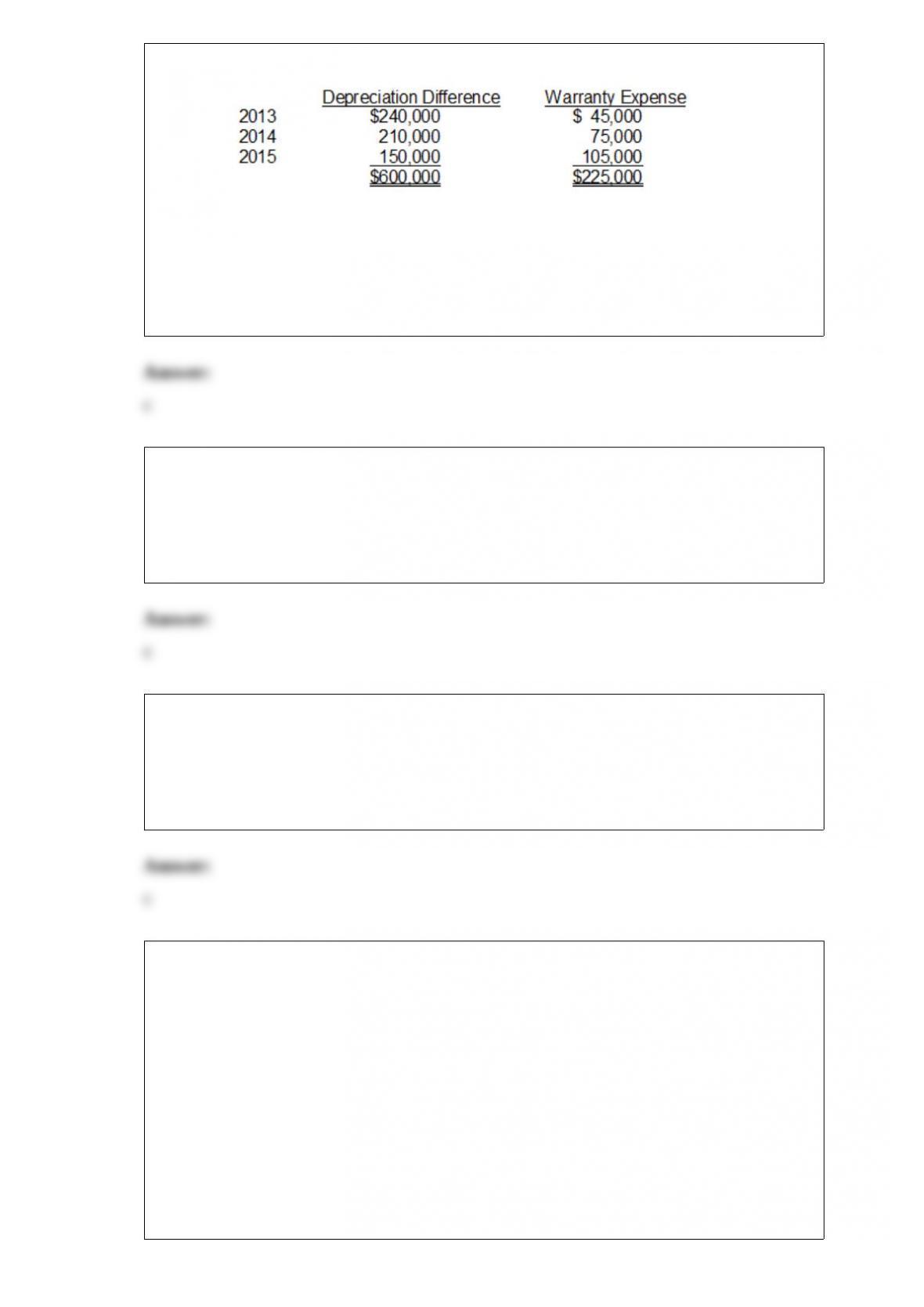
will reverse over the next three years as follows:
these were kane’s only temporary differences. in kane’s 2012 income statement, the
deferred portion of its provision for income taxes should be
a.$200,700
b.$112,500
c.$101,700
d.$109,800
9) which of the following taxes does not represent a common payroll deduction?
a.federal income taxes
b.fica taxes
c.state unemployment taxes
d.state income taxes
10) companies use intraperiod tax allocation for all of the following items except
a.discontinued operations
b.extraordinary items
c.changes in accounting estimates
d.income from continuing operations
11) on january 1, 2012, crown company sold property to leary company. there was no
established exchange price for the property, and leary gave crown a $3,000,000
zero-interest-bearing note payable in 5 equal annual installments of $600,000, with the
first payment due december 31, 2012. the prevailing rate of interest for a note of this
type is 9%. the present value of the note at 9% was $2,163,000 at january 1, 2012. what
should be the balance of the discount on notes payable account on the books of leary at
december 31, 2012 after adjusting entries are made, assuming that the effective-interest
method is used?
a.$0
b.$642,330
c.$669,600
d.$837,000