
The presence of the independent auditors and their review of a company’s internal
controls
A.encourages collusion.
B.encourages consolidation of duties and responsibilities.
C.helps to prevent fraud.
D.totally prevent fraud.
The minimum desired ROI rate
A.is based on industry averages.
B.is based on a division’s operating characteristics.
C.is equal to the company’s cost of funds.
D.is set by generally accepted accounting principles.
Which of the following would be a direct cost for a computer manufacturer?
A.cost of utilities in the factory
B.wages of the workers in the keyboard manufacturing department
C.wages of the workers in the repair department
D.factory supervision
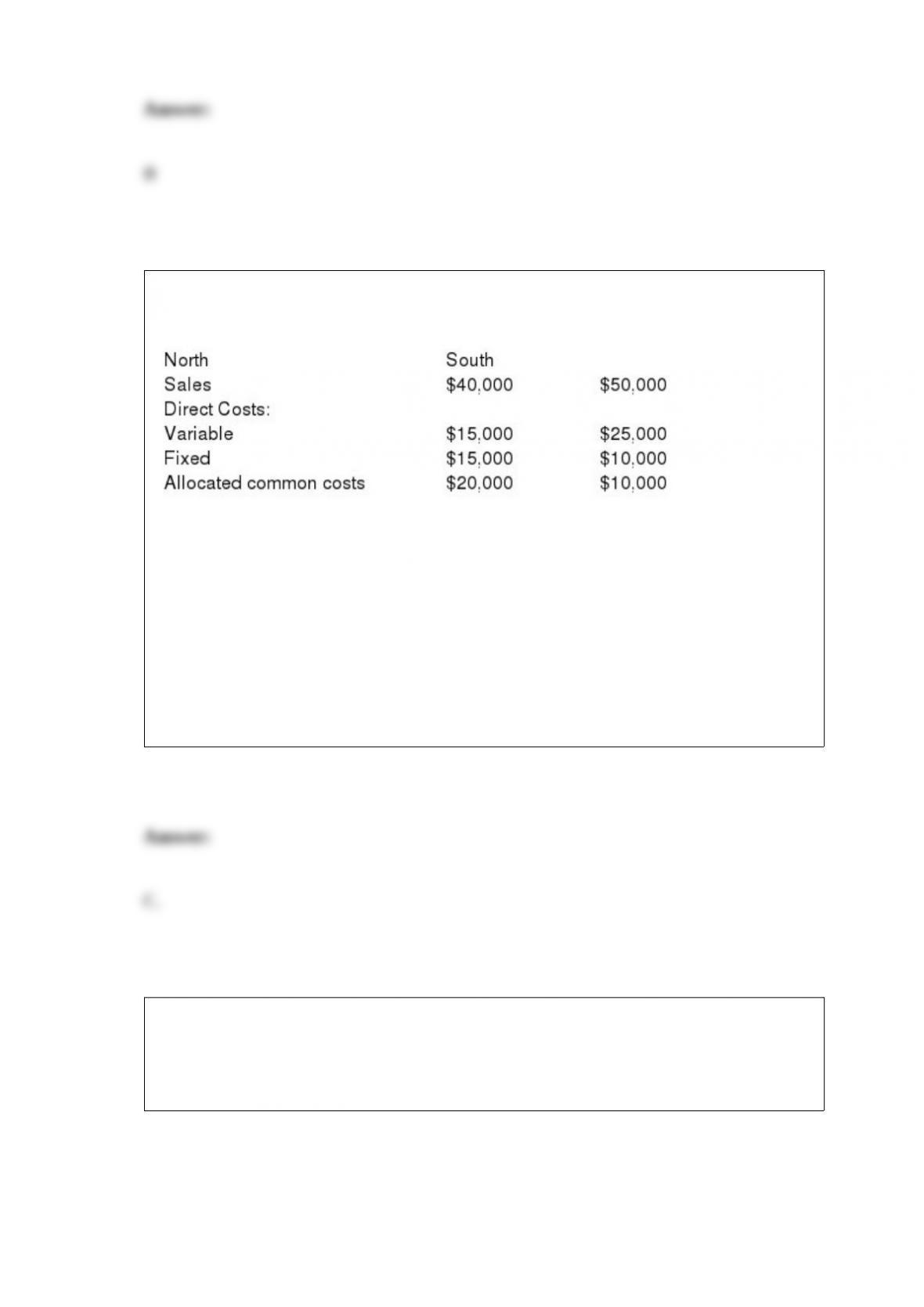
Ben’s Foods has two sales offices: North and South. The company’s records report the
following information
Management is considering dropping the North office. What will happen to operating
income if North is eliminated?
A.Profit of $10,000
B.Profit of $5,000
C.Loss of $15,000
D.Company would be at break-even.
Marshall Manufacturing Co.
Marshall Manufacturing Co. uses an activity-based costing system. The company has
gathered the following information concerning various cost pools and activity drivers;
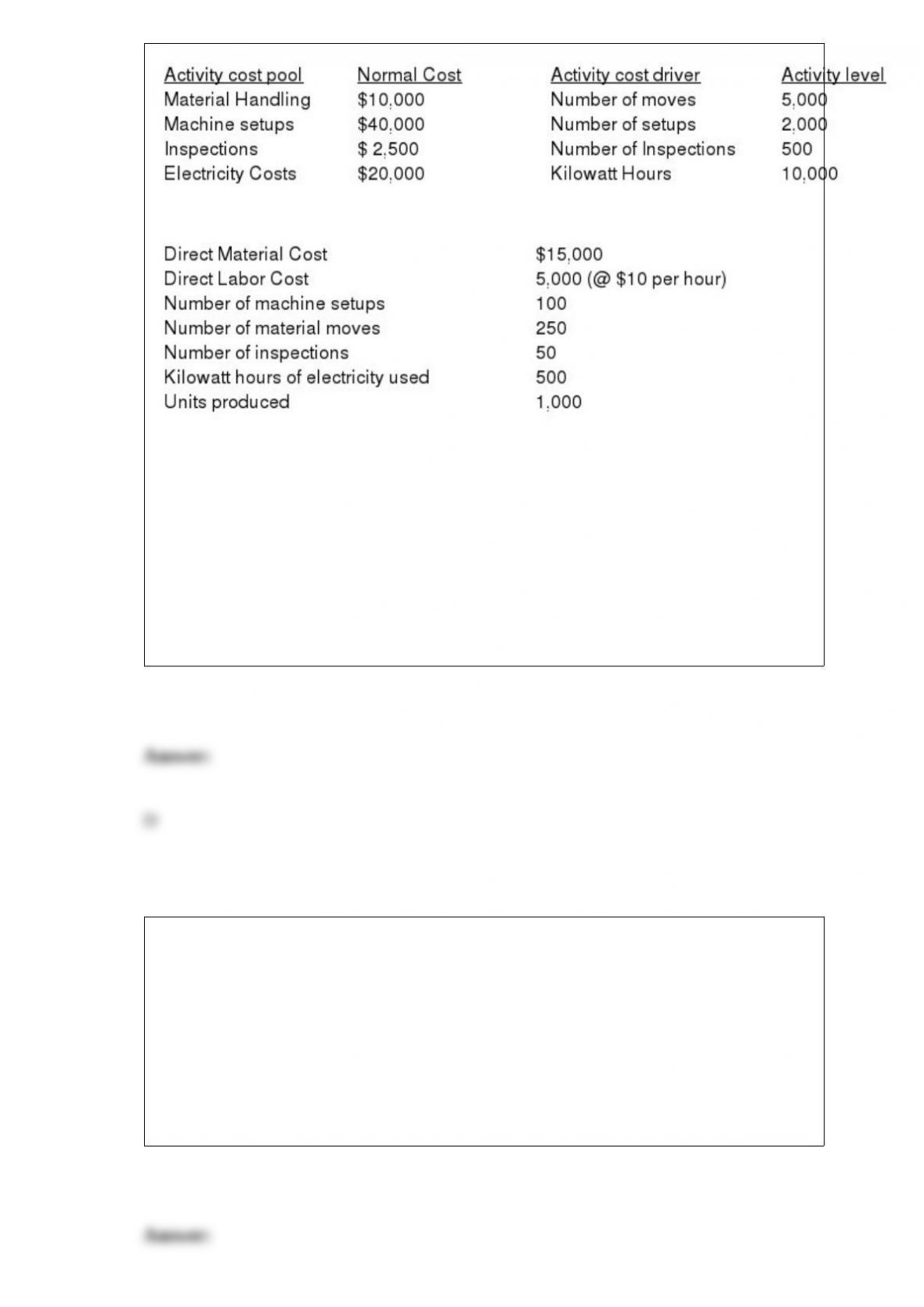
The following data was collected and is specific to Item No. 824.
Refer to Marshall Manufacturing Co. What would be the amount of machine setup cost
allocated to Item No. 824?
A.$40,000
B.$ 8,000
C.$ 2,500
D.$ 2,000
Why is activity-based costing used to allocate service department costs?
A.To improve allocations of production department costs to production departments.
B.To improve allocations of production department costs to service departments.
C.To improve allocations of service department costs to production departments.
D.None of the answers is correct.

Which statement is true concerning long-run decisions?
A.Long-run decisions include pricing a minor product in a minor market.
B.Long-run decisions include pricing a minor product in a major market.
C.Long-run decisions include pricing a main product in a minor market.
D.Long-run decisions include pricing a main product in a major market.
A cost or revenue is _________ if the change results in a difference between
alternatives.
A.relevant
B.differential
C.effective
D.strategic
Quality improvement. Designer Frames makes bicycle frames in two processes, tubing
and welding. The tubing process has a capacity of 40,000 units per year; welding has a
capacity of 75,000 units per year. Cost information follows:
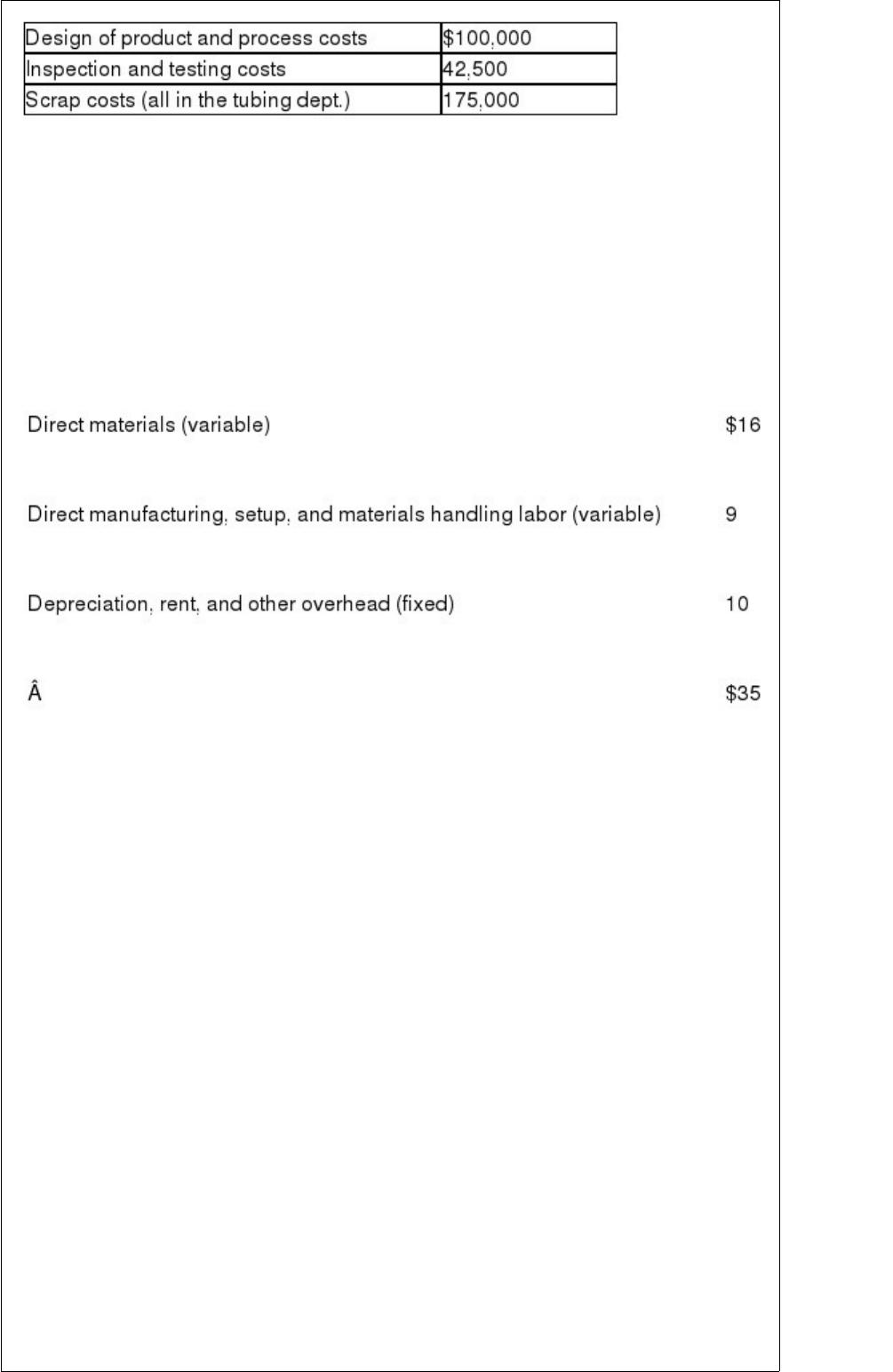
The company enjoys high demand for its products. Designer Frames can sell whatever
output it can produce for the market price of $53 per frame. Designer Frames can start
only 50,000 units into production in the tubing department because of capacity
constraints on the tubing machines. The company scraps all defective units produced in
the tubing department. Of the 40,000 units started in the tubing operation, 4,000 units
(10 percent) are scrapped at the end of the production process. Scrap costs, based on
total (fixed and variable) manufacturing costs incurred in the tubing operation, equal
$35 per unit as follows:
The “$10 fixed cost” is the portion of the total fixed costs of $400,000 allocated to each
unit, whether good or defective. The good units from the tubing department are sent to
the welding department. Variable manufacturing costs in the welding department are
$2.00 per unit. There is no scrap in the welding department. Therefore, Designer
Frames’ total sales quantity equals the tubing department’s output. Designer Frames
incurs no other variable costs. Designer Frames’ designers have discovered that using a
different type of material in the tubing operation would reduce scrap to zero, but it
would increase the variable costs per unit in the tubing department by $2.50. Recall that
only 40,000 units can be
started each year.
Required:
a. What is the additional direct materials cost of implementing the new method?
b. What is the additional benefit to Designer Frames from using the new material and
improving quality?
c. Should Designer Frames use the new materials?
d. What other nonfinancial and qualitative factors should Designer Frames consider in
making the decision?
Often the most interesting and challenging step(s) of activity-based costing (ABC)
which also require(s) the manager to know the product is to
A.identify the activities that consume resources, and assign costs to those activities.
B.identify the cost driver(s) associated with each activity.
C.compute a cost rate per cost driver unit.
D.assign costs to products by multiplying the cost driver rate by the volume of cost
drivers consumed by the product.
Break-even and target profits. Analysis of the operations of Reyes Company shows
the
fixed costs to be $140,000 and the variable costs to be $7 per unit. Selling price is $14
per unit.
Required:
a. Derive the break-even point expressed in units.
b. How many units must the firm sell to earn a profit of $168,000?
c. What would profits be if revenue from sales were $2,100,000?
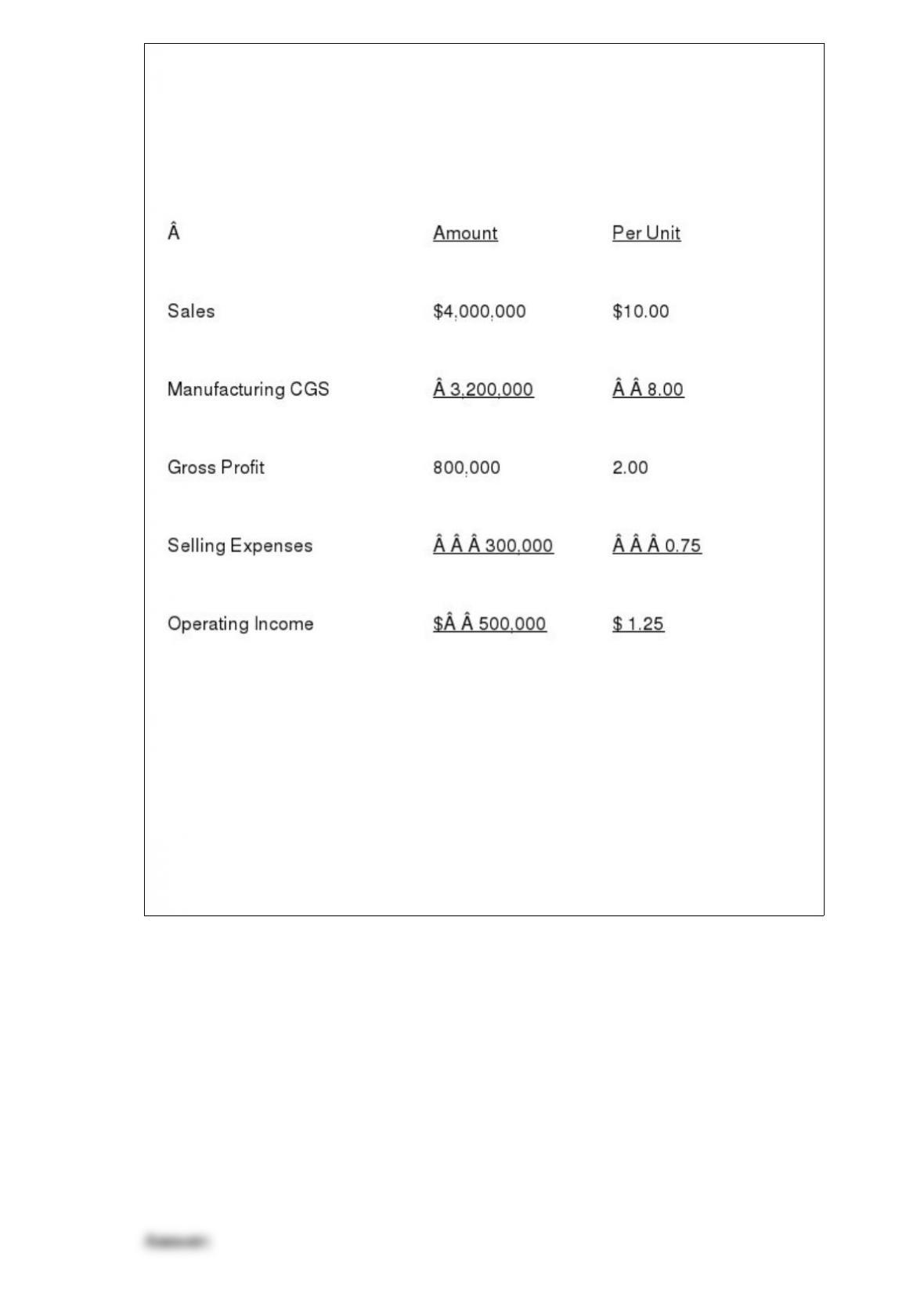
Grizzly Company
Grizzly Company manufactures footballs. The forecasted income statement for the year
before any special orders is as follows:
Refer to Grizzly Company. By what amount would operating income of Grizzly be
increased or decreased as a result of accepting the special order?
A.$25,000 decrease
B.$62,500 decrease
C.$100,000 increase
D.$125,000 increase

Fixed production costs variances are calculated as
A.the difference between actual and budgeted fixed costs.
B.(actual hours x standard inputs) – budgeted fixed costs.
C.(actual hours x standard outputs) – budgeted fixed costs.
D.(actual hours x standard outputs) – actual fixed costs.
In comparison to an activity-based costing system, traditional allocation systems would
most likely distort which of the following costs?
A.product costs.
B.activity costs.
C.department costs.
D.plant costs.
For which one of the following activities is it more difficult to obtain reasonable
measures to allocate the costs?
A.Indirect labor
B.Machine setups
C.Plant administration
D.Quality control inspections
Clear Sailing Lifeboats
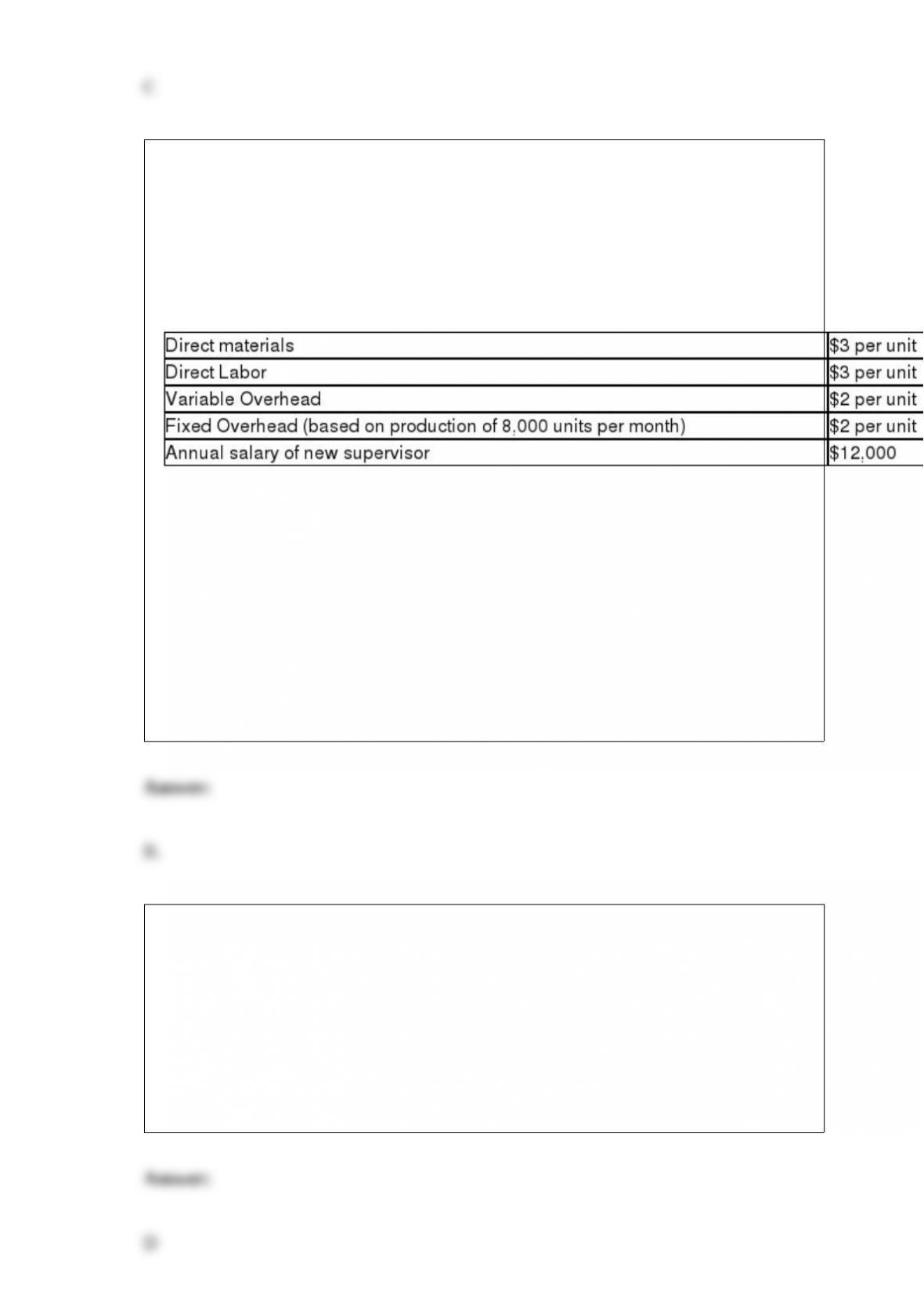
Clear Sailing Lifeboats uses 12,000 units of a certain component in production each
year. Presently, this component is purchased from an outside supplier at $9.50 per unit.
For some time now there has been idle capacity in the factory that could be utilized to
make this component. The costs associated with manufacturing the component
internally rather than buying it from the outside supplier are
Refer to Clear Sailing Lifeboats. If the company chooses to make the component
instead of buying it from an outside supplier, the changes in the company’s net income
per year would be a
A.$6,000 decrease.
B.$6,000 increase.
C.$8,400 decrease.
D.$8,400 increase.
Which of the following is(are) potential causes of defects in cause and effect analysis?
A.human factors.
B.methods and design factors.
C.machine related and materials/components factors.
D.All of the answers are correct.