A company pays $9,000 in interest on notes consisting of $6,000 of interest that was
accrued during the last accounting period and $3,000 of interest that accumulated
during the current accounting period but has not yet been accrued on the books. The
journal entry for the interest payment should include a:
A) debit to Interest Expense for $9,000 and a credit to Cash for $9,000.
B) debit to Cash for $9,000 and a credit to Interest Payable for $9,000.
C) debit to Interest Expense for $3,000, a debit to Interest Payable for $6,000, and a
credit to Cash for $9,000.
D) debit to Interest Payable for $6,000, a debit to Accrued Interest for $3,000, and a
credit to Cash for $9,000.
Which of the following is the equation for cost of goods sold?
A) Beginning inventory + Purchases – Ending inventory
B) Beginning inventory + Purchases + Ending inventory
C) Net purchases – Ending inventory
D) Ending inventory + Purchases – Beginning inventory
A company pays $18,000 in interest on notes, consisting of $12,000 interest that was
accrued during the last accounting period and $6,000 of interest that accumulated
during the current accounting period but has not yet been accrued on the books. The
journal entry for the interest payment should:
A) debit Interest Expense for $18,000 and credit Cash for $18,000.
B) debit Cash for $18,000 and credit Interest Payable for $18,000.
C) debit Interest Expense for $6,000, debit Interest Payable $12,000 and credit Cash for
$18,000.
D) debit Interest Payable for $12,000, debit Accrued Interest $6,000 and credit Cash for
$18,000.
Brighton, Inc. uses the indirect method to determine its net cash flows from operating
activities. During the course of the year, the company’s Accounts Receivable increased
by $10,000 and its Accounts Payable decreased by $5,000. If these are the only two
adjustments required to convert net income to net cash provided by operating activities,
the combined effect will be a(n):
A) subtraction of $5,000.
B) addition of $5,000.
C) addition of $15,000.
D) subtraction of $15,000.
The adjusting entry to record the estimated bad debts in the period credit sales occur
includes a debit to an:
A) asset account and a credit to a liability account.
B) expense account and a credit to an asset account.
C) expense account and a credit to a revenue account.
D) expense account and a credit to a contra-asset account.
Which of the following is a liquidity ratio?
A) Inventory turnover
B) Price/Earnings ratio
C) Net profit margin
D) Times interest earned
If you wish to examine how one aspect of a business is doing relative to other aspects of
the business at the current time, you are most likely to use:
A) time-series analysis.
B) ratio analysis.
C) horizontal analysis.
D cross-sectional analysis.
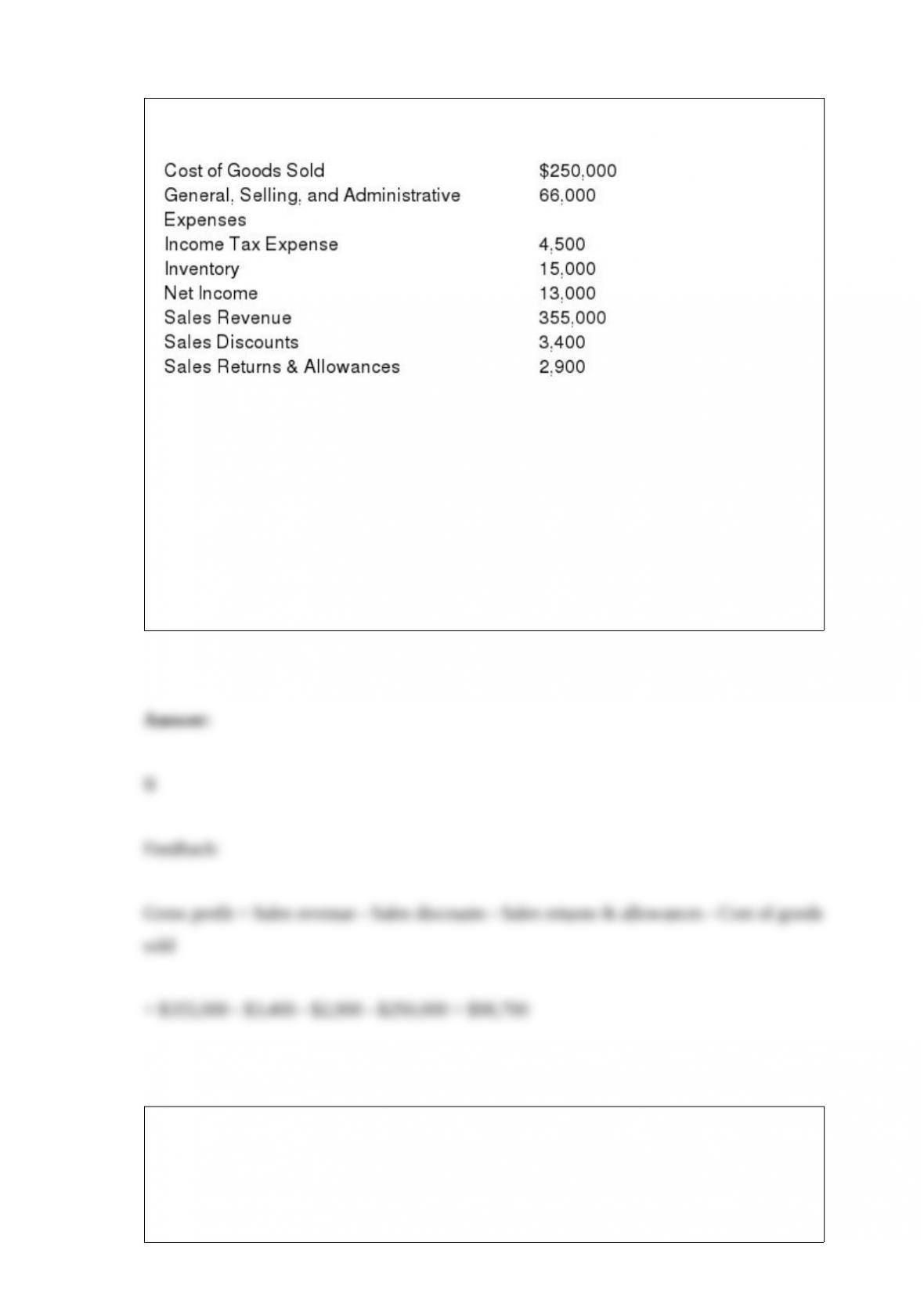
A company reported the following:
Use the above information to answer the following question. What is the amount of
gross profit?
A) $94,200
B) $98,700
C) $105,000
D) $32,700
Which of the following statements about net profit margin is not correct?
A) If a company’s net profit margin increases from 15% to 20% this would be
considered an improvement in profitability.
B) A company with a net profit margin of 10% is using 90% of each dollar of revenue
to cover costs and expenses.
C) Net profit margin indicates how much net income is earned for every dollar of
revenue.
D) A company with a net profit margin of 10% may be evaluated differently depending
upon which industry it is in.
A trial balance:
A) ensures that all journal entries have been posted.
B) is a way to check that no mistakes have been made during the accounting cycle.
C) is a report for internal use only.
D) is a way to check that all journal entries have been posted and that no mistakes have
been made during the accounting cycle.
Which of the following actions would be considered unethical?
A) A company does not distribute any of its profits to stockholders.
B) A company rounds the revenues and expenses that it reports on the income
statement.
C) An unintentional mistake made by a new accountant.
D) Receiving a paycheck for double the amount due to you and not reporting it to your
employer.