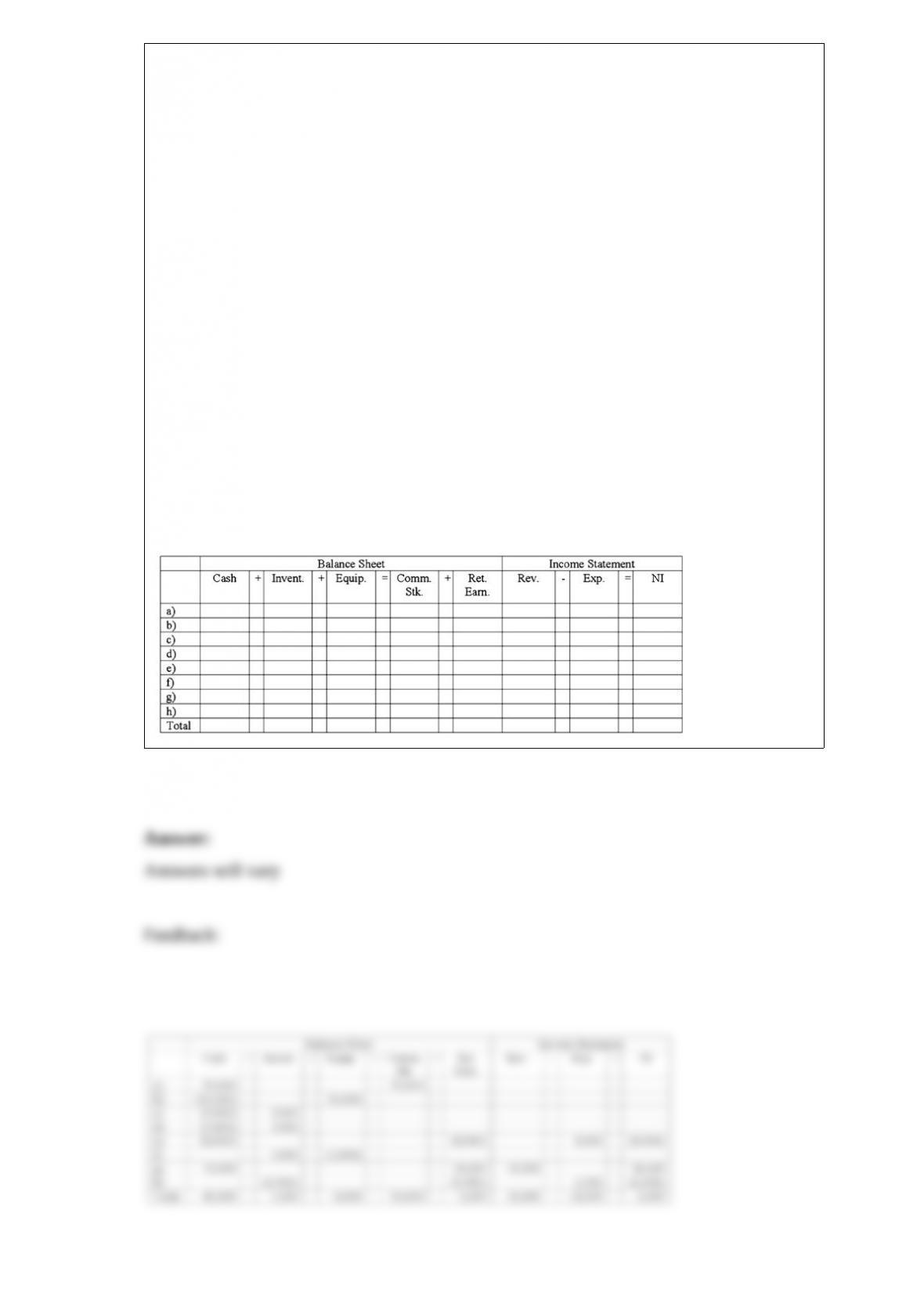
The Szakos Company engaged in the following transactions during 2013:
a) Acquired $50,000 of cash by issuing common stock to owners
b) Paid $10,000 to acquire manufacturing equipment
c) Paid $5,000 cash for materials used in production
d) Paid $2,000 for wages of production workers
e) Paid $8,000 in general, selling, and administrative costs
f) Recognized $1,000 of depreciation on the manufacturing equipment
g) Sold inventory for $18,000 cash
h) The cost of the inventory sold was $6,500
Required:
Show the balance sheet and income statement effects of the transactions by completing
the financial statement model provided.
Budgeting that involves the development of a master budget to direct the firm’s
activities over the short-term is referred to as:
A. capital budgeting.
B. operations budgeting.
C. strategic planning.
D. None of these.
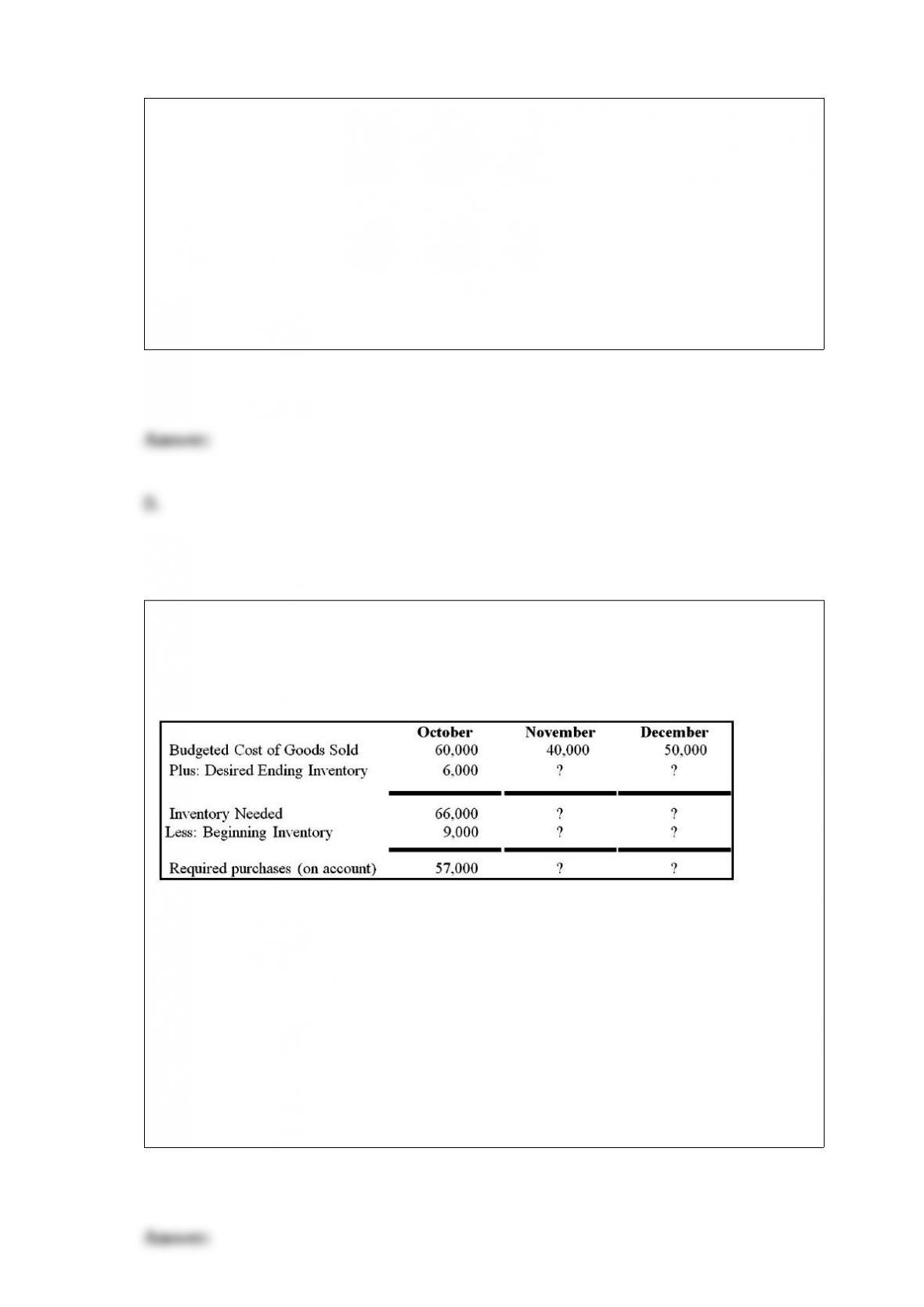
Sentra Sporting Company sells tennis rackets and other sporting equipment. The
purchasing department manager prepared the inventory purchases budget. Sentra’s
policy is to maintain an ending inventory balance equal to 15% of the following
month’s cost of goods sold. January’s budgeted cost of goods sold is $70,000.
What is the amount of cost of goods sold the company will report on its fourth quarter
pro forma income statement?
A. $100,000
B. $50,000
C. $150,000
D. $162,300

Select the incorrect statement.
A. If both the flexible budget and actual results are based on the actual volume of
activity, the flexible budget sales variance will be attributable to sales price, not sales
volume.
B. Budget slack is the difference between deflated and realistic standards.
C. Gamesmanship is decreased if superiors and subordinates participate sincerely in
setting mutually agreeable, attainable standards.
D. For performance evaluation, management should compare actual results to a flexible
budget based on the actual volume of activity.
Managerial accounting information is limited or restricted by which of the following
authorities or principles?
A. Securities and Exchange Commission
B. Generally Accepted Accounting Principles
C. Managerial Accounting Standards Board
D. Value-Added Principle
Alvarez Company makes three joint products, products A, B, and C. For each batch, the
materials cost is $16,000, direct labor cost is $4,000, and manufacturing overhead is
$10,000. From each batch, the company makes 2,000 pounds of A, 1,200 pounds of B,
and 800 pounds of C.
Required:
1) What are the total joint costs for each batch of the products?
2) Allocate the joint costs to each of the three products.
3) Determine the cost per pound for product A.
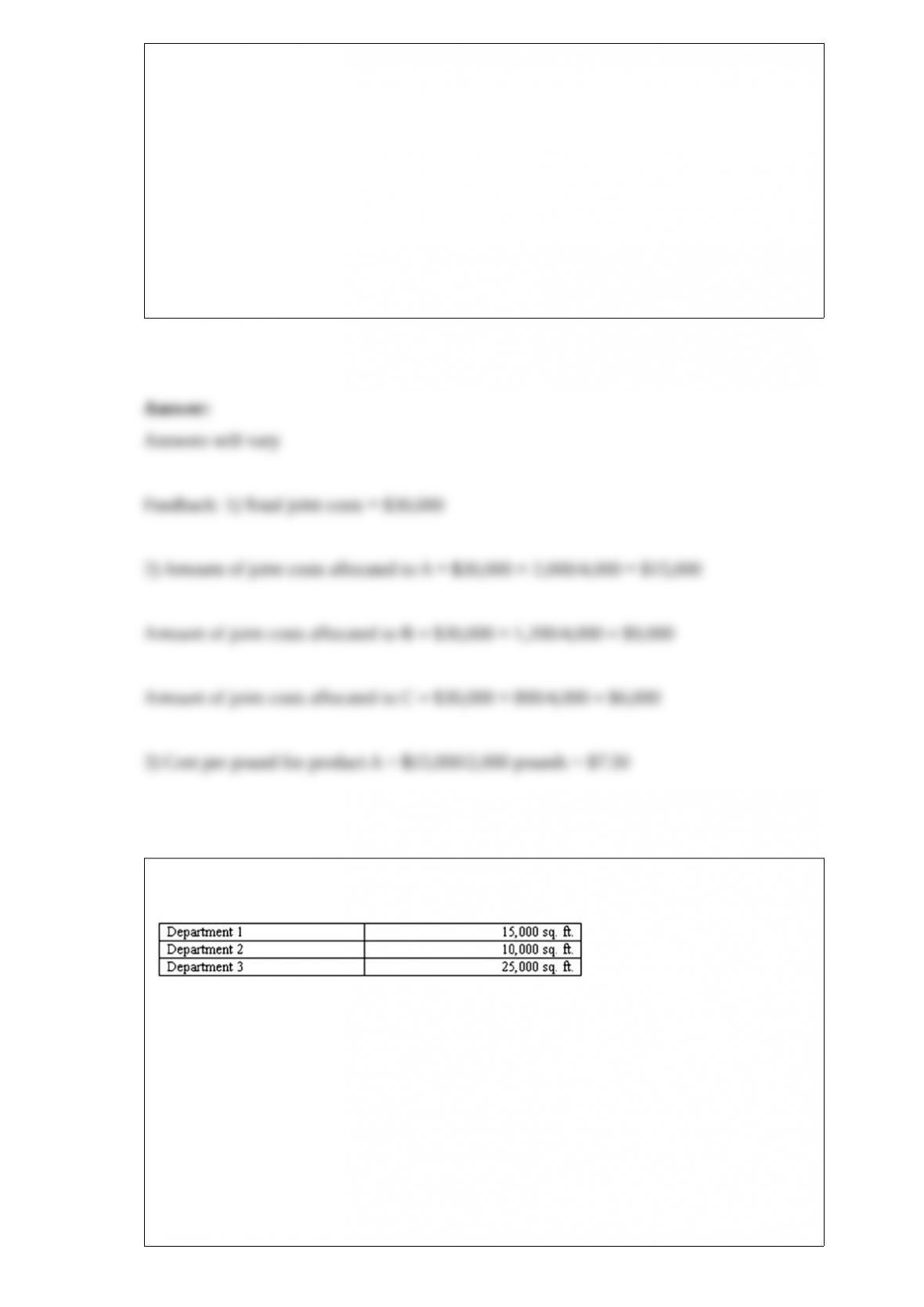
Marsden Company has three departments occupying the following amount of floor
space:
How much store rent should be allocated to Department 3 if total rent is equal to
$200,000? (Do not round your intermediate calculations.)
A. $100,000
B. $50,000
C. $66,667
D. None of these answers is correct.
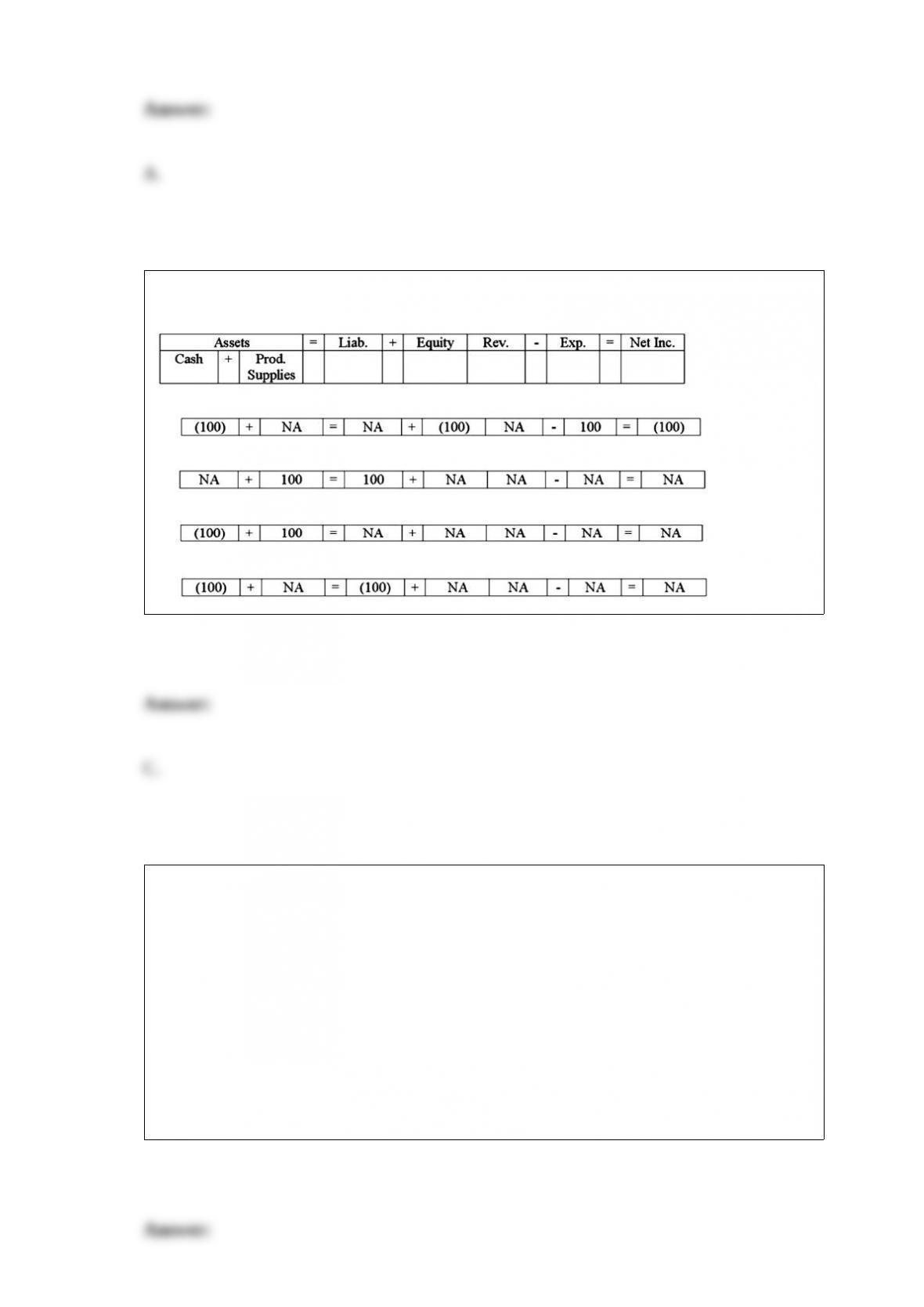
Orlando Company paid $100 cash to purchase production supplies. How does this
transaction affect the financial statements?
A.
B.
C.
D.
Jiminez Company paid its annual property tax of $6,000 on its manufacturing facility in
January. The company expects to make 4,000 units of product during the year. During
January, 300 units of product were produced. Based on this information:
A. $450 of the property tax cost should be allocated to the January production.
B. $1,500 of the property tax cost should be allocated to the January production.
C. $6,000 of the property tax cost should be assigned to the January production.
D. $500 of the property tax cost should be allocated to the January production.

Which range of difficulty should normally be used to develop standards?
A. Practical standards
B. Lax standards
C. Ideal standards
D. Inflated standards
Which of the following would be classified as a batch level activity?
A. Depreciation on production equipment
B. Inspection of a product, where each unit must be individually inspected
C. Changing machine configuration before starting a production run
D. Sales commissions
During its first year of operations, Silverman Company paid $14,000 for direct
materials and $19,000 for production workers’ wages. Lease payments and utilities on
the production facilities amounted to $17,000 while general, selling, and administrative
expenses totaled $8,000. The company produced 5,000 units and sold 3,000 units at a
price of $15.00 a unit.
What is the amount of gross margin for the first year?
A. $15,000
B. $24,000
C. $20,000
D. $45,000
Which costs are relevant for equipment replacement decisions?
A. Unit-level costs
B. Batch-level costs
C. Product-level costs
D. All of these.
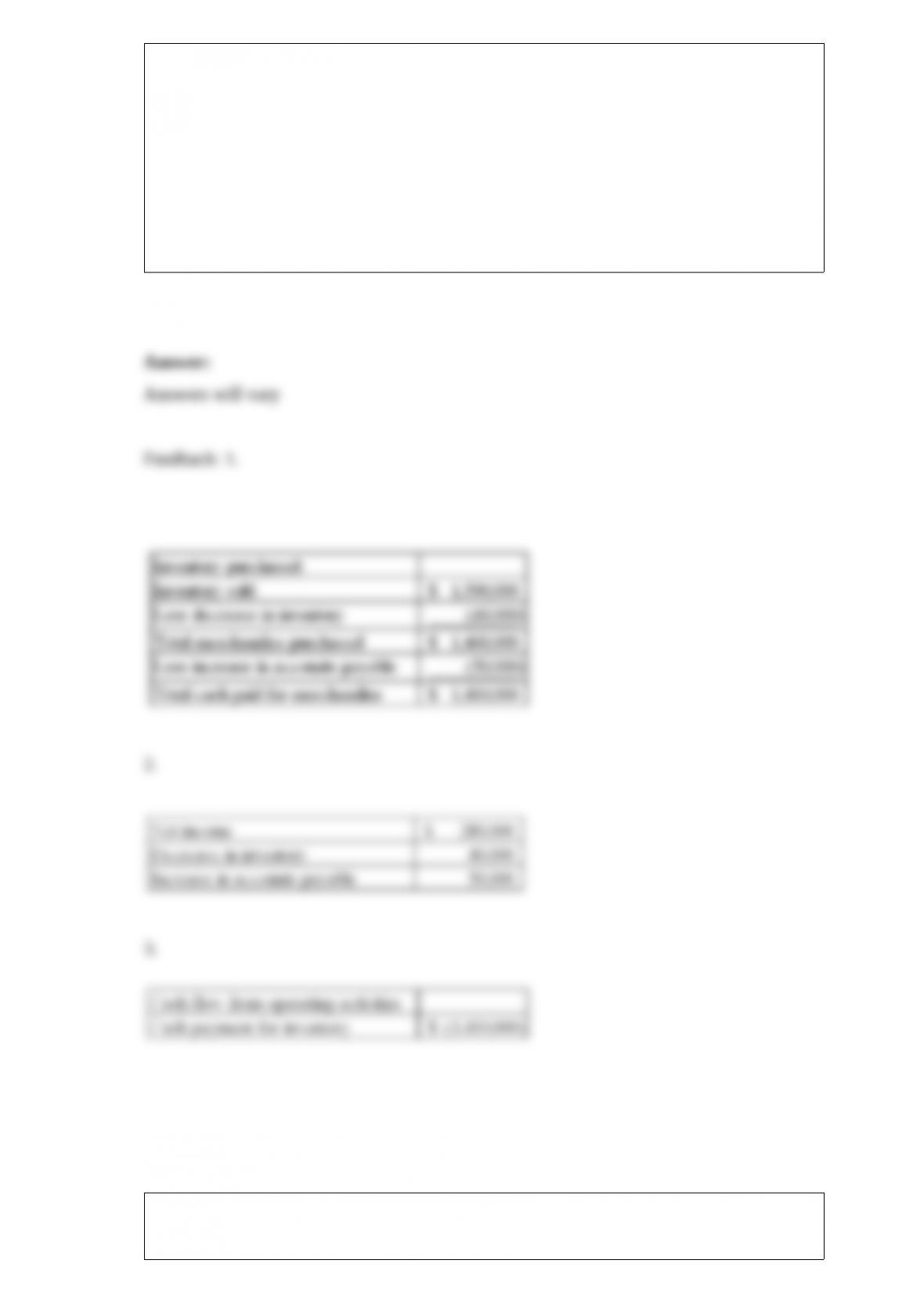
The following information is available for Kent Company for 2014.
Required:
1) What amount of cash was paid for the purchase of merchandise?
2) How will the above items be shown on the statement of cash flows using the indirect
method?
3) How will the amount computed in 1) be shown on the statement of cash flows using
the direct method?
Company A makes and sells a single product, unless otherwise indicated. For each of
the following changes, indicate whether the break-even point increases (i.e., break even
would occur at a higher volume of sales), decreases, is not affected, or the direction of
change cannot be determined from the information given. Assume that nothing changes
except the given item(s).
What happens to break-even volume when the variable cost per unit and selling price
both decrease by the same amount?
Why is a company’s selection of cost allocation methods important to individual
managers?
Larimore Company sales are $560,000. The company has variable costs equal to 40%
of sales and total fixed costs of $150,000.
Required:
1) What is the company’s break-even point in sales dollars?
2) Compute the company’s operating leverage at its current sales level.
3) Compute the percentage change in income that will accompany a 10% increase in
sales.
4) Compute the company’s net income and operating leverage (rounded to one decimal
place) if sales increase by 10%.
5) Describe the effect on operating leverage as a company’s sales increase and it moves
further beyond its break-even point.
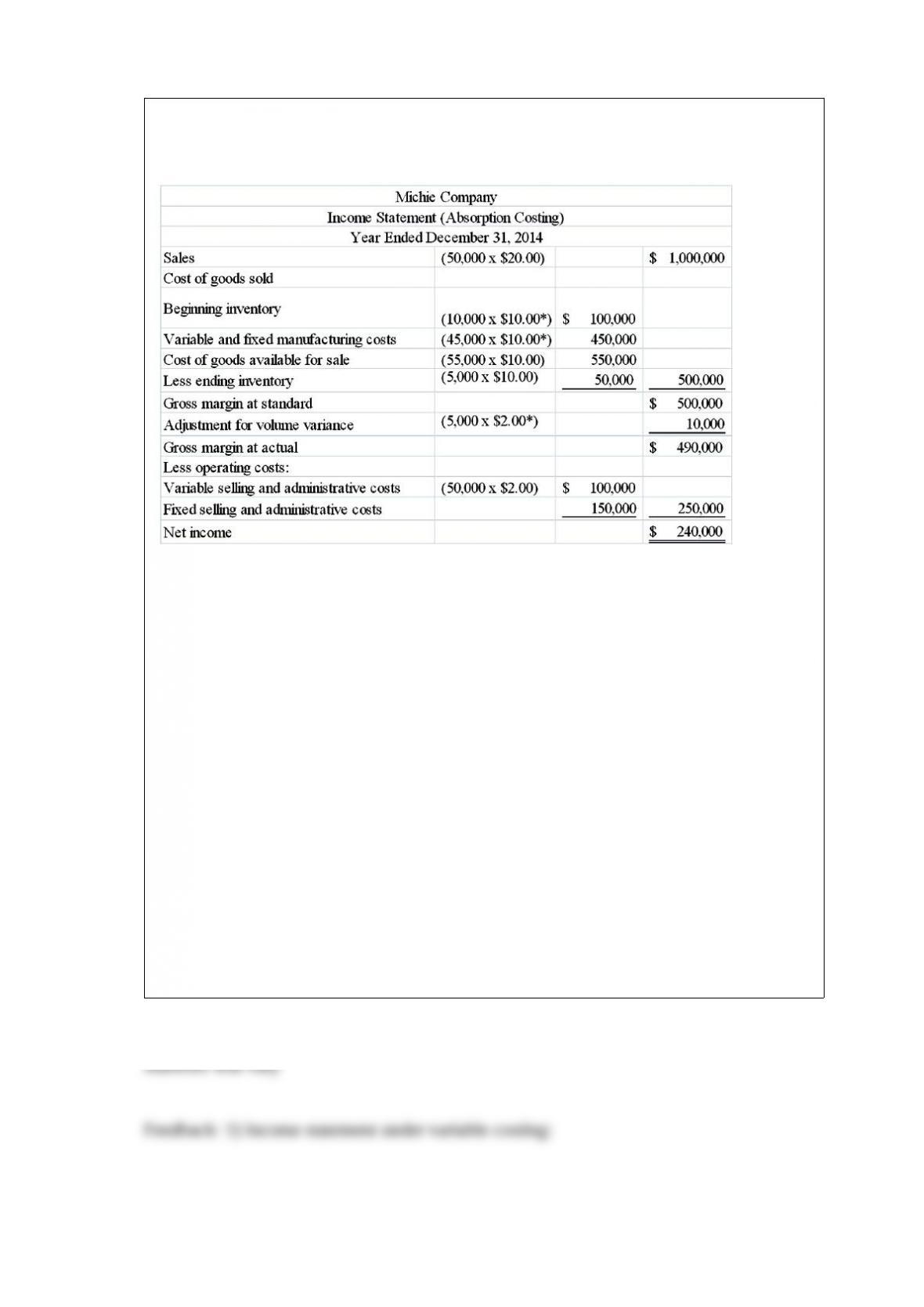
Michie Company’s management accountant prepared the following income statement
using the absorption costing format:
Breakeven point under absorption costing 20,000 units.
* Variable manufacturing costs of $8.00 plus fixed manufacturing costs of $2.00.
** The $2.00 fixed manufacturing cost per unit is based on budgeted production of
50,000 units.
Since actual production was only 45,000, an unfavorable volume variance of $10,000
occurred.
The company uses a standard costing system. The only variance that occurred during
the period was the $10,000 unfavorable volume variance.
Required:
1) Prepare an income statement for Michie Company under variable costing.
2) Compute the breakeven point in units (total fixed costs/unit contribution margin)
under variable costing.
Why would a company need to estimate the fixed and variable components of a mixed
cost?
Maynard Manufacturing Company uses a job order cost system in its two departments,
Machining and Assembly. Overhead is allocated in the Machining Department on the
basis of machine hours, while in the Assembly Department overhead is allocated on the
basis of direct labor cost. The following budget data are provided:
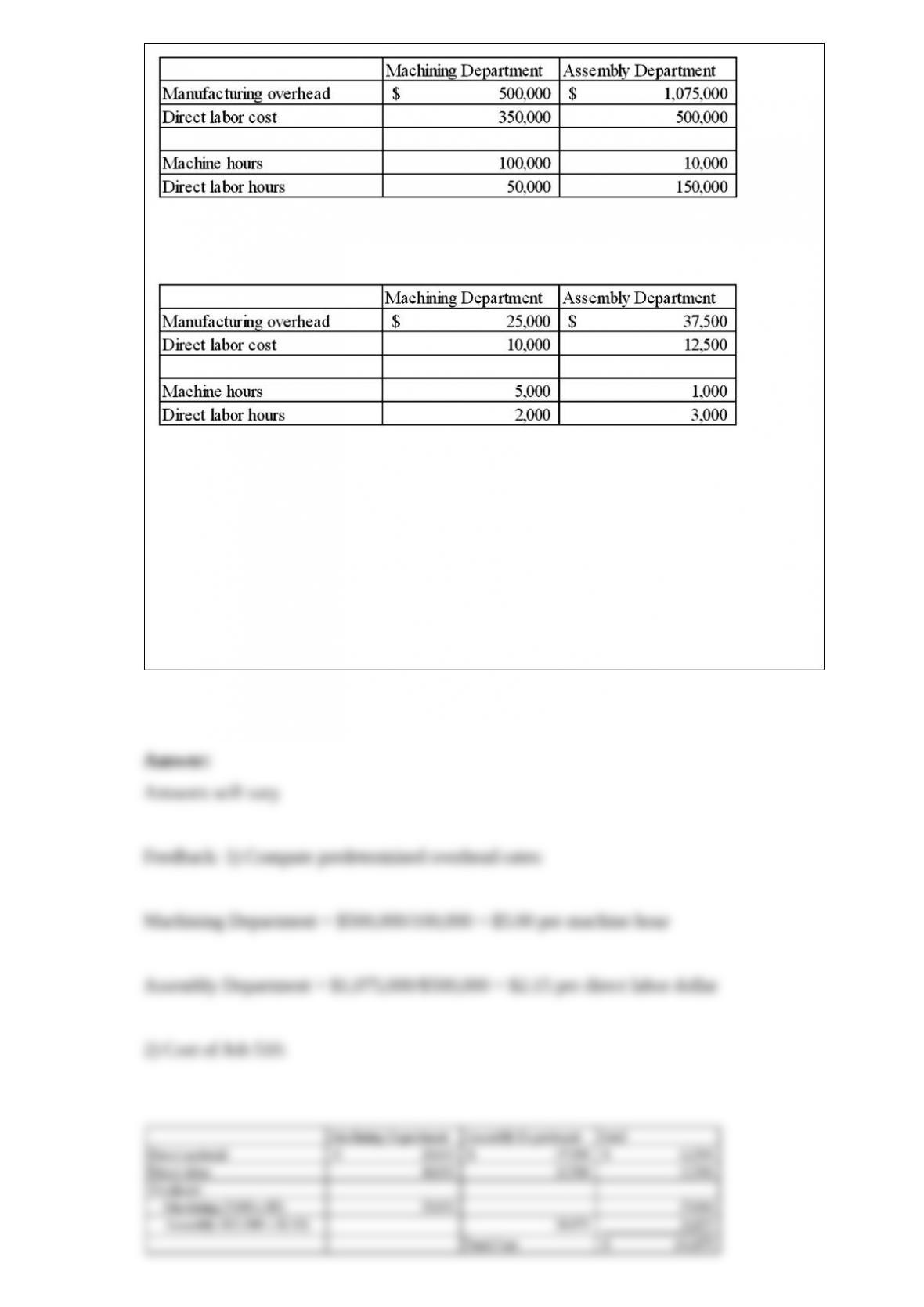
The following information is provided for a job (Job No. 510) recently completed by
the company:
Required:
1) Compute the two departmental overhead rates.
2) Compute the cost of Job No. 510.
3) Assume that the company decides to use a single overhead rate for the two
departments, calculated by adding their overhead costs and using direct labor hours as
the allocation base. What would the overhead rate be, and how much manufacturing
overhead cost would be assigned to Job No. 510?