1) When discounted cash flow methods of capital budgeting are used, the working
capital required for a project is ordinarily counted as a cash inflow at the beginning of
the project and as a cash outflow at the end of the project.
2) Preference decisions follow screening decisions and seek to rank investment
proposals in order of their desirability.
3) If the unit sales for one product are more sensitive to price increases than another
product, then its markup over variable cost should be less than for the other product if
the company wants to maximize profit.
4) A common-size financial statement is a vertical analysis in which each financial
statement account is expressed as a percentage.
5) Fixed costs may or may not be relevant in decisions about whether a product should
be dropped.
6) Organization-sustaining overhead costs should be allocated to products just like
unit-level and product-level activities.
7) Under variable costing, product costs consist of direct materials, direct labor, and
variable manufacturing overhead.
8) The basic idea underlying responsibility accounting is that each manager should be
held responsible for the overall profit of the company to ensure that all managers are
acting together.
9) Under conventional absorption costing, the fixed costs associated with idle
production capacity are not included as part of the product cost.
10) The company’s return on equity for Year 2 is closest to:
A.3.02%
B.3.77%
C.2.11%
D.79.14%
Return on equity = Net income Average stockholders’ equity*
= $25,100 $1,188,500 = 2.11% (rounded)
*Average stockholders’ equity = ($1,197,000 + $1,180,000) 2 = $1,188,500
Kearin Corporation has provided the following financial data:
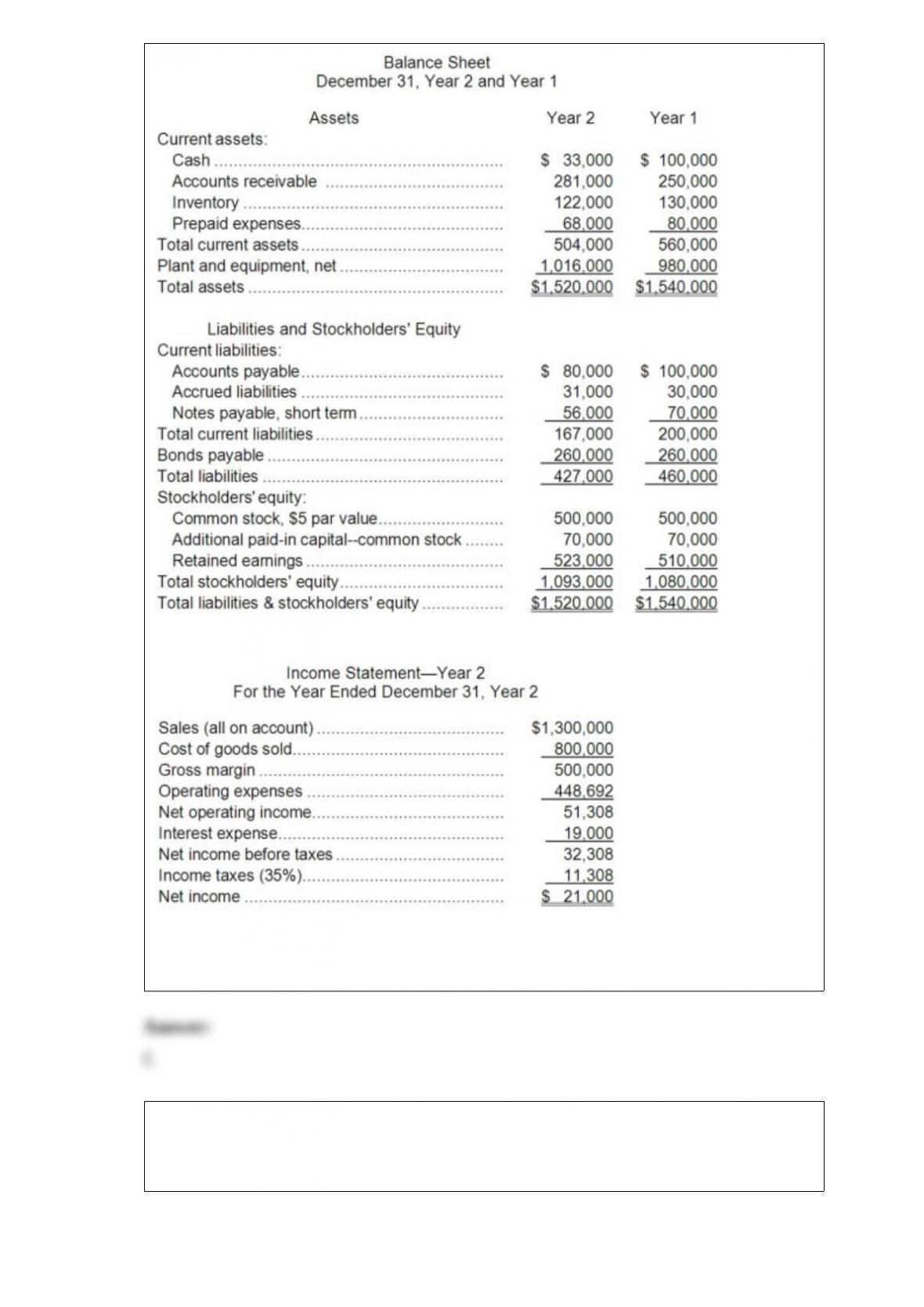
Dividends on common stock during Year 2 totaled $8,000. The market price of common
stock at the end of Year 2 was $2.02 per share.
11) Bard Hotel bases its budgets on guest-days. The hotel’s static budget for January
appears below:
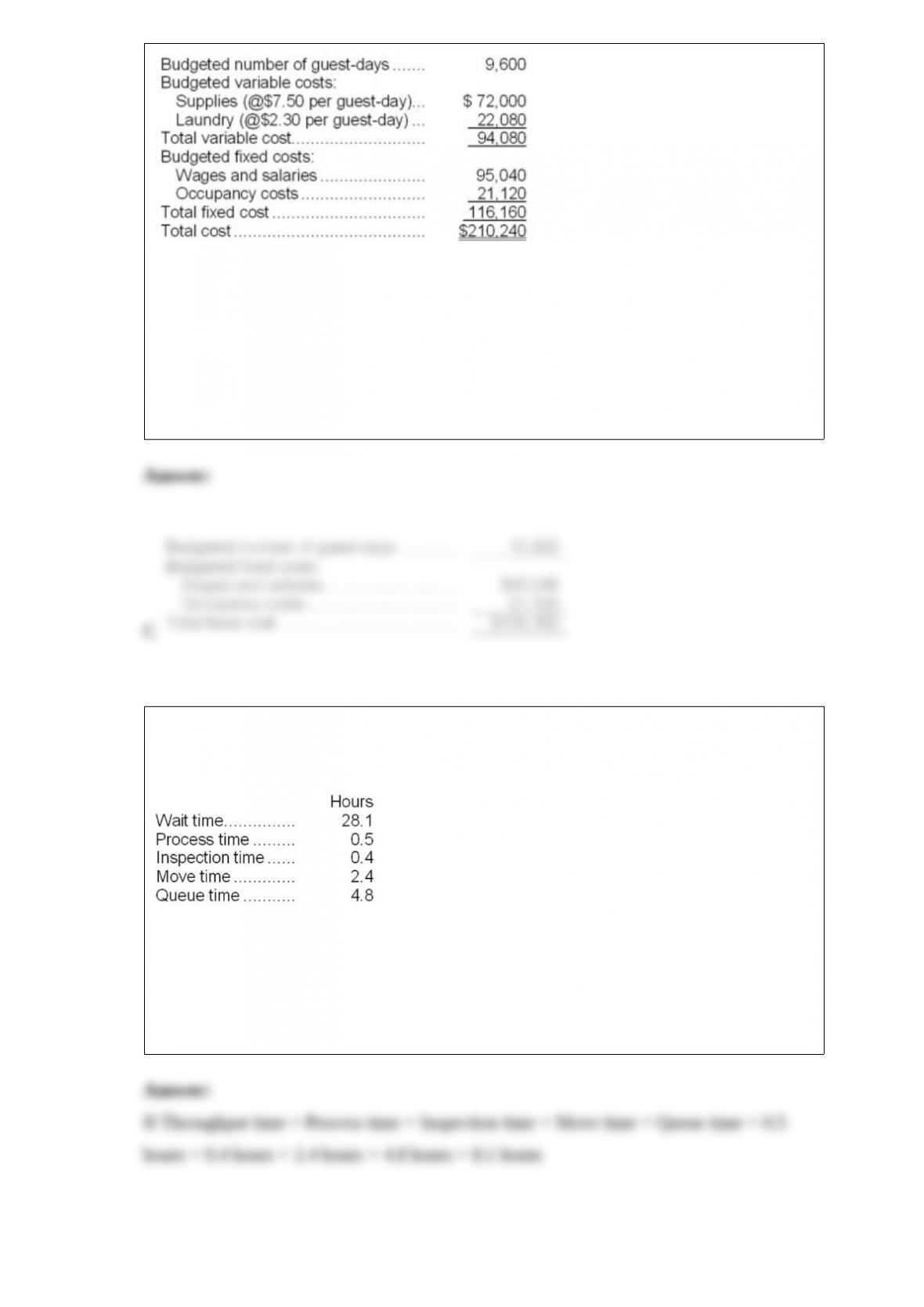
The total fixed cost at the activity level of 10,600 guest-days per month should be:
A.$210,240
B.$232,140
C.$116,160
D.$128,260
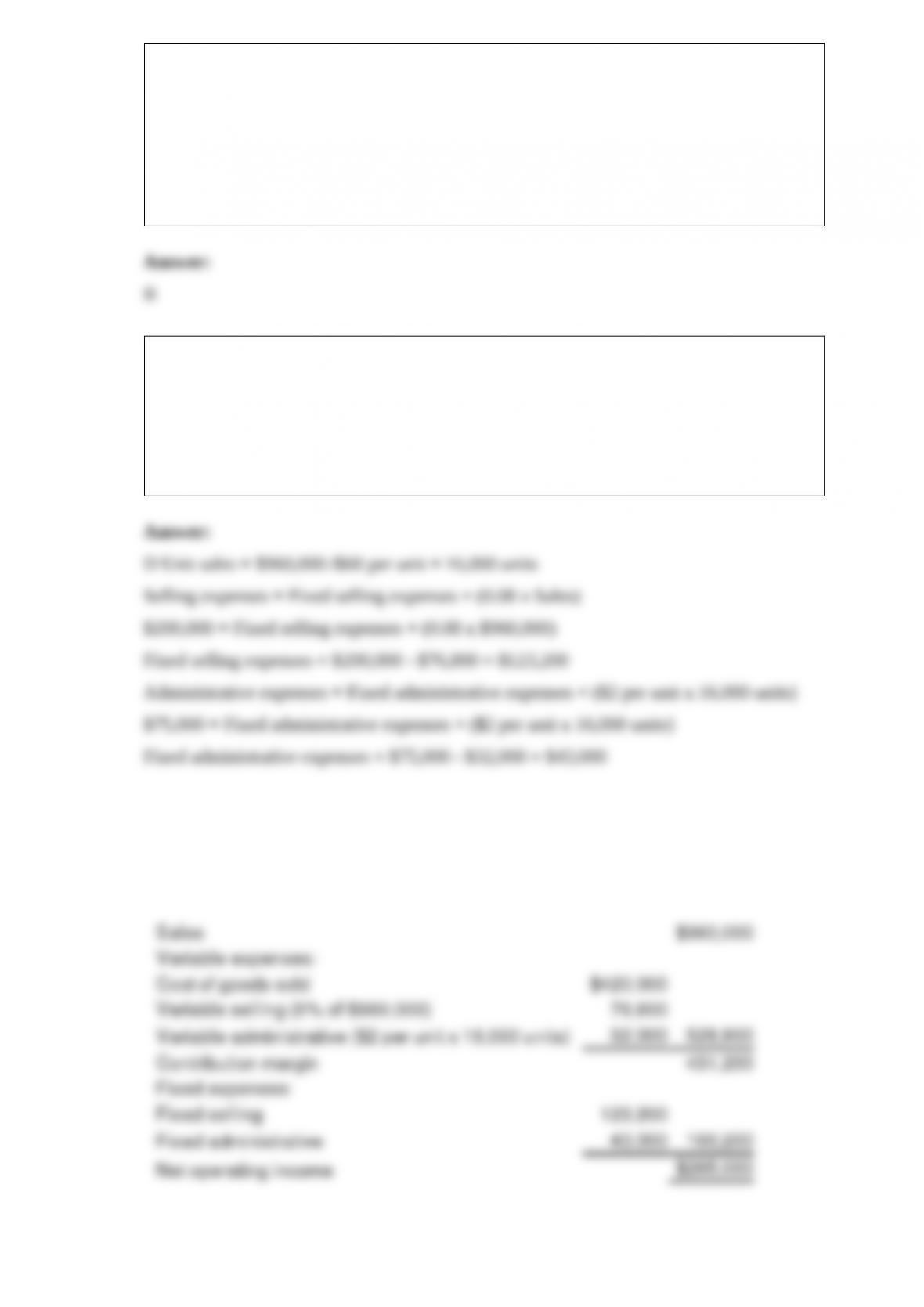
12) Garde Corporation keeps careful track of the time required to fill orders. Data
concerning a particular order appear below:
The throughput time was:
A.36.2 hours
B.8.1 hours
C.3.3 hours
D.32.9 hours
13) Fresh Wreath Corporation manufactures wreaths according to customer
specifications and ships them to customers using United Parcel Service (UPS). Which
two terms below describe the cost of shipping these wreaths?
A) variable cost and product cost
B) variable cost and period cost
C) fixed cost and product cost
D) fixed cost and period cost
14) Bee Company’s net operating income for the second quarter using the contribution
approach is:
A) $156,200
B) $685,000
C) $431,200
D) $265,000
15) What would be the total appraisal cost appearing on the quality cost report?
A.$105,000
B.$100,000
C.$75,000
D.$78,000
16) The following direct labor standards have been established for product N30A:
The following data pertain to the most recent month’s operations during which 400 units
of product N30A were made:
Required:
a. What was the labor rate variance for the month?
b. What was the labor efficiency variance for the month?
c. Prepare a journal entry to record direct labor costs during the month, including the
direct labor variances.
17) Daab Products is a division of a major corporation. The following data are for the
most recent year of operations:
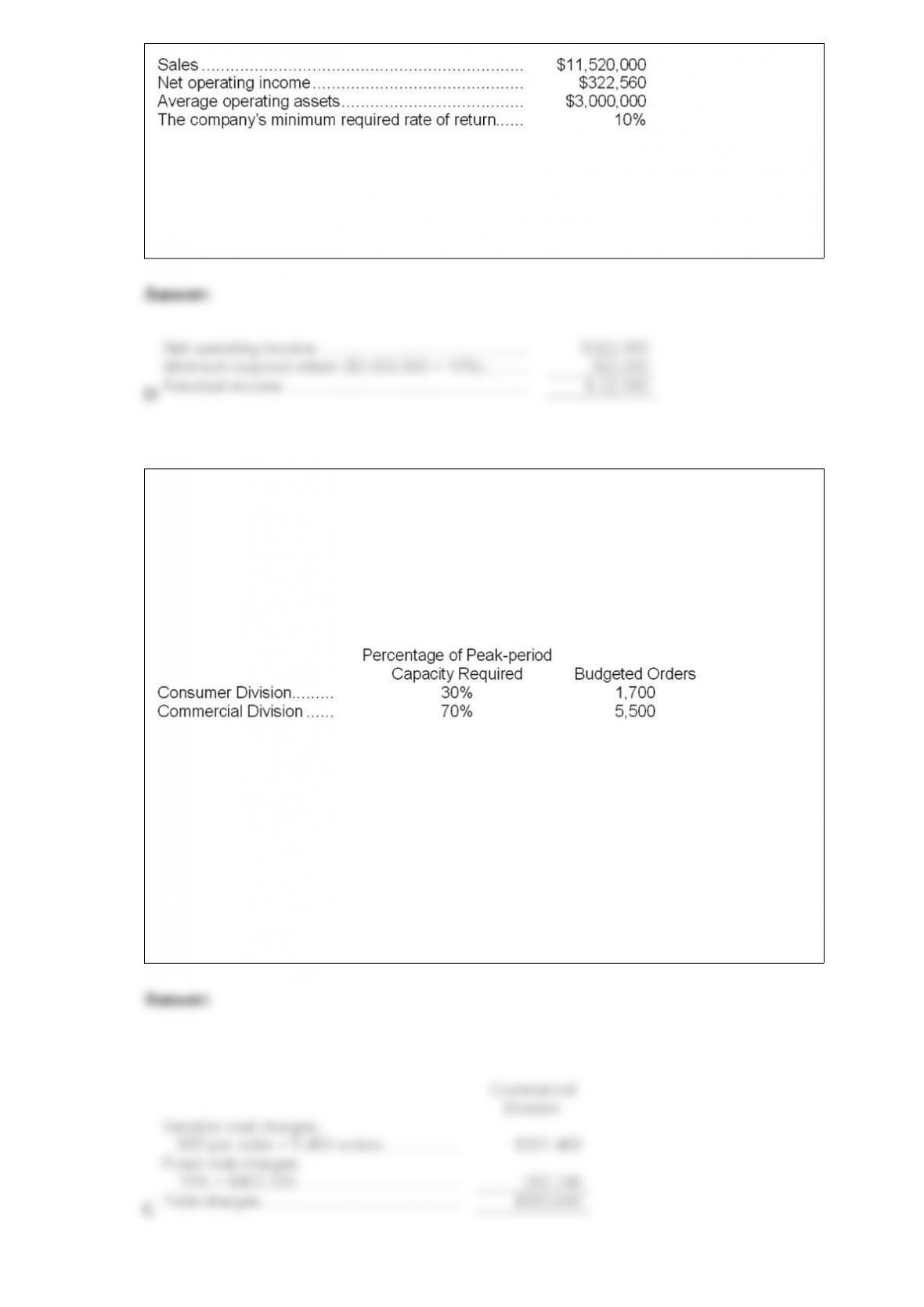
The division’s residual income is closest to:
A.$322,560
B.$622,560
C.$(829,440)
D.$22,560
18) Plaut Corporation has two operating divisions–a Consumer Division and a
Commercial Division. The company’s Order Fulfillment Department provides services
to both divisions. The variable costs of the Order Fulfillment Department are budgeted
at $55 per order. The Order Fulfillment Department’s fixed costs are budgeted at
$403,200 for the year. The fixed costs of the Order Fulfillment Department are
determined based on the peak-period orders.
At the end of the year, actual Order Fulfillment Department variable costs totaled
$409,528 and fixed costs totaled $422,330. The Consumer Division had a total of 1,730
orders and the Commercial Division had a total of 5,480 orders for the year. For
purposes of evaluation performance, how much Order Fulfillment Department cost
should be charged to the Commercial Division at the end of the year?
A.$607,854
B.$632,258
C.$583,640
D.$606,895
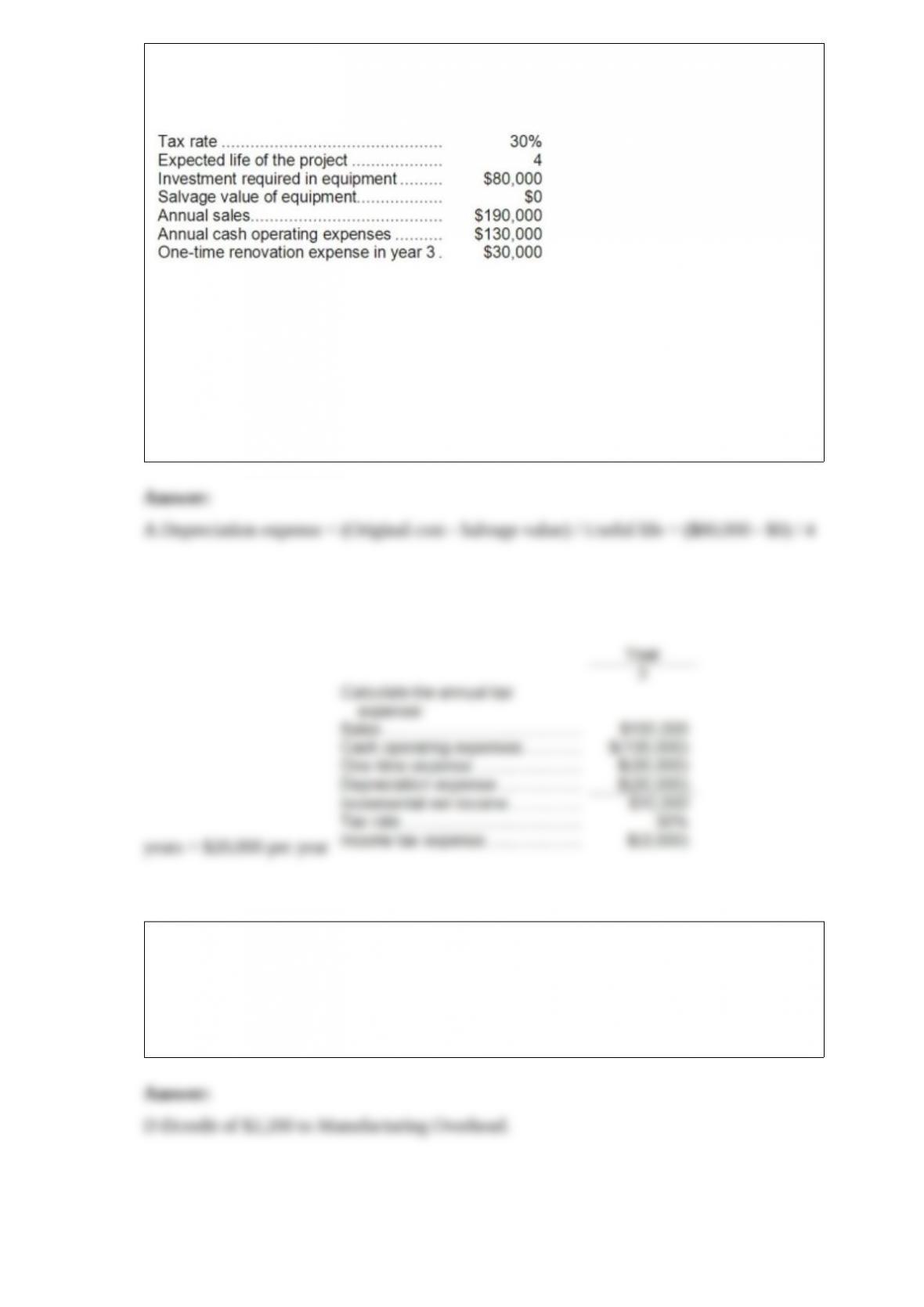
19) Wollard Corporation has provided the following information concerning a capital
budgeting project:
The company uses straight-line depreciation on all equipment.
The income tax expense in year 3 is:
A.$3,000
B.$12,000
C.$18,000
D.$9,000
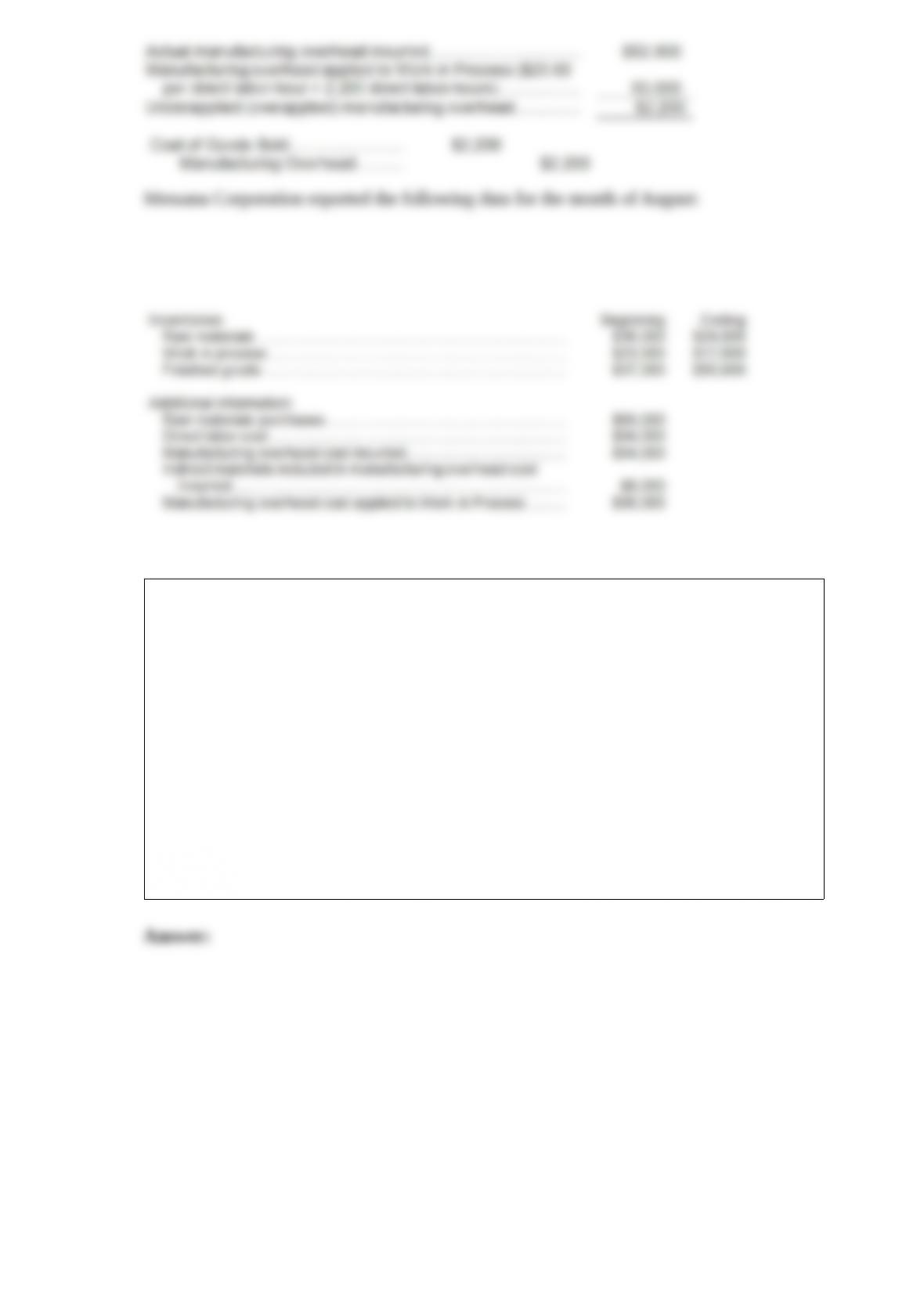
20) The entry to dispose of the underapplied or overapplied manufacturing overhead
cost for the month would include a:
A.debit of $2,200 to Manufacturing Overhead.
B.debit of $14,950 to Manufacturing Overhead.
C.credit of $14,950 to Manufacturing Overhead.
21) Sader Corporation is considering a capital budgeting project that would require an
investment of $160,000 in equipment with a 4 year expected life and zero salvage
value. Annual incremental sales will be $420,000 and annual incremental cash
operating expenses will be $320,000. The company’s income tax rate is 30% and the
after-tax discount rate is 8%. The company uses straight-line depreciation on all
equipment; the annual depreciation expense will be $40,000. Assume cash flows occur
at the end of the year except for the initial investments. The company takes income
taxes into account in its capital budgeting.
The net present value of the project is closest to:
A.$271,584
B.$111,584
C.$171,200
D.$168,000
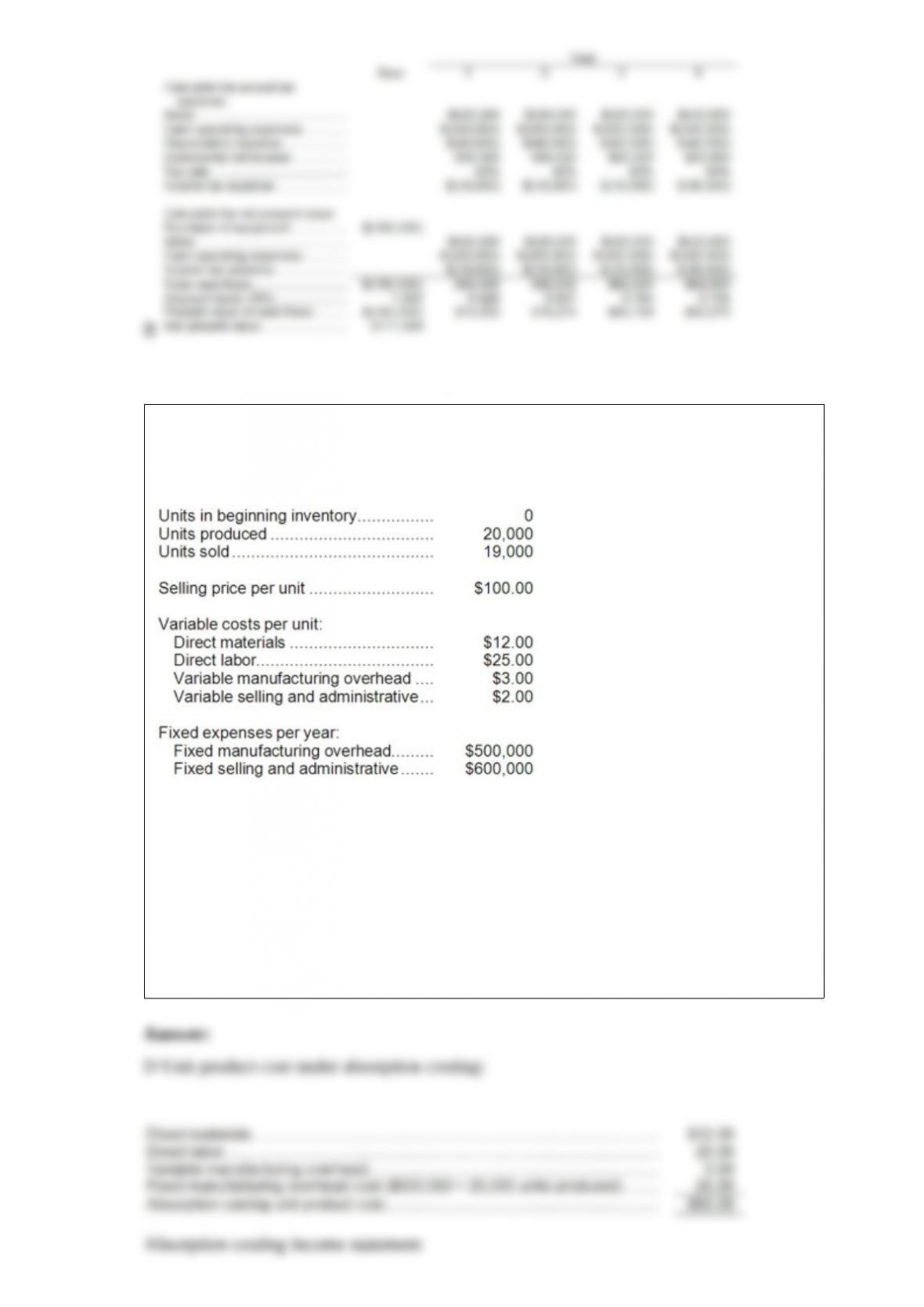
22) The following data pertain to last year’s operations at Tredder Corporation, a
company that produces a single product:
What was the absorption costing net operating income last year?
A.$12,000
B.$57,000
C.$2,000
D.$27,000