
When estimated costs are used in applying the cost-plus approach to product pricing,
the estimates should be based upon normal levels of performance.
Answer:
The balance of the Allowance for Doubtful Accounts is added to Accounts Receivable
on the balance sheet.
Answer:
Revenue is earned only when money is received.
Answer:
Financial statements should be prepared before the closing entries are journalized and
posted.

Answer:
Using vertical analysis of the income statement, a company’s net income as a
percentage of net sales is 15%; therefore, the cost of goods sold as a percentage of sales
must be 85%.
Answer:
Variable costs are costs that remain constant on a per-unit basis as the level of activity
changes.
Answer:
Because variable costs are assumed to change in direct proportion to changes in the
activity level, the graph of the variable costs when plotted against the activity level
appears as a circle.

Answer:
Net income and net profit do not mean the same thing.
Answer:
Sales to customers who use nonbank credit cards, such as American Express, are
generally treated as credit sales.
Answer:
Most companies invest excess cash in bonds as investments in order to profit long-term
from the growth of the investment.
Answer:

Trading securities are reported on the balance sheet at cost.
Answer:
When depreciation estimates are revised, all years of the asset’s life are affected.
Answer:
At the end of a period (before adjustment), Allowance for Doubtful Accounts has a
debit balance of $500. Net credit sales for the period totaled $800,000. If bad debt
expense is estimated at 1% of net credit sales, the amount of bad debt expense to be
recorded in the adjusting entry is $8,500.
Answer:

The budgeting process is used to effectively communicate planned expectations
regarding profits and expenses to the entire organization.
Answer:
Balance Sheet accounts are not considered real accounts.
Answer:
The cost concept is the basis for entering the exchange price into the accounting
records.
Answer:

Interest expense is reported in the operating expense section of the income statement.
Answer:
A person may be admitted to a partnership only with the consent of all the current
partners.
Answer:
Trading securities should be reported on the financial statements at fair market value.
Answer:
The financial loss that each stockholder in a corporation can incur is usually limited to
the amount invested by the stockholder.

Answer:
The balance in the capital account on the worksheet will equal the amount presented in
the balance sheet.
Answer:
A loan in which the lender deducts interest from the amount borrowed before the
money is advanced to the borrower is called an interest bearing note.
Answer:
Standby equipment held for use in the event of a breakdown of regular equipment is
reported as property, plant, and equipment on the balance sheet.

Answer:
If the standard to produce a given amount of product is 1,000 units of direct materials at
$11 and the actual was 800 units at $12, the direct materials price variance was $800
favorable.
Answer:
Receiving payments on an account receivable increases both equity and assets.
Answer:
If the balance in Cash Short and Over at the end of a period is a credit, it should be
reported as an “other income” item on the income statement.
Answer:

Accrued expenses are ordinarily listed on the balance sheet as current assets.
Answer:
The controller’s staff consists of management accountants responsible for systems and
procedures, general accounting, budgets, taxes, and cost accounting.
Answer:
Businesses must implement controls to help guide the behavior of their employees
toward business objectives.
Answer:

The main objective for all business is to maximize unrealized profits.
Answer:
An income statement is a summary of the revenues and expenses of a business as of a
specific date.
Answer:
Both job order and process cost accounting use equivalent units of production to
determine costs.
Answer:

A rental cost of $20,000 plus $.70 per machine hour of use is an example of a mixed
cost.
Answer:
For proper matching of revenues and expenses, the estimated cost of fringe benefits
must be recognized as an expense of the period during which the employee earns the
benefits.
Answer:
A production supervisor’s salary that does not vary with the number of units produced is
an example of a fixed cost.
Answer:
Financial accounting provides information to all users, while the main focus for

managerial accounting is to provide information to the management.
Answer:
Federal unemployment taxes are paid by the employer and the employee.
Answer:
The master budget of a small manufacturer would normally include all component
budgets that impact on the financial statements.
Answer:
In order to be a recorded contingent liability, the liability must be possible and easily
estimated.

Answer:
The price of a bond is equal to the sum of the interest payments and the face amount of
the bonds.
Answer:
Hakik Enterprises offers rug cleaning services to business clients. Below is the trial
balance for Hakik Enterprises, which was prepared on the end of period spreadsheet
(work sheet) for the year ended July 31, 2010.
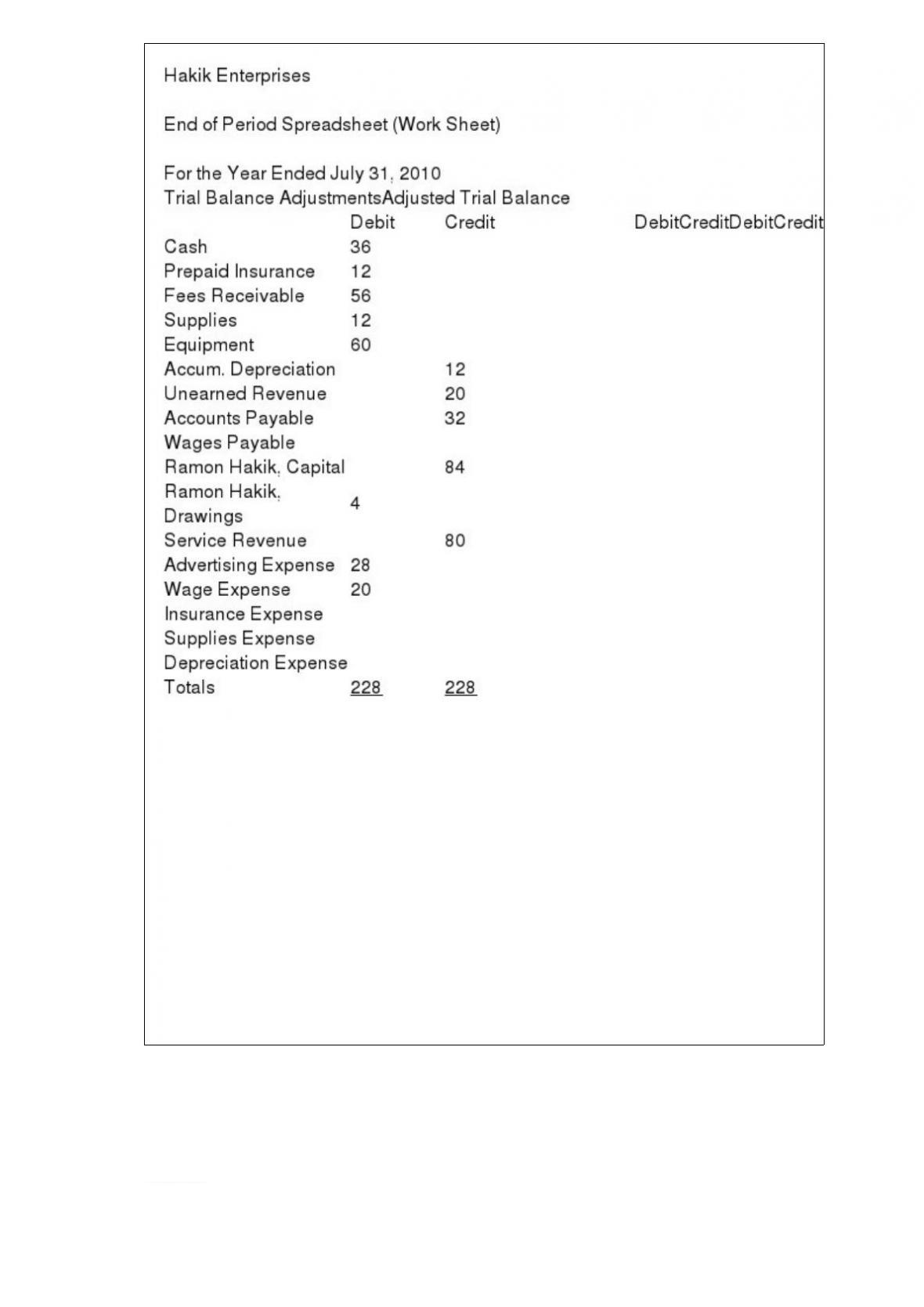
REQUIRED: Enter the adjustment data in the work sheet for the transactions shown
below and place the balances in the Adjusted Trial Balance columns.
a) The equipment is estimated to last for 5 years with no salvage value. The asset will
be depreciated evenly over its useful life. Record one month’s depreciation.
b) Accrued Wages $2.
c) Unused supplies on hand $8.
d) Of the unearned revenue, 75% has been earned.
e) Unexpired insurance remaining at the end of the month, $9.
Answer:
Estimating and recording product warranty expense in the period of the sale best
follows which of the following accounting concepts?
A.cost concept
B.business entity concept
C.matching concept
D.materiality concept

Answer:
A business pays weekly salaries of $25,000 on Friday for a five-day week ending on
that day. The adjusting entry necessary at the end of the fiscal period ending on Tuesday
is
A.debit Salaries Payable, $10,000; credit Cash, $10,000
B.debit Salary Expense, $10,000; credit Drawing, $10,000
C.debit Salary Expense, $10,000; credit Salaries Payable, $10,000
D.debit Drawing, $10,000; credit Cash, $10,000
Answer:
When comparing a retail business to a service business, the financial statement that
changes the least is the
A.Balance Sheet
B.Income Statement
C.Statement of Owner’s Equity
D.Statement of Cash Flow

Answer:
Using a perpetual inventory system, the entry to record the sale of merchandise on
account includes a
A.debit to Sales
B.debit to Merchandise Inventory
C.credit to Merchandise Inventory
D.credit to Accounts Receivable
Answer:
A company purchases equipment for $32,000 cash. This transaction should be shown on
the statement of cash flows under
A.investing activities
B.financing activities
C.noncash investing and financing activities
D.operating activities

Answer:
Yadkin Valley’s April sales forecast projects that 6,000 units will sell at a price of
$10.50 per unit. The desired ending inventory is 30% higher than the beginning
inventory, which was 1,000 units. Budgeted purchases of units in April would be:
A.7,000 units
B.6,000 units
C.6,300 units
D.7,300 units
Answer:
A corporation has 50,000 shares of $28 par value stock outstanding that has a current
market value of $150. If the corporation issues a 4-for-1 stock split, the market value of
the stock will fall to approximately
A.$7.00
B.$112.00
C.$37.50
D.$600.00

Answer:
Xavier and Yolanda have original investments of $50,000 and $100,000 respectively in
a partnership. The articles of partnership include the following provisions regarding the
division of net income: interest on original investment at 10%, salary allowances of
$27,000 and $18,000 respectively, and the remainder equally. How much of the net loss
of $6,000 is allocated to Yolanda?
A.$1,000
B.$3,000
C.$5,000
D.$0
Answer:
A retailer purchases merchandise with a catalog list price of $25,000. The retailer
receives a 30% trade discount and credit terms of 2/10, n/30. What amount should the
retailer debit to the Merchandise Inventory account?
A.$7,500
B.$17,500
C.$25,000
D.$17,250

Answer:
The amount of the estimated average income for a proposed investment of $90,000 in a
fixed asset, giving effect to depreciation (straight-line method), with a useful life of four
years, no residual value, and an expected total income yield of $21,600, is:
A.$10,800
B.$21,600
C.$ 5,400
D.$45,000
Answer:
The management of Wyoming Corporation is considering the purchase of a new
machine costing $375,000. The company’s desired rate of return is 6%. The present
value factor for an annuity of $1 at interest of 6% for 5 years is 4.212. In addition to the
foregoing information, use the following data in determining the acceptability in this
situation:
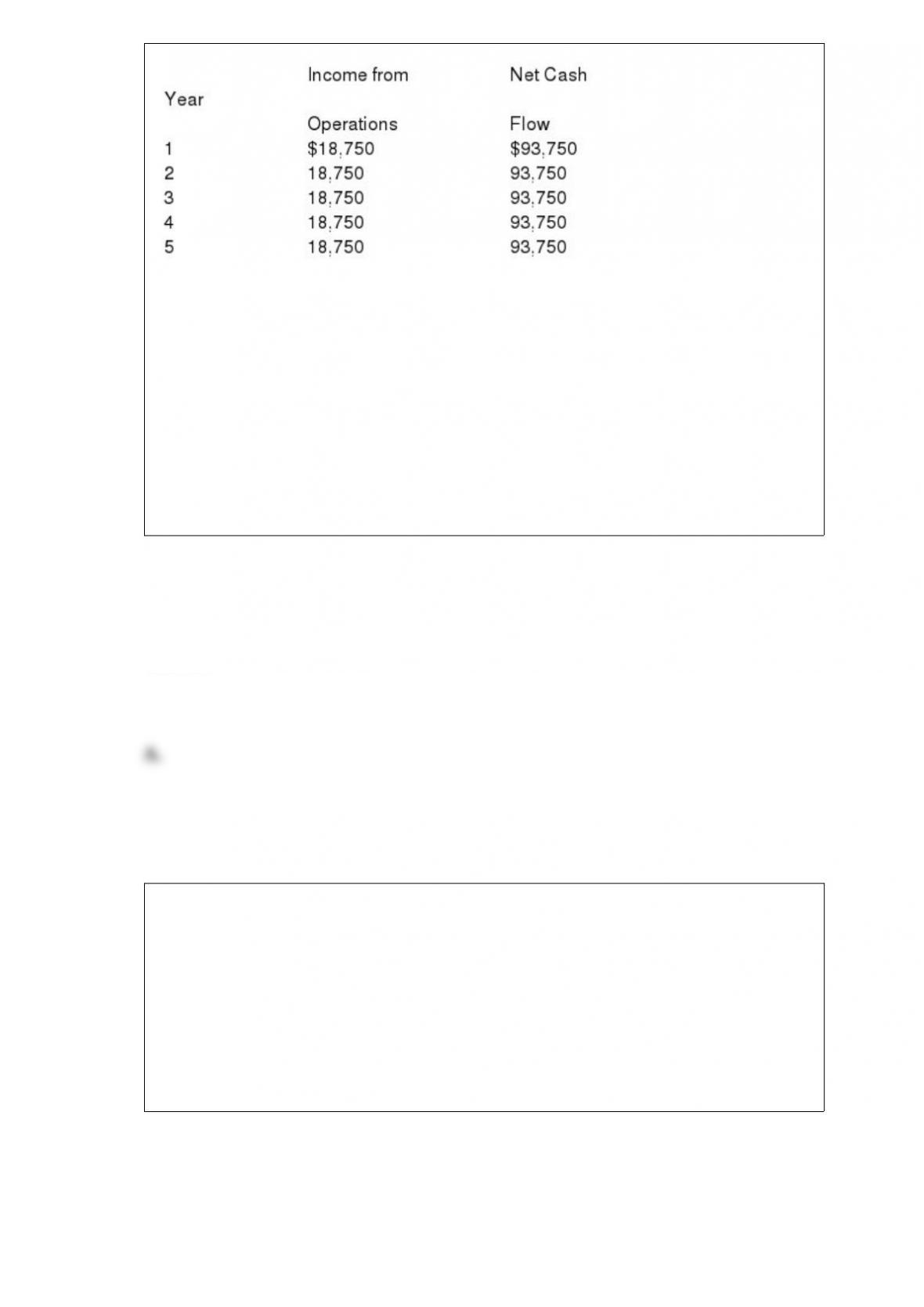
The cash payback period for this investment is:
A.4 years
B.5 years
C.20 years
D.3 years
Answer:
The following are true regarding product costs except
A.product costs are found on the balance sheet until they are sold.
B.product costs consist of direct labor, direct materials, and factory overhead.
C.product costs can be found in three accounts in the balance sheet.
D.product costs include sales and administrative expenses.
Answer:

The transfer price that must be less than the market price but greater than the supplying
division’s variable costs per unit is called
A.the cost price approach
B.the negotiated cost approach
C.the standard cost approach
D.the market price approach
Answer:
List the internal control objectives illustrated by the following:
(a) keeping the inventory storeroom locked
(b) counting the inventory at the end of the accounting period and comparing it with the
inventory ledger clerk’s records
(c) using subsidiary ledgers and a perpetual inventory system
Answer:

A cash purchase of supplies should be recorded in the
A.Cash Receipts journal
B.Purchase journal
C.General journal
D.Cash Payments journal
Answer:
The Lowery Co. uses the direct write-off method of accounting for uncollectible
accounts receivable. Lowery has a customer whose accounts receivable balance has
been determined to likely be uncollectible. The entry to write off this account would be
which of the following?:
A.debit Allowance for Doubtful Accounts; credit Accounts Receivable
B.debit Sales Returns and Allowance, credit Accounts Receivable
C.debit Bad Debt Expense; credit Allowance for Doubtful Accounts
D.debit Bad Debt Expense; credit Accounts Receivable
Answer:
On January 5, 2014, Garrett Company, a calendar-year company, issued $1,000,000 of
notes payable, of which $200,000 is due on January 1 for each of the next five years.
The proper balance sheet presentation on December 31, 2014, is
A.Current Liabilities, $1,000,000.
B.Current Liabilities, $200,000; Long-term Debt, $800,000.
C.Long-term Debt, $1,000,000
D.Current Liabilities, $800,000; Long-term Debt, $200,000.
Answer:
Based on the following production and sales estimates for May, determine the number
of units expected to be manufactured in May.
A.75,000

B.90,000
C.85,000
D.115,000
Answer:
Which of the following entities would probably use a process costing system?
A.A custom boat builder
B.A custom furniture manufacturer
C.A one of a kind jewelry creator
D.An oil refinery.
Answer:
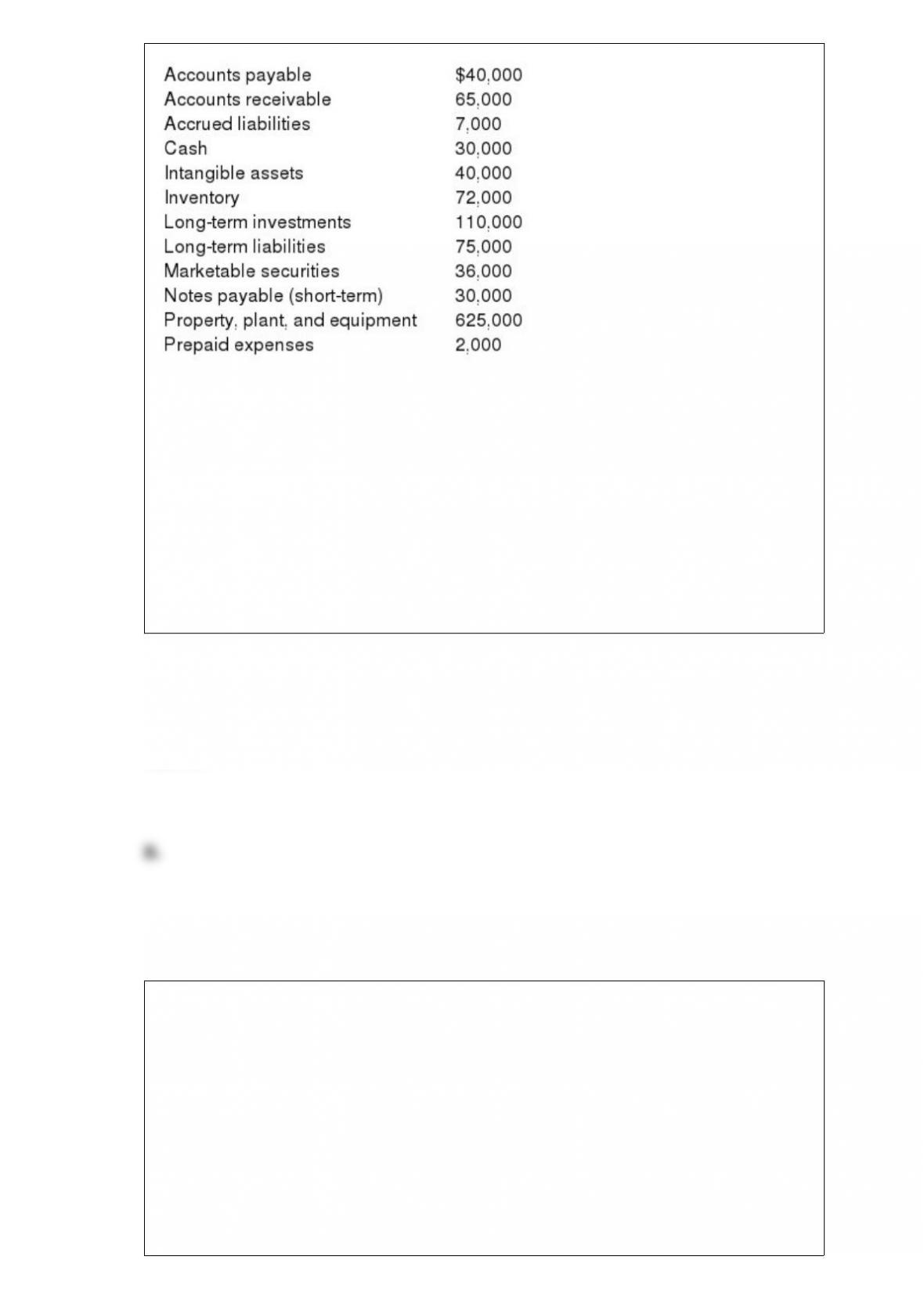
Based on the above data, what is the amount of working capital?
A.$238,000
B.$128,000
C.$168,000
D.$203,000
Answer:
The expected average rate of return for a proposed investment of $500,000 in a fixed
asset, with a useful life of four years, straight-line depreciation, no residual value, and
an expected total net income of $240,000 for the 4 years, is:
A.18%
B.48%
C.24%
D.12%

Answer:
The following information is available for Carter Corporation for 2012:
1) Materials inventory decreased $4,000 during 2012.
2) Materials inventory on December 31, 2012, was 50% of materials inventory on
January 1, 2012.
3) Beginning work in process inventory was $145,000.
4) Ending finished goods inventory was $65,000.
5) Purchases of direct materials were $154,700.
6) Direct materials used were 2.5 times the cost of direct labor.
7) Total manufacturing costs incurred were $246,400, 80% of cost of goods
manufactured and $156,000 less than cost of goods sold.
Compute:
a) finished goods inventory on January 1, 2012
b) work in process inventory on December 31, 2012
c) direct labor incurred
d) factory overhead incurred
e) direct materials used
f) materials inventory on January 1, 2012
g) materials inventory on December 31, 2012
Note to students: The answers are not necessarily calculated in alphabetical order.
Answer:
An employee receives an hourly rate of $30, with time and a half for all hours worked
in excess of 40 during a week. Payroll data for the current week are as follows: hours
worked, 48; federal income tax withheld, $300; cumulative earnings for year prior to
current week, $90,700; social security tax rate, 6.0% on maximum of $100,000; and
Medicare tax rate, 1.5% on all earnings. What is the net amount to be paid to the
employee?
A.$1,032.00
B.$1,143.00
C.$1,053.60

D.$1,166.40
Answer:
The reduction of par or stated value of stock by issuance of a proportionate number of
additional shares is termed a
A.liquidating dividend
B.stock split
C.stock option
D.preferred dividend
Answer:
Debtors are interested in the times-interest-earned ratio because they want to
A.know what rate of interest the corporation is paying
B.have adequate protection against a potential drop in earnings jeopardizing their
interest payments
C.be sure their debt is backed by collateral
D.know the tax effect of lending to a corporation
Answer:
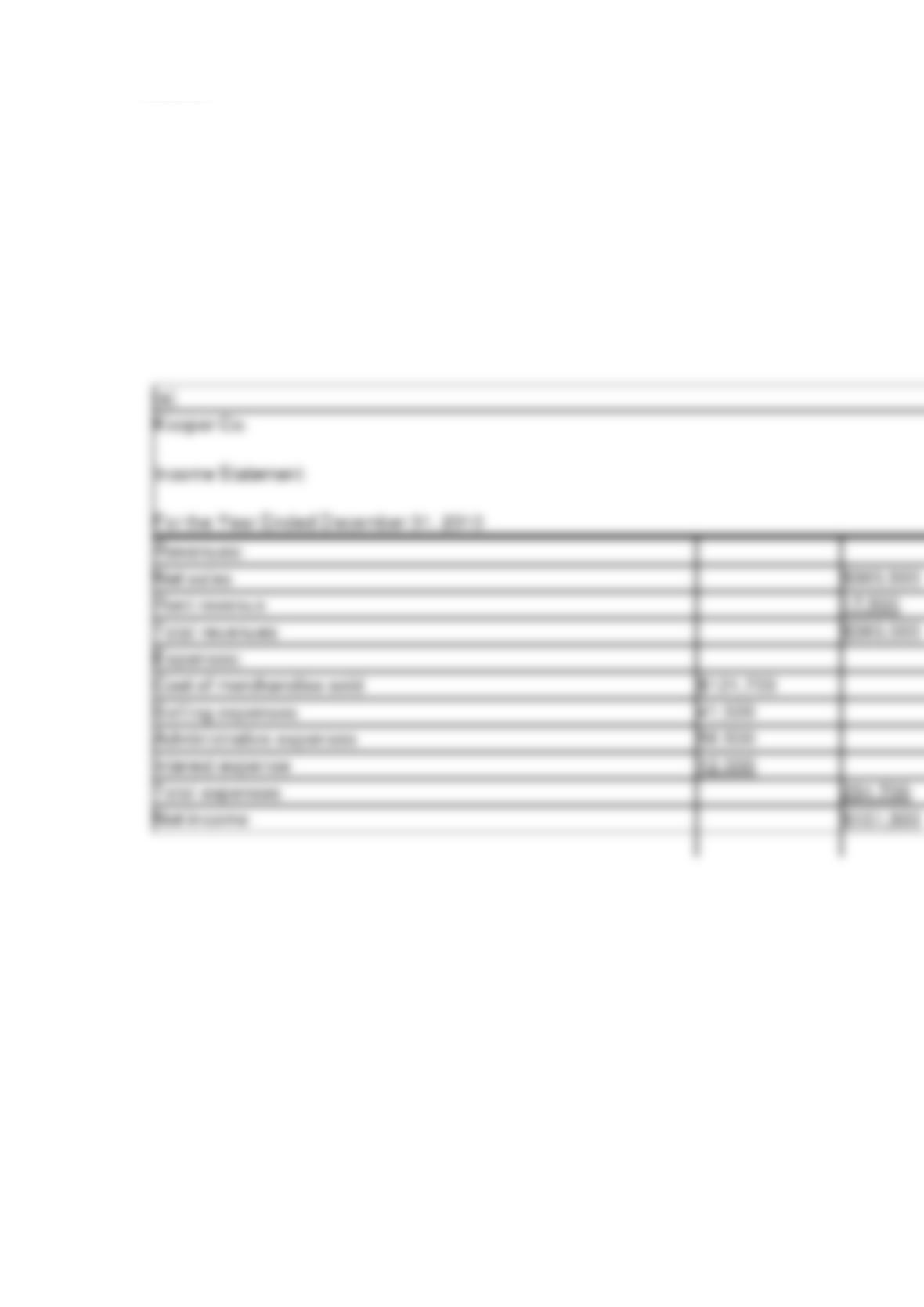
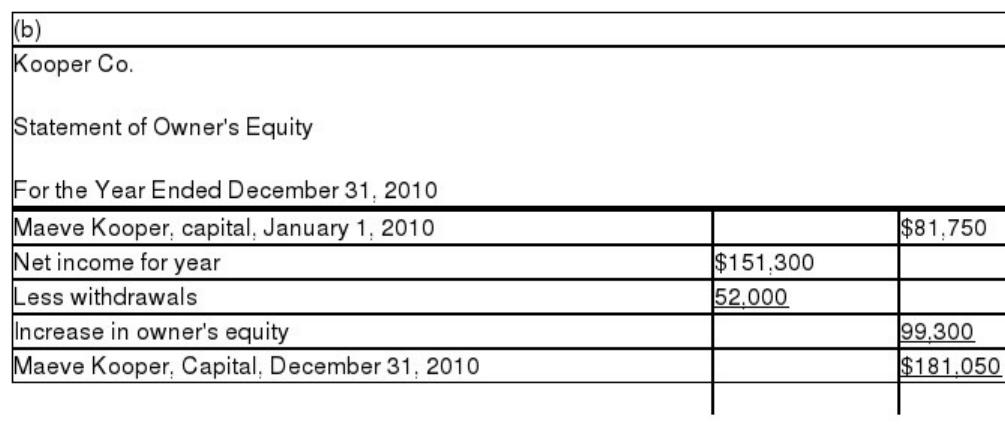
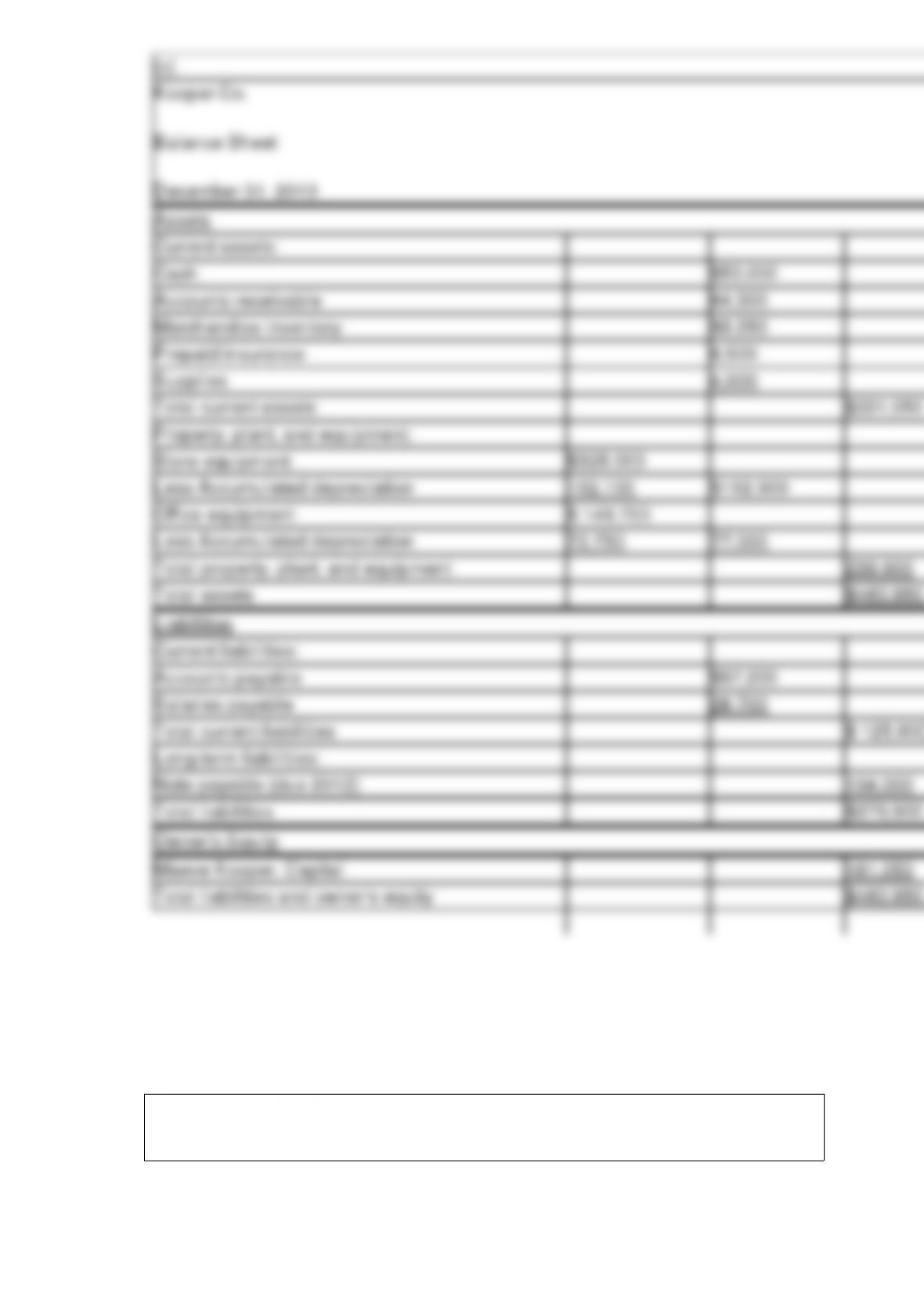
Prepare (a) a single-step income statement, (b) a statement of owner’s equity, and (c) a
balance sheet in report form from the following data for Kooper Co., taken from the
ledger after adjustment on December 31, 2010 the end of the fiscal year.
Answer:
The standard costs and actual costs for factory overhead for the manufacture of 2,500
units of actual production are as follows:
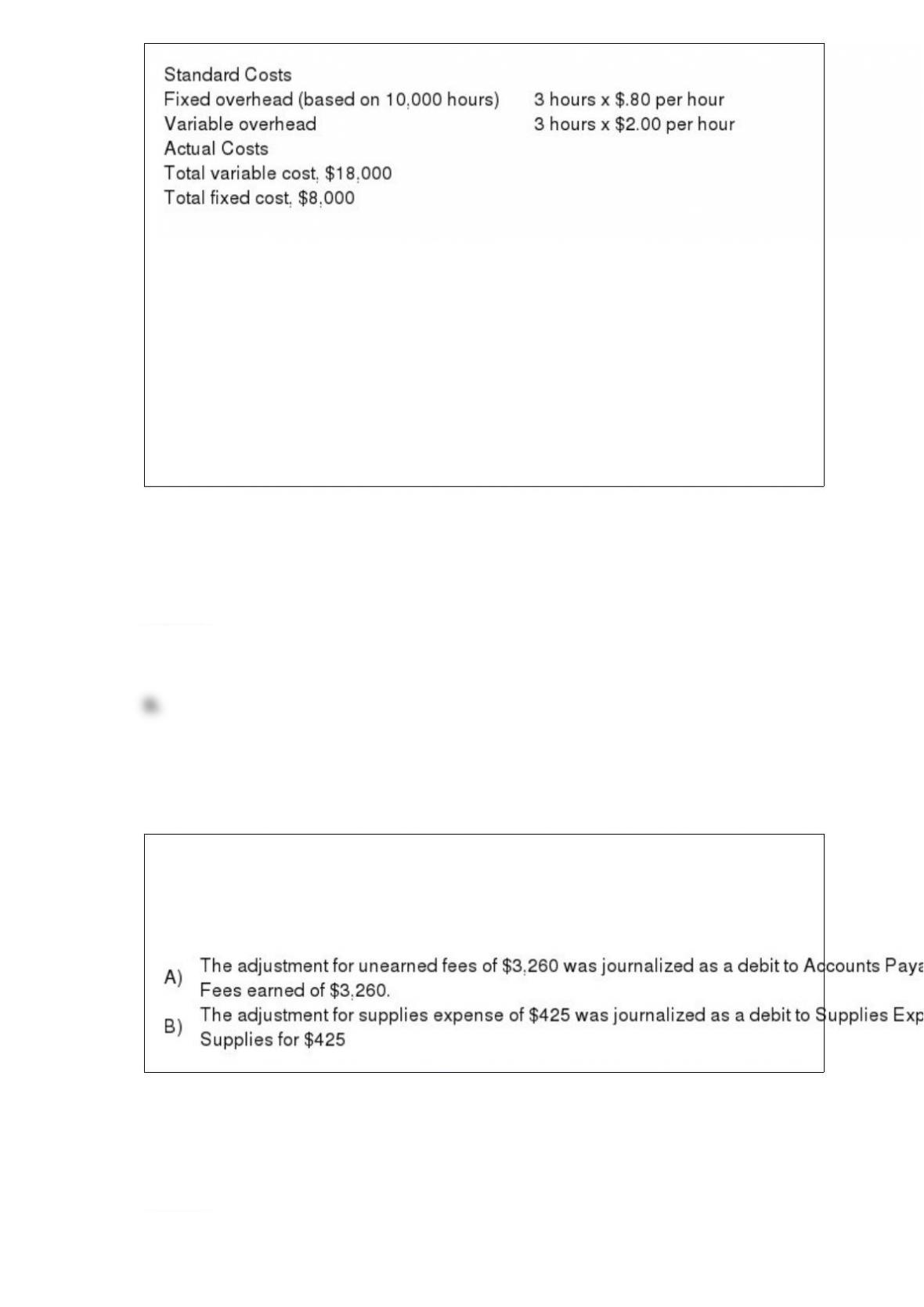
The amount of the factory overhead volume variance is:
A.$2,000 favorable
B.$2,000 unfavorable
C.$2,500 unfavorable
D.$0
Answer:
For each of the following errors, considered individually, indicate whether the error
would cause the adjusted trial balance totals to be unequal. If the error would cause the
adjusted trial balance total to be unequal, indicate whether the debit or credit total is
higher and by how much.
Answer:
At the end of July, the first month of the current fiscal year, the factory overhead
account had a debit balance. Which of the following describes the nature of this balance
and how it would be reported on the interim balance sheet?
A.Overapplied, deferred credit
B.Underapplied, deferred debit
C.Underapplied, deferred credit
D.Overapplied, deferred debit
Answer:
Two income statements for PS Enterprises are shown below:
Prepare a vertical analysis of PS Enterprises’ income statements. Has operating income
increased or decreased as a percentage of revenue?

A.Yes, increased by 5%.
B.Yes, increased by 111%.
C.No, decreased by 5%.
D.None are correct.
Answer:
When a limited partnership is formed
A.the partnership activities are limited
B.all partners have limited liability
C.some of the partners have limited liability
D.none of the partners have limited liability
Answer:
A business received an offer from an exporter for 30,000 units of product at $16 per
unit. The acceptance of the offer will not affect normal production or domestic sales
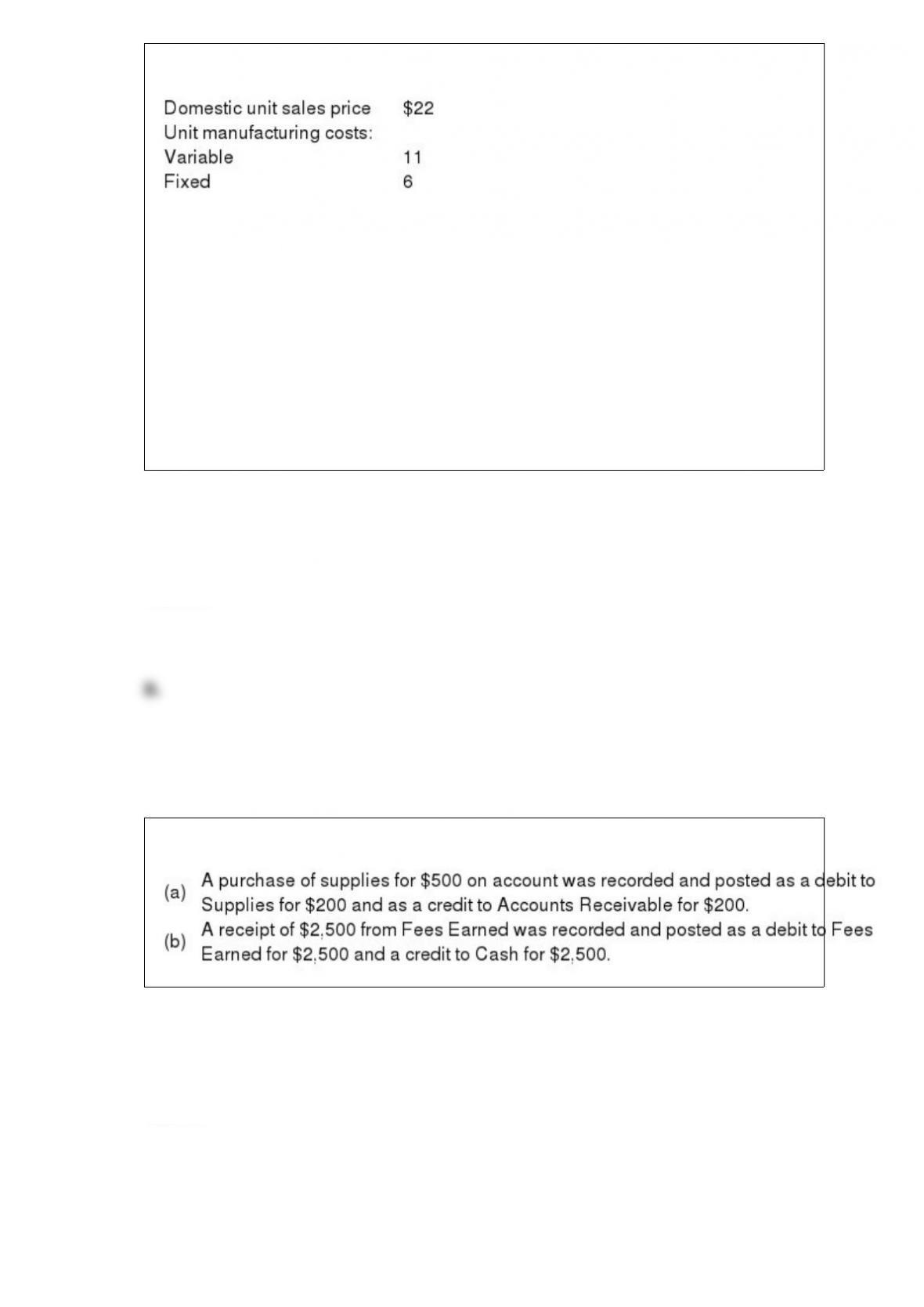
prices. The following data are available:
What is the differential cost from the acceptance of the offer?
A.$120,000
B.$330,000
C.$300,000
D.$510,000
Answer:
Journalize the entries to correct the following errors:
Answer:

When the amount of use of a fixed asset varies from year to year, the method of
determining depreciation expense that best matches allocation of cost with revenue is
A.declining-balance
B.straight-line
C.units-of-production
D.MACRS
Answer:
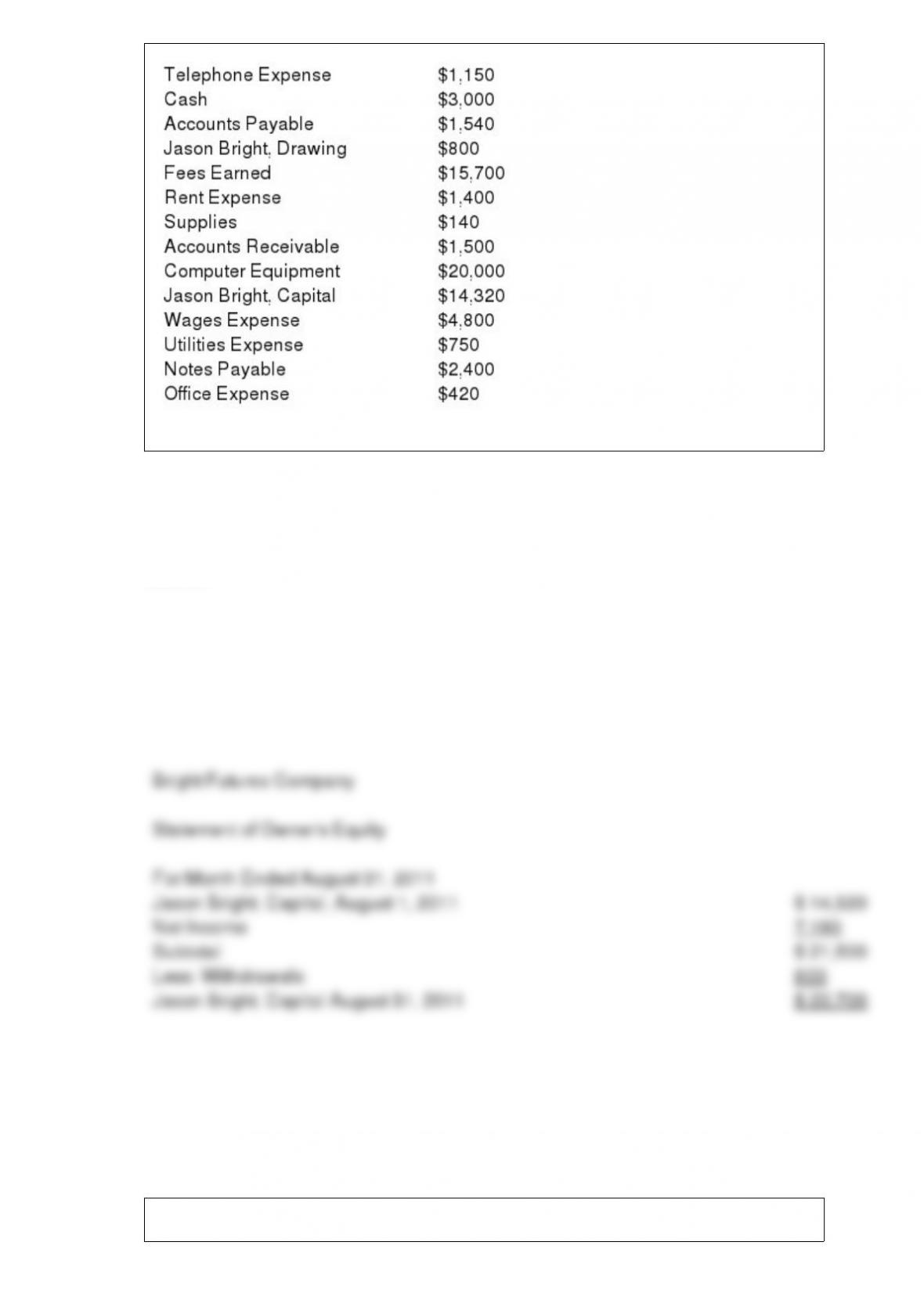
Using the following accounts and their amounts, prepare in good format a Statement of
Owner’s Equity for Bright Futures Company, month ended August 31, 2011:
Answer:
On January 2, Todd Company acquired 40% of the outstanding stock of McGuire
Company for $205,000. For the year ending, December 31, McGuire earned income of
$48,000 and paid dividends of $14,000.
Prepare the entries for Todd Company for the purchase of the stock, share of McGuire
income and dividends received from McGuire.
Answer:
For each of the following business, explain how a revenue journal might be modified
for the specific business.
1) Jon’s Auto Repair Business
2) Esquire Movie Theater
3) Beach Hut Snack Bar, Restaurant, and Lounge
Answer:
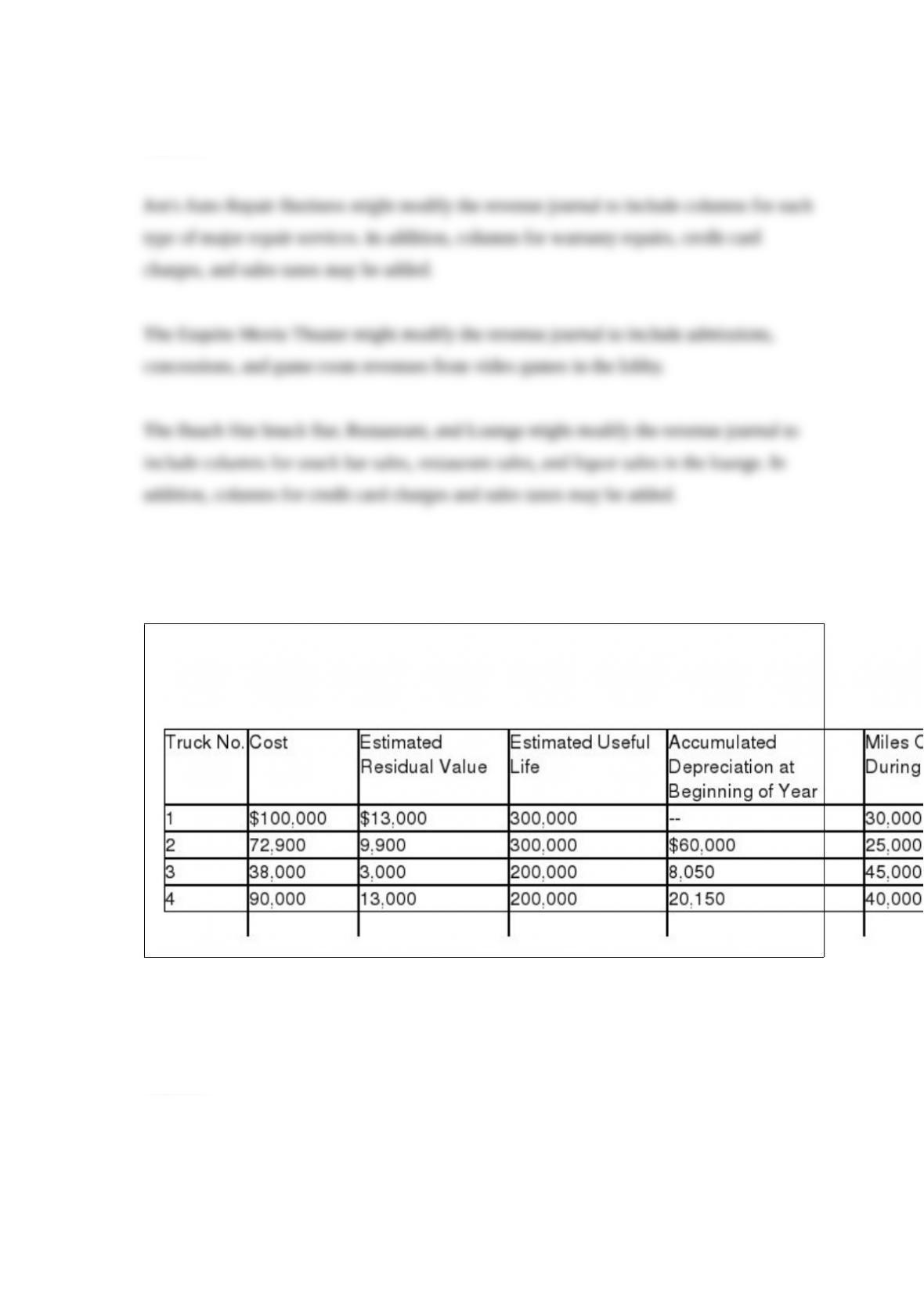
Prior to adjustment at the end of the year, the balance in Trucks is $300,900 and the
balance in Accumulated Depreciation-Trucks is $88,200. Details of the subsidiary
ledger are as follows:
Answer:
The assets and liabilities of S&P Day Spa at December 31, 2014 and expenses for the
year are listed below. The capital of the owner was $68,000 at January 1, 2014. The
owner invested an additional $10,000 during the year. Net income for 2014 is $45,625.
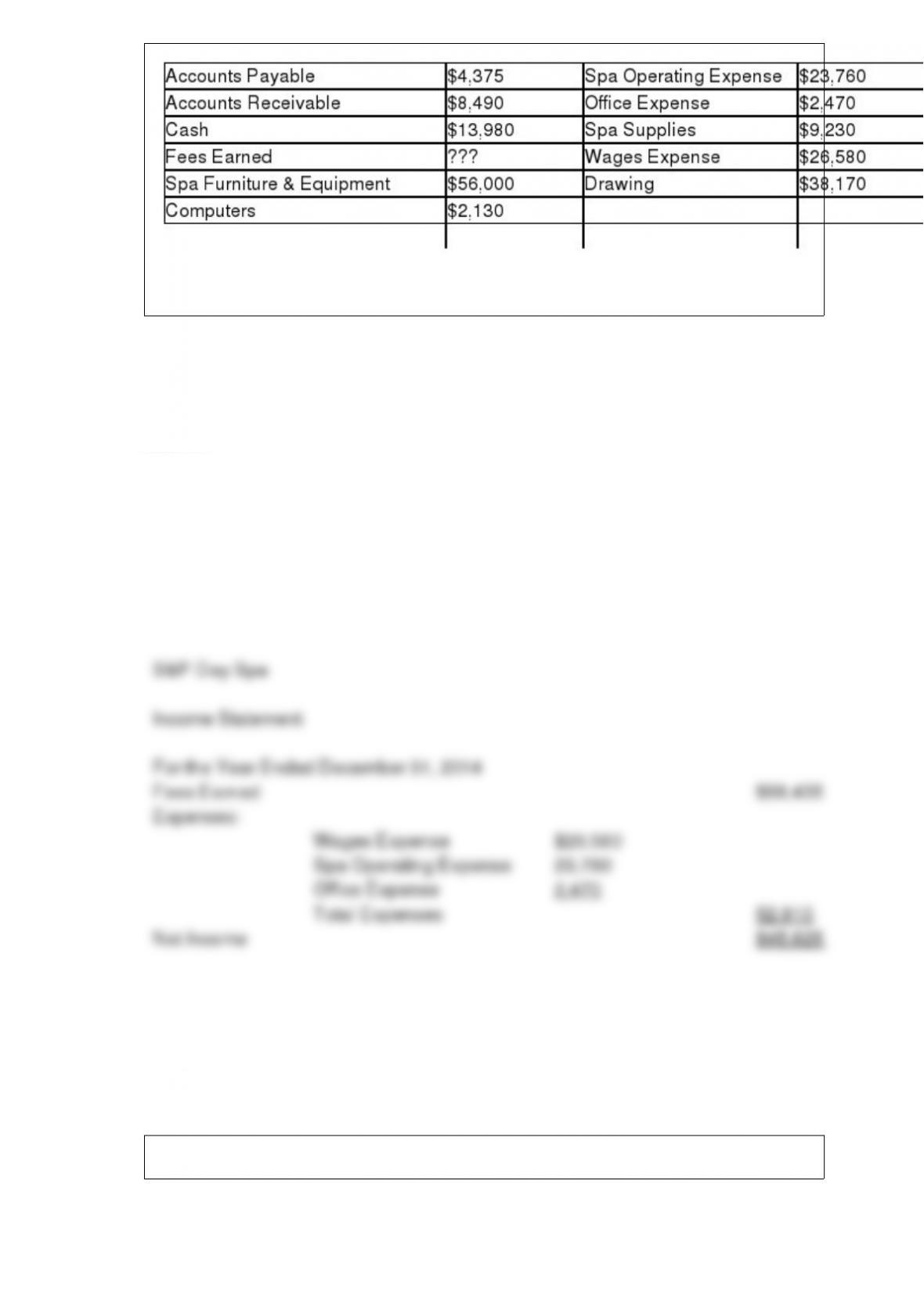
Prepare an income statement for the current year ended December 31, 2014.
Answer:
Calculate the gross profit for Jonas Company based on the data given below:
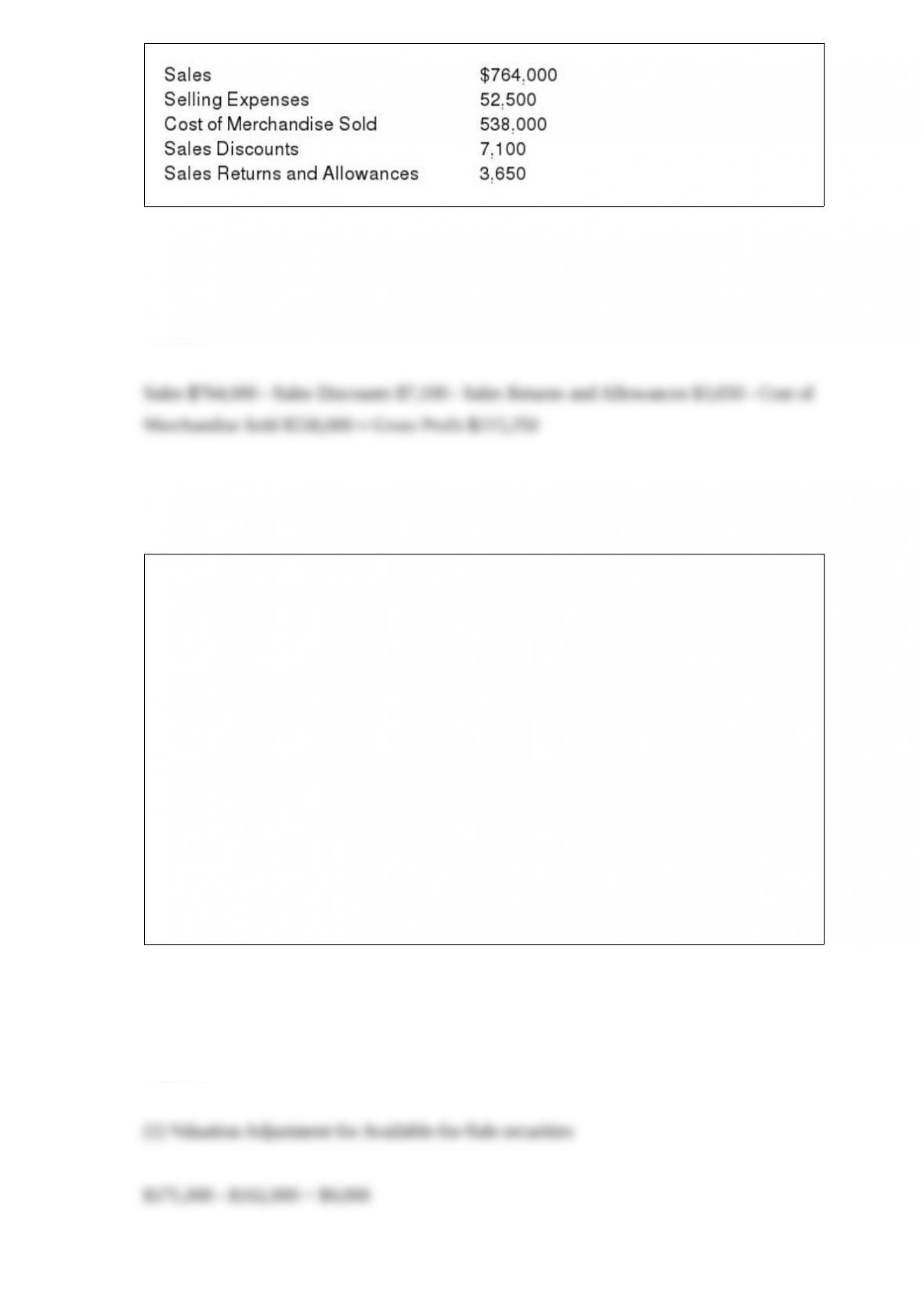
Answer:
Mangrill, Inc. reported net income for the year ending December 31, 2012 of $483,500.
Dividends paid during the year totaled $42,900. The company holds available-for-sale
securities with an original cost of $162,000 and a fair value of $171,000 at the end of
the year. They also hold trading securities with an original cost of $150,000 and a fair
value of $147,000. Retained Earnings on January 1, 2012 was $736,400 and
Accumulated Other Comprehensive Income on January 1, 2012 was $16,200.
Calculate the following balances to be reported in the financial statements dated
December 31, 2012.
(1) Valuation Allowance for Available-for-Sale securities
(2) Comprehensive Income
(3) Retained Earnings
(4) Accumulated Other Comprehensive Income
Answer:

Journalize the following transactions using the direct write-off method of accounting
for uncollectible receivables.
April 1 Sold merchandise on account to Jim Dobbs, $7,200. The cost of the
merchandise is $5,400.
June 10 Received payment for one-third of the receivable from Jim Dobbs and wrote
off the remainder.
Oct. 11 Reinstated the account of Jim Dobbs for and received cash in full payment.
Answer:
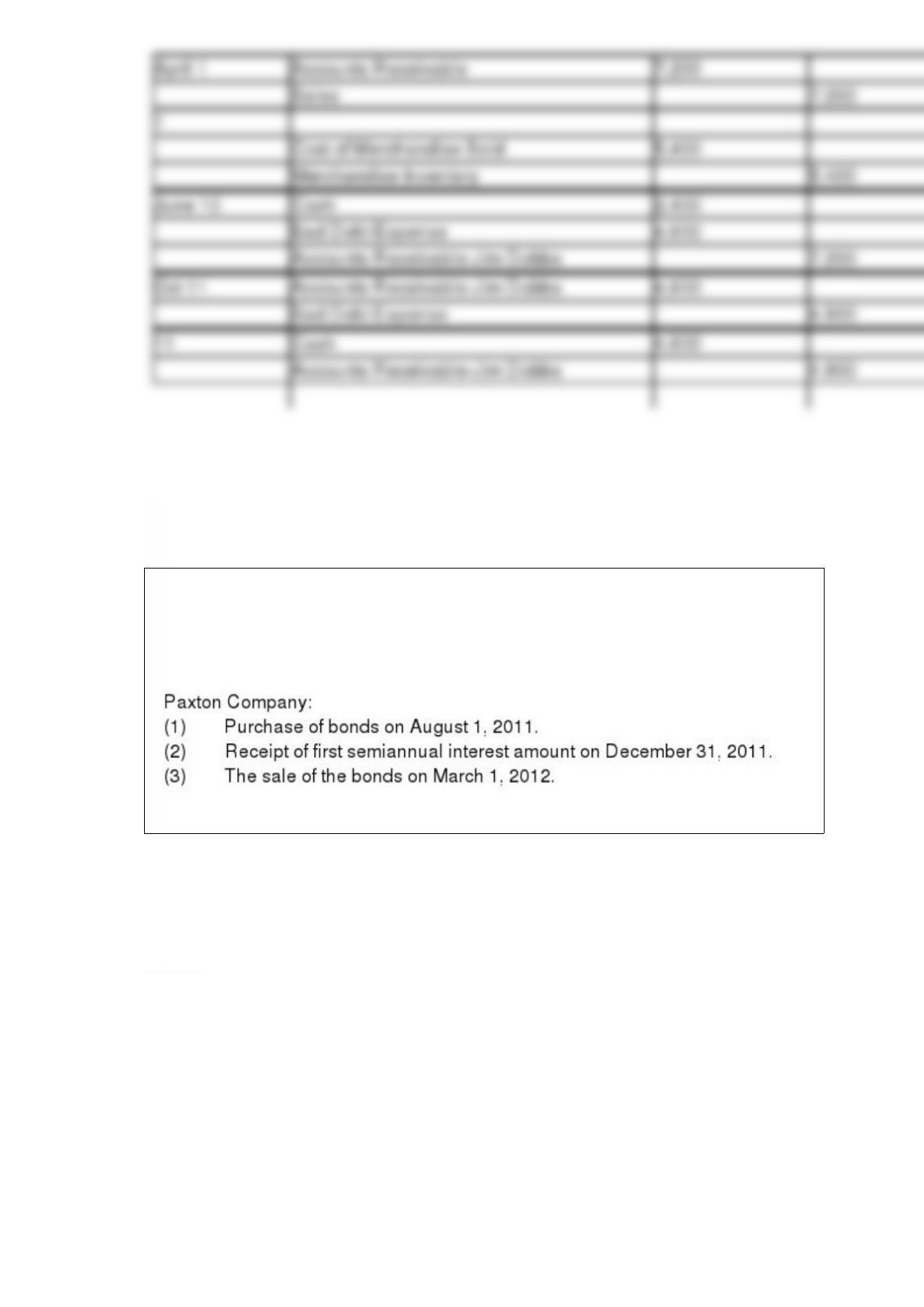
On August 1, 2011, Airport Company sold Paxton Company $1,000,000 of 10-year, 6%
bonds, dated July 1 at 100 plus accrued interest. On March 1, 2012, Paxton sold half of
the bonds for $520,000 plus accrued interest. Present entries to record the following
transactions:
Answer:
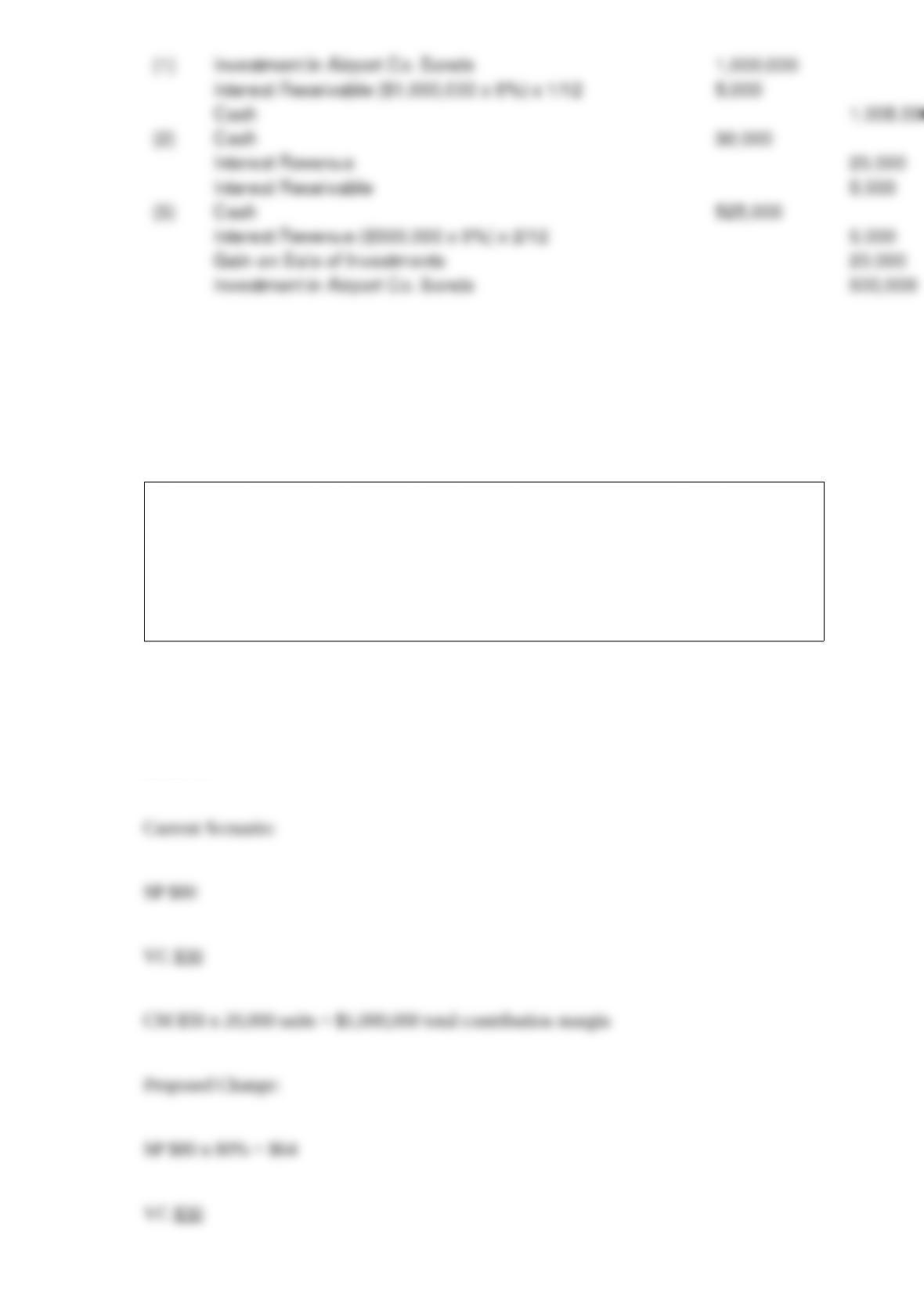
Carrolton, Inc. currently sells widgets for $80 per unit. The variable cost is $30 per unit
and total fixed costs equal $240,000 per year. Sales are currently 20,000 units annually.
The company is considering a 20% drop in selling price that they believe will raise
units sold by 20%. Assuming all costs stay the same, what is the impact on income if
they make this change?
Answer:
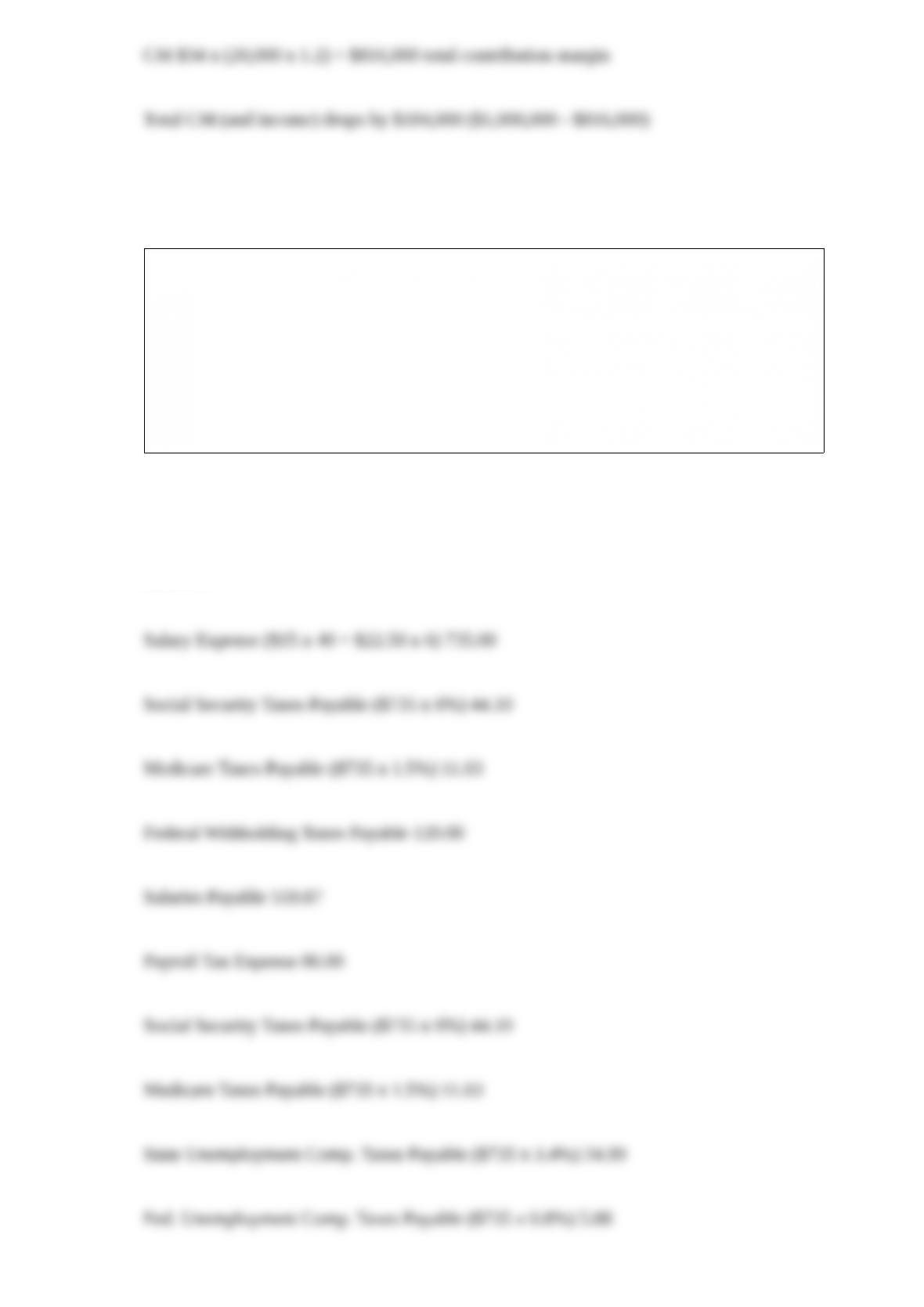
An employee receives an hourly rate of $15, with time and a half for all hours worked
in excess of 40 during the week. Payroll data for the current week are as follows: hours
worked, 46; federal income tax withheld, $120; cumulative earnings for the year prior
to this week, $5,500; Social security tax rate, 6% on maximum of $100,000; and
Medicare tax rate, 1.5% on all earnings; state unemployment compensation tax, 3.4%
on the first $7,000; federal unemployment compensation tax, .8% on the first $7,000.
Prepare the journal entries to record the salaries expense and the employer payroll tax
expense.
Answer:
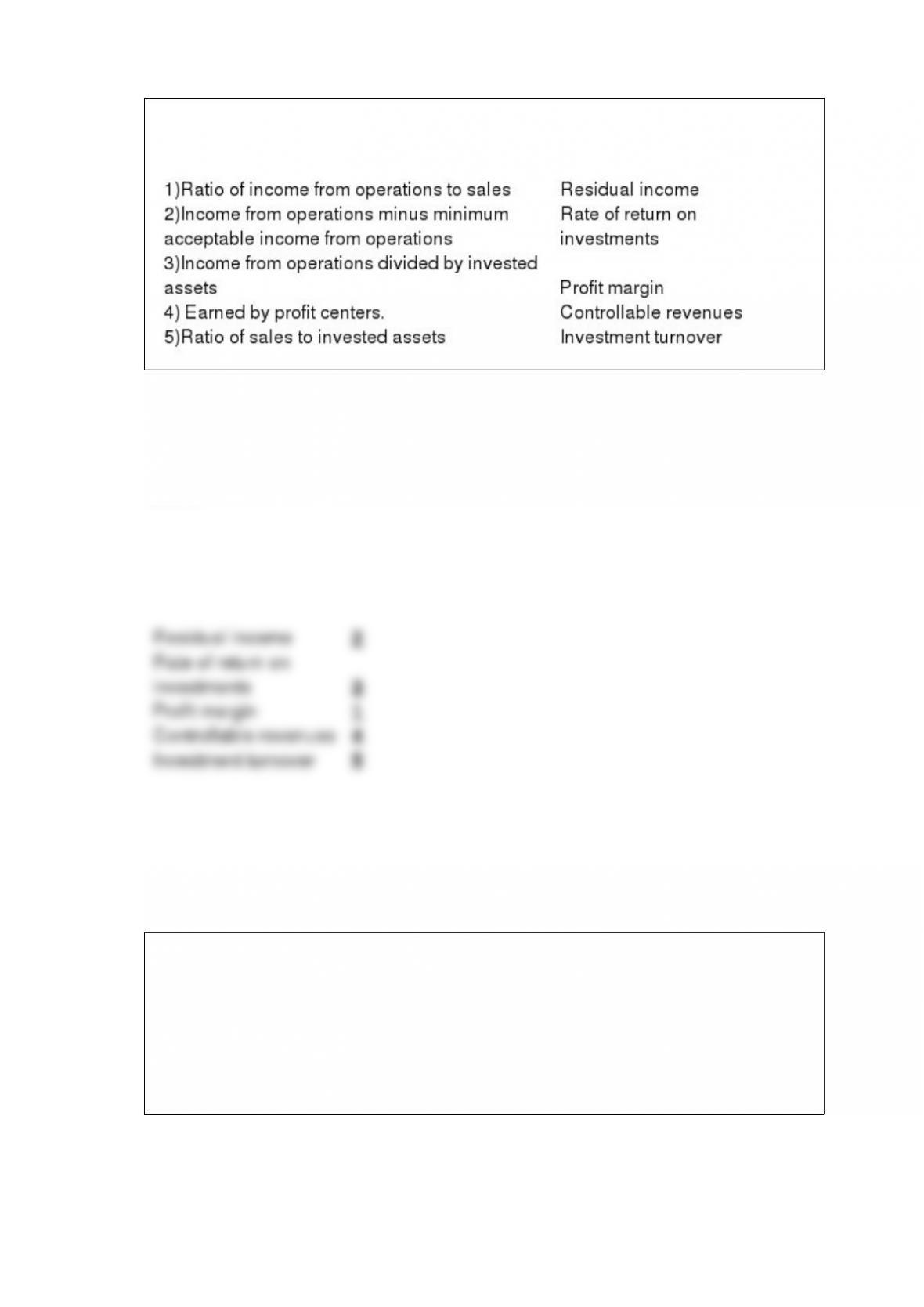
Match the following terms with the best definition given below.
Answer:
Kamin Company’s mixing department had a beginning inventory of 4,000 units which
had accumulated conversion costs of $55,000. During the period, the mixing
department accumulated conversion costs of $92,000 and started 8,000 new units.
Ending inventory was 2,500 units which were 40% complete with respect to conversion
costs. Kamin uses the average cost method to cost inventories.
Calculate the cost per equivalent unit for conversion costs in the mixing department.
Answer:

At December 31st, the Jeter Company had the following ending balances;
Retained Earnings – $100,000
Preferred Stock ($100 par, 7% cumulative, 10,000 authorized, 5,000 issued and
outstanding) – 500,000
Treasury stock – $35,000
Additional paid in capital – common stock – 400,000
Additional paid in capital – preferred stock – 50,000
Common stock ($5.00 par value, 100,000 shares authorized, 60,000 issued) – 300,000
Prepare the stockholders equity section of the balance sheet in good form with all of the
required disclosures. .
Answer:
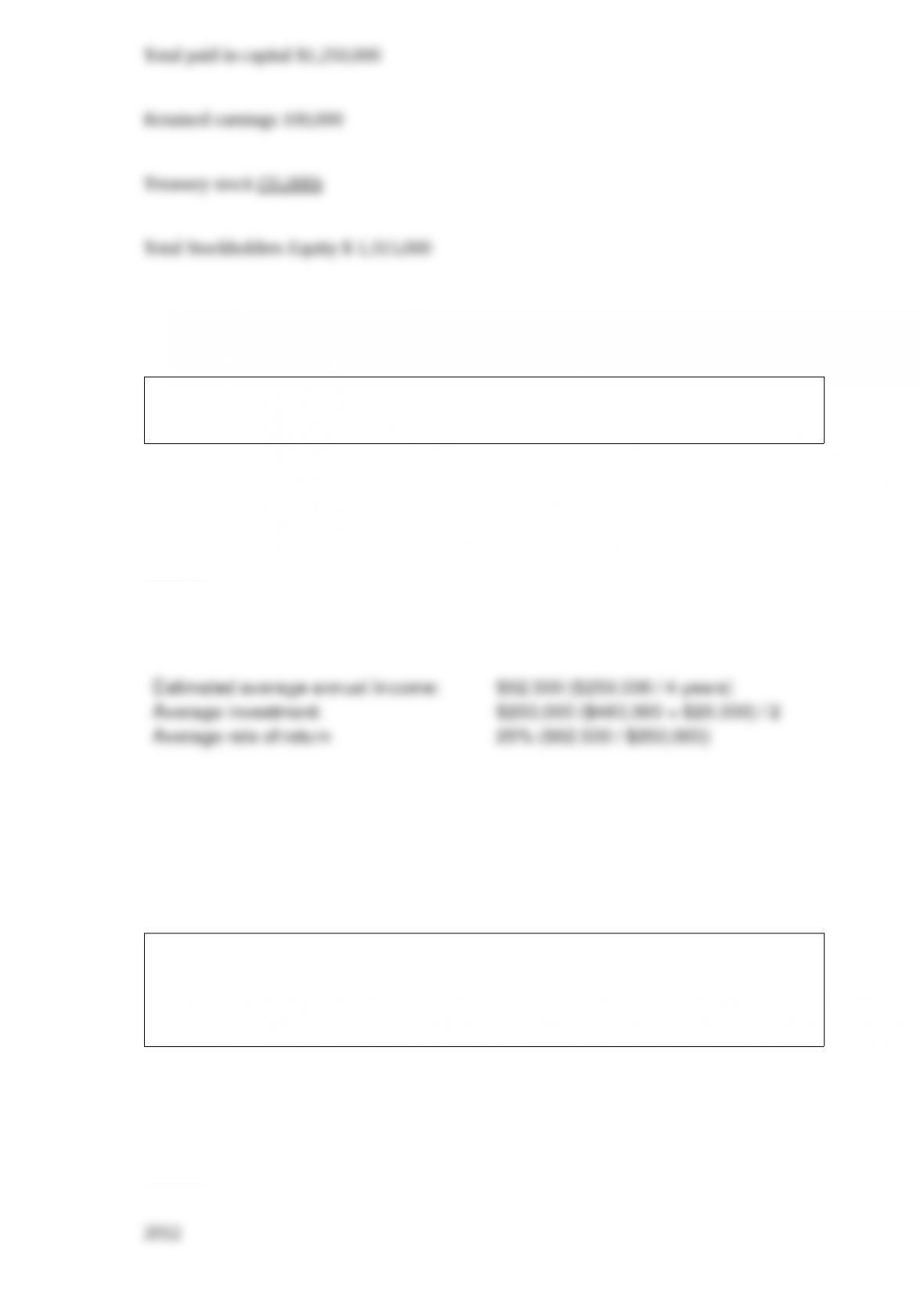
Determine the average rate of return for a project that is estimated to yield total income
of $250,000 over four years, cost $480,000, and has a $20,000 residual value.
Answer:
On January 1, 2012, Valuation Allowance for Available-for-Sale Investments had a zero
balance. On December 31, 2012, the cost of the available-for-sale securities was
$48,700, and the fair value was $39,200. Prepare the adjusting entry to record the
unrealized gain or loss for available-for-sale investments on December 31, 2012.
Answer:
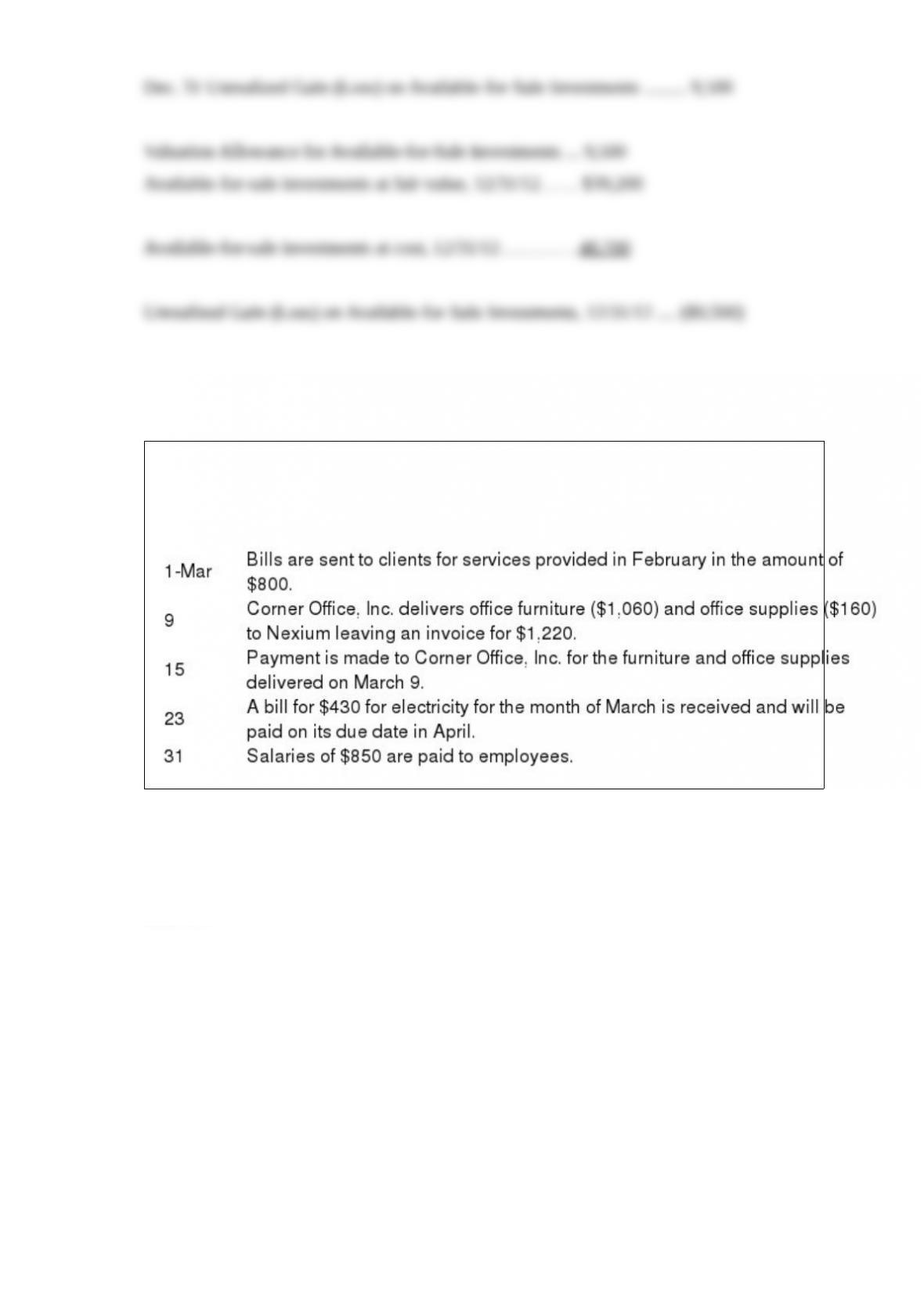
Journalize the following five transactions for Nexium & Associates, Inc. Omit
explanations.
Answer:
Discuss the appropriate financial treatment when an investor has a greater than 50%
ownership in another company.
Answer:
The company determines that the interest expense on a note payable for period ending
December 31st is $775. This amount is payable on January 1st. Prepare the journal
entries required on December 31st and January 1st.

Answer: