When a customer buys services on account, it should be recorded by the company as:
A. a debit to Cash and a credit to Accounts Receivable.
B. a debit to Accounts Receivable and a credit to Revenue.
C. a debit to Services and a credit to Unearned Revenue.
D. a debit to Cash and a credit to Accounts Payable.
Answer:
Which of the following statements regarding financial statements and the trial balance
is correct?
A. Financial statements are prepared only after the adjusted trial balance has shown that
debits equal credits.
B. A post-closing trial balance should be prepared before temporary accounts are
closed.
C. An adjusted trial balance reflects the amount of retained earnings to be shown on the
Balance Sheet.
D. A post-closing trial balance lists all the accounts that are shown on the Income
Statement.
Answer:
The amount of liabilities at the end of the year is
A. $30,000.
B. $33,000.
C. $28,000.
D. $32,000.
Answer:
Stock splits and stock dividends have the following effects on retained earnings:
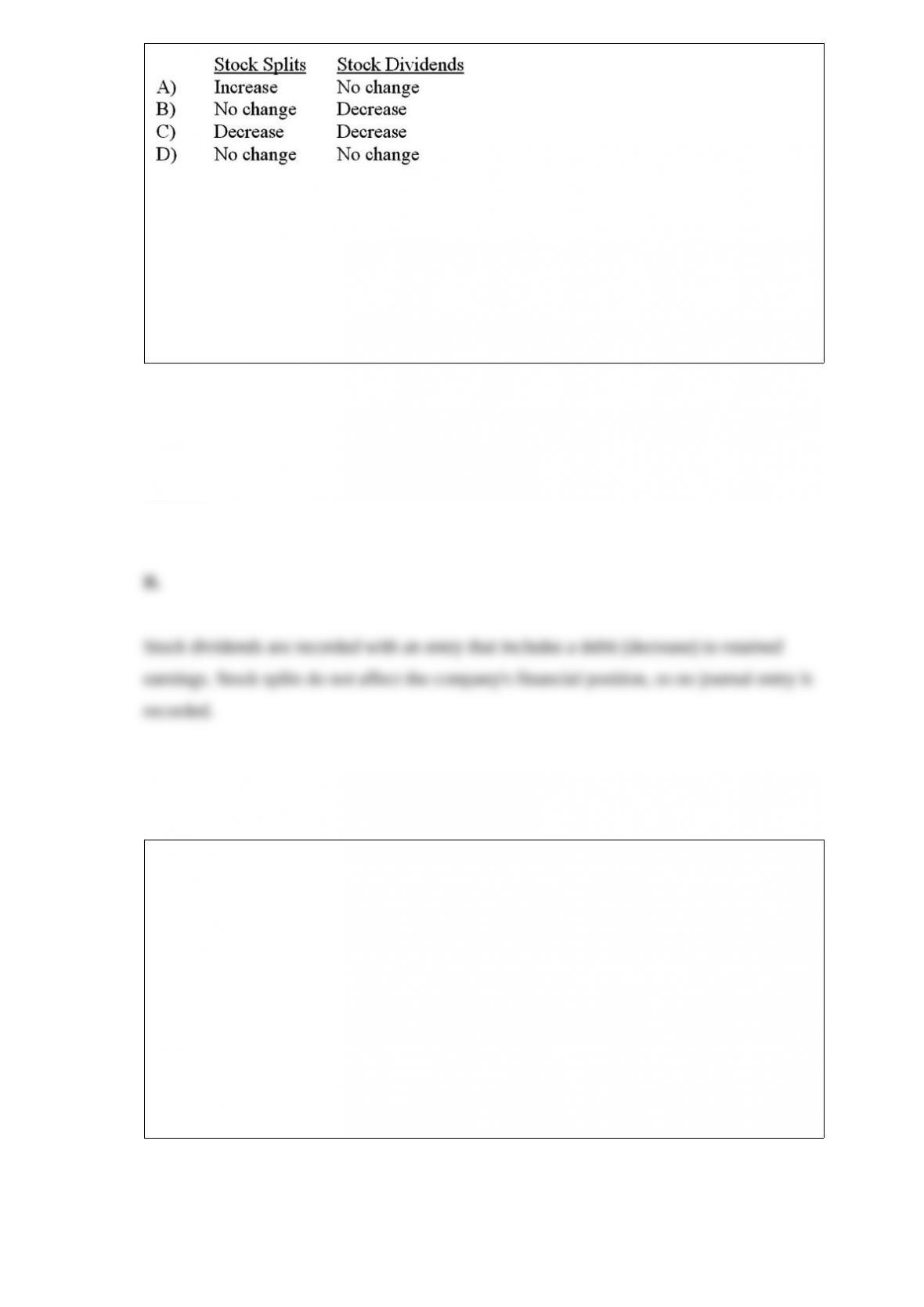
A. Option A
B. Option B
C. Option C
D. Option D
Answer:
Purrfect Pets has a facility that originally cost $375,000. The balance of the
accumulated depreciation account for the facility is $258,000. The company expects to
be able to sell the facility for $107,000 at the end of its useful life. The depreciable cost
of the facility is:
A. $117,000.
B. $151,000.
C. $268,000.
D. $107,000.
Answer:
How will a company’s current ratio be affected by the purchase of equipment for cash?
A. The current ratio will increase because current assets increase.
B. The current ratio will decrease because current liabilities increase.
C. The current ratio will decrease because current assets decrease.
D. The current ratio will remain unchanged.
Answer:
Company X paid Company Y $1.35 million for a new plant. During the same
accounting period, Company X experienced the following changes in its balance sheet:
Cash decreased by $350,000, Accounts Receivable increased by $321,300, Inventory
increased by $275,800, Property, Plant, and Equipment increased by $752,900, and
Bonds Payable increased by $1 million. The net cash flow from financing activities is:
A. An inflow of $1.35 million.
B. An outflow of $350,000.
C. An inflow of $1 million.
D. An inflow of $752,900.
Answer:
A declining fixed asset turnover ratio suggests that a:
A. company is not as efficient in using its fixed assets as it was in previous periods.
B. company’s net sales must be increasing.
C. company must have purchased some intangible assets.
D. company’s beginning fixed asset balance must be greater than its ending fixed asset
balance.
Answer:
Which of the following is not stated as a primary objective of a company’s internal
control policies and procedures?
A. The proper recording and authorization of transactions.
B. The maintenance of adequate records.
C. The prevention or detection of unauthorized activities involving a company’s
records.
D. The provision of current information for outside investors and analysts.
Answer:
Which of the following is not needed to prepare a statement of cash flows?
A. Statement of retained earnings.
B. Comparative balance sheet.
C. Additional information on financing and investing activities.
D. Income statement.
Answer:
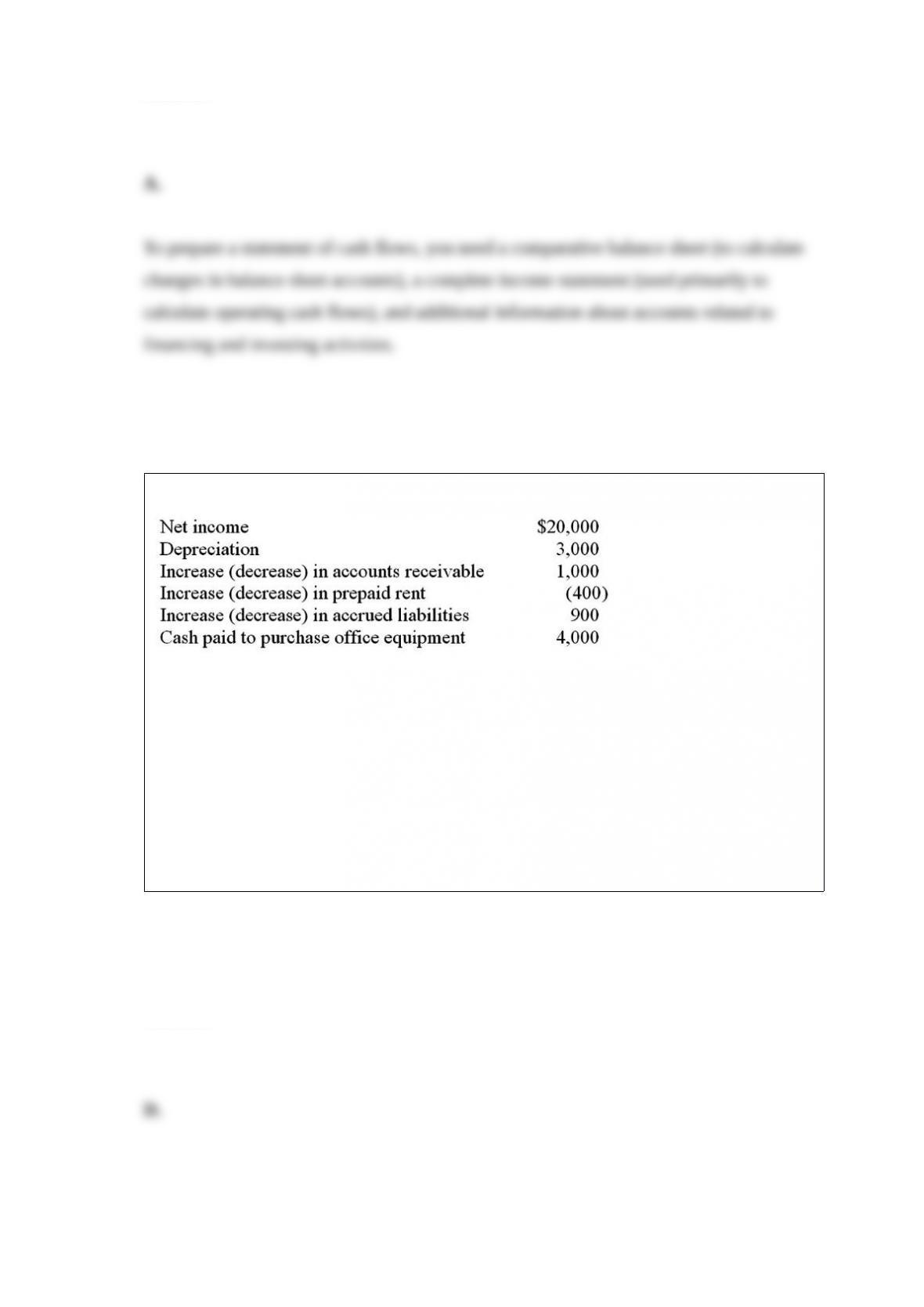
Consider the following information:
The company would report net cash provided by operating activities of:
A. $17,500.
B. $18,500.
C. $21,500.
D. $23,300.
Answer:
If a company achieves a small increase in its gross profit percentage from one year to
the next, the company:
A. will always have a higher net income.
B. must be obtaining products at a lower cost per unit.
C. must have increased its sales revenue.
D. may not have had a volume increase.
Answer:
When the indirect method is used, if prepaid expenses decrease during the accounting
period, the change in prepaid expenses is:
A. added to the change in the cash account.
B. subtracted from net income.
C. added to net income.
D. subtracted from the change in the cash account.
Answer:
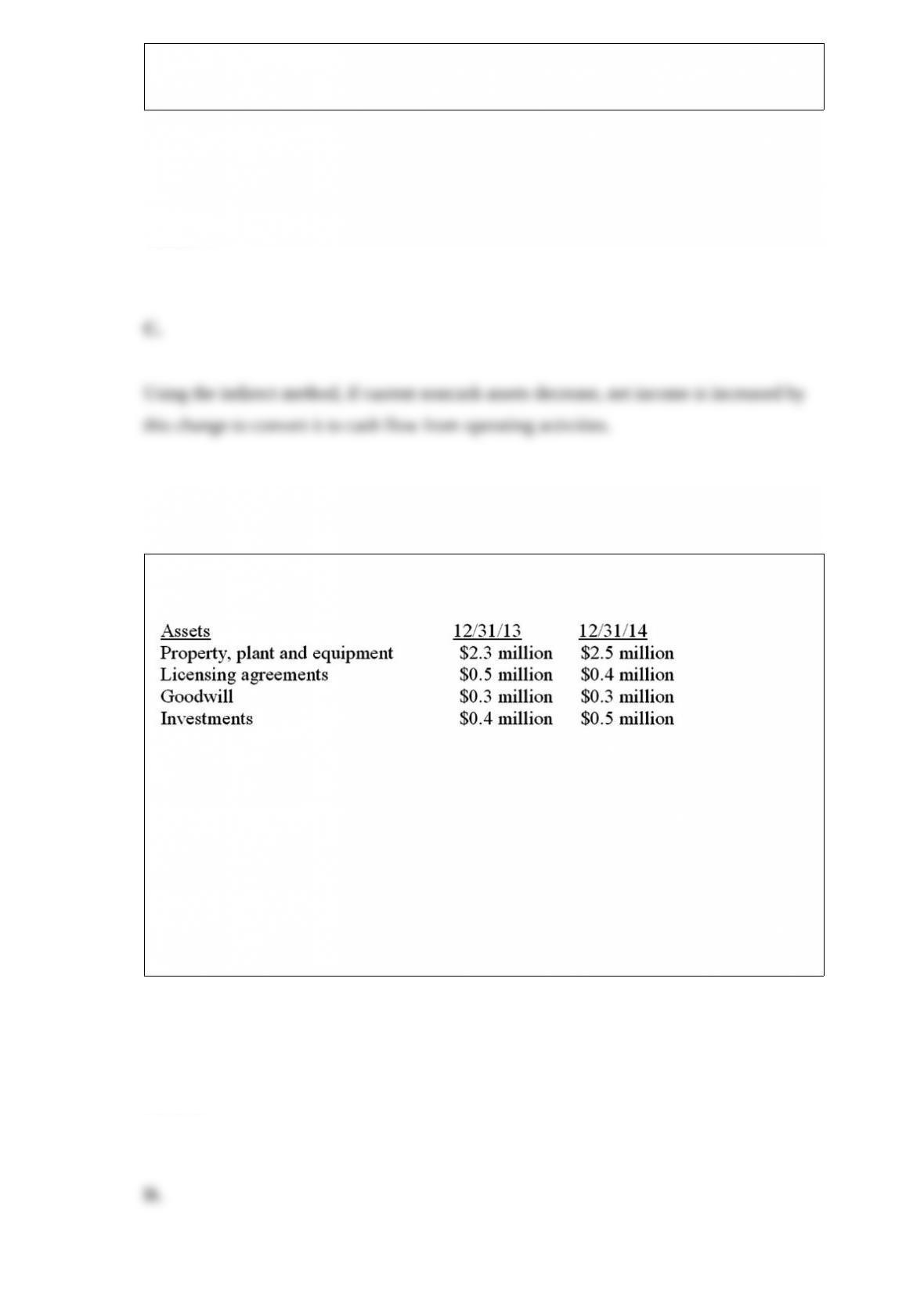
The company has net sales revenue of $3.6 million during 2014. The company’s records
also included the following information:
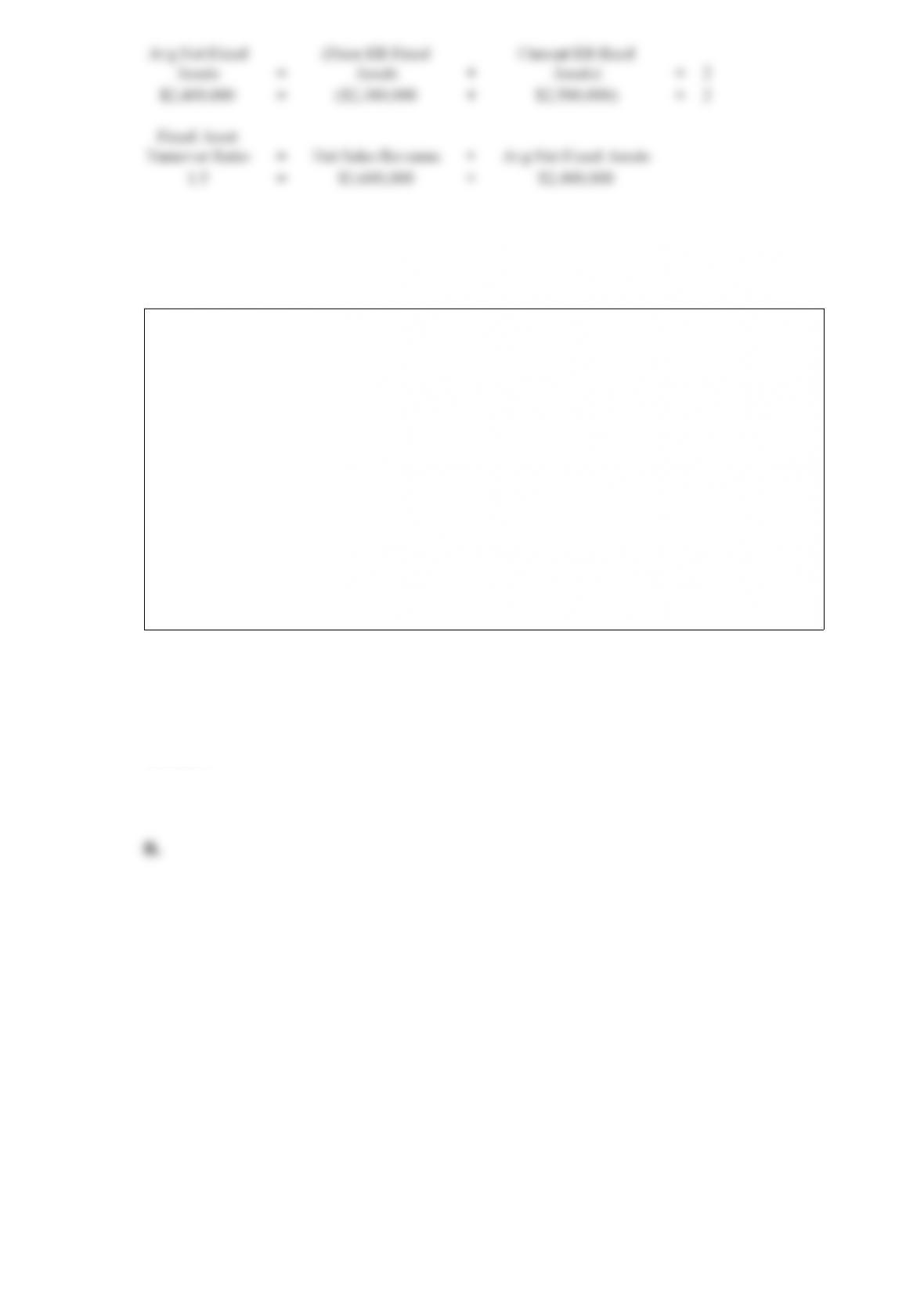
What is the company’s fixed asset turnover ratio for 2014?
A. 18.00
B. 1.33
C. 1.00
D. 1.50
Answer:
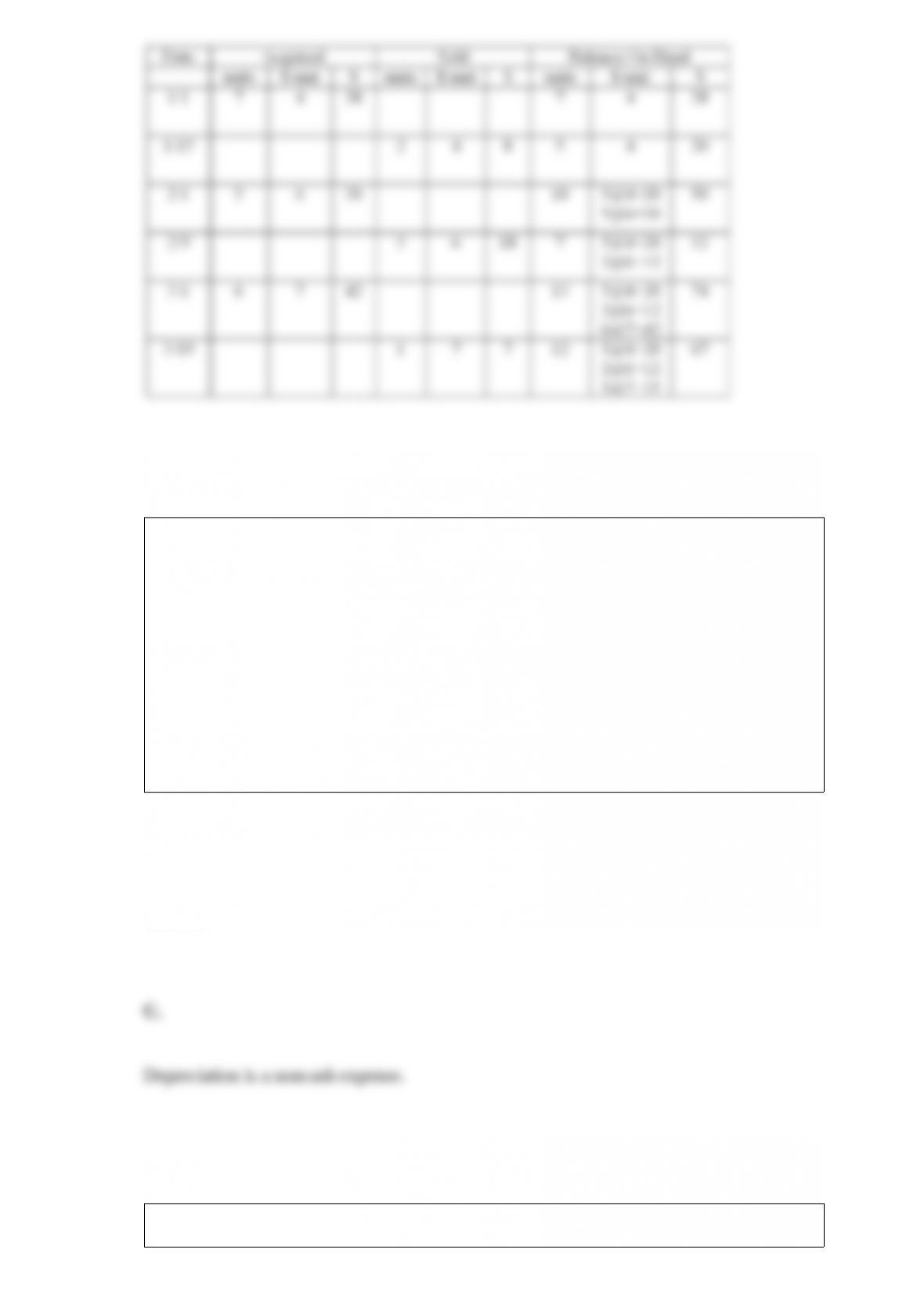
Alphabet Company buys different letters for resale. It buys A thru G on January 1 at $4
per letter, and sells A and E on January 15. On February 1, it buys H thru L at $6 per
letter and sells D, H and J on February 9. It then buys M thru R on March 1 at $7 per
letter and sells N on March 19. If the company uses the LIFO method on a perpetual
basis, what is the cost of its ending inventory (rounded to the nearest dollar)?
A. $58
B. $67
C. $72
D. $76
Answer:
Depreciation expense is $20,000 and the beginning and ending accumulated
depreciation balances are $150,000 and $155,000, respectively. What is the cash paid
for depreciation?
A. $20,000
B. $5,000
C. $0
D. $25,000
Answer:
A company purchased property for $100,000. The property included a building,
equipment and land. The building was appraised at $62,000, the land at $45,000, and
the equipment at $18,000. What is the amount of cost to be allocated to the building in
the accounting records?
A. $0.
B. $49,600.
C. $62,000.
D. $100,000
Answer:
An outdoor water park in the Midwestern states with a calendar year-end is likely to
have:
A. unpredictable fluctuations in cash flow from quarter to quarter.
B. the largest cash inflow from operations in the second and third quarters (April –
September).
C. a fairly stable cash flow across all four quarters.
D. the largest cash inflow from operations in the fourth and first quarters (October –
March).
Answer:
One of the most common sources of misstatement in financial statements is the:
A. use of alternating inventory costing methods.
B. failure to write down inventory when the market value is below cost.
C. failure to report stock issues appropriately.
D. incorrectly calculating the inventory turnover ratio.
Answer:
Net Income is
A. the amount the company earned after expenses and dividends are subtracted from
revenue.
B. the amount by which assets exceed expenses.
C. the amount by which assets exceed liabilities.
D. the amount by which revenues exceed expenses.
Answer:
Which of the following would help a company improve its quick ratio?
A. Borrowing money on a long-term note just before the end of the accounting period.
B. Shifting resources from long-term assets to supplies and inventory.
C. Shifting obligations from long-term liabilities to short-term liabilities.
D. Acquiring inventory by issuing a long-term note.
Answer:
Advantages of the corporate form include all of the following except:
A. Easy to raise capital.
B. Shares can be purchased in small amounts.
C. Ownership interests are transferrable.
D. Unlimited legal liability.
Answer:
Purrfect Pets has a debt-to-assets ratio of 0.55. This means that:
A. stockholders’ equity is 55% of total assets.
B. stockholders’ equity is 45% of total assets.
C. investors provide 55% of the company’s financing.
D. liabilities are 55% of equity.
Answer:
Which of the following journal entries would have an effect on cash from operating
activities?
A. Recording bad debts.
B. Recording depreciation.
C. Recording loss on sale of investment.
D. Recording cash paid for interest on long-term note payable.
Answer:
A company purchased equipment by issuing a $200,000, one-year, 8% note payable.
The transaction would be recorded in the accounting records with a credit to
A. Notes payable for $200,000.
B. Notes payable for $216,000.
C. Notes payable for $184,000.
D. Notes payable for $208,000.
Answer:
Which of the following statements regarding tangible long-lived assets is not correct?
A. Depreciation and maintenance are expenses associated with the use of tangible
long-lived assets.
B. Assuming no additions, replacements, or extraordinary repairs, the carrying value of
a long-lived asset is never more than its original cost.
C. The cost of a long-lived asset minus the accumulated depreciation is called the
carrying value of the asset.
D. All long-lived assets are depreciated as they are used in the business.
Answer:
If a company receives the rent for January 2014 from a tenant in December 2013, this
will be reported as:
A. revenue in 2013.
B. an expense in 2013.
C. a liability in 2013.
D. stockholders’ equity in 2013.
Answer:
The common characteristic possessed by all assets is
A. long life.
B. great financial value.
C. physical substance.
D. future economic benefit.
Answer:
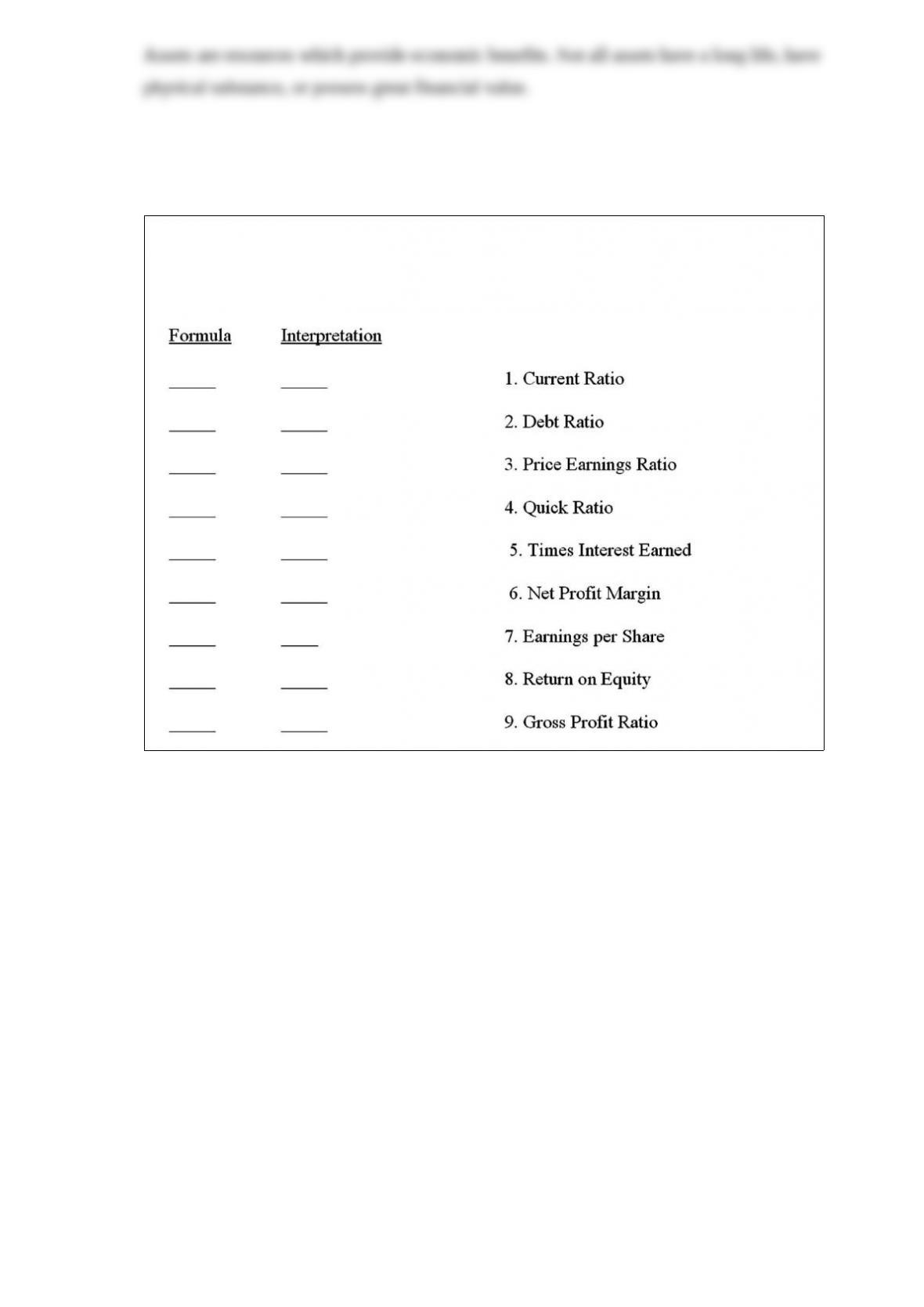
Fill in the Formula blank with the letter that corresponds to the correct formula for
each ratio. Fill in the Interpretation blank with the letter that corresponds to the
interpretation provided.
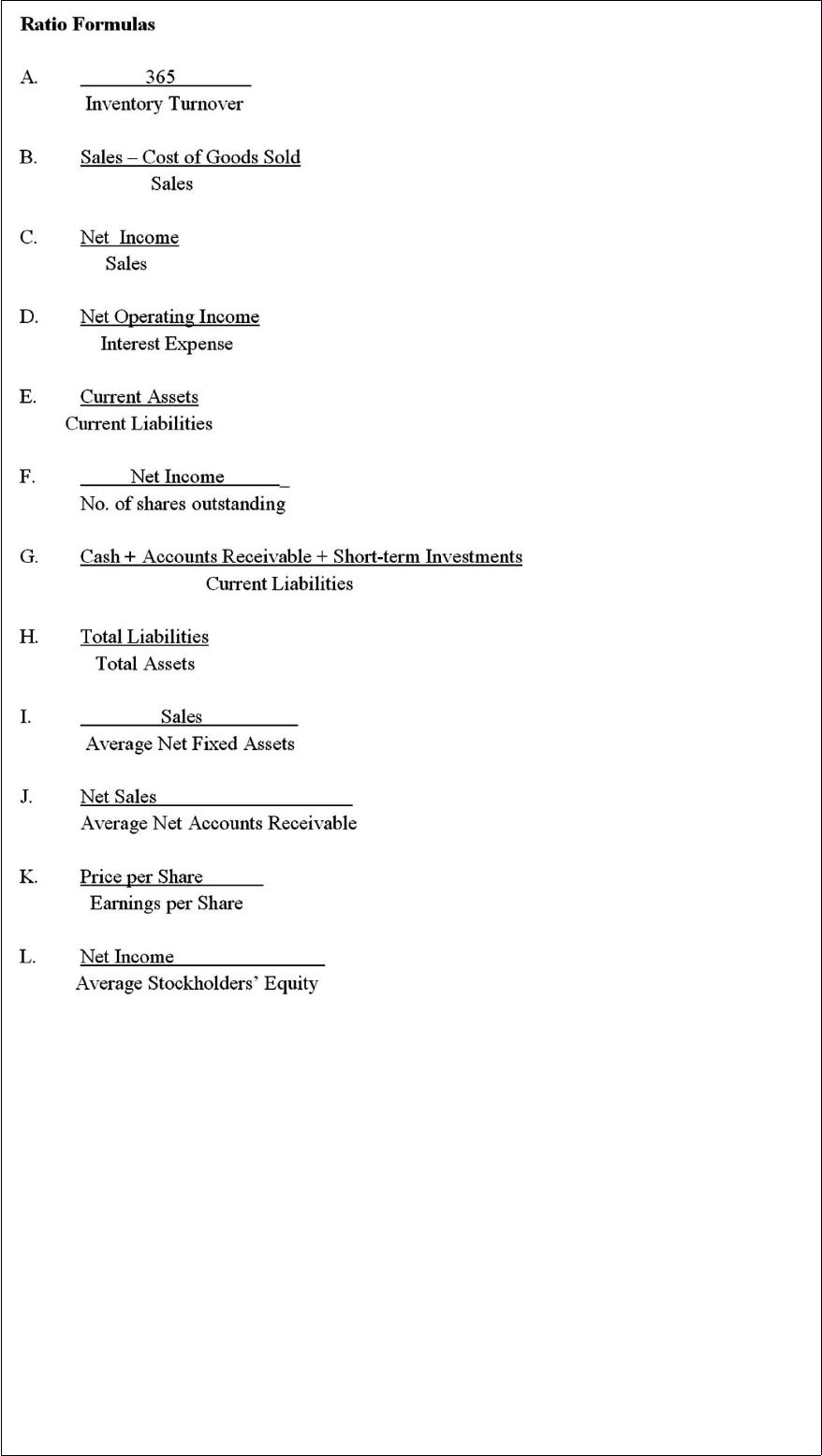
Ratio Interpretations
A. The portion of sales that is attributable to merchandise profit.
B. Ability of a company to pay its short-term debts as they come due.
C. How quickly a company is collecting amounts owed to it by customers.
D. How well a company can afford to make interest payments on its debt.
E. The percent of each sales dollar that is left over after covering costs and expenses.
F. How much investors are willing to pay for a dollar of the company’s earnings.
G. Ability of a company to quickly pay its short-term debts as they come due.
H. The portion of a company’s total financing that comes from debt.
I. How long it takes a company to sell its merchandise.
J. The net income of a company that is attributable to a single share of stock.
K. How effectively a company is using its assets to generate revenue.
L. How much profit is generated for each dollar invested by stockholders.
Answer:
Which of the following is NOT one of the requirements of the Sarbanes-Oxley Act
(SOX)?
A. SOX requires an assessment by management of the internal control structure.
B. SOX states that the board of directors is required to establish an audit committee to
oversee financial matters of the company.
C. SOX requires the external auditors to test the effectiveness of internal controls and
issue a report which gives an opinion on the effectiveness of the internal controls.
D. SOX requires that all employees adopt a code of ethics.
Answer: