
Shareholders use audit reports to monitor management performance. An example of an
item that an audit report does NOT provide is:
a. Reasonable assurance on reported information that might be used to provide
justification for management’s performance-based compensation.
b. Access to foreign markets.
c. An indication of whether or not a company has major problems in its internal control
over financial reporting.
d. Feedback on any ICFR material weaknesses that management may choose to use to
improve operational or financial efficiency.
Account analyses are:
a. tests of balances.
b. tests of transactions.
c. Both a and b.
d. None of the above.
A retail entity’s primary business activity is selling finished goods inventory to a
customer for:

a. credit.
b. cash.
c. cash or on credit.
d. credit with monthly payments.
e. credit for one year or more.
An auditor requests a tour of the production facilities prior to observing inventory. The
reason for this is:
a. to observe the state of the physical plant.
b. to observe the layout of the plant.
c. to observe how production flowed.
d. None of the above.
An auditor is responsible for communicating which of the following matters to the audit
committee?
a. Audit adjustments.
b. Consultation with other accountants.

c. Disagreements with management.
d. All of the above.
In order for an auditor to test ownership of a client’s inventories, each of the following
substantive tests of details of account balances are appropriate except:
a. review loan agreements for inventory that has been pledged or assigned.
b. review sales agreements for bill-and-hold arrangements.
c. review contracts for inventory held on consignment.
d. review policy for asset impairment write-downs.
Which of the following is not an acceptable manner of testing an audit client’s
estimates?
a. Compare subsequent actual amounts to the accounting estimates.
b. Recalculate accounting estimates using management’s process.
c. Prepare an independent estimate and compare with management’s result.
d. Observe management’s process of calculating estimates.

Which of the following would be a control deficiency?
(a) The person assigned to implement the control does not understand how to do so.
(b) The control does not allow management to detect or prevent a material
misstatement.
(c) The control does not operate as intended.
(d) All of the above.
You are assigned to audit accounts payable for a manufacturing client. As part of the
planning, your manager sets a tolerable misstatement amount of+/- $125,000. Your
review of unpaid invoices indicates an understatement error of $25,253 from a sample
of $675,467. The population value of A/P is $5,241,687 at October 31st. The remaining
unadjusted difference (rounded) is:
a. $6,998.
b. $150,253.
c. $131,998.
d. $12,998.

What purpose does a purchase requisition serve?
a. It describes why something needs to be purchased.
b. It provides evidence for the purchase.
c. It separates the requisition from the purchase.
d. Both b and c.
Reviewing sales invoices and asking a sales manager to explain why a price deviation
occurred is an example of which audit testing procedure(s):
(a) observation.
(b) inquiry.
(c) inspection.
(d) Both b and c.

Write-offs of doubtful accounts should be approved by:
a. the salesperson.
b. the credit manager.
c. the treasurer.
d. the cashier.
e. the C.E.O.
The foreseen third-party rule states:
a. Auditors can be held liable for damages to plaintiffs even if they are not known to the
auditor.
b. The auditor is liable to third parties not normally having privity.
c. The plaintiff does not have to show standing.
d. Both a and b.
Negligence is defined as:
a. Conduct which falls below the standards established by law.
b. Conduct which violates the audit standards.
c. Conduct which fails to detect a misstatement in the financial statements.
d. Both a and b.

The limitations of an audit which are documented in an engagement letter pertain to
each of the following except:
(a) material errors or illegal activities having a direct and material financial statement
impact may not be detected because of the judgmental nature of many audit areas and
the fact that detailed tests are not performed for all types of transactions.
(b) fraudulent activities having a direct and material financial statement impact may not
be detected because of the nature of fraud, including the possibility of the perpetrator’s
concealment efforts and/or management’s override of controls.
(c) internal controls may change or deteriorate such that they may not be effective in the
prevention or detection of future material misstatements in the financial statements.
(d) under the standards established by the PCAOB, the auditor’s responsibilities for
communicating internal control weaknesses are limited to notification to the company’s
shareholders regarding material weaknesses.
The engagement letter states that auditors are responsible for informing the client’s
audit committee about certain matters related to the conduct of the audit, including any:
(a) serious difficulties encountered in performing the audit.
(b) disagreements among audit team members pertaining to conclusions reached during
the audit.
(c) revisions made in the nature of audit tests performed as a result of information
discovered during the course of the audit.

(d) changes in the company’s operational procedures during the year.
An example of an incentive/pressure for fraudulent financial reporting risk factor is
(a) a threat to the client company’s financial stability caused by rapid growth compared
to that of other companies in the same industry.
(b) significant operations located across international borders in jurisdictions where
differing business environments exist.
(c) inadequate job applicant screening processes for employees with access to cash.
(d) ineffective communication of the company’s ethical standards by management.
Samantha is a senior manager at a national CPA firm. She has recently taken over the
planning responsibilities on her firm’s largest client, a midsize publicly traded company
with multiple subsidiaries around North America. The client chose her firm primarily
because of its cost efficiencies compared to those of larger firms. The client is publicly
traded, so Samantha is planning an integrated audit as well as quarterly review work.
(a) How will each of the following concepts affect Samantha’s audit planning?
(1) Nature
(2) Timing
(3) Extent
(b) Should Samantha consider the audit budget when planning the audit?
Explain, particularly addressing pressures to limit any audit procedures to keep the
budget within an expected range.
Auditing of interbank transfers occurs:
(a) at year-end.
(b) after year-end.
(c) prior to year-end.
(d) All of the above, depending on the circumstances.

The Board of Directors:
a. Reports to management.
b. Runs the company on a day-to-day basis.
c. Is elected by the shareholders.
d. All of the above.
Which of the following procedures ordinarily should be applied when an independent
accountant conducts a review of interim financial information of a publicly held entity?
a. Verify changes in key account balances.
b. Inspect the open purchase order file.
c. Perform cut-off tests for cash receipts and disbursements.
d. Recalculate important estimates.
e. Read the minutes of the board of directors’ meetings.

Which of the following statements is true regarding the complex nature of inventory
accounting in the land development and home building industry?
a. Common costs, such as capitalized interest, often require complex calculations.
b. The size and type of units to which costs must be allocated for a single parcel of land
may vary considerably.
c. Costs associated with zoning applications and legal fees may occur in periods prior to
the land acquisition.
d. All of the above are true.
Detail tests of balances for debt include:
(a) sending confirmations to creditors requesting information concerning outstanding
debt.
(b) a search of activity subsequent to year-end for any payments linked to debt that was
not disclosed.
(c) a search of the cash receipts journal for amounts received relating to new debt.
(d) All of the above.
Tracing the amounts used to calculate payroll to the source documents tests which
assertion?

a. Existence.
b. Authorization.
c. Valuation.
d. Both a and b.
Match the type of evidence below with the correct example. You may use each type
more than once and more than one type may be present.
EVIDENCE TYPE:
1> Observation
2> Inquiry
3> Reperformance
4> Inspection
EXAMPLES:
(a) James discuss reasons for the large cost variances with the Cost Accounting
manager.
(b) Marie calculates the debits to inventory in order to determine if the correct standard
costs were used.
(c) Jenny tours the factory prior to the start of year-end inventory.
(d) Mary Ellen examines paid invoices for proper approval.
(e) Joe retraces journal entries to the sources documents for accuracy and correct
posting.
(f) Carlos performs test counts during inventory observation and also evaluates the
goods’ physical condition.
(g) Dennis interviews the plant manager regarding new equipment purchased during the
past year. He then tours the plant to verify the equipment exists.
(h) Dennis requests that the machine be turned on to determine if it operates.
(i) Manuel uses CAAT software that foots and cross-foots the general ledger.
(j) Daniel reviews the results of positive confirmations from the client’s customers.
The audit planning meeting must
(a) take place before the client acceptance decision is made.
(b) be attended by the entire core engagement team and the predecessor auditors.
(c) establish an understanding among the members of the audit team about the
objectives of the audit.
(d) prepare the internal auditors for the work they will be asked to perform to
supplement the auditor’s procedures.

Sufficient evidence may be provided without examining all of the transactions in an
account balance is the auditor uses well-designed
(a) sampling approaches
(b) internal control procedures
(c) inspection techniques
(d) assertions related to the fair presentation of account balances.
GAAP requires the use of _______ costing for accumulating all direct and allocated
costs to inventory units.
a. job order
b. absorption
c. backflush
d. fair value

Stock compensation plans are frequently valued:
a. using the Black-Scholes model.
b. by the auditor.
c. by specialists within the audit firm.
d. Both a and c.
An output control needed regardless of who processes payroll is:
a. agree record counts, hash totals, and control totals after processing to the input.
b. agree record counts, hash totals, and control totals to the input.
c. agree record counts and control totals to the input and output.
d. None of the above.
An audit engagement letter:
(a) is prepared by the client company and signed by a representative of the audit firm.
(b) provides a guarantee that the auditor will express an opinion as a result of the audit.
(c) is signed by management at the conclusion of the audit engagement.

(d) specifies that management is responsible for establishing and maintaining effective
ICFR.
The auditor’s responsibility for fraud:
a. ends as of the balance sheet date.
b. ends as of the date of the audit report.
c. ends as of the withdrawal from the client.
d. essentially never ends.
What is the purpose of a financial statement audit?
a. To provide assurance that the company is solvent.
b. To provide assurance that the company has an effective internal control system that
can produce fair financial statements.
c. To provide assurance that the financial statements are reliable.
d. Both b and c.
The integrity of management plays a key role in deciding whether or not to accept a
client.
The foreseeable third-party doctrine of standing has yet to be used as a viable
requirement of standing in a case against auditors.Why may such a doctrine be
catastrophic to auditors? Why may such a doctrine be catastrophic to society as a
whole if all auditors believe their business risks outweigh their benefits.
The auditor begins with tests of internal control.
An audit plan will be the same regardless of whether the client company outsources its
financial activities to a service provider or conducts the activities in house.
An operating deficiency occurs when a control fails to prevent or detect a material
misstatement.
An auditor’s quality control (QC) standards provide important benchmarks against
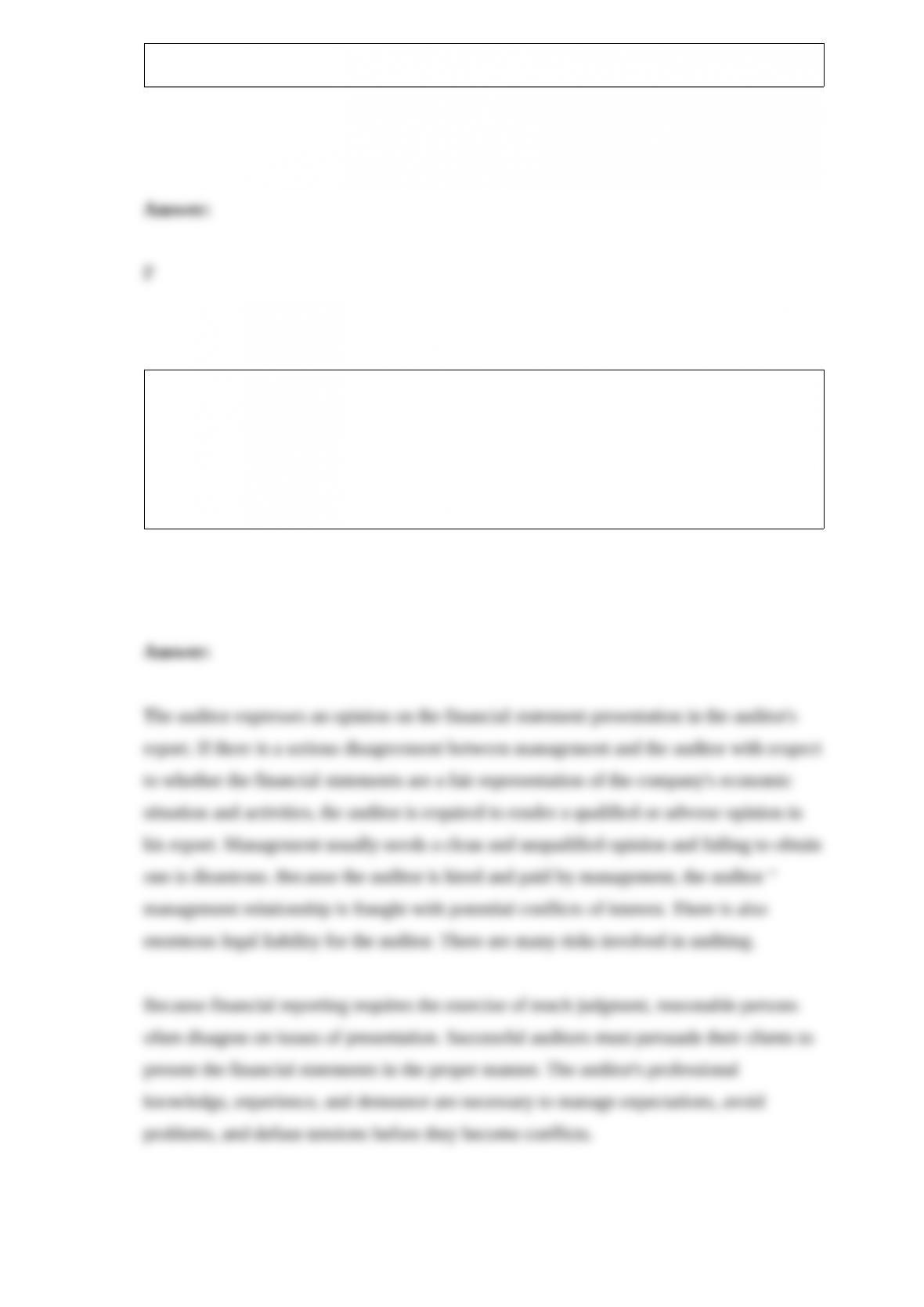
which an auditor can assess the quality of a potential client.
Auditors cannot change the financial statements. Explain the influence the auditor has
on management’s decisions regarding financial statement presentation. Also, explain
your perception of the possible tension created by any power struggle inherent in the
management”auditor relationship. How do you think auditors should respond when
management wants the company’s financial statements to be presented in a certain way
but the auditor disagrees?
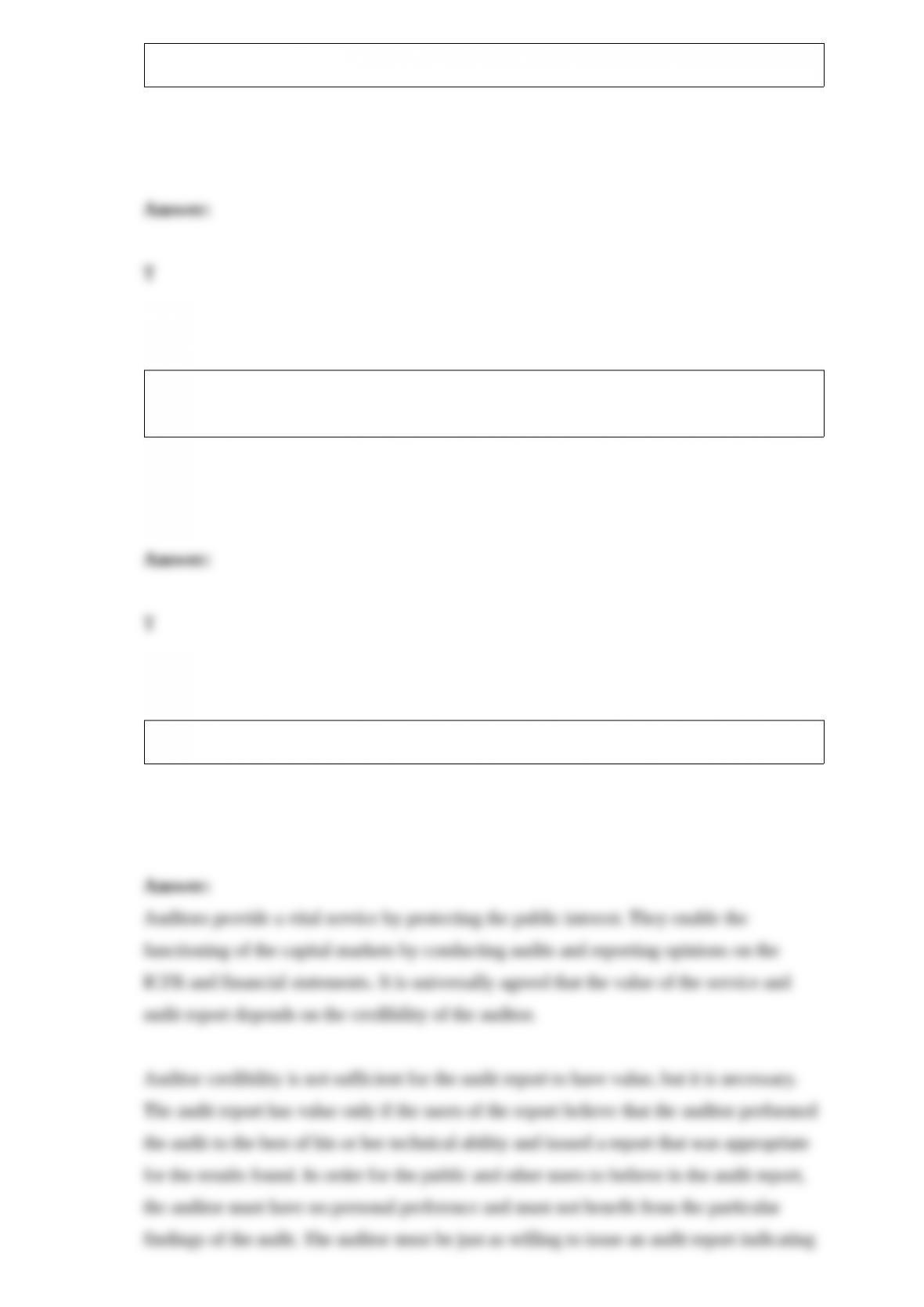
Obsolete inventory is an example of inherent risk.
Scaling the audit refers to fitting the audit work into the proper context in terms of the
engagement’s size, environment, and complexity.
Why is it necessary for an auditor to be independent?
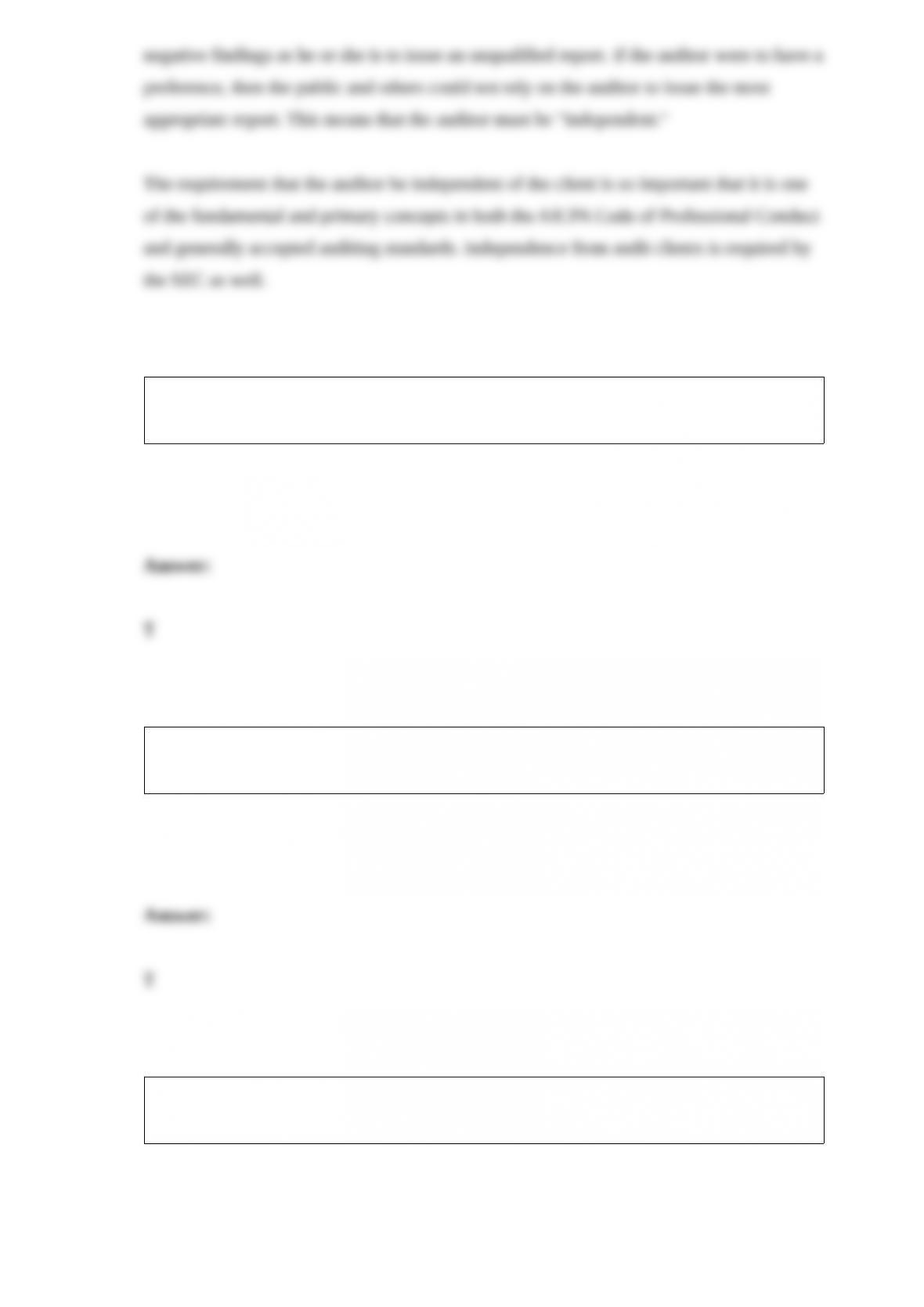
Quality Control (QC) Standards provide guidance for public accounting firms regarding
policies needed for well-functioning, well-monitored practices.
The concept of independence from the Institute of Internal Auditors standpoint is
different from its meaning in the context of an AICPA or PCAOB audit.
Many people misunderstand forensic accounting and believe it is limited to fraud
investigations.
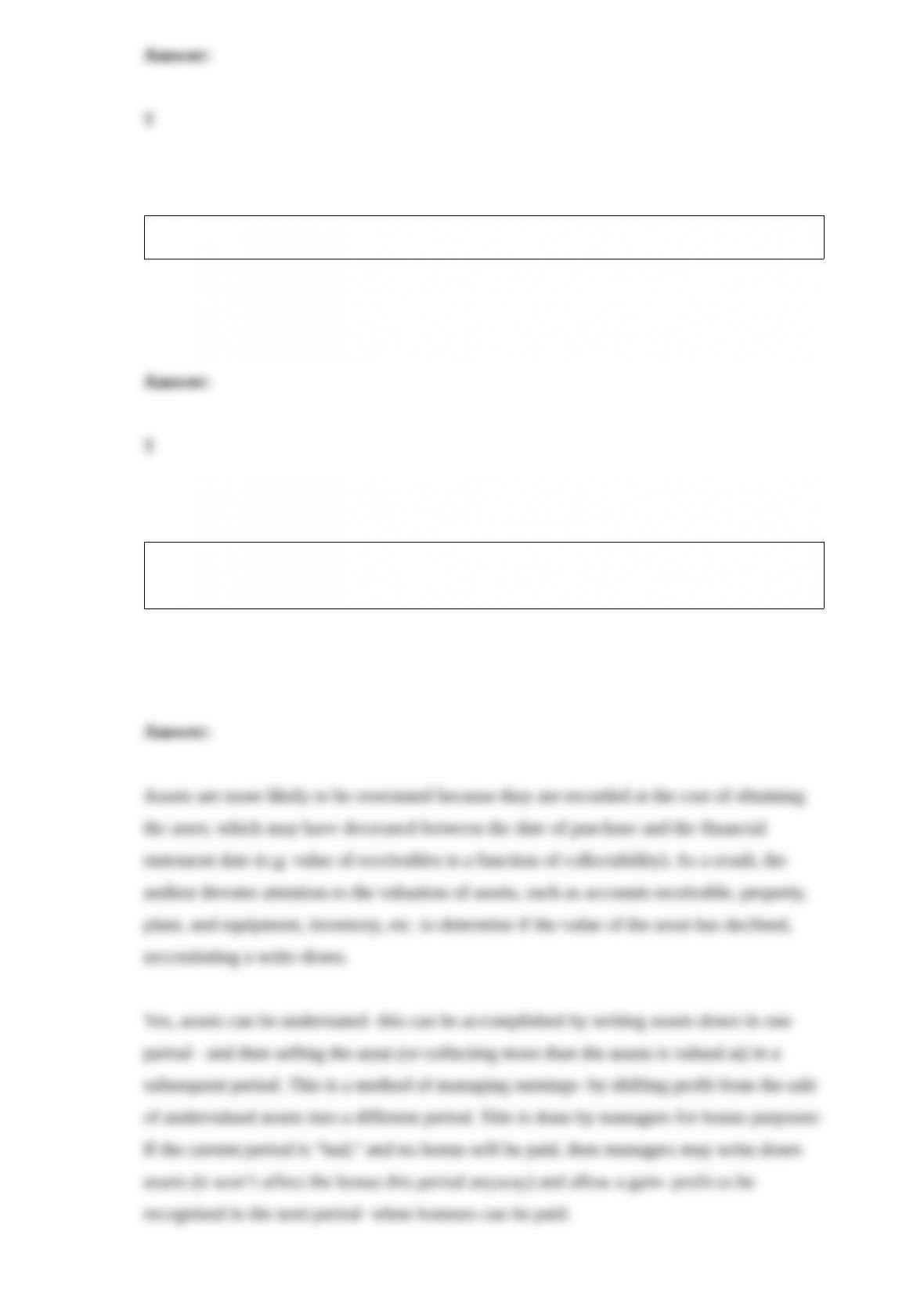
An audit of a public company is referred to as an integrated audit.
Discuss why assets are more likely to be overstated than understated. What effect does
this have on the auditor’s emphasis in the audit of assets?
Self-regulation is not a right granted to most professions, including accountants.