1) Significant sunk costs are relevant to decisions about the future.
2) A measure used to evaluate the manager of an investment center is return on total
costs for the investment center.
3) Total depreciation expense over an asset’s useful life will be identical under all
methods of depreciation.
4) The cash basis of accounting is an accounting system in which revenues are recorded
when cash is received and expenses are recorded when cash is paid.
5) Ending capital reported on the statement of owner’s equity is calculated by adding
owner investments and net losses and subtracting net incomes and withdrawals.
6) A work sheet is a substitute for the set of financial statements.
7) A company with a high inventory turnover requires a smaller investment in inventory
than one producing the same sales with a lower turnover.
8) If a company reporting on a calendar year basis, paid $18,000 cash on January 1 for
one year of rent in advance and adjusting entries are made at the end of each month, the
balance of Prepaid Rent as of December 1 should be $1,500.
9) Manufacturers usually have three inventories: raw materials, goods in process, and
finished goods.
10) Notes receivable are classified as current liabilities.
11) Morgan Company purchased 2,000 shares of Asta’s common stock for $143,000 as
a long-term investment. The investment is classified as available-for-sale securities. The
par value of the stock was $1 per share. Morgan paid $375 in commissions on the
transaction. The entry to record the transaction would include a:
A.Credit to Common Stock for $2,000
B.Credit to Common Stock for $143,000
C.Credit to Common Stock for $143,375
D.Debit to Long-Term Investments-AFS for $143,000
E.Debit to Long-Term Investments-AFS for $143,375
12) Use the following information to determine the ending cash balance to be reported
on the month ended June 30 cash budget.
a. Beginning cash balance on June 1, $94,000.
b. Cash receipts from sales, $413,000.
c. Budgeted cash disbursements for purchases, $268,000.
d. Budgeted cash disbursements for salaries, $95,000.
e. Other budgeted expenses, $57,000.
13) On April 1, 2010, a company discarded a computer that cost $15,000 and that had a
useful life of 4 years, and a salvage value of $1,000. Based on straight-line
depreciation, the accumulated depreciation as of December 31, 2009 was $10,700.
a. Prepare the journal entry to record depreciation up to the date of disposal of the
computer.
b. Prepare the journal entry to record the disposal of the computer.
14) A company had net cash flows from operations of $120,000, cash flows from
financing of $330,000, total cash flows of $500,000, and average total assets of
$2,500,000. The cash flow on total assets ratio equals:
A.4.8%
B.5.0%
C.20.0%
D.20.8%
E.24.0%
15) A company sells computers with a 6-month warranty. In January, the company sold
100,000 computers at $1,750 each; and 1,500 computers were turned in for repairs
during that same month. The total repairs amounted to $185,000 costs from the
computer parts inventory. It is estimated that 2% of all units sold will need repairs under
warranty at an estimated cost of $200 per unit. Prepare the journal entries to record (a)
estimated warranty expense for January and (b) warranty repair costs for January.
16) The controlling investor is called the:
A.Owner
B.Subsidiary
C.Parent
D.Investee

E.Senior entity
17) Long-term investments are reported in the:
A.Current asset section of the balance sheet
B.Intangible asset section of the balance sheet
C.Non-current section of the balance sheet called long-term investments
D.Plant assets section of the balance sheet
E.Equity section of the balance sheet
18) Walker Corporation issued 14%, 5-year bonds with a par value of $5,000,000 on
January 1, Year 1. Interest is to be paid semiannually on each June 30 and December
31. The bonds are issued at $5,368,035 cash when the market rate for this bond is 12%.
(a) Prepare the general journal entry to record the issuance of the bonds on January 1,
year 1
(b) Show how the bonds would be reported on Walker’s balance sheet at January 1, Year
1
(c) Assume that Walker uses the effective interest method of amortization of any
discount or premium on bonds. Prepare the general journal entry to record the first
semiannual interest payment on June 30, Year 1
(d) Assume instead that Walker uses the straight-line method of amortization of any
discount or premium on bonds. Prepare the general journal entry to record the first
semiannual interest payment on June 30, Year 1
19) On February 15, Seacroft buys 7,000 shares of Kebo common stock at $28.53 per
share plus a brokerage fee of $400. The stock is classified as available-for-sale
securities. On March 15, Kebo declares a dividend of $1.15 per share payable to
stockholders of record on April 15. Seacroft received the dividend on April 15 and
ultimately sells half of the Kebo stock on November 17 of the current year for $29.30
per share less a brokerage fee of $250. The journal entry to record the purchase on
February 15 is:
A.Debit Long-Term Investments-HTM $199,710; credit Cash $199,710
B.Debit Long-Term Investments-AFS $199,710; credit Cash $199,710
C.Debit Long-Term Investments-Trading $199,710; credit Cash $199,710
D.Debit Long-Term Investments-Trading $200,110; credit Cash $200,110
E.Debit Long-Term Investments-AFS $200,110; credit Cash $200,110
20) A company had net sales of $31,500 and ending accounts receivable of $2,700 for
the current period. Its days’ sales uncollected equals:
A.11.7 days
B.23.3 days
C.31.3 days
D.42.5 days
E.46.6 days
21) On March 17, Grady Company agrees to accept a 60-day, 10%, $4,500 note from
Alert Company to extend the due date on an overdue account. What is the journal entry
needed to record the payment of the note by Alert Company on the maturity date?
A.Debit Notes Payable $4,500; debit Interest Expense $75; credit Cash $4,575
B.Debit Notes Payable $4,500; credit Interest Expense $75, credit Cash $4,425
C.Debit Cash $4,575; credit Interest Revenue $75; credit Notes Payable $4,500
D.Debit Notes Payable $4,500; debit Interest Expense $112; credit Cash $4,612
E.Debit Cash $4,575; credit Interest Revenue $75; credit Notes Receivable $4,500
22) A responsibility accounting performance report reports:
A.Only actual costs
B.Only budgeted costs
C.Both actual costs and budgeted costs
D.Only direct costs
E.Only indirect costs
23) In comparison to a general accounting system for a manufacturing company, a cost
accounting system places an emphasis on:
A.Periodic inventory counts
B.Total costs
C.Continually updating costs of materials, goods in process, and finished goods
inventories
D.Products and average costs
E.Large volume operations involving standardized products
24) The comparison of a company’s financial condition and performance to a base
amount is known as:
A.Financial reporting
B.Horizontal ratios
C.Investment analysis
D.Risk analysis
E.Vertical analysis
25) Dell Builders manufactures each house to customer specifications. It most likely
would use:
A.Process costing
B.A periodic inventory system
C.Unique costing
D.Job order costing
E.Activity-based costing
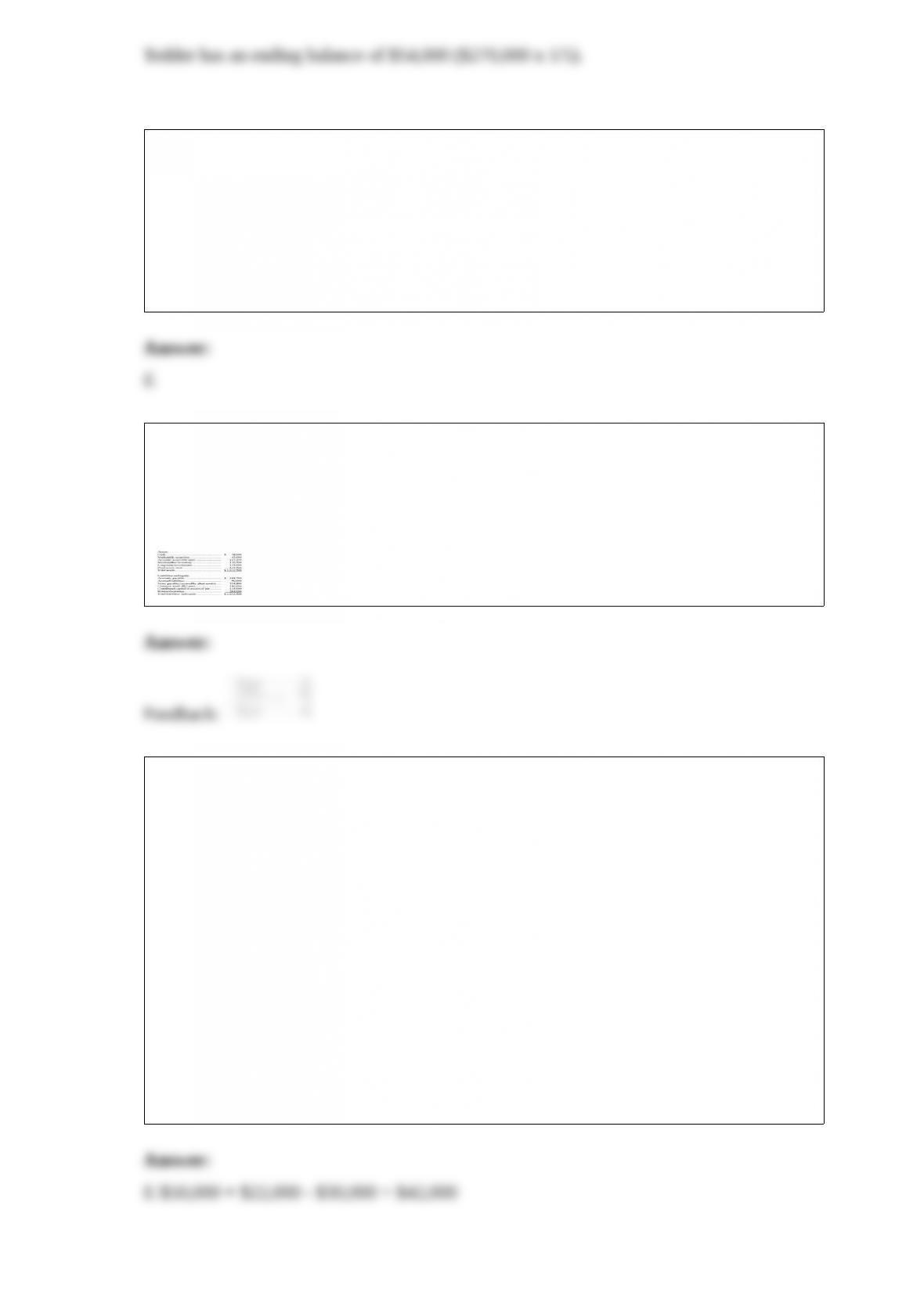
26) The following information is available on Stewart Enterprises, a partnership, for the
most recent fiscal year:
There are three partners in Stewart Enterprises: Stewart, Tedder and Armstrong. At the
end of the year, the partners’ capital accounts were in the ratio of 2:1:2, respectively.
Compute the ending capital balances of the three partners.
A.Stewart = $108,000; Tedder = $54,000; Armstrong = $108,000
B.Stewart = $90,000; Tedder = $90,000; Armstrong = $90,000
C.Stewart = $204,000; Tedder = $102,000; Armstrong = $204,000
D.Stewart = $84,000; Tedder = $102,000; Armstrong = $84,000
E.Stewart = $60,000; Tedder = $30,000; Armstrong = $60,000
27) The retirement of stock:
A.Reduces the number of issued shares
B.Does not reduce the number of authorized shares
C.Removes all paid-in capital amounts related to the retired shares
D.Reduces retained earnings if the purchase price exceeds the net amount removed
from paid-in capital
E.All of these
28) The current year-end balance sheet data for a company are shown below. Calculate
the company’s:
(a) working capital.
(b) current ratio.
(c) acid-test ratio.
29) Woodlawn Company is preparing the company’s statement of cash flows for the
fiscal year just ended. The following information is available:
Retained earnings balance at the beginning of the year $233,000
Cash dividends declared for the year $50,000
Proceeds from the sale of equipment $85,000
Gain on the sale of equipment $4,500
Cash dividends payable at the beginning of the year $22,000
Cash dividends payable at the end of the year $30,000
Net income for the year $110,000
The amount of cash paid for dividends was:
A.$52,000
B.$60,000
C.$58,000
D.$50,000
E.$42,000

30) An internal control system consists of the policies and procedures managers use to
do all of the following except:
A.Urge adherence to company policies
B.Promote efficient operations
C.Ensure reliable accounting
D.Determine pricing for products
E.Protect assets
31) Times interest earned is calculated by:
A.Multiplying interest expense times income
B.Dividing interest expense by income before interest expense
C.Dividing income before interest expense and income taxes by interest expense
D.Multiplying interest expense by income before interest expense
E.Dividing income before interest expense by interest expense and income taxes
32) A company’s prime costs total $3,000,000 and its conversion costs total $7,000,000.
If direct materials are $1,000,000 and factory overhead is $5,000,000, then direct labor
is:
A.$4,000,000
B.$14,000,000
C.$2,000,000
D.$1,000,000
E.$3,000,000
33) On April 1, a company paid the $1,350 premium on a three-year insurance policy
with benefits beginning on that date. What will be the insurance expense on the annual
income statement for the year ended December 31?
A.$1,350.00
B.$450.00
C.$1,012.50
D.$337.50
E.$37.50
34) A company borrowed $50,000 cash from the bank and signed a 6-year note at 7%.
The present value of an annuity for 6 years at 7% is 4.7665. The annual annuity
payments equal:
A.$10,489.88
B.$11,004.88
C.$50,000.00
D.$52,450.00
E.$238,325.00
35) A graph used to analyze past cost behaviors by displaying costs and volume levels
for each period as points on the diagram is called a:
A.Least-squares diagram
B.Step-wise diagram
C.Scatter diagram
D.Break-even diagram
E.Composite diagram
36) Large aircraft producers such as McDonnell Douglas normally use:
A.Job order costing
B.Process costing
C.Mixed costing
D.Full costing
E.Simple costing
37) The annual Federal Unemployment Tax Return is:
A.Form 940
B.Form 1099
C.Form 104
D.Form W-2
E.Form W-4
38) A new machine is expected to produce 600,000 units of product during its 8-year
useful life. The machine cost $1,800,000 cash and it is estimated to have a $60,000
salvage value.
1> Calculate the depreciation if the machine produces 70,000 units of product during its
first year, using the units-of-production method.
2> Calculate the depreciation on the machine using the double-declining-balance
method.
3> Calculate the depreciation on the machine using the straight-line method.
39) A company uses four special journals: purchases, sales, cash receipts, and cash
disbursements. The following transactions were incurred during August:
Record these transactions in the appropriate special journals below.
40) Calculate the current ratio in each of the following separate cases.
41) The following information is available for the Ehrens Corporation:
Additional information:
(1) There was no gain or loss on the sales of the long-term investments, nor on the
bonds retired.
(2) Old equipment with an original cost of $37,550 was sold for $2,100 cash.
(3) New equipment was purchased for $67,550 cash.
(4) Cash dividends of $33,600 were paid.
(5) Additional shares of stock were issued for cash.
Prepare a complete statement of cash flows for calendar-year 2011 using the indirect
method.
42) Why is the Process Cost Summary important to management and how does the
Process Cost Summary accomplish its purposes?
43) ______________________ are required at the end of the accounting period because
certain internal transactions and events remain unrecorded.
44) The following trial balance is prepared from the general ledger of Hal’s Auto
Repair.
Because the trial balance did not balance, you decided to examine the accounting
records. You found that the following errors had been made:
1> A purchase of supplies on account for $245 was posted as a debit to Supplies and as
a debit to Accounts Payable.
2> An investment of $500 cash by the owner was debited to Hal Frederick, Capital and
credited to Cash.
3> In computing the balance of the Accounts Receivable account, a debit of $600 was
omitted from the computation.
4> One debit of $300 to the Hal Frederick, Withdrawals account was posted as a credit.
5> Office equipment purchased for $800 was posted to the Repair Equipment account.
6> One entire entry was not posted to the general ledger. The transaction involved the
receipt of $125 cash for repair services performed for cash.
Prepare a corrected trial balance for the Hal’s Auto Repair as of October 31.
45) A company had total assets of $350,000 and total liabilities of $101,500 and total
equity of $248,500. Calculate its debt ratio.