The Modified Accelerated Cost Recovery System (MACRS) specifies which of the
following depreciation methods for land?
A. 150% declining-balance.
B. Double-declining-balance.
C. Straight line.
D. Land is not a depreciable asset.
Which of the following accounts is part of working capital?
A. Retained Earnings
B. Sales
C. Merchandise Inventory
D. Common Stock
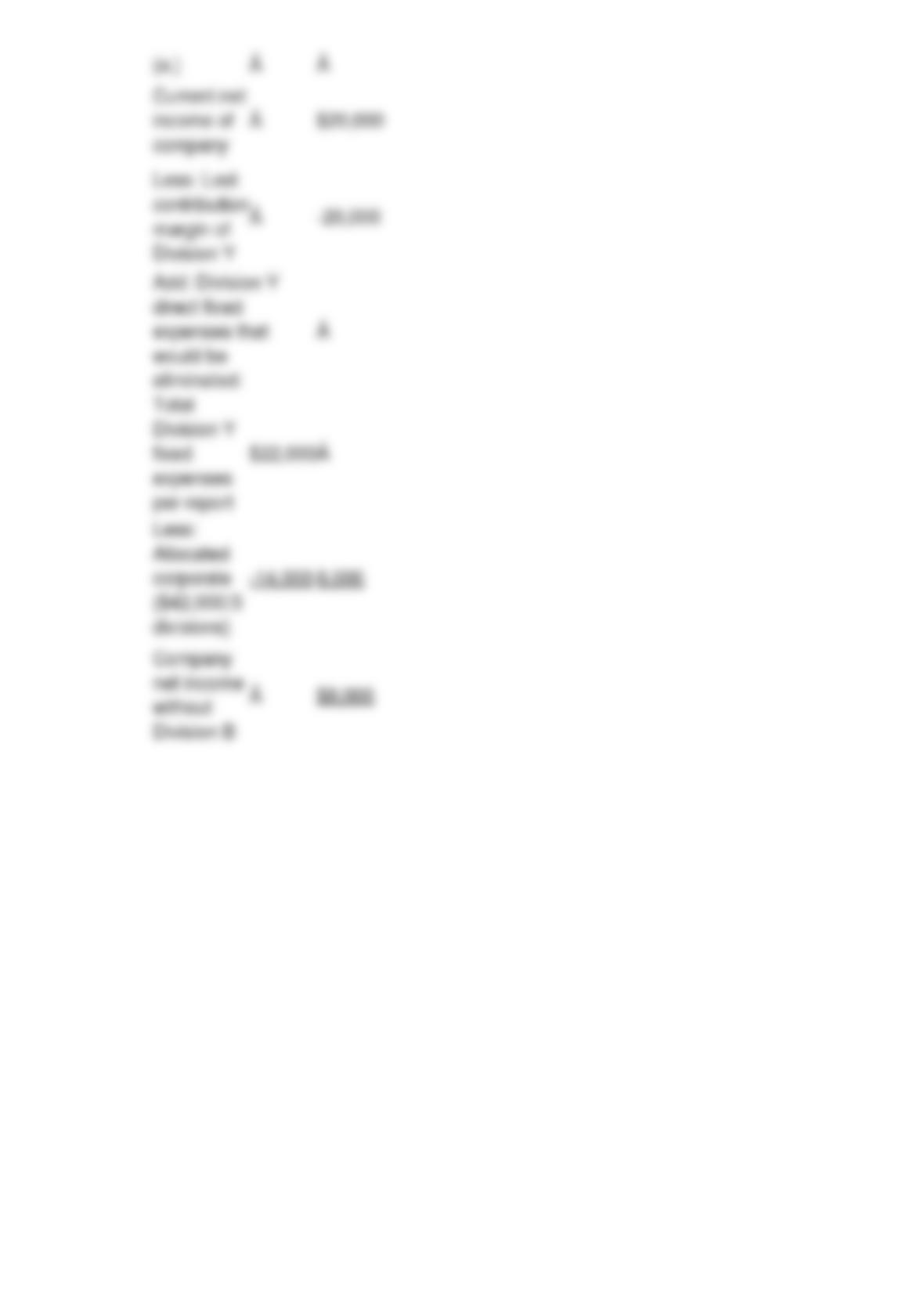
ABC, Inc., is segmented into three divisions and the company is concerned about the
performance of Division Y. During your analysis of Division Y, you learn that $42,000
of the fixed expenses relate to general corporate expenses and had been allocated
equally between the three divisions.
(a.) Calculate what the company’s net income would be if Division Y were closed down.
(b.) Revise the income statement presented above into a more useful segmented income
statement.
Month Total Maintenance Cost Production Volume (units) January $1,880 1,750 units
February $1,800 1,500 units March $2,200 2,500 units April $2,120 2,250 units May
$2,300 2,750 units
Using the high-low method, the variable rate for maintenance is:
A. $0.40.
B. $0.80.
C. $1.20.
D. $2.50.
Financial leverage refers to which of the following?
A. The difference between the rate of return earned on assets (ROI) and the rate of
return earned on stockholders’ equity (ROE).
B. The difference between the rate of return earned on current assets and the rate of
return earned on retained earnings.
C. The leverage a firm obtains from increasing production.
D. Decreasing fixed costs per unit by increasing production.
The cost formula for monthly customer order processing cost has been established as
$100 + $0.15 per order. It is expected that 5,600 orders will be processed in May and
6,400 in June. Total order processing costs for May and June combined will be
estimated to be:
A. $940.
B. $1,060.
C. $2,000.
D. $2,500.
A concept or principle that relates to transactions is:
A. materiality.
B. full disclosure.
C. original cost.
D. consistency.
Product costs are inventoried and treated as assets until:
A. the next accounting period.
B. related liabilities no longer exist.
C. the period in which the products they relate to are sold.
D. none of the above.
Standard costing is developed and used for:
A. planning purposes.
B. control purposes.
C. product costing purposes.
D. all of the above.
The comparison of activity measures of different companies is complicated by the fact
that:
A. different inventory cost flow assumptions may be used.
B. dollar amounts of assets may be significantly different.
C. only one of the companies may have preferred stock outstanding.
D. the number of shares of common stock issued may be significantly different.
The effect of an adjustment on the financial statements is usually to:
A. make the balance sheet balance.
B. increase net income.
C. increase the accuracy of both the balance sheet and income statement.
D. match revenues and assets.
Martin & Associates borrowed $15,000 on April 1, 2016 at 8% interest with both
principal and interest due on March 31, 2017.
How much should be in the firm’s interest payable account at December 31, 2016?
A. $900
B. $1,200
C. $0
D. $1,000
Management’s statement of responsibility:
A. explains that the entity’s financial statements are the responsibility of the entity’s
auditors.
B. states that the financial statements are free of significant error.
C. affirms that management is responsible for assuring adherence to internal control
policies and procedures.
D. guarantees that the firm has operated in a highly ethical manner.
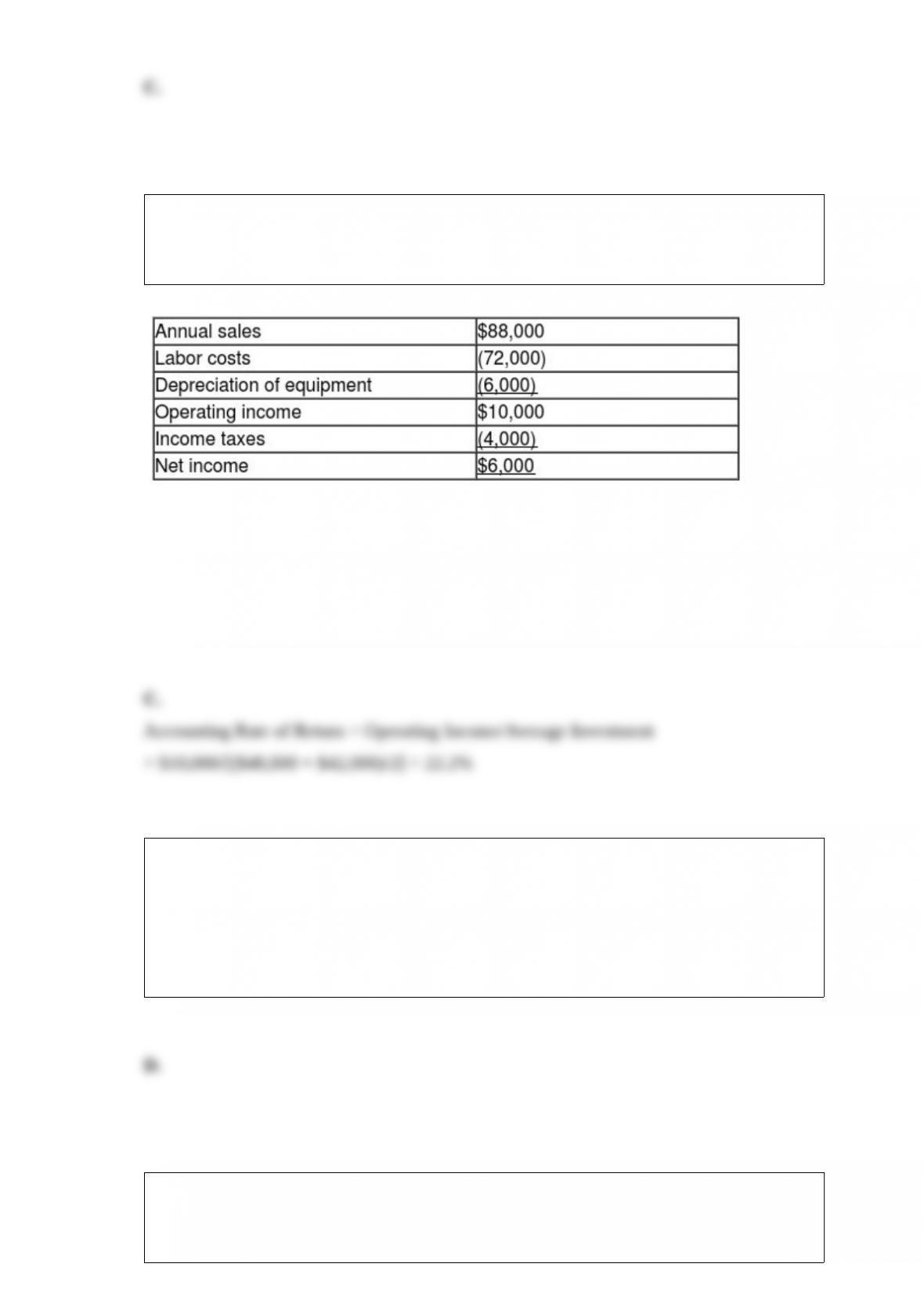
Boccardi Inc., has invested in new pasta manufacturing equipment at a cost of $48,000.
The equipment has an estimated useful life of eight years. Estimated annual sales and
operating expenses related to the pasta equipment follow:
A. 12.5%.
B. 18.0%.
C. 22.2%.
D. 25.0%.
Establishing the standard cost for a unit of product involves:
A. aggregating the standard costs for each of the products inputs.
B. determining the standard costs for raw materials, direct labor, and manufacturing
overhead.
C. determining the standard quantities allowed for each unit of input.
D. all of the above.
Which of the following is true about an unfavorable variance appearing in a
performance report?
A. actual revenue exceeded budgeted revenue.
B. budgeted expense exceeded actual expense.
C. budgeted variable costs exceeded actual variable costs.
D. budgeted revenue exceeded actual revenue.
If the P/E ratio of a company’s common stock were 12, and its earnings were $2.50 per
common share:
A. the market value of the common stock would be $20.83 per share.
B. the market value of the common stock would be $25.00 per share.
C. an increase in earnings of $0.20 per share, with no change in the multiple, would
result in a market price increase of $2.40 per share.
D. an increase in earnings of $0.20 per share, with no change in the multiple, would
result in a market price increase of $1.67 per share. 12 * 2.5 = $30 compared to 12 * 2.7
= $32.40.
The kind of standard that will almost never be achieved and results in an unrealistic
performance target is:
A. an attainable standard.
B. an engineered standard.
C. a negotiated standard.
D. a past experience standard.
A simple cost/benefit analysis is not appropriate for:
A. sell or process further decisions.
B. make or buy decisions.
C. capital expenditure decisions.
D. special pricing decisions.
A firm has revenues of $120,000, a contribution margin ratio of 30%, and fixed
expenses that total $56,000. If revenues increase $20,000, then:
A. operating income will increase by $6000.
B. operating income will be 0.
C. fixed expenses will increase $8000.
D. the contribution margin ratio will increase by 1/8.
ABC Company’s standard direct labor cost per unit includes 3 hours @ $15 per hour.
During May ABC Company produced 380 units and incurred total labor cost of $16,200
for 1,200 actual direct labor hours worked. ABC’s labor rate variance for May is:
A. $1,200 U.
B. $1,200 F.
C. $1,800 U.
D. $1,800 F.
Accounting for natural resources:
A. involves using the accumulated depreciation account.
B. involves estimating the quantity of the natural resource to be recovered.
C. involves an exception to the matching concept.
D. involves a double-declining balance depletion calculation.
In addition to developing the standard cost for a unit of product, organizations may
determine standards for such activities as:
A. quality control measures.
B. machine usage and performance.
C. customer service response times.

D. all of the above.
The nature and content of disclosures relate to all of the following except:
A. accounting changes.
B. segment information.
C. management’s plans for the future.
D. contingencies and commitments.
E. events subsequent to the balance sheet date.
The first caption in most income statements in annual reports is:
A. gross sales.
B. net sales.
C. earned revenues.
D. sales, less sales returns and allowances.
When an uncollectible account receivable is written off against the allowance for bad
debts:
A. total current assets decrease and expenses increase.
B. total current assets are not affected.
C. total current assets decrease and expenses decrease.
D. current assets decrease and expenses are not affected.
A cost that is incurred because of a long-range policy decision is known as a:

A. discretionary cost.
B. committed cost.
C. continuous cost.
D. standard cost.
Operating expenses are best budgeted on the basis of knowledge about:
A. cost behavior patterns.
B. relevant range.
C. prior period actual expenses.
D. current period budget amounts.
The term transfer price refers to:
A. The price at which a product or service is sold to a government entity.
B. The price at which a product or service is sold by one segment to another related
segment.
C. The price at which a product or service is sold by a segment to an outside party.
D. None of the above.
How are unfavorable standard cost variances reported in an organization’s annual
report?
A. as an expense in the income statement.
B. as a reduction in the work in process inventory in the balance sheet.
C. as an explanatory note to accompany the financial statements.
D. none of the above.

A chart of accounts:
A. is where transactions are initially recorded.
B. is where transactions are posted to after they are initially recorded.
C. serves as an index to the ledger, with each account numbered to facilitate frequent
references that are made to it.
D. is the same as a T-account, with debits on the left and credits on the right.
Which of the following is a true statement regarding absorption and/or direct costing?
A. A firm can choose to use either absorption or direct costing for income tax purposes.
B. A firm can choose to use either absorption or direct costing for financial reporting
purposes.
C. Direct costing assigns only direct materials and direct labor to products.
D. Absorption costing includes fixed overhead in product costs whereas direct costing
does not.
Indirect costs pertain to costs that:
A. are traceable to a cost object.
B. are not traceable to a cost object.
C. are commonly incurred.
D. are variable costs.
A firm’s net income is $630,000 on sales of $63 million. Average assets for the period
were $14 million. For the year:
A. margin was 5%, turnover was 1.2, and ROI was 6%.
B. margin was 6%, turnover was 1.5, and ROI was 6%.
C. margin was 4%, turnover was 1.2, and ROI was 4.8%.
D. margin was 1%, turnover was 4.5, and ROI was 4.5%. Margin =
$630,000/$63,000,000 = 1%