A division earning a profit will increase its return on investment (ROI) if it increases
operating expenses and
A. sales by the same dollar amount.
B. sales by the same percentage.
C. investment by the same dollar amount.
D. investment by the same percentage.
Answer:
Terri Martin Nerdmeister, CPA provides bookkeeping and tax services to her clients.
She charges a fee of $60 per hour for bookkeeping and $90 per hour for tax services.
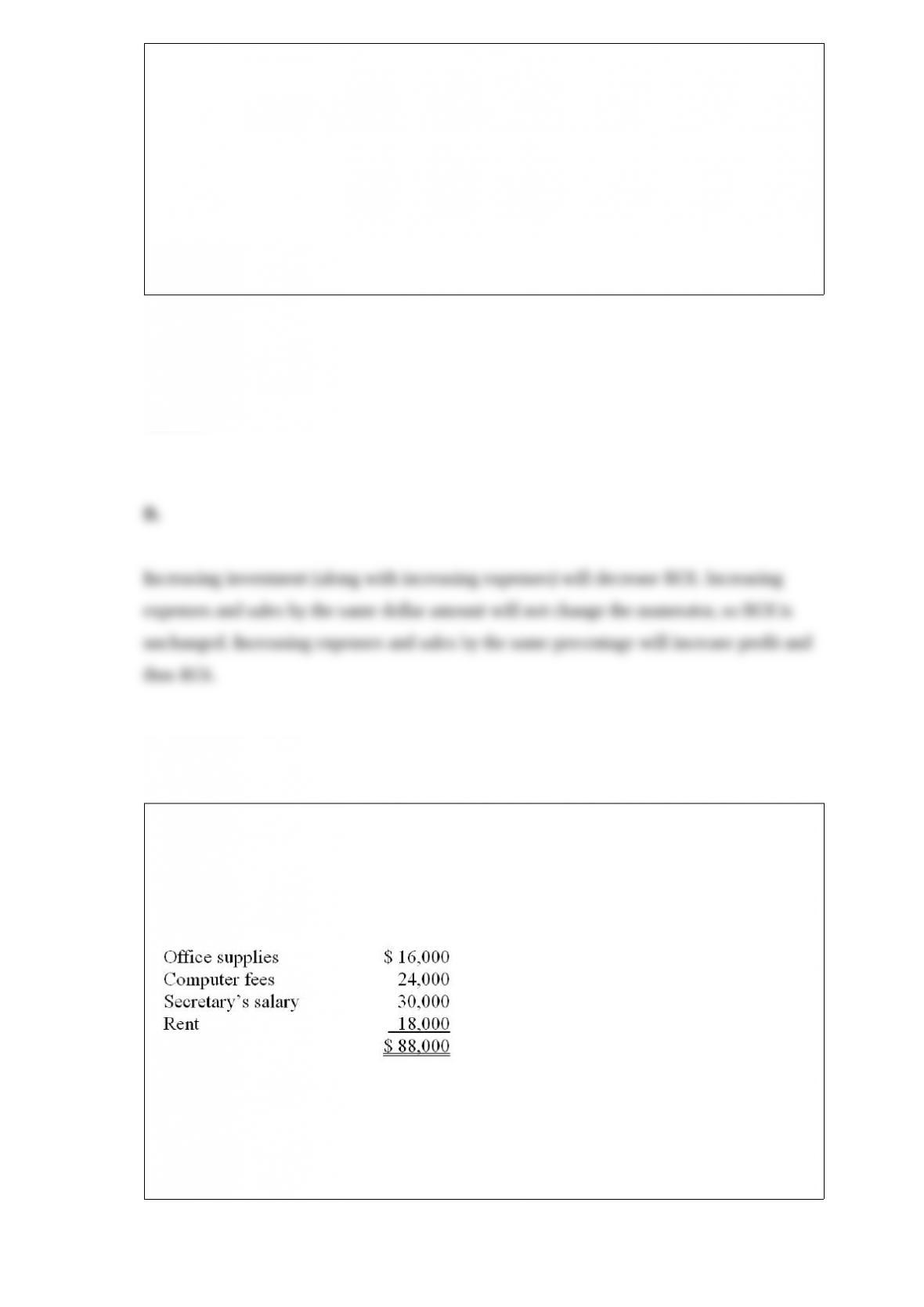
Martin estimates the following costs for the upcoming year:
Operating profits declined last year and Ms. Martin has decided to use activity-based
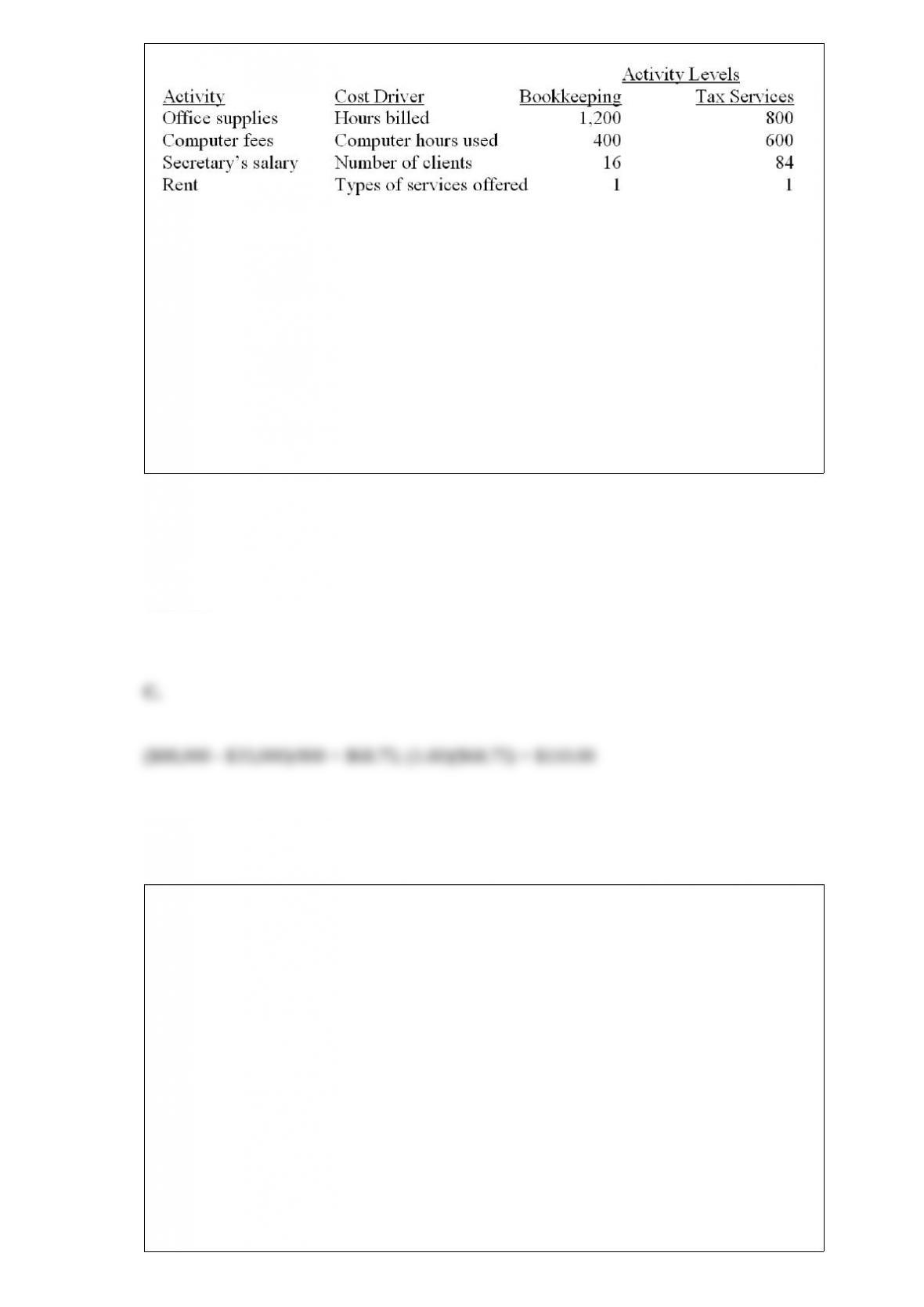
costing (ABC) procedures to evaluate her hourly fees. She gathered the following
information from last year’s records:
Martin wants her hourly fees for the tax services to be 160% of their activity-based
costs. What is the fee per hour for tax services in the upcoming year?
A. $70.40
B. $88.00
C. $110.00
D. $118.40
Answer:
Flowers and Flowers, Inc., has two divisions. Division A has an investment base of
$750,000 and produces (and sells) 100,000 units of Eyne at a market price of $10.00
per unit. Variable costs total $3.50 per unit, and fixed charges are $4.00 per unit (based
on a capacity of 120,000 units). Division B wants to purchase 25,000 units of Eyne
from Division A. However, Division B is only willing to pay $6.75 per unit.
What is the contribution margin for Division A if it transfers 25,000 units to Division B
at $6.75 per unit?
A. $250,000
B. $650,000
C. $675,000
D. $698,750
Answer:
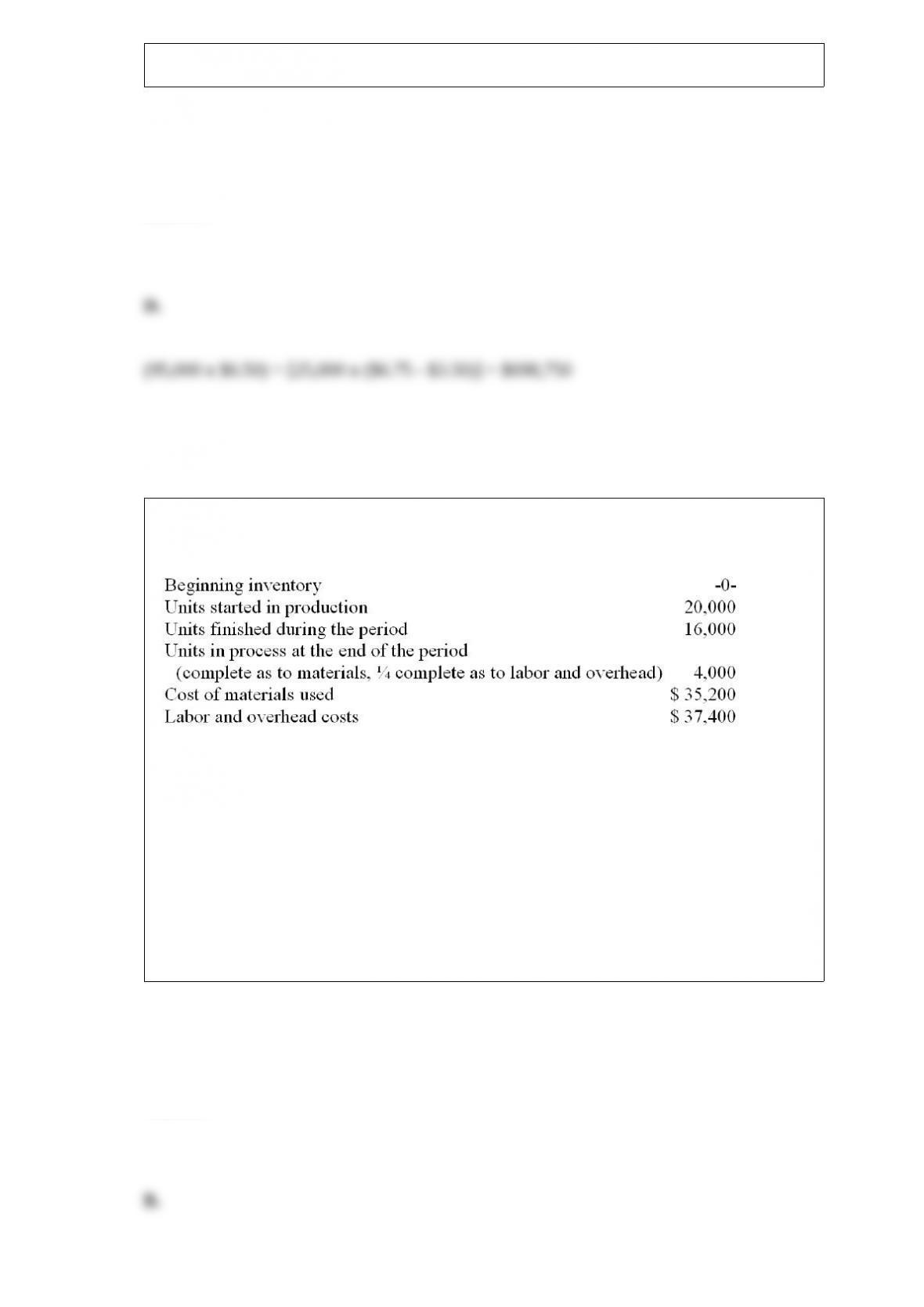
The WISCO Company uses a weighted-average process costing system. The following
data are available:
Equivalent units of production for labor and overhead are
A. 16,000.
B. 17,000.
C. 19,000.
D. 20,000.
Answer:
Which of the following statements is (are) true regarding performance measures?
(A) In general, objective performance measures are better than subjective performance
measures.
(B) In general, the use of multiple performance measures is better than the use of single
performance measures.
A. Only A is true.
B. Only B is true.
C. Both A and B are true.
D. Neither A nor B is true.
Answer:
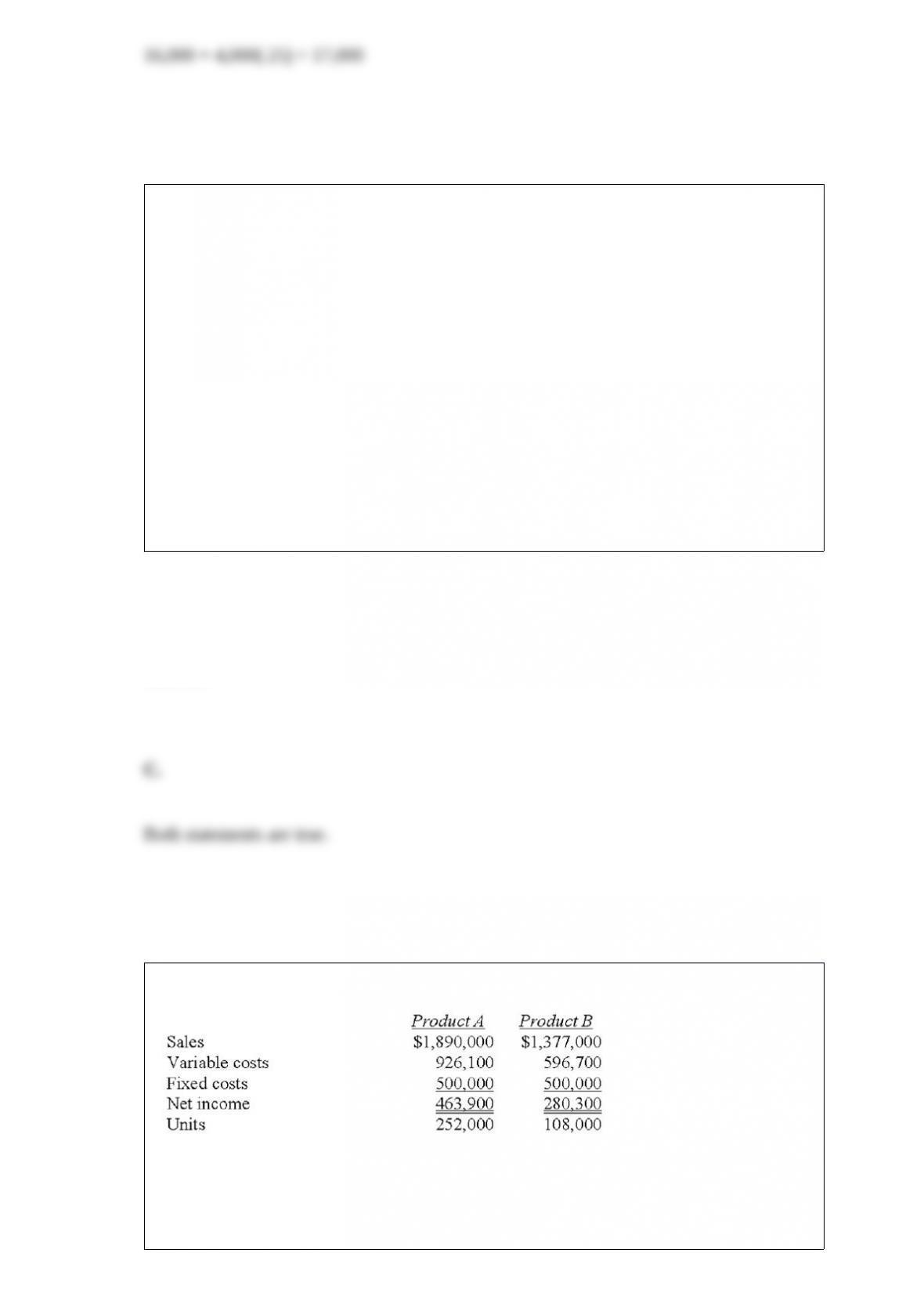
The next year’s budget for Green, Inc., a multi-product company, is given below:
At the end of the year, the total fixed costs and the variable costs per unit were exactly
as budgeted, but the following units per product line were sold. Green analyzes the
effects its sales variances have on the profitability of the company.
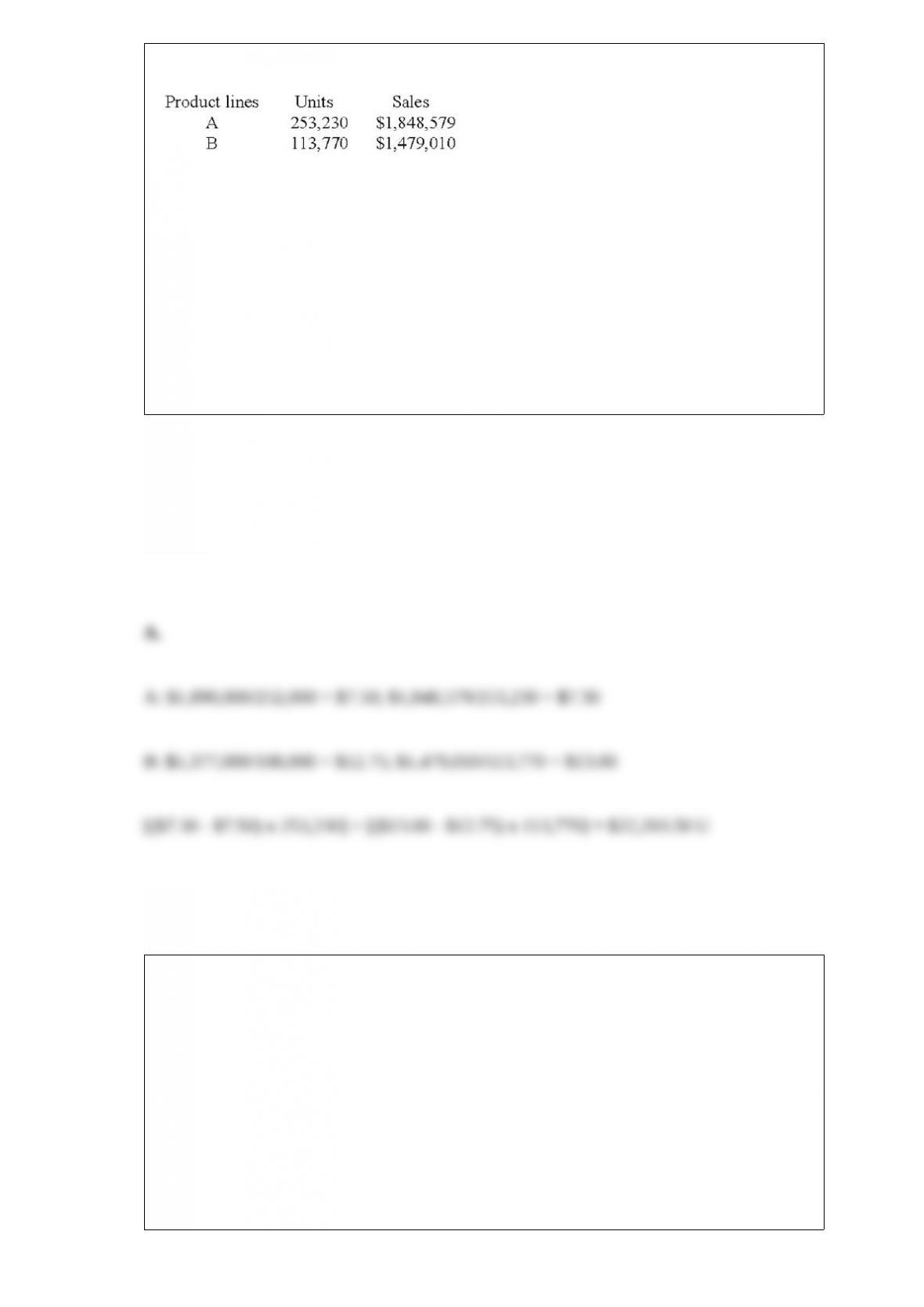
What is the total sales price variance?
A. $22,203.50
B. $28,442.50
C. $50,646.50
D. $79,088.50
Answer:
In 2008, Wishbone Corporation had an operating profit of $750,000 and a residual
income of $300,000. If Wishbone’s cost of capital is 15%, what is the amount of the
invested capital?
A. $5,000,000
B. $3,000,000
C. $2,000,000
D. $1,250,000
Answer:
Which of the following statements is (are) true regarding the master budget?
(A) A master budget consists of (a) organizational goals, (b) strategic long-range profit
plan, and (c) tactical short-range profit plan.
(B) A master budget consists of only a budgeted (a) income statement, (b) balance
sheet, and (c) stockholder’s equity statement.
A. Only A is true.
B. Only B is true.
C. Both A and B are true.
D. Neither A nor B is true.
Answer:
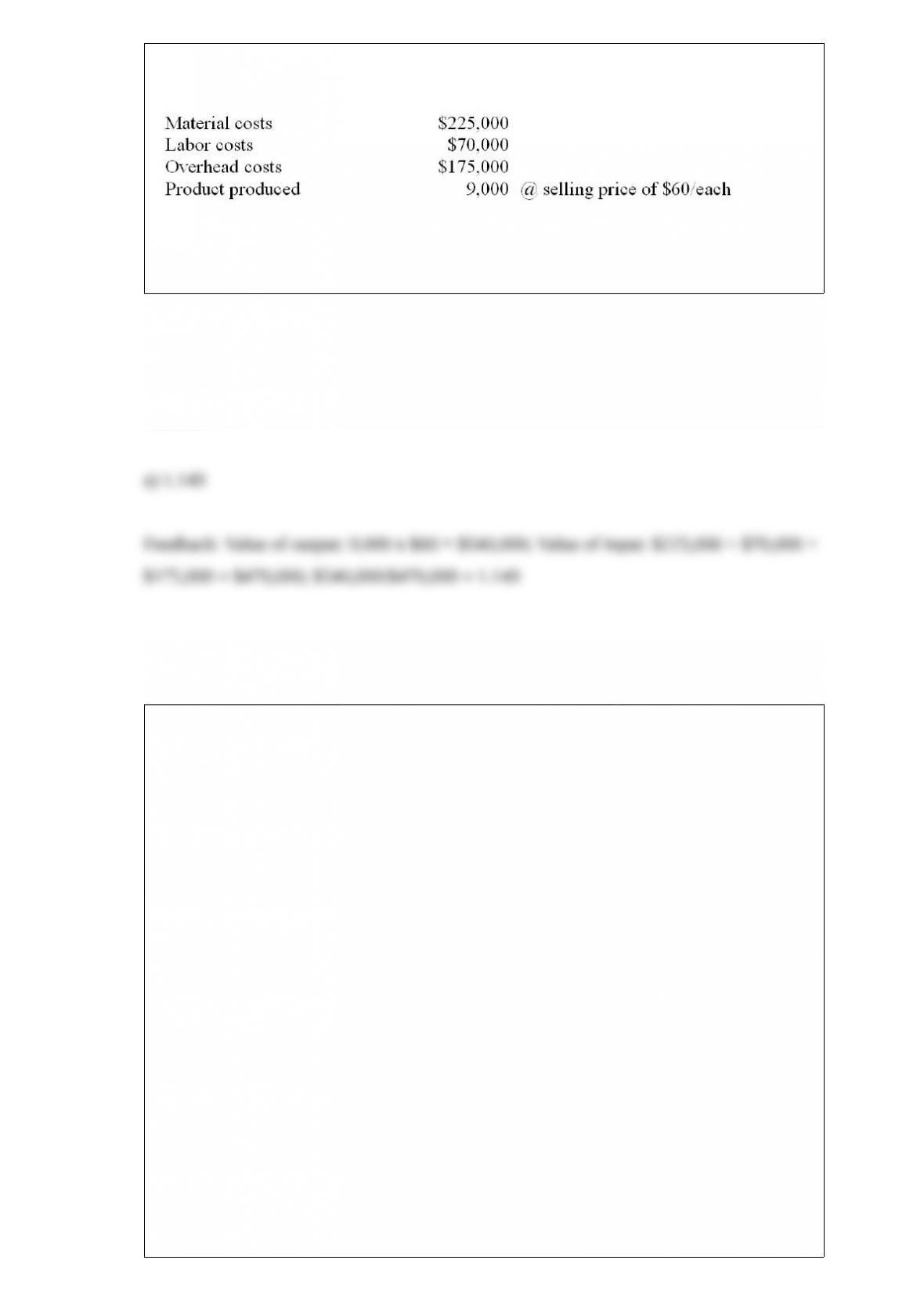
Branson Co. has provided the following information for last year:
Required:
a) Calculate the total factor productivity measure.
Answer:
Using the abbreviations listed below, what is the market share variance?
AMS = actual market share
BMS = budgeted market share
BCM = budgeted contribution margin per unit
ACM = actual contribution margin per unit
ATM = actual total market
BTM = budgeted total market
A. (ATM – BTM) (BMS) (ACM)
B. (ATM – BTM) (BMS) (BCM)
C. (AMS – BMS) (ATM) (ACM)
D. (AMS – BMS) (ATM) (BCM)
E. (ATM – BTM) (AMS) (ACM)

Answer:
Which of the following service departments could logically use space occupied (square
footage) to allocate its costs to user departments?
A. Material Handling
B. Cafeteria
C. Custodial Services
D. Cost Accounting
E. Engineering
Answer:
Blue Company produces Trivets. Based on its master budget, the company should
produce 1,000 Trivets each month, working 2,500 direct labor hours. During May, only
900 Trivets were produced. The company worked 2,400 direct labor hours. The
standard hours allowed for May production would be

A. 2,500 hours.
B. 2,400 hours.
C. 2,250 hours.
D. 1,800 hours.
Answer:
Benchmarks are used to evaluate the performance of an activity or operation relative to
other organizations or other parts of one’s own organization. Which of the following is
not a guideline for using benchmarks to evaluate performance?
A. Benchmarks should only be used for nonfinancial measures.
B. Do not benchmark everything at the best-in-the-business level.
C. Benchmark only best-in-the-business activities that are important.
D. Use internal benchmarks for less important activities or operations.
Answer:
Stanley Clipper, now retired, owns the Campus Barber Shop. He employs five (5)
barbers and pays each a base rate of $500 per month. One of the barbers serves as the
manager and receives an extra $300 per month. In addition to the base rate, each barber
also receives a commission of $3 per haircut. A barber can do as many as 20 haircuts a
day, but the average is 14 haircuts per day. The Campus Barber Shop is a corporation
with a 30% tax rate and is open 24 days a month.
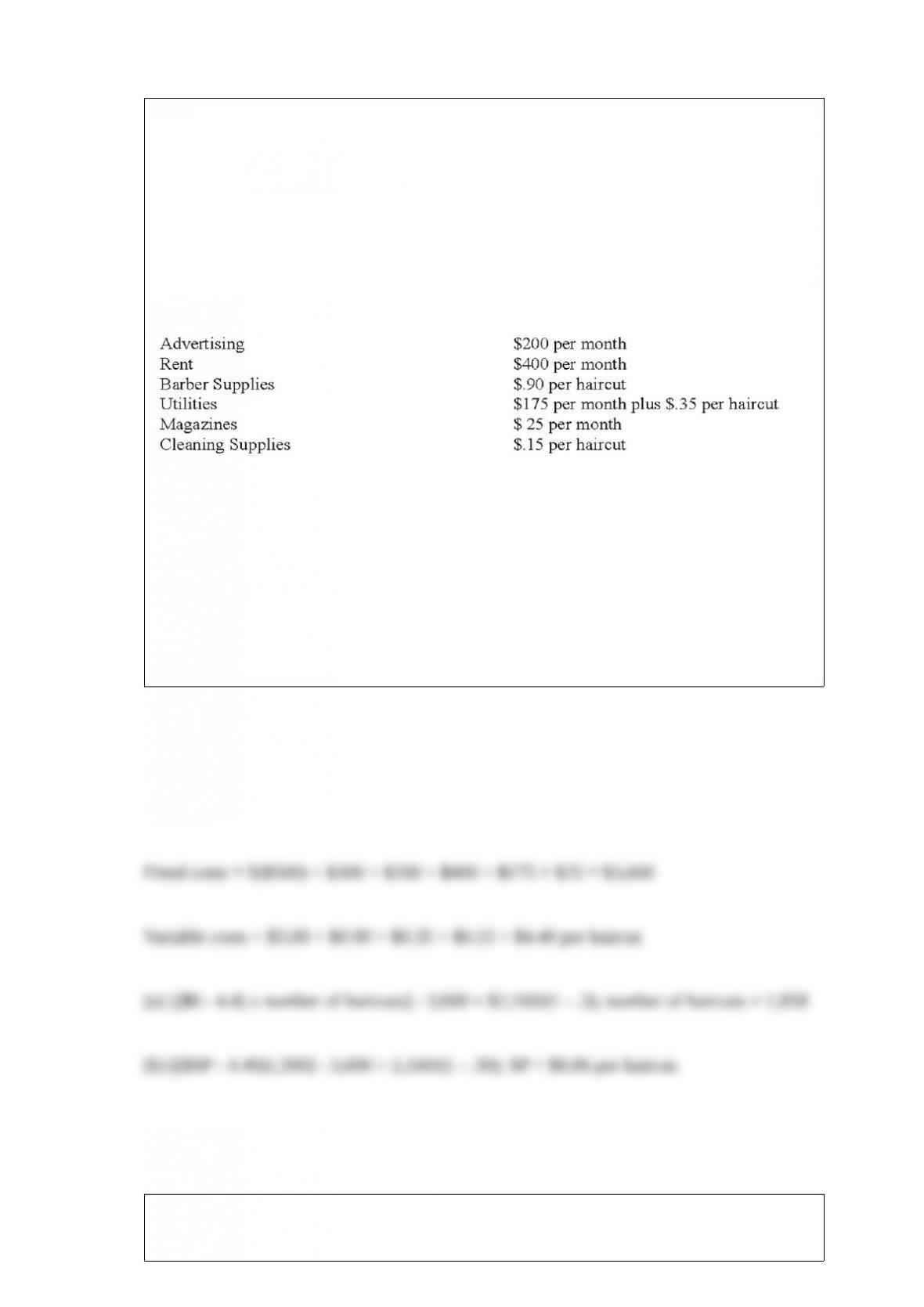
Other costs are incurred as follows:
Stanley currently charges $8 per haircut.
Required:
(a) Stanley wants to earn $2,160 in after-tax operating profits. Compute the number of
haircuts that must be given to reach this goal in July.
(b) In July, only 1,500 haircuts were given. Compute the price per haircut that Stanley
should have charged in July to earn $2,160 in after-tax operating profits.
Answer:
The unused resource capacity is the difference between the resources supplied and the
resources
A. purchased.
B. wasted.
C. used.
D. on hand.
Answer:
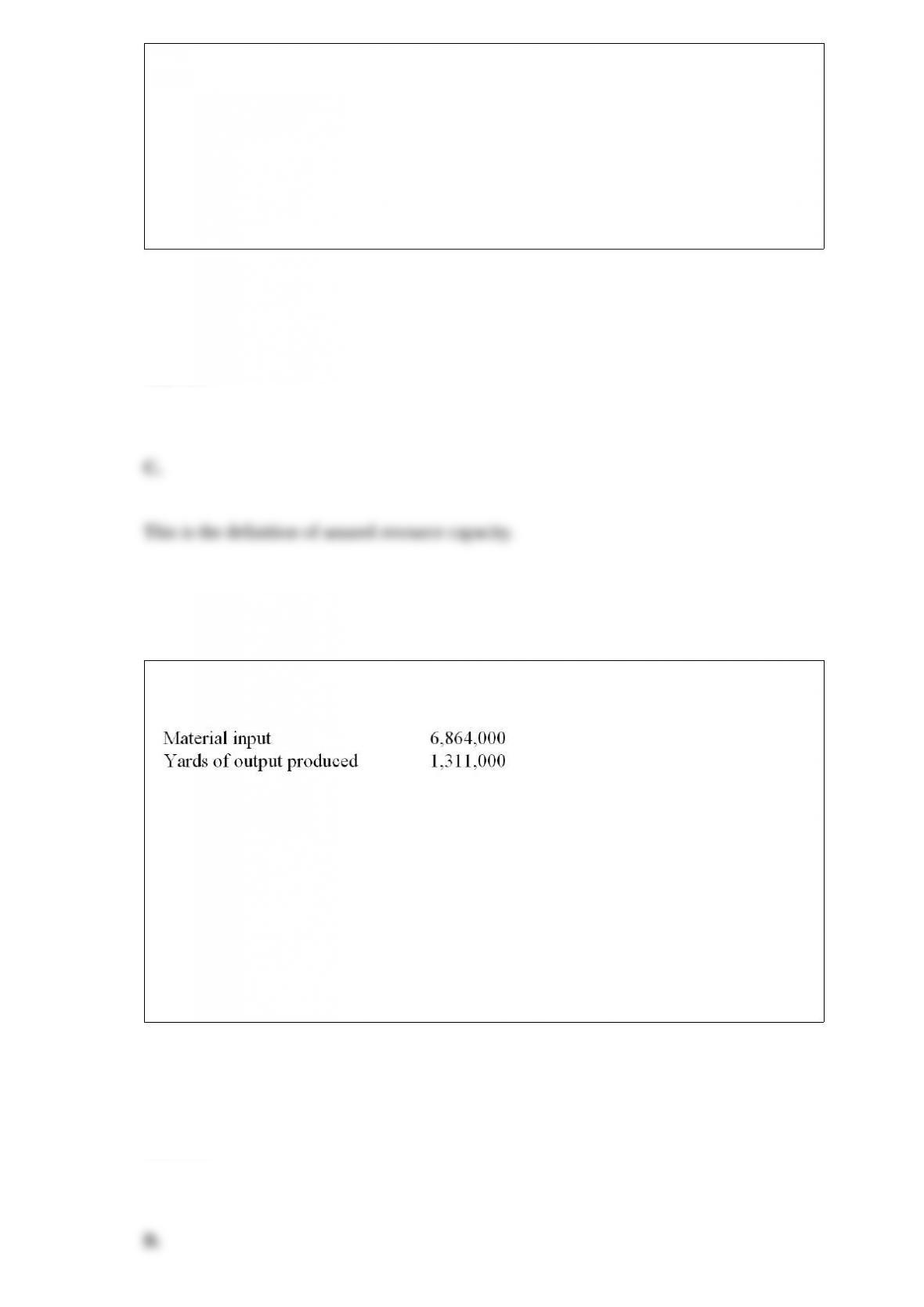
The Baxter Milling Co has the following information for last year
The partial productivity for materials is
A. 0.131
B. 0.191
C. 0.686
D. 5.236
Answer:
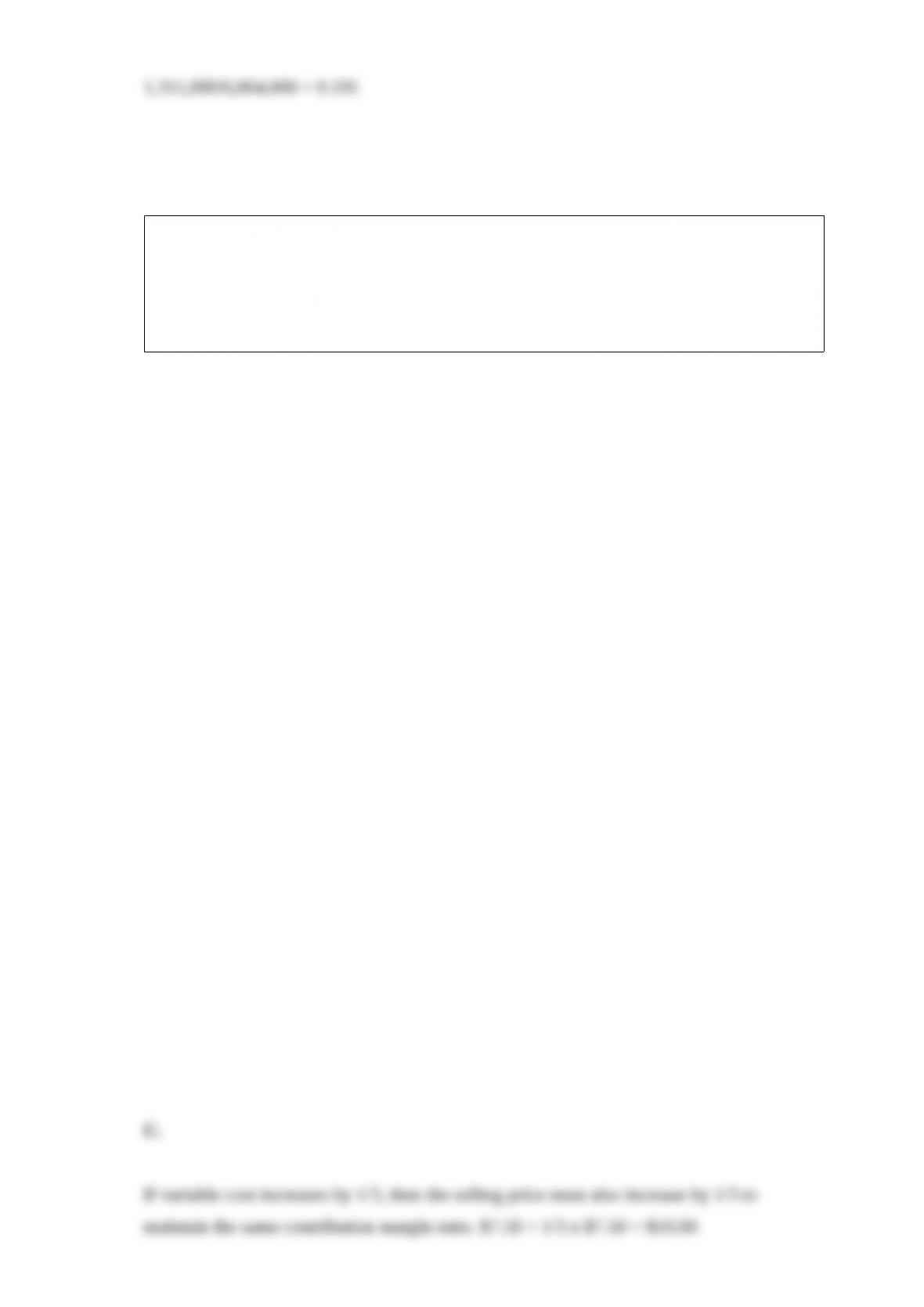
Donnelly Corporation manufactures and sells T-shirts imprinted with college names
and slogans. Last year, the shirts sold for $7.50 each, and the variable cost to
manufacture them was $2.25 per unit. The company needed to sell 20,000 shirts to
break even. The after tax net income last year was $5,040. Donnelly’s expectations for
the coming year include the following: (CMA adapted)
• The sales price of the T-shirts will be $9
•Variable cost to manufacture will increase by one-third
•Fixed costs will increase by 10%
•The income tax rate of 40% will be unchanged.
The selling price that would maintain the same contribution margin ratio as last year is
A. $9.00.
B. $8.25.
C. $10.00.
D. $9.50.
Answer:
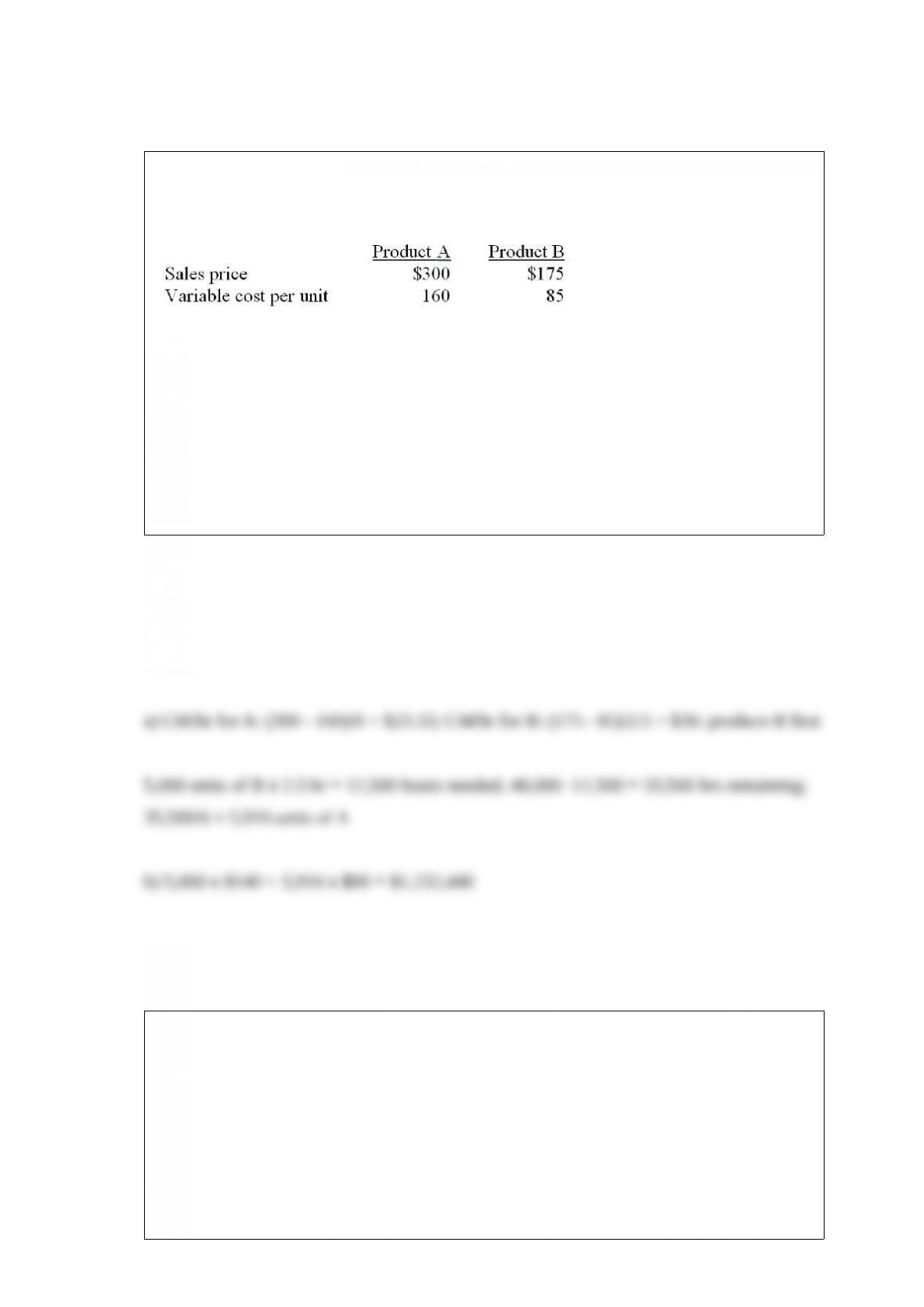
The Wood Company manufactures two products: A and B. The costs and revenues are
as follows:
Total demand for Product A is 7,000 units and for Product B is 5,000 units. Machine
time is a scarce resource. During the year, 48,000 machine hours are available. Product
A requires 6 machine hours per unit, while Product B requires 2.5 machine hours per
unit.
a) How many units of Products A and B should Wood produce?
b) What will be the maximum possible contribution margin?
Answer:
The electricity used for production machinery would be classified as a
A. volume-related activity.
B. batch-related activity.
C. product-related activity.
D. facility-related activity.
Answer:
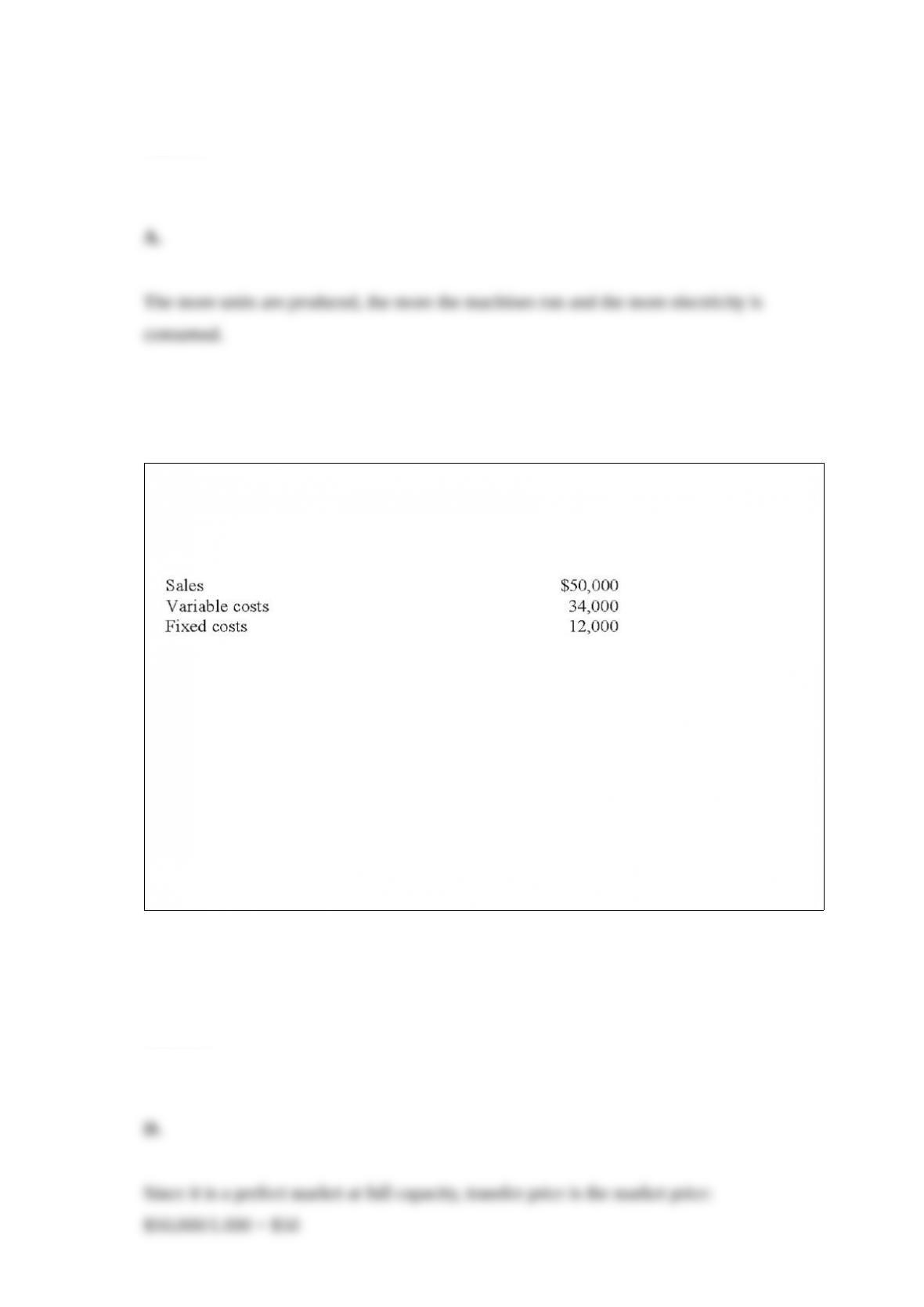
The Alpha Division of a company, which is operating at capacity, produces and sells
1,000 units of a certain electronic component in a perfectly competitive market.
Revenue and cost data are as follows: (CIA adapted)
The minimum transfer price that should be charged to the Beta Division of the same
company for each component is
A. $12
B. $34
C. $46
D. $50
Answer:
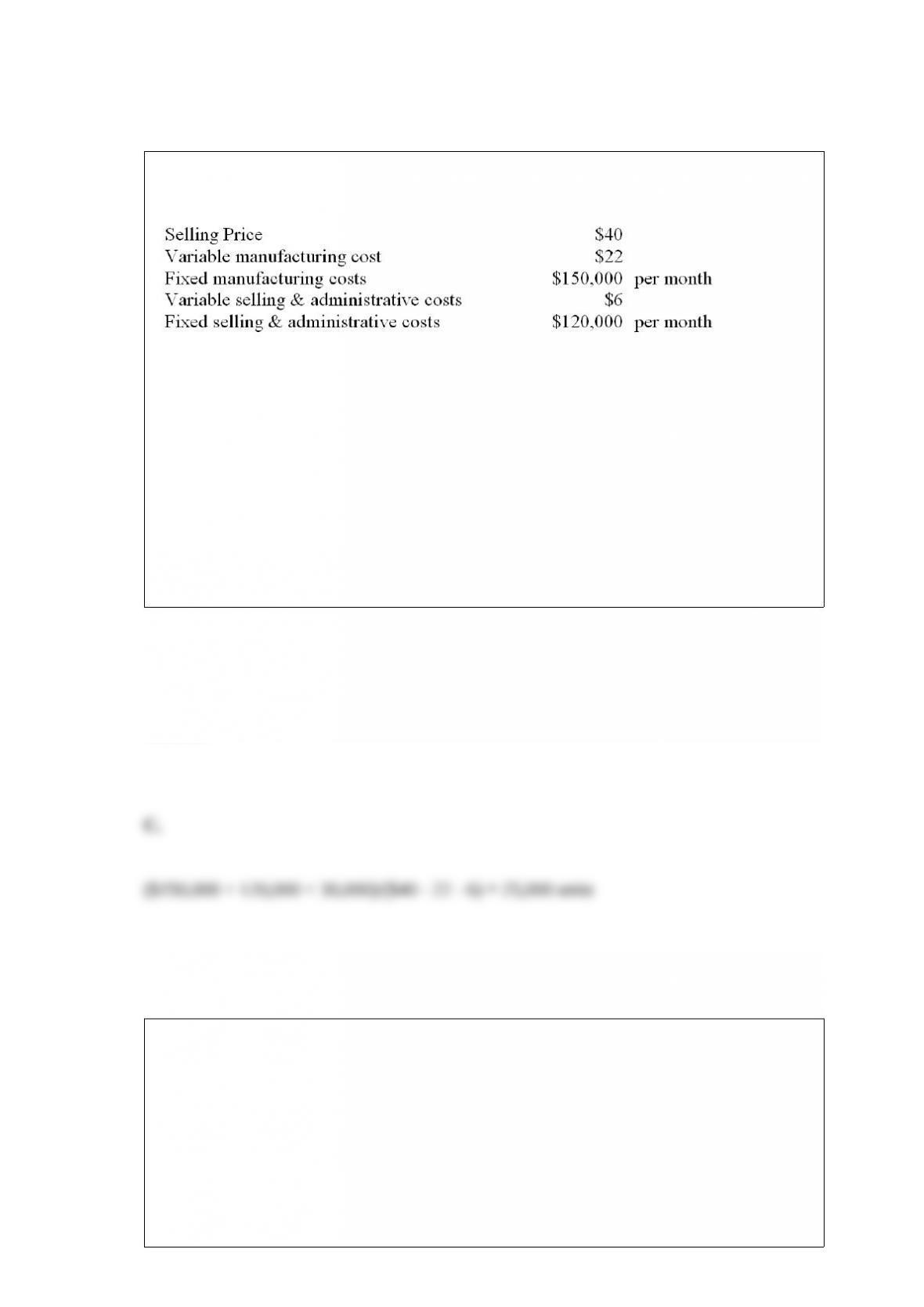
Sanfran has the following data:
How many units must Sanfran produce and sell in order to achieve a profit of $30,000
per month?
A. 10,000 units
B. 8,824 units
C. 25,000 units
D. 15,000 units
Answer:
Which of the following statements is (are) true regarding the potential effects of using
reported product costs for decision making?
(A) Traditional product costing systems (e.g., job and process costing) are designed
primarily to accumulate cost information for financial reporting.
(B) If a single cost driver is used as the allocation base, applied manufacturing overhead
for product costing purposes may lead to inappropriate managerial decisions.
A. Only A is true
B. Only B is true.
C. Both A and B are true.
D. Neither A nor B is true.
Answer:
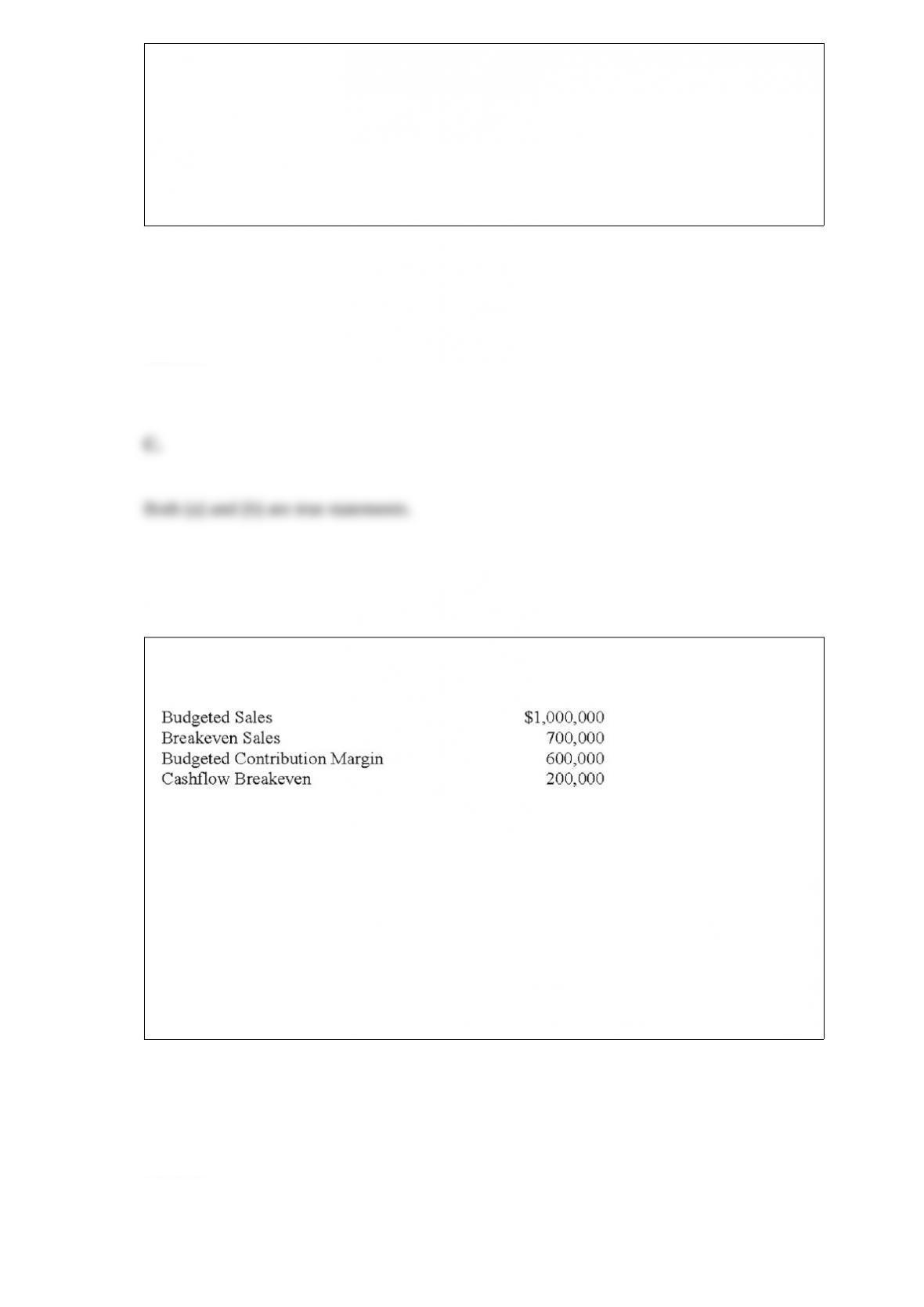
The following pertains to Clove Co. for the year ending December 31, 2008:
Clove’s margin of safety is: (CPA adapted)
A. $300,000
B. $400,000
C. $500,000
D. $800,000
Answer:
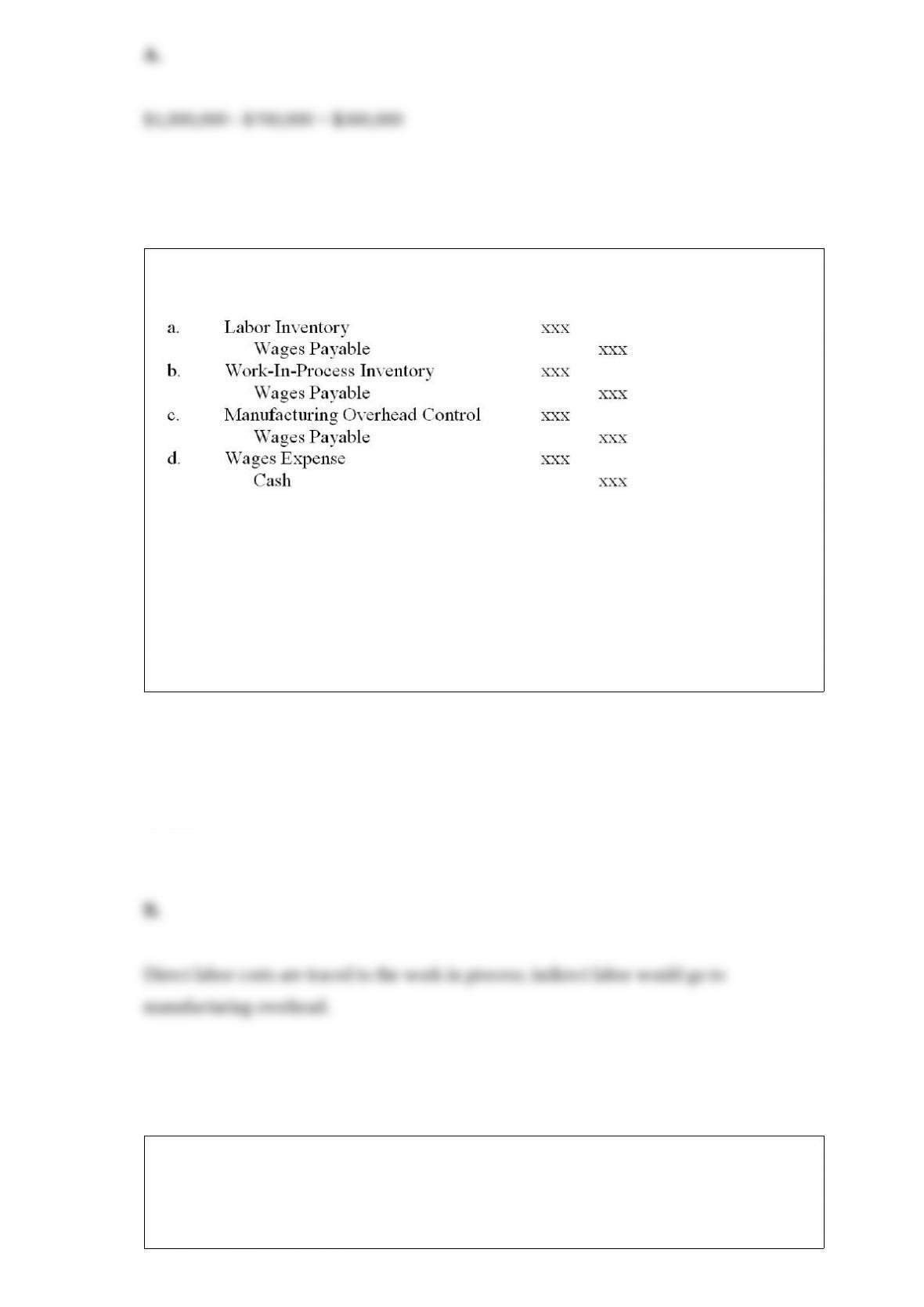
What is the journal entry to record the direct labor costs for the period?
A. a
B. b
C. c
D. d
Answer:
Carver Test Systems manufactures automated test systems that perform quality
inspections during and at the completion of the manufacturing process. As most
manufacturing processes are unique, Carver’s test equipment is designed to customer
specifications, and each system has a selling price in excess of $300,000. The company
uses a job-order cost system based on the full absorption of actual costs and applies
overhead on the basis of machine hours using a predetermined overhead rate. For the
fiscal year ended November 30 budgeted manufacturing overhead was $1,960,000, and
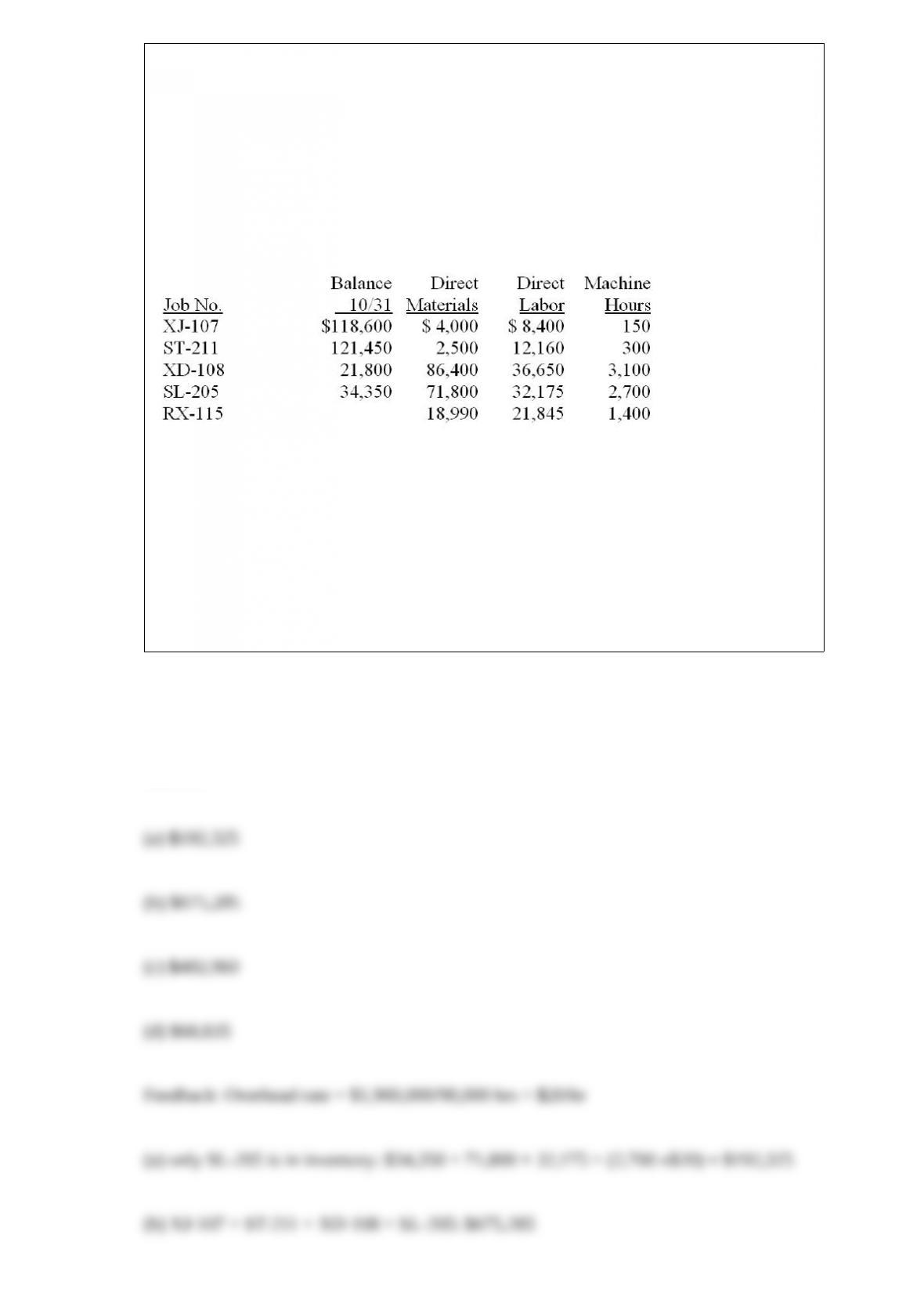
the expected activity level was 98,000 machine hours. Data regarding several jobs at
Carver are presented below.
By the end of November all jobs but RX-115 were completed, and all completed jobs
had been delivered to customers with the exception of SL-205.
Required:
(a) Determine the balance in the Finished Goods Inventory on November
(b) Compute the cost of goods manufactured for November.
(c) Compute the Cost of Goods Sold for November.
(d) Determine the balance in Work-In-Process Inventory on November 30.
Answer:
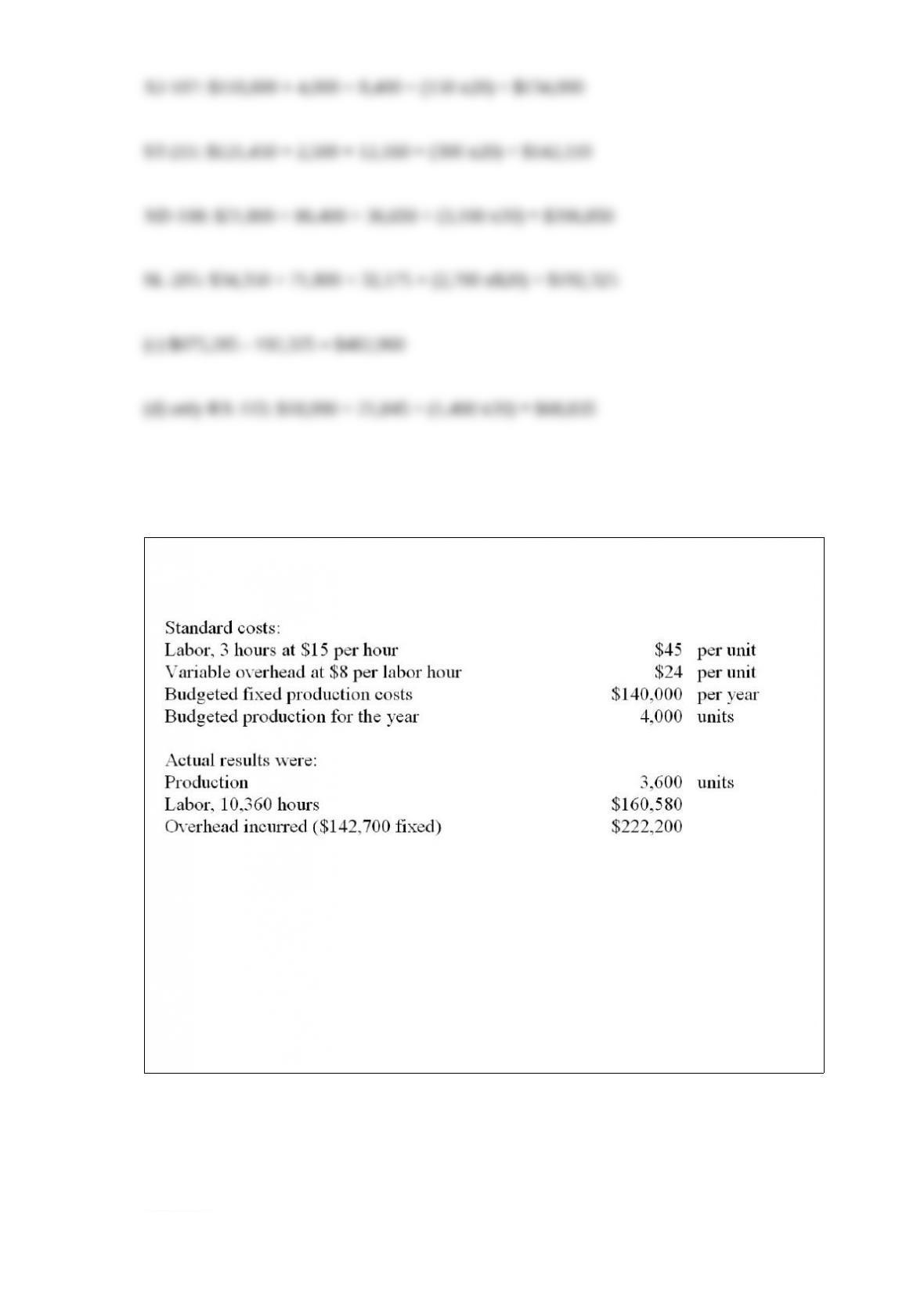
The data below relate to a product of Valois Company.
Required: (Be sure to indicate whether the variances are favorable or unfavorable.)
a) What is the variable overhead efficiency variance?
b) What is the variable overhead price variance?
c) What is the fixed overhead budget variance?
d) What is the fixed production volume variance?
Answer:
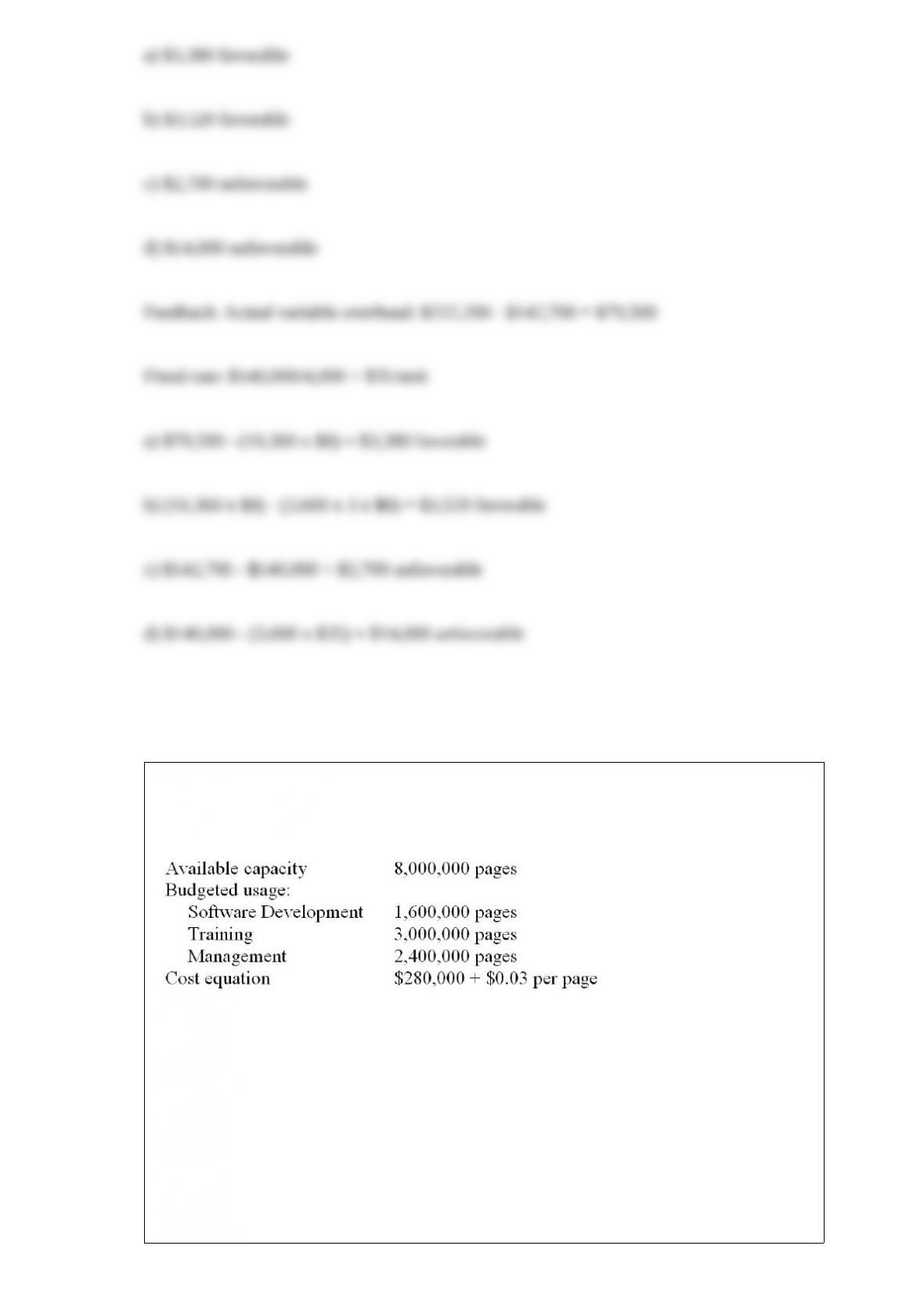
The Document Creation Center (DCC) for Alegis Corp. provides photocopying and
document services for three departments in the St. Paul office. The following budget
has been prepared for the year.
If DCC uses a dual-rate for allocating its costs, how much cost will be allocated to the
Training Department, assuming the Training Department actually made 3,250,000
copies during the year?
A. $227,500
B. $211,250
C. $217,500
D. $223,017
Answer:
Before prorating the manufacturing overhead costs at the end of 2008, the Cost of
Goods Sold and Finished Goods Inventory had applied overhead costs of $57,500 and
$20,000 in them, respectively. There was no work in process at the beginning or end of
2008. During the year, manufacturing overhead costs of $74,000 were actually incurred.
The balance in the Applied Manufacturing Overhead was $77,500 at the end of 2008. If
the under- or overapplied overhead is prorated between Cost of Goods Sold and the
inventory accounts, how much will be the Cost of Goods Sold after the proration?
A. $58,403
B. $56,597
C. $60,197
D. $54,903
Answer:

The asset turnover is a measure (ratio) of an investment center’s ability to
A. earn profits.
B. generate sales.
C. control costs.
D. remain solvent.
Answer:
Which of the following cost estimation methods finds the variable portion of a mixed
cost before calculating the fixed portion?
A. Scattergraph.
B. High-low method.
C. Account analysis.
D. Linear regression.
E. Engineering approach.
Answer: