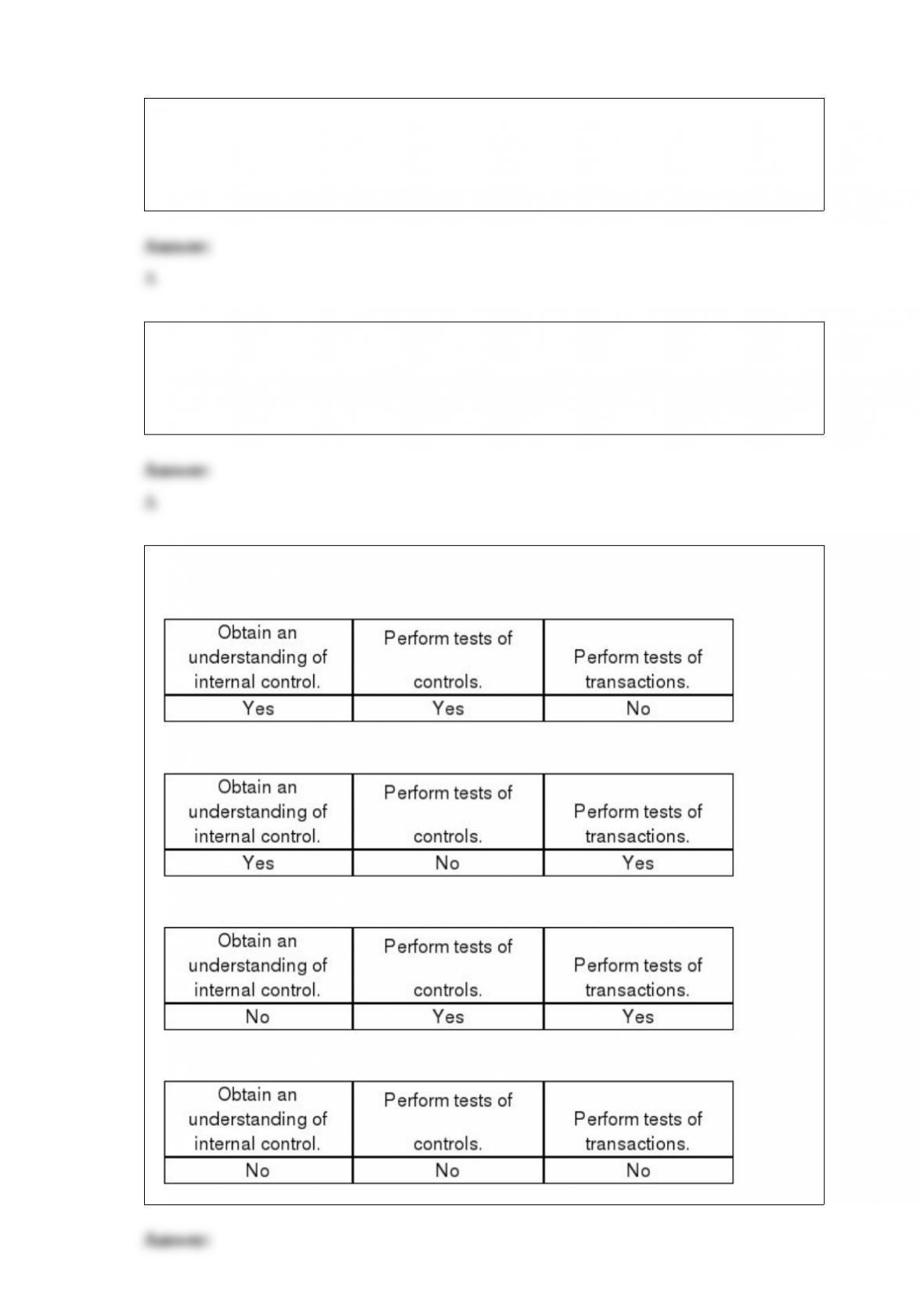
1) Operational audits are often categorized as functional, organizational, or special
assignments.
A) True
B) False
2) Procedures to obtain an understanding of internal control may suffice for tests of
controls when the auditor is assessing automated controls.
A) True
B) False
3) For compilations, an accountant does which of the following?
A)
B)
C)
D)

4) The relationship of acceptable risk of accessing control risk too low (ARACR) to
sample size is:
A) variable (sometimes larger, sometimes smaller)
B) direct (larger ARACR = larger sample)
C) inverse (larger ARACR = smaller sample)
D) nonexistent
5) A useful starting point for becoming familiar with the client’s inventory is for the
auditor to:
A) read the
B) review accounting theory covering special problems, such as gas and oil accounting,
or lease-purchase agreements
C) read the client’s Accounting Manual
D) tour the client’s facility
6) When auditing client’s using database management systems the auditor is principally
aware of elevated risk due to:
A) multiple users can access and update accounting files
B) the accounting information is only in one place
C) the database administrator may lack appropriate accounting knowledge
D) multiple users could all access the data simultaneously causing system shutdown
7) It is virtually impossible to reduce sampling risk to zero.
A) True
B) False
8) If a bank does not respond to a bank confirmation request, the auditor would most
likely:
A)
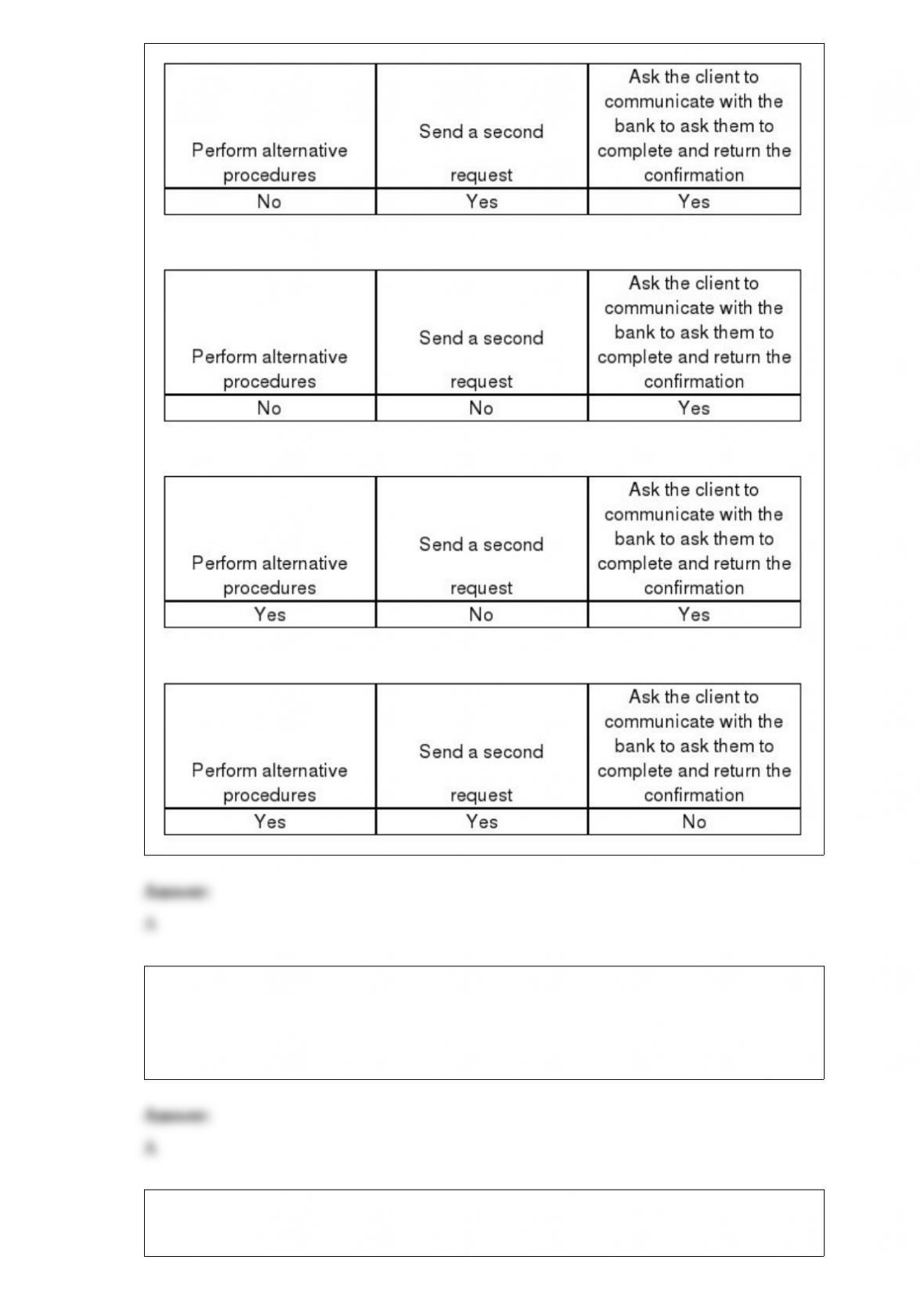
B)
C)
D)
9) When testing for contingent liabilities, the primary objective at the initial stage of the
tests is to determine the existence of contingencies.
A) True
B) False
10) Of the four parts of the
A) Ethical Rulings

B) Rules of Conduct
C) Principles
D) Interpretations
11) Auditing standards require that an audit be designed to provide reasonable
assurance of detecting:
A) material errors in the financial statements
B) fraud in the financial statements
C) material errors and fraud in the financial statements
D) inadequate disclosure in the notes to the financial statements
12) The auditor’s primary concerns relative to presentation and disclosure-related
objectives is:
A) accuracy
B) existence
C) completeness
D) occurrence
13) Which of the following is not one of the major differences between financial and
operational auditing?
A) The financial audit is oriented to the past, but an operational audit concerns
performance for the future
B) The financial audit report has widespread distribution, but the operational audit
report has limited distribution
C) Financial audits deal with the information on the financial statements, but
operational audits are concerned with the information in the ledgers
D) Financial audits are limited to matters that directly affect the fairness of the financial
statement presentation, but operational audits cover any aspect of efficiency and
effectiveness
14) Which one of the following is not a Field Work Standard?
A) Adequate planning and supervision
B) Due professional care
C) Understand the entity and its environment including internal control
D) Sufficient appropriate audit evidence
15) In testing acquisitions, the auditor must understand the relevant accounting
standards to insure the client adheres to accepted accounting practices for property,
plant, and equipment. Describe below the auditor concerns in this area.
16) Which of the following scenarios does not result in a qualified opinion?
A) A scope limitation prevents the auditor from completing an important audit
procedure
B) The auditor’s report refers to the work of a specialist
C) The auditor lacks independence with respect to the audited entity
D) An accounting principle at variance with GAAP is used
17) If several employees collude to falsify documents, the chance a normal audit would
uncover such acts is:
A) very low
B) very high
C) zero
D) none of the above
18) Why do auditors find MUS appealing?
A) MUS increases the likelihood of selecting a balance of high and low dollar items
B) MUS is easy to use in the audit environment
C) MUS provides a nonstatistical, rather than a statistical, conclusion
D) When misstatements are found, MUS rarely produces bounds in excess of
materiality
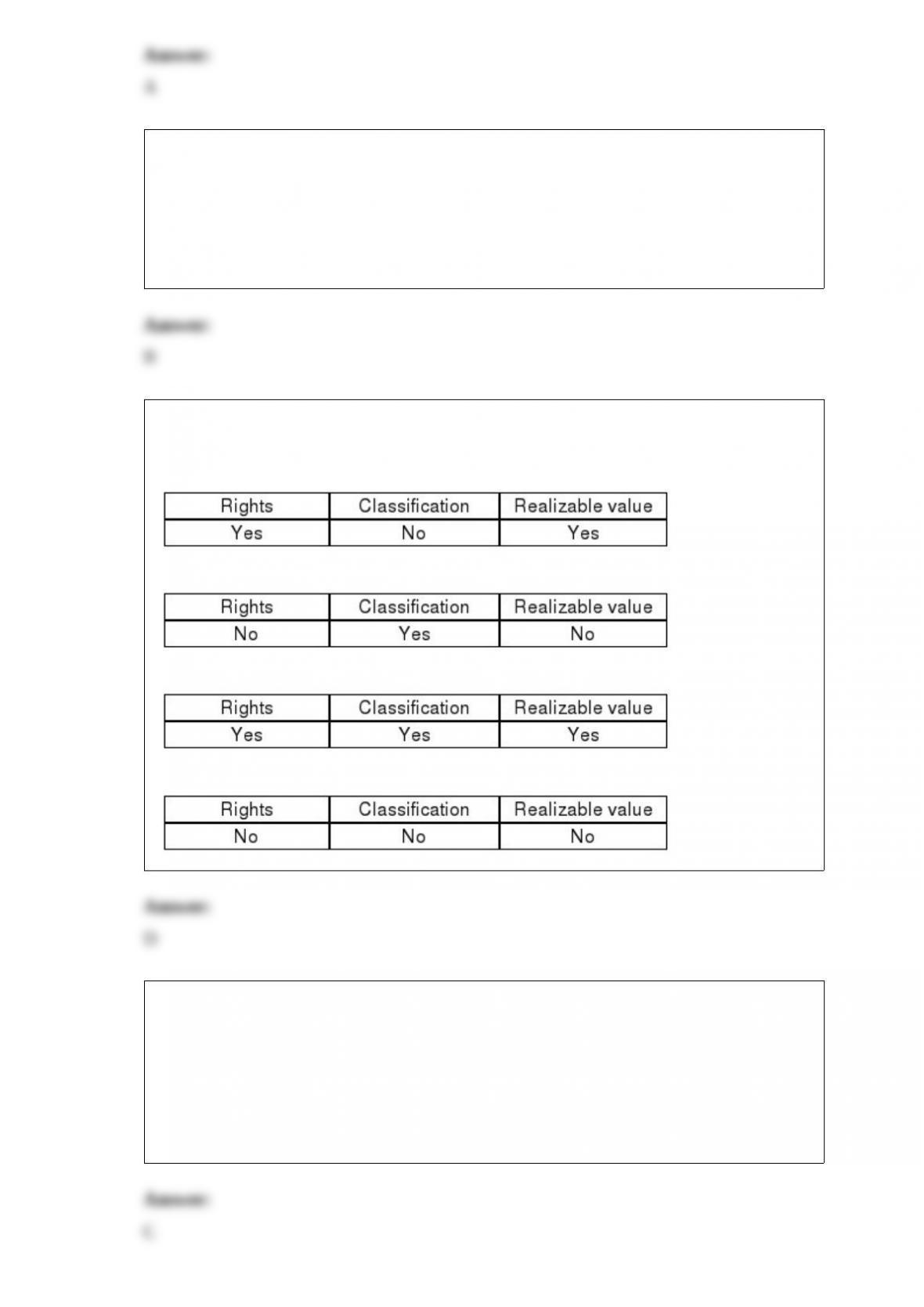
19) Which of the following balance-related objectives applies to auditing the general
cash account?
A)
B)
C)
D)
20) The predecessor auditor is required to respond to the request of the successor
auditor for information, but the response can be limited to stating that no information
will be provided when:
A) the predecessor auditor has poor relations with the successor auditor
B) the client is dissatisfied with the predecessor’s work
C) there are actual or potential legal problems between the client and the predecessor
D) the predecessor believes that the client lacks integrity

21) Because a client representation letter is a written statement from a non-independent
source, it cannot be regarded as reliable evidence.
A) True
B) False
22) A primary concern in reporting on a comprehensive basis is to make sure that the
statements clearly indicate that they are prepared on a basis other than GAAP.
A) True
B) False
23) Auditors should consider risk factors related to incentives, opportunities, and
attitudes whenever they assess the likelihood of material misstatements due to fraud.
A) True
B) False
24) The Sarbanes-Oxley Act permits the auditor to perform a wide variety of non-audit
services for audit clients.
A) True
B) False
25) The concept of reasonable assurance is provided for in which one of the following
engagements?
A) review
B) compilation
C) audit
D) none of the above
26) Operational audits may be performed by internal auditors and government auditors,
but not by external auditors.
A) True
B) False
27) Examining the minutes of the board of directors’ meetings for proper authorization
ordinarily tests the occurrence objective for capital stock transactions.
A) True
B) False
28) Discuss the four key controls over notes payable.
29) Define ordinary negligence, gross negligence, and constructive fraud.
30) The audit of the inventory and warehousing cycle will be affected by the results
from other business processes. Identify the “other” business cycles and how they impact
the audit of inventory.
31) The following is a portion of a qualified scope and opinion report due to a scope
restriction. (Note: A separate report was issued on the effectiveness of internal control
over financial reporting.)
Independent Auditor’s Report
To the shareholders of Fast Times Corporation
We have audited the accompanying balance sheet of Fast Times Corporation as of
September 30, 2012, and the related statements of income, retained earnings, and cash
flows for the year then ended. These financial statements are the responsibility of the
company’s management. Our responsibility is to express an opinion on these financial
statements based on our audit.
Except as discussed in the following paragraph, we conducted our audit in accordance
with the standards of the Public Company Accounting Oversight Board (United States).
Those standards require that we plan and perform the audit to obtain reasonable
assurance about whether the financial statements are free of material misstatement. An
audit includes examining, on a test basis, evidence supporting the amounts and
disclosures in the financial statements. An audit also includes assessing the accounting
principles used and significant estimates made by management, as well as evaluating
the overall financial statement presentation. We believe that our audit provides a
reasonable basis for our opinion.
We were unable to obtain audited financial statements supporting the company’s
investment in a foreign affiliate stated at $1,040,000, or its equity in earnings of that
affiliate of $501,000, which is included in net income, as described in Note 14 to the
financial statements. Because of the nature of the company’s records, we were unable to
satisfy ourselves as to the carrying value of the investment or the equity in its earnings
by means of other auditing procedures.
Required:
Complete the above report by preparing the opinion paragraph. Do not date or sign the
report.
32) Distinguish between generally accepted auditing standards (GAAS) and generally
accepted accounting principles (GAAP). What professional organization establishes
GAAS? What professional organization establishes GAAP?
33) List and briefly describe examples of risk factors for each condition of fraud for
fraudulent financial reporting.
34) Describe for each function below their role in the acquisition and payment cycle:
Purchasing
Invoice Processing
Accounts Payable