In a weighted-average process costing system, the costs in the beginning
Work-in-Process Inventory are not used to compute the costs transferred-out.
Answer:
One of the most common decisions facing managers is determining the price at which
to sell one of their product or provide their services.
Answer:
One reason to allocate service department costs to user departments is to encourage the
user departments to monitor their use of the service department costs.
Answer:
Professional accounting firms could not compute a labor mix and labor yield variance
for their auditors because labor in accounting is not substitutable.
Answer:
One problem associated with using accounting measures to evaluate divisional
performance is the measures are based on historical information.
Answer:
In general, profit centers are found at higher levels in an organization than investment
centers.
Answer:
When deciding whether or not to accept a special order, a decision-maker should focus
on differential costs instead of full costs.
Answer:
The production budget is not needed for a service organization.
Answer:
In essence, the terms “master budget” and “operating budget” mean the same thing and
can be used interchangeably.
Answer:
In general, variable costs are allocated using a first-stage cost allocation system and
fixed costs are allocated using a second-stage cost allocation system.
Answer:
In general, the unit-level costs in an activity-based costing (ABC) system are variable
costs.
Answer:
In general, it is better to have a higher return on investment (ROI) than a lower one.
Answer:
Participative budgeting eliminates or reduces the amount of budgetary slack inherent in
the budgeting process.
Answer:
Cost information used for one managerial decision could be irrelevant for another
managerial decision.
Answer:
Variance analysis for fixed production costs is virtually the same as for variable
production costs.
Answer:
In general, managerial decisions affecting capacity-level costs and activities also affect
volume-level, batch-level, and product-level cost and activities.
Answer:
Total variable costs change inversely with changes in the volume of activity.
Answer:
A perfect intermediate market exists if buyers can buy and sellers can sell outside of
the organization.
Answer:
An expense is an expired cost matched with revenues in a specific accounting period.
Answer:
Cost accounting information can be used by managers to defraud customers, creditors,
and owners.
Answer:
Properly designed management control systems have both fixed compensation and
contingent compensation.
Answer:
It is possible for performance evaluation systems and/or management control systems
to contribute to unethical or fraudulent behavior.
Answer:
The only purpose of cost information is to determine the individual product cost on a
per unit basis in order to value inventory.
Answer:
The step method allocates some, but not all, service department costs to other service
departments.
Answer:
In general, it is better to use a product’s market value at the split-off point than its
estimated net realizable value in allocating joint costs.
Answer:
An increase in an organization’s fixed costs will result in a lower margin of safety,
assuming all other costs and sales remain unchanged.
Answer:
A transfer price is the value assigned to the transfer of goods or services between
divisions within the same organization.
Answer:
One advantage of nonfinancial measures is that managers directly involved in
operations are likely to understand them.
Answer:
If the Beginning Balance (BB) equals the Ending Balance (EB), then the Transfers In
(TI) equal the Transfers Out (TO).
Answer:
One disadvantage of using after-tax income as a performance measure of divisional
results is it’s an absolute measure which makes it difficult to compare divisions of
significantly different sizes.
Answer:
A person who makes unethical decisions in their personal life is likely to make
unethical decisions in their professional life.
Answer:
In a sell-or-process-further decision, the common costs incurred prior to the spilt-off
point are irrelevant.
Answer:
The following information relates to the Jax Company for the upcoming year.
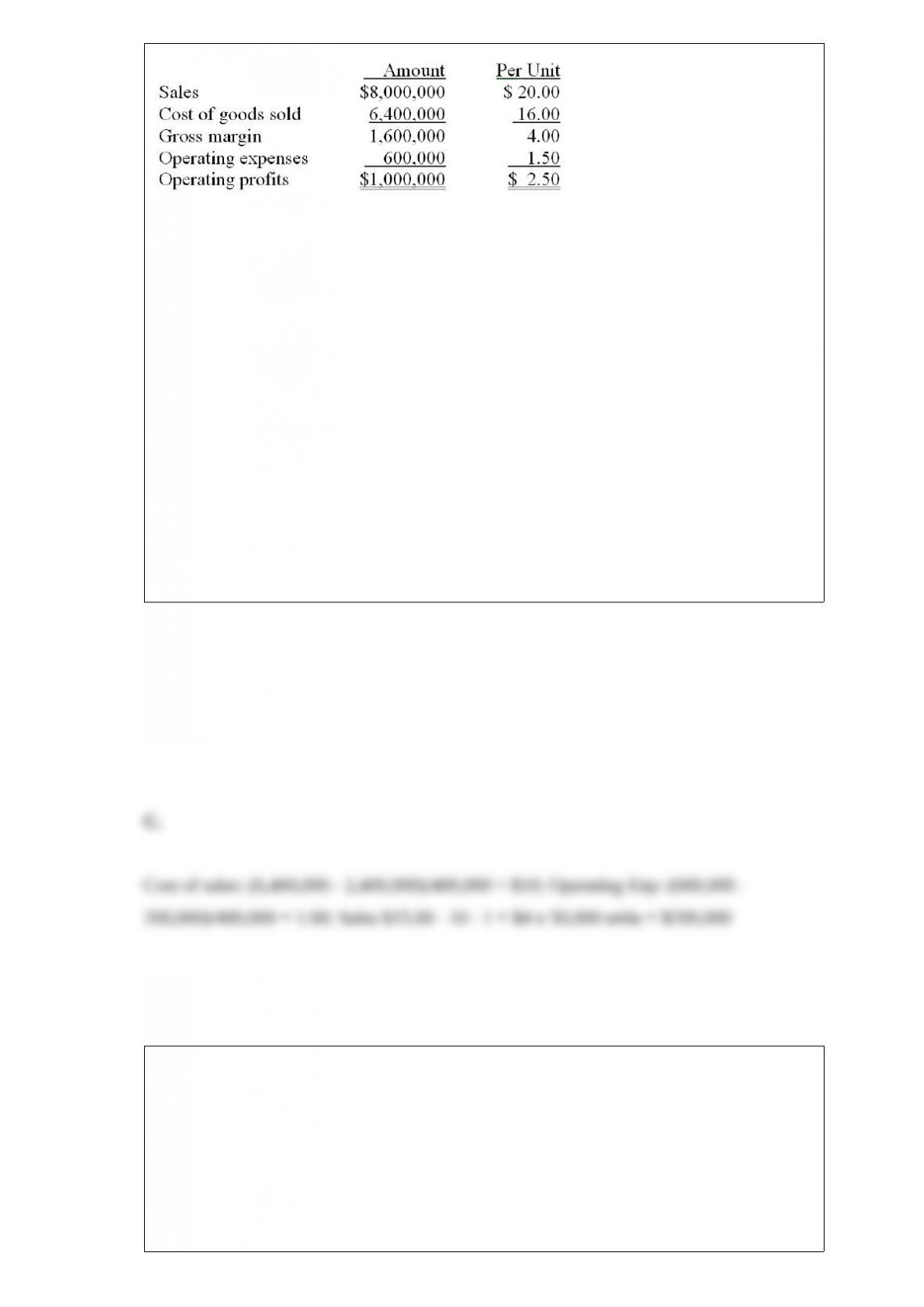
The cost of goods sold includes $2,400,000 of fixed manufacturing overhead; the
operating expenses include $200,000 of fixed marketing expenses. A special order
offering to buy 50,000 units for $15.00 per unit has been made to Jax. Fortunately, there
will be no additional operating expenses associated with the order and Jax has sufficient
capacity to handle the order. How much will operating profits increase if Jax accepts the
special order?
A. $50,000
B. $125,000
C. $200,000
D. $250,000
E. Operating profits will not increase as a result of accepting the special order.
Answer:
Which of the following statements is (are) false?
(A) All variances should be prorated to inventories and cost of goods sold at the end of
the accounting period.
(B) If the number of units produced exceeds the number of units sold, the
full-absorption operating profit will be lower than variable costing operating profit.
A. Only A is false.
B. Only B is false.
C. Both A and B are false.
D. Neither A nor B is false.
Answer:
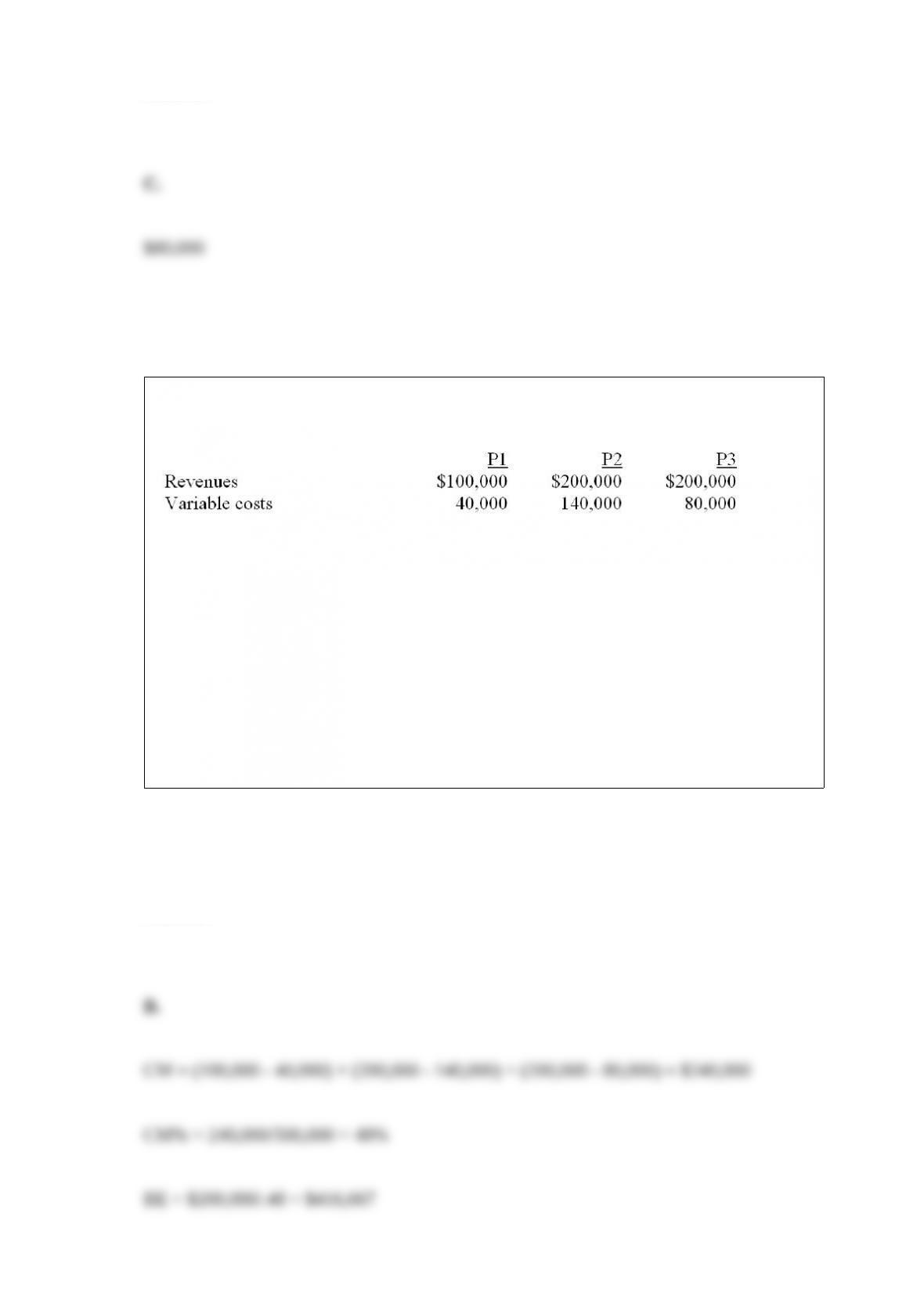
QC Enterprises quality control report for August contains the following items.
What would be the total of the appraisal costs on the August quality control report for
QC Enterprises?
A. $30,000
B. $70,000
C. $80,000
D. $90,000
Answer:
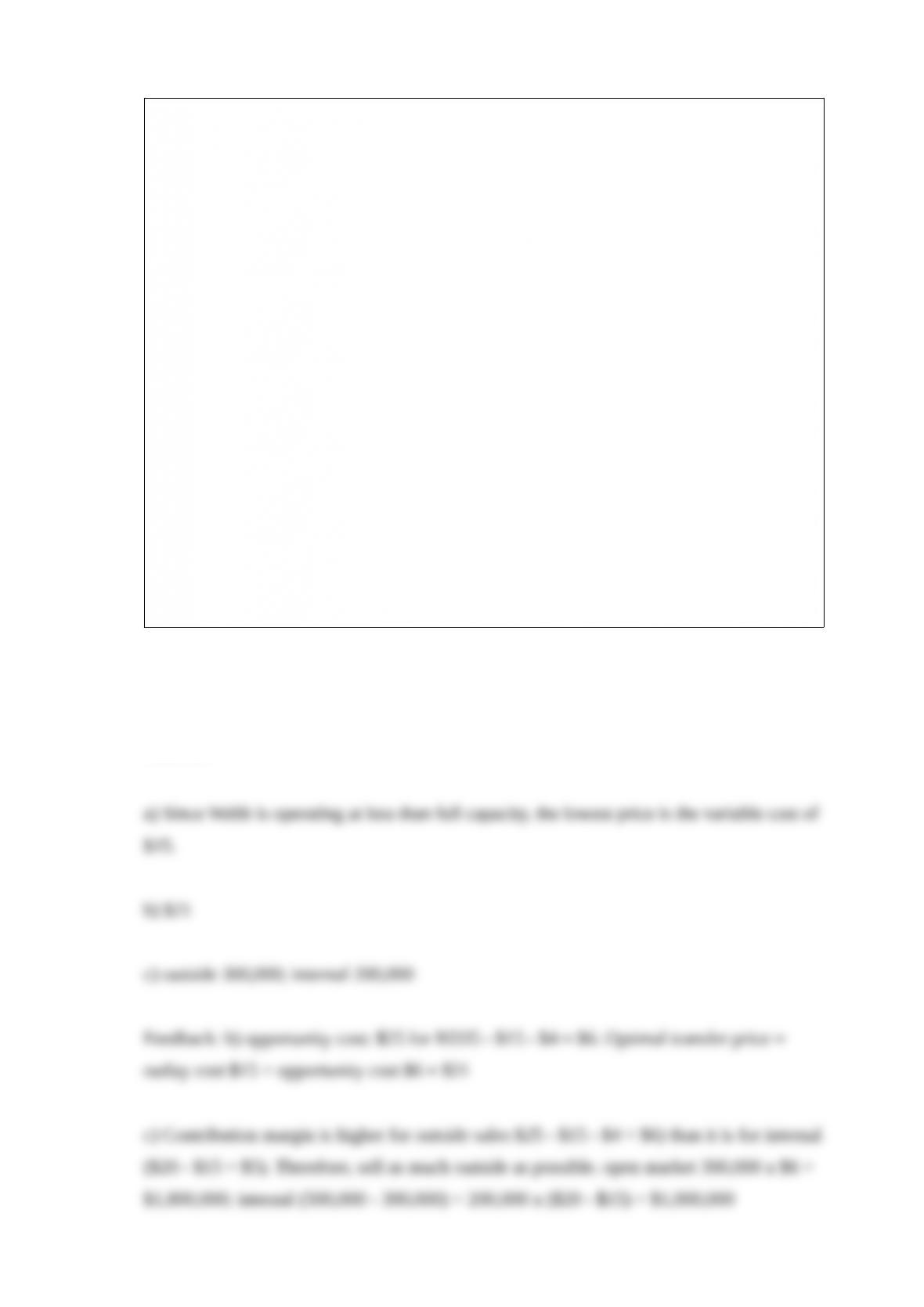
Kanmore produces and sells three products. Last month’s results are as follows:
Fixed costs total $200,000. What is Kanmore’s break-even sales volume? (Assume the
current product mix)
A. $500,000
B. $416,667
C. $384,615
D. $460,000
Answer:
Baldwin Corp. manufactures RD34 in its Webb Division. This output is sold to the
Roberts Division as raw material in Robert’s product. Webb also further processes the
RD34 into RD35, and then sells it to other companies.
The Webb Division’s variable costs for the basic ingredient are $15 per unit. The Robert
Division’s variable costs are $5 per unit in addition to what it pays the Webb Division.
The Roberts Division has a capacity of 400,000 units and it can sell everything it
produces. The market price for the finished additive is $40 per unit. If the Webb
Division converts the RD34 into RD35, it can receive $25 per unit on the open market,
but it incurs an additional $4 per unit for this processing.
Required:
a) What is the lowest price the Webb Division should be willing to transfer RD34 to the
Roberts Division, assuming the Webb Division is not at full capacity?
b) What is the lowest price the Webb Division should be willing to transfer RD34 to the
Roberts Division, assuming the Webb Division is at full capacity?
c) Ignore parts (a) and (b). Assume that the Webb Division has a capacity of 500,000
units, but can only sell 300,000 on the open market. How many units should the Webb
Division sell externally and how many units should it sell to Roberts Division at a
transfer price of $20?
Answer:
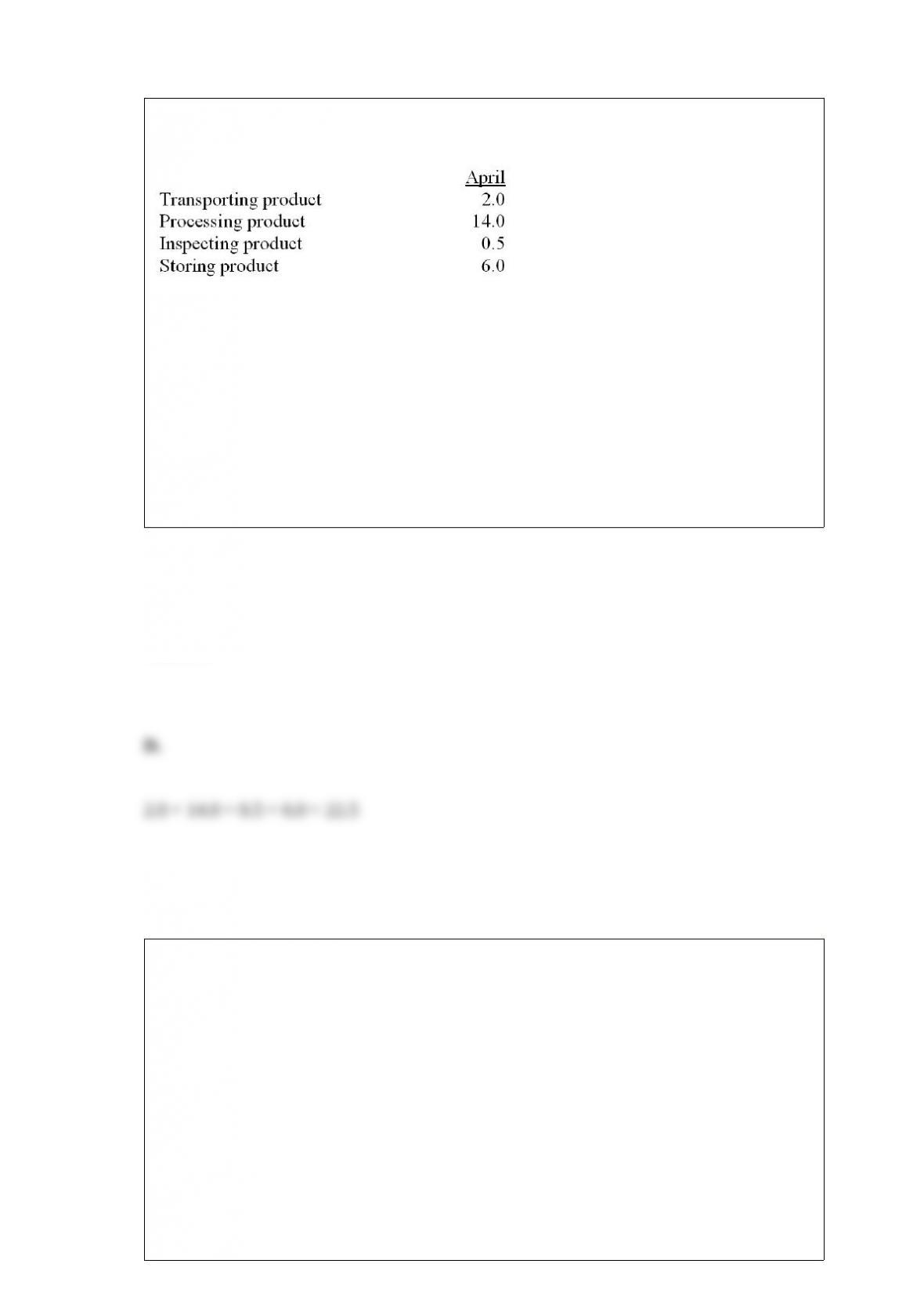
The ABC Manufacturing Company collected the following information (in days):
What is the manufacturing cycle time?
A. 14.0 days
B. 16.0 days
C. 22.0 days
D. 22.5 days
Answer:
In a job costing system, the dollar amount in the journal entry that transfers the costs of
jobs from Work-in-Process Inventory to Finished Goods Inventory is the sum of the
costs charged to all jobs
A. sold during the period.
B. completed during the period.
C. in process during the period.
D. started in process during the period.
E. completed and sold during the period.
Answer:
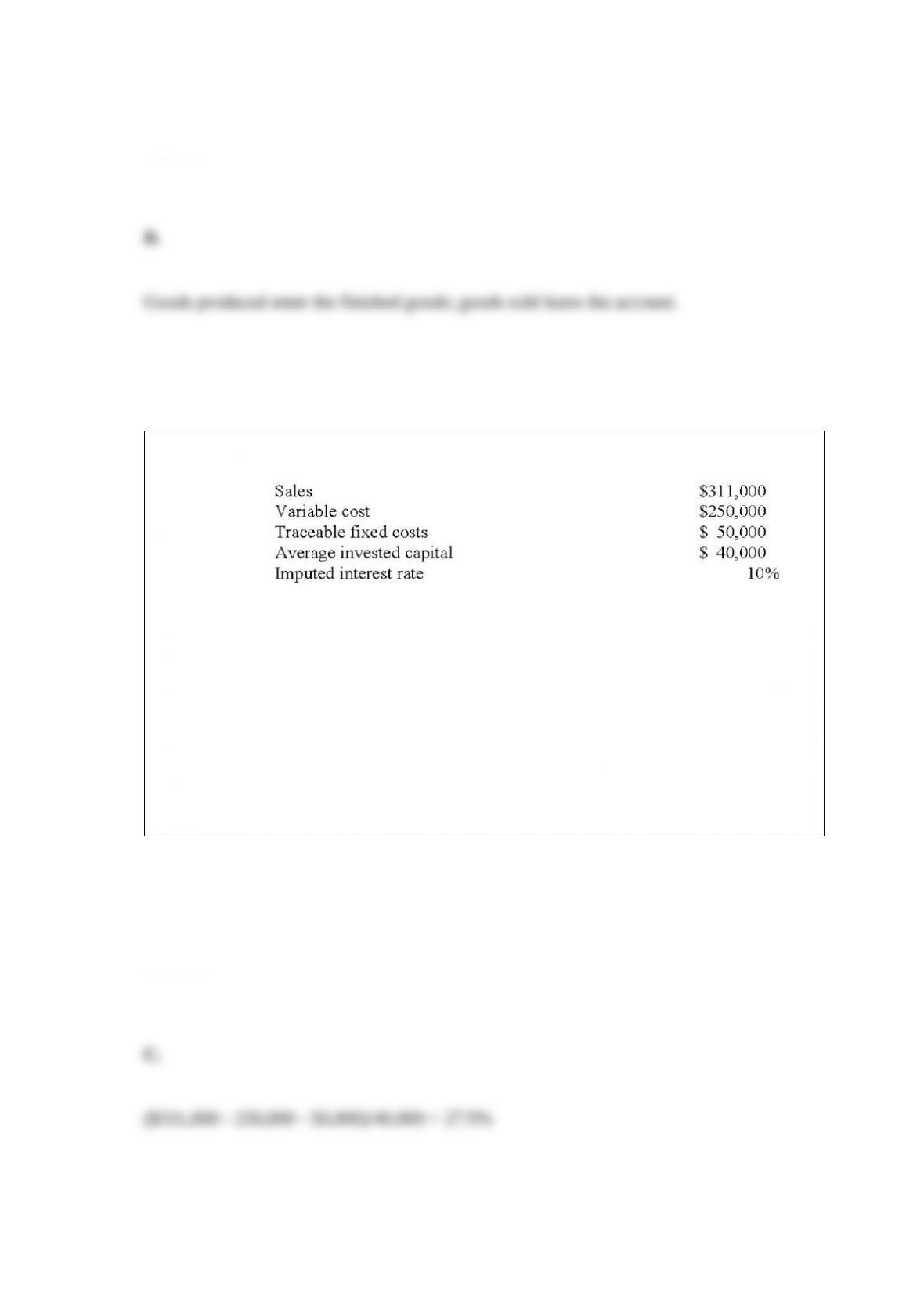
The following information pertains to Quest Co.’s Gold Division for the current year:
(CPA adapted)
Quest’s return on investment was
A. 10.00%.
B. 13.33%.
C. 27.50%.
D. 30.00%.
Answer:
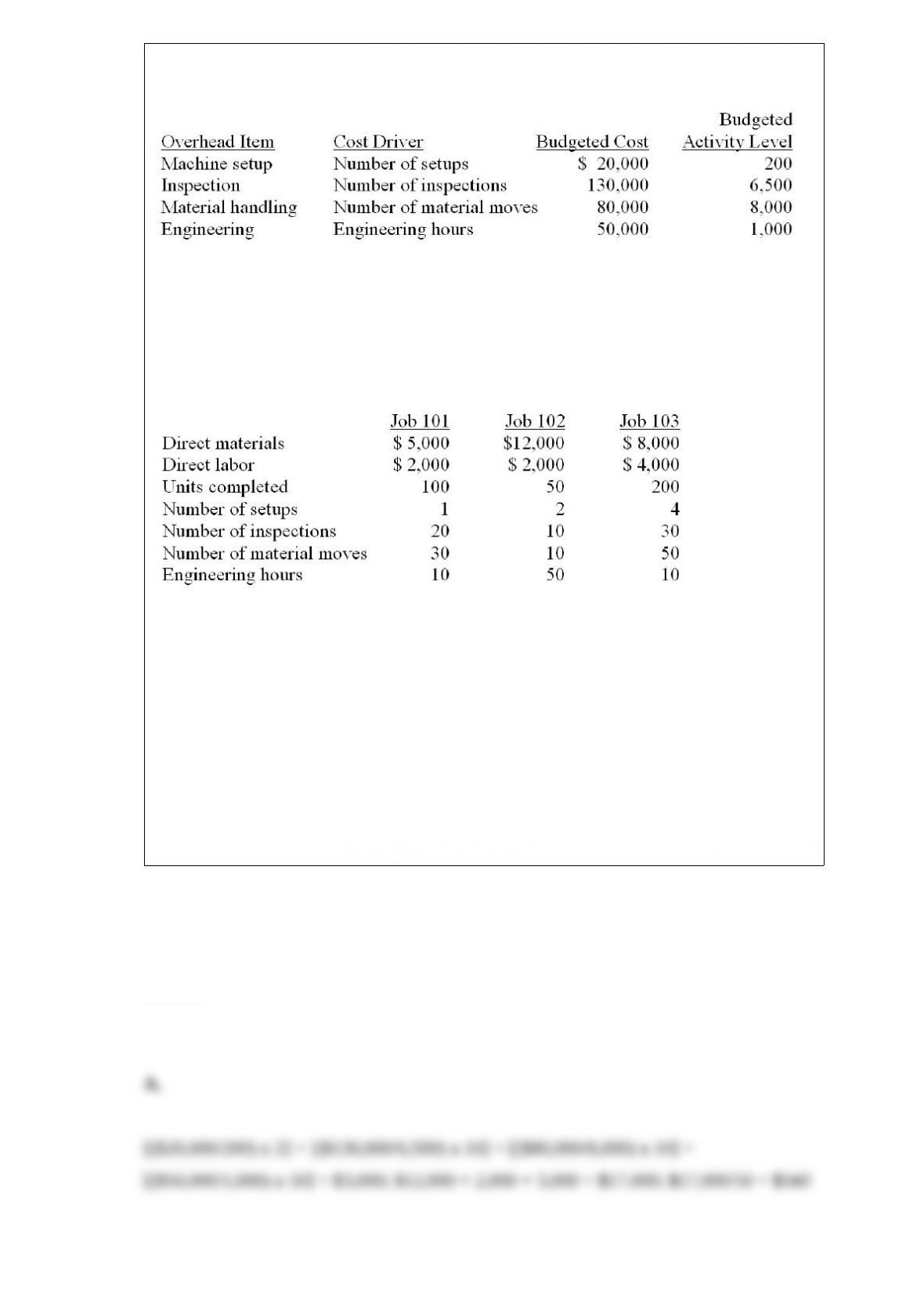
A company has identified the following overhead costs and cost drivers for the coming
year: (CIA adapted)
Budgeted direct labor cost was $100,000 and budgeted direct material cost was
$280,000. The following information was collected on three jobs that were completed
during the year:
If the company uses activity-based costing (ABC), what is the cost of each unit of Job
102?
A. $340
B. $392
C. $440
D. $520
Answer:

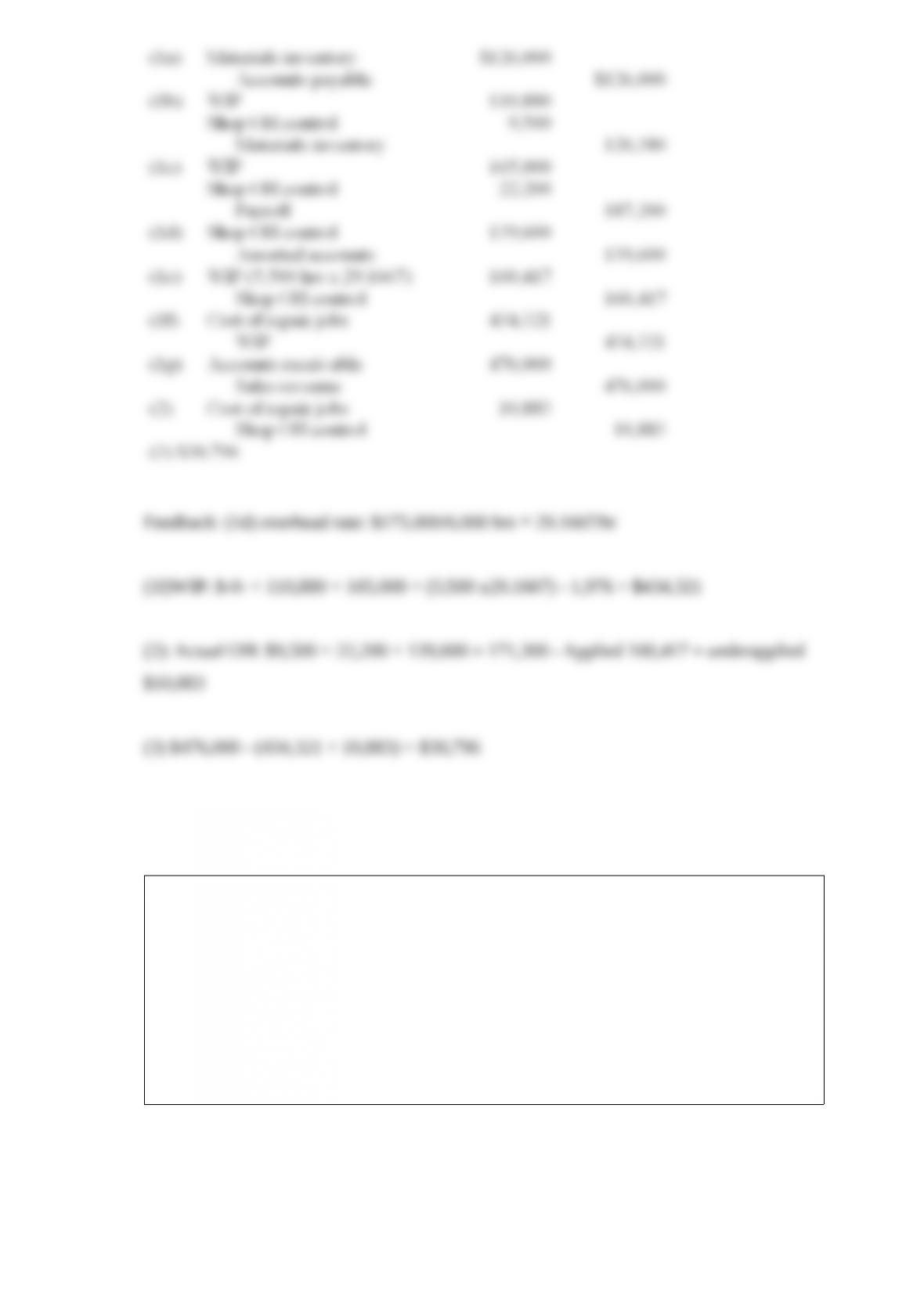
The Perrot Company is a computer repair shop and had the following transactions and
events during the year. Estimated overhead for the year was $175,000; estimated labor
for the year was 6,000 hours.
a) Purchased materials on account, $126,000.
b) Traced materials to repair jobs $110,880; general shop materials used $9,500.
c) Labor traced to repair jobs $165,000, untraced labor was $22,200.
d) Overhead incurred (not including materials or labor): $139,600.
e) Overhead is applied to repair jobs based on labor hours. All workers were paid
$30/hr.
f) Ending work-in-process consisted of one repair job with a cost of $1,976. There was
no beginning work-in-process.
g) Repair jobs were billed to the customers for $476,000.
Required:
(1) Prepare the journal entries to record the transactions for the year.
(2) Prepare the journal entry to write-off the over- or underapplied overhead to the cost
of repair jobs.
(3) What would Perrot’s operating profit for the year?
Answer:
Relative performance evaluations (RPE) are not designed to
A. compare managers to other comparable managers.
B. compare divisions with other comparable divisions.
C. remove the effect of environmental factors that are beyond a manager’s control.
D. restate departmental goals so meaningful comparisons can be made.
Answer:
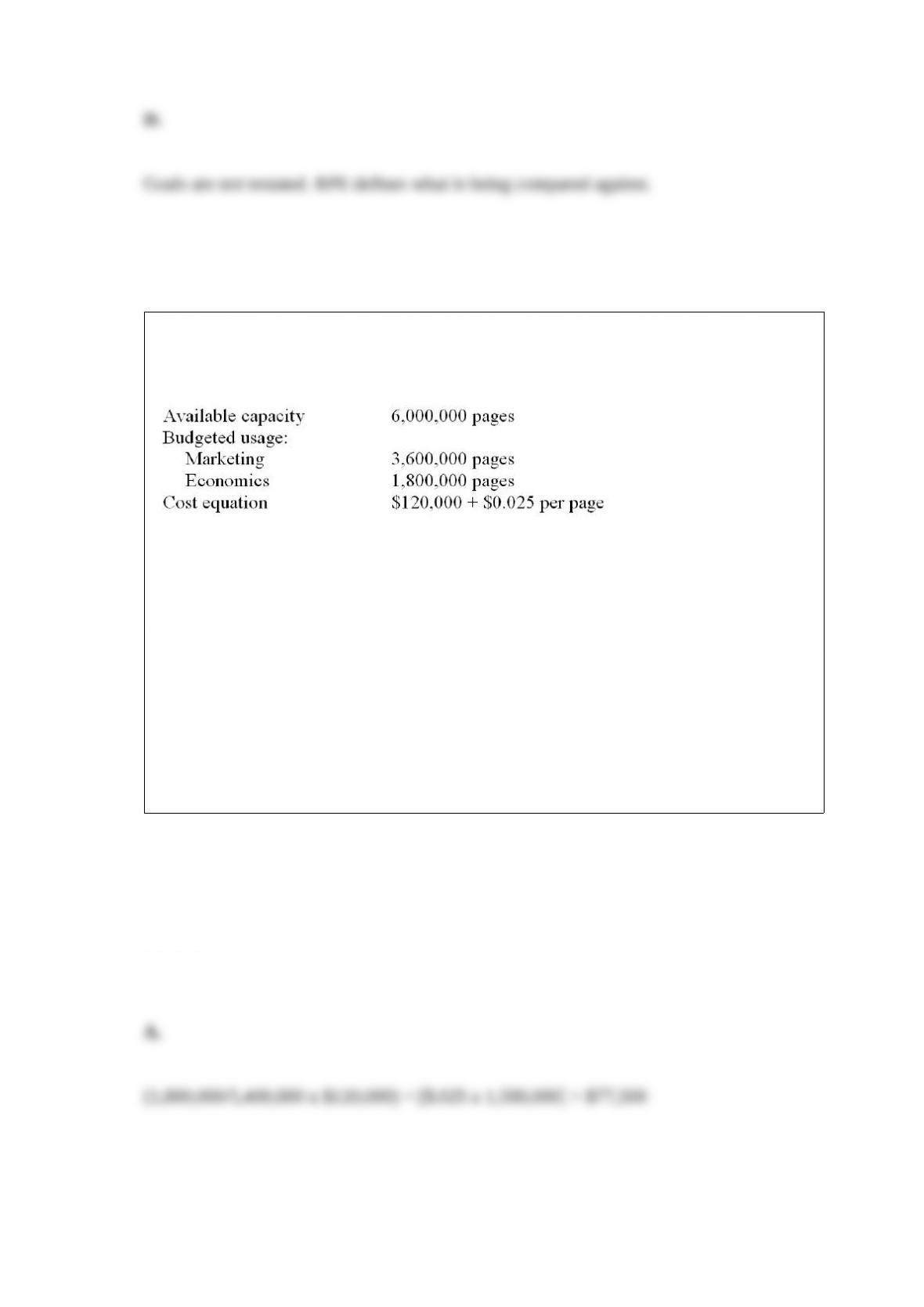
The Copy Department in the College of Business at State University provides
photocopying service for both the Marketing and Economics Department. The
following budget has been prepared for the year.
If the Copy Department uses a dual-rate for allocating its costs, how much cost will be
allocated to the Economics Department, assuming the Economics Department actually
made 1,500,000 copies during the year?
A. $77,500
B. $92,500
C. $132,500
D. $112,500
Answer:
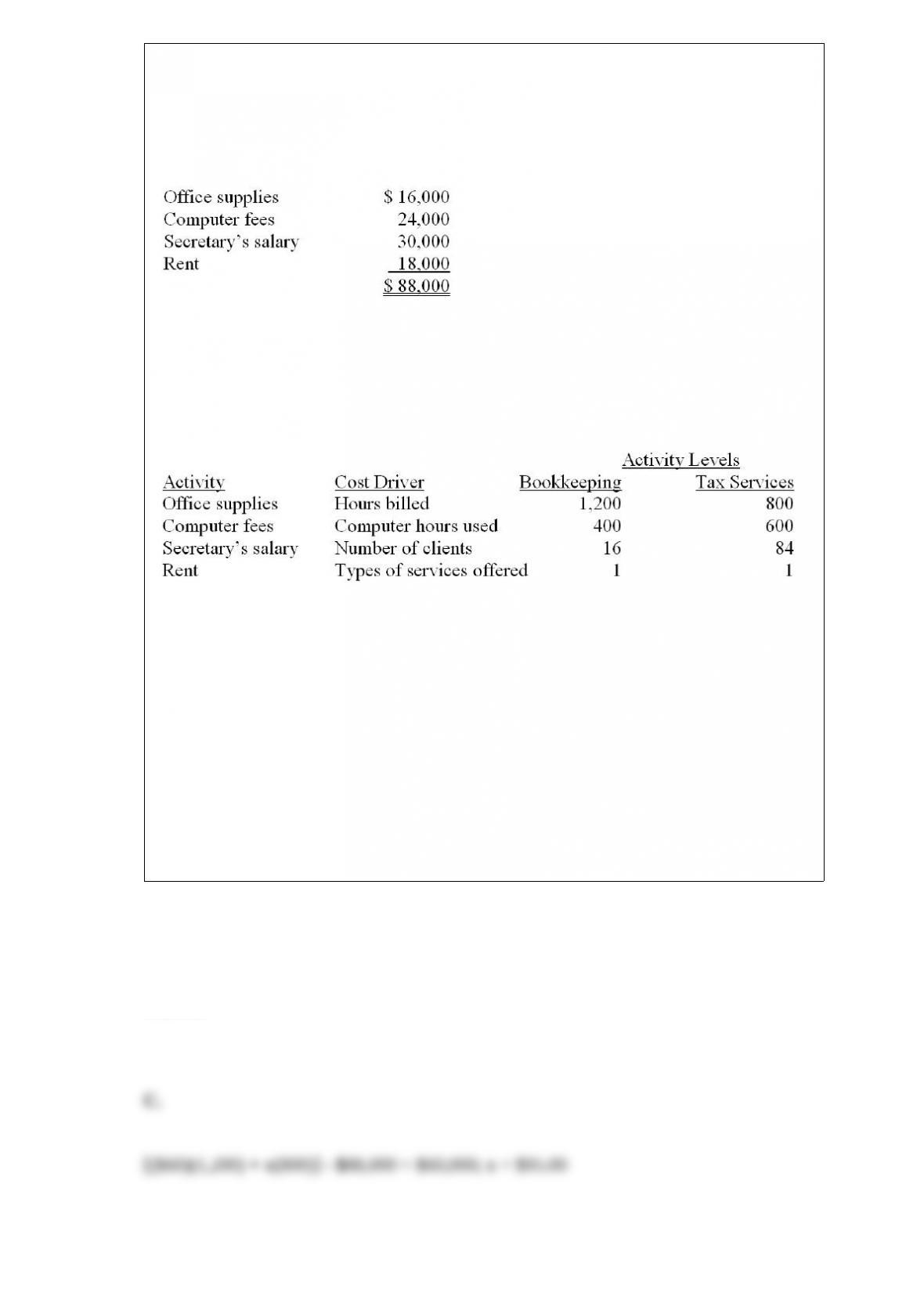
Terri Martin Nerdmeister, CPA provides bookkeeping and tax services to her clients.
She charges a fee of $60 per hour for bookkeeping and $90 per hour for tax services.
Martin estimates the following costs for the upcoming year:
Operating profits declined last year and Ms. Martin has decided to use activity-based
costing (ABC) procedures to evaluate her hourly fees. She gathered the following
information from last year’s records:
Martin cannot change the hourly fee for the bookkeeping services because of the
number of competing firms in the area. If Martin wants to earn $60,000 pre-tax in the
upcoming year, how much will she charge per hour for tax services?
A. $74
B. $90
C. $95
D. $106
Answer:
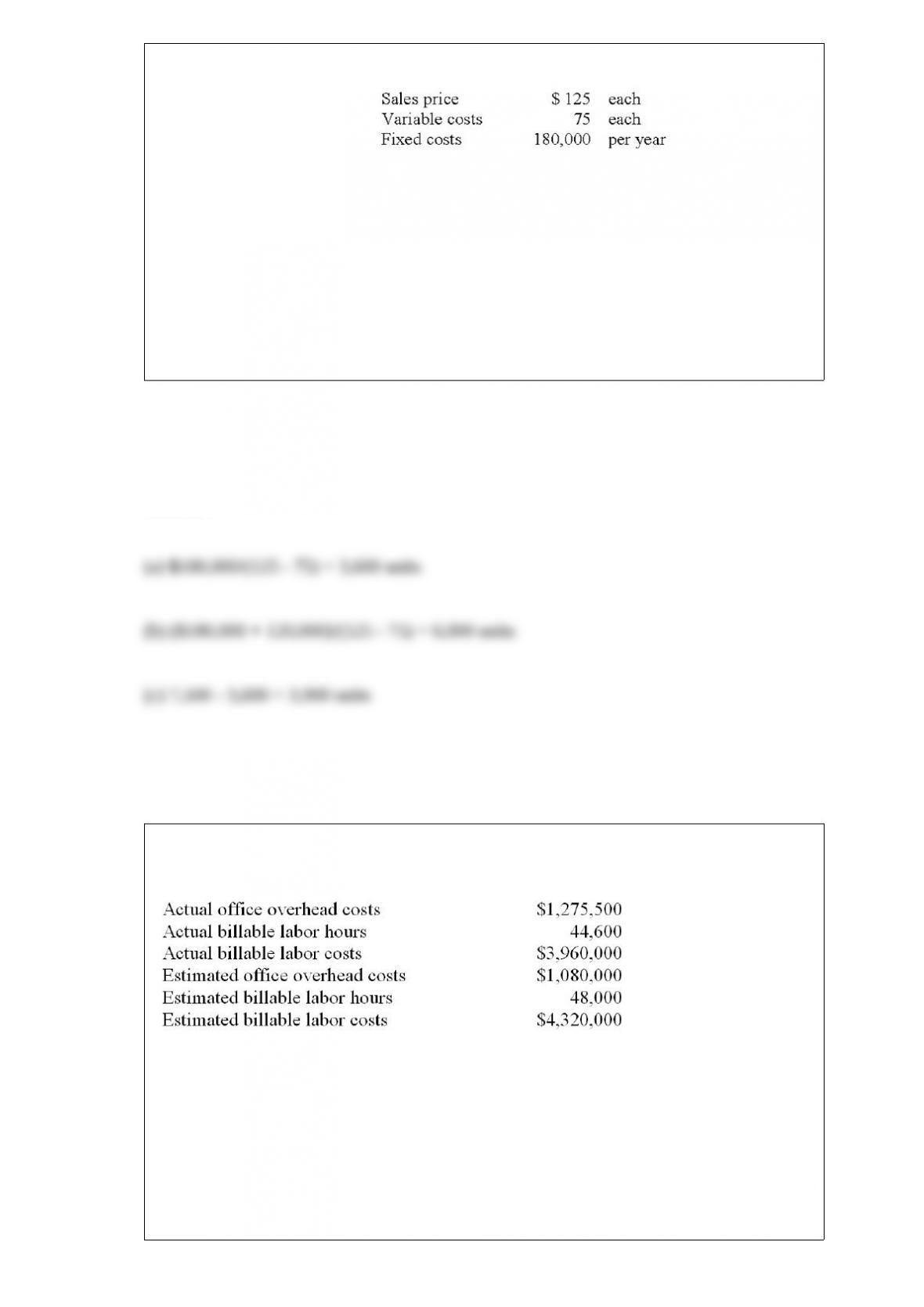
T-Tunes, Inc. is considering the introduction of a new music player with the following
price and cost characteristics:
Required
(a) How many units must T-Tunes sell to break even?
(b) How many units must T-Tunes sell to make an operating profit of $120,000 for the
year?
(c) If projected sales are 7,500 units, what is the margin of safety in units?
Answer:
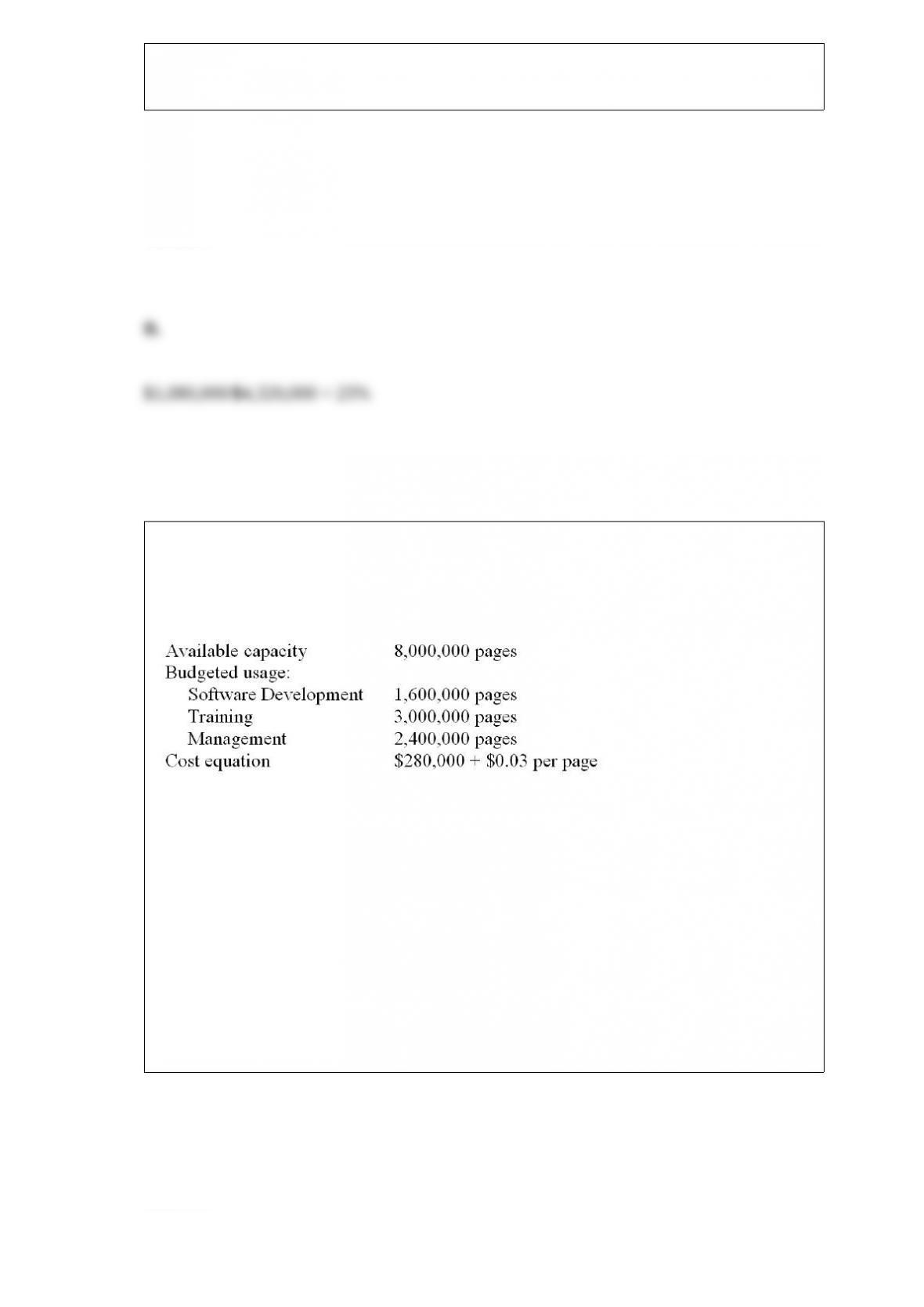
The following information has been gathered for Cheatham Law Offices for its fiscal
year ending December 31:
What is the predetermined office overhead rate per billable labor dollar?
A. 118.10%
B. 25.00%
C. 32.21%
D. 400.00%
Answer:
The Document Creation Center (DCC) for Alegis Corp. provides photocopying and
document services for three departments in the St. Paul office. The following budget
has been prepared for the year.
If DCC uses a dual-rate for allocating its costs, how much cost will be allocated to the
Training Department, assuming the Training Department actually made 2,770,000
copies during the year?
A. $180,050
B. $190,079
C. $193,900
D. $203,100
Answer:
The costing method that first assigns costs to activities and then assigns them to
products based on the products’ consumption of activities is called
A. lean accounting
B. responsibility centers
C. activity-based costing
D. budgeting
E. outsourcing
Answer:
How will increases in the following items affect residual income?
A. a
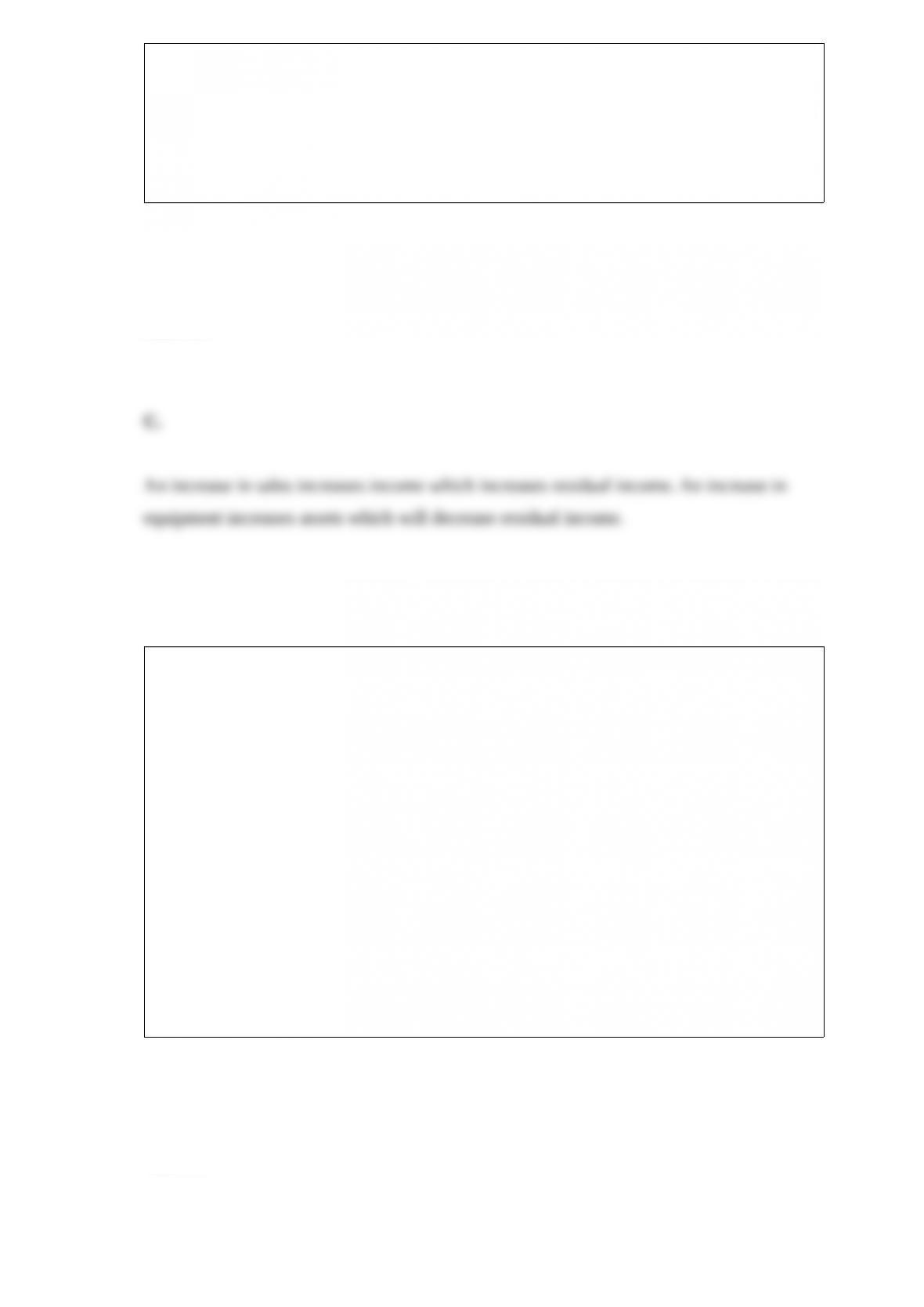
B. b
C. c
D. d
Answer:
Which of the following statements is (are) true regarding the benefits associated with
participative budgeting?
(A) Goal congruence by divisions means top management need not be concerned with
overall profitability.
(B) Budget assumptions and estimates are prepared by those closest to the budgeted
activity.
A. Only A is true.
B. Only B is true.
C. Both A and B are true.
D. Neither A nor B is true.
Answer:
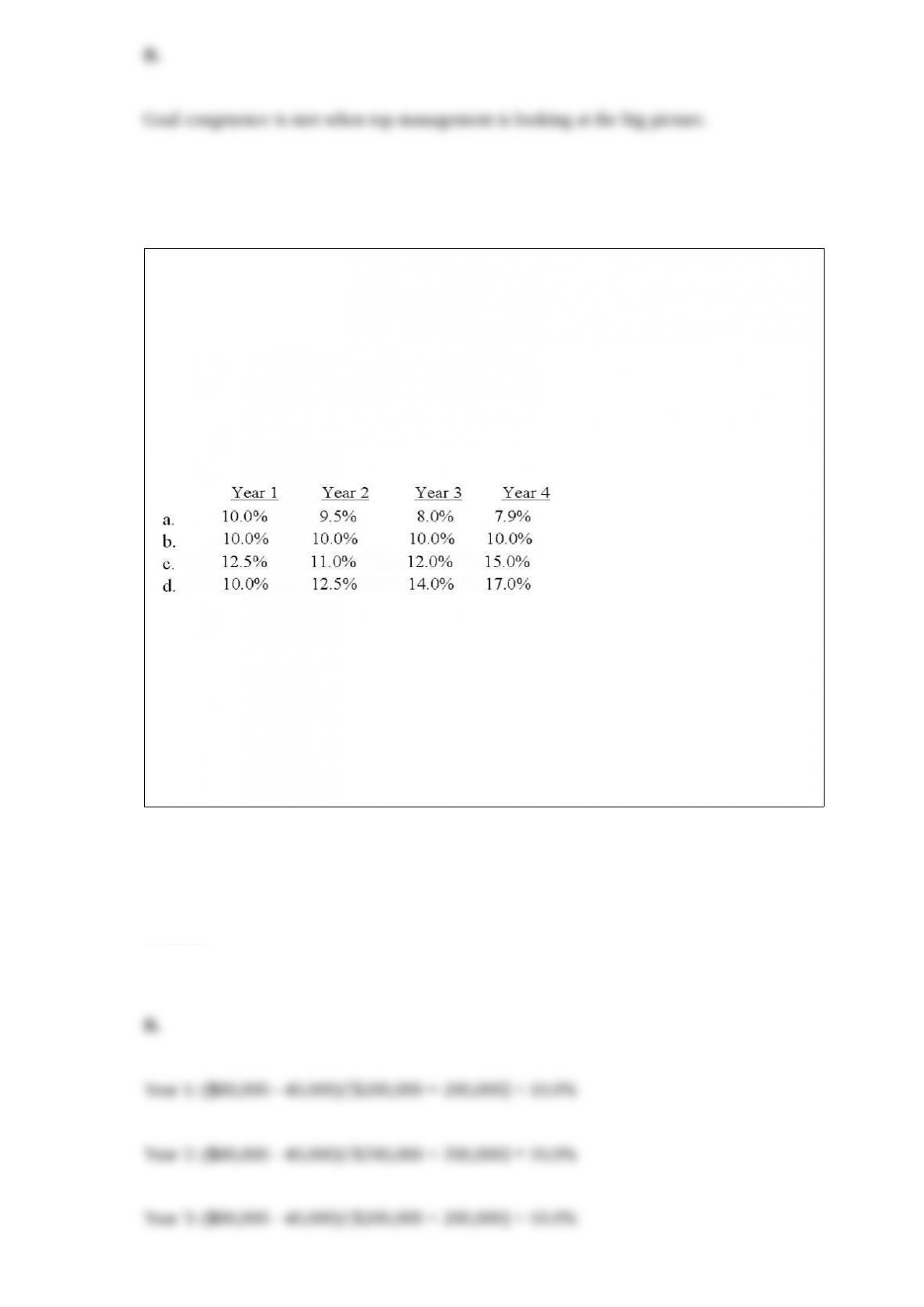
A company purchased assets costing $200,000 which will be depreciated over 5-years
using straight-line depreciation and no salvage value. The company also purchased land
and other assets, which are not depreciable at a cost of $200,000. It is estimated that in
5-years, the value of these assets will be unchanged. Assume that annual cash profits
are $80,000 and, for return on investment (ROI) calculations, the company uses
end-of-year asset values.
What is the ROI for each year using gross book value?
A. a
B. b
C. c
D. d
Answer:
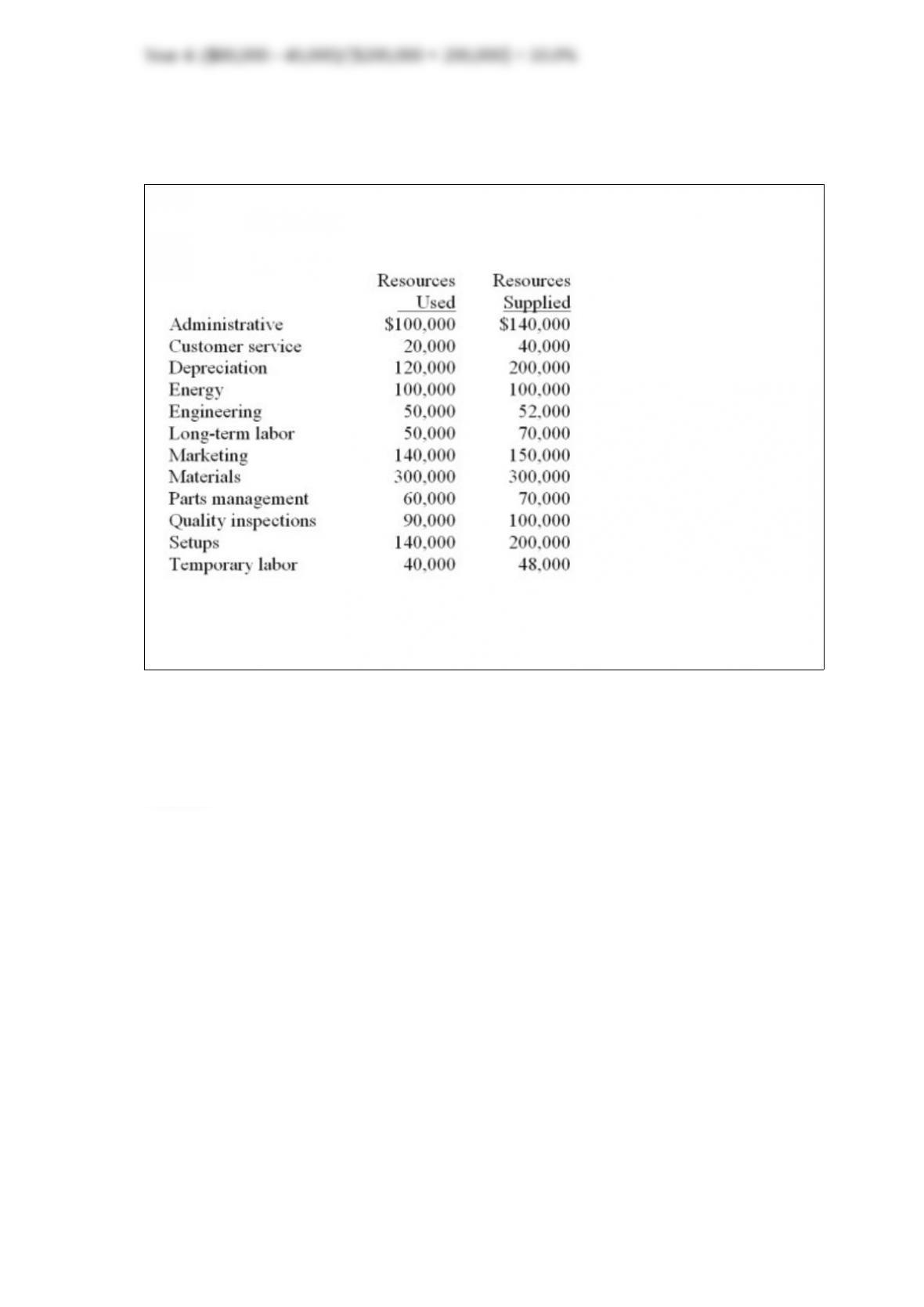
Carr Valley Corporation manufactures electric scooters. Information regarding
resources for the month follows:
Required
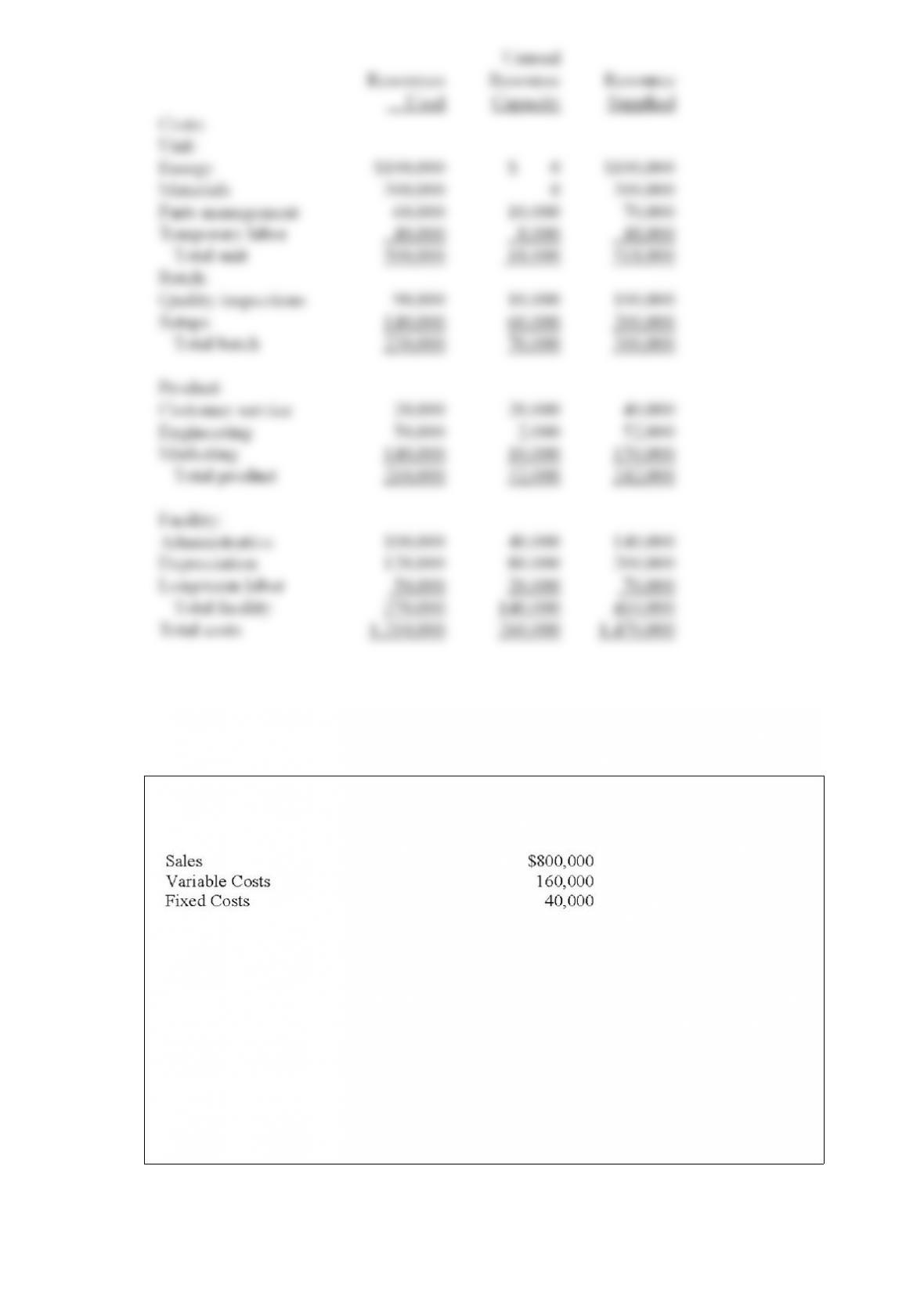
a) Prepare an analysis of the unused resource capacity for the month.
Answer:
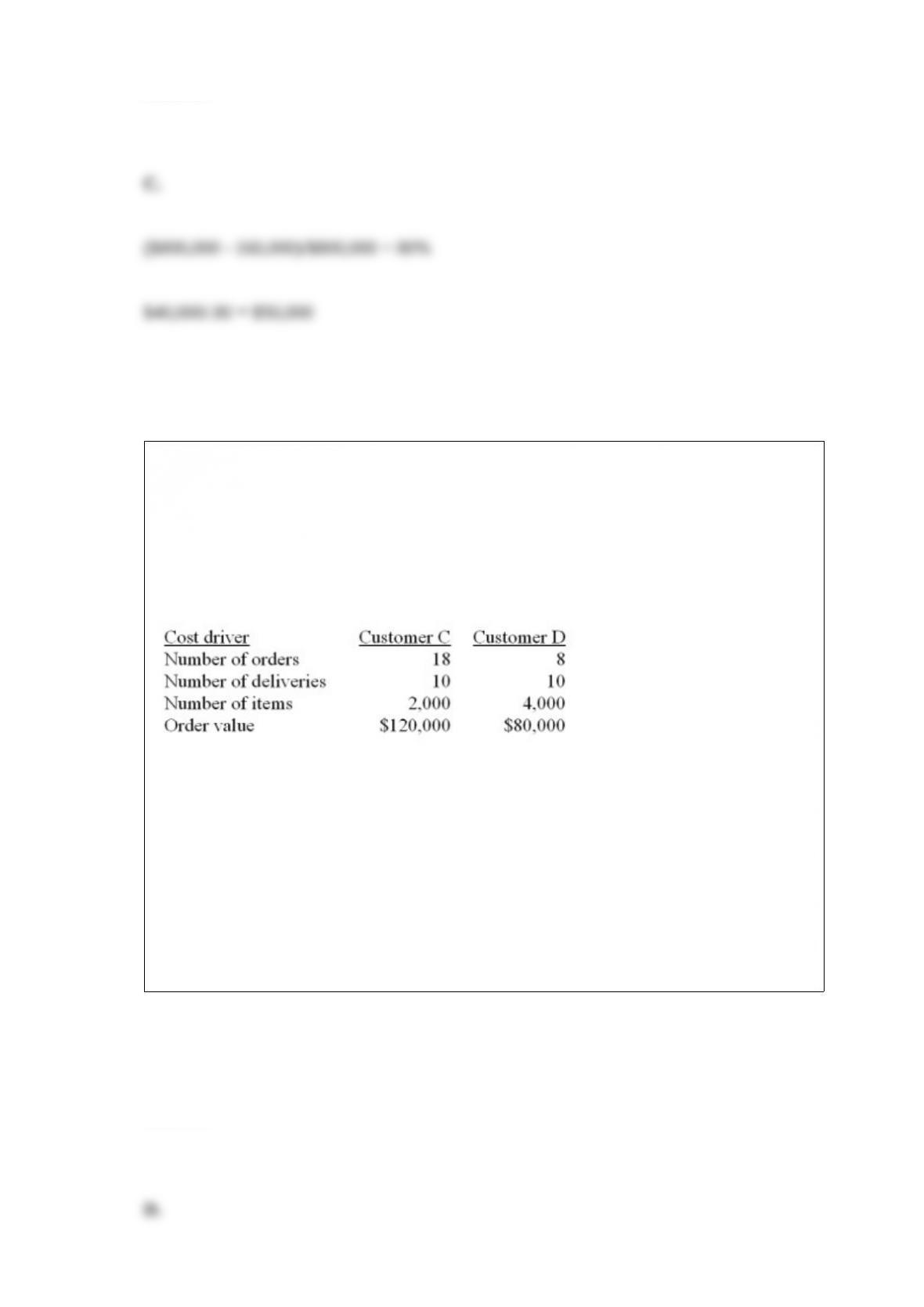
The following information pertains to Syl Co.:
What is Syl’s break-even point in sales dollars? (CPA adapted)
A. $200,000
B. $160,000
C. $50,000
D. $40,000
Answer:
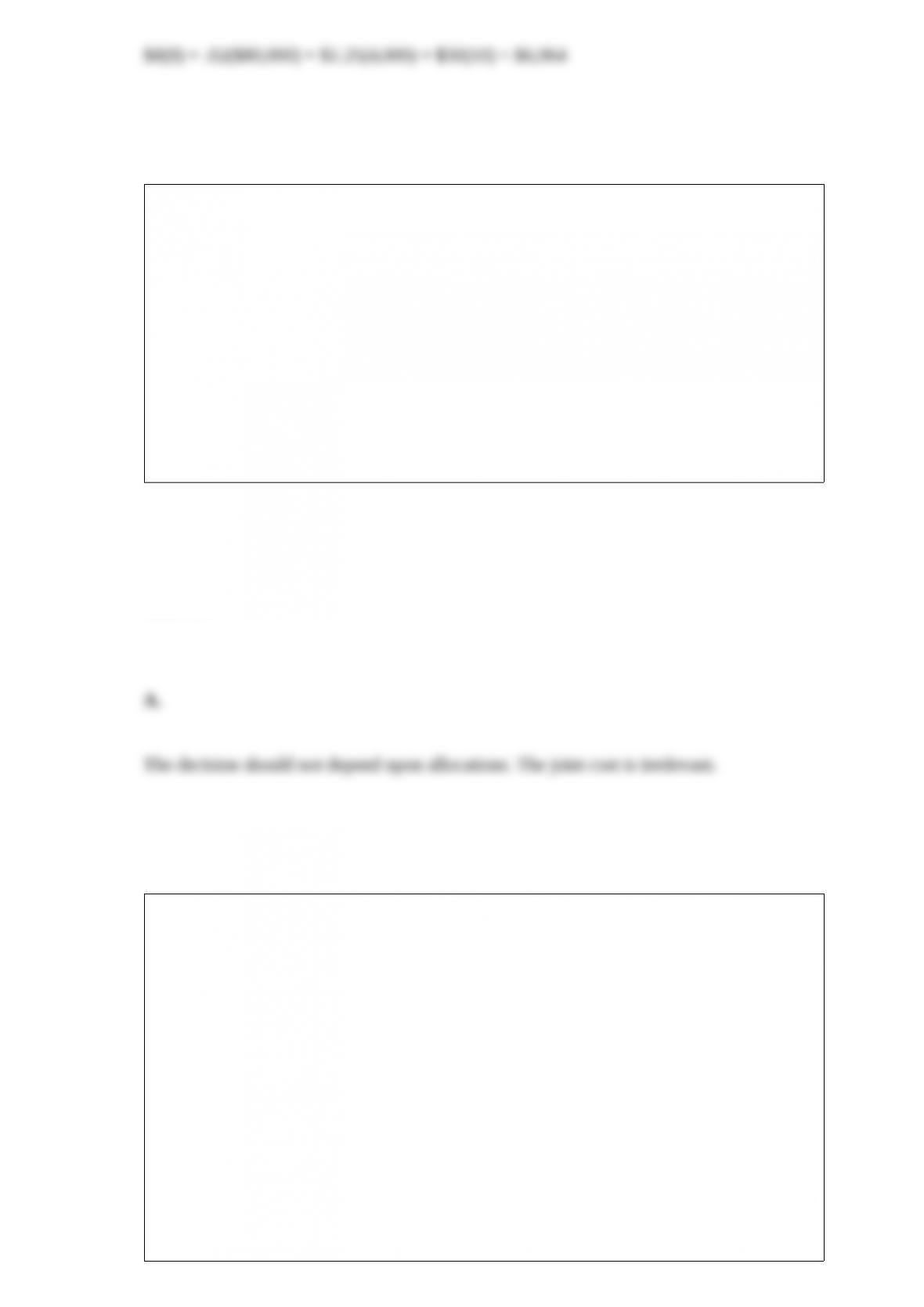
Yellow Industries decides to price delivery service according to the results of a recent
activity-based costing (ABC) study. The study indicates Yellow should charge $8 per
order, 2% of the order’s value for general delivery costs, $1.25 per item, and $30 for
delivery.
A year later, Yellow collected the following information for two of its best customers:
What are the total delivery costs charged to Customer D during the year?
A. $5,344
B. $5,364
C. $6,900
D. $6,964
Answer:
Product C is one of several joint products that come out of Department M. The joint
costs incurred in Department M total $40,000. Product C can be sold at split-off or
processed further and sold as a higher quality item. The decision to process further
should be based on the
A. assumption that the $40,000 is irrelevant.
B. allocation of the $40,000, using the net realizable value.
C. allocation of the $40,000, using a physical measures approach.
D. allocation of the $40,000, using the relative sales value at split-off method.
Answer:
Cascade Cliffs, Inc., operates two divisions: (1) a management division that owns and
manages bulk carriers on the Great Lakes and (2) a repair division that operates a dry
dock in Cheboygan, Michigan. The repair division works on company ships, as well as
other large-hull ships.
The repair division has an estimated variable cost of $37 per labor-hour. The repair
division has a backlog of work for outside ships. They charge $70.00 per hour for labor,
which is standard for this type of work. The management division complained that it
could hire its own repair workers for $45.00 per hour, including leasing an adequate
work area.
What is the maximum transfer price per hour that the management division should
pay?
A. $33.00

B. $37.00
C. $45.00
D. $70.00
E. $82.00
Answer:
What is the allocation rate for the upcoming year assuming Boxes-2-Go uses the
single-rate method and allocates common costs based on the number of calls?
A. $10.00
B. $15.00
C. $20.00
D. $25.00
Answer:
Which of the following is a total factor productivity measure?
A. tons output/tons of material used
B. units produced/machine hour
C. sales value/total cost
D. gallons output/direct labor hour
Answer:
Fowler Manufacturing Company has a fixed cost of $225,000 for the production of
tubes. Estimated sales are 150,000 units. A before tax profit of $125,000 is desired by
the controller. If the tubes sell for $5 each, what unit contribution margin is required to
attain the profit target?
A. $3.00.
B. $2.33.
C. $1.47.
D. $.90.
Answer:
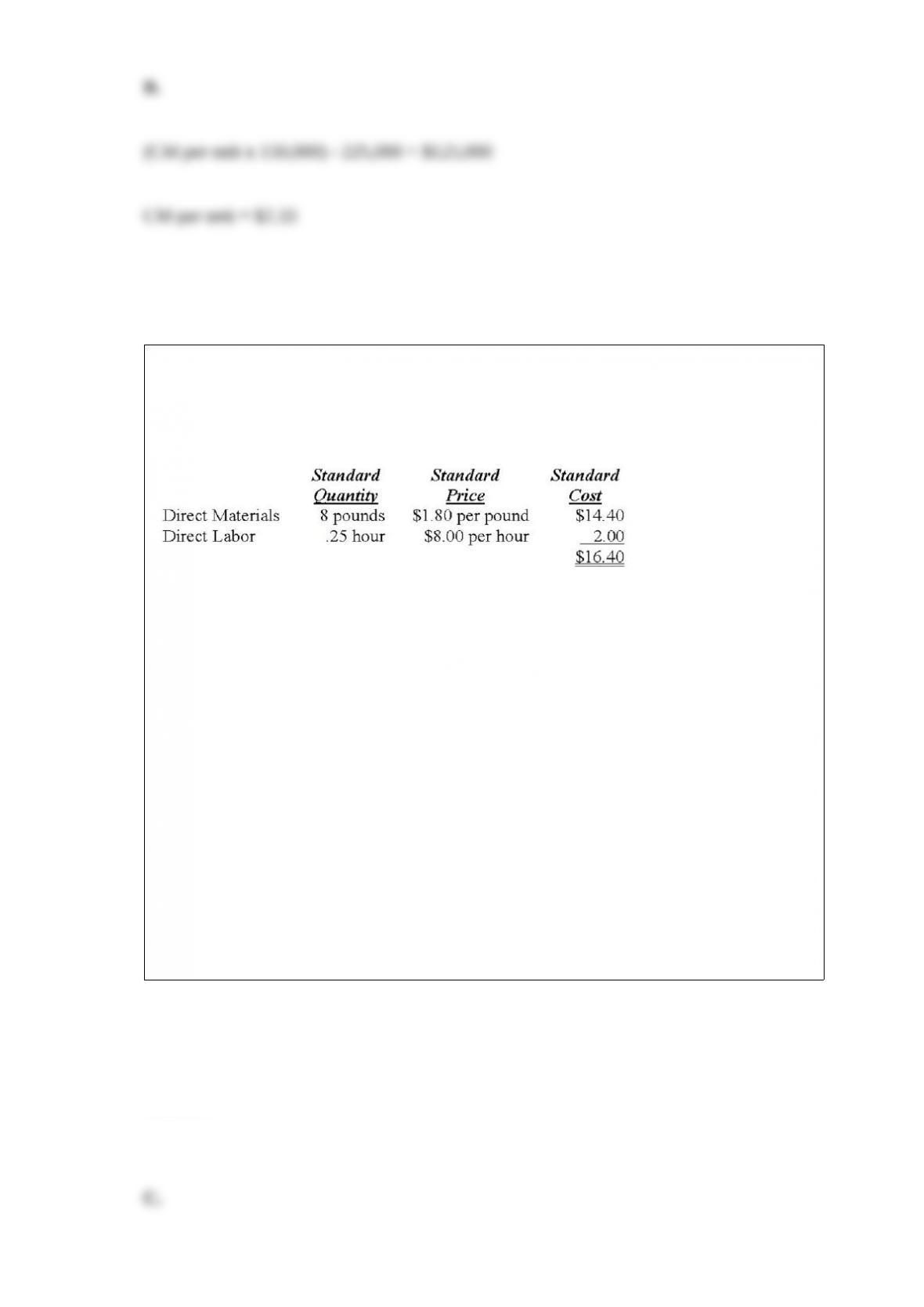
Arrow Industries employs a standard cost system in which direct materials inventory is
carried at standard cost. Arrow has established the following standards for the prime
costs of one unit of product.
During November, Arrow purchased 160,000 pounds of direct materials at a total cost
of $304,000. The total factory wages for November were $42,000, 90% of which were
for direct labor. Arrow manufactured 19,000 units of product during November using
142,500 pounds of direct materials and 5,000 direct labor hours.
What is the direct labor efficiency variance for November?
A. $1,800
B. $1,900
C. $2,000
D. $2,090
E. $2,200
Answer:
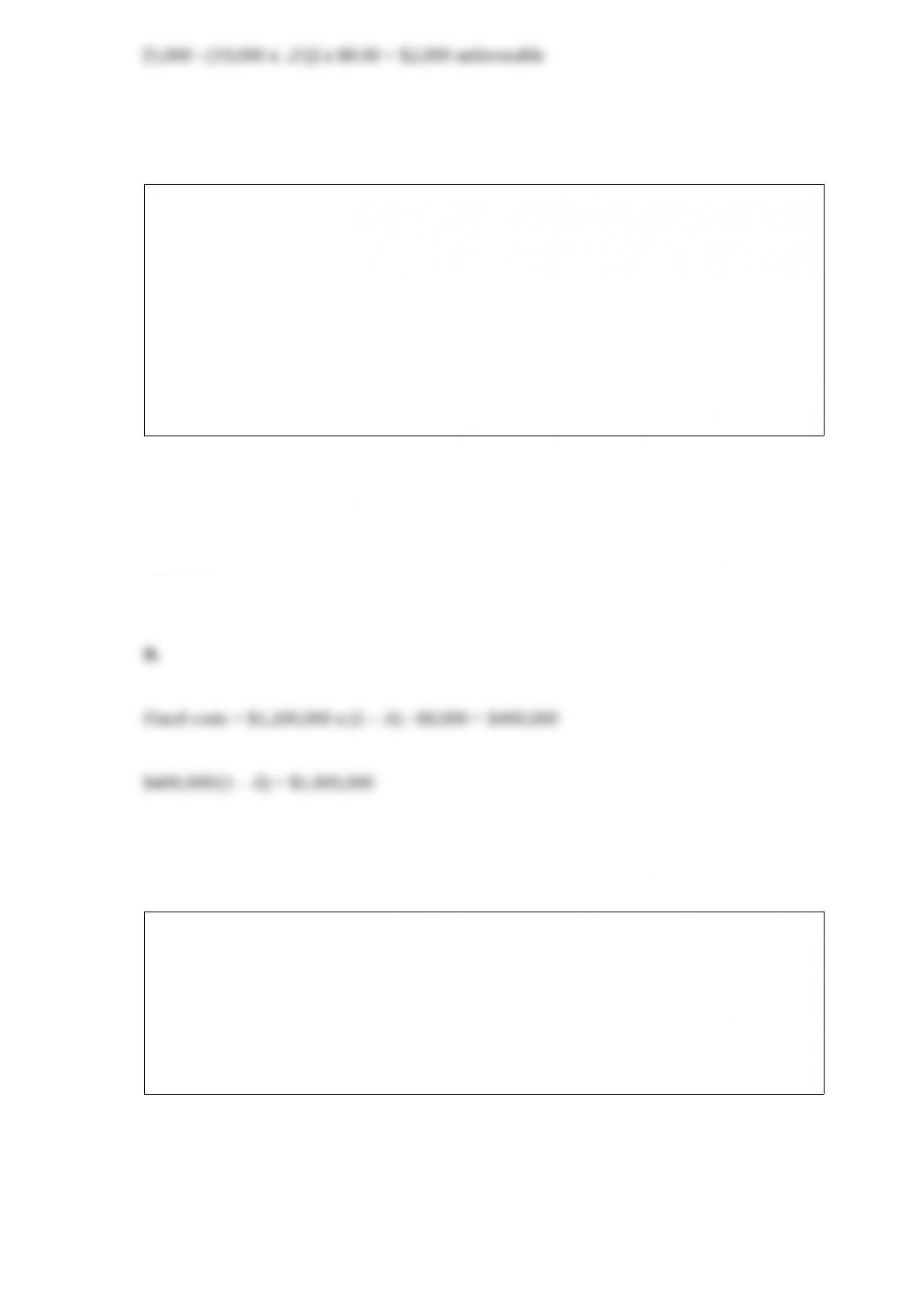
KR Sales had $1,200,000 in sales last month. The variable cost ratio was 60% and
operating profits were $80,000. What is KR’s break-even sales volume?
A. $800,000
B. $1,000,000
C. $1,200,000
D. $2,000,000
Answer:
Rock Solid Bank and Trust (RSB&T) only offers checking accounts. Customers can
write checks and use a network of automated teller machines. RSB&T earns revenue by
investing the money deposited (subject to reserve requirements). Currently RSB&T
averages 6% return annually on its investments. In order to compete with larger banks,
RSB&T pays depositors 1% on all deposits. A recent study classified the operating costs
of the bank into four activities. Data on these activities are:
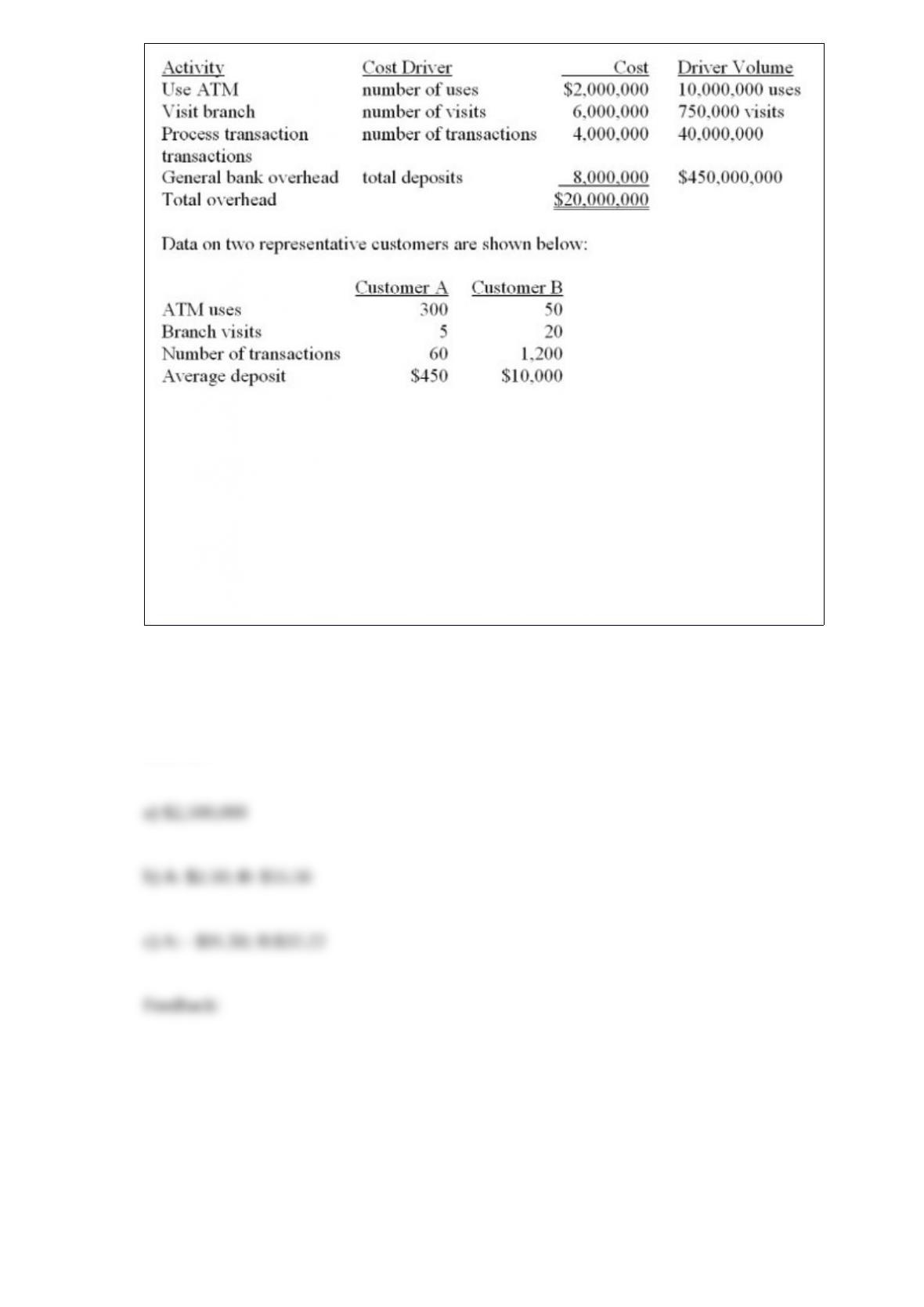
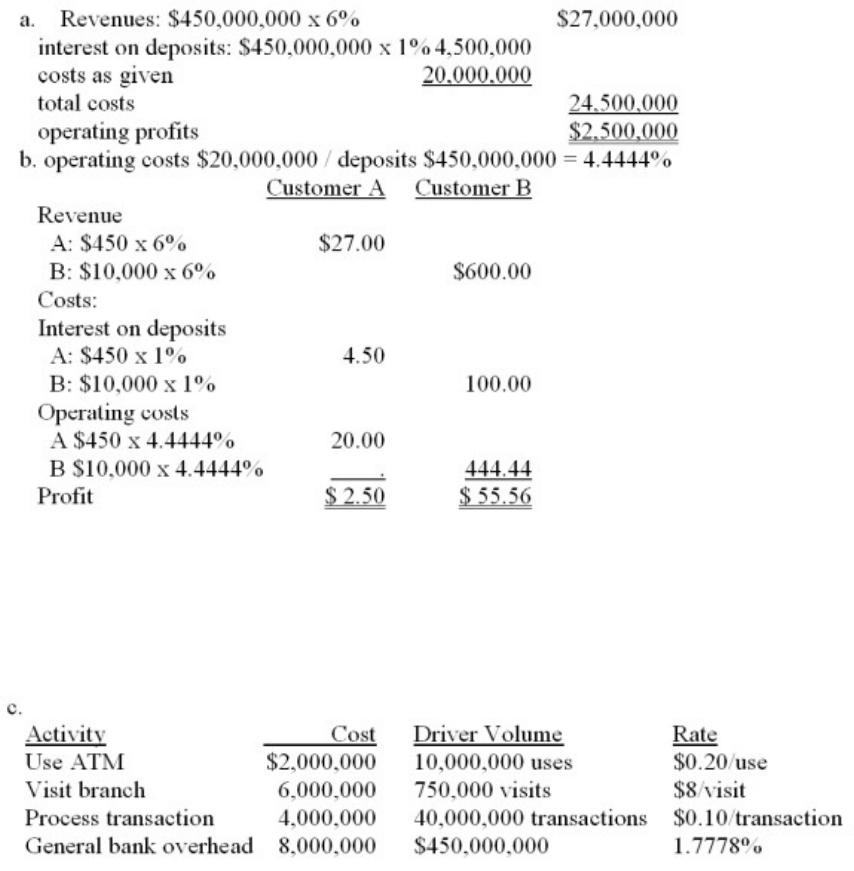
Required:
(a) Compute the operating profits of the RSB&T.
(b) Compute the profit of Customer A and Customer B assuming that customer costs are
based only on deposits.
(c) Compute the profit of Customer A and Customer B assuming that customer costs are
computed using the information in the activity-based costing analysis.
Answer:
If the total materials variance for a given operation is favorable, why must this variance
be further evaluated as to price and usage?
A. There is no need to further evaluate the total materials variance if it is favorable.
B. Generally accepted accounting principles require that all variances be analyzed in
three stages.
C. All variances must appear in the annual report to equity owners for proper
disclosure.
D. A further evaluation lets management evaluate the activities of the purchasing and
production functions.
Answer:
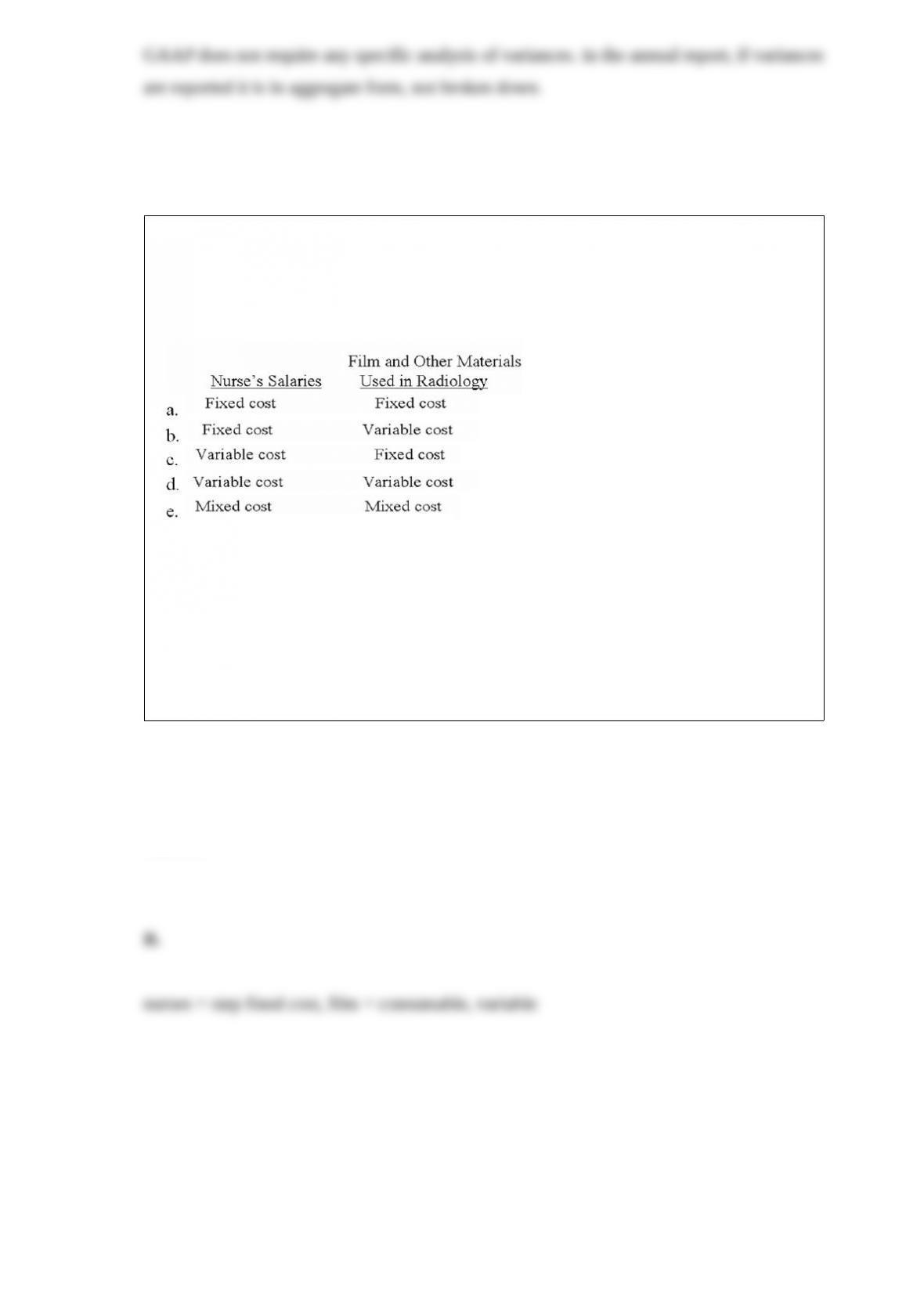
The student health center employs one doctor, three nurses, and several other
employees. How would you classify (1) the nurses’ salary and (2) film and other
materials used in radiology to give X-rays to students? Assume the activity is the
number of students visiting the health center.
A. Option A
B. Option B
C. Option C
D. Option D
Answer: