Purchasing equipment by issuing a six-month note should be shown on the statement of
cash flows under the investing activities section.
Answer:
A statement of owner’s equity reports the changes in the owner’s equity for a period of
time.
Answer:
When cities give land or buildings to a company to locate in the community, no entry is
made since there is no cost to the company.
Answer:
If 800 shares of $40 par common stock are sold for $43,000, the $43,000 would be
reported in the cash flows from financing activities section of the statement of cash
flows.
Answer:
A budget procedure that provides for the maintenance at all times of a twelve-month
projection into the future is called master budgeting.
Answer:
Available-for-sale securities are securities that management expects to sell in the future,
but are not actively traded for profit.
Answer:
For a month’s transactions for a typical medium-sized business, the salary expense
account is likely to have only credit entries.

Answer:
The borrower is the one who issues a note payable to a creditor.
Answer:
A corporation is a separate entity for accounting purposes but not for legal purposes.
Answer:
One of the advantages of decentralization is that delegating authority to managers
closest to the operation always results in better decisions.
Answer:
A service organization will not use the job order costing method because it has no direct
materials.
Answer:
The order of the flow of accounting data is (1) record in the ledger, (2) record in the
journal, (3) prepare the financial statements.
Answer:
When a property, plant, and equipment asset is sold for cash, any gain or loss on the
asset sold should be recorded.
Answer:
Fair value accounting is used more under Generally Accepted Accounting Principles
(GAAP) than it is under International Financial Reporting Standards (IRFS).
Answer:
Debits will increase Unearned Revenues and Revenues.
Answer:
Expenses use up assets or consume services in the process of generating revenues.
Answer:

The cash budget presents the expected inflow and outflow of cash for a specified period
of time.
Answer:
The selection of an inventory costing method has no significant impact on the financial
statements.
Answer:
Depreciation Expense is reported on the balance sheet as an addition to the related
asset.
Answer:
The vice presidents of production and sales and the controller hold line positions in
most large organizations.
Answer:
The interest portion of an installment note payment is computed by multiplying the
interest rate by the carrying amount of the note at the end of the period.
Answer:
Examples of temporary accounts are supplies and prepaid expenses which are in the
ledger for just a short time before they expire.
Answer:
Money orders are considered cash.
Answer:
In using the product cost concept of applying the cost-plus approach to product pricing,
selling expenses, administrative expenses, and profit are covered in the markup.
Answer:
When the terms of sale are FOB shipping point, the buyer should pay the freight
charges.
Answer:
The process by which management allocates available investment funds among
competing capital investment proposals is termed capital rationing.
Answer:
When a major corporation develops its own trademark and over time it becomes very
valuable, the trademark may not be shown on their balance sheet due to lack of a
material cost.
Answer:
The chart of accounts for a merchandise business would include an account called
Delivery Expense.
Answer:
Land acquired as a speculation is reported under Investments on the balance sheet.
Answer:
If cash dividends of $135,000 were paid during the year and the company sold 1,000
shares of common stock at $30 per share, the statement of cash flows would report net
cash flow from financing activities as $165,000.
Answer:
The difference between the balance in a fixed asset account and its related accumulated
depreciation account is the asset’s book value.
Answer:
Once an accounting system has been implemented, feedback will be used to
continuously analyze and improve the system.
Answer:

The excess of current assets over current liabilities is referred to as working capital.
Answer:
The number of days’ sales in receivables is one means of expressing the relationship
between average daily sales and accounts receivable.
Answer:
A company pays an employee $3,000 for a five day work week, Monday – Friday. The
adjusting entry on December 31, which is a Wednesday, is debit Wages Expense, $1,800
and credit Wages Payable, $1,800.
Answer:
The rates at which services are charged to each division are called service department
charge rates.
Answer:
Even when a trial balance is in balance, there may be errors in the individual accounts.
Answer:
Under the LIFO inventory costing method, the most recent costs are assigned to ending
inventory.
Answer:
Financial Statement data for the years ended December 31 for Parker Corporation is as
follows:
a) Determine the accounts receivable turnover for 2012 and 2011.
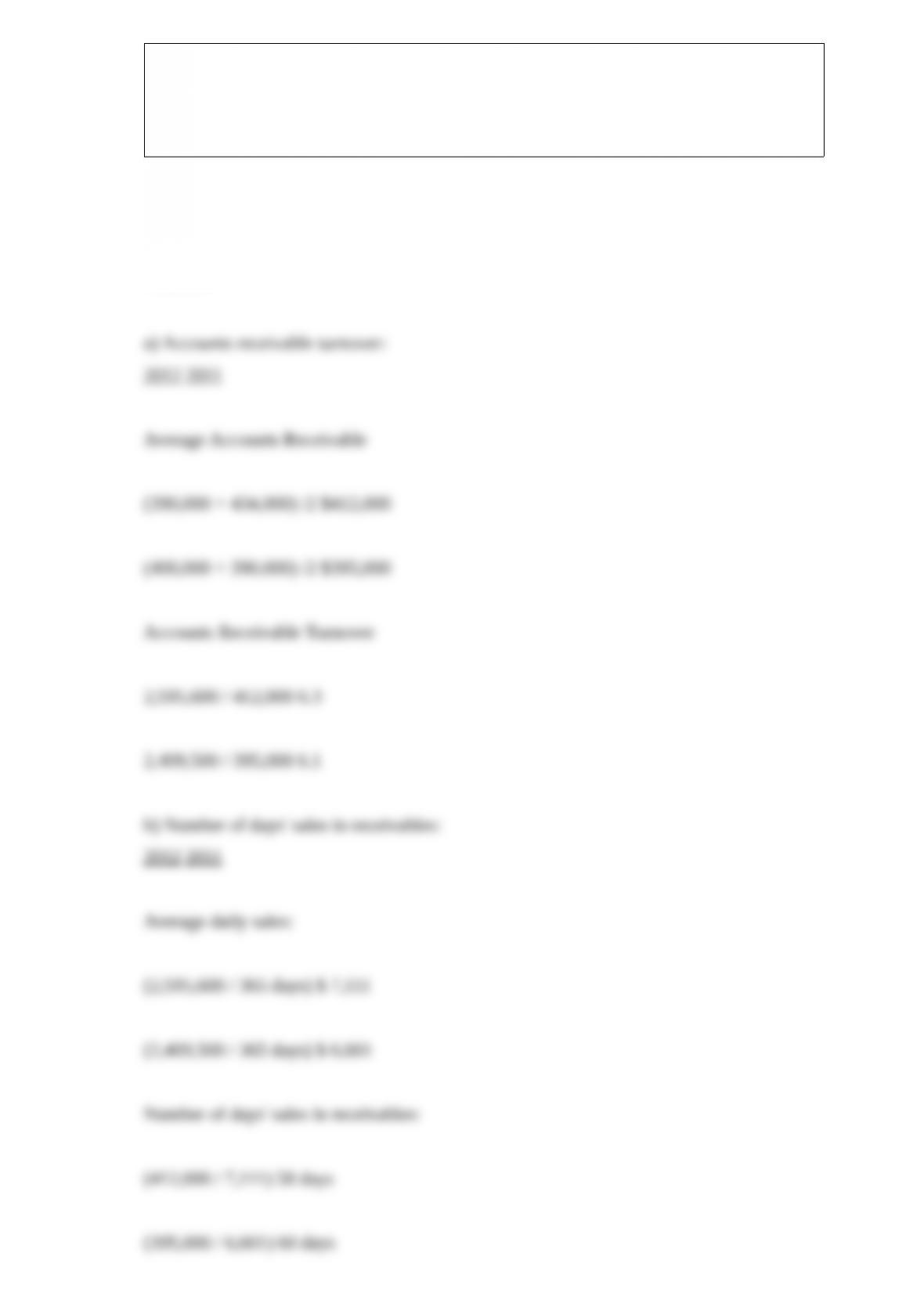
b) Determine the number of days’ sales in receivables for 2012 and
c) Does the change in accounts receivable turnover and number of days’ sales in
receivables from 2011 to 2012 indicate a favorable or unfavorable trend.?
Answer:
When a firm adopts a just-in-time operating environment,
A.new, more efficient machinery and equipment must be purchased and installed in the
original layout.
B.machinery and equipment are moved into small autonomous production lines called
manufacturing cells.
C.new machinery and equipment must be purchased from franchised JIT dealers.
D.employees are retrained on different equipment but the plant layout generally stays
unchanged.
Answer:
Identify the formula for the rate of return on investment.
A.Invested Assets/Income From Operations
B.Sales/Invested Assets
C.Income From Operations/Sales
D.Income From Operations/Invested Assets

Answer:
Which of the following items should be classified as an extraordinary item on a
corporate income statement?
A.gain on the retirement of a bond payable
B.loss from land condemned for public use
C.loss due to an discontinued operation
D.selling treasury stock for more than the company paid for it
Answer:
Which of the following entries records the receipt of cash from patients on account?
A.Accounts Payable, debit; Fees Earned, credit
B.Accounts Receivable, debit; Fees Earned, credit
C.Accounts Receivable, debit; Cash, credit
D.Cash, debit; Accounts Receivable, credit
Answer:
Prepare the following journal entries and calculations:
(a) A patent that was acquired for $410,000 at the beginning of the current year expires
in 15 years and is expected to have value for 4 years. Present the adjusting entry to
amortize the patent for the current year.
(b) Mineral rights on an ore deposit estimated at 4,000,000 tons of ore were acquired
for $2,800,000. Present the adjusting entry to record depletion for the current year,
during which 350,000 tons of ore were removed.
(c) Legal costs incurred to defend the rights that a patent provided in (a) were $60,000.
At the time the patent had been in existence for 5 years. Determine the amount to be
amortized for the current fiscal year.
Answer:
Which of the statements below indicates that a company earned a net income for the

period?
A.The sum of the credits exceeds the sum of the debits in the Balance Sheet columns on
the work sheet.
B.The sum of the credits exceeds the sum of the debits in the Income Statement
columns on the work sheet.
C.The sum of the debits exceeds the sum of the credits in the Income Statement
columns on the work sheet.
D.Cash inflows exceeded cash outflows.
Answer:
In addition to B2B and B2C transactions, e-commerce is commonly used in all of the
following business activities except:
A.supply chain management
B.regulatory compliance management
C.customer relationship management
D.product life cycle management
Answer:

Which of the following is true of the cash payback period?
A.The longer the payback, the longer the estimated life of the asset.
B.The longer the payback, the sooner the cash spent on the investment is recovered.
C.The shorter the payback, the less likely the possibility of obsolescence.
D.All of the above are correct.
Answer:
Computer equipment was acquired at the beginning of the year at a cost of $57,000 that
has an estimated residual value of $9,000 and an estimated useful life of 5 years.
Determine the 2nd year’s depreciation using straight-line depreciation.
A.$13,200
B.$19,200
C.$ 9,600
D.$ 9,000
Answer:

Which of the following describes the classification and normal balance of the fees
earned account?
A.asset, credit
B.liability, credit
C.owner’s equity, debit
D.revenue, credit
Answer:
Closing entries
A.need not be journalized if adjusting entries are prepared
B.need not be posted if the financial statements are prepared from the work sheet
C.are not needed if adjusting entries are prepared
D.must be journalized and posted
Answer:

Sparrow Co. is currently operating at 80% of capacity and is currently purchasing a part
used in its manufacturing operations for $8.00 a unit. The unit cost for Sparrow Co. to
make the part is $9.00, which includes $.60 of fixed costs. If 4,000 units of the part are
normally purchased each year but could be manufactured using unused capacity, what
would be the amount of differential cost increase or decrease for making the part rather
than purchasing it?
A.$12,000 cost decrease
B.$4,000 cost increase
C.$20,000 cost decrease
D.$1,600 cost increase
Answer:
The expected average rate of return for a proposed investment of $8,000,000 in a fixed
asset, using straight line depreciation, with a useful life of 20 years, no residual value,
and an expected total net income of $12,000,000 is:
A.15%
B.12%
C.40%
D.7.5%
Answer:

The authorized stock of a corporation
A.must be recorded in a formal accounting entry.
B.only reflects the initial capital needs of the company.
C.is indicated in its by-laws.
D.is indicated in its charter.
Answer:
The adjusting entry to record the depreciation of equipment for the fiscal period is
A.debit Depreciation Expense; credit Equipment
B.debit Depreciation Expense; credit Accumulated Depreciation
C.debit Accumulated Depreciation; credit Depreciation Expense
D.debit Equipment; credit Depreciation Expense
Answer:

Falcon Co. produces a single product. Its normal selling price is $30.00 per unit. The
variable costs are $19.00 per unit. Fixed costs are $25,000 for a normal production run
of 5,000 units per month. Falcon received a request for a special order that would not
interfere with normal sales. The order was for 1,500 units and a special price of $20.00
per unit. Falcon Co. has the capacity to handle the special order and, for this order, a
variable selling cost of $1.00 per unit would be eliminated.
If the order is accepted, what would be the impact on net income?
A.decrease of $750
B.decrease of $4,500
C.increase of $3,000
D.increase of $1,500
Answer:
Which of the following forms is typically given to employees at the end of the calendar
year so that employees can file their individual income tax forms?
A.Employee’s Withholding Allowance Certificate (W-4)
B.Wage and Tax Statement (Form W-2)
C.Employer’s Quarterly Federal Tax Return (Form 941)
D.401k plans
Answer:

A variant of fiscal-year budgeting whereby a twelve-month projection into the future is
maintained at all times is termed:
A.flexible budgeting
B.continuous budgeting
C.zero-based budgeting
D.master budgeting
Answer:
The formula to compute direct material quantity variance is to calculate the difference
between
A.actual costs – standard costs
B.standard costs – actual costs
C.(actual quantity * standard price) – standard costs
D.actual costs – (standard price * standard costs)
Answer:
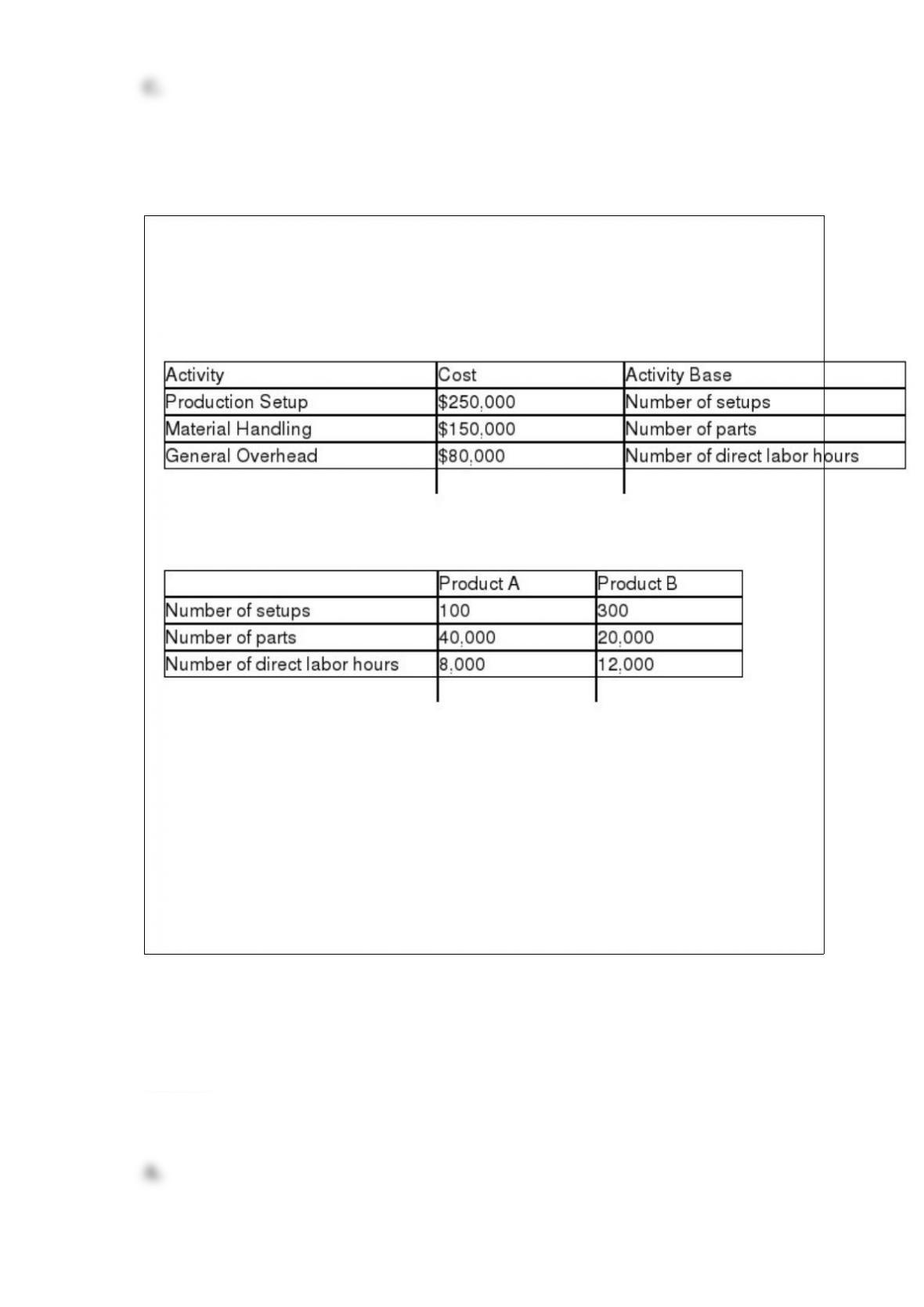
Miramar Industries manufactures two products, A and B. The manufacturing operation
involves three overhead activities – production setup, material handling, and general
factory activities. Miramar uses activity-based costing to allocate overhead to products.
An activity analysis of the overhead revealed the following estimated costs and activity
bases for these activities:
Each product’s total activity in each of the three areas are as follows:
What is the total overhead allocated to Product A using activity-based costing?
A.$194,500
B.$162,500
C.$32,000
D.$224,000
Answer:

Douglas pays Selena $45,000 for her 30% interest in a partnership with total net assets
of $125,000. Following this transaction, Douglas’ capital account should have a credit
balance of
A.$37,500
B.$45,000
C.$13,500
D.more than $45,000
Answer:
Harris Company had checks outstanding totaling $15,400 on its May bank
reconciliation. In June, Harris Company issued checks totaling $64,900. The June bank
statement shows that $47,600 in checks cleared the bank in June. A check from one of
Harris Company’s customers in the amount of $300 was also returned marked “NSF.”
The amount of outstanding checks on Harris Company’s June bank reconciliation
should be
A.$49,500
B.$63,000
C.$47,600
D.$32,700
Answer:

The numerator of the rate earned on common stockholders’ equity ratio is equal to
A.net income
B.net income minus preferred dividends
C.income before income tax
D.operating income minus interest expense
Answer:
At the end of the month, the total of the amount column of the revenue journal is posted
as a
A.debit to Accounts Receivable and a credit to Cash
B.debit to Accounts Receivable and a credit to Fees Earned
C.debit to Cash and a credit to Fees Earned
D.debit to Cash and a credit to Accounts Payable
Answer:

Expenditures that add to the utility of fixed assets for more than one accounting period
are
A.committed expenditures
B.revenue expenditures
C.utility expenditures
D.capital expenditures
Answer:
At the beginning of the period, the Assembly Department budgeted direct labor of
$110,000, direct material of $170,000 and fixed factory overhead of $28,000 for 8,000
hours of production. The department actually completed 10,000 hours of production.
What is the appropriate total budget for the department, assuming it uses flexible
budgeting.
A.$288,000
B.$305,000
C.$350,000
D.$378,000
Answer:

The monetary value charged to customers for the performance of services sold is called
a(n)
A.asset
B.net income
C.capital
D.revenue
Answer:
The Miracle Corporation issues 1,000, 10-year, 8%, $1,000 bonds dated January 1,
2011, at 96. The journal entry to record the issuance will show a
A.debit to Discount on Bonds Payable for $40,000.
B.debit to Cash of $1,000,000.
C.credit to Bonds Payable for $960,000.
D.credit to Cash for $960,000.
Answer:
Materials used by Best Bread Company in producing Division A’s product are currently
purchased from outside suppliers at a cost of $30 per unit. However, the same materials
are available from Division B. Division B has unused capacity and can produce the
materials needed by Division A at a variable cost of $20 per unit.
(a) If a transfer price of $25 per unit is established and 60,000 units of material are
transferred, with no reductions in Division B’s current sales, how much would Best
Bread Company’s total income from operations increase?
(b) Assuming transfer price of $25 per unit is established and 60,000 units of material
are transferred, with no reductions in Division B’s current sales, how much would the
income from operations of Division A increase?
(c) Assuming transfer price of $25 per unit is established and 60,000 units of material
are transferred, with no reductions in Division B’s current sales, how much would the
income from operations of Division B increase?
(d) If the negotiated price approach is used, what would be the range of acceptable
transfer prices?
Answer:
An investor purchased 500 shares of common stock, $25 par, for $21,750.
Subsequently, 100 shares were sold for $49.50 per share. What is the amount of gain or
loss on the sale?
A.$12,750 gain
B.$600 gain

C.$600 loss
D.$9,250 loss
Answer:
Which of the following would not be included with the Cash and Equivalents on the
Balance Sheet?
A.Commercial Paper
B.Short-Term Receivables
C.Certificates of Deposit
D.Money Market Mutual Funds
Answer:
Use the following information to answer the following questions.
The Boxwood Company sells blankets for $60 each. The following was taken from the
inventory records during May. The company had no beginning inventory on May 1.
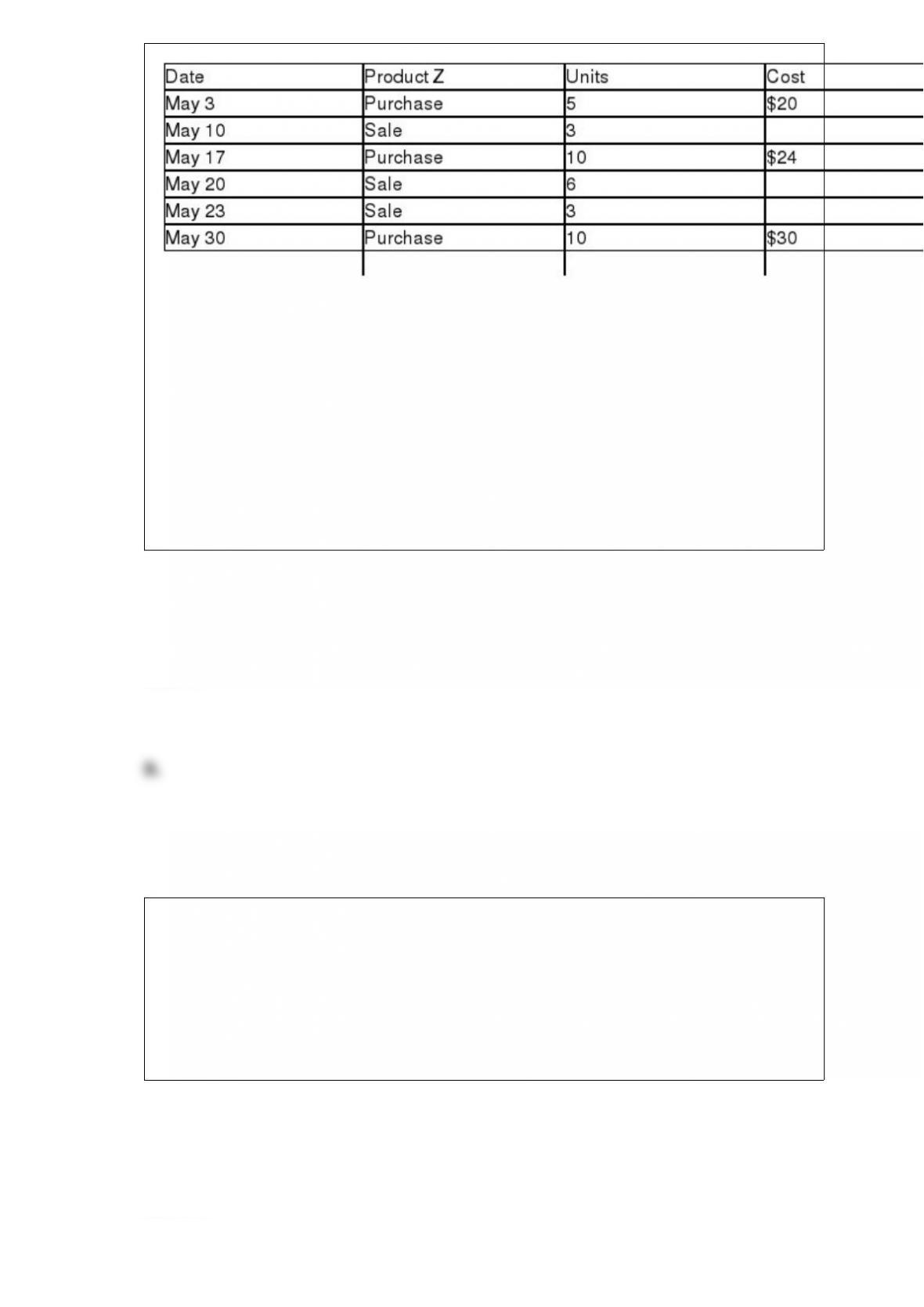
Assuming that the company uses the perpetual inventory system, determine the cost of
merchandise sold for the sale of May 20 using the LIFO inventory cost method.
A.$136
B.$144
C.$180
D.$120
Answer:
At the end of the current year, Accounts Receivable has a balance of $750,000;
Allowance for Doubtful Accounts has a debit balance of $6,200; and net sales for the
year total $3,500,000. Bad debt expense is estimated at 1/2 of 1% of net sales.
Determine (a) the amount of the adjusting entry for bad debt expense; (b) the adjusted
balances of Accounts Receivable, Allowance of Doubtful Accounts; and Bad Debt
Expense; and (c) the net realizable value of accounts receivable.
Answer:
Sales for the year were $600,000. Accounts receivable were $100,000 and $80,000 at
the beginning and end of the year. Cash received from customers to be reported on the
cash flow statement using the direct method is
A.$700,000
B.$600,000
C.$580,000
D.$620,000
Answer:
Define and discuss the two main types of cost accounting systems for manufacturing
operations. What are their similarities and differences?
Answer:
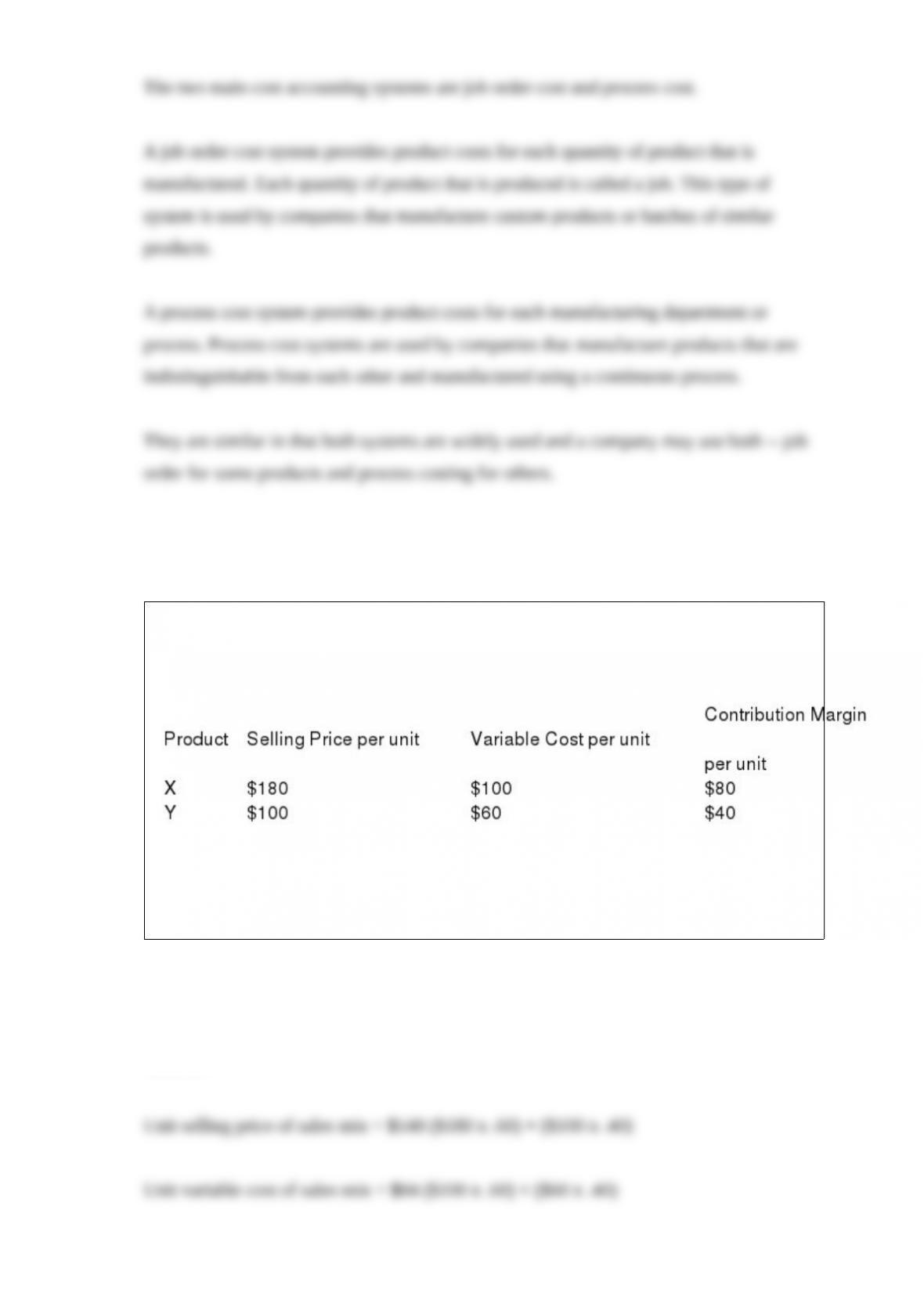
Bobby Company has fixed costs of $160,000. The unit selling price, variable cost per
unit, and contribution margin per unit for the company’s two products are provided
below.
The sales mix for product X and Y is 60% and 40% respectively. Determine the
break-even point in units of X and Y.
Answer:
Trumpet Company produced 8,700 units of product that required 3.25 standard hours
per unit. The standard variable overhead cost per unit is $4.00 per hour. The actual
variance factory overhead was $111,000. Determine the variable factory overhead
controllable variance.
Answer:
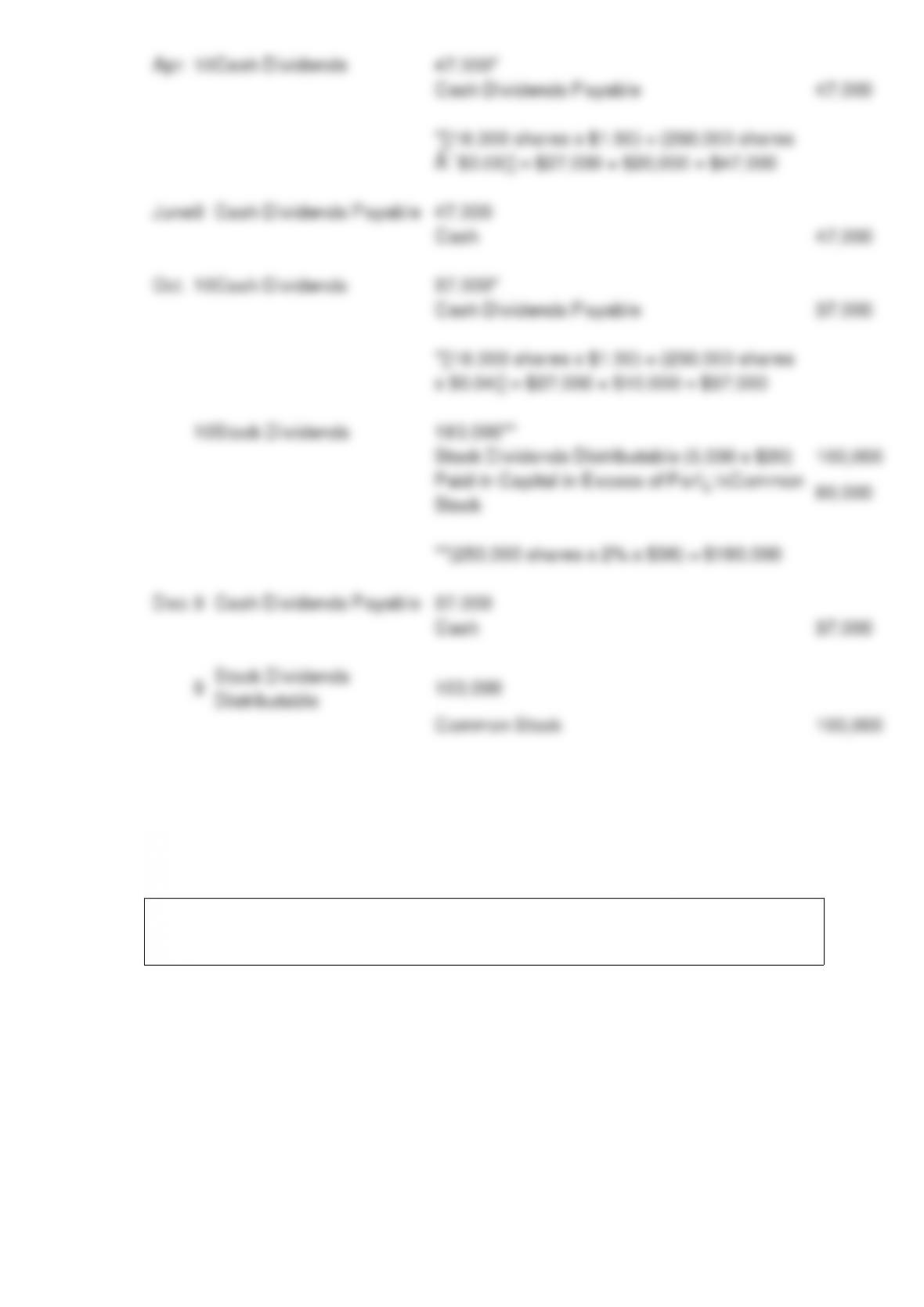
Selected transactions completed by Breezeway Construction during the current fiscal
year are as follows:
Answer:

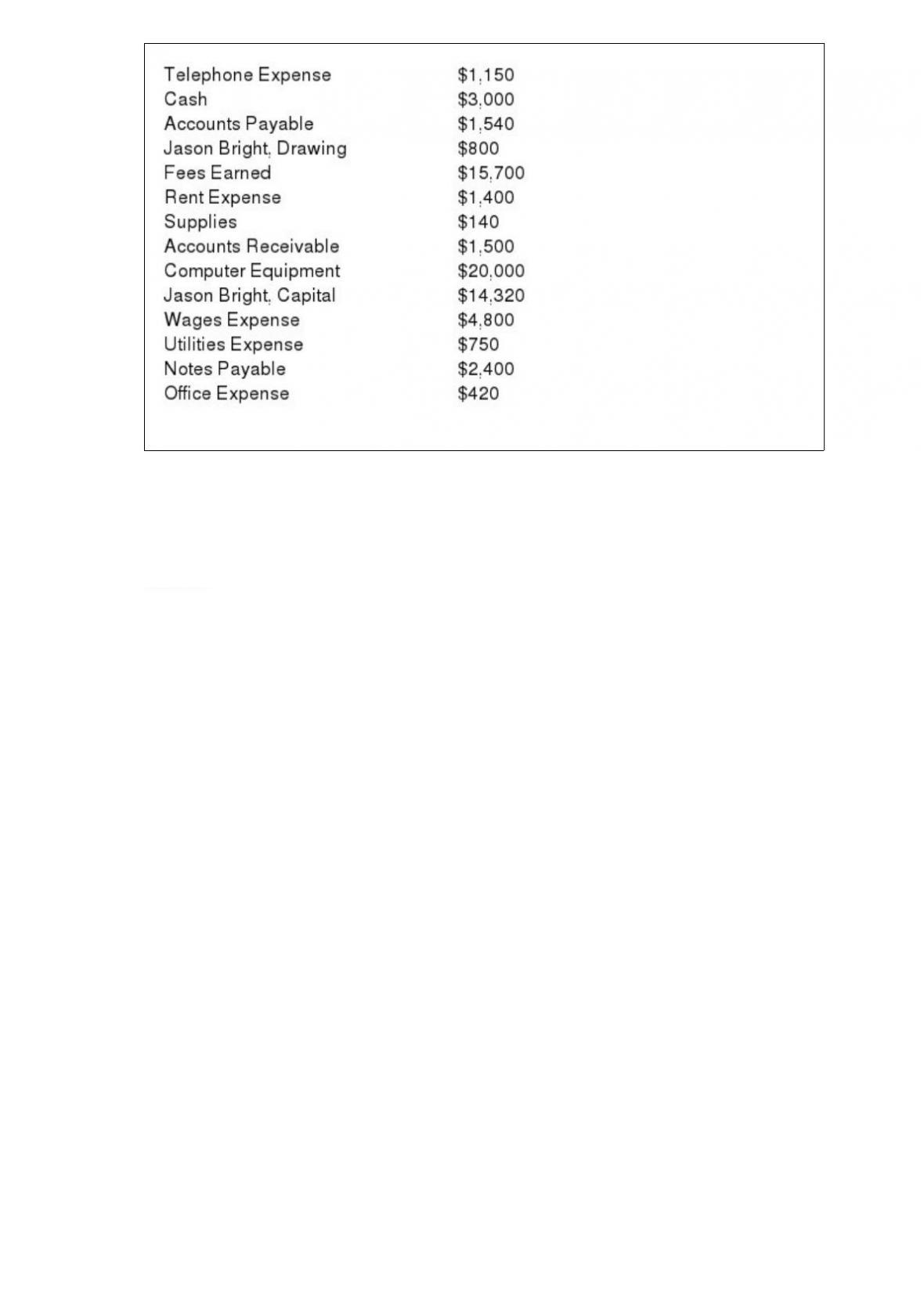
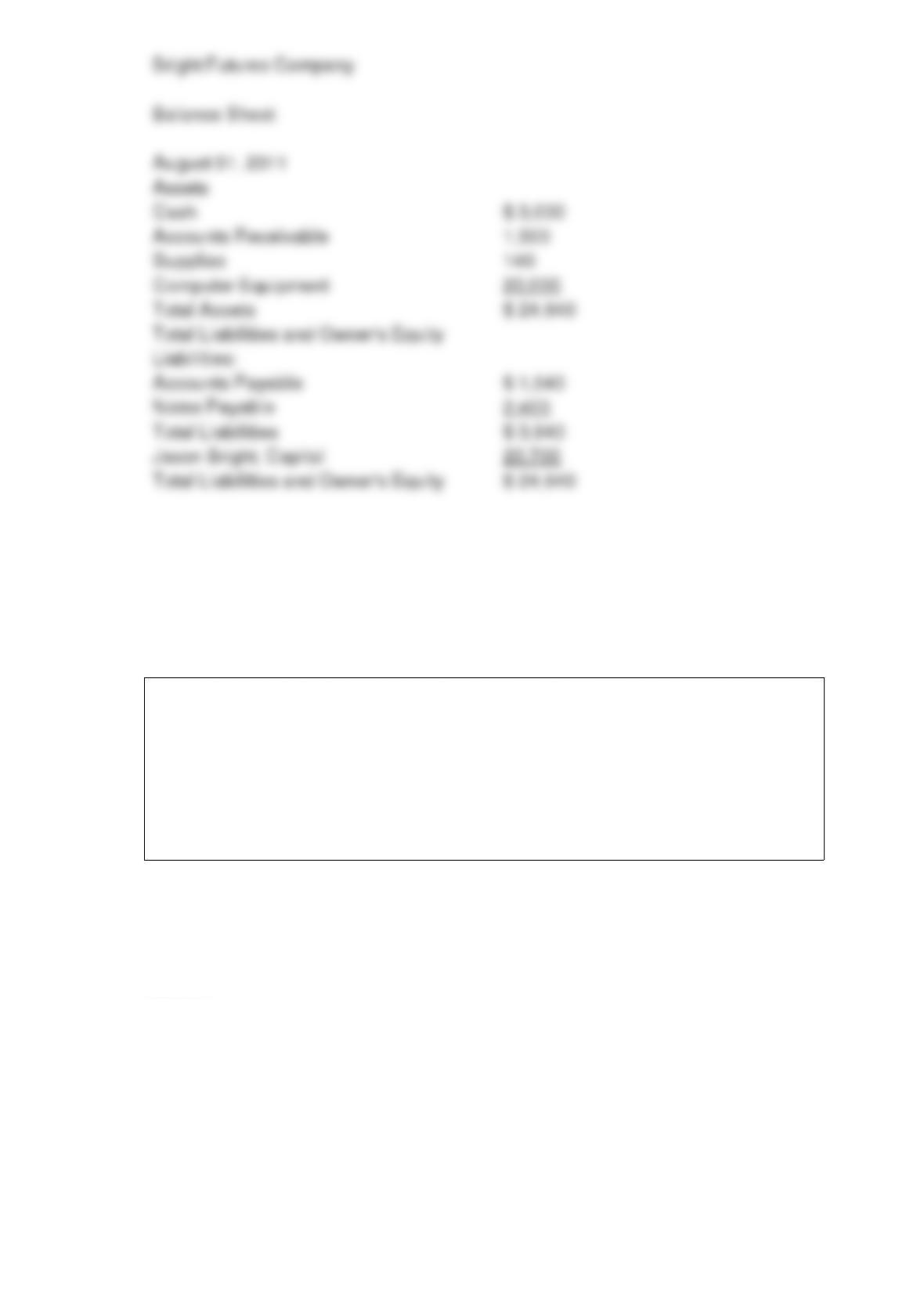
Using the following accounts and their amounts, prepare in good format a Balance
Sheet for Bright Futures Company, month ended August 31, 2011:
Answer:
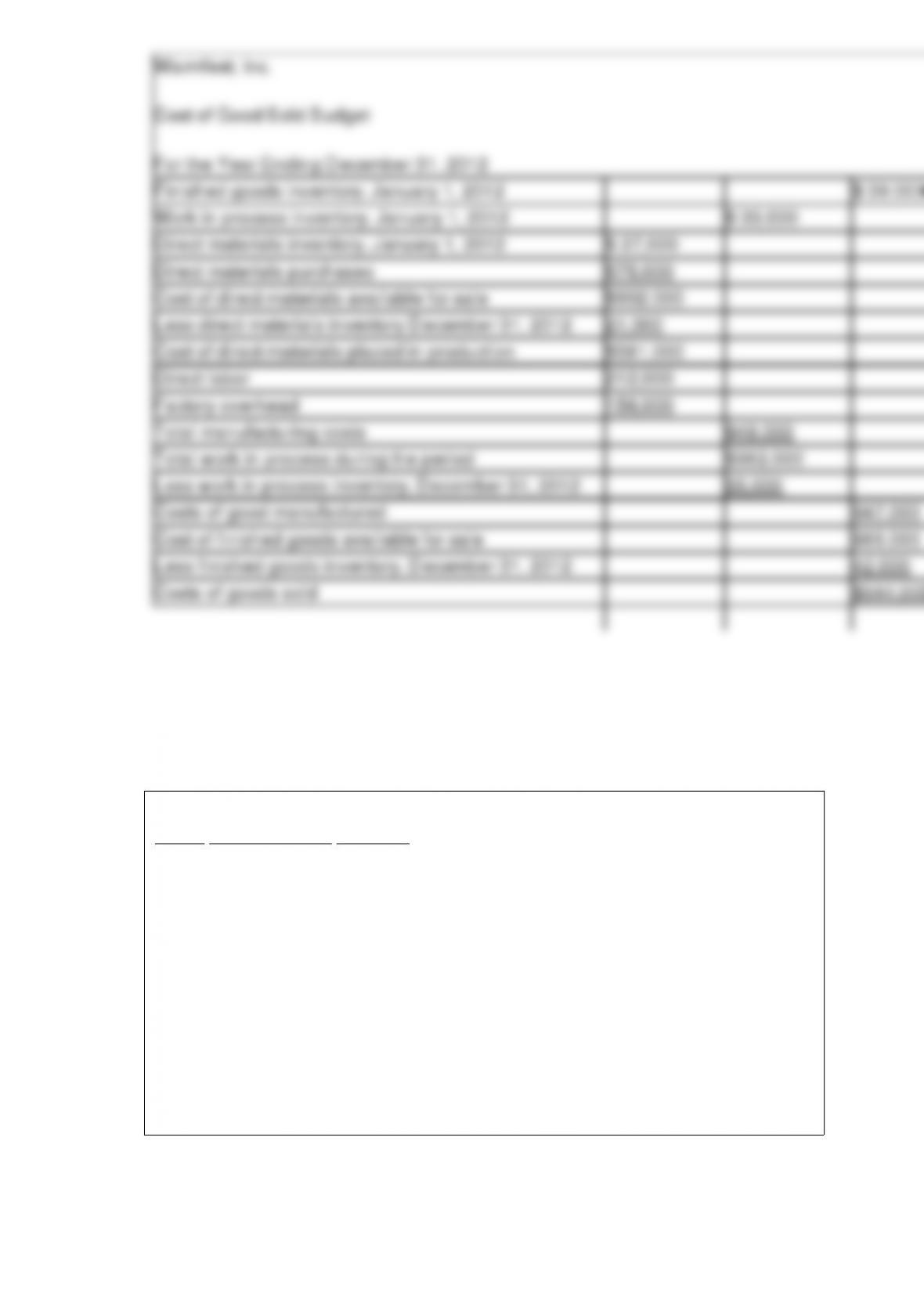
Warmfeet manufactures comforters. Assume the estimated inventories on January 1,
2012, for finished goods, work in process, and materials were $39,000, $33,000 and
$27,000 respectively. Also assume the desired inventories on December 31, 2012, for
finished goods, work in process, and materials were $42,000, $35,000 and $21,000
respectively. Direct material purchases were $575,000. Direct labor was $212,000 for
the year. Factory overhead was $156,000. Prepare a cost of goods sold budget for
Warmfeet, Inc.
Answer:
Global Publishers has collected the following data for recent months:
Month Issues published Total cost
March 20,500 $20,960
April 21,800 22,464
May 17,750 18,495
June 21,200 21,395
a. Using the high-low method, find variable cost per unit, total fixed costs, and the total
cost equation.
b. What is the estimated cost for a month in which 19,000 issues are published?
Answer:
On January 1, 2011, Citrus Retail Co. issued a $500,000, 5 year, 8% installment note
payable with payments of $100,000 principal plus interest due on January 1 of each
year for the next 5 years.
1) Prepare the adjusting journal entry at December 31, 2011 to accrue interest for the
year.
2) Show the account(s) and amount(s) and where it will appear on a multi-step income
statement prepared on December 31, 2011.
3) Show the account(s) and amount(s) and where they will appear on a classified
balance sheet prepared on December 31, 2011.
Answer:
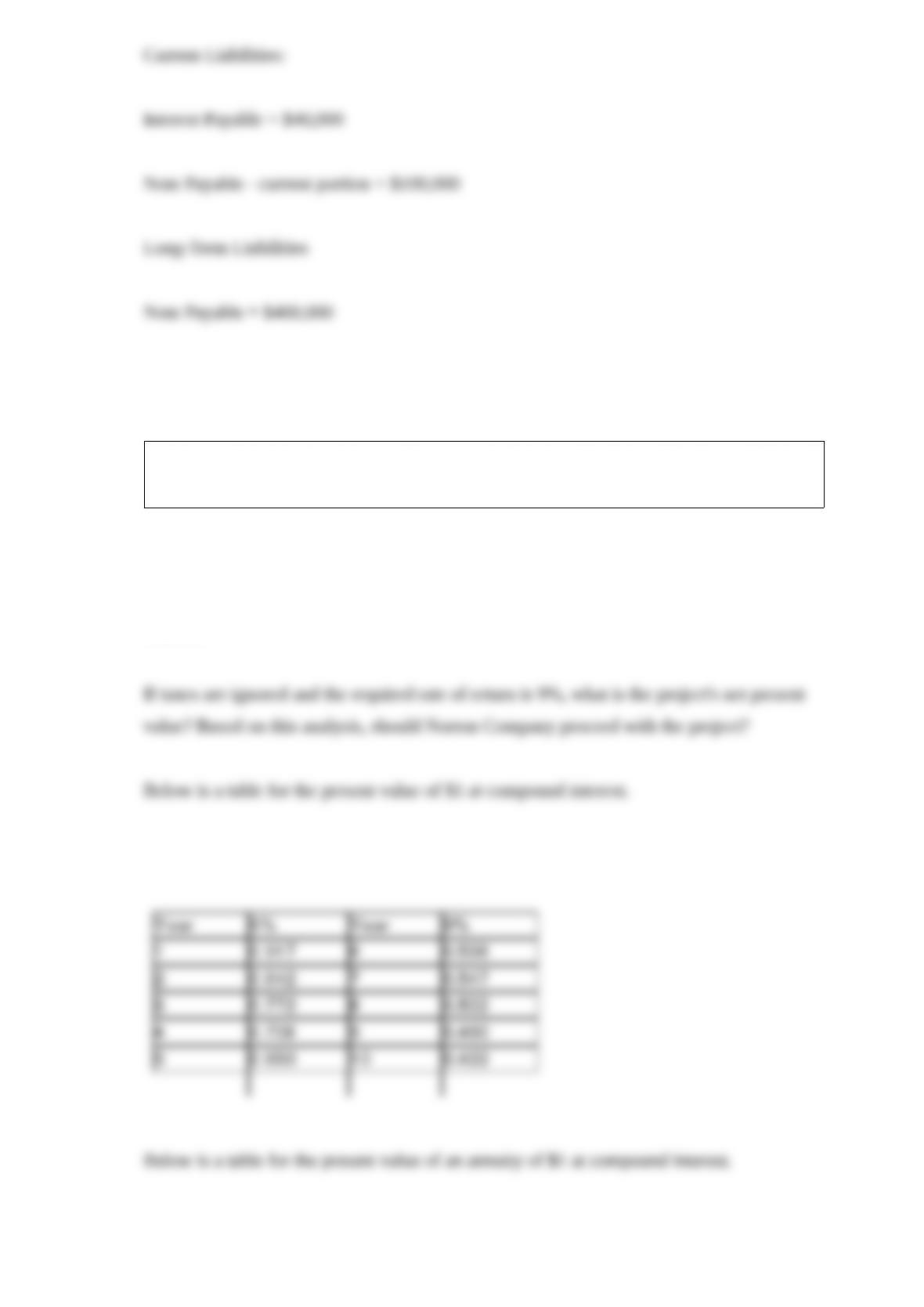
Norton Company is considering a project that will require an initial investment of
$750,000 and will return $200,000 each year for five years.
Answer:
What is a capital expenditures budget?
Answer:
During August, the first month of the fiscal year, sales totaled $875,000 and the cost of
merchandise available for sale totaled $700,000. Estimate the cost of the merchandise
inventory as of August 31, based on an estimated gross profit rate of 45%.
Answer:
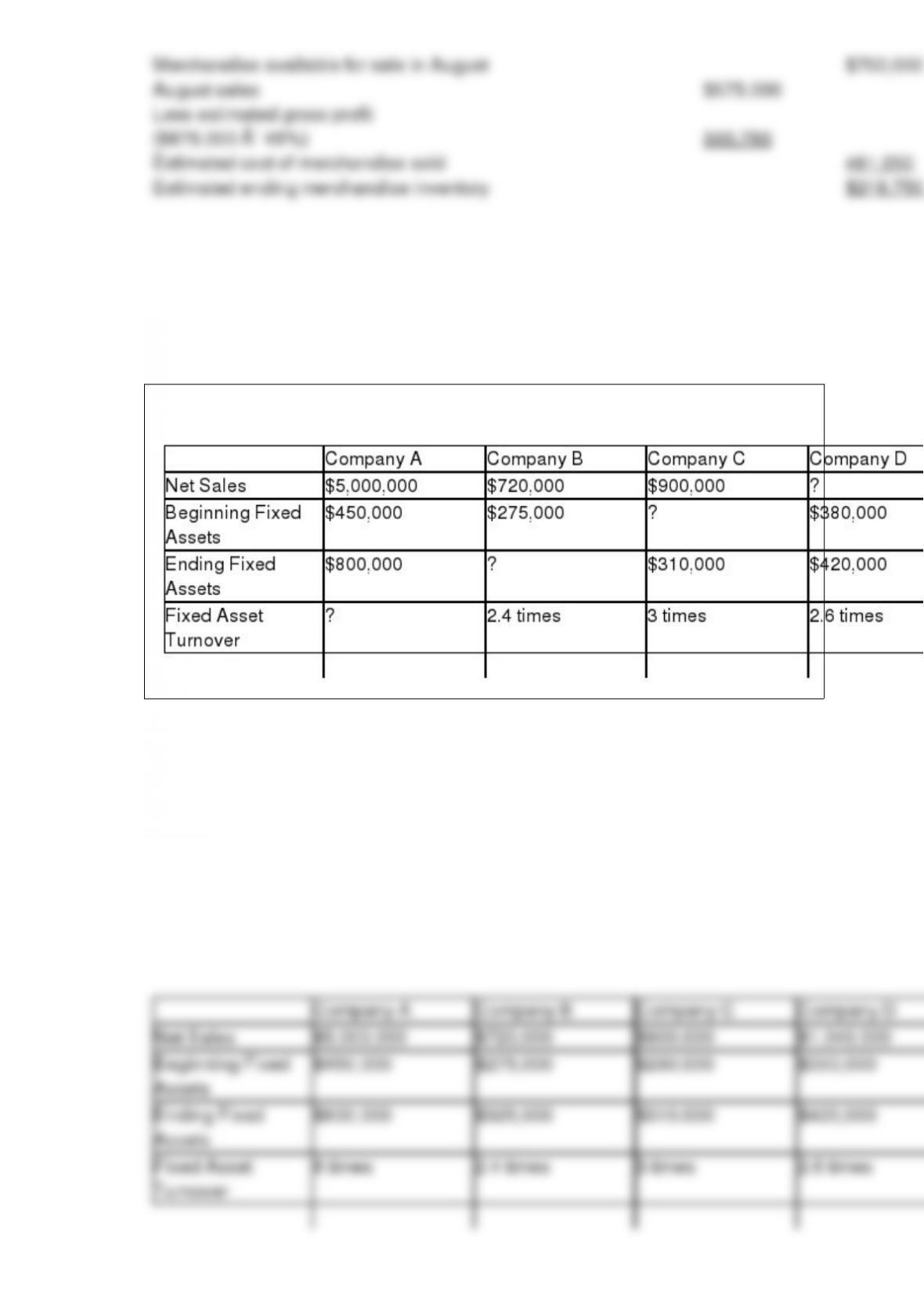
Fill in the missing numbers using the formula for Fixed Asset Turnover:
Answer:
DogMart Company records depreciation to Office Equipment and Production
Equipment. Depreciation for the period ending December 31 is $1,400 for Office
Equipment and $2,650 for Production Equipment. Prepare two entries to record the
Office Equipment and Production Equipment depreciation.
Answer:
Other than accounts receivable and notes receivable, name other receivables that might
be included in the general ledger.
Answer:
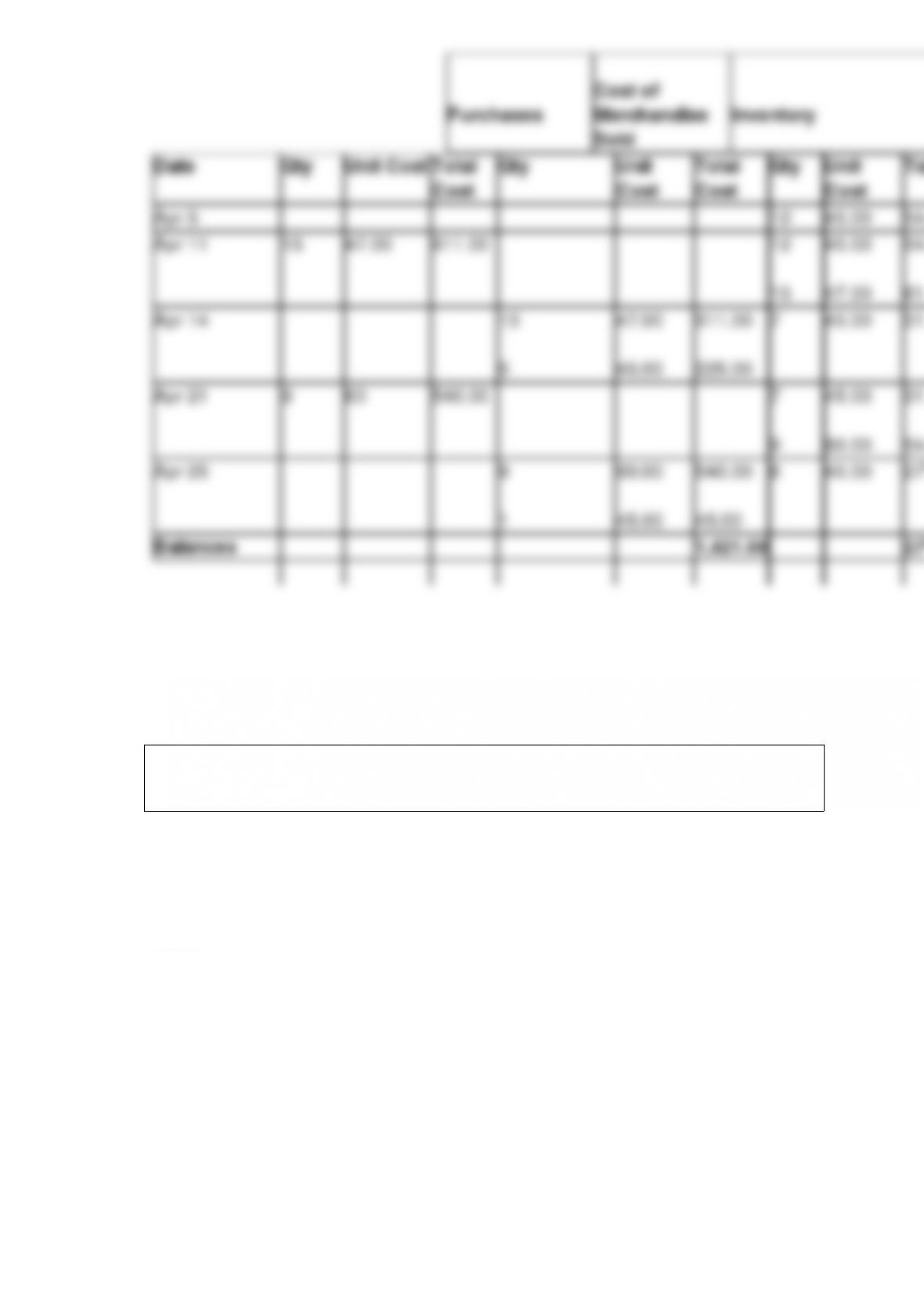
Beginning inventory, purchases and sales data for tennis rackets are as follows:
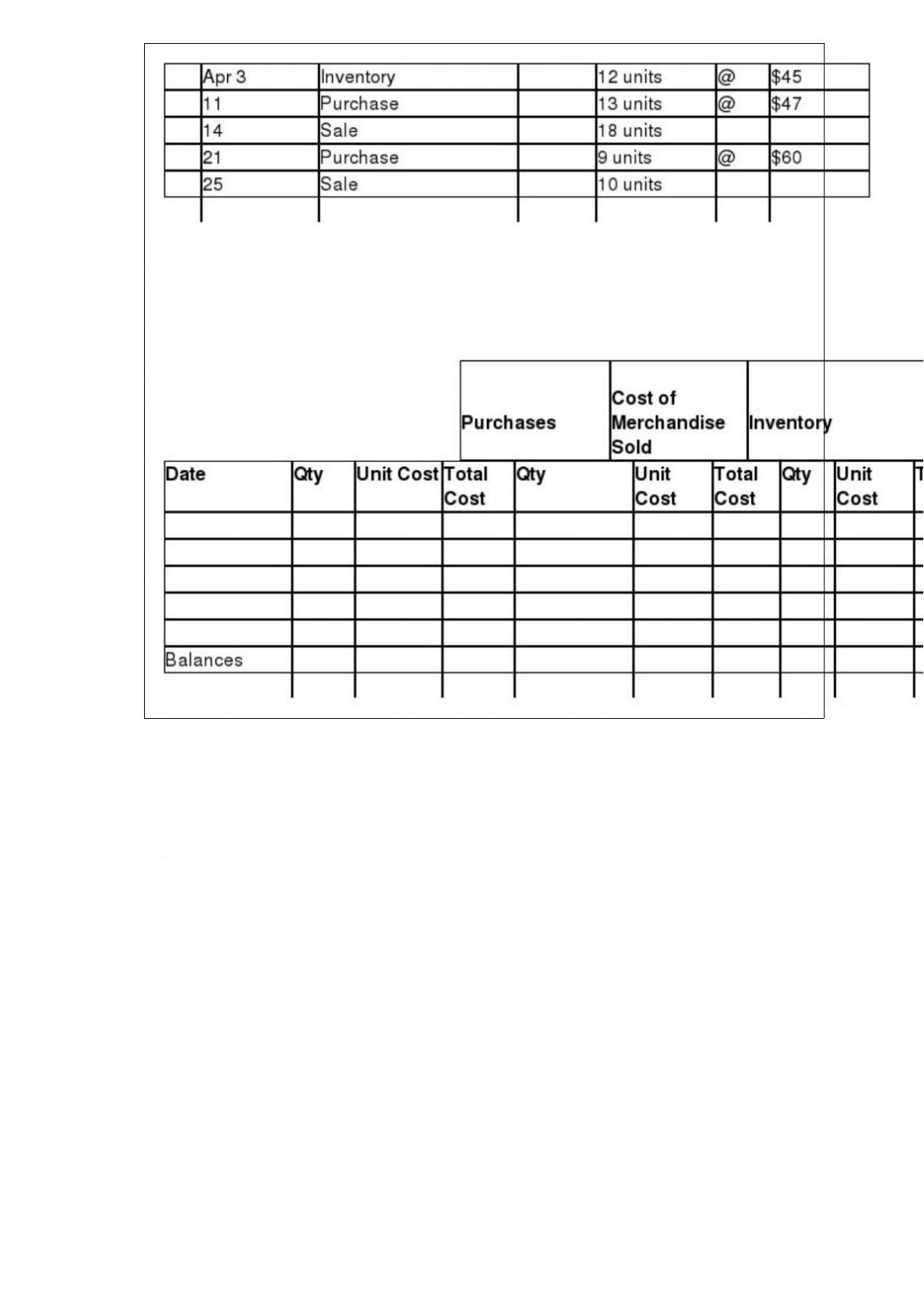
Complete the inventory cost card assuming the business maintains a perpetual
inventory system and calculates the cost of merchandise sold and ending inventory
using LIFO.
Answer:
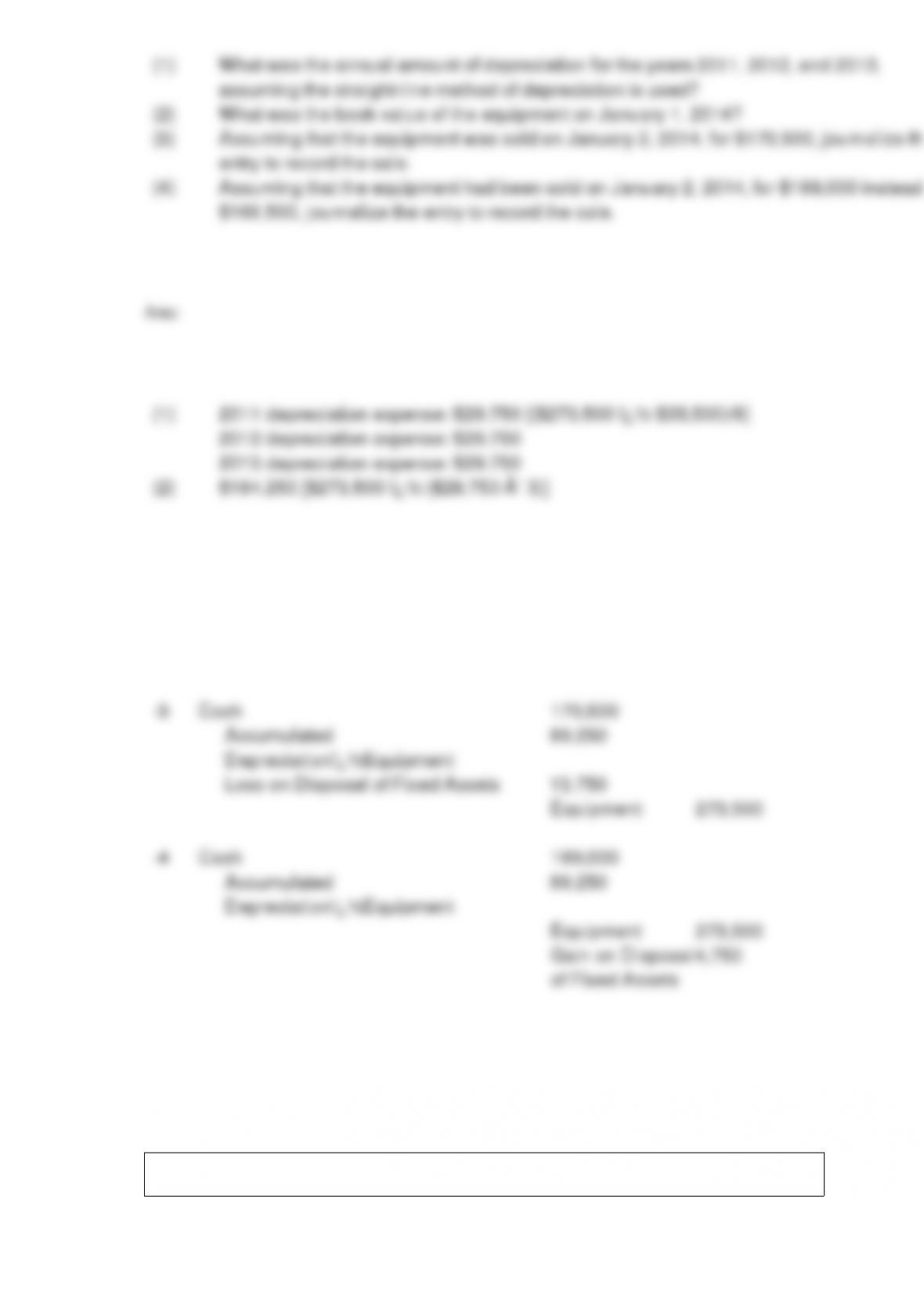
Equipment acquired on January 2, 2011 at a cost of $273,500 has an estimated useful
life of eight years and an estimated residual value of $35,500.
Answer:
The units of an item available for sale during the year were as follows:
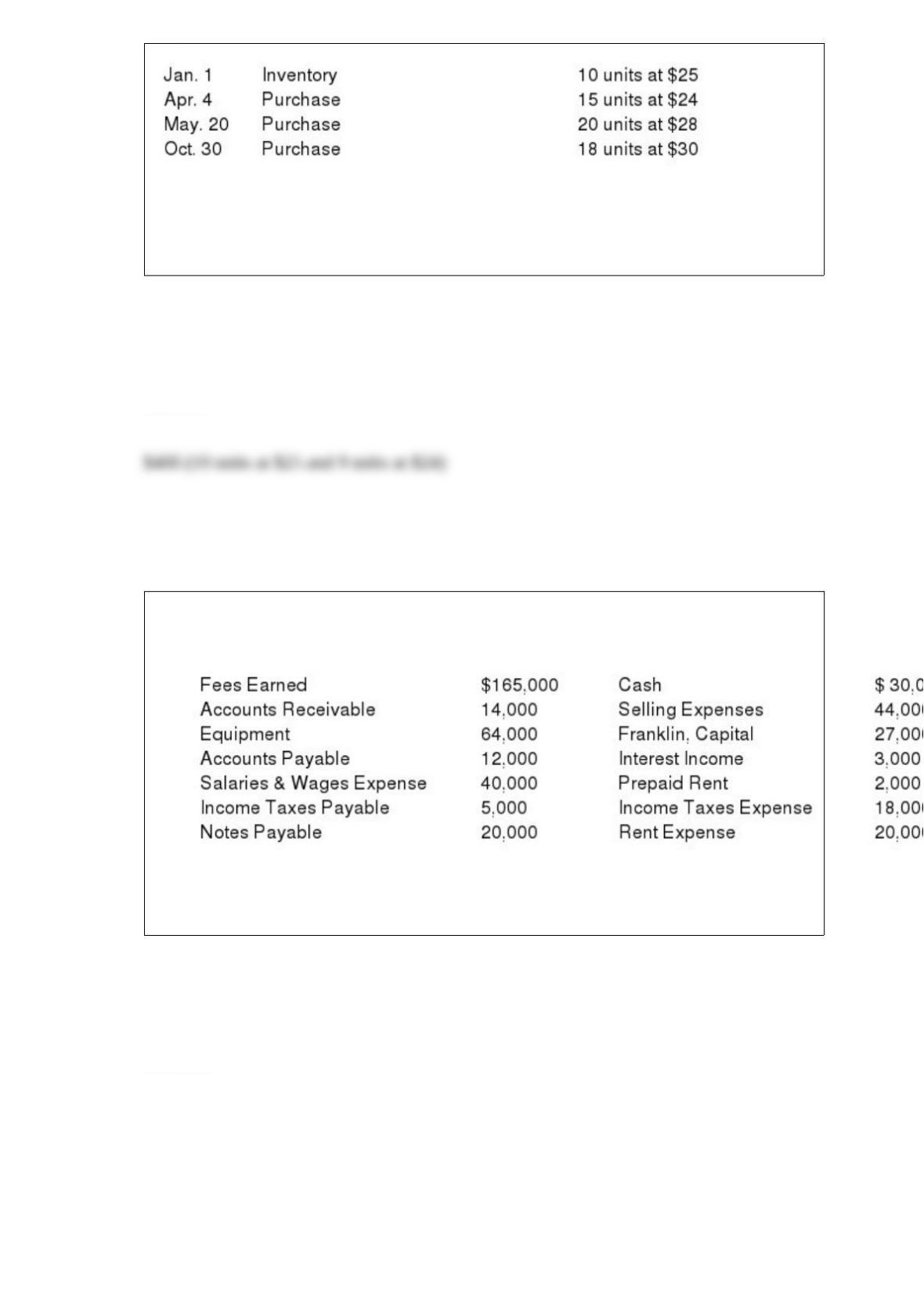
There are 19 units of the item in the physical inventory at December 31. The periodic
inventory system is used. Determine the ending inventory cost using LIFO.
Answer:
The accountant for Franklin Company prepared the following list of account balances
from the company’s records for the year ended December 31, 2011:
Determine the total assets at the end of 2011 for Franklin Company.
Answer: