1) The following are transactions for the city of Franklin.
a.Borrowed $20,000 by issuing a two-year note.
b.Purchased equipment for $6,000 cash.
c.Licenses for $700 were billed on account.
d.Accrued employee salary costs of $7,000.
e.Depreciation expense on equipment for year, $1,000.
Required:
Analyze the above transactions by using the accounting equation for a proprietary fund.
2) Plenty Corporation issued six thousand, $1,000 par, 6% bonds on January 1, 2010, at
par. Interest is paid on January 1 and July 1 of each year; the bonds mature on January
1, 2015 . On January 2, 2012, Scrawn Corporation, a 75%-owned subsidiary of Plenty,
purchased 3,000 of the bonds on the open market at 102.50 . Plenty’s separate net
income for 2012 included the annual interest expense for all 3,000 bonds. Scrawn’s
separate net income for 2012 was $400,000, which included the bond interest received
on July 1 as well as the accrual of bond interest revenue earned on December 31 . Both
companies use straight-line amortization of bond discounts/premiums.
What was the amount of gain or (loss) from the intercompany purchase of Plenty’s
bonds on January 2, 2012?
A) $(56,250)
B) $(75,000)
C) $ 75,000
D) $ 56,250

3) Match each of the following fund types to one of the following three fund categories
as indicated. Each fund category may be used more than once.
A.Governmental Fund
B.Proprietary Fund
C.Fiduciary Fund
_____1>Debt Service Fund
_____2>Internal Service Fund
_____3>Agency Fund
_____4>General Fund
_____5>Permanent Fund
_____6>Enterprise Fund
_____7>Capital Projects Fund
_____8>Trust Fund
_____9>Special Revenue Fund
_____10>Pension Fund
4) Which of the following does not occur for a trustee in a Chapter 7 bankruptcy case?
A) Gains and losses on the sale of assets are debited to the estate equity account
B) Unrecorded liabilities discovered by the trustee are debited to the estate equity
account and credited to the liability account
C) Liquidation expenses are debited to the estate equity account
D) An income statement is prepared showing gains and losses on sale of assets
5) Proceeds from bonds issued for the construction of capital assets are classified on the
Statement of Cash Flows for an Enterprise Fund as
A) Cash Flows from Operating Activities
B) Cash Flows from Noncapital Financing Activities
C) Cash Flows from Capital and Related Financing Activities
D) Cash Flows from Investing Activities
6) Pew Corporation acquired 80% ownership of Sordid Incorporated, at a time when
Pew’s investment cost was equal to 80% of Sordid’s book value. At the time of
acquisition, the book values and fair values of Sordid’s assets and liabilities were equal.
Pew uses the equity method. During 2011, Pew sold goods to Sordid for $160,000
making a gross profit percentage of 20%. Half of these goods remained unsold in
Sordid’s inventory at the end of the year. Income statement information for Pew and

Sordid for 2011 were as follows:
Pew Sordid
Sales Revenue$800,000 $300,000
Cost of Goods Sold500,000160,000
Operating Expenses200,00080,000
Separate incomes$100,000$60,000
The 2011 consolidated income statement showed noncontrolling interest share of
A) $3,200
B) $6,400
C) $8,800
D) $12,000
7) Pascalian Company owns a 90% interest in Sapp Company. On January 1, 2010,
Pascalian had $300,000, 6% bonds outstanding with an unamortized premium of
$9,000. The bonds mature on December 31, 2014 . Sapp acquired one-third of
Pascalian’s bonds in the open market for $97,000 on January 1, 2010 . Both companies
use straight-line amortization of bond discounts/premiums. Interest is paid on
December 31 . On December 31, 2010, the books of the two affiliates held the
following balances:
Pascalian’s books
6% bonds payable$300,000
Premium on bonds7,200
Interest expense16,200
Sapp’s books
Investment in Pascalian bonds$ 97,600
Interest income6,600
The gain from the bond purchase that appeared on the December 31, 2010 consolidated
income statement was
A) $4,320
B) $4,800
C) $5,400
D) $6,000
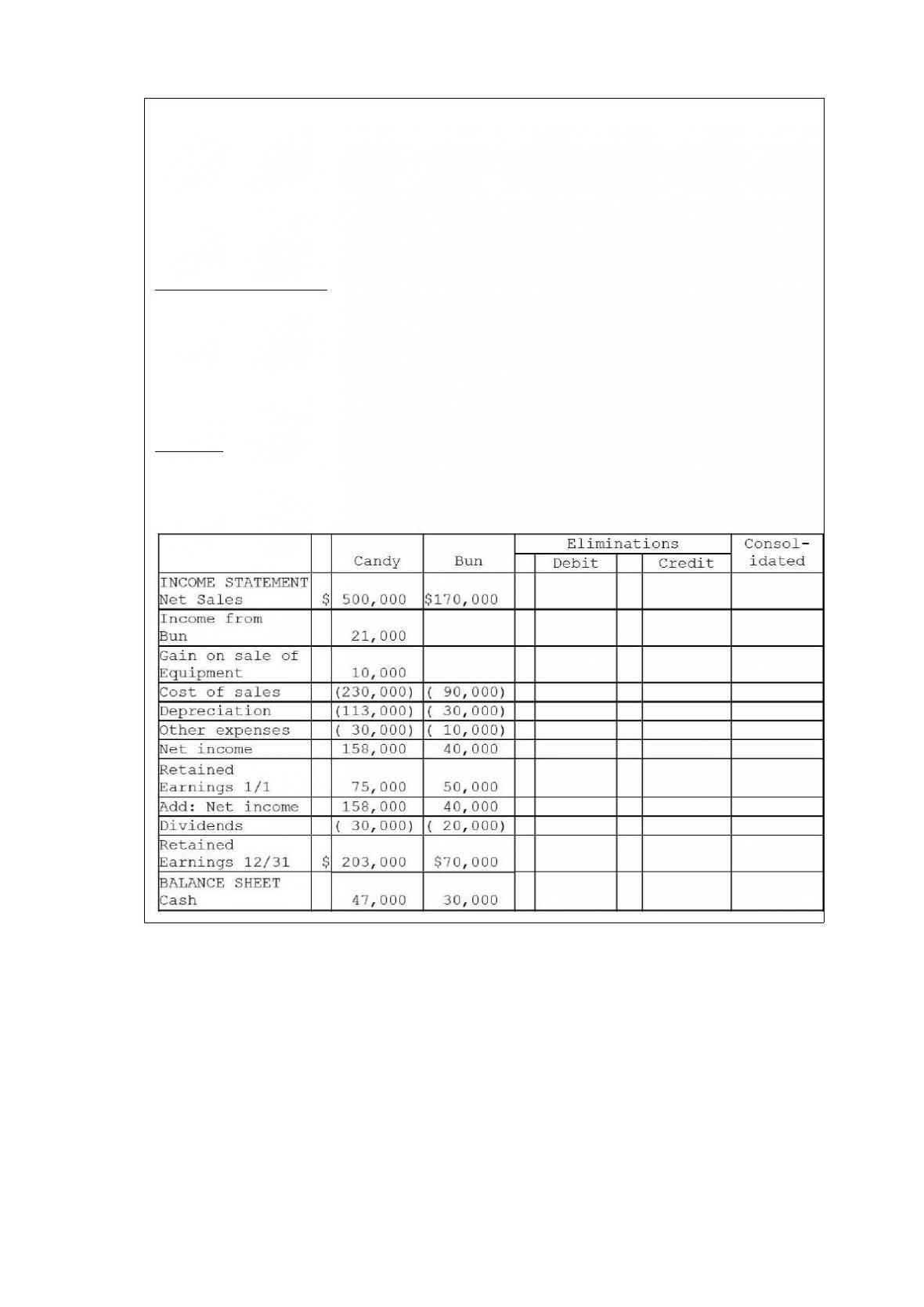
8) Candy Corporation paid $240,000 on April 1, 2011 for all of the common stock of
Bun Corporation in a business acquisition. On January 1, 2011, Bun’s stockholders’
equity was equal to $195,000. Bun’s first quarter 2011 net income was $10,000 and first
quarter 2011 dividends were $5,000. In 2011, preacquisition sales were $32,500 and
preacquisition cost of sales was $22,500. (There were no other preacquisition expenses
in 2011) Dividends are paid quarterly on March 31, June 30, September 30 and
December 31 . Any excess cost over book value acquired is allocated to goodwill.
Additional information:
1> Candy sold equipment with a 5-year remaining useful life to Bun on July 1, 2011 for
a gain of $10,000. Salvage value of the equipment is zero and both companies use the
straight-line depreciation method.
2> Bun’s accounts payable balance at December 31 includes $5,000 due to Candy from
the sale of equipment.
3> Candy accounts for its investment in Bun using the equity method.
Required:
Complete the working papers to consolidate the financial statements of Candy and Bun
Corporations for the year ending December 31, 2011 .

9) On January 1, 2011, Punch Corporation purchased 80% of the common stock of
Soopy Co. Separate balance sheet data for the companies at the acquisition date(after
the acquisition) are given below:
PunchSoopy
Cash$34,000 $206,000
Accounts Receivable144,00026,000
Inventory132,00038,000
Land68,00032,000
Plant assets700,000300,000
Accum. Depreciation(240,000)(60,000)
Investment in Soopy392,000
Total assets$ 1,230,000$ 542,000
Accounts payable$206,000$142,000
Capital stock800,000300,000
Retained earnings224,000100,000
Total liabilities & equities$ 1,230,000$ 542,000
At the date of the acquisition, the book values of Soopy’s net assets were equal to the
fair value except for Soopy’s inventory, which had a fair value of $60,000.
Determine below what the consolidated balance would be for each of the requested
accounts.
What amount of Goodwill will be reported?
A) $54,400
B) $68,000
C) $72,000
D) $90,000
10) If investors expect interest rates to fall significantly in the future, the yield curve

will be inverted This means that the yield curve has a ________ slope
A) steep upward
B) slight upward
C) flat
D) downward
11) An enterprise fund collects $100,000 cash for customer deposits to insure timely
payment for services. What journal entry did the enterprise fund prepare?
A) Debit Cash $100,000, credit Revenue $100,000
B) Debit Cash $100,000, credit Deferred Revenue $100,000
C) Debit Restricted Cash $100,000, credit Customer Deposits $100,000
D) Debit Restricted Cash $100,000, credit Revenue $100,000
12) The collapse of the subprime mortgage market
A) did not affect the corporate bond market
B) increased the perceived riskiness of Treasury securities
C) reduced the Baa-Aaa spread
D) increased the Baa-Aaa spread
13) Noncontrolling interest share is viewed as an expense under ________ theory.
A) parent company
B) entity
C) contemporary
D) joint venture
14) Rank the following claims 1 through 5, with 1 being the first priority claim, under
Chapter 7 of the bankruptcy code.
_____ A. Trustee fees for administration of the estate.
_____ B. Accounts payable for goods delivered prior to filing an involuntary petition
for bankruptcy
_____ C. Customer deposits for services never rendered.
_____ D. First mortgage on the company’s real estate.
_____ E. Income taxes owed for the prior year.

15) In reference to the Uniform Probate Code, which of the following statements is
correct?
A) The Code entitles the surviving spouse to a homestead allowance that is exempt
from, and has priority over, all claims against the estate
B) The Code provides a homestead allowance to the surviving spouse of $100,000
C) The Code provides an allowance for dependents, after other claims have been settled
D) The Code entitles the surviving spouse to claim 100% of the estate after claims to
third-parties are settled
16) Mason Dixon dies on November 30, 2011, leaving a valid will. The will reads as
follows:
“I leave my boat to my son, George. I leave my automobile to my daughter, Georgia. I
leave the income on my estate to be divided equally between George and Georgia.
Estate expenses are to be paid from principal, not estate income. All other property, I
leave to a trust to care for my wife, Gladys. Any remaining property at the time of her
death is to be transferred into a trust to pay college education expenses of my
grandchildren until such time as it is used up. I name my wife, Gladys, as executrix of
my estate.”
Gladys prepares an estate inventory for all assets discovered and files the appropriate
notice to potential creditors on December 15 .
Cash$ 90,000
Investments1,200,000
Interest Receivable2,000
Life Insurance Receivable500,000
Residence180,000
Automobile20,000
Boat70,000
Total$2,062,000
A check for interest is received of $5,000, and estate liabilities (such as funeral
expenses, administrative costs, and taxes) are settled for $20,000. The will is
administered.
Required:
Prepare a charge-discharge statement for the estate of Mason Dixon on December 31,
2011 . Assume the life insurance proceeds have not been paid out.
17) In a Chapter 7 bankruptcy case, what is the first-to-last ranking order of priority for
payment? (Use the following list of claim types.)
I.stockholder claims
II.unsecured priority claims
III.secured claims
IV.unsecured nonpriority claims
A) I, II, IV, and III
B) III, II, IV, and I
C) III, I, IV, and II
D) II, IV, III, and I
18) Pablo Corporation acquired 60% of Abagia Corporation on January 1, 2010, at a
cost of $20,000 in excess of book value. Also, on July 1, 2010, Pablo acquired 60% of
Babin Corporation at book value. On January 1, 2011, Abagia acquired a 20% interest
in Babin at a cost of $10,000 in excess of book value. The excess purchase costs paid
by Pablo and Abagia were attributed to goodwill.
On July 1, 2011, Pablo sold land with a book value of $20,000 to Abagia for $40,000.
The $20,000 unrealized gain is included in Pablo’s separate income. Separate net
incomes for the affiliated companies (excluding investment income) for 2011 are:
Pablo$250,000
Abagia70,000
Babin100,000
Controlling interest share of consolidated net income for 2011 is
A) $304,000
B) $324,000
C) $344,000
D) $364,000
19) Address the following situations separately.
1>For the budgetary year beginning July 1, 2011, Coastal City expected the following
cash flow resources:
Property taxes, licenses, and fees$3,000,000
Proceeds of debt issue1,000,000
Interfund transfers to debt service fund750,000
In the budgetary entry, what amount did Coastal City record for estimated revenues?
2>During the fiscal year ended June 30, 2011, Western County issued purchase orders
totaling $7,000,000. Western County received $6,500,000 of invoiced goods at the
encumbered amounts and paid $6,100,000 toward them before year-end.
How much were Western County’s encumbrances on July 1, 2011?
3>The following information pertains to property taxes levied ($1,035,000 total) by
Southern Township for the calendar year 2011:
Expected collections during 2011$750,000
Expected collections in first 60 days of 2012200,000
Expected collections during the remainder of 201250,000
Expected collections during January 201330,000
Estimated to be uncollectible5,000
What amount did Southern Township report for property tax revenues in 2011?
4> The following information pertains to Northern City’s general fund for 2011:
Expenditures5,500,000
Other financing sources1,000,000
Other financing uses3,000,000
Revenues9,000,000
At what amount will Northern City’s total fund balance increase (decrease) in 2011?
20) The following data relate to Elle Corporation’s industry segments. (Elle HQ
represents the corporate headquarters). All other segments are geographical sales
segments.
AttributeEuropeRussiaChinaJapanElle HQ
External sales$35,000$24,000$33,000$0$0
Intersegment
Sales2,0001,0004,00000
Expenses27,00018,00029,0005,00012,000
Assets assigned20,00022,00030,00014,00015,000
Income from
Equity investee5,000
Required:
1> Prepare a report which reconciles the reportable segment profits to total consolidated
profits assuming that corporate expenses are not allocated to the operating segments.
2> Prepare a report which reconciles the reportable segment profits to total consolidated
profits assuming that corporate expenses are allocated evenly among the operating
segments.
21) Journalize the following utility transactions in the Quest County Enterprise Fund:
1>Billings to external customers $1,600,000; billings to Quest County governmental
funds $130,000.
2>Collected refundable deposits from new customers $10,000.
3>Collected 95% of all billings by fiscal year-end.
4>Refunded $4,000 in deposits to former customers.
5>Unbilled services to outside customers at year-end $14,000.

22) Cindy Lou’s parents passed away while she was still dependent on them, and their
will designated that a trust should be established with their estate proceeds to care for
her. The following transactions occurred in the first two months following their deaths.
1>The trust account was opened with the $2,000,000 in funds received from the estate.
The funds were deposited into a non-interest bearing checking account to be used for
expenses.
2>$1,500,000 was put into a multi-year certificate of deposit which earned 3%
annually, with interest paid monthly back to the checking account.
3>One month’s interest from the certificates of deposit was received.
4>The bank’s trust administration fee was paid for $65.
5>Tuition was paid for the boarding school where Cindy Lou was living for $6,500.
Required:
Prepare the journal entries for the listed transactions. Disregard the impact of estate and
income taxes.
23) Passerby International purchased 80% of Standaround Company’s outstanding
common stock for $200,000 on January 2, 2011 . At that time, the fair value of
Standaround’s net assets were equal to the book values. The balance sheets of Passerby
and Standaround at January 2, 2011 are summarized as follows:
PasserbyStandaround
Assets$1,600,000$470,000
Liabilities$840,000$230,000
Capital stock360,00050,000
Retained earnings400,000190,000
Required: Determine the consolidated balances as of January 2, 2011 for the following
five balance sheet line items: Goodwill, Liabilities, Capital Stock, Retained Earnings,
and Noncontrolling Interest.