Your company is planning to issue $1,000 bonds with a stated interest rate of 7% and a
maturity date of July 15, 2022. If interest rates fall in the economy so that similar
financial investments pay 5%, your company will:
A) not be able to issue the bonds because no one will buy them.
B) receive a higher issue price as buyers compete for the bonds.
C) have to accept a lower issue price to attract buyers.
D) have to reprint the bond certificates to change stated interest rate to 5%.
How do debits appear in a T-account?
A) They are listed on the left side for asset accounts, but listed on the right side for
liabilities and stockholders’ equity accounts.
B) They are always listed on the right side of the account.
C) They are always listed on the left side of the account.
D) They are listed on the right side for asset accounts, but listed on the left side for
liabilities and stockholders’ equity accounts.

Match the term and its definition. There are more definitions than terms.
Terms
____ 1> Contra-Account
____ 2> Carrying Value
____ 3> Deferral Adjustment
____ 4> Closing Journal Entry
____ 5> Net Loss
____ 6> Adjusted Trial Balance
____ 7> Temporary Account
____ 8> Accrual Adjustment
____ 9> Income Before Income Taxes
Definitions
A. When revenue minus expenses is a negative number.
B. Adds new values into the balance sheet and income statement accounts.
C. Also known as balance sheet accounts.
D. Entries made to update existing accounts and record new events.
E. The level of profit prior to considering income tax.
F. Lists the balances of all accounts to check that revenues equal expenses.
G. The amount at which an asset or liability is reported in the financial statements.
H. An account that is paired with another account and acts to reduce its book value.
I. Lists the balances of all temporary and permanent accounts to provide a check on the
equality of the debits and credits.
J. A journal entry that transfers net income or loss to the Retained Earnings account.
K. Converts some of an asset’s or a liability’s book value into an expense or a revenue.
L. An account that must have a zero balance after Closing entries have been made.
M. Lists the balances of all permanent accounts to check that debits equal credits.
The return on equity ratio measures the:
A) return stockholders receive in dividends for each dollar of their investment.
B) return stockholders receive in dividends and stock price growth for each dollar of
their investment.
C) amount of income earned for each dollar of common stockholders’ equity.
D) amount earned by the company on each dollar obtained from equity and debt
financing.
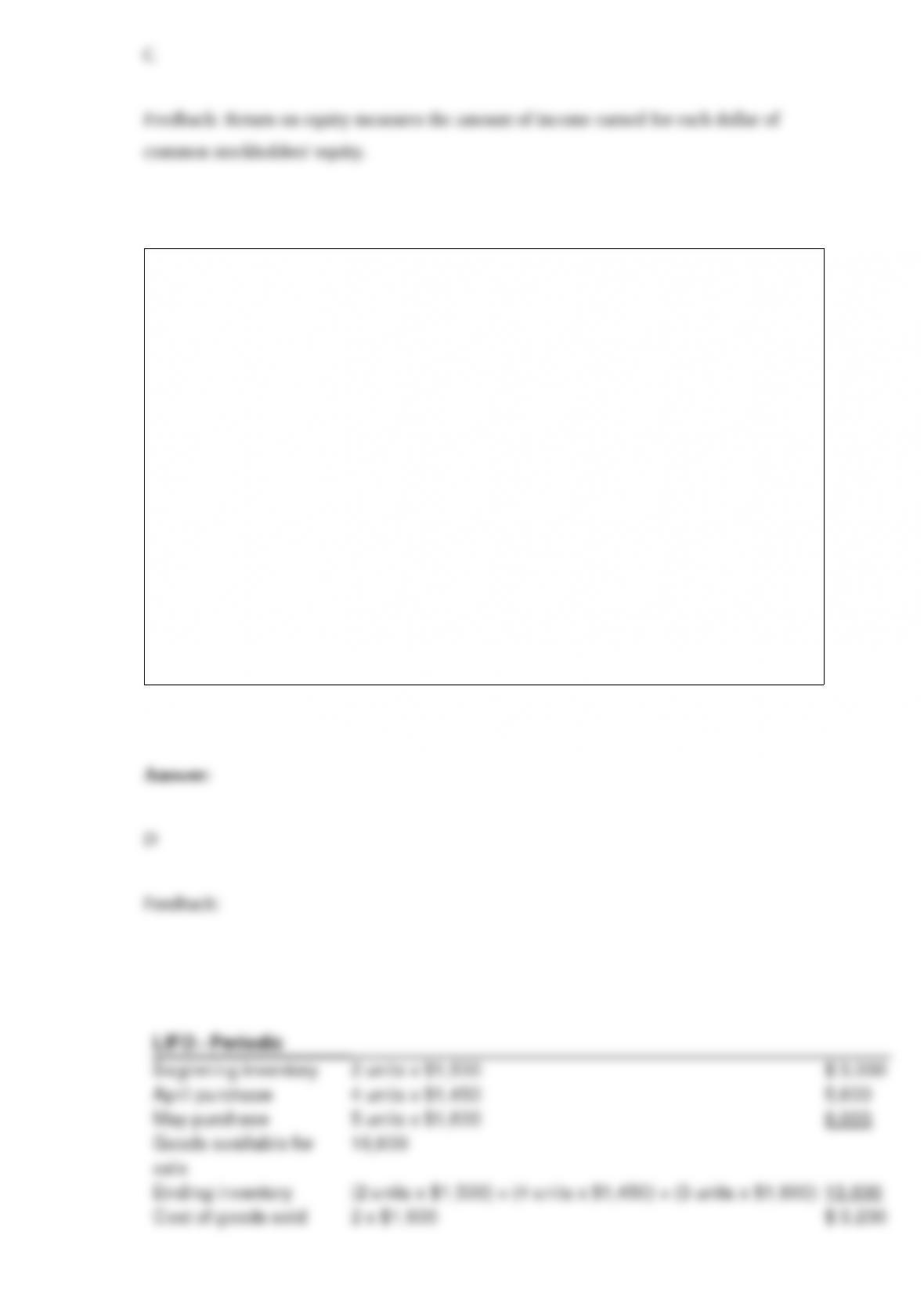
Eaton Electronics uses a periodic inventory system. On March 31, Eaton has two
plasma TVs on hand at a cost of $1,500 each (serial numbers 11534892 and 11534894).
In April, the company purchases four more identical TVs from Toshiba for $1,450 each
(serial numbers 11542631 through 11542634). In May, the company purchases five
more identical TVs for $1,600 each (serial numbers 11550964 through 11550968). In
June, Eaton sells two of these TVs (serial numbers 11534894 and 11542631). There
were no additional purchases or sales during the remainder of the year.
Use the information above to answer the following question. Eaton Electronics uses the
LIFO method. What is the cost of its ending inventory?
A) $13,850
B) $13,800
C) $13,760
D) $13,600
Which of the following statements about the income statement is correct?
A) Expenses are listed before revenues on the income statement.
B) Revenues are listed before expenses on the income statement.
C) The income statement is prepared after the balance sheet.
D) Dividends are listed on the income statement.
On January 1, 2016, a company issues 3-year bonds with a face value of $50,000 and a
stated interest rate of 7%. Because the market interest rate is 5%, the company receives
$52,723 for the bonds.
Required:
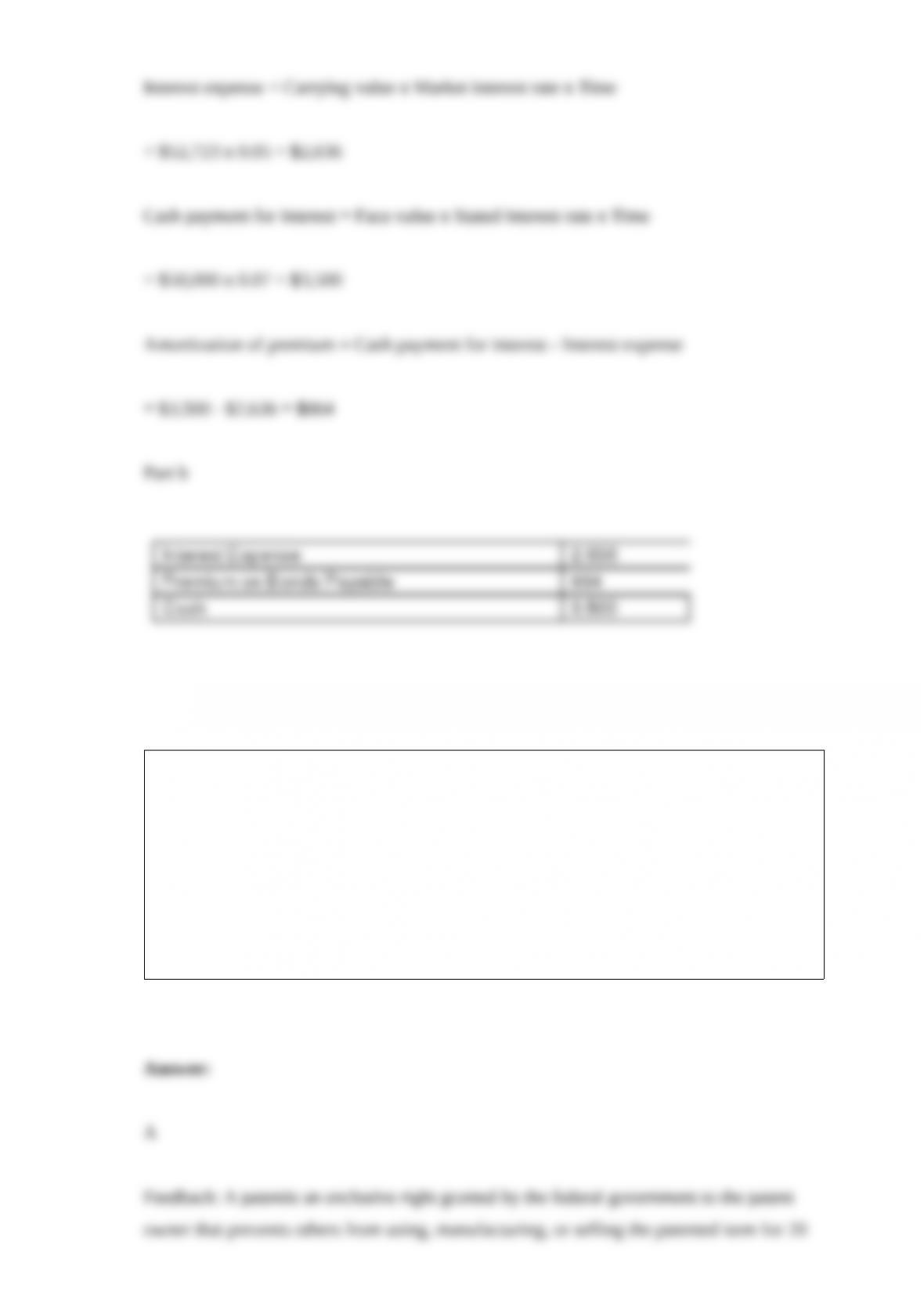
Part a. Determine the interest expense, the cash payment for interest, and the amount of
the premium that will be amortized during the year ending December 31, 2016.
Part b. Prepare the journal entry to record the first interest payment on December 31,
2016.
The right to exclude others from making or using an invention is a:
A) patent.
B) copyright
C) franchise.
D) licensing right.
Countryside Corporation uses the allowance method. Countryside writes off a $350
customer account balance when it becomes clear that the customer will never pay.
Countryside Corporation should debit:
A) Bad Debt Expense and credit Accounts Receivable for $350.
B) Allowance for Doubtful Accounts and credit Accounts Receivable for $350.
C) Bad Debt Expense and credit Cash for $350.
D) Accounts Receivable and credit Bad Debt Expense for $350.
Choose the appropriate letter to match the term and the definition. There are more
definitions than terms.
TERM
1>____ Days to Sell
2> ____ FIFO
3> ____ Inventory Turnover
4> ____ LIFO
5> ____ LIFO Conformity Rule
6> ____ Lower of Cost or Market Rule
7> ____ Specific Identification
8> ____ Weighted Average Cost

DEFINITION
A. A valuation rule that requires Inventory to be written down when its market value
falls below its cost.
B. Inventory costing method that assumes that the costs of the first goods purchased are
the costs of the first goods sold.
C. Beginning Inventory + Purchases – Ending Inventory
D. Consists of products acquired in a finished condition, ready for sale without further
processing.
E. The expense that follows directly after Net Sales on a multiple step income
statement.
F. Goods a company is holding on behalf of the goods ‘ owner.
G. Goods that are held for sale in the normal course of business or are used to produce
other goods for sale.
H. Goods that are in the process of being manufactured.
I. Inventory costing method that identifies the cost of the specific item that was sold.
J. The inventory that starts the manufacturing process.
K. Inventory that was in process and now is completed and ready for sale.
L. Inventory items being transported.
M. A measure of the average number of days from the time inventory is bought to the
time it is sold.
N. How many times (on average) that inventory has been bought or sold.
O. Requires that if LIFO is used on the income tax return, it also must be used in
financial statement reporting.
P. Beginning Inventory + Purchases – Cost of Goods Sold
Q. The difference between net sales and cost of goods sold.
R. Inventory costing method that assumes that the costs of the last goods purchased are
the costs of the first goods sold.
S. Inventory costing method that uses the weighted average unit cost of the goods
available for sale for both cost of goods sold and ending inventory.
Company X has net sales revenue of $780,000, cost of goods sold of $343,200, and all
other expenses of $327,600. The net profit margin is closest to:
A) 0.32.
B) 0.56.
C) 0.86.
D) 0.14.
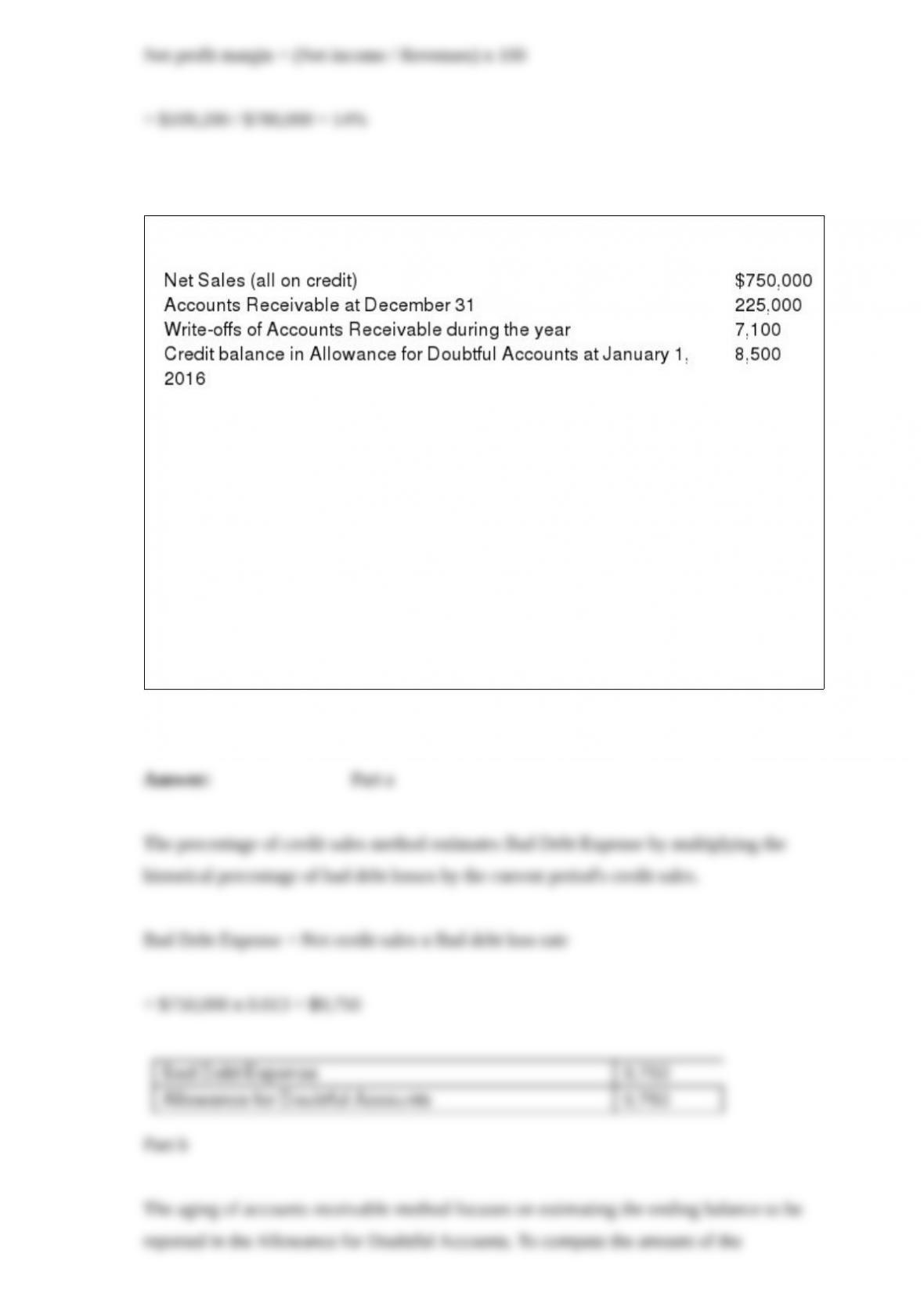
At December 31, 2016, a company’s records include the following:
Required:
Part a. The company estimates bad debts as 1.3% of credit sales. Prepare the required
adjusting entry to record Bad Debt Expense for the year.
Part b. Assume instead that the company uses the aging of receivables method. Its aging
analysis reveals that the estimate of uncollectible receivables is $11,250. Prepare the
required adjusting entry to record Bad Debt Expense for the year.
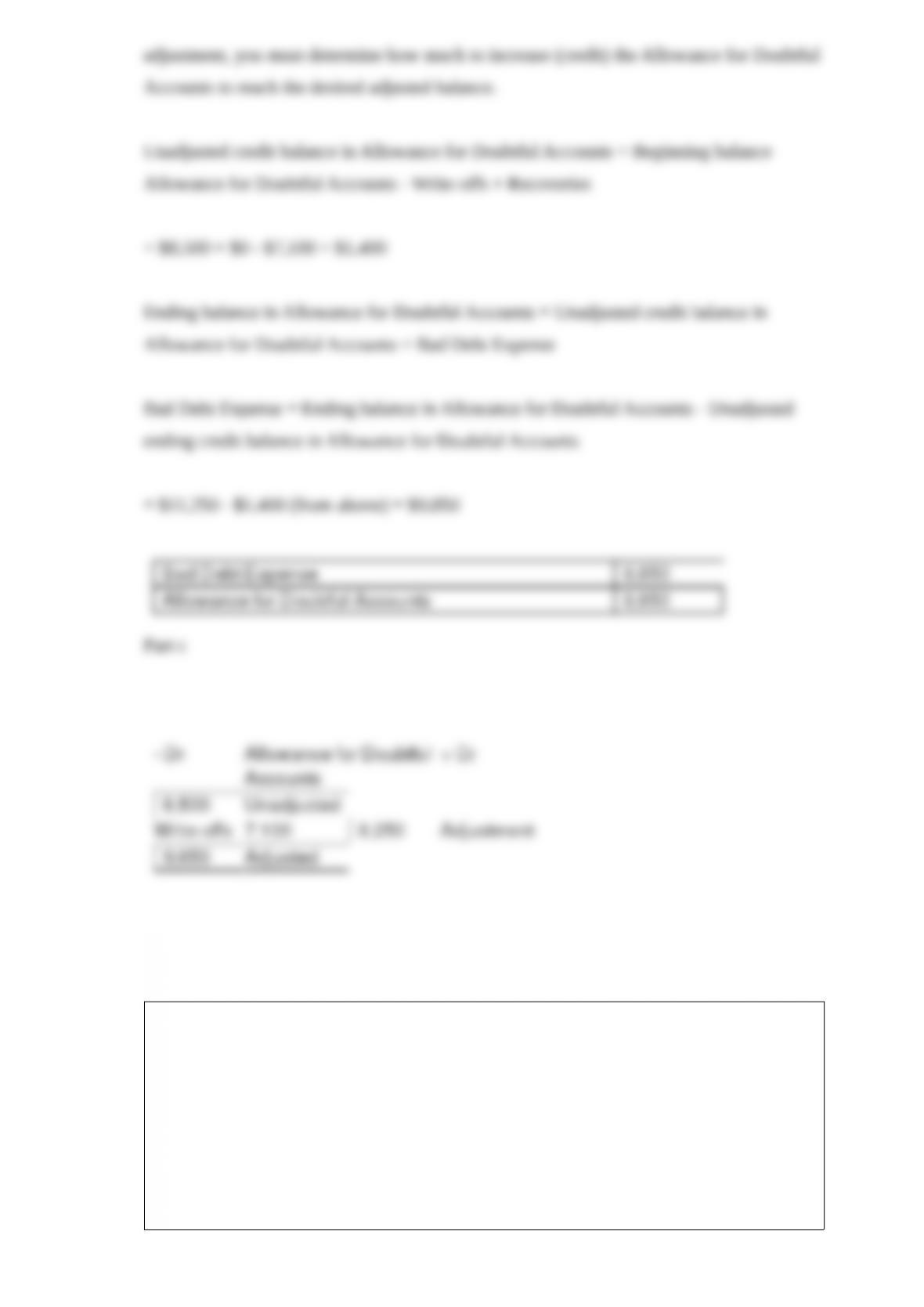
Part c. Assume instead that the company estimates that its Bad Debt Expense for the
year is $8,250. Use a T-account to determine the adjusted balance in the Allowance for
Doubtful Accounts.
Adjusting entries affect:
A) only balance sheet accounts.
B) only income statement accounts.
C) only statement of cash flow accounts.
D) both income statement and balance sheet accounts.
A contra-account:
A) increases the original value of the account to which it relates.
B) always appears in the same column of the trial balance as the account to which it
relates.
C) offsets, or reduces, another account.
D) reduce the asset to its fair value.
Which one of the following accounts would not necessarily be classified as a current
liability?
A) Accounts payable
B) Accrued liabilities
C) Contingent liabilities
D) Current portion of long-term debt