Merchandise with a sales price of $6,000 is sold on account with term 2/10, n/30. The
journal entry to record the sale would include a
A.debit to Cash for $6,000
B.Debit to Sales Discounts for $120
C.Credit to Sales for $6,000
D.Debit to Accounts Receivable for $5,880
Answer:
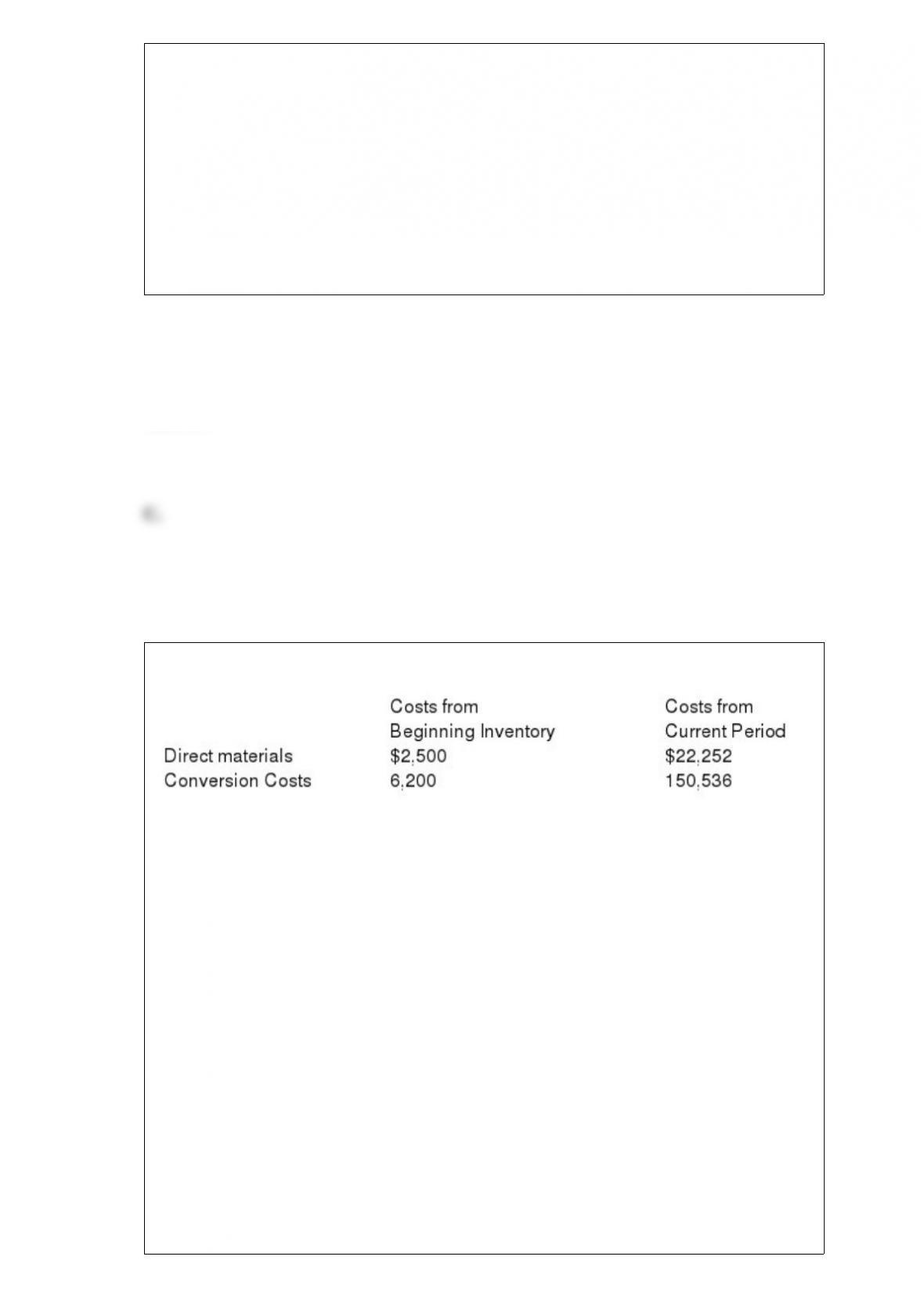
Carmelita Inc., has the following information available:
At the beginning of the period, there were 500 units in process that were 60 percent
complete as to conversion costs and 100 percent complete as to direct materials costs.
During the period 4,500 units were started and completed. Ending inventory contained
340 units that were 30 percent complete as to conversion costs and 100 percent
complete as to materials costs. (Assume that the company uses the FIFO process cost
method.)
The equivalent units of production for direct materials and conversion costs,
respectively, were
A.5,340 for direct materials and 4,902 for conversion costs.
B.4,840 for direct materials and 4,802 for conversion costs.
C.4,602 for direct materials and 4,802 for conversion costs.
D.4,902 for direct materials and 4,802 for conversion costs.

Answer:
The amount of the average investment for a proposed investment of $90,000 in a fixed
asset, with a useful life of four years, straight-line depreciation, no residual value, and
an expected total net income of $21,600 for the 4 years, is:
A.$10,800
B.$21,600
C.$ 5,400
D.$45,000
Answer:
Carmen Company a publicly traded company with preferred and common stock issued.
As of January 1st, it had 50,000 shares of $100 par, 2% preferred stock outstanding and
250,000 shares of $10 par common stock outstanding.
(a) On January 31st, the Board of Directors issues a requirement to purchase 5,000
shares of its common stock at market price. The shares are purchased at a market price
of $22 per share. Journalize the purchase utilizing the cost concept.
(b) On March 15th, Carmen declares a dividend on preferred stock of $2.75 per share.
The date of record is March 25th and the date of payment is March 31st. Journalize
these events.
(c) On December 1st, Carmen declares a cash dividend on common stock of $0.12 per
share. The date of record is December 15th and the date of payment is December 21st.
Journalize these events.
(d) On December 27th the board orders that 2,500 shares of treasury stock be sold. The
sale price is $25 per share. Journalize this event.
Answer:
What is the normal balance of the following accounts?
a. Sales Tax Payable
b. Merchandise Inventory
c. Delivery Expense
d. Cost of Merchandise Sold
e. Sales Returns and Allowance
f. Sales Discounts
g. Sales
Answer:
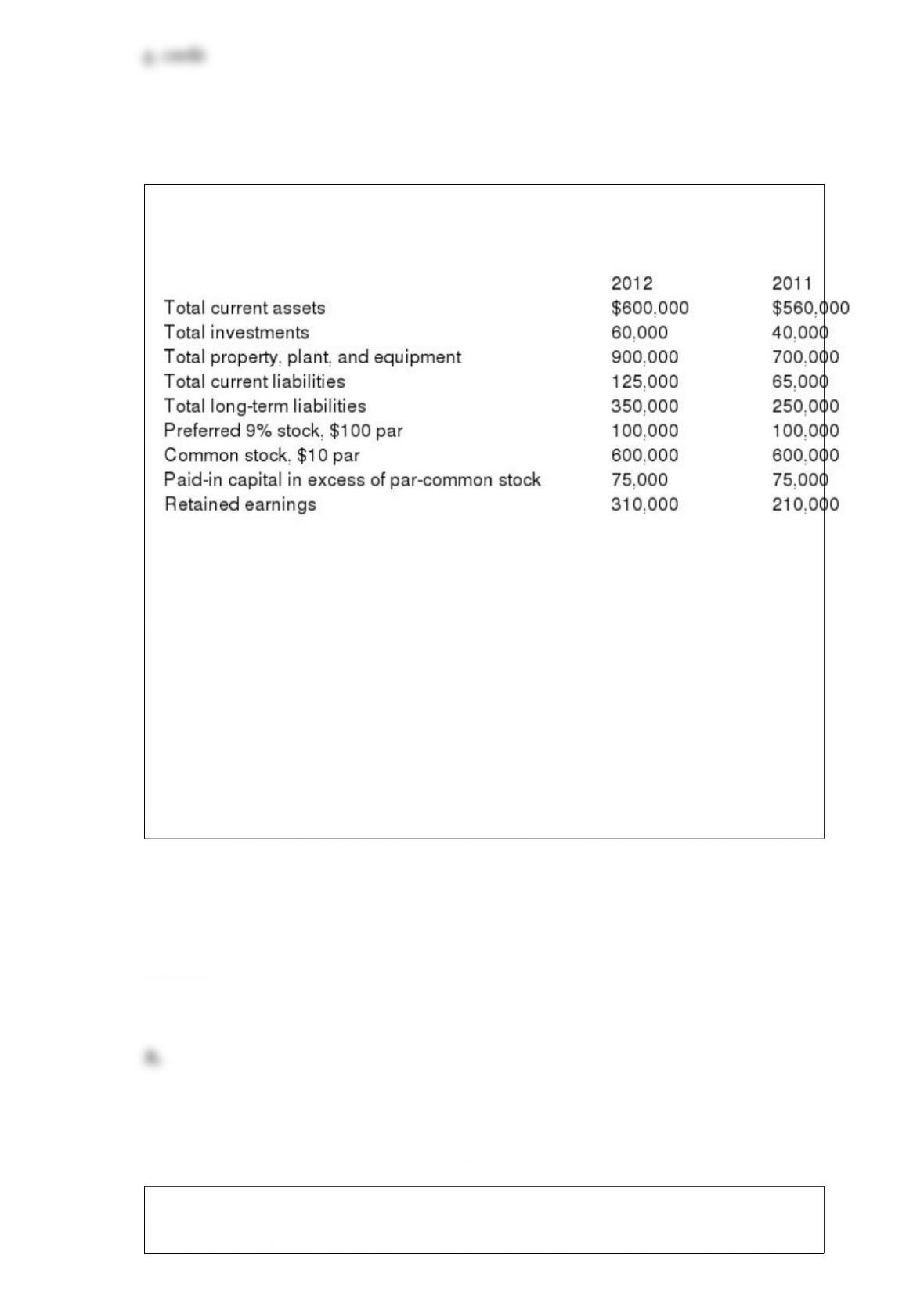
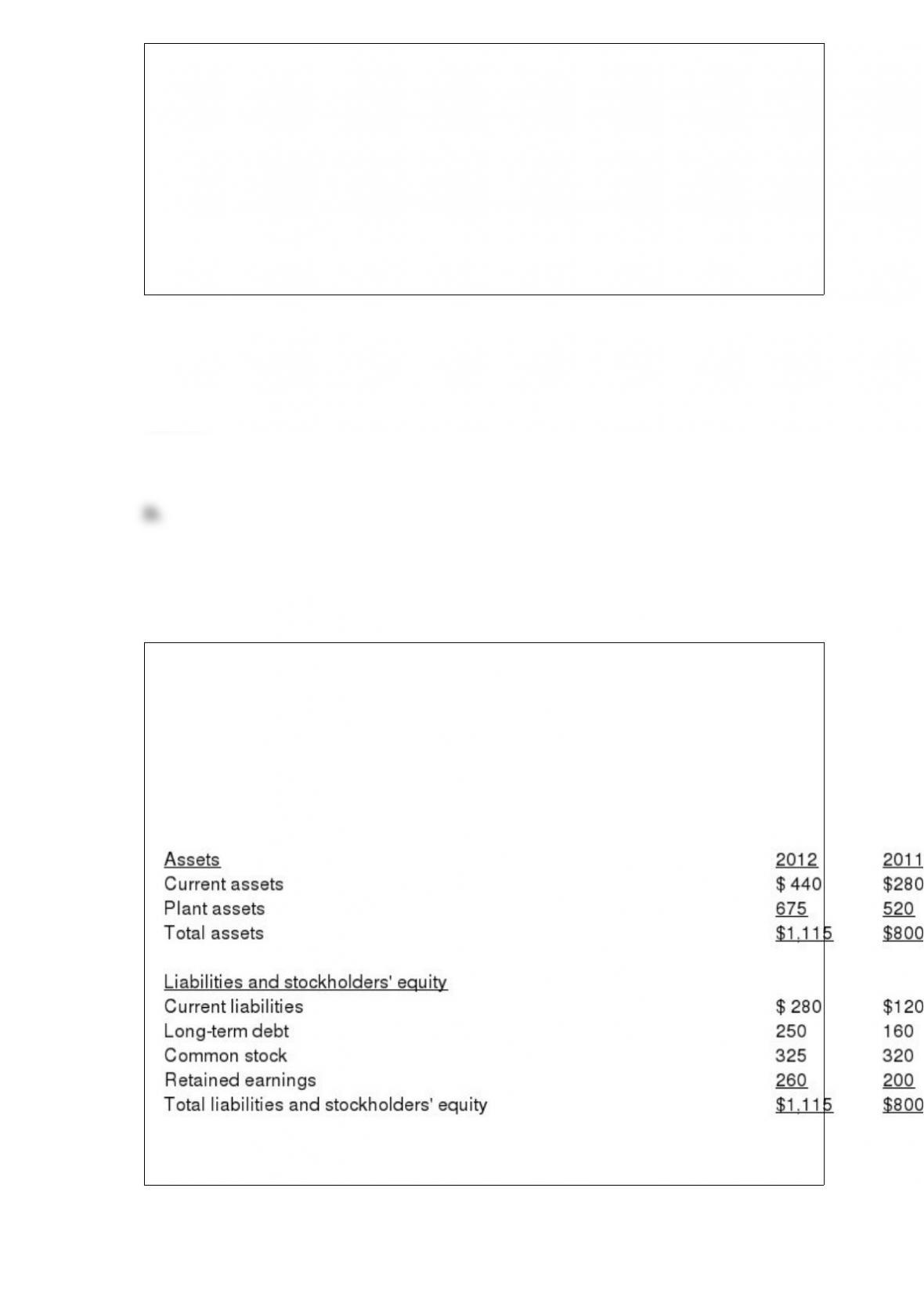
The balance sheets at the end of each of the first two years of operations indicate the
following:
If net income is $115,000 and interest expense is $30,000 for 2012, and the market
price is $30, What is the price-earnings ratio on common stock for 2012 (Round
intermediate calculation to two decimal place and final answers to one decimal place)?
A.16.9
B.12.1
C.14.4
D.13.3
Answer:
A company is contemplating investing in a new piece of manufacturing machinery. The
amount to be invested is $100,000. The present value of the future cash flows at the

company’s desired rate of return is $100,000. The IRR on the project is 12%. Which of
the following statements is true?
A.The project should not be accepted because the net present value is negative.
B.The desired rate of return used to calculate the present value of the future cash flows
is less than 12%.
C.The desired rate of return used to calculate the present value of the future cash flows
is more than 12%.
D.The desired rate of return used to calculate the present value of the future cash flows
is equal to 12%.
Answer:
Revenue should be recognized when
A.cash is received
B.the service is performed
C.the customer places an order
D.the supplier charges an order
Answer:
The cash and securities comprising a sinking fund established to redeem bonds at
maturity in 2015 should be classified on the balance sheet as
A.fixed assets
B.current assets
C.intangible assets
D.investments
Answer:
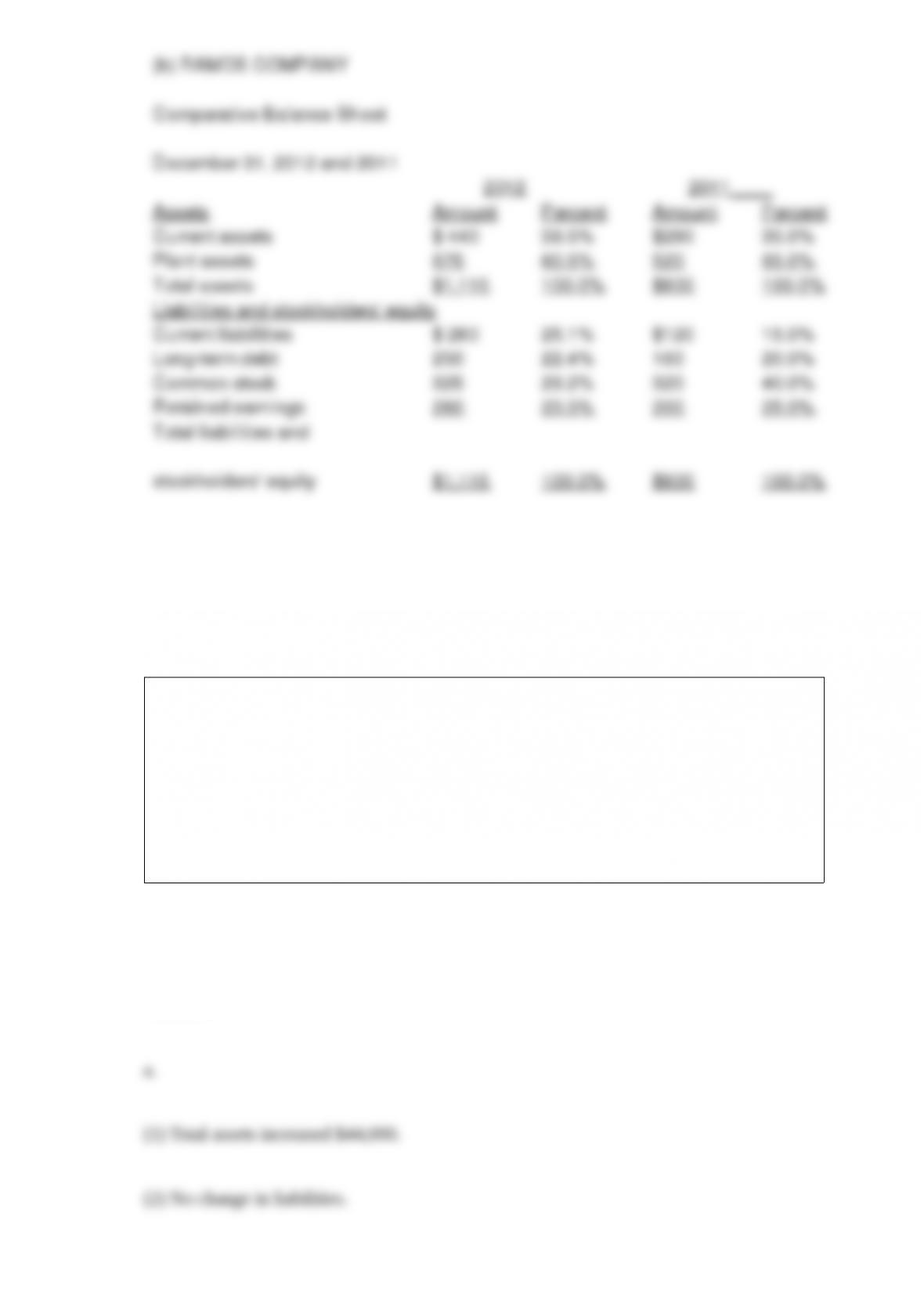
The comparative balance sheet of Ramos Company appears below:
(a) RAMOS COMPANY
Comparative Balance Sheet
December 31, 2012 and 2011
Instructions
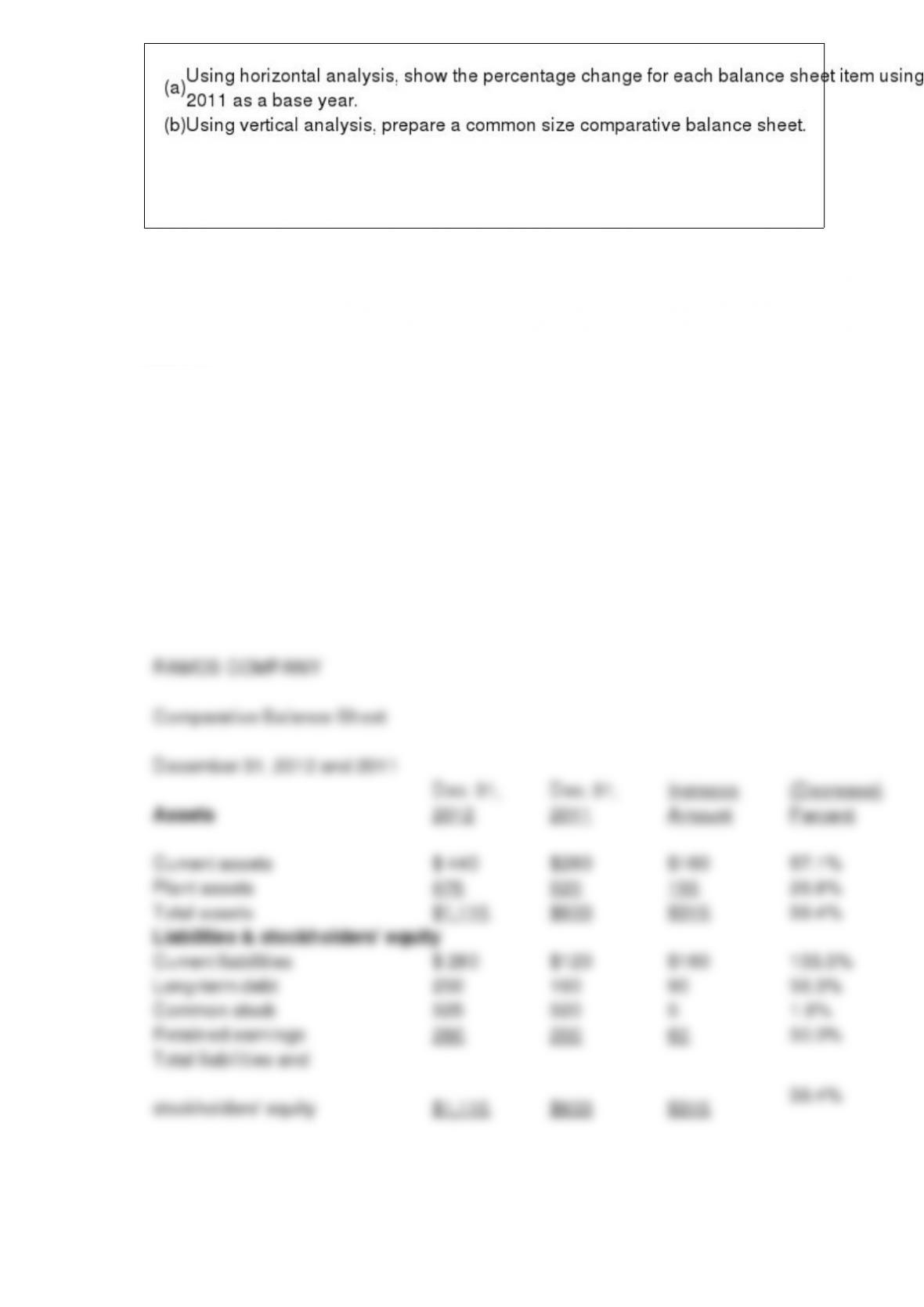
Round percentage to one decimal place.
Answer:
a. A vacant lot acquired for $83,000 cash is sold for $127,000 in cash. What is the effect
of the sale on the total amount of the seller’s (1) assets, (2) liabilities, and (3) owner’s
equity?
b. Assume that the seller owes $52,000 on a loan for the land. After receiving the
$127,000 cash in (a), the seller pays the $52,000 owed. What is the effect of the
payment on the total amount of the seller’s (1) assets, (2) liabilities, and (3) owner’s
equity?
Answer:

A factor in determining the rate of return on investment–the ratio of sales to invested
assets–is called:
A.profit margin
B.indirect margin
C.investment turnover
D.cost ratio
Answer:
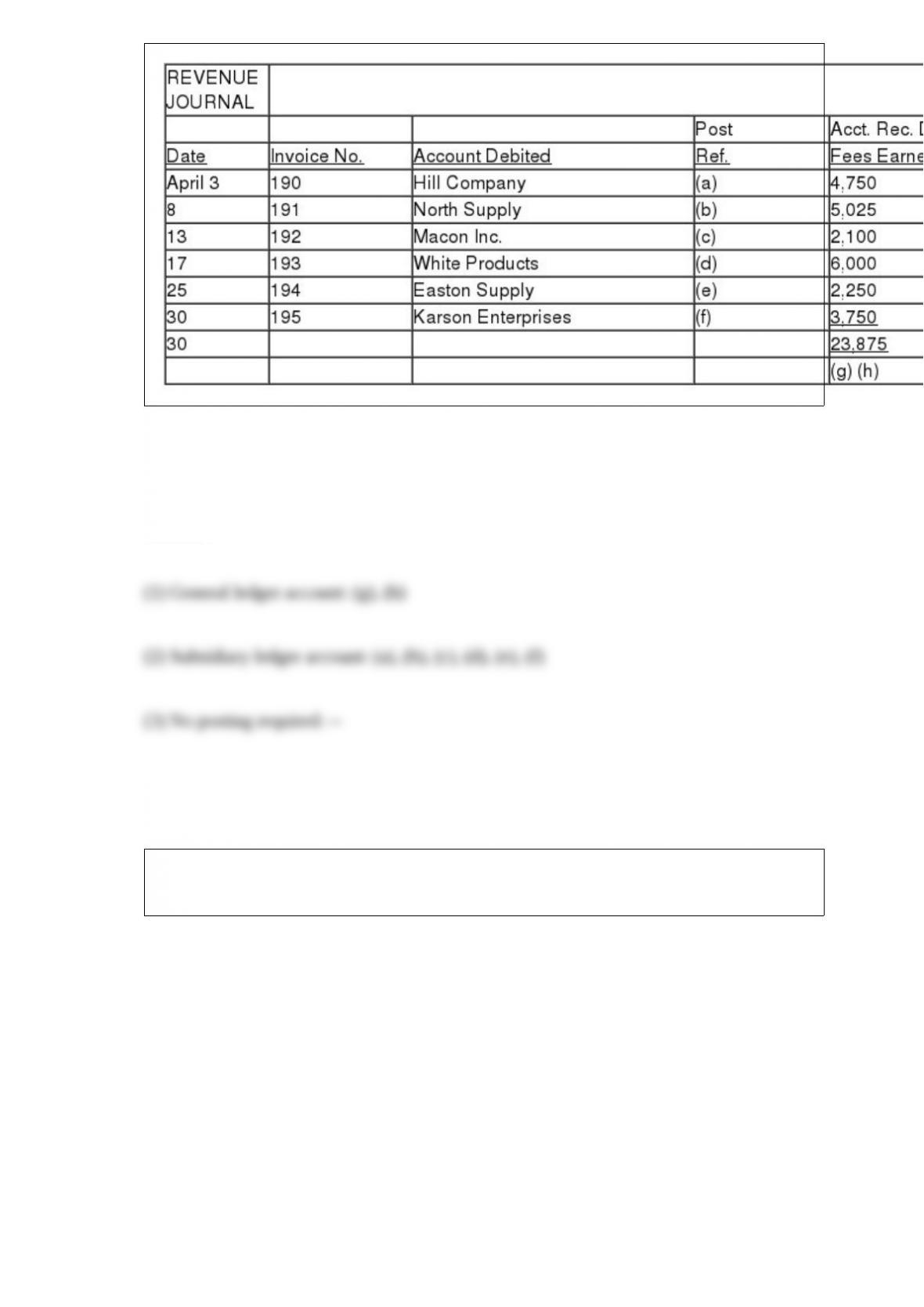
The posting references in the following revenue journal are indicated by letters. Identify
each posting reference [(a) through (h)] as representing (1) a posting to a general ledger
account, (2) a posting to a subsidiary ledger account, or (3) that no posting is required.
Answer:
Encore Consulting is completing the accounting information processing at the end of
the fiscal year, December 31, 2011. The following trial balances are available.
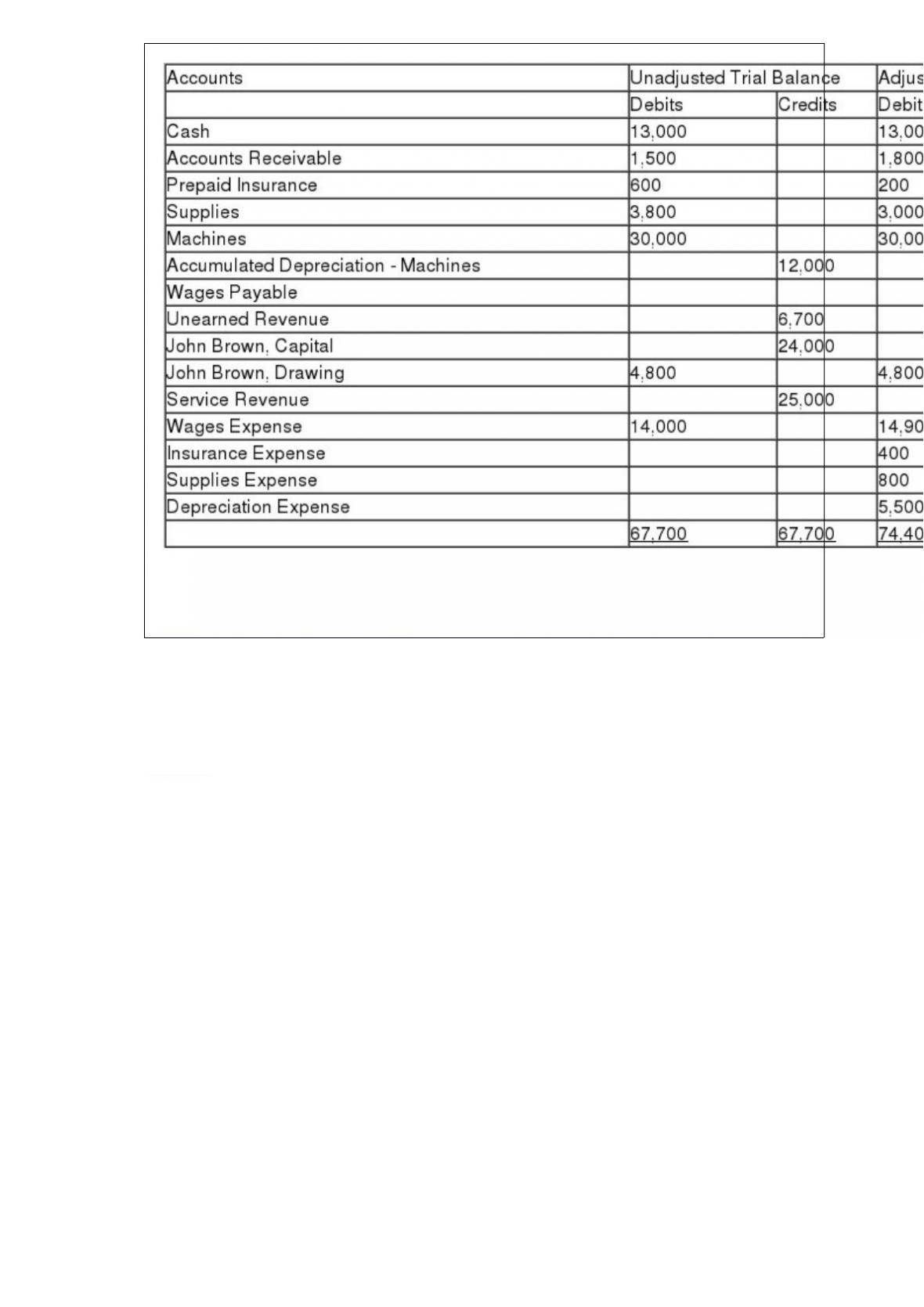
A. Reconstruct the adjusting entries and give a brief explanation of each.
B. What is the amount of net income?
Answer:
Income from operations for Division Z is $250,000, total service department charges
are $400,000 and operating expenses are $2,266,000. What are the revenues for
Division Z?
A.$650,000
B.$2,516,000
C.$2,916,000
D.$2,666,000
Answer:
Another term often used to refer to factory overhead is:
A.surplus
B.period cost
C.supervisory cost
D.factory burden
Answer:
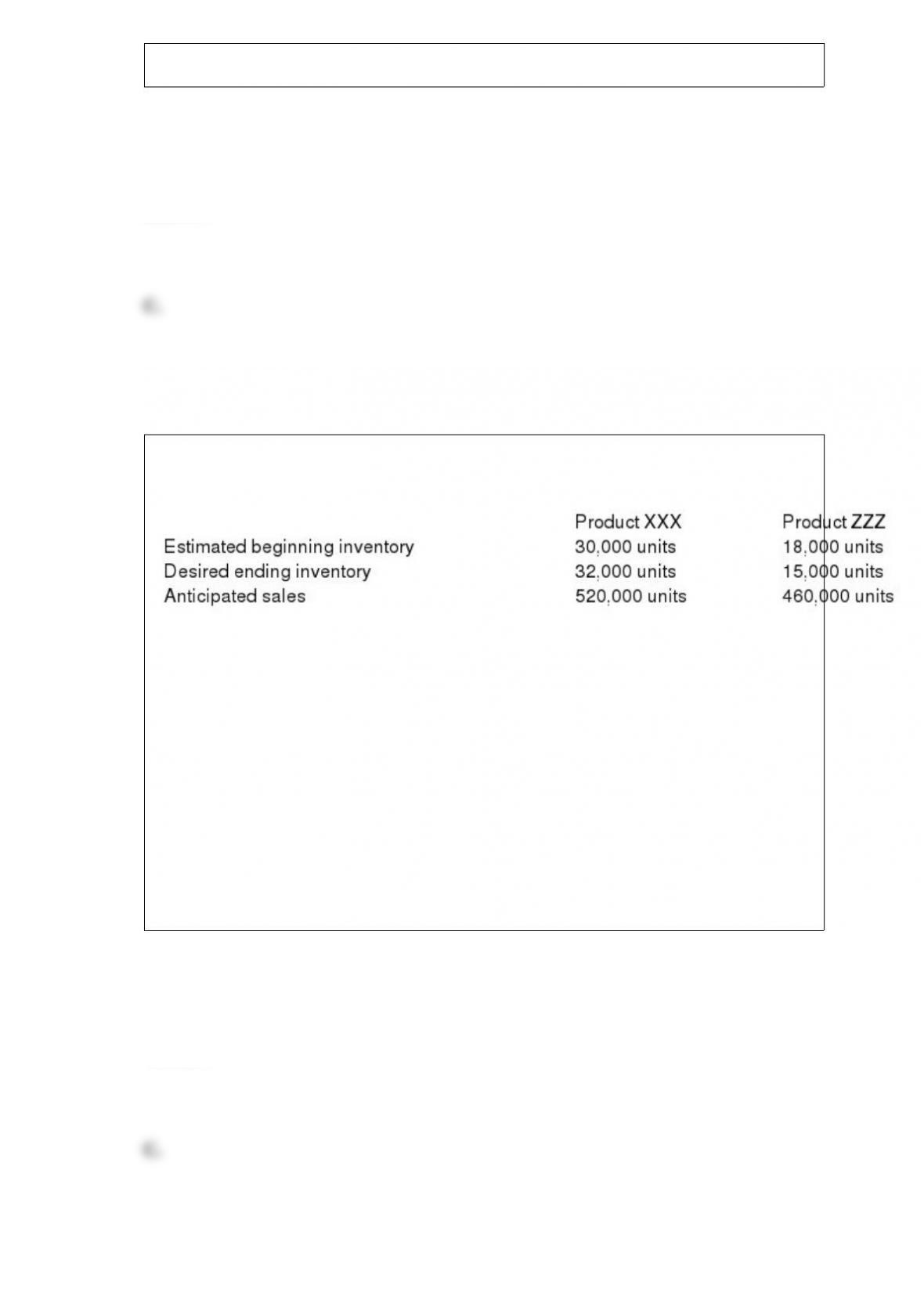
The rate of earnings is 10% and the cash to be received in three years is $10,000.
Determine the present value amount, using the following partial table of present value
of $1 at compound interest:
A.$13,316
B.$6,830
C.$7,510
D.$8,260
Answer:
Below is budgeted production and sales information for Bluebird Company for the
month of December:
The unit selling price for product XXX is $5 and for product ZZZ is $14.
Budgeted production for product ZZZ during the month is:
A.460,000 units
B.475,000 units
C.457,000 units
D.463,000 units
Answer:

Which of the following would not be found in a Schedule of Noncash Investing and
Financing Activities, reported at the end of a Statement of Cash Flows?
A.equipment acquired in exchange for a note payable
B.bonds payable exchanged for capital stock
C.purchase of treasury stock
D.capital stock issued to acquire fixed assets
Answer:
The net income reported on the income statement is $58,000. However, adjusting
entries have not been made at the end of the period for supplies expense of $2,200 and
accrued salaries of $1,300. Net income, as corrected, is
A.$56,700
B.$58,000
C.$55,800
D.$54,500
Answer:

The formula to compute direct labor time variance is to calculate the difference between
A.actual costs – standard costs
B.actual costs + standard costs
C.(actual hours * standard rate) – standard costs
D.actual costs – (actual hours * standard rate)
Answer:
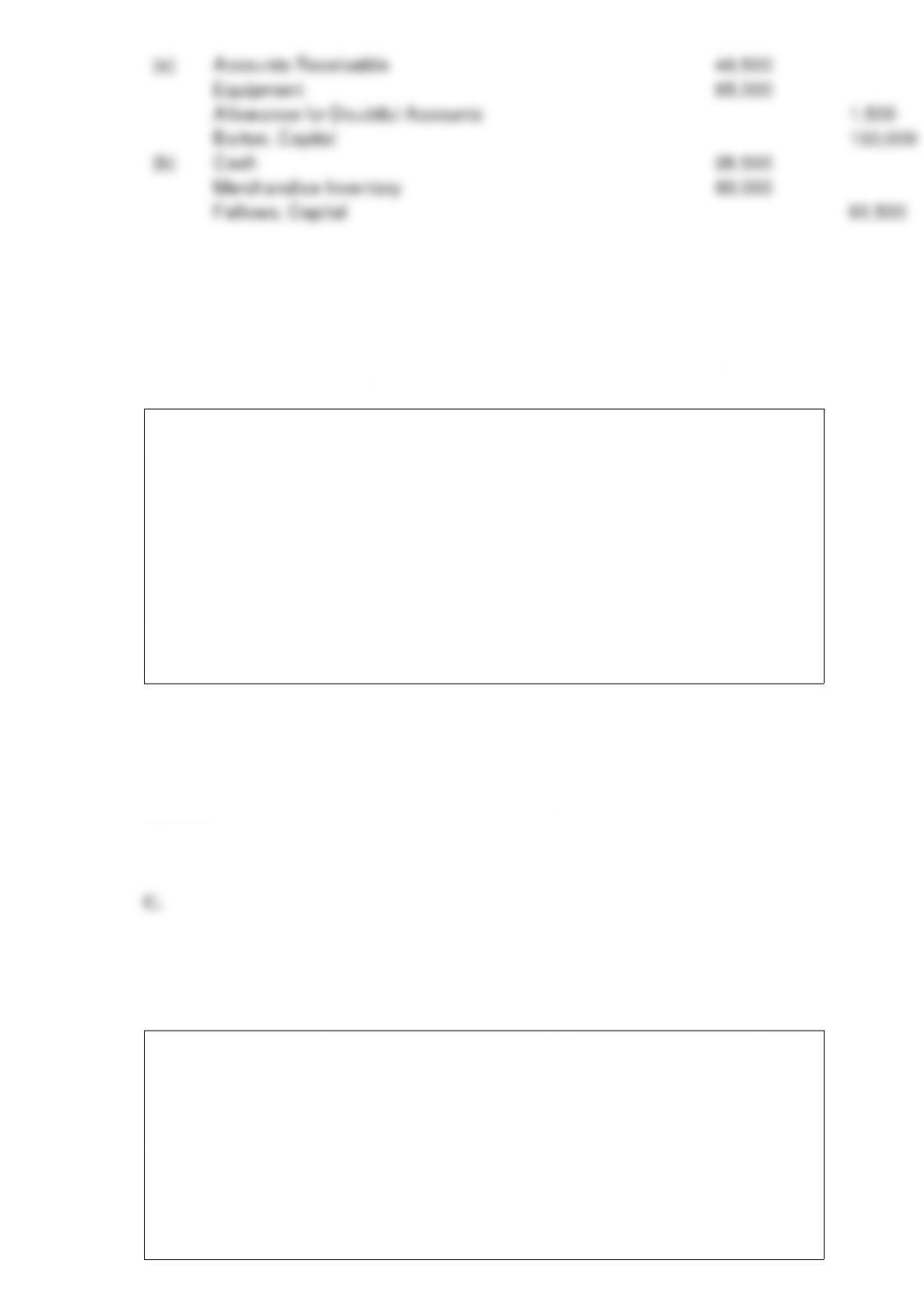
Barton and Fallows form a partnership by combining the assets of their separate
businesses. Barton contributes accounts receivable with a face amount of $50,000 and
equipment with a cost of $190,000 and accumulated depreciation of $100,000. The
partners agree that the equipment is to be priced at $85,000, that $3,500 of the accounts
receivable are completely worthless and are not to be accepted by the partnership, and
that $1,500 is a reasonable allowance for the uncollectibility of the remaining accounts
receivable. Fallows contributes cash of $28,500 and merchandise inventory of $55,500.
The partners agree that the merchandise inventory is to be priced at $60,000. Journalize
the entries to record in the partnership accounts (a) Barton’s investment and (b) Fallows’
investment.
Answer:
Dalton Company uses the allowance method to account for uncollectible receivables.
Dalton has determined that the Irish Company account is uncollectible. To write-off this
account, Dalton should debit
A.Bad Debt Expense and credit Accounts Receivable
B.Bad Debt Expense and credit Allowance for Doubtful Accounts
C.Allowance for Doubtful Accounts and credit Accounts Receivable
D.Accounts receivable and credit Allowance for Doubtful Accounts
Answer:
Nuthatch Corporation began its operations on September 1 of the current year.
Budgeted sales for the first three months of business are $260,000, $375,000, and
$400,000, respectively, for September, October, and November. The company expects
to sell 30% of its merchandise for cash. Of sales on account, 80% are expected to be
collected in the month of the sale and 20% in the month following the sale.
The cash collections in September from accounts receivable are:
A.$223,600

B.$145,600
C.$182,000
D.$168,000
Answer:
A fixed asset with a cost of $30,000 and accumulated depreciation of $28,500 is sold
for $3,500. What is the amount of the gain or loss on disposal of the fixed asset?
A.$2,000 loss
B.$1,500 loss
C.$3,500 gain
D.$2,000 gain
Answer:
The Cardinal Company had a finished goods inventory of 55,000 units on January 1. Its
projected sales for the next four months were: January – 200,000 units; February –
180,000 units; March – 210,000 units; and April – 230,000 units. The Cardinal Company
wishes to maintain a desired ending finished goods inventory of 20% of the following
months sales.
What should the budgeted production be for January?
A.236,000
B.181,000
C.200,000
D.219,000
Answer:
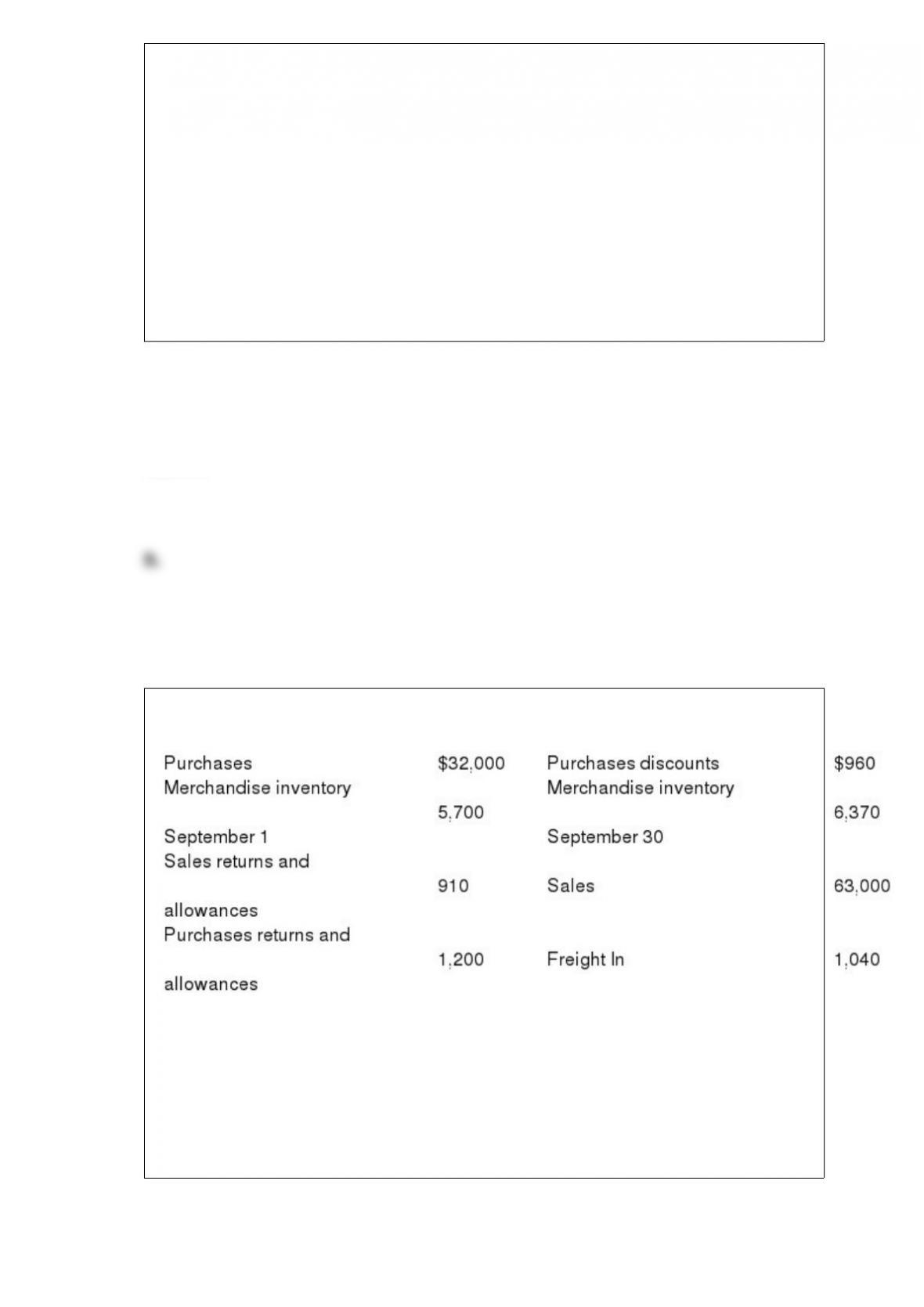
Using the following information, what is the amount of gross profit?
A.$34,870
B.$31,880
C.$27,460
D.$62,090

Answer:
The Dayton Corporation began the current year with a retained earnings balance of
$32,000. During the year, the company corrected an error made in the prior year, which
was a failure to record depreciation expense of $3,000 on equipment. Also, during the
current year, the company earned net income of $12,000 and declared cash dividends of
$7,000. Compute the year end retained earnings balance.
A.$34,000
B.$37,000
C.$41,000
D.$44,000
Answer:
Materials used by Square Yard Products Inc. in producing Division 3’s product are
currently purchased from outside suppliers at a cost of $5 per unit. However, the same
materials are available from Division 6. Division 6 has unused capacity and can
produce the materials needed by Division 3 at a variable cost of $3 per unit. A transfer
price of $3.20 per unit is established, and 40,000 units of material are transferred, with
no reduction in Division 6’s current sales.
How much would Division 3’s income from operations increase?
A.$150,000

B.$50,000
C.$32,000
D.$72,000
Answer:
What is the purpose of the Statement of Cost of Goods Manufactured?
A.to determine the ending materials inventory
B.to determine the ending work in process inventory
C.to determine the amounts transferred to finished goods
D.all of the answers are true
Answer:
The balance sheet of Morgan and Rockwell was as follows immediately prior to the
partnership’s being liquidated: cash, $20,000; other assets, $160,000; liabilities,
$40,000; Morgan capital, $60,000; Rockwell capital, $80,000. The other assets were
sold for $139,000. Morgan and Rockwell share profits and losses in a 2:1 ratio. As a
final cash distribution from the liquidation, Morgan will receive cash totaling

A.$46,000
B.$51,000
C.$60,000
D.$49,500
Answer: