1) For companies with a complex capital structure, a convertible security is potentially
dilutive if its incremental EPS is
a. greater than basic EPS after considering any stock options, rights, and warrants
b. less than basic EPS after considering any stock options, rights, and warrants
c. equal to basic EPS after considering any stock options, rights, and warrants
d. less than 1.00 after considering any stock options, rights, and warrants
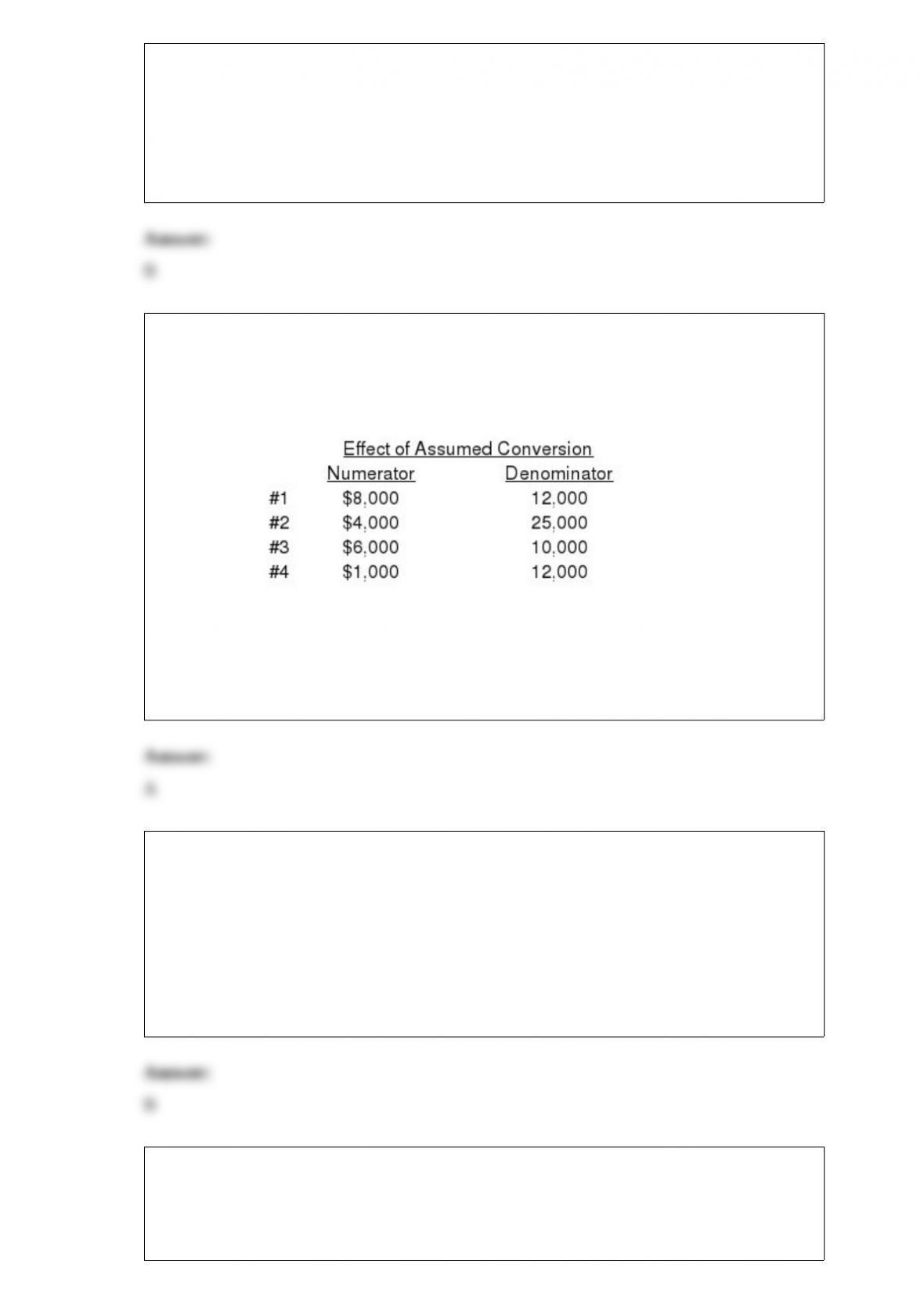
2) A company earned $20,000 in 2014 and had 20,000 shares of common stock
outstanding the entire year. The following four potentially dilutive securities were also
outstanding for the entire year. The numerator and denominator effects of the issues are
as indicated:
What is diluted EPS?
a. $0.49
b. $0.32
c. $1.00
d. $0.81
3) On December 31, 2014, Zulu Company’s current liabilities total $55,000 and
long-term liabilities total $155,000. Working capital at December 31, 2014, is equal to
$85,000. If Zulu Company’s debt-to-equity ratio is .30 to 1, total long-term assets must
equal
a. $910,000
b. $770,000
c. $700,000
d. $825,000
4) In order for a lease to be considered a finance (or capital) lease, international
accounting standards require that a lease agreement
a. transfers substantially all risks and rewards incident to ownership of an asset to the
lessee

b. contains a provision requiring transfer of title to the lessee by the end of the lease
term
c. provides that the term of the lease contract be longer than one year
d. provides for a bargain purchase option
5) Information needed to compute a depletion charge per unit includes the
a. estimated total amount of resources available for removal
b. amount of resources removed during the period
c. cumulative amount of resources removed
d. amount of resources sold during the period
6) An expenditure subsequent to acquisition of assembly-line manufacturing equipment
benefits future periods. The expenditure should be capitalized if it is a
Betterment Rearrangement
a. Yes Yes
b. Yes No
c. No Yes
d. No No
7) The result of interperiod income tax allocation is that
a. wide fluctuations in a company’s tax liability payments are eliminated
b. tax expense shown in the income statement is equal to the deferred taxes shown on
the balance sheet
c. tax liability shown in the balance sheet is equal to the deferred taxes shown on the
previous year’s balance sheet plus the income tax expense shown on the income
statement
d. tax expense shown on the income statement is equal to income taxes payable for the
current year plus or minus the change in the deferred tax asset or liability balances for
the year
8) Generally, recognition criteria are met and revenues are recognized
a. at the point of sale
b. when cause and effect are associated
c. at the point of cash collection
d. at appropriate points throughout the operating cycle
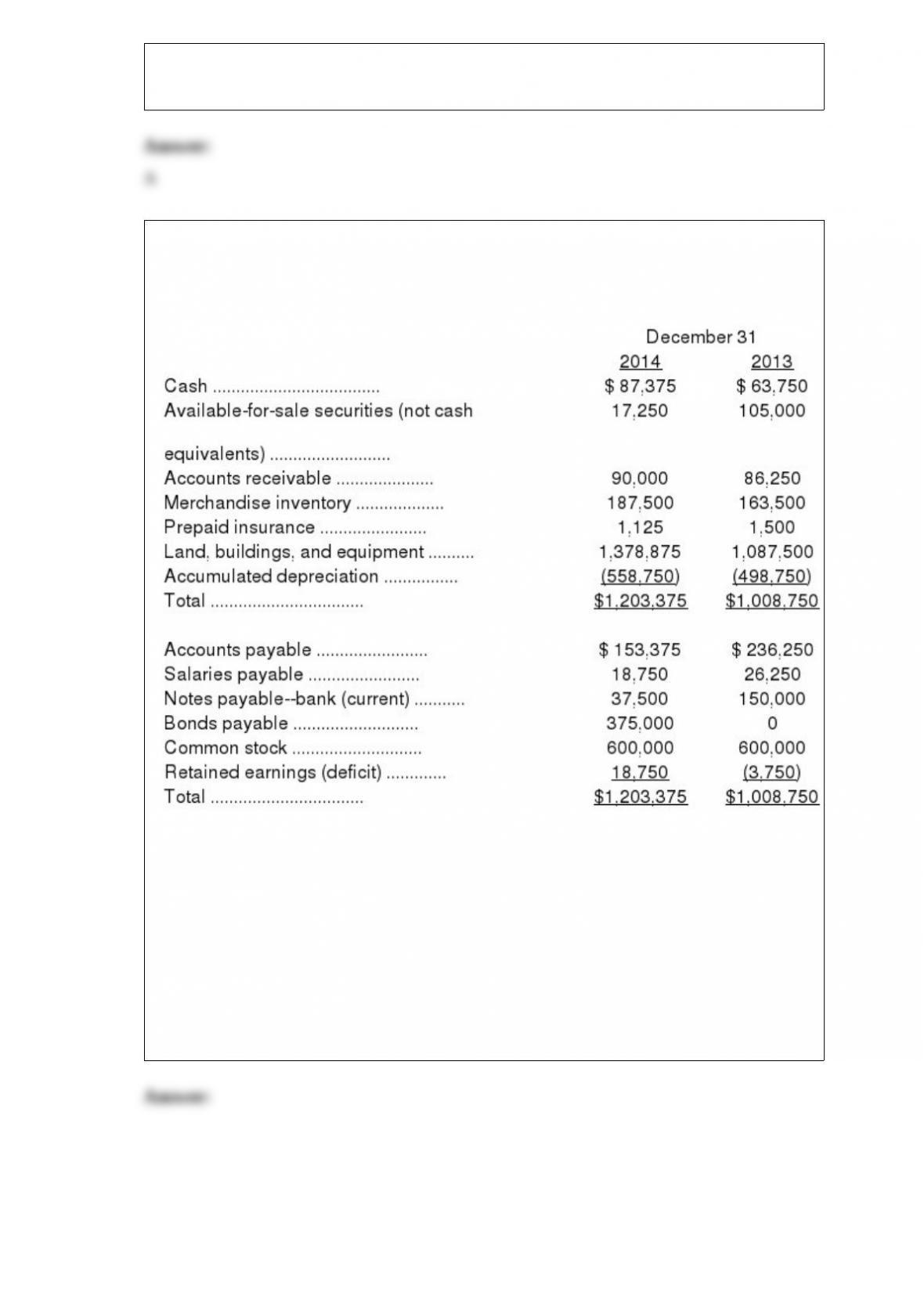
9) The Dakota Corporation prepared, for 2014 and 2013, the following balance sheet
data:
Additional information:
(a) Sold available-for-sale securities (not cash equivalents) costing $87,750 for $90,000.
(b) Equipment costing $18,750 with a book value of $3,750 was sold for $4,500.
(c) Issued 8% bonds payable at par, $375,000.
(d) Purchased new equipment for cash, $310,125.
(e) Paid cash dividends of $22,500 during the year.
(f) Net income for 2014 was $45,000.
(g) Proceeds from the notes payable were used for operating purposes.
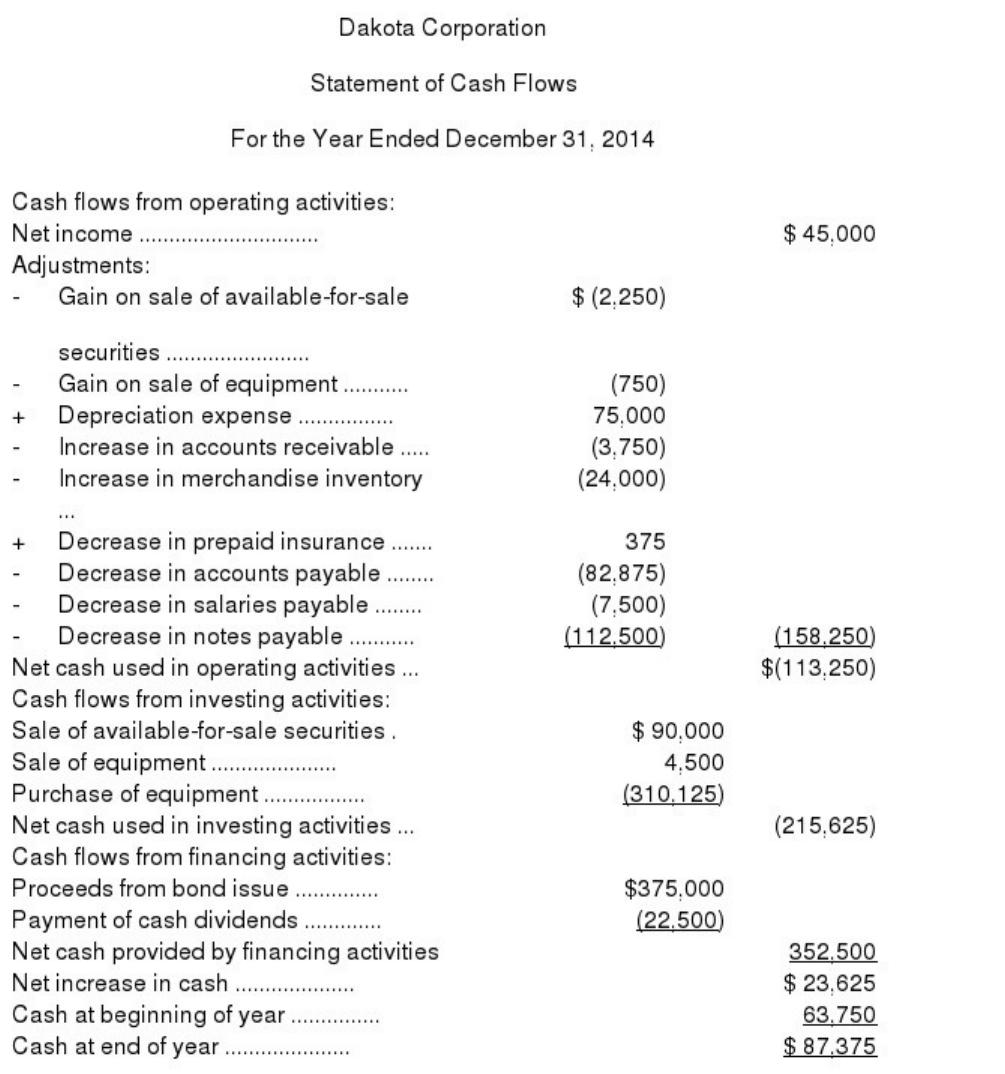
Prepare a cash flow statement for Dakota Corporation for 2014, using the indirect
method. Calculate the Cash Flow to Net Income and the Cash Flow Adequacy ratios.

10) If a $1,000, 9 percent, 10-year bond was issued at 103 plus accrued interest one
month after the authorization date, how much cash did the issuer receive?
a. $1,037.50
b. $1,030.00
c. $1,007.50
d. $992.50
11) The Chisholm Company purchased a machine on November 1, 2005, for $148,000.
At the time of acquisition, the machine was estimated to have a useful life of ten years
and an estimated salvage value of $4,000. Chisholm has recorded monthly depreciation
using the straight-line method. On July 1, 2014, the machine was sold for $13,000.
What should be the loss recognized from the sale of the machine?
a. $4,000
b. $5,000
c. $10,200
d. $13,000
12) Which of the following would be an example of an investing activity?
a. Issuance of long-term bonds
b. Issuance of common stock
c. Payment of cash dividends
d. Sale of plant assets
13) Which of the following does NOT represent a change in reporting entity?
a. Changing the companies included in combined financial statements
b. Disposition of a subsidiary or other business unit
c. Presenting consolidated statements in place of the statements of individual companies
d. Changing specific subsidiaries that constitute the group of companies for which
consolidated financial statements are presented
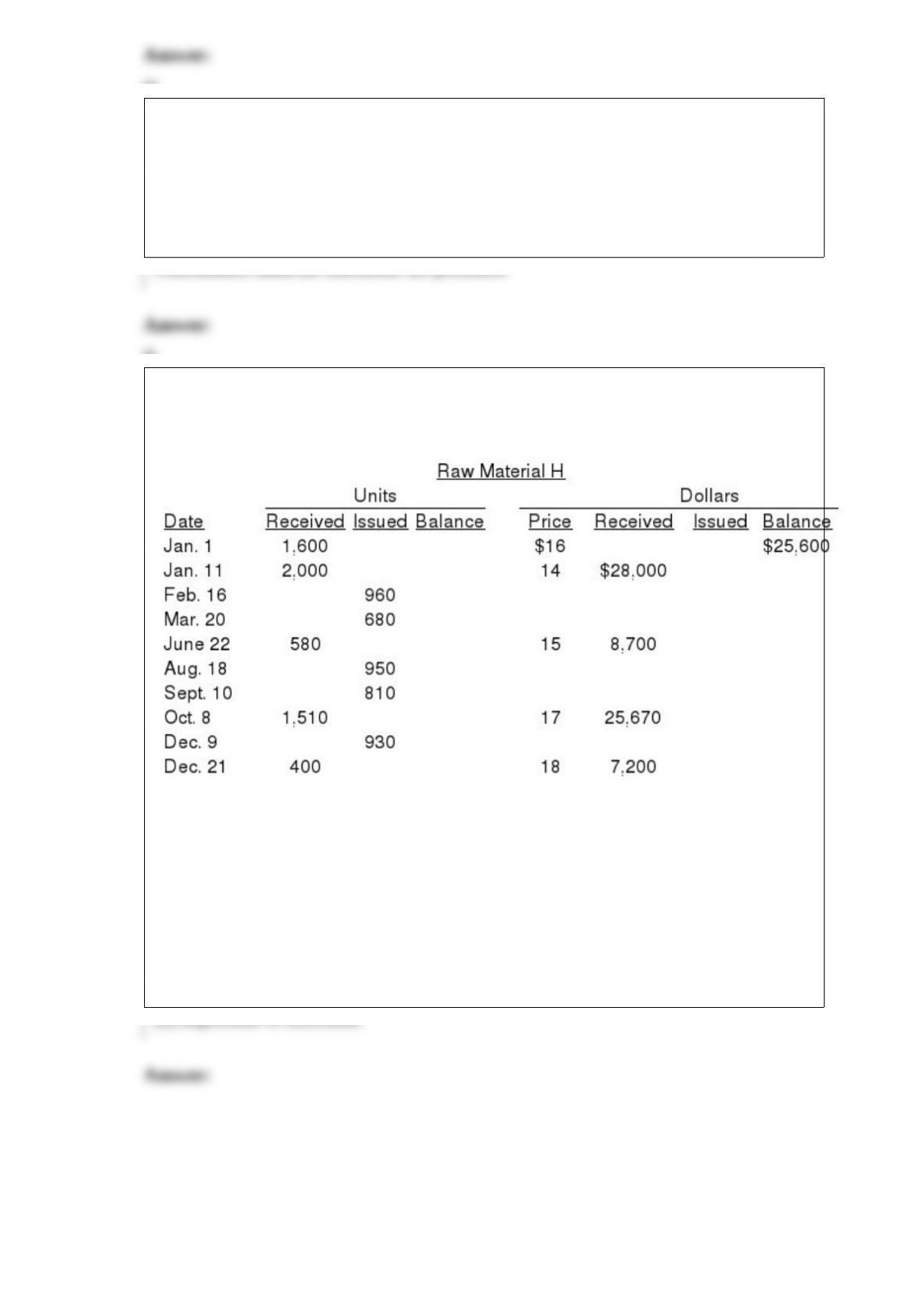
14) The data below relate to Raw Material H, which is stocked by Mason Inc. in its
warehousing operation:
From these data, provide answers for the following [show computations for (1)]:
(1) Assuming a perpetual inventory system is used, compute the ending inventory under
(a) FIFO and (b) LIFO.
(2) If a perpetual inventory of Raw Material H is kept on a moving average basis, the
ending inventory will be:
(a) lower than the LIFO basis.
(b) higher than the FIFO basis.
(c) lower than the FIFO basis.
(d) impossible to determine.

15) Which of the following does NOT meet the FASB’s definition of a liability?
a. The signing of a three-year employment contract at a fixed annual salary
b. An obligation to provide goods or services in the future
c. A note payable with no specified maturity date
d. An obligation that is estimated in amount
16) Proceeds from the sale of investments in common stock accounted for by the equity
method would be classified into which of the following sections of the statement of
cash flows?
a. Operating
b. Investing
c. Financing
d. Non-cash item
17) FASB ASC Topic 715 requires that the notes accompanying the financial statements
include a schedule reconciling the
a. funded status of the plan with amounts reported in the balance sheet
b. current period employer contributions with pension expense reported in the income
statement
c. projected benefit obligation and the accumulated benefit obligation
d. actual return on plan assets with the expected return

18) Using the information above, the call option would be recorded in the accounts of
Allman as
a. an asset
b. a liability
c. a gain
d. would not be recorded in the accounts (memorandum entry only)
19) When bonds are redeemed by the issuer prior to their maturity date, any gain or loss
on the redemption, if material, is
a. amortized over the period remaining to maturity and reported as an extraordinary
item in the income statement
b. amortized over the period remaining to maturity and reported as part of income from
continuing operations in the income statement
c. reported in the income statement as an extraordinary item in the period of redemption
d. reported in the income statement as part of income from continuing operations in the
period of redemption
20) What is the correct ordering (ranking) of the dilutive issues for determining their
inclusion into diluted earnings per share?
a. 1, 2, 3
b. 3, 1, 2
c. 3, 2, 1
d. 2, 1, 3

21) A truck owned and operated by Mingus Company was involved in an accident with
an auto driven by S. Nara on January 12, 2014. Mingus received notice on April 24,
2014, of a lawsuit for $800,000 damages for a personal injury suffered by S. Nara.
Minguss counsel believes it is probable that S. Nara will be successful against the
company for an estimated amount in the range between $100,000 and $400,000. No
amount within this range is a better estimate of potential damages than any other
amount. It is expected that the lawsuit will be adjudicated in the latter part of 2015.
What amount of loss should Mingus accrue at December 31, 2014?
a. $400,000
b. $250,000
c. $100,000
d. $800,000
22) Which of the following concepts for postretirement benefit plans is comparable to
the projected benefit obligation (PBO) of pension plans?
a. Accumulated Postretirement Benefit Obligation (APBO)
b. Expected Postretirement Benefit Obligation (EPBO)
c. Actual return on plan assets
d. Expected return on plan assets
23) Choose the combination that best reflects the appropriate classification of cash paid
for investing and financing activities.
Cash Paid for Cash Paid for
Investing Activities Financing Activities
a. Treasury stock Operational assets
b. Treasury stock Dividends
c. Operational assets Investment securities
d. Investment securities Dividends
24) A variable interest in a variable interest entity (VIE) may arise from all of the
following except
a. management contracts
b. service contracts
c. leases

d. defined-benefit pension plans
25) What is the effect of the collection of accounts receivable on the current ratio and
net working capital, respectively?
Current Ratio Net Working Capital
a. No effect No effect
b. Increase Increase
c. Increase No effect
d. No effect Increase
26) How should these stock rights be treated in the earnings per share calculation for
the year ending December 31, 2013?
a. The stock options are antidilutive and should not be included either in basic or diluted
earnings per share
b. The stock options are dilutive and should be included in diluted earnings per share in
the amount of 77 shares
c. The stock options are dilutive and should be included in diluted earnings per share in
the amount of 2,000 shares
d. The stock options are dilutive and should be included in diluted earnings per share in
the amount of 333 shares
27) The amortization of a bond premium can correctly be presented in the statement of
cash flows in which of the following ways?
a. A positive adjustment to net income in determining cash flows from operating
activities
b. A use of cash in determining cash flows from investing activities
c. A source of cash in determining cash flows from financing activities
d. A negative adjustment to net income in determining cash flows from operating
activities
28) Which of the following best describes the approach prescribed in IAS 38, Intangible
Assets?
a. Expense all research and development costs

b. Capitalize all research and development costs
c. Expense all research costs and capitalize all development costs
d. Capitalize all research costs and expense all development costs
29) On January 1, 2014, O’neil, Inc. signed a noncancelable lease for a silver polishing
machine. The machine has an estimated useful life of nine years. The term of the lease
is a six-year term with title passing to O’neil at the end of the lease. The agreement
called for annual payments of $40,000 starting at the end of the first year. Assume
aggregate lease payments were determined to have a present value of $200,000, based
on implicit interest of 12 percent. What amount of interest expense should O’neil report
in its 2014 income statement from this lease transaction?
a. $0
b. $16,000
c. $24,000
d. $33,333
30) Total sales for a year are $40,000, which includes cash sales of $5,000. The
beginning and ending balances of accounts receivable are $10,000 and $15,000,
respectively. How much cash was received from customers?
a. $30,000
b. $20,000
c. $25,000
d. $35,000
31) On July 1, Toucan Corporation, a calendar-year company, received a condemnation
award of $150,000 as compensation for the forced sale of a plant located on company
property that stood in the path of a new highway. On this date, the plant building had a
depreciated cost of $75,000 and the land cost was $25,000. On October 1, Toucan
purchased a parcel of land for a new plant site at a cost of $62,500. Ignoring income
taxes, Toucan should report in its income statement for the year ended December 31 a
gain of
a. $0
b. $12,500
c. $37,500
d. $50,000

32) Conservatism is best described as selecting an accounting alternative that
a. understates assets and/or net income
b. has the least favorable impact on owners’ equity
c. overstates, as opposed to understates, liabilities
d. is least likely to mislead users of financial information
33) Which of the following is issued to shareholders by a corporation as evidence of the
ownership of rights to acquire its unissued or treasury stock?
a. Stock options
b. Stock rights
c. Stock dividends
d. Stock subscriptions
34) A company loaned $6,000 to another corporation on December 1, Year 1, and
received a 90-day, 10 percent, interest-bearing note with a face value of $6,000. The
lenders December 31, Year 1, adjusting entry is
a. Interest Receivable $150 Interest Revenue $150
b. Interest Receivable $ 50 Interest Revenue $ 50
c. Interest Revenue $100 Interest Receivable $100
d. Interest Revenue $150 Interest Receivable $150
35) Lease X does not contain a bargain purchase option, but the lease term is equal to
90 percent of the estimated economic life of the leased property. Lease Y does not
transfer ownership of the property to the lessee by the end of the lease term, but the
lease term is equal to 75 percent of the estimated economic life of the leased property.
How should the lessee classify these leases?
Lease X Lease Y
a. Capital lease Operating lease
b. Capital lease Capital lease
c. Operating lease Capital lease
d. Operating lease Operating lease
36) A decrease in accounts receivable should be presented in a statement of cash flows
(indirect method) as
a. an inflow and outflow of cash
b. an outflow of cash
c. a deduction from net income
d. an addition to net income
37) Which of the following statements is correct?
a. Retained earnings are translated at the average exchange rate for the year
b. Capital stock of a foreign subsidiary is translated at the historical rate, that is, the rate
prevailing on the date the subsidiary was acquired
c. Dividends are translated at the average exchange rate for the year
d. Assets and liabilities are translated at the historical rate prevailing when the
subsidiary was acquired
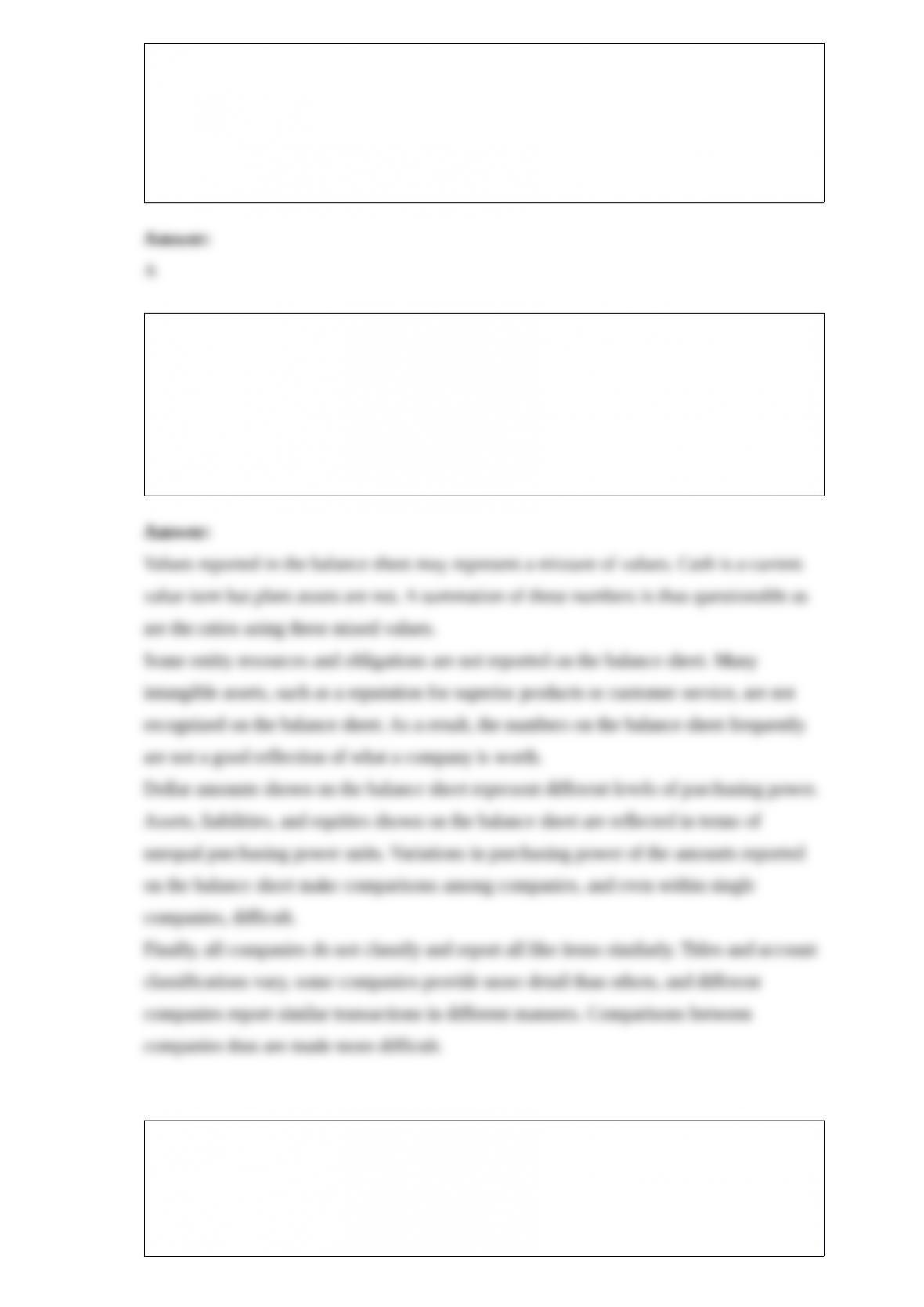
38) Silken Corp. reported net income of $420,000 for 2014. Changes occurred in
several balance sheet accounts as follows:
Additional information:
In Silkens 2014 statement of cash flows, net cash used in investing activities should be
a. $30,800
b. $16,800
c. $2,800
d. $49,000
39) Which of the following is NOT acceptable in estimating uncollectible accounts
receivable under GAAP?
a. The estimate of uncollectible accounts is based on a percentage of sales for the period
b. The estimate of uncollectible accounts is based on a percentage of the accounts
receivable balance at the end of a period
c. The estimate of uncollectible accounts is based on an aging schedule
d. No estimate of uncollectible accounts is made; accounts are written off when it is
determined they cannot be collected
40) The balance sheet provides information concerning liquidity, financial flexibility,
and information for calculating various financial ratios. The balance sheet serves as a
major indicator of an enterprise’s ability to survive. Nevertheless, the analysis of the
balance sheet should be approached with a clear understanding of the limitations of the
statement.
What are the major limitations of the balance sheet that should be recognized in
analyzing the statement?
41) Bill Hopen is the president of the Eastern Sutton Railroad Company. The Eastern
Sutton is a bridge line that receives traffic from the Union Pacific Railroad and the
Burlington Northern railroads at Charleston, West Virginia, and hauls the freight to
Denver, Colorado, for connections with other lines to points east. Recently, traffic on
the Eastern Sutton has increased dramatically and the railroad is in need of additional
locomotives to haul its trains. Accordingly, Bill is considering leasing locomotives to
meet the demands of this increase in traffic until new engines can be ordered if the
surge subsides. As the controller of the railroad, Bill has asked you to advise him as to
the disadvantages associated with leasing generally.
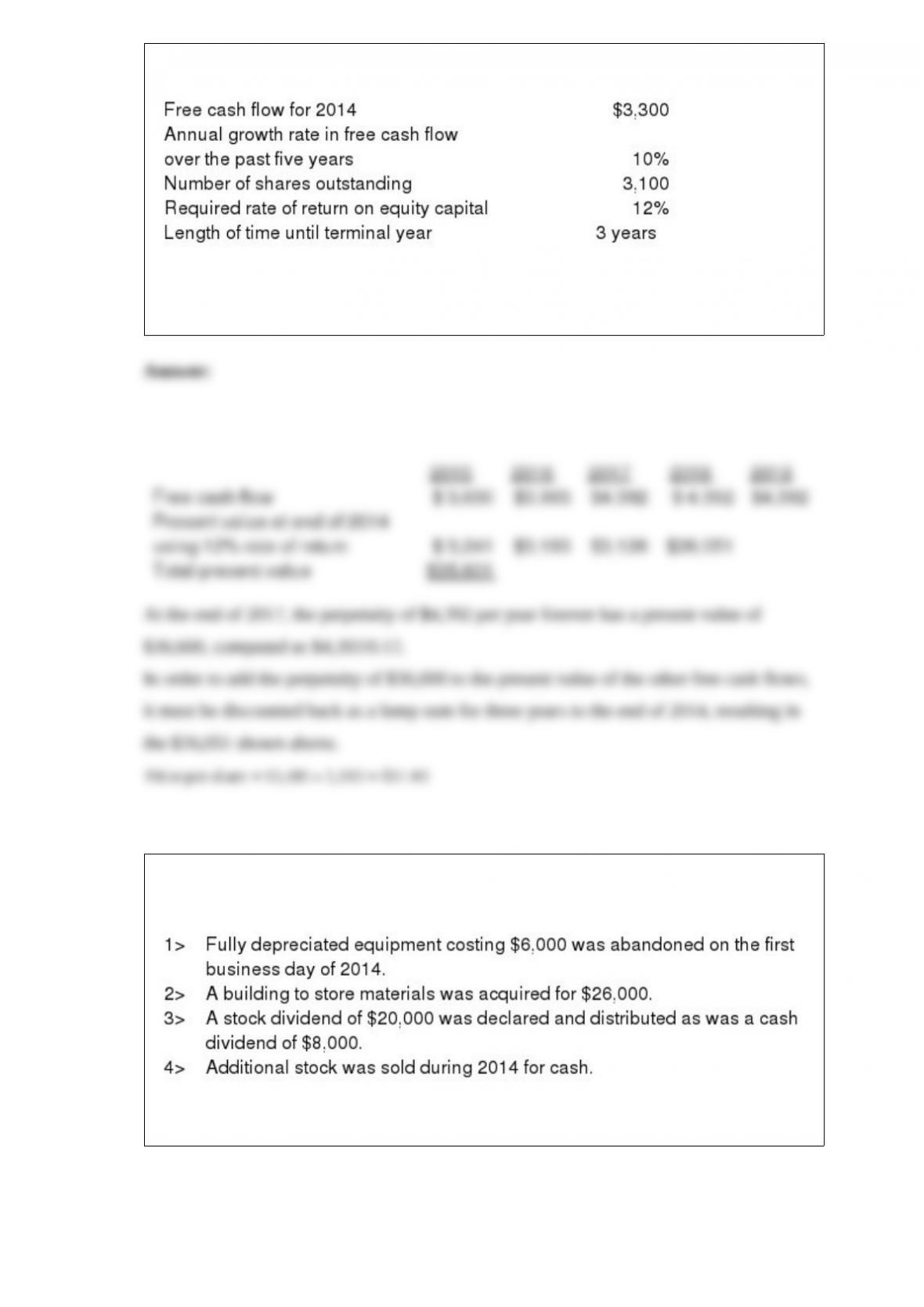
42) The following information has been collected for Lloyd Turnbull Company:
Required:
Estimate the price per share for Lloyd Turnbulls common stock using the discounted
free cash flow model.
43) See information regarding Delilah, Inc. above. The following additional
information is provided:
Required:
Compute the following:

44) A large body of scholarly literature exists relating to the subject of choices of
accounting methods. The choice of depreciation methods is an example of these
accounting choices. The choice of depreciation method affects several ratios.
Required: