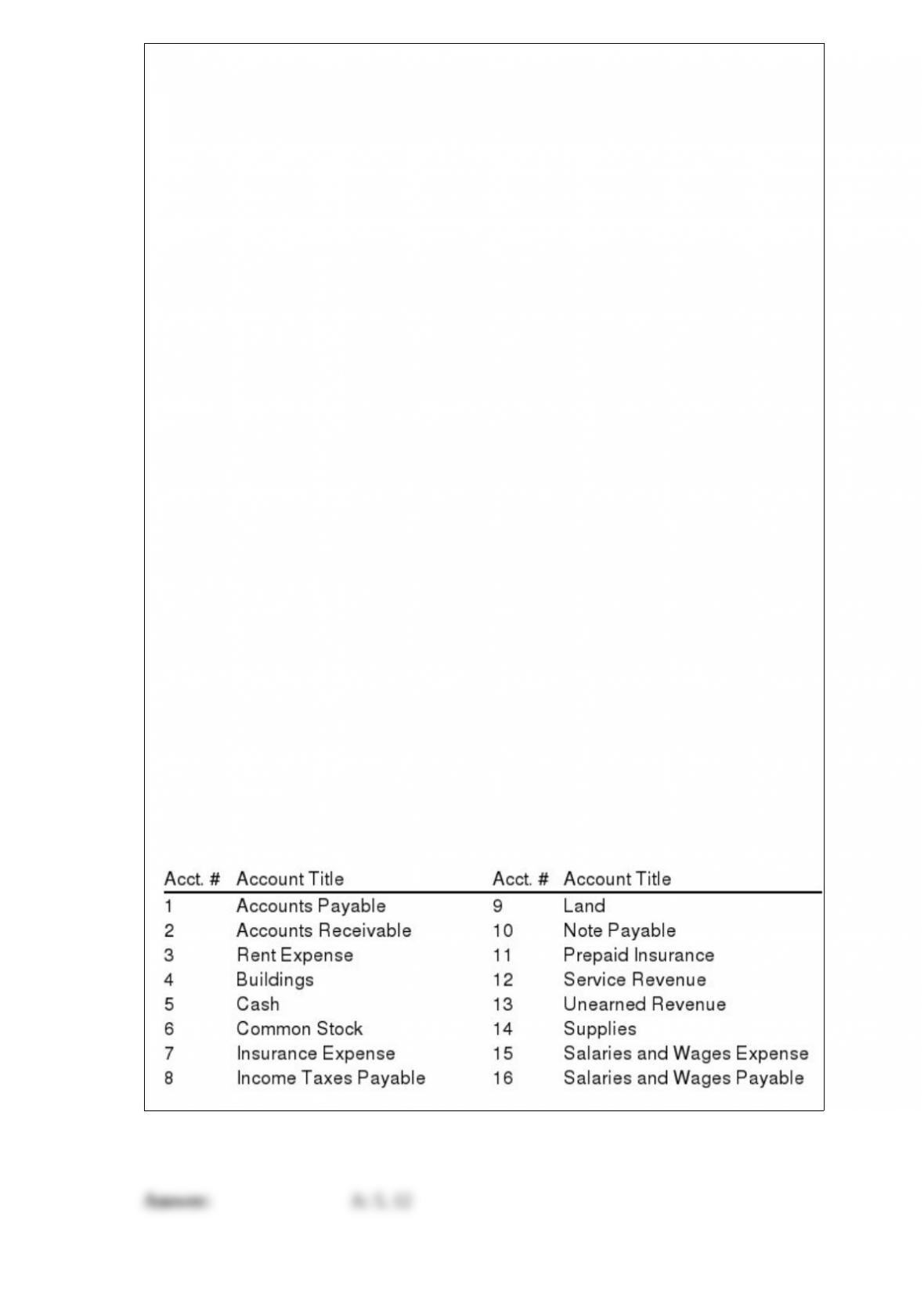
Sprinkler Blowout Company entered into the activities listed in the table below. The
company’s chart of accounts appears below the list of activities.
For each activity, decide whether a transaction has occurred, and, if so, indicate the
account(s) that should be debited and the account(s) that should be credited in the
related journal entry by entering the appropriate account number(s) in the “Debit” and
“Credit” columns in the table. If the activity is not a transaction, enter the word “None“
in the “Debit” column for that activity.
The account numbers to be used in the journal entry prepared for the first transaction
are provided as an example.
Activity Debit Credit
Example: Collected cash from customers paying off their accounts. 5 2
A. Performed services for customers this month for cash.
B. Purchased supplies on credit.
C. Purchased a building, paying part cash and signing a note for the rest.
D. Paid insurance premium for six months of coverage beginning next month.
E. Accepted customer orders for services to be performed next month; no cash
collected.
F. Made payment to suppliers on account.
G. Collected from customers for work to be performed next month.
H. Hired an employee.
I. Paid this month’s rent.
Closing journal entries:
A) transfer revenues and expenses to Retained Earnings.
B) transfer assets and liabilities to Retained Earnings.
C) transfer net income (or loss) and Dividends to Retained Earnings.
D) close permanent and temporary accounts.
A company issues $20 million in new stock. It later uses the cash received to pay off
promissory notes. What accounts are affected by these two transactions?
A) Common Stock, Cash, and Notes Payable.
B) Common Stock, Cash, Investments, and Notes Payable.
C) Cash, Common Stock, and Accounts Payable.
D) Common Stock, Investments, and Notes Payable.
Which of the following would not be affected by the choice of an inventory costing
method (that is, choosing between FIFO, LIFO, weighted average, and specific
identification)?
A) Sales revenue
B) Cost of goods sold
C) Gross profit
D) Net income
Which of the following is correct about reissuing treasury stock?
A) If treasury stock is sold at a higher price than the stock’s cost when the company
reacquired it, a gain will be recognized.
B) If treasury stock is sold at a higher price than the stock’s par value, a gain will be
recognized.
C) If the treasury stock is sold at a lower price than the amount of the original issuance,
a loss will be recognized.
D) A gain or loss on the reissuance of treasury stock is never recognized.
A trucking company sold its fleet of trucks for $55,000. The trucks originally cost
$1,410,000 and had Accumulated Depreciation of $1,269,000 recorded through the date
of disposal. What gain or loss did the trucking company record when it sold the fleet of
trucks?
A) Gain of $86,000
B) Gain of $55,000
C) Loss of $55,000
D) Loss of $86,000

Match the term and its definition. There are more definitions than terms.
Terms
____ 1> Net Realizable Value
____ 2> Percentage of Credit Sales Method
____ 3> Allowance for Doubtful Accounts
____ 4> Principal
____ 5> Write-Off
____ 6> Aging of Accounts Receivable
____ 7> Credit Terms
____ 8> Factoring
Definitions
A. How much money you can expect to earn over a period of time selling your goods.
B. The length of the credit period and any discounts offered for prompt payment.
C. A method of estimating uncollectible debts by forecasting the probability of not
collecting late accounts.
D. Selling accounts receivable to another company for immediate cash.
E. The account in which the estimated amount of accounts receivable expected to be
uncollectible is recorded.
F. Also known as net accounts receivable.
G. A method of estimating uncollectible debts by looking at the historical average of

credit sales not collected.
H. The amount of money lent.
I. Credit that a company receives when one good is exchanged for another.
J. The interest earned by money over a period of time.
K. When a company increases the amount of accounts receivable by adding the interest
earned as accounts age without being collected.
L. The process of removing specific customers’ accounts deemed uncollectible.
Daley Company uses the allowance method. At December 31, 2015, the company’s
balance sheet reports Accounts Receivable, Net in the amount of $17,000. On January
2, 2016, Daley writes off a $1,500 customer account balance when it becomes clear that
the customer will never pay. What is the amount of Accounts Receivable, Net after the
write-off?
A) $17,000
B) $1,500
C) $18,500
D) $15,500
Each account is assigned a number; this listing of all accounts is called a:
A) trial balance.
B) journal.
C) ledger.
D) chart of accounts.
Which of the following statements about inventory classifications is not correct?
A) Inventory may include materials used in producing goods for sale.
B) Manufacturers hold three types of inventory that are referred to as raw materials
inventory, work in process inventory, and finished goods inventory.
C) Inventory is classified as a long-term asset on the balance sheet.
D) Merchandisers buy inventory in finished form ready for resale.
Earnings per share (EPS) can be affected by all of the following except:
A) how the company chose to finance its operations.
B) the method of depreciation.
C) the inventory costing method.
D) classification of debt as current or long-term.
Typical cash flows from investing activities include:
A) payments to purchase property and equipment.
B) repayment of loans.
C) proceeds from issuing notes payable.
D) receipts from cash sales.
Which of the following statements about adjusting entries is not correct?
A) Adjustments are needed to ensure that the accounting system includes all of the
revenues and expenses of the period.
B) Adjustments help to ensure the related accounts on the balance sheet and income
statement are up to date and complete.
C) Adjusting entries often affect the cash account.
D) Adjusting entries generally include one balance sheet and one income statement
account.
Axle Inc. updates its inventory perpetually. Its beginning inventory is $35,000, goods
purchased during the period cost $120,000, and the cost of goods sold for the period is
$140,000. What is the amount of the ending inventory?
A) $45,000
B) $20,000
C) $25,000
D) $15,000
A stock dividend transfers:
A) contributed capital to Retained Earnings.
B) Retained Earnings to assets.
C) contributed capital to assets.
D) Retained Earnings to contributed capital.