
Identifying activities performed in the organization is the first step in developing
activity-based product costs. Which of the following is a way to identify these
activities?
a. Asking employees what they do
b. Analyzing industry averages
c. Both asking employees what they do and analyzing industry averages.
d. Neither asking employees what they do nor analyzing industry averages.
Costs a company incurs that are not product costs are referred to as
a. Period costs.
b. Contribution costs.
c. Accrued costs.
d. None of these answer choices are correct.
Selected information from the comparative financial statements of Faure Company for
the year ended December 31, appears below:
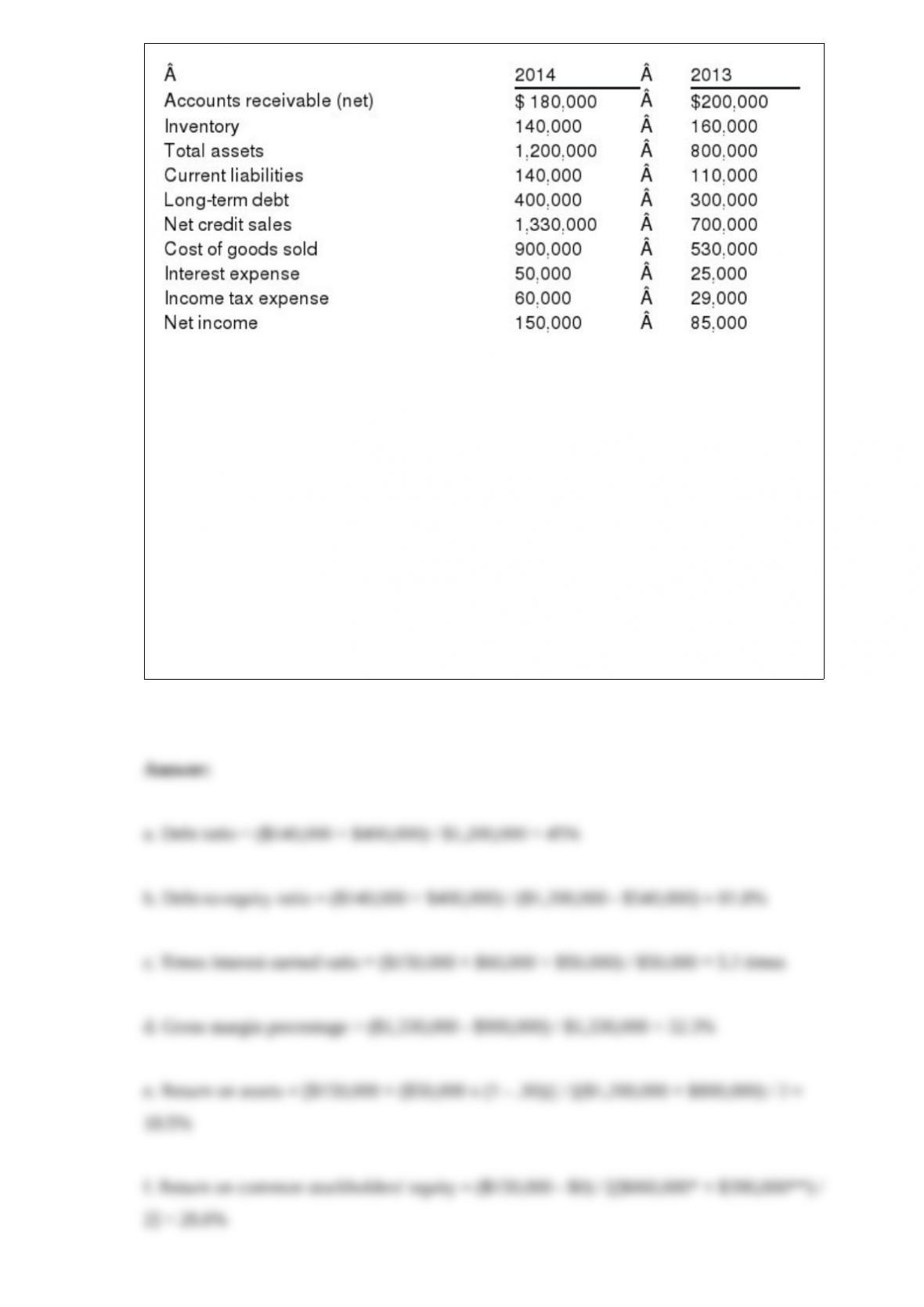
There is no preferred stock and the tax rate is 30%. Required: Calculate each of the
following for 2014:
a. Debt ratio
b. Debt-to-equity ratio
c. Times interest earned ratio
d. Gross margin percentage
e. Return on assets
f. Return on common stockholders’ equity
Sampson Company manufactures two products, plain and complex. The company has
estimated its overhead in the order-processing department to be $480,000. The company
produces 50,000 plain and 80,000 complex each year. Plain production requires 25,000
machine hours, complex production requires 50,000 machine hours. The company
places raw materials orders 10 times per month, 2 times for raw materials for plain and
the remainder for raw materials for complex. How much of the order processing
overhead should be allocated to complex?
a. $240,000
b. $320,000
c. $295,386
d. $384,000
Sara Speed requested $120,000 in her budget to cover salary expenses. However, Sara
realistically expects to spend $110,000 on salaries. This is an example of
a. Top-down budgeting.
b. Operating income padding.
c. Rolling budgeting.
d. Budgetary slack.

Which of the following is the step in implementing an activity-based costing system
that can generate the greatest error?
a. Identifying activities
b. Developing activity cost pools
c. Calculating activity cost pool rates
d. Calculate the unit product cost
Which of the following is not classified as a direct labor cost?
a. Wages of the store manager at Starbucks
b. Wages of the assemblers who put planes together at Boeing
c. Wages of computer animators at Pixar
d. Ring engravers at Josten’s
Joan’s Style manufactures dining room tables for both home and restaurant locations.
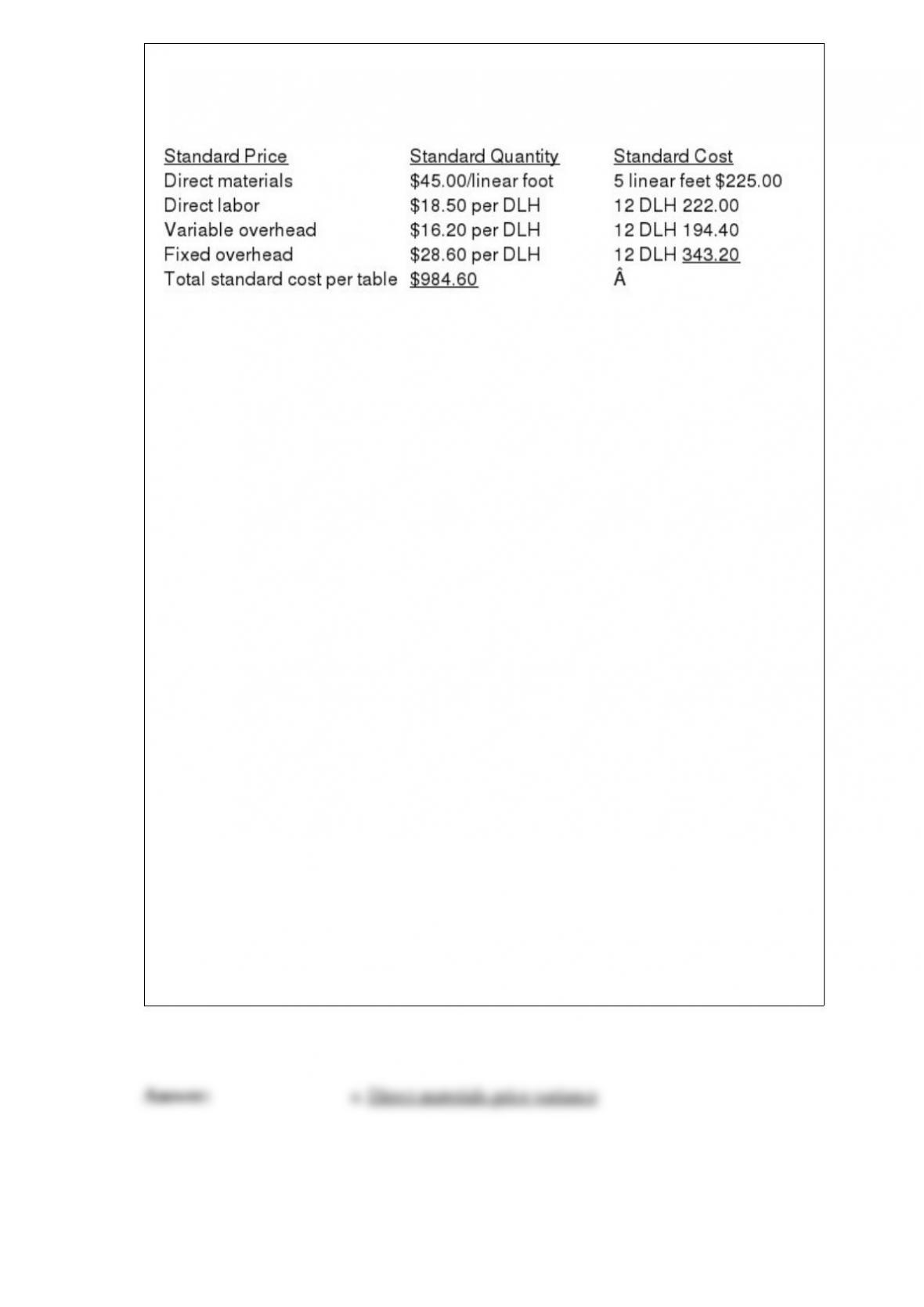
Kona Clair, the company’s controller, developed the following standard costs for each
48-foot table. Ms. Clair developed these standards based on the company
manufacturing 1,200 tables per month.
At the end of the current month, Kona reported the following operational results:
-The company actually manufactured 1,100 tables during the month.
-5,900 linear feet of direct materials were purchased during the month at a total cost of
$258,420.
-5,400 linear feet of direct materials were used to manufacture the tables.
-13,400 direct labor hours were worked at a total cost of $242,880.
-Actual variable overhead was $234,600.
-Actual fixed overhead was $410,500.
Required
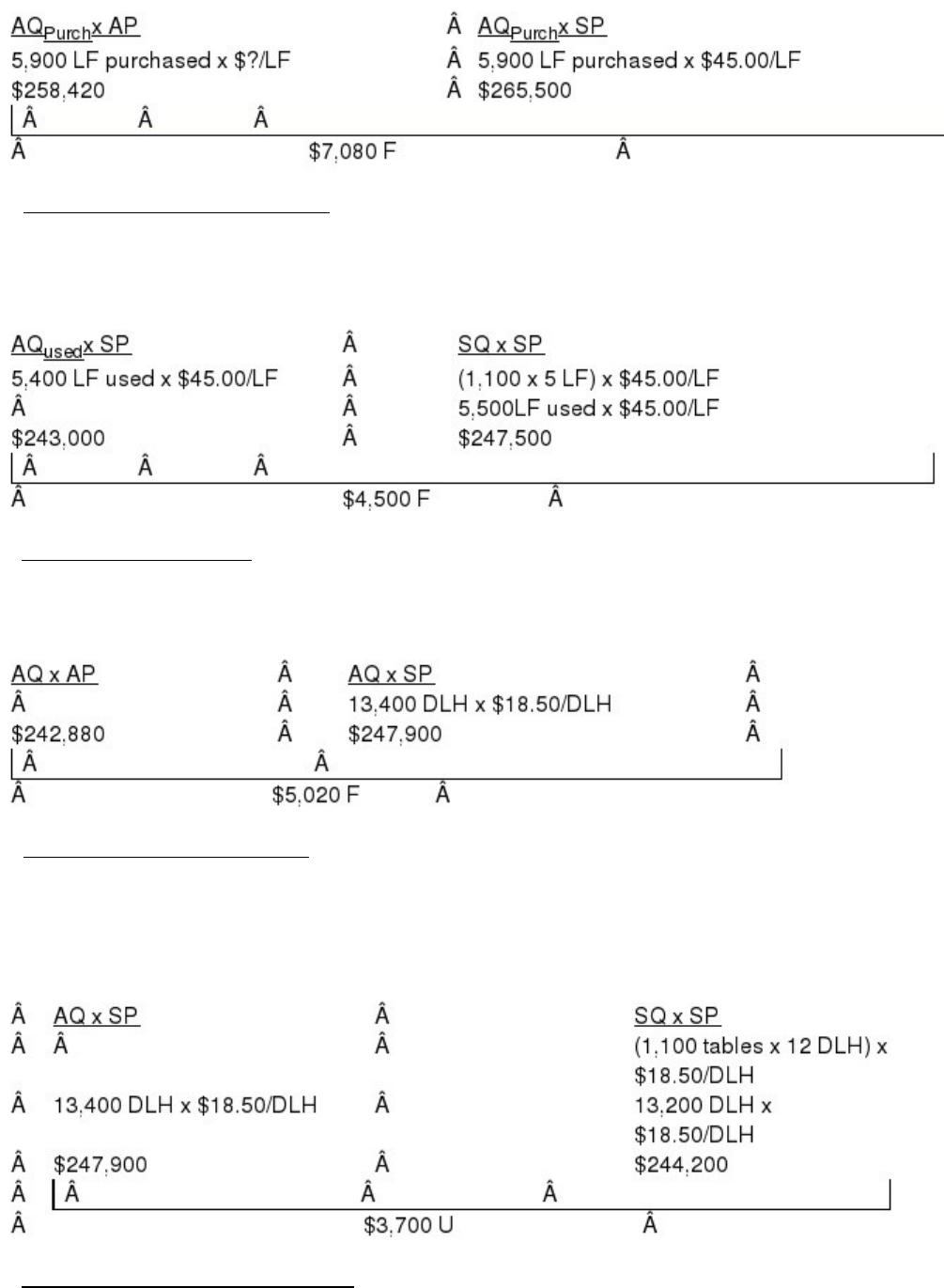
a. Calculate the direct material price variance for the month.
b. Calculate the direct material quantity variance for the month.
c. Calculate the direct labor rate variance for the month.
d. Calculate the direct labor efficiency variance for the month.
e. Calculate the variable overhead spending variance for the month.
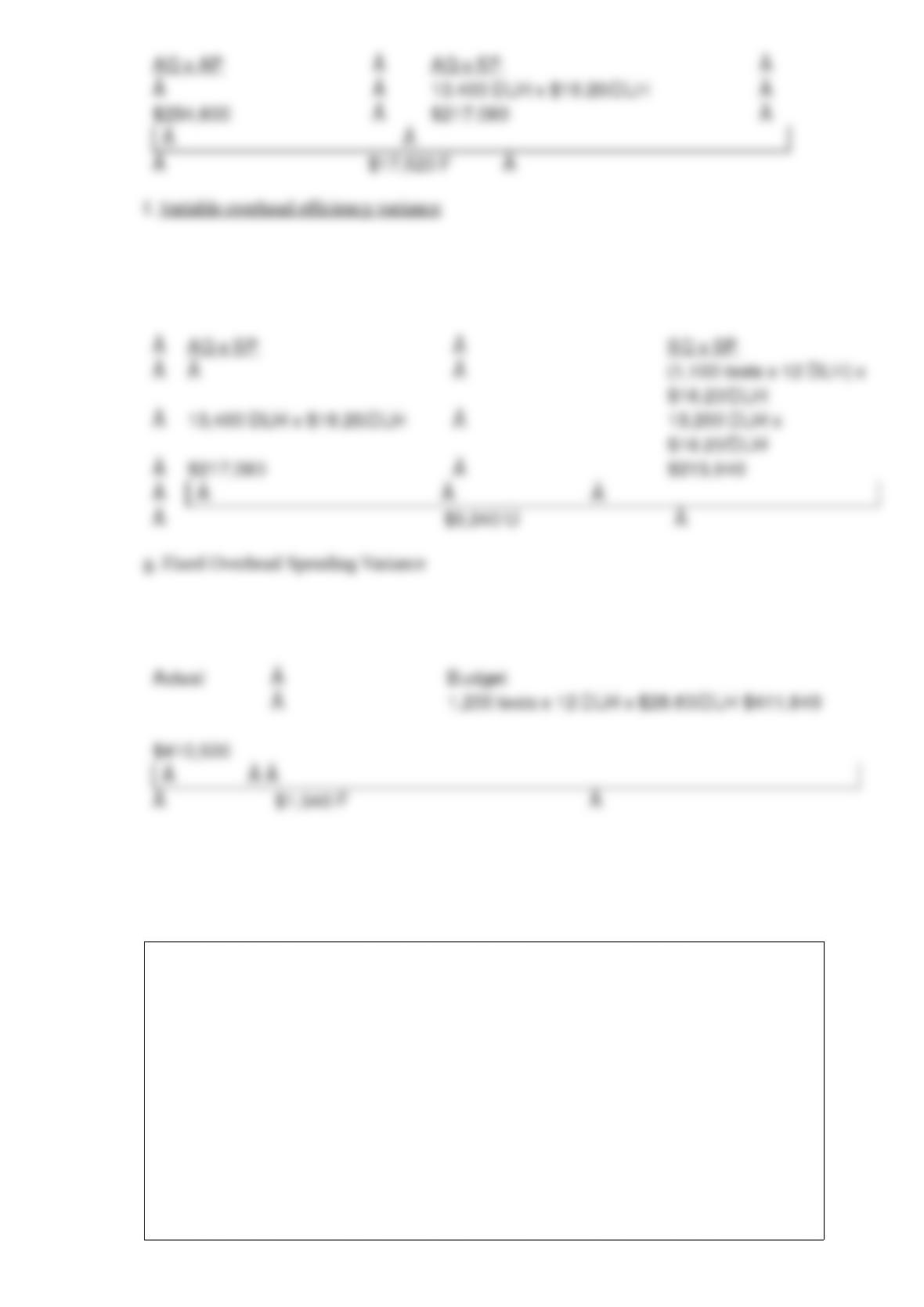
f. Calculate the variable overhead efficiency variance for the month.
g. Calculate the fixed overhead spending variance for the month.
Due to a recent increase in demand, Office Electronics has been able to sell its most
expensive document shredder for a profit of 25%.
Required:
a. If Office Electronics sells the shredder for $250, what is the cost of the shredder
assuming a 25% markup?
b. If Office Electronics were to reduce the cost of the shredder to $175, what would be
the markup percentage at the $250 sales price?
c. If Office Electronics were to reduce the cost of the shredder to $175, what would be

the sales price at a 25% gross margin?
Which of the following is a reason that employees must estimate how much time
employees spend performing each activity?
a. So that the budget committee will know how to allocate direct material
b. So that the resources consumed by the activities can be calculated
c. So that the level of detail will not become too burdensome
d. None of these answer choices are correct.
Which of the following is not one of the four balanced scorecard perspectives?
a. Internal business processes
b. Customer
c. Industry
d. Financial